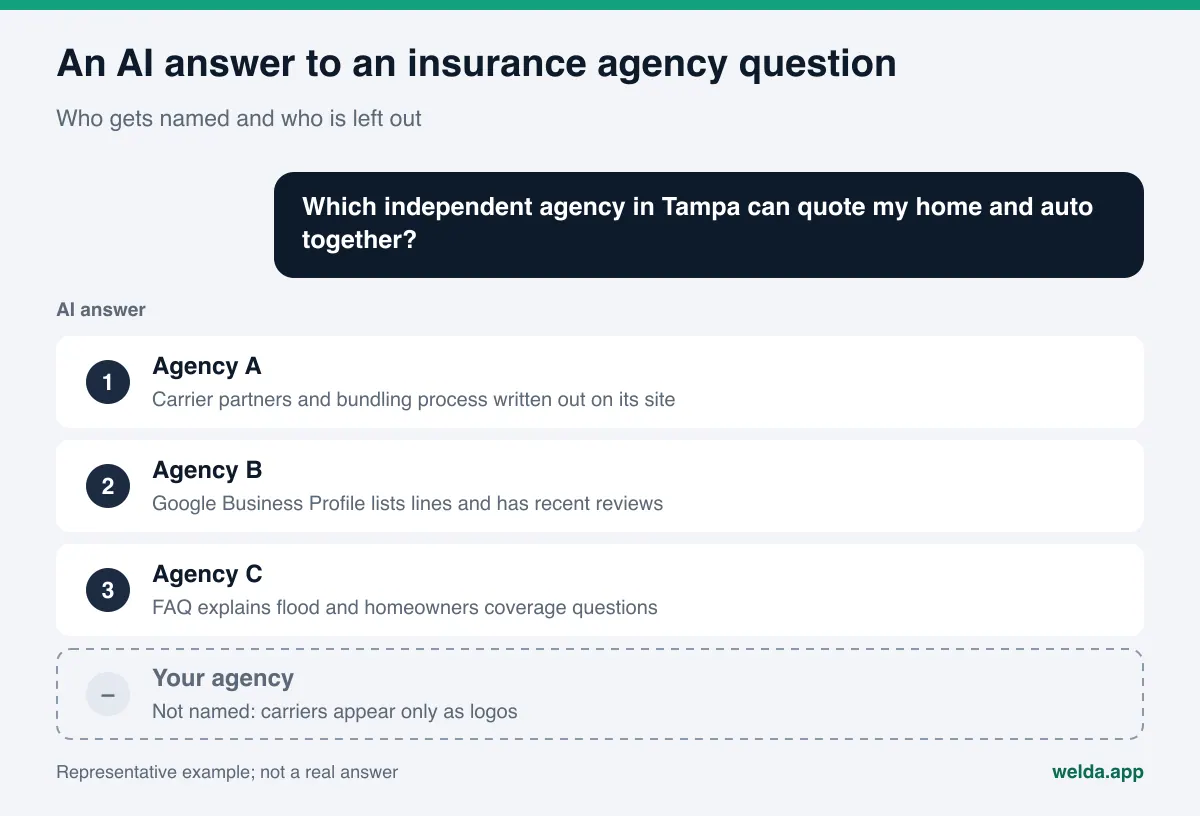
What does AI visibility software for insurance agencies actually do? It checks whether your agency gets named when people ask ChatGPT, Gemini, Perplexity or Google's AI features questions like "Which independent agency in Tampa can quote my home and auto together?" It shows why you are or are not mentioned, and it lists the fixes that make your agency easier for AI to read and verify. No tool can guarantee a spot in those answers; what you can control is how clear and consistent your information is.
This guide is for agency owners and principals, office managers who handle marketing, and whoever runs the agency website and listings. Shopping for insurance has always been slow and comparison-heavy. A homeowner whose carrier just non-renewed them, a contractor who needs general liability before a job starts, a family adding a teen driver: each of them now describes the situation to an AI assistant and asks for a recommendation. If the answer names two or three agencies and yours is not among them, you are out of the running before anyone calls. That is the problem answer engine optimization (AEO) addresses. You may also see it called GEO, short for generative engine optimization; in this guide we use AEO. Below we cover what the problem looks like for an agency, the work step by step, how Welda handles it, and what it does not do. If you want a baseline first, run a free AI visibility analysis of your site.
Why AI search visibility is different for insurance agencies
For a coffee shop, an AI answer is mostly about location and hours. Insurance questions carry far more detail. People name the line of coverage, their city, sometimes their vehicle, their home's age or their type of business. To build an answer, an AI engine looks for facts it can read and cross-check:
- Which lines you write: personal auto, homeowners, renters, umbrella, commercial auto, general liability, business owner's policies, workers' comp, life.
- Whether you are an independent agency that works with multiple carriers or a captive agency that represents one company.
- Which states you are licensed in and which areas you actually serve.
- What happens at claim time: whether you help clients report a claim and follow up with the carrier.
- Who you serve best: homeowners in coastal counties, small contractors, restaurants, rideshare drivers, landlords.
- What other people say about you on Google Business Profile, Yelp, the BBB and local community forums.
On many agency websites this information is hidden. Carrier partners appear only as a row of logos. Lines of coverage sit in a dropdown menu with no text behind them. The quote form is the whole page. A person can work out what the agency does; an AI engine often cannot, so it quotes the competitor or the comparison site that spells it out.
Trust matters even more. Insurance involves money and risk, and AI engines tend to be cautious in those areas. They are more likely to name a business they can confirm across several sources. If your agency name, address and phone number appear one way on your site, another way on Google Business Profile and a third way on an old directory listing, the engine has a harder time treating them as one business. We cover this in detail in our guide to NAP consistency for AI search.
What people ask AI, and what AI visibility software for insurance agencies should track
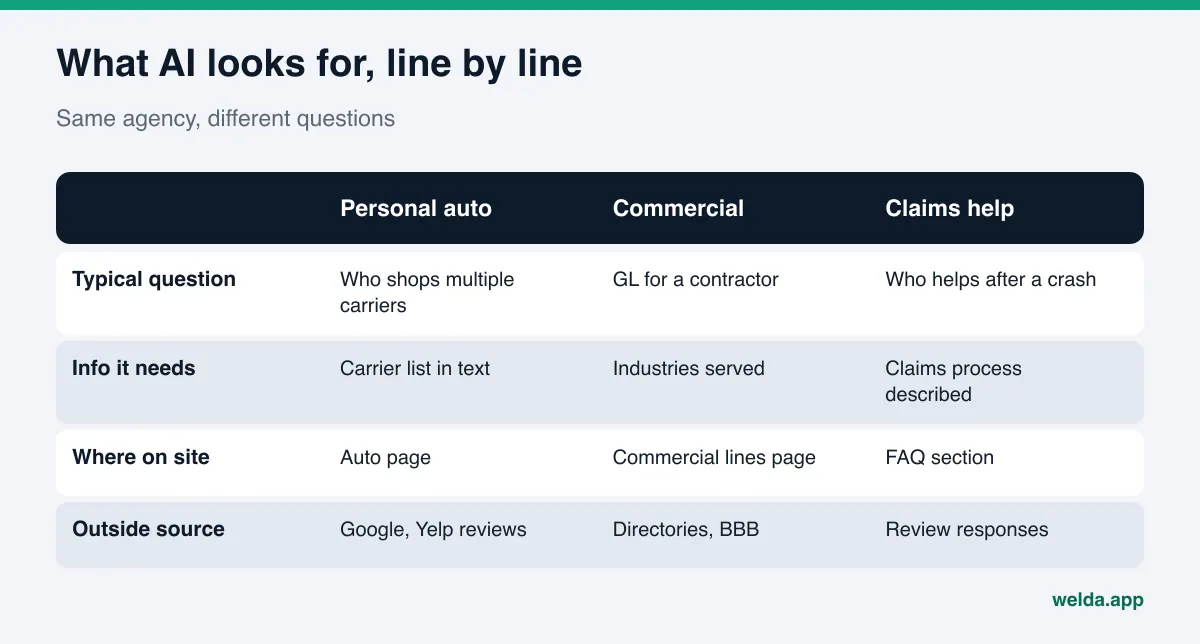
Try a handful of questions yourself and the variety is obvious. The examples below are illustrative. A list built around your own lines and your own market is the basis of any real measurement.
| Question type | Example | What the AI looks for |
|---|---|---|
| Local | "Who's a good insurance agent near Plano for auto and home?" | Address, service area, personal lines |
| Independent vs captive | "Find me an independent agency that shops multiple carriers in Charlotte." | Carrier list, quoting process |
| Commercial | "Where can a small landscaping company get general liability and commercial auto?" | Commercial lines page, industries served |
| Hard market | "My home insurance was non-renewed, which local agency can help?" | Homeowners page, how you handle hard-to-place risks |
| Claims | "Which agency actually helps you when you file a claim?" | Claims support description, contact options |
| Trust | "Is this insurance agency legit? What do reviews say?" | Reviews, BBB profile, license information |
The takeaway: being visible for one generic "insurance agent" question is not enough. A family asking about auto and a business owner asking about workers' comp get different answers built from different sources. Measurement has to happen line by line and intent by intent. Commercial questions behave a lot like B2B purchasing research, which we discuss in how B2B buyers use AI to find vendors.
How to improve AI visibility for an insurance agency, step by step
These steps apply whether you use a tool or not. The order matters: measure first, then fix the basics, then align outside sources.
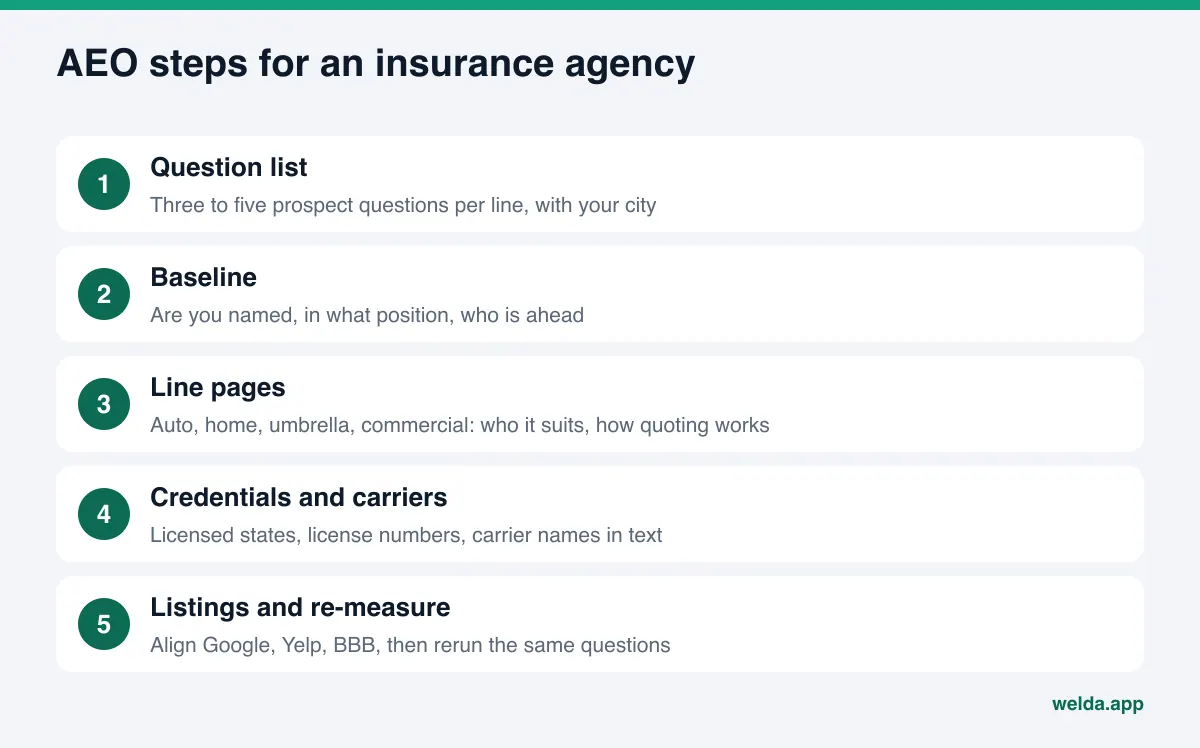
- Write your question list. For each line you write, draft three to five questions a prospect would ask, with your city or county. Keep commercial questions in their own group.
- Measure where you stand. Ask those questions in the AI assistants your clients use. Note whether your agency is named, where it appears in the answer and who appears ahead of you. One try is not enough; the same question can get a different answer an hour later.
- Make sure AI can read your site. Your robots.txt file should not block AI crawlers. Your page title and meta description should say "insurance agency" and name your city. Your main heading should say in one sentence what you do and where.
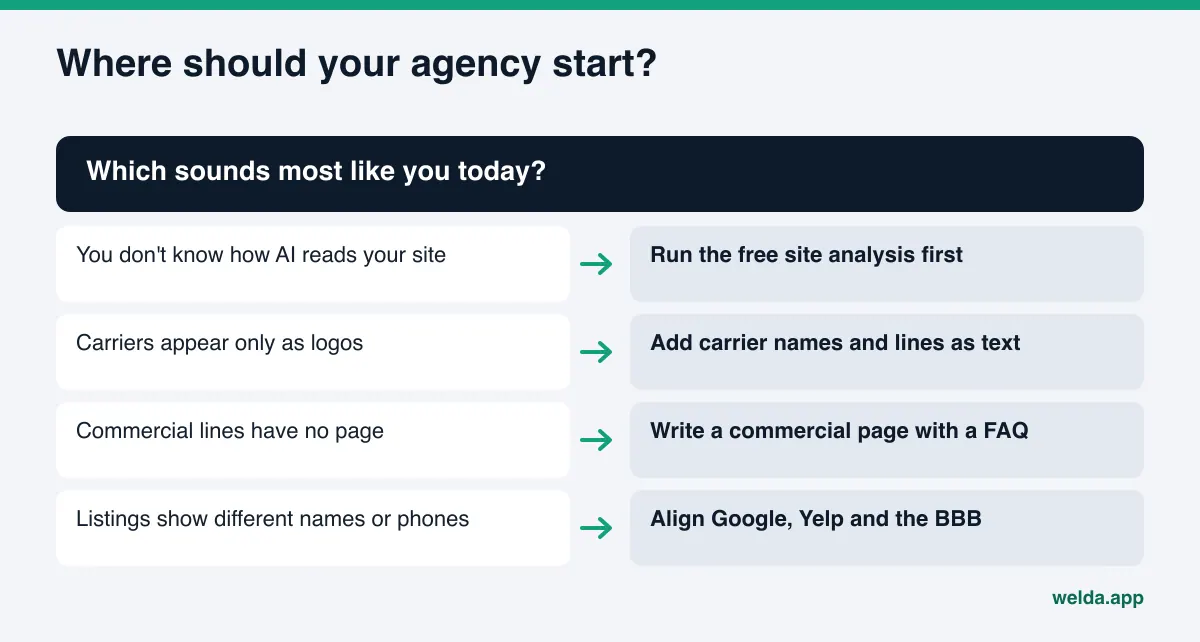
- Give every line its own text. Write a short page or section for auto, home, renters, umbrella, commercial and life: who it suits, what you need to prepare a quote, how the process works.
- Name your carriers in text. Keep the logos if you like, but add the carrier names as plain text. If your appointments differ by line or by state, say so.
- Show your credentials. List your agency name, the states you are licensed in and your license numbers as text. The NIPR explains that a National Producer Number is a unique identifier assigned during licensing; information that matches public records is a trust signal for people and machines alike.
- Add business markup (Schema). Put your business name, address, phone, hours and service area in a machine-readable form on the site.
- Write a FAQ section. Answer questions like "What do I need for an auto quote?", "What should I do right after an accident?" and "How many carriers do you quote?" briefly and plainly.
- Align your listings. Make name, address, phone and category match on Google Business Profile, Yelp, the BBB and the directories that matter in your market.
- Measure again. New content usually takes weeks to show up in AI answers. Re-run the same question list on a schedule and check which change moved which question.
Which directories carry weight depends on the industry. Our guide to business directories for AI visibility walks through how to choose them.
Common gaps on insurance agency websites
The free site analysis reads your homepage and a few inner pages, such as services, pricing, about and contact, the way Google and an AI engine would. On agency sites, the gaps below are the kind worth checking first. This is not a statistic; it is a list of places to look.
- A slogan instead of a headline. "Protecting what matters most" tells an AI nothing about your city or your lines. "Independent insurance agency in Tampa for home, auto, flood and small business coverage" tells it a lot.
- "All lines of insurance" in one sentence. That phrase does not answer the person asking about umbrella coverage for a rental property.
- A quote form with no explanation. Forms are fine for people ready to act, but AI engines do not read inside them. A few sentences above the form describing the process go a long way.
- Contact details inside an image. If your phone number and address sit in a banner graphic, they are not readable text.
- Missing or outdated business markup. If the Schema code has an old address or none at all, the engine cannot connect your site to your listings.
- Profiles not linked from the site. Without links from your site to your Google Business Profile and social accounts, it is harder to confirm they belong to the same agency.
- No trust signals on your own site. Reviews, licensing details and years in business may live elsewhere, but they belong on your site too.
For each gap, the analysis explains what it found, why it matters and how to fix it. It also drafts homepage copy: title, meta description, main heading, opening paragraph and FAQ. Our guide to homepage copy for AI search shows how to structure that page.
How reviews and complaint responses shape AI answers for agencies
In insurance, client satisfaction is tested at claim time. Many reviews and complaints come from claims, not from the sale. When someone asks an AI engine for a "trustworthy agency," the engine reads review and complaint sources. What counts is not the absence of complaints but how you respond to them.
Take an example scenario: a client posts that a claim payment is taking too long. An unanswered review suggests an agency that does not care. A calm reply that shares no personal details and explains the process paints a different picture: "Your claim is with the carrier's adjuster. We are following up and will call you directly." The reply should not blame, promise or imply a payment outcome. The carrier makes the payment decision, and the agency says so honestly.
The FTC has guidance on endorsements and consumer reviews, including a rule aimed at fake and false reviews and testimonials. That is one more reason to earn reviews honestly. Welda can draft review responses, but posting them and handling negative reviews stays with the agency.
How Welda handles AI visibility for an insurance agency
Welda is software that measures where a business shows up in AI answers and prepares the fixes on the business's behalf. For an insurance agency, three parts matter most: question tracking by line, the sources view and the compliance check before anything goes live.
Question tracking: are you named for auto, home and commercial? In the Welda panel, the question list is built around your lines and your market. Auto questions, homeowners questions and commercial questions sit in separate rows. Each question is asked three times in ChatGPT, Gemini, Perplexity and Google AI, because AI engines do not give the same answer every time. For every row you see which engines name your agency and in what position. Click a row and you read the answer itself and the sources it cites. The decision this screen supports is simple: where am I invisible, and what do I fix first? If your agency shows up for auto questions but never for small-business questions, the next job is clear: a commercial lines page and a FAQ that matches it.
Sources: what does AI read when it answers an insurance question? The second screen lists the sites the engines cite. For an agency, that often means your own website, Google Business Profile, review sites, the BBB and comparison or directory sites. Next to each source is your status there: listed, incomplete or missing. The screen answers a practical question: which site am I missing from, and which engine builds its answers from that site? If engines in your market keep citing Google Business Profile and yours lacks a clear category and description, that task moves to the top of the to-do list.
Compliance check: catching "lowest rates guaranteed" before it is published. Insurance marketing copy is sensitive. Phrases like "cheapest premiums," "we'll pay any claim" or "best coverage in Texas" can mislead clients and create regulatory risk. Welda's compliance check flags price, guarantee and superiority claims before content is published. The flagged sentence comes back to you to edit or approve. The check is not legal advice and has not been reviewed by legal counsel; decisions about state insurance rules stay with your agency and your advisors. We cover superiority claims in "best" claims and advertising rules in AI content.
The panel also has a home screen with the score and a one-line summary, a to-do list, a competitors view, before-and-after comparison and a one-page monthly report. Welda drafts page copy, profile text and review responses; you keep publishing approval. On WordPress, Welda connects through a separate Editor user and an application password, with no code to install; content opens as a draft on your site and goes live once you approve it. For other systems, Welda provides a ready package and the changes are applied by hand. Content always lives on your own site.
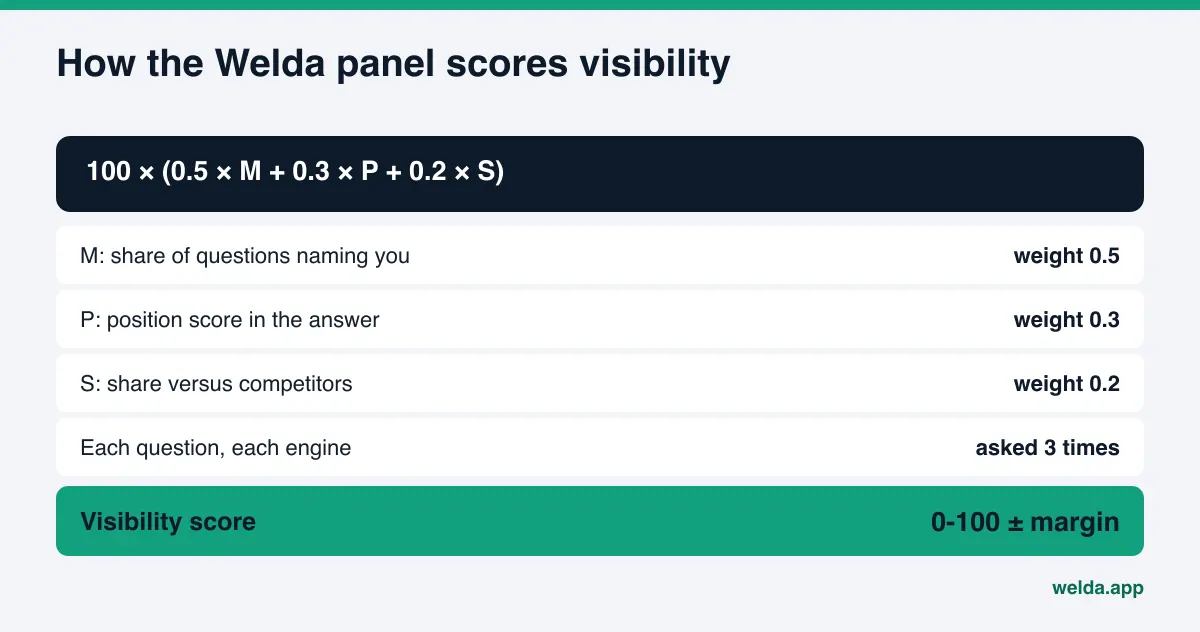
The score formula is published: 100 × (0.5 × the share of questions that name you + 0.3 × your position score + 0.2 × your share versus competitors). Because every question runs three times, the spread across runs becomes a plus-or-minus margin. For an agency, that means being named is only part of it. Prospects usually look at the first two or three names, so position counts, and share versus competitors shows how you stack up against the other agencies in the same answers.
An honest note on availability: the Welda panel is in early access and is opening first to businesses in Turkey. Regular four-engine tracking is being added during early access, and the sample screens in the panel use representative data. What anyone can use right now is the free site analysis, which works in English. Pricing is discussed in the early access conversation.
What the free analysis shows an insurance agency
You do not need the panel to see where you stand today. The free site analysis gives you:
- A score out of 100, with technical and content scores shown separately.
- For each gap: what was found, why it matters and how to fix it.
- Ready-to-use homepage copy: title, meta description, main heading, opening paragraph and FAQ.
- A simulation of how much each fix would raise the score.
- A comparison with competitors.
- A fix package to add to your site, including business markup code.
- A PDF report and a shareable score card.
The analysis also asks five questions your clients might ask to an AI assistant that can search the web, and checks whether your agency is named in the answers. That is a one-time check, not ongoing tracking. It is free once per site. Your email and phone are verified, the results link arrives by email and stays open for 14 days. It does not measure rankings and does not promise them.
Limits: what Welda does not do
- No guarantees. Welda does not guarantee rankings or that ChatGPT will recommend you. AI answers draw on many sources and change over time.
- No guessing. Welda does not invent your carrier list, your licensed states or your claims process. It asks you. A wrong coverage statement in insurance can cause real harm.
- No unapproved sensitive content. Copy that touches price, coverage or guarantees comes to you for approval.
- No fake reviews. Welda drafts responses to reviews; it never writes reviews.
- Some work stays with you. Handling negative reviews, opening directory accounts and press outreach remain the agency's job. Welda lists these as manual tasks.
- It takes time. New content usually takes weeks to show up in AI answers.
- Not legal advice. The compliance check flags risky patterns. Final decisions on state insurance and advertising rules belong to you and your counsel.
Checklist for choosing AI visibility software for insurance agencies
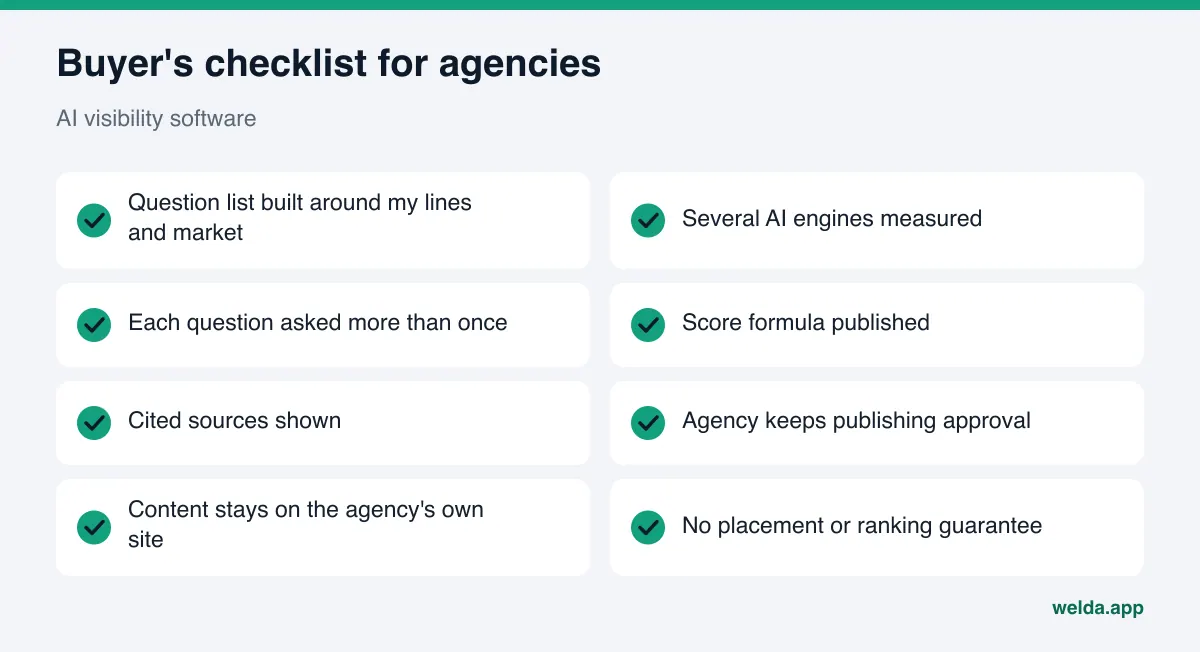
Whether you look at Welda or something else, ask these questions:
| Question | Why it matters |
|---|---|
| Is the question list built around my lines and my market? | Generic questions miss what auto and commercial prospects actually ask. |
| Are several AI engines measured? | Your clients use different assistants; one engine shows part of the picture. |
| Is each question asked more than once? | A single run can be a fluke. |
| Is the score formula published? | You cannot interpret a change without knowing what is measured. |
| Are cited sources shown? | You need to know where you are missing before you start. |
| Do I keep publishing approval? | One wrong coverage sentence can create a problem with a client. |
| Does content stay on my own site? | If you stop using the tool, your content should remain yours. |
| Does anyone promise placement? | Nobody can guarantee an AI answer; be careful with anyone who does. |
A few manual checks in ChatGPT are a fine start, but they get hard to manage once you multiply lines, towns and engines. We weigh both approaches in manual ChatGPT checks vs tracking tools.
FAQ
Does AI visibility software for insurance agencies replace SEO?
No. A site that search engines can read well is a good starting point for AI too. AI visibility software looks at something different: whether AI answers name you and which sources they rely on.
Can a captive agency show up in AI answers?
Yes. What matters is stating clearly which lines you write and where you serve. If you represent one carrier, saying so plainly also sets the right expectations for prospects.
Should I put license numbers on my website?
Clear identity information helps people and AI engines connect your site to public records. Check your state's rules and your advisors for what is required where.
Should I publish premium examples?
Premiums vary by person, property and vehicle, so a fixed number can mislead. Explaining the quoting process and what information you need is safer. Welda's compliance check flags price and guarantee language before publishing.
How soon will I see results?
New content usually takes weeks to show up in AI answers. That is why you need repeat measurement with the same questions and a before-and-after comparison.
Can a US agency use the Welda panel today?
The panel is in early access and is opening first in Turkey. The free site analysis works in English today, and pricing is discussed in the early access conversation.
Next step: see how AI reads your agency today
Insurance shoppers now ask AI for agency recommendations. To be part of those answers, state your lines, carriers, service area and credentials clearly and consistently, align your outside listings and measure the result over time. The first step is knowing where you stand. Start your free AI visibility analysis and get your score, your gaps and ready-to-use fixes for your agency's site.