What does AI visibility software for gyms actually do? It checks whether your gym is named when someone asks ChatGPT, Gemini, Perplexity or Google's AI Overviews and AI Mode for a place to work out, shows which gyms get picked instead and why, and helps you close the gaps. Answer engines tend to name the gym whose site clearly states its classes, neighborhood, hours and membership terms, and whose details match everywhere.
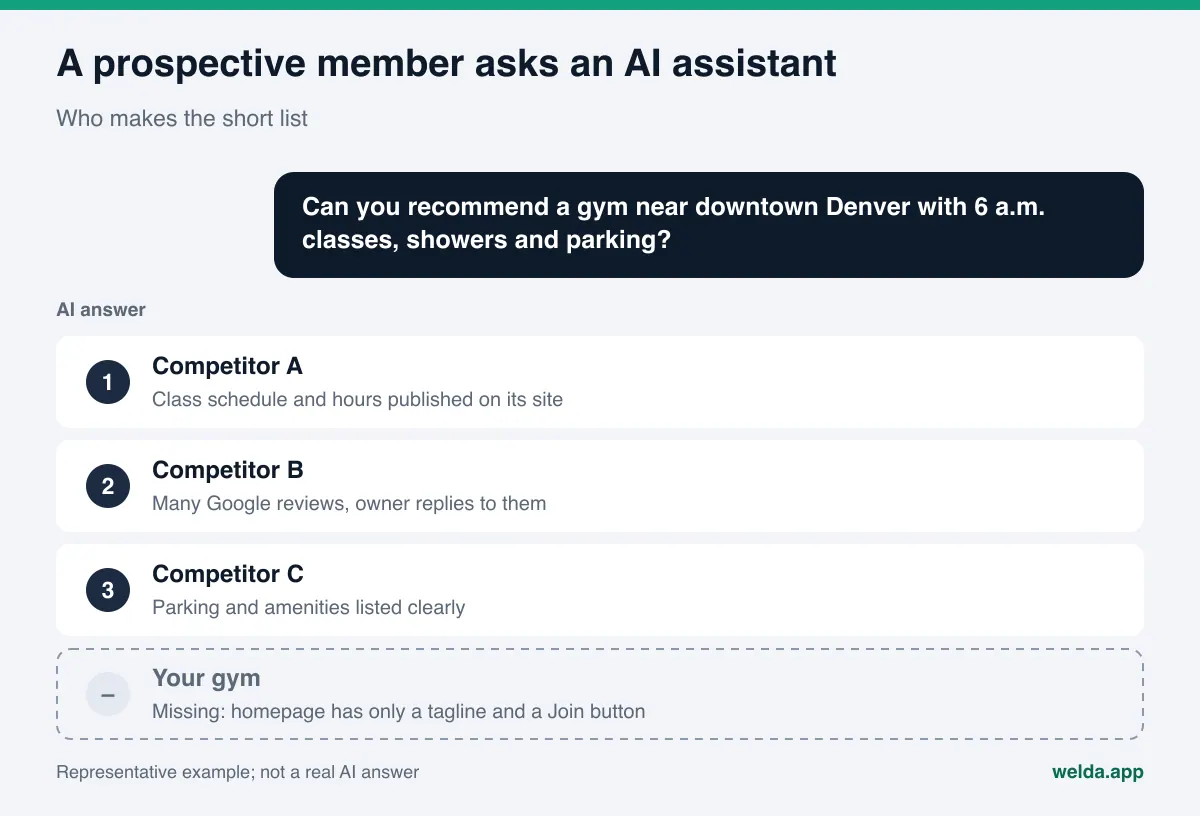
Choosing a gym increasingly starts in a chat window. Someone new to town types "Gym near downtown Denver that opens at 5 a.m. and has showers and parking". A parent coming back to fitness asks "Can you recommend a small strength studio in South Austin with one-on-one coaching for beginners". The answer is a few sentences and two or three business names. If your gym is not on that short list, the person never books a free class, never fills out your contact form and never walks through the door. This guide covers what AI visibility software for gyms measures, which work stays with the gym owner, and how Welda measures and closes the gaps. The discipline is usually called AEO (answer engine optimization); you may also see GEO, short for generative engine optimization, which means roughly the same thing. If you want to see your starting point first, run the free site analysis; the result helps you put the steps below in the right order for your site.
Why AEO is its own job for gyms and fitness studios
A gym is a neighborhood purchase. Most people pick from the few options within a short drive of home or work, and they compare on very practical things: hours, classes, parking, price structure, whether it feels welcoming to a beginner. In classic search, they collected that information from map results and a handful of open tabs. In an AI answer, the assistant reads those sources and returns a short summary. Whoever is in the summary gets compared. Everyone else is invisible at the moment of choice.
That shift has three practical consequences. First, questions are specific. People rarely ask for "the best gym". They combine location, class type, schedule, budget and goal in one sentence: "a gym in Arlington with early morning HIIT classes, no long-term contract, good for beginners". If your homepage only says "Stronger every day", the model has nothing to match. Second, most gyms market on Instagram. Photos and reels persuade people, but an AI model cannot reliably extract "this studio runs reformer Pilates at 7 a.m. on weekdays" from an image. It needs readable, quotable text. Third, gym details change often. Class schedules shift, a second location opens, the pool closes for repairs, holiday hours apply. If an old version sits somewhere on the web, an AI answer may repeat it, and the new member learns the truth at a locked door.
Google explains how its AI features draw on web content in its documentation on AI features and your website. The short version: the basics of a crawlable, clearly written site still apply, and there is no shortcut around them. That is why AI visibility software for gyms is a measurement and organization tool, not a trick.
What prospective members ask AI tools about gyms
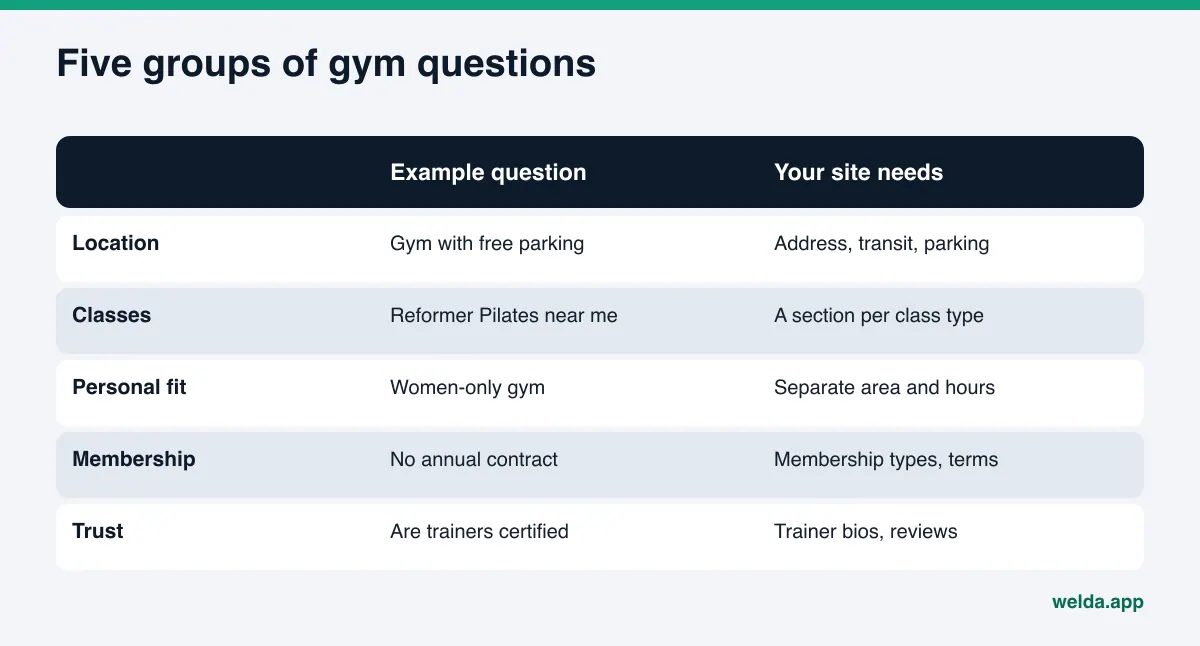
It helps to sort gym questions into five groups. The examples below were written for this guide as illustrations; every gym should adapt them to its own market and class mix.
- Location and access questions: "24-hour gym near Midtown Atlanta", "Gym with free parking in Pasadena", "Fitness studio walking distance from the Capitol Hill light rail station". Without your address, parking and transit details written out, you will rarely appear here.
- Class and training questions: "Where can I take reformer Pilates in Scottsdale", "Boxing classes for adults in Brooklyn", "Small group strength training for beginners". Each class type needs its own clear description.
- Personal fit questions: "Women-only gym near me", "Low-impact classes for people over 55", "Gym that is good for someone recovering from a knee injury". Be careful here: health-related questions call for describing scope, not promising outcomes.
- Membership and price questions: "Gyms with no annual contract in Charlotte", "Can I freeze my membership", "Is there a free trial class". The model looks for membership types and terms.
- Trust and comparison questions: "Is this gym clean, what do reviews say", "Are the trainers certified", "Gym A or Gym B for powerlifting". Reviews and trainer information carry weight here.
Writing this list once and filing it away is not enough. Our guide to prompts to track for AI visibility explains how to choose and maintain the question set. Price questions deserve extra care because an outdated number can stick in AI answers; see pricing questions in AI answers for how to handle them.
What AI visibility software for gyms should measure
Whatever a vendor calls it, AEO software that is useful for a gym should answer four questions. Which questions mention my gym? Where in the answer am I named? When I am missing, who is named instead and why? What exactly should I change to fix that? A tool that answers the first three shows you the situation. A tool that also answers the fourth gets the work done.
A few details matter specifically for gyms. Questions should be tracked per neighborhood, because the same gym can be named for "gyms in Uptown" and missing for "gyms near Lake Street". Class questions should be tracked separately from general ones; being strong on "gym near me" and invisible on "Pilates near me" is a common pattern. And each question should be asked more than once, because AI answers vary even for the same prompt. A single run can look lucky or unlucky by chance.
| Metric | What it means for a gym | Why it matters |
|---|---|---|
| Questions where you are named | Split by neighborhood, class type, hours and membership | Shows which member segment you are missing |
| Position in the answer | Named first, or at the end of the list | People usually check only the first two or three options |
| Share against competitors | Compared with gyms in the same area | Reveals which class type a competitor owns |
| Cited sources | Google Business Profile, Yelp, local guides, your own site | Shows where the AI is getting its information |
| Accuracy of facts | Hours, address, phone, class list | Wrong facts turn into a bad first visit |
Step by step: how to get your gym named in AI answers
The order below is built to get the most effect for the least effort. Every step is something you or your staff can do; software speeds it up, but your knowledge of the gym feeds the content.
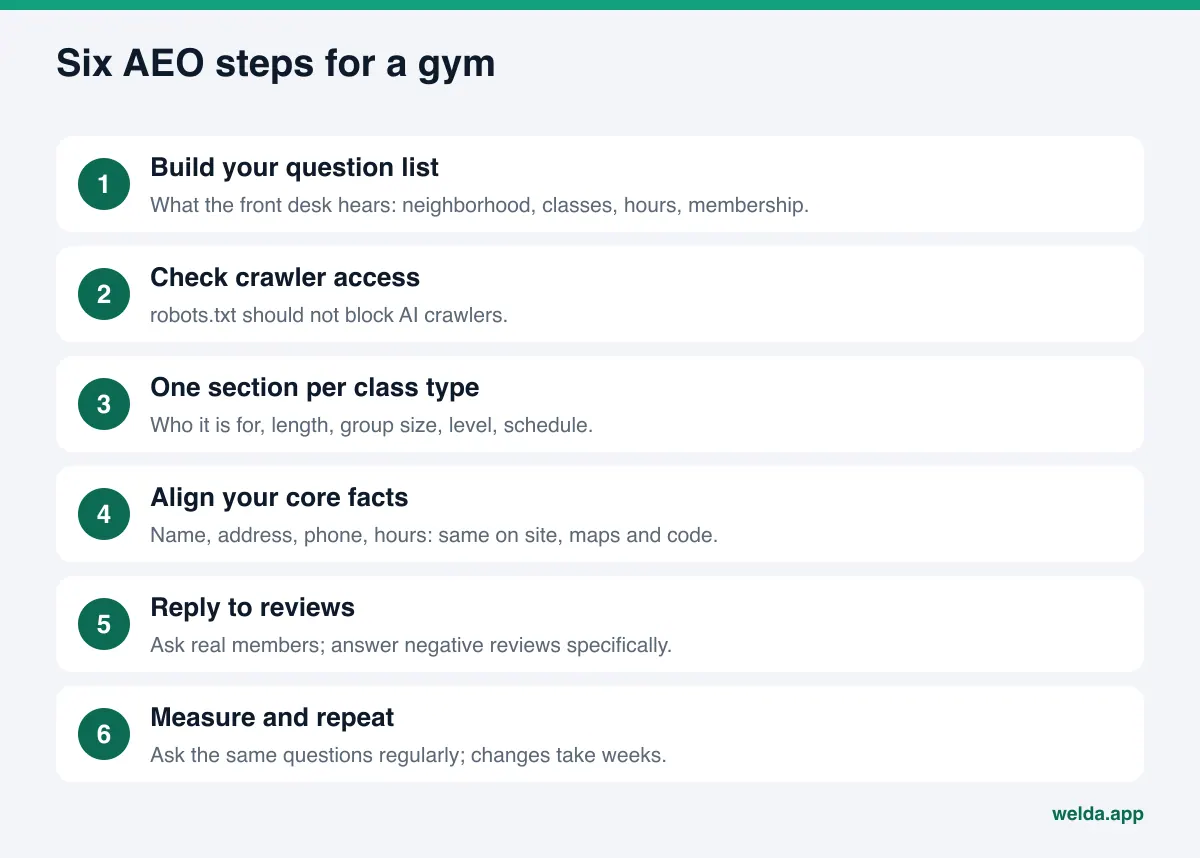
- Build your question list. What does your front desk hear most often, by phone, text, email and in person? Those questions overlap heavily with what people ask AI tools. Twenty to forty questions across location, classes, hours and membership is a solid start.
- Make sure AI crawlers can reach your site. If your robots.txt blocks them, your site is not read. OpenAI, for example, states in its crawler documentation that OAI-SearchBot is the bot that determines whether a site can appear in ChatGPT search answers.
- Give every class type its own section or page. Strength, HIIT, reformer Pilates, yoga, boxing, personal training. For each one, write who it is for, session length, group size, level and when it runs.
- State your core facts once, the same way everywhere. Name, address, phone, hours, women-only area if you have one, showers, lockers, parking, transit. Keep your site, Google Business Profile, Yelp and Apple Maps listings identical. Our article on wrong address or phone number in AI answers covers what to do when they drift.
- Add structured data. Schema.org has a dedicated ExerciseGym type, a kind of local business. Name, address, phone, opening hours and your map profiles can be declared there.
- Publish an FAQ section. "Do you offer a free trial class", "Can I freeze my membership", "Where should a beginner start", "Is there a contract". Short, direct answers.
- Respond to reviews and invite members to leave them. Reviews on Google, Yelp and the BBB are among the trust signals AI answers lean on. Ask real members, never buy or fabricate reviews, and reply to negative ones calmly and specifically.
- Measure and repeat. Ask the same questions at regular intervals and log what changed. New content usually takes weeks to show up in AI answers, so do not judge a change after one week.
What your gym website needs to say: classes, hours, membership, trainers
Many gym websites are a single page: a hero photo, a tagline, a "Join now" button. That page may persuade a visitor, but it tells an AI model almost nothing. When the model looks for an answer to "Does this gym offer reformer Pilates", it wants a plain sentence. The table below lists what a gym site should contain and which question group each item serves.
| Information | Example wording | Question group it answers |
|---|---|---|
| Class types | "Reformer Pilates: groups of 6, 50 minutes, beginner and intermediate" | Class and training |
| Hours | "Mon-Fri 5 a.m.-11 p.m., Sat-Sun 7 a.m.-8 p.m." | Location and access |
| Special areas | "Separate women-only training room, open daily" | Personal fit |
| Membership types | "Month-to-month and 12-month memberships; freeze and cancellation terms listed below" | Membership and price |
| Trainers | Each trainer's name, specialty and certifications | Trust and comparison |
| Amenities | Showers, lockers, towels, parking, distance to transit | Location and access |
The hours and group sizes above are only illustrations of the format; write your gym's actual details. Whether you publish prices is a business decision. Even if you do not, spelling out membership types, freeze rules, cancellation terms and trial class conditions keeps AI answers from guessing.
A note on health claims. Promises like "lose 15 pounds in 30 days" or "fix your back pain" are risky under advertising rules and do not earn the model's trust either. On the review side, the FTC's final rule banning fake reviews and testimonials, announced in August 2024, is worth knowing; it also covers buying reviews and undisclosed insider reviews. Describe scope instead: "We build individual programs for members cleared by their physical therapist." This is not legal advice; check claims you are unsure about with a qualified advisor.
How Welda handles AEO for a gym
Welda is software that measures where a business shows up in AI answers and fills in the gaps on the business's behalf. For a gym, three parts do most of the work: the questions view, the competitors view and the to-do list. First, the current status, plainly: Welda's dashboard is in early access and is opening first to businesses in Turkey. Regular four-engine tracking is being added during early access, and the sample dashboard screens use representative data. What anyone can use today, in English, is the free site analysis.
Questions view: which prompts name your gym. The question list built for your gym is asked to ChatGPT, Gemini, Perplexity and Google AI three times each. Each question is one row, and for every engine you see whether your gym was named and in what position. For a gym, that table usually tells a clear story. You might find you are named for "gyms in Uptown Dallas" but absent from "reformer Pilates Uptown Dallas" and "women-only gym Dallas". That points to class and amenity information that is either missing from your site or buried. Question language can be set to English or Turkish.
Competitors view: who wins which topic in your area. This view shows your share against nearby competitors, plus the topic cluster and the source each competitor wins from. A typical gym finding looks like this: Competitor A leads on group class questions thanks to a large number of Google reviews and a published class schedule; Competitor B leads on Pilates questions because of a detailed Pilates page on its own site. That does not tell you what to copy. It tells you which gap to close first. If a competitor wins from a source other than its own website, the job is less about writing copy and more about your Google Business Profile and reviews.
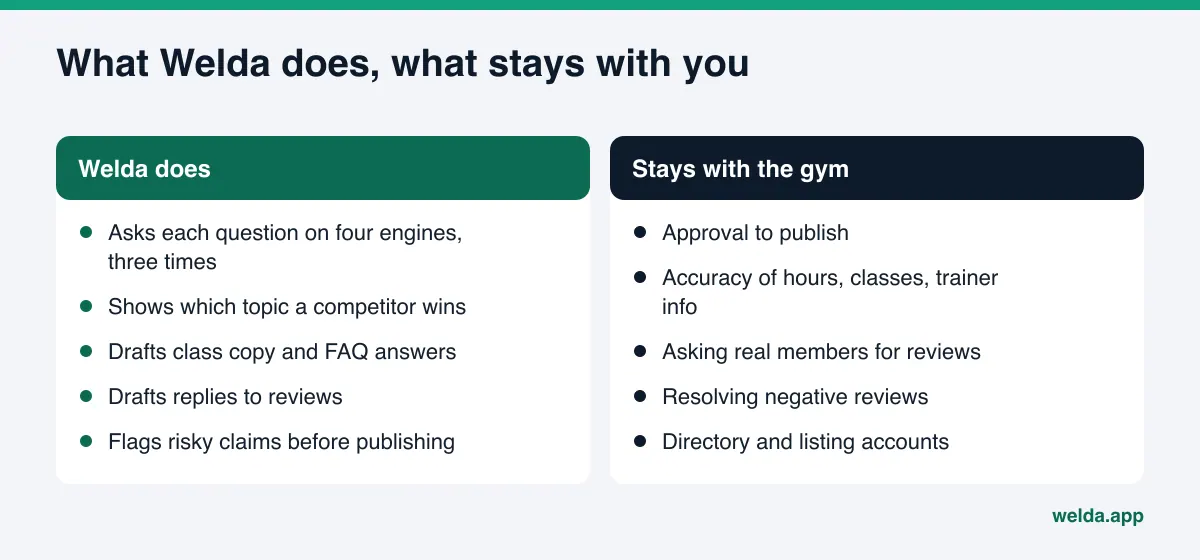
To-do list: ready-made text and your approval. Every task from the measurement lands in one list: missing information, content waiting for approval and manual tasks. Welda drafts, for example, a description for your Pilates section, answers for your FAQ, profile text for your Google Business Profile and replies to reviews. It does not invent facts; it asks you instead, for example "What hours is the women-only room open?". Publishing stays with you. Content always lives on your own site; Welda does not host content. On WordPress, Welda connects through a separate Editor user and an application password, without installing code; drafts appear on your site and go live when you approve them. Our WordPress AEO guide covers that setup in more depth. On other platforms, Welda hands you a ready-to-apply package and the changes are made by hand. Google Business Profile, Instagram and Facebook can be connected; if they are not, the task is listed as manual.
Alongside these, a compliance check flags patterns such as price claims, guarantees, superiority claims and diagnostic suggestions before anything goes live. A "guaranteed results in 30 days" line left in a draft gets flagged. This check is not legal advice and has not been reviewed by legal counsel. At the end of the month you get a one-page report.
How the score is calculated and how a gym should read it
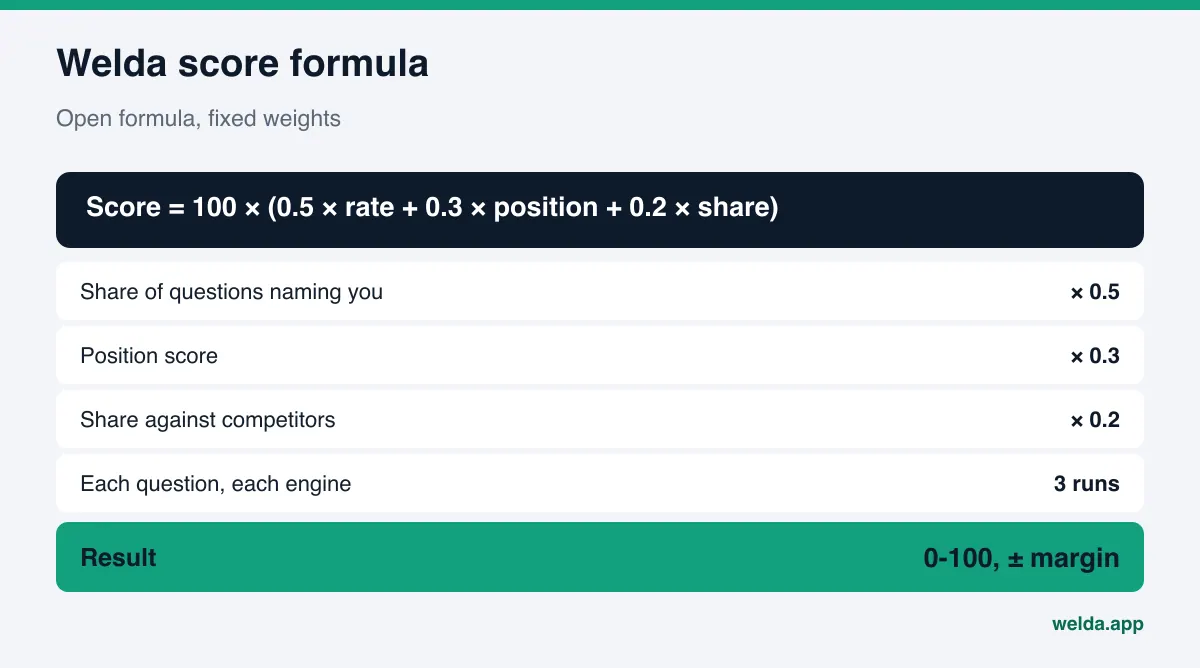
Welda's score formula is open: 100 × (0.5 × share of questions where your name appears + 0.3 × position score + 0.2 × share against competitors). Because every question is asked three times per engine, the spread across the three runs produces a ± margin of error, shown next to the score. For a gym, the practical meaning is simple: the biggest weight is on how many questions name you. Broadening coverage, so you show up on class and neighborhood questions, usually moves the score more than climbing a position or two.
Reading the score by question group helps more than reading it as one number. Strong on general questions but weak on class questions: the work is on your site. Strong on classes but weak on trust questions: the work is in reviews and trainer information. A wide margin of error means the engines are inconsistent; in that case, a single week's dip is not an alarm.
Limits: what Welda does not do for a gym
When you choose a tool, knowing what it does not do matters as much as knowing what it does. Here is what Welda does not do:
- It does not guarantee rankings or a spot in ChatGPT. AI answers are the engines' own decision.
- It does not make up facts. Class times, trainer certifications and special hours come from you.
- It does not publish sensitive content without approval. Statements about health or weight loss go through you.
- It does not create fake reviews. It drafts replies; real members write the reviews.
- Resolving negative reviews, managing directory accounts and press work stay with you.
- New content usually takes weeks to show up in AI answers. Expecting results the next day is not realistic.
The free site analysis has limits too. It does not measure rankings or promise them. It also asks five questions a customer might ask to an AI assistant that can search the web and checks whether your business name appears in the answers. That is a one-time snapshot. We compare it with continuous tracking in one-time AEO audit vs ongoing tracking.
What the free analysis checks on a gym website
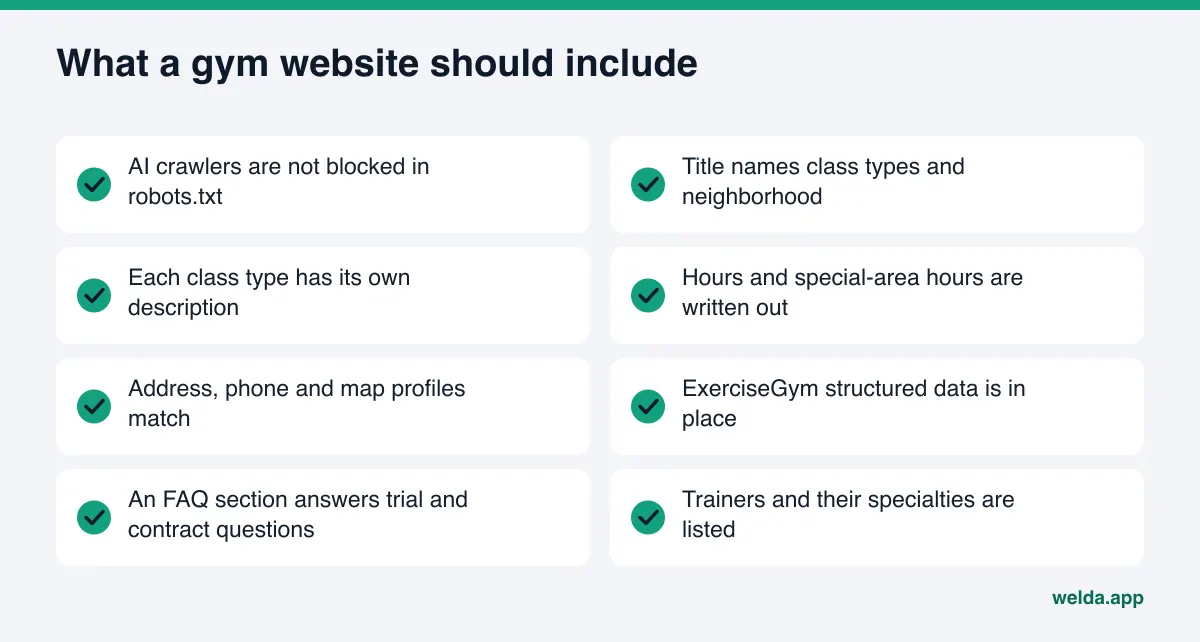
The free analysis reads your homepage and a few inner pages (services, pricing, about, contact) the way Google and an AI model would. On a gym site, the findings that matter most are: whether AI crawlers are blocked in robots.txt, whether your title and main heading mention class types and neighborhood, whether structured business data (Schema) is present, whether address, phone and location are written out, whether map and social profiles link to your site, whether there is an FAQ section, review and trust signals, whether services are described clearly, and page speed.
You get a score out of 100, with technical and content scored separately. For every gap, the report states what was found, why it matters and how to fix it. It suggests ready-made text for your homepage: title, meta description, main heading, intro paragraph and FAQ. A simulation shows how much each fix would raise the score, and you also get a competitor comparison, a ready-to-install fix package (including the structured data code), a PDF and a shareable score card. It is free once per site; email and phone are verified, and the results link arrives by email and stays open for 14 days.
Checklist: choosing AI visibility software for gyms
Whether you evaluate Welda or another tool, ask these questions. Our AI visibility tool demo checklist goes into more detail.
- Can questions be tracked separately by neighborhood and class type?
- Is each question asked more than once, with the margin of error shown?
- Can you see which class type a competitor wins and from which source?
- Does the tool only report, or does it also produce ready-made text and a to-do list?
- Does publishing approval stay with you, and does content stay on your site?
- Does it ask you for missing facts instead of inventing them?
- Are guaranteed-results and health claims flagged before publishing?
- Is the score formula disclosed, so you can see what changed month to month?
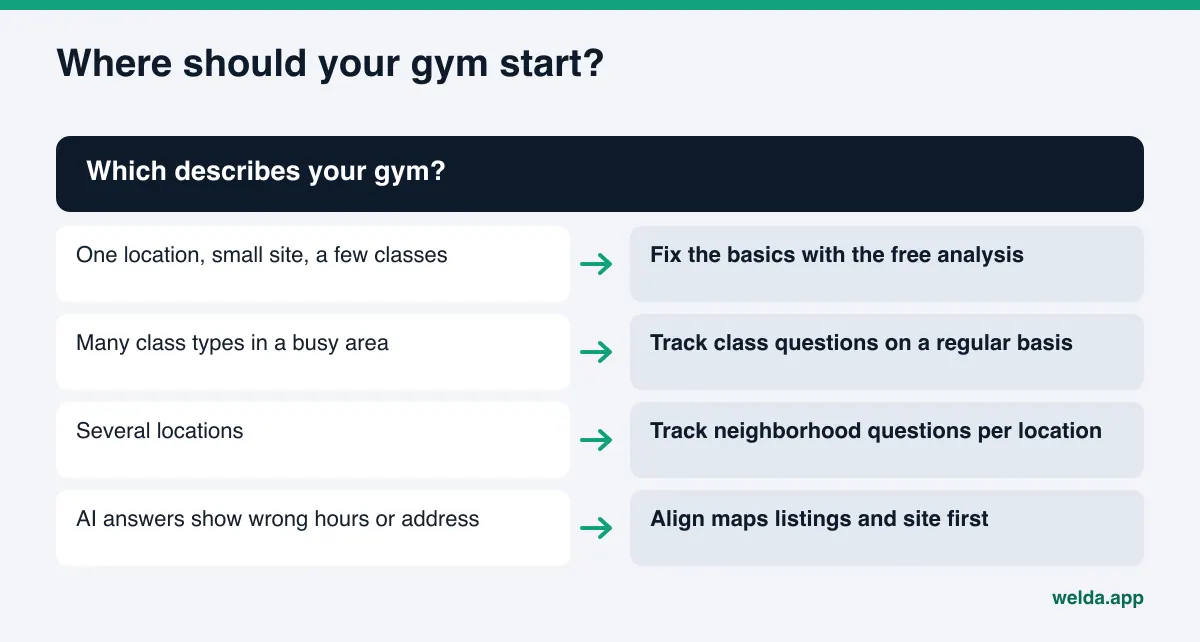
As a decision rule: if you run a single-location studio with a small site, start with the free analysis and close the basic gaps. If you run several class types in a competitive area, or several locations, regular per-neighborhood and per-class tracking is worth more.
Frequently asked questions
What does AI visibility software for gyms do, exactly?
It measures whether your gym is named in the questions prospective members ask AI tools, where you appear in the answer and where competitors lead. Good software also turns missing information and suggested text into a to-do list.
Our Instagram is strong. Isn't that enough?
Instagram persuades people, but AI models cannot reliably pull class types, hours and address from photos. They need readable text. Linking Instagram to your site and writing the same facts clearly on the site builds a firmer base.
Do we have to publish prices?
No, that is a business decision. Spelling out membership types, freeze rules, cancellation terms and trial conditions still reduces the risk that an AI answer repeats old or wrong information.
Will Welda get our gym to the top of ChatGPT?
No. Welda does not guarantee rankings or placement in ChatGPT. It shows what it measures, prepares the fixes and publishes them with your approval. Changes usually take weeks to show up.
Is Welda available for gyms in the US?
The free site analysis works in English today. The full dashboard is in early access and is opening first in Turkey. Pricing is not published; it is discussed in the early access conversation.
What do I need for the free analysis?
Your website address, plus a verified email and phone number. The results link arrives by email and stays open for 14 days.
See where your gym stands today
AI visibility software for gyms lets you start this work knowing what is missing. The first step is small: see how your site reads to an AI model. Run the free site analysis to get your score, your gaps and suggested homepage text. Then decide which class type and which neighborhood to work on first.