What does AI search optimization for travel agencies actually involve? Travelers now ask ChatGPT, Gemini, Perplexity or Google's AI Mode things like "which travel agency plans family trips to Costa Rica from Chicago" and get back a few agency names with a reason next to each. AI search optimization is the work of making your website, profiles and trip details clear enough that an AI assistant can find them, trust them and repeat them. This guide covers what a travel agency should publish, what to measure, and which parts of the work Welda takes on.
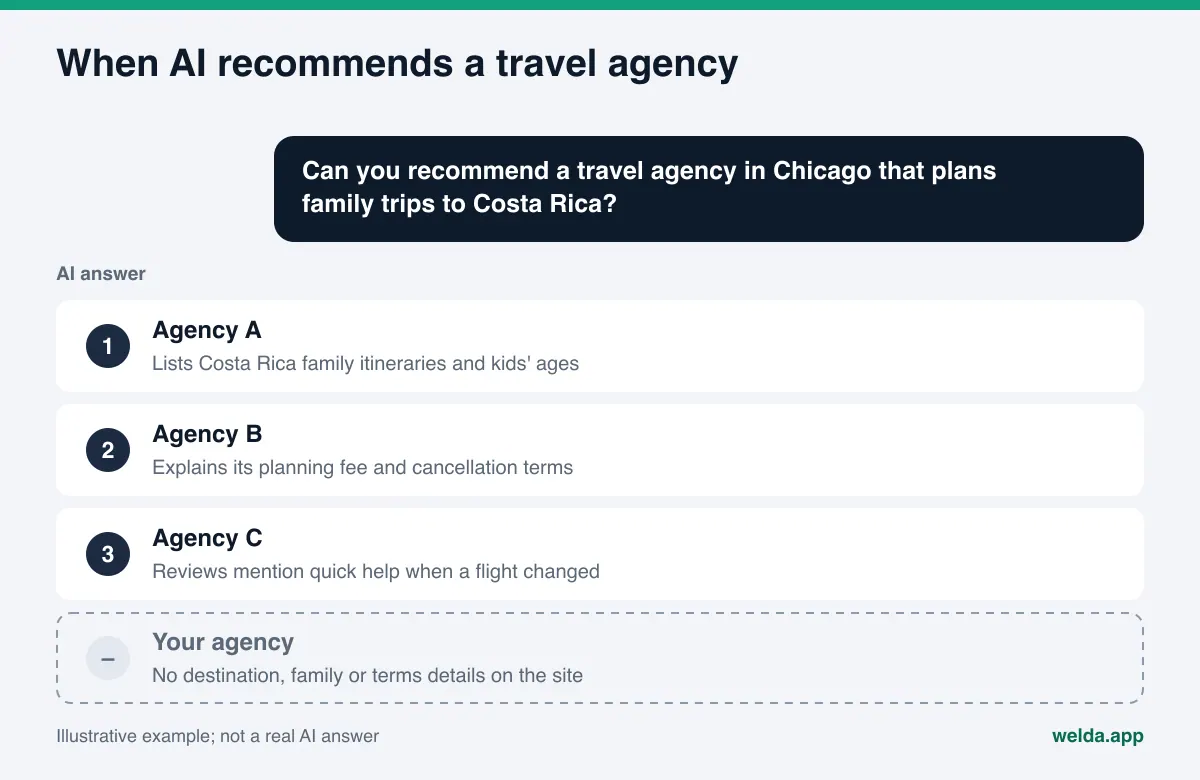
Why AI search optimization for travel agencies matters now
AI search visibility is a simple idea: when a traveler asks an AI assistant for a recommendation, is your agency in the answer? The work of earning that spot is usually called AEO, answer engine optimization. You will also see the term GEO, generative engine optimization, which means roughly the same thing. In this article we use AEO.
In classic search, a traveler sees ten links, opens a few agency sites and compares itineraries. In an AI answer, the traveler often sees a short list of three or four names, each with a one-line reason. The inquiries, calls and consultation bookings go to that list. If your agency is not on it, you are not in the conversation.
Travel agencies feel this shift more sharply than many local businesses, for three reasons:
- The questions are long and specific. One prompt can include the departure city, travel dates, group size, budget, kids' ages, a honeymoon or a mobility need. An agency website that answers none of those conditions cannot be the answer.
- Trust comes before price. Travelers ask "is this agency legit", "what happens if the tour is canceled", "who do I call if a flight is missed". AI assistants answer from what the agency publishes about itself and what others say about it.
- You share the answer with big booking platforms. Online travel sites have huge numbers of pages and are strong in classic search. An AI answer, though, looks for the clearest source for a specific need. An agency that specializes in a destination, a traveler type or a service, and says so in plain words, has a real opening there.
The fastest way to see where you stand is Welda's free website analysis. It reads your homepage and a few key pages (services, pricing, about, contact) the way Google and AI systems read them, and lists each gap separately with a suggested fix.
What do travelers ask AI before they book?
Travel prompts are almost never as short as "good travel agent". The table groups the question types a travel agency website should be ready for. The examples were written for this article; they are not survey or measurement results.
| Question type | Example prompt | Where the answer should live on your site |
|---|---|---|
| Destination and length | "Agency that plans 10-day Italy trips for first-time visitors" | A dedicated page per destination or itinerary |
| Traveler type | "Travel advisor for multigenerational family trips with young kids" | A "who this trip is for" section |
| Credentials | "Is this travel agency registered as a seller of travel in California" | About page and site footer |
| Pricing logic | "Do travel agents charge a planning fee, and what does it cover" | A page that explains fees and what is included |
| Departure city | "Honeymoon planner near Dallas who books Maldives packages" | Service area and departure city details |
| Cancellations | "What happens to my deposit if the tour operator cancels" | Terms page and FAQ |
| Special needs | "Accessible cruise planning for a wheelchair user" | Accessibility section, custom trip page |
There is a pattern here. Each part of the answer is something an agent usually explains on a call. An AI assistant cannot listen in. What is not written down does not make it into the answer. If you also sell to international visitors, those questions come in other languages too; we cover that in our guide on tourists asking AI for recommendations.
Where does AI learn about a travel agency?
When an AI assistant runs a web search to build its answer, it reads several sources together. For a travel agency, a good share of those sources are under your control. Others belong to customers and platforms.
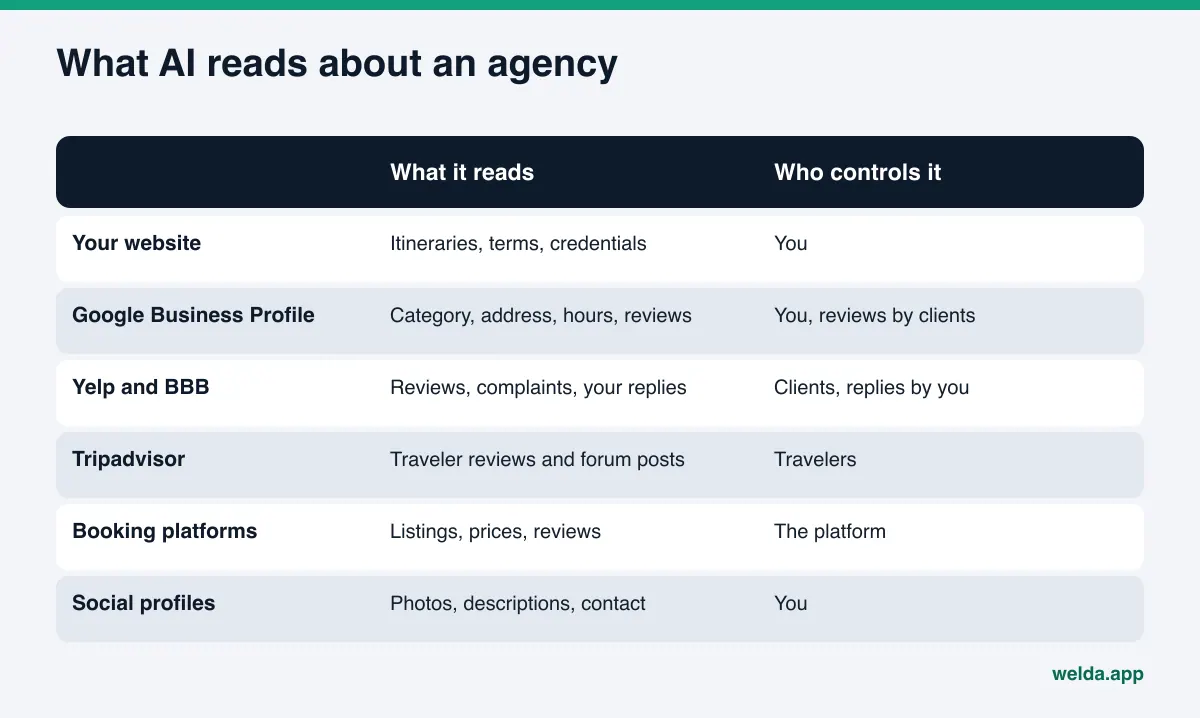
Three rules matter in practice:
- Keep facts identical everywhere. If your website says one suite number, Google Business Profile shows an old address and Facebook lists a different phone, the assistant cannot be sure which is right. Conflicting facts can mean not being named at all. We describe the extreme version of this in when AI says your business is closed.
- Review and complaint sites count as sources. A Yelp review, a BBB complaint and your reply to it can all feed into the answer to "is this agency trustworthy". An unanswered complaint affects the AI answer as well as the reader.
- Make credentials visible. Some states regulate sellers of travel. California, for example, requires sellers of travel to register with the Attorney General and to show the registration number in their advertising, according to the California Attorney General's Seller of Travel page. Check what applies in your state. Putting a registration number on your site gives a concrete answer to the trust question. This is not legal advice.
AI search optimization for travel agencies, step by step
These steps are in the order a small or mid-sized agency can work through them with its own team. The first three usually take a day or two. Most of the effort goes into itinerary pages.
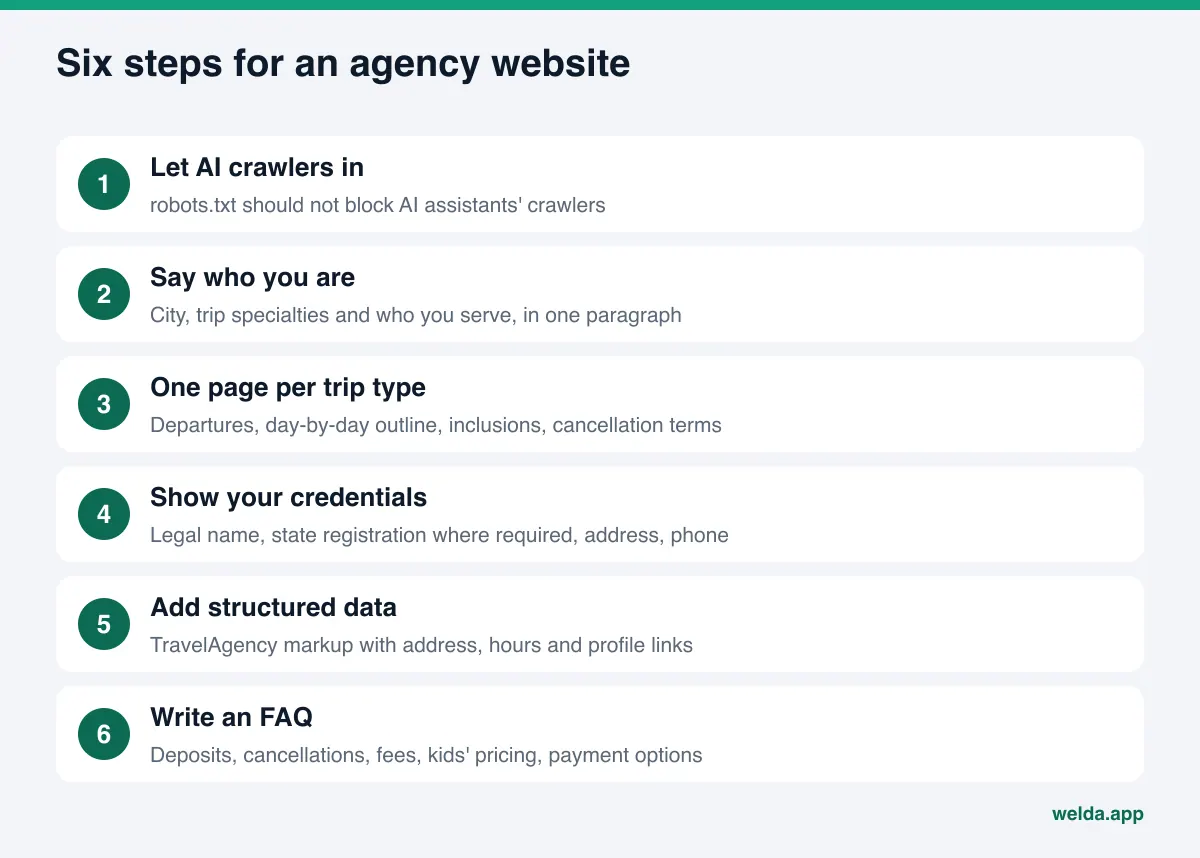
- Check that AI crawlers can reach your site. Your robots.txt file may block the crawlers AI assistants use. On sites built with booking engines or travel website templates, this setting can change without anyone at the agency noticing.
- Say who you are in one paragraph. In the homepage intro, state your city, the kinds of trips you specialize in and who you serve. Lines like "your dream vacation awaits" tell an AI system nothing.
- Give each trip type its own full page. Departure options, length, a day-by-day outline, hotel level, transportation, what is included and what is not, and cancellation terms belong on one page. A single "destinations" grid answers none of these questions.
- Explain how pricing works. Exact prices change with dates, availability and supplier rates. You can still write "per person, double occupancy, flights not included" and a short list of what moves the price. If you charge a planning fee, say what it covers. Our guide on pricing pages for AI answers covers this approach.
- Show your credentials. Legal business name, registration numbers where your state requires them, a physical address and a direct phone number belong in the footer and on your about page.
- Describe add-on services separately. Travel insurance, visa and passport guidance, airport transfers and group coordination show up often in prompts. Say clearly what you do and what you do not do.
- Add structured data. schema.org has a specific TravelAgency type. Address, phone, hours and links to your profiles can be marked up so machines read them reliably.
- Write an FAQ. Deposits, cancellations, single supplements, kids' pricing, payment options and what happens when a supplier changes plans. Short, direct answers work best.
- Align profiles and review replies. Category, description and hours on Google Business Profile should match your site. Reply to reviews on Google, Yelp and Tripadvisor with a name, a calm tone and specifics.
How should itinerary pages be written for AI answers?
Itinerary pages make the biggest difference for a travel agency. A traveler's prompt describes a destination, a length and a type of trip. The only page that can answer it is the page about that trip.
Here is an example. An example agency's Japan page has a photo gallery, the line "experience the trip of a lifetime" and a contact button. A competing agency wrote this for the same destination: departures from Seattle and San Francisco, 12 nights, a day-by-day outline, a note that the rail pass is included but city tours are optional, a minimum age for one hiking day, and how deposits are handled if the trip is canceled. When someone asks for "a Japan trip from the West Coast that works for teens and includes a rail pass", it is not hard to guess which agency the assistant will name.
A strong itinerary page usually includes:
- A one-sentence summary: destination, length, departure options, who it suits
- A day-by-day outline, two or three sentences per day
- Lodging: hotel category, room type, meal plan
- Getting there: flights, rail or self-drive, and where the trip starts
- What is included and what is not, as two separate lists
- Available dates, group size limits and when a departure might be canceled
- Deposit, cancellation and change terms
- Passport, visa and health entry requirements, with a pointer to official sources
- An FAQ for that specific trip
Agencies that sell seasonal trips often face one more problem: the page comes down when the season ends and goes back up next year. That makes it harder for AI systems to link your agency to that destination. Keeping the page live with "next departure dates" usually works better. We go deeper in AEO for seasonal businesses.
How Welda handles AI search visibility for a travel agency
Welda is software that measures where a business appears in AI answers and fills in the gaps on the business's behalf. Here are the three parts that matter most for a travel agency.
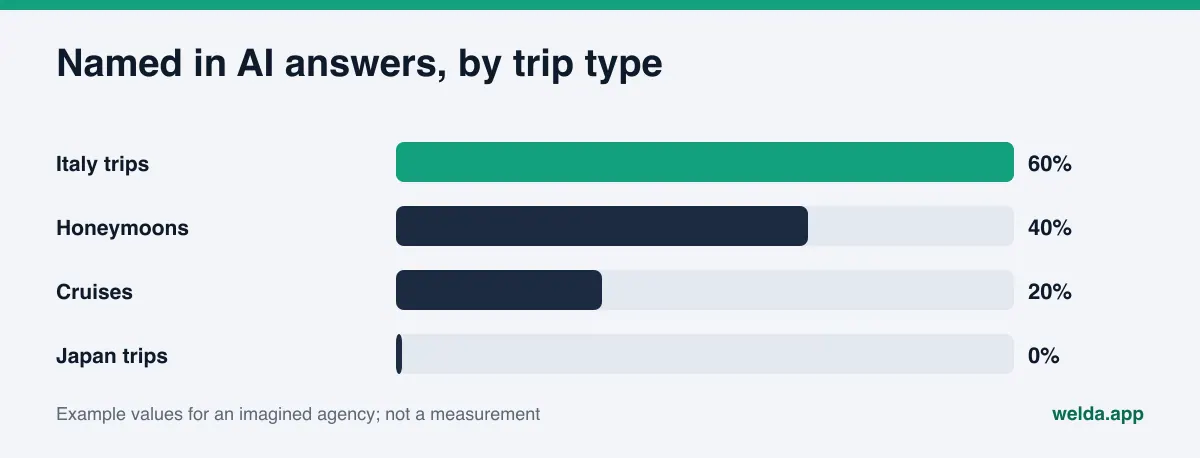
Question tracking: which trips you are named for. The panel lists the questions your clients are likely to ask, built around destinations, trip length, departure city and traveler type. Each question goes to ChatGPT, Gemini, Perplexity and Google AI three times. For every question you see which engine names you and in what position. For an agency, the value is a quick map of which trips AI already connects with you and which it does not. If you show up for Italy questions and never for Japan questions, the next job is clear: the Japan page.
The score formula is public: 100 × (0.5 × share of questions naming you + 0.3 × position score + 0.2 × share versus competitors). Because each question runs three times, the spread between answers gives a ± margin of error. AI answers do not come back the same every time, so a single check can mislead. We explain why in margin of error in AI visibility tracking.
Sources: where AI learns about you. The sources view shows which sites AI assistants cite when they answer and how your agency looks on each. For a travel agency, this usually answers one question: which piece of information is a competitor winning with, and where does it live? Sometimes it is the competitor's own site, sometimes a map profile, sometimes a review page. Each source comes with a suggested next step.
Drafts and approval: who does the work. For each gap, Welda drafts itinerary copy, FAQ answers, profile descriptions and review replies. It does not invent facts. Cancellation terms, registration numbers or departure dates it does not know show up on your to-do list as questions. If your site runs on WordPress, Welda connects through a separate Editor user and an application password, with no code to install; drafts open on your site and go live only when you approve them. On other systems, Welda gives you a ready-to-apply package and your team makes the change. Content always stays on your own site.
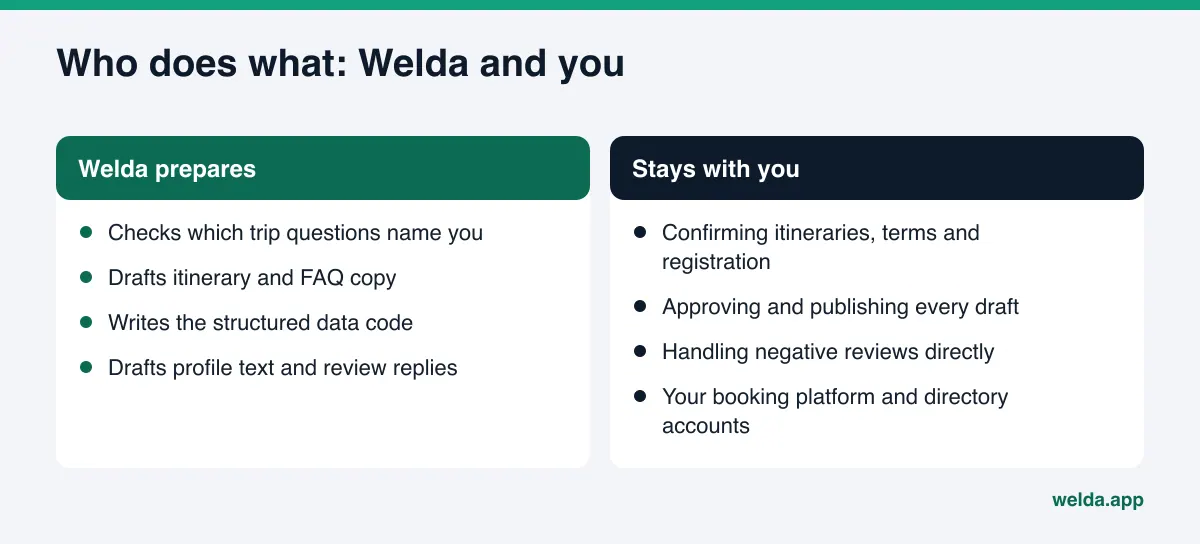
Alongside this, a compliance check flags phrases such as price or guarantee claims before anything is published, so a line like "lowest price guaranteed" comes back to you with a note. A one-page monthly PDF report sums up what changed.
Limits: what Welda does not do
There are limits every agency should know before starting.
Early access. The Welda panel is in early access and is opening in stages, starting with businesses in Turkey. Regular four-engine tracking is being added during early access, and sample screens in the panel use illustrative data. What anyone can use today is the free website analysis, which works in English and German. Pricing is discussed in an early access call.
- No guarantees. Welda does not guarantee rankings or "getting into ChatGPT". We explain why such promises do not hold up in guaranteed ChatGPT rankings.
- No invented facts. Itineraries, terms, registration details and pricing logic come from you. Welda flags what is missing and asks.
- Nothing goes live without approval. Every draft is published only after you approve it.
- No fake reviews. Welda drafts replies to reviews. It does not write or solicit reviews.
- Some work stays with you. Handling negative reviews directly, your accounts on booking platforms and directories, and press work remain with the agency.
- It takes time. New pages usually take weeks to show up in AI answers. If you want to be visible for peak season, start months ahead.
Travel agency AEO checklist
Compare this list with your site as it is today. Every item you cannot check off is a possible reason your agency is left out of an AI answer.
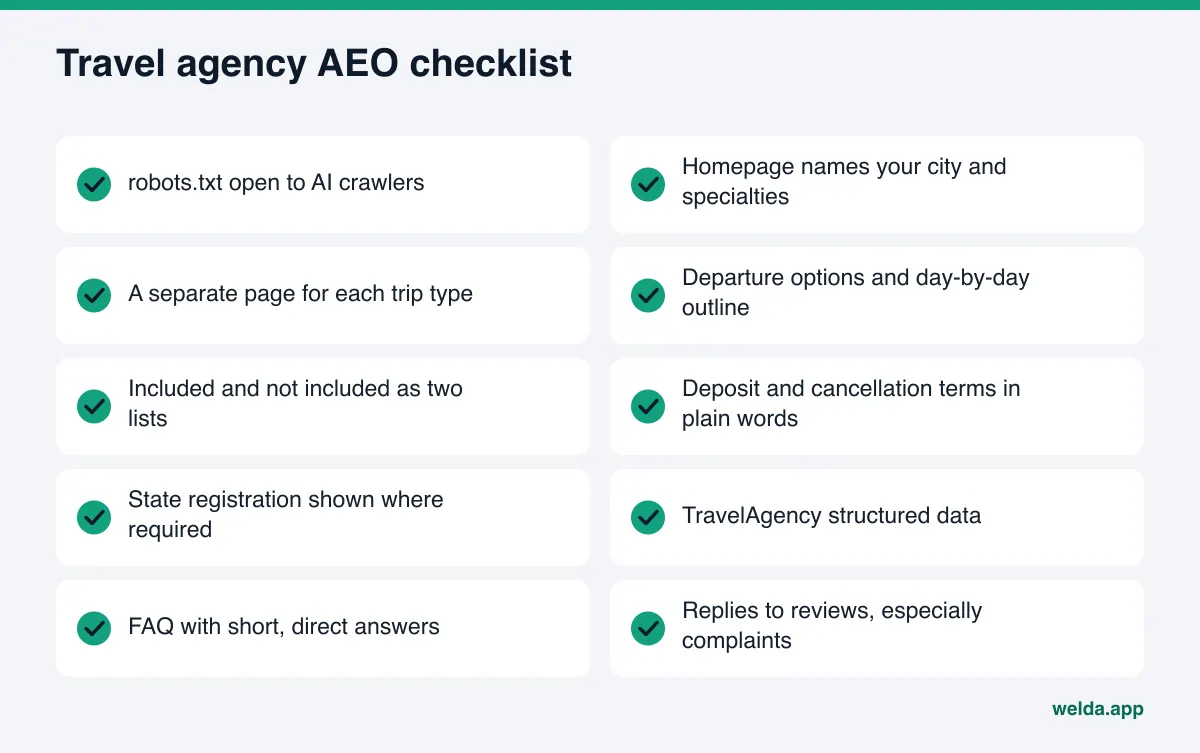
To set priorities, use a simple rule: write the first full page for the trip type that brings in the most revenue. For an agency focused on European tours, that may be its Italy page; for a honeymoon specialist, a page on how planning works and what the fee covers may come first. Three complete pages do more than ten thin ones.
Then there is the question of who owns the work. Advisors know the itineraries, the owner knows the terms and fees, and whoever answers the phone knows the questions people really ask. One person in charge of collecting that knowledge onto the page speeds everything up.
Frequently asked questions
Does AI search optimization for travel agencies replace SEO?
No. A clean, fast, well-structured site is a good base for both. AEO adds content that answers travelers' long, specific questions directly, plus consistent profile information across the web.
Can a small agency show up in AI answers next to big booking sites?
An agency that specializes in a destination, a traveler type or a service, and says so clearly, has a real chance in specific questions. It is not a guarantee, but it is more realistic than competing on broad lists.
Do I need to publish exact prices?
No. Supplier rates and dates change prices. Still, writing what is included and what changes the price gives an AI assistant something it can use when a traveler asks about cost.
Does showing my seller of travel registration help?
It gives a concrete answer to "is this agency legitimate", which travelers also look for. We cannot know exactly how each AI system weighs it, but information that is not on the page cannot be used at all.
What does the free analysis show a travel agency?
It reads your homepage and a few key pages and gives a score out of 100, split into technical and content, with what was found and how to fix each gap. It also asks an AI assistant with web search 5 questions customers might ask and checks whether your agency is named in the answers.
How long until a new itinerary page shows up in AI answers?
Usually weeks, and it varies by engine. That is why seasonal pages should be ready months ahead and stay live after the season ends.
Where to start
Start by seeing what your site tells AI systems today. Welda's free AI visibility analysis reads your agency's site, from the robots.txt setting and structured data to the FAQ and trust signals, and suggests a ready fix for each gap. It is free once per site; the results link arrives by email and stays open for 14 days. Put the report next to your itinerary pages and write the first complete page for the trip that earns you the most.