What is AI search optimization for pediatricians? It is the work of making sure that when a parent asks ChatGPT, Gemini, Perplexity or Google's AI Overviews "which pediatrician near me has evening hours," your practice and your providers show up in the answer with correct details. What decides this is clear, consistent and compliant information on your site and on the sources that talk about you. No one can guarantee a specific position.
This guide is for independent pediatricians, multi-provider pediatric groups, and the office managers or marketing staff who run their websites and listings. The practice of shaping content so AI assistants can find, understand and cite it is usually called AEO, short for answer engine optimization. You may also see the term GEO (generative engine optimization); it means essentially the same thing. Below we cover the problem, the steps, how Welda handles this work, and where it stops. If you want to see where your site stands today, start with the free site analysis.
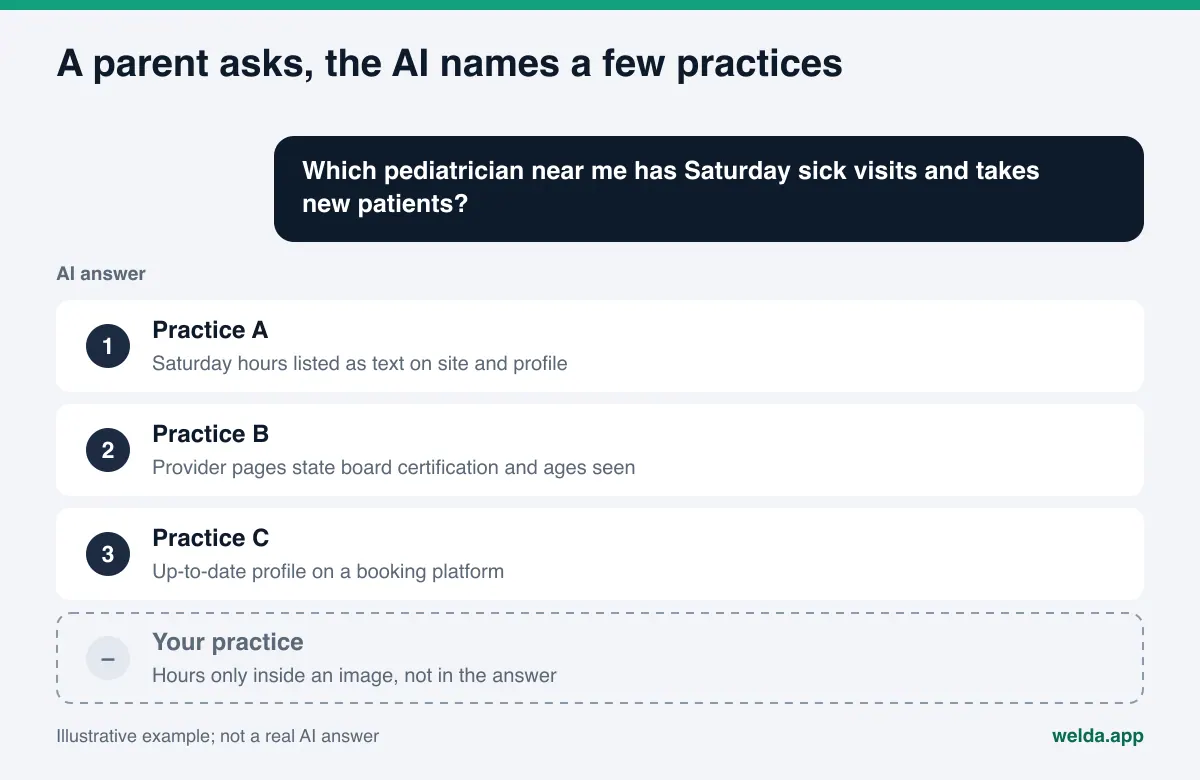
Why parents now ask AI assistants for a pediatrician
Choosing a pediatrician is rarely a one-time decision. Many families stay with the same practice from the newborn visit through the teenage years. That is why parents ask a lot of questions before they choose: Is the office close? Does it have evening or Saturday sick visits? Is it accepting new patients? Does it take our insurance plan, or Medicaid? Does a provider see newborns in the hospital? Is there someone who focuses on allergies or ADHD?
Parents used to answer these questions across search results, parenting groups, insurance directories and recommendations from friends. AI assistants pull that research into one conversation. A parent types the neighborhood, the child's age and the need in a single sentence, and the assistant replies with a short list of practices. The parent of a toddler with a fever at 7 p.m. and the expecting couple choosing a pediatrician before delivery can both end up asking this way.
If your practice is not named in that answer, it never enters the parent's shortlist. In a classic results page, ranking eighth still gave you a chance at a click. In an AI answer, there are usually only a few names. So this is not just a marketing preference. It is about which path new families take to find you.
Why AI search optimization for pediatricians is its own job
Pediatrics has question patterns that a general medical practice does not. For an AI assistant to describe you correctly, each pattern needs a clear answer on your site. Five features set pediatrics apart:
- The patient is not the one asking. A parent writes the child's age, the concern and their own practical needs together: "for my 2-year-old," "for our newborn." If your site does not say which ages you see, the assistant cannot make the match.
- Timing drives the question. Fevers, ear pain and vomiting rarely respect office hours. "Open evenings," "Saturday sick visits" and "after-hours nurse line" come up again and again. A practice that lists hours only inside a banner image or a social post cannot be a source for those questions.
- Services split by stage. Newborn care, well-child visits, vaccines, sick visits, sports physicals and adolescent care are different questions with different answers. A site that lists them all in one bullet list is a weak source for each of them.
- Coverage matters early. Families often filter by plan before anything else. Accepted plans, including Medicaid or CHIP if you participate, need to be written down and kept current.
- The topic is sensitive and regulated. Patient privacy rules, review rules and the general care required around children's information all apply. Every sentence you write to be visible has to stay inside those limits.
Put together, AEO for a pediatric practice is not a generic "let's refresh the website" project. It is a matter of writing specific pages, in a specific order, in careful language.
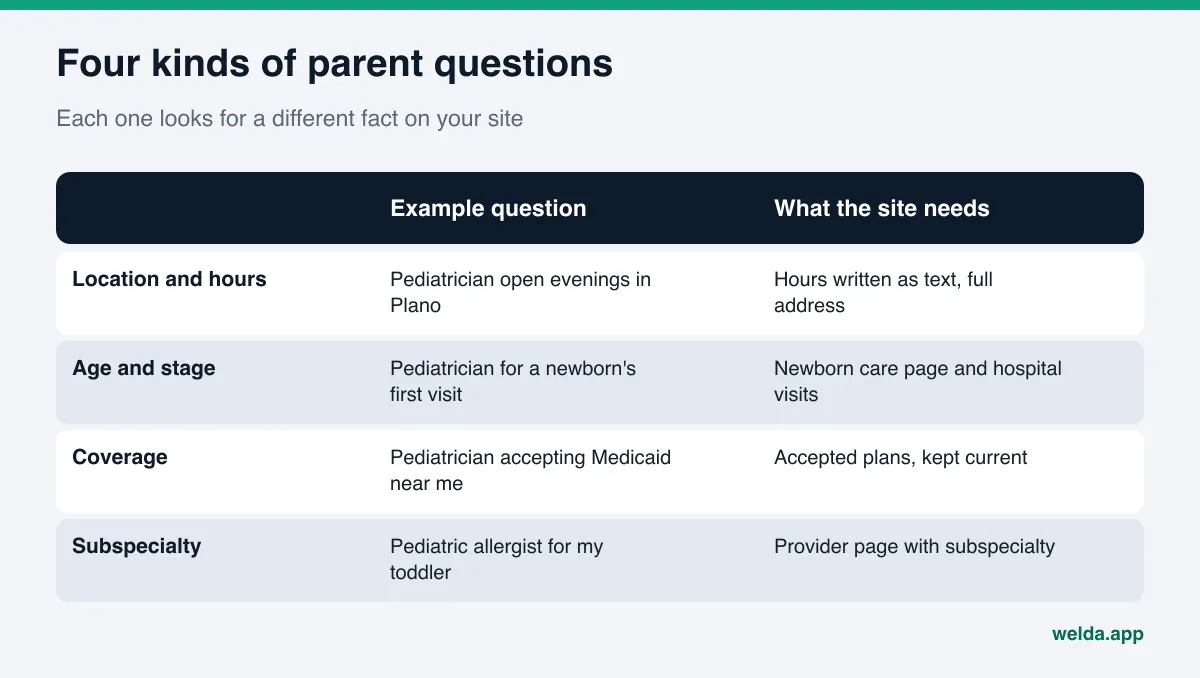
What parents ask and where the answer should live
When an AI assistant answers a question, it looks for the matching fact on your site. If it does not find it, it turns to another source such as a booking platform, an insurance directory or a review site. The table below matches typical parent questions with the information the assistant needs and where that information should live. The questions are examples written for this guide.
| Parent's question (example) | What the AI looks for | Where it should live on your site |
|---|---|---|
| Pediatrician open until 7 pm near Plano? | Hours written as text, location | Contact page, homepage, business markup |
| Who does newborn visits at the hospital where we deliver? | Hospital affiliations, newborn care details | Newborn care page, provider pages |
| Pediatrician accepting new patients with Medicaid? | New patient status, accepted plans | Insurance page or FAQ |
| Pediatric practice that does same-day sick visits? | How sick visits are scheduled | Sick visit page |
| Which pediatrician near me focuses on ADHD? | Provider interests, services offered | Provider pages and related service page |
| Is there a Saturday pediatric clinic nearby? | Weekend hours, holiday schedule | Contact page and Google Business Profile |
Each row also shows a gap. No written hours means no evening or weekend answers. No newborn page means no first-visit answers. No provider interests means no answers for focused questions.
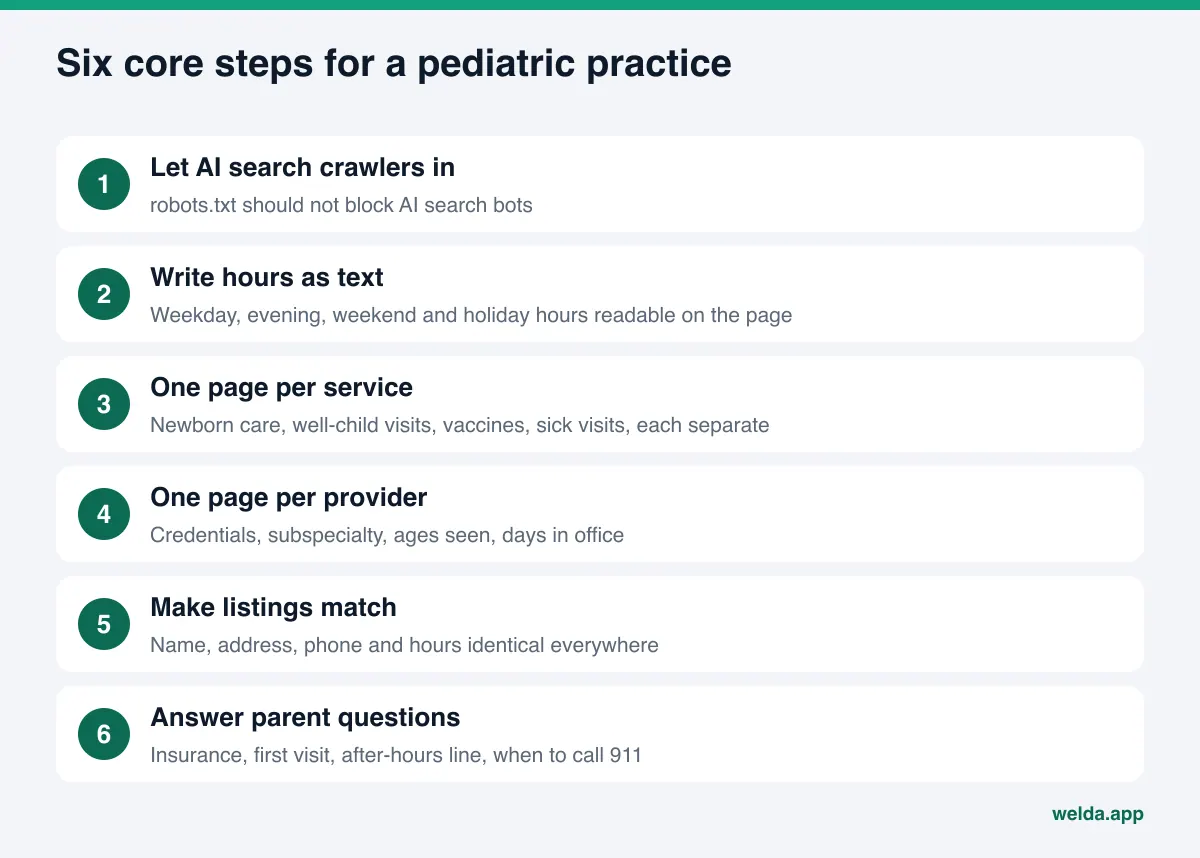
AI search optimization for pediatricians, step by step
Done in this order, these steps close the most gaps with the least effort. Each step builds on the one before.
- Check that AI crawlers can reach your site. If your robots.txt blocks AI search crawlers, nothing else matters. According to OpenAI's crawler documentation, sites that opt out of OAI-SearchBot are not shown in ChatGPT search answers. For Google, there are no extra requirements for AI Overviews or AI Mode; a page needs to be indexed and eligible to show with a snippet.
- Fix your title and description. The homepage title should say "pediatrician" or "pediatric practice" plus your city or neighborhood. "Welcome to our practice" tells an AI nothing.
- Write hours as text. List weekday, evening, Saturday, Sunday and holiday hours in readable text on the page. A graphic or a Facebook post is not enough. When hours change, update the site, Google Business Profile and booking profiles the same day.
- Give each service its own page. Newborn care, well-child visits, vaccines, sick visits, sports and camp physicals, and adolescent care. On each page, say who it is for, which ages it covers, how to book and what generally happens during the visit.
- Write a page for every provider. Credentials and board certification, areas of interest, hospital affiliations, ages seen and days in the office. In a group practice, link these pages to the service pages.
- Add business markup. Schema markup gives address, phone, hours and specialty in a form machines read directly. The schema.org MedicalSpecialty list includes a "Pediatric" value you can use to state the specialty.
- Make every listing match. Practice name, address, phone, hours and provider names should read the same on your site, Google Business Profile, Healthgrades, Zocdoc, Yelp and your health system's directory. Conflicting details can make an AI assistant avoid naming you. We cover this in detail in keeping business hours accurate for AI.
- Answer parent questions on the page. How to become a new patient, what to bring to the first visit, how the after-hours line works, which plans you accept, and when to call 911 instead of the office. See FAQ pages for AEO for how to structure these.
Staying within the rules: reviews, privacy and claims
Pediatric practices operate under the same federal rules as other healthcare providers, plus the extra care families expect around their children's information. Three areas matter most for AEO work.
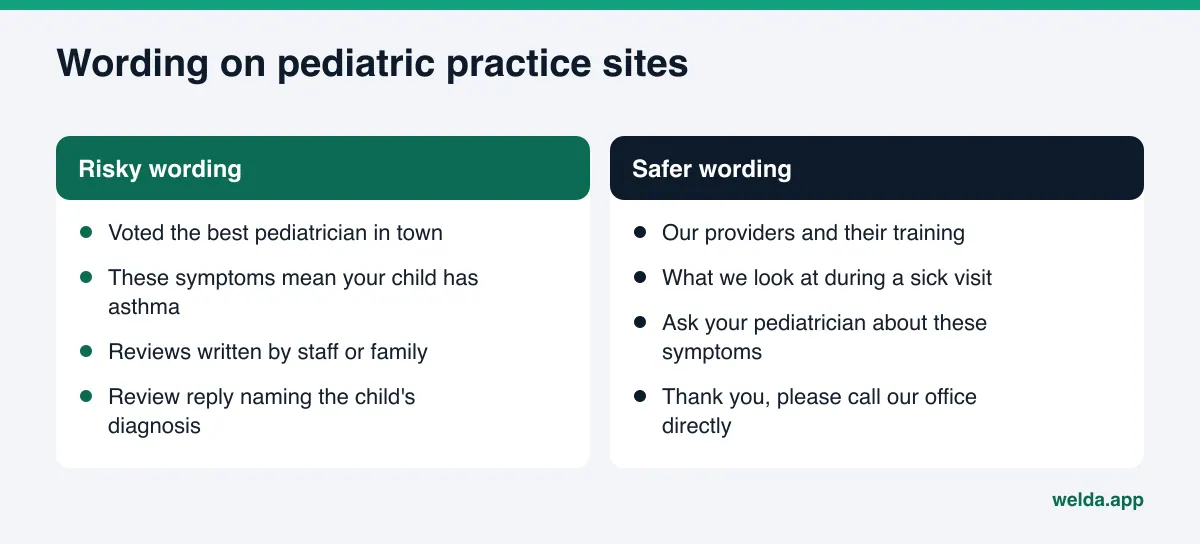
Reviews. The FTC's Trade Regulation Rule on the Use of Consumer Reviews and Testimonials (16 CFR Part 465, published August 2024) prohibits fake reviews, including AI-generated ones, buying reviews, and certain undisclosed insider reviews. For a practice, that means no reviews written by staff or relatives, no paid reviews, and no "review swaps."
Privacy in replies. Under HIPAA, a reply to an online review should not confirm that the reviewer's child is a patient or mention any care details. A short, polite reply that invites the family to call the office directly is the safer pattern.
Claims. Avoid "best pediatrician in town," outcome promises and content that reads like an online diagnosis. Explain what a visit involves and when to talk to a clinician instead. State medical boards and professional bodies may have their own advertising rules; check with your counsel.
For a broader look at this topic, read compliant AEO content for healthcare practices. This section is not legal advice.
The sources AI assistants check besides your site
When an AI assistant recommends a pediatrician, it does not read only your website. It collects facts from other sources too, and it often shows those sources under the answer. For a pediatric practice, these usually matter most:
- Google Business Profile and Google Maps. Hours, address, phone, category and reviews come from here. The primary category should be pediatrician, and holiday hours should be set.
- Physician directories and booking platforms. Healthgrades, Zocdoc and similar sites carry provider profiles, specialties and hours. If those profiles disagree with your site, the assistant cannot tell which to trust.
- Review sites. Yelp and similar platforms can carry reviews of your practice. You cannot write these, but you can reply carefully within privacy rules.
- Hospital and health system directories. If your providers have privileges at a hospital or belong to a health system, those directory pages can be cited too. They need the same correct details.
- Insurance directories. Parents often check whether a provider is in network. An outdated listing there can send them elsewhere.
All these sources describe the same people and the same office. When name, credentials, address and hours read the same everywhere, an assistant can connect them to one practice. Small differences, such as an old suite number or a provider listed under two name spellings, weaken that link. Listing work is not a one-time task; when hours or providers change, every listing should change the same day.
How Welda does this work
Welda is software that measures where a business appears in AI answers and fills the gaps on the business's behalf. For a pediatric practice, three parts of that work matter most: measuring with parent questions, leaving unknown facts blank and asking you, and sending every healthcare item for approval.
Measuring with parent questions. In the Welda panel, the question tracking screen is built from the questions parents would actually ask: "pediatrician open evenings" plus your area, "newborn first visit," "pediatrician accepting new patients." Each question is asked three times in ChatGPT, Gemini, Perplexity and Google AI. Each row shows which engines name you and in what position. Open a row and you see the answer itself and the sources it cited. If you are named for newborn questions but never for weekend questions, you know the gap is in your hours information. Question language can be set to English or Turkish. How the score is calculated is explained in our ChatGPT rank tracker guide.
Unknown facts stay blank until you answer. At the top of the to-do list sits a section for information Welda needs from you. Welda does not invent what it could not read from your site: Saturday hours, the full address, holiday schedules, or whether you offer a given service are left empty and listed as questions. Under each field you see how many drafts will use that answer. You fill it once and it flows into every draft. For pediatric practices these are often weekend hours, newborn hospital visits and accepted plans.
No automatic publishing in healthcare. Welda drafts service pages, FAQs, Google Business Profile text and review replies. In healthcare, none of it goes live on its own; every item lands in an approval queue where you read and approve it. Before that, a compliance check flags patterns such as prices, guarantees, superiority claims and diagnostic suggestions. That check is not legal advice and has not been reviewed by legal counsel; the final call is yours. Patient data is never sent to AI; Welda works with your public information only.
The rest in brief. On WordPress sites, Welda connects through a separate Editor user and an application password, with no code to install; content opens as a draft on your site and goes live when you approve it. On other systems, Welda provides a ready-made package and the changes are applied by hand. Content always lives on your own site. A competitor screen shows who leads on which topic and from which source, and a one-page monthly report compares before and after.
An honest note on availability. The Welda panel is in early access and is opening first in Turkey. Regular four-engine measurement is being added during early access, and sample screens in the panel use illustrative data. What anyone can use today, in English, is the free site analysis. Pricing is discussed during the early access conversation.
Limits: what Welda does not do
- No ranking guarantee. Welda does not promise placement in ChatGPT or any position. AI answers vary, which is why each question is asked three times.
- No fake reviews. Welda does not write reviews. It drafts replies to real ones, and those replies never mention a child or a family's situation.
- No guessed facts. Which vaccines you give or which plans you accept never enters a draft until you confirm it.
- Some work stays with you. Handling negative reviews, directory and booking accounts, and press work remain your responsibility. Profiles that are not connected are listed as manual tasks.
- It takes time. Technical fixes are quick, but new content usually takes weeks to show up in AI answers.
Decision guide and checklist
Where you start depends on your situation. The diagram below covers the most common cases. If you are named for some questions and not others, read how to read your AI visibility report to find out which gap matters most.
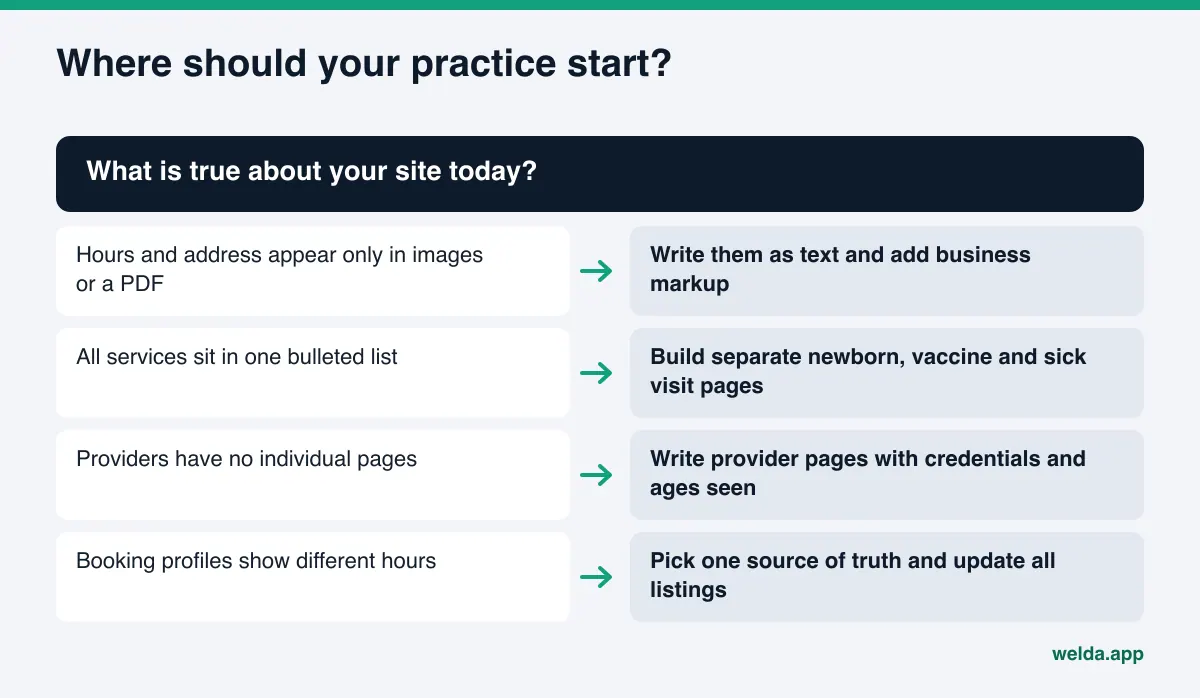
| If your practice | Then focus on |
|---|---|
| Is a solo pediatrician with a one-page site | Hours, address, ages seen and services as text, plus business markup |
| Is a group with several locations | One page per location with its own hours and providers |
| Has providers with special interests | Provider pages that state those interests and link to services |
| Has review replies that mention patients | Clean up replies before any visibility work |
| Serves many Spanish-speaking families | State languages spoken on provider and contact pages |
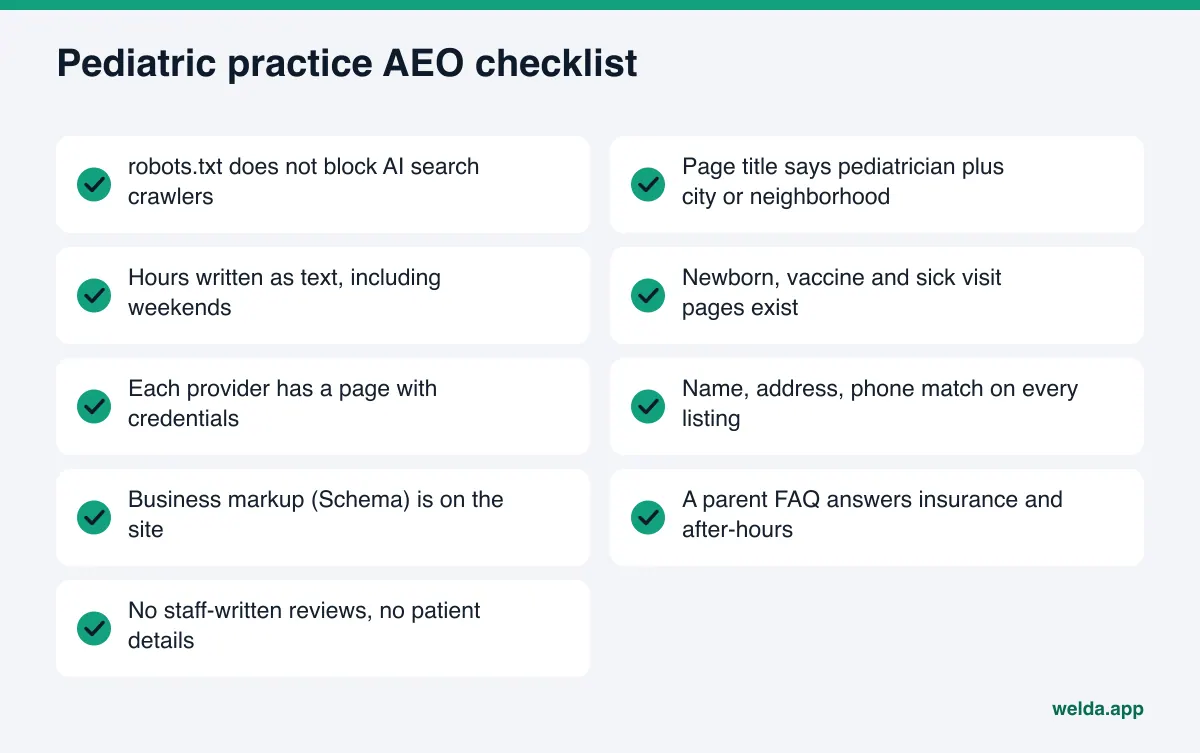
Use the checklist below for a quick pass. Every "no" is a task.
Frequently asked questions
Is AEO different from local SEO for a pediatric practice?
The foundation is shared: correct address, consistent details, clear service pages. The difference is that an AI assistant produces an answer, not a list. Only a few practices appear, and parents often pick from those. Hours, ages seen and services need to be written clearly enough to be quoted in one sentence.
Does a solo pediatrician need this?
Yes, and it is often simpler. In a solo practice, the provider page and the homepage overlap. Writing hours, location, ages seen and services clearly closes most of the basic gaps.
Can we show parent testimonials on our site?
Genuine reviews from real families are allowed, but fake or staff-written reviews are prohibited under the FTC rule, and any use of patient information has to respect HIPAA. Many practices simply link to their public review profiles. Check with your counsel for your situation; this is not legal advice.
Does Welda see patient records?
No. Welda works with the practice's public information: website, profiles and directory listings. Patient data is never sent to AI.
How long until changes show up in AI answers?
Technical fixes are quick, but new content usually takes weeks to be reflected. No one can promise a timeline or a position. Comparing measurements a few weeks apart is more meaningful than checking daily.
What does the free analysis show for a pediatric site?
It reads your homepage and a few inner pages such as services, about and contact. It checks crawler access, title and description, business markup, address and phone consistency, an FAQ section, trust signals and how clearly services are described. You get a score out of 100, a fix for each gap and ready-to-use text suggestions. It also asks five questions parents might ask to an AI assistant that can search the web and checks whether your practice is named. That is a one-time measurement.
See where your practice stands today
AI search optimization for pediatricians starts with a few well-written pages and hours, address and services that read the same everywhere. The first step is knowing where you stand. The free site analysis is free once per site and works in English. After you verify your email and phone, the results link arrives by email and stays open for 14 days. It does not measure rankings and does not promise any, but it shows which gap to close first.