What is AI search optimization for ice cream and dessert shops, and why does it matter this season? When someone asks ChatGPT, Gemini, Perplexity or Google's AI Overviews for "an ice cream shop open late near the boardwalk" or "a dairy-free dessert place downtown," the answer names two or three businesses, not ten links. AI search optimization for ice cream and dessert shops, usually called AEO (answer engine optimization), is the work of making your hours, flavors and dietary options clear enough that those answers can include you.
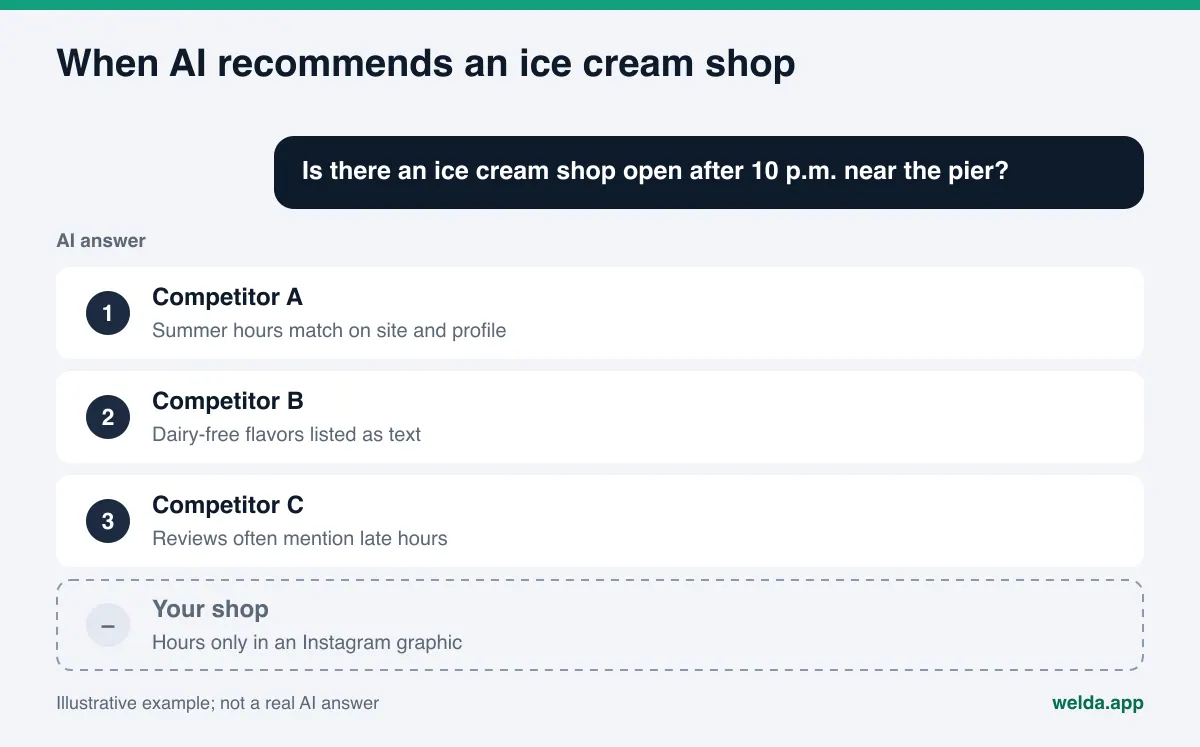
Why AEO for ice cream and dessert shops is its own problem
AI search visibility rests on the same foundation in every industry: an AI assistant recommends a business when it can find clear, consistent and current information about it. You will also see this called GEO (generative engine optimization); in the US, AEO is the more common term, and we use it in this guide. Ice cream parlors, gelato shops, frozen custard stands and dessert bars face three extra challenges on top of that foundation.
The first is seasonality. A shop in a beach town, a lake community or a northern city can look like two different businesses in July and in January. Hours shrink, some locations close for the winter, and half the menu rotates with the weather. If your website still says "open daily noon to 11 p.m." in November while you actually close at 8, an AI answer to "open right now" either repeats the wrong hours or skips you. A customer who walks up to a dark storefront does not just leave; they sometimes leave a review saying so, and that review becomes another source the AI reads.
The second is product detail. Dessert is a category where people ask very specific questions: Is the ice cream made in-house? Is there a vegan or dairy-free option? Is the kitchen nut-free? Do you sell pints or quarts to go? Can I order an ice cream cake for Saturday? Do you cater events? If that information only lives on a chalkboard, a menu photo or an Instagram story, an AI assistant cannot read it.
The third is the impulse decision. Very few people plan a scoop of ice cream a week ahead. A family leaving dinner, a couple on an evening walk or a tourist exploring a new city asks their phone "where can we get dessert nearby" and starts walking within minutes. If your name is not in that answer, there is rarely a second chance.
So AEO for an ice cream or dessert shop is less about a website redesign and more about writing your season, your products and your location in a way an AI can understand. The fastest way to see where you stand is to check how your site reads today. Welda's free site analysis reads your homepage and a few inner pages the way Google and AI assistants do and lists each gap with a fix.
What customers ask AI about ice cream and dessert
Dessert questions look short but usually carry three or four conditions at once: a place or landmark, a time, a product and sometimes a dietary need. The questions below are examples written for this guide, not queries from a study, but they show how people phrase these requests:
- "Is there an ice cream shop open after 10 p.m. near the pier?"
- "Where can I get dairy-free soft serve in Austin?"
- "Best place for a custom ice cream cake for a kid's birthday this weekend?"
- "Gelato shop with vegan sorbet options near downtown?"
- "Dessert spot with outdoor seating that is good for families with strollers?"
- "Is there a nut-free ice cream place for kids with allergies?"
Each of these questions requires specific facts about your shop: address and neighborhood, current hours, flavors and product types, dairy-free, vegan, sugar-free and nut-free options, pints, cakes and catering, and seating. If those facts are not written clearly on your site or on the sources AI assistants trust, being included becomes a matter of luck.
Questions about allergies deserve extra care. For a parent, "nut-free" is not a preference, it is a safety question. Write exactly what is true: which flavors contain nuts, whether you use shared scoops or equipment, and what you can and cannot promise. An honest "we use shared equipment and cannot guarantee a nut-free product" is better information for an AI answer, and for the parent, than silence. Allergen disclosure rules for restaurants and food service vary by state and city, so check your local requirements with your health department or an advisor.
Where AI assistants read about your dessert shop
AI assistants draw on several kinds of sources. How much weight each source gets varies by engine and by question, but for dessert and ice cream questions these show up often:
| Source | What the AI reads there | What you should do |
|---|---|---|
| Your own website | Products, hours, address, dietary options, FAQ | Write it as text, keep it current, keep it in one place |
| Google Business Profile and Google Maps | Category, hours, special hours, reviews, photos | Choose the right category, add seasonal and holiday hours, reply to reviews |
| Yelp | Reviews, categories, attributes, photos | Claim the listing and keep hours and attributes in sync with your site |
| Tripadvisor | Visitor reviews in tourist areas | Check that hours and seasonal closures are correct |
| Local guides and "best of" lists | City roundups, neighborhood guides | Check that facts about you are accurate |
| New flavors, opening day, specials | Put address, hours and your website link in the profile bio |
Consistency across these sources matters more than any single one. If your website says "vegan options available," your Google profile says nothing and a local guide says "no dairy-free choices," the AI may resolve the conflict by leaving you out of that question. Consistency is the most commonly skipped part of AEO for ice cream and dessert shops.
Seasonal hours: the biggest gap for ice cream shops
For ice cream shops, hours cause more AI visibility problems than anything else. When a question includes "now," "tonight" or "late," the AI looks for hours. If it cannot find them, or finds hours that contradict each other, it recommends a business it is more confident about.
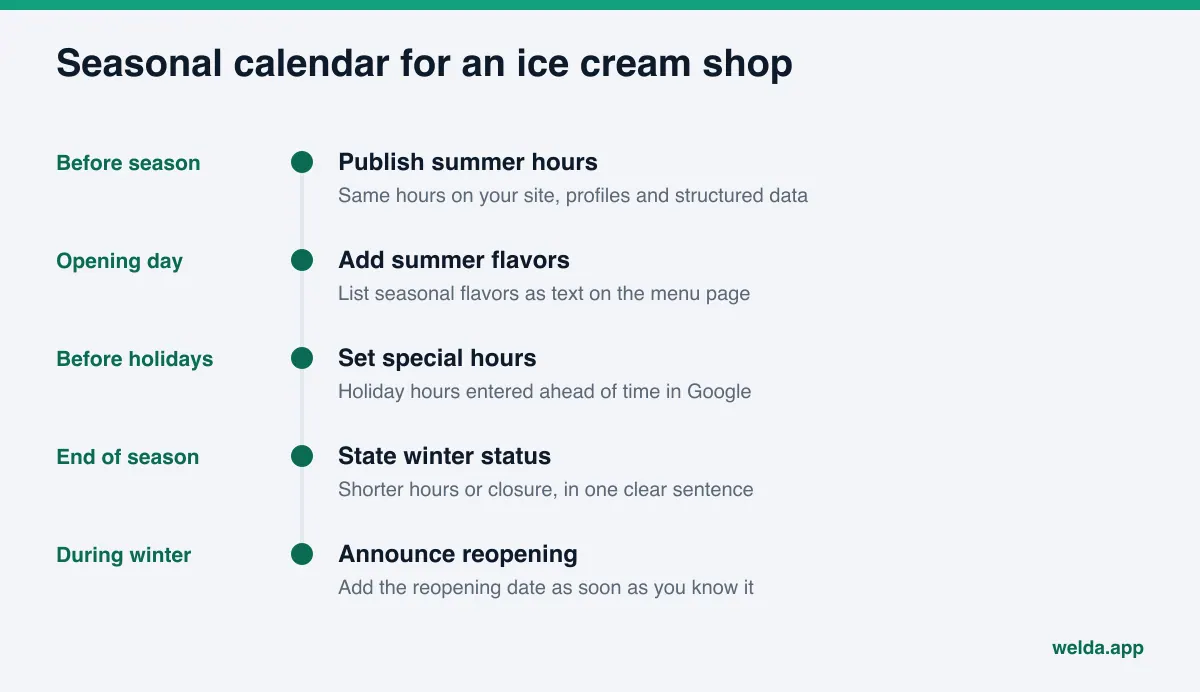
In practice, list your summer and winter hours separately on your website, with dates instead of vague wording like "hours vary by season." If a location closes for the winter, say so in a plain sentence and add the reopening date as soon as you know it. In Google Business Profile, set special hours for holidays ahead of time; Google's help page describes this field for short-term changes to your regular hours. Keep the opening hours in your structured data current as well.
Dessert shops that are open all year face a different calendar. Bakeries and dessert bars see demand peaks around holidays such as Thanksgiving, Christmas and Valentine's Day, and the questions shift to "last day to order a pie," "are you open on the Fourth of July," or "do you have pre-orders for Mother's Day." Publishing order deadlines and holiday hours a few weeks in advance makes it easier for AI answers to repeat the right information when those questions peak.
AI search optimization for ice cream and dessert shops, step by step
The order below starts with the basics and moves toward the work that takes the most effort. Each step builds on the previous one.
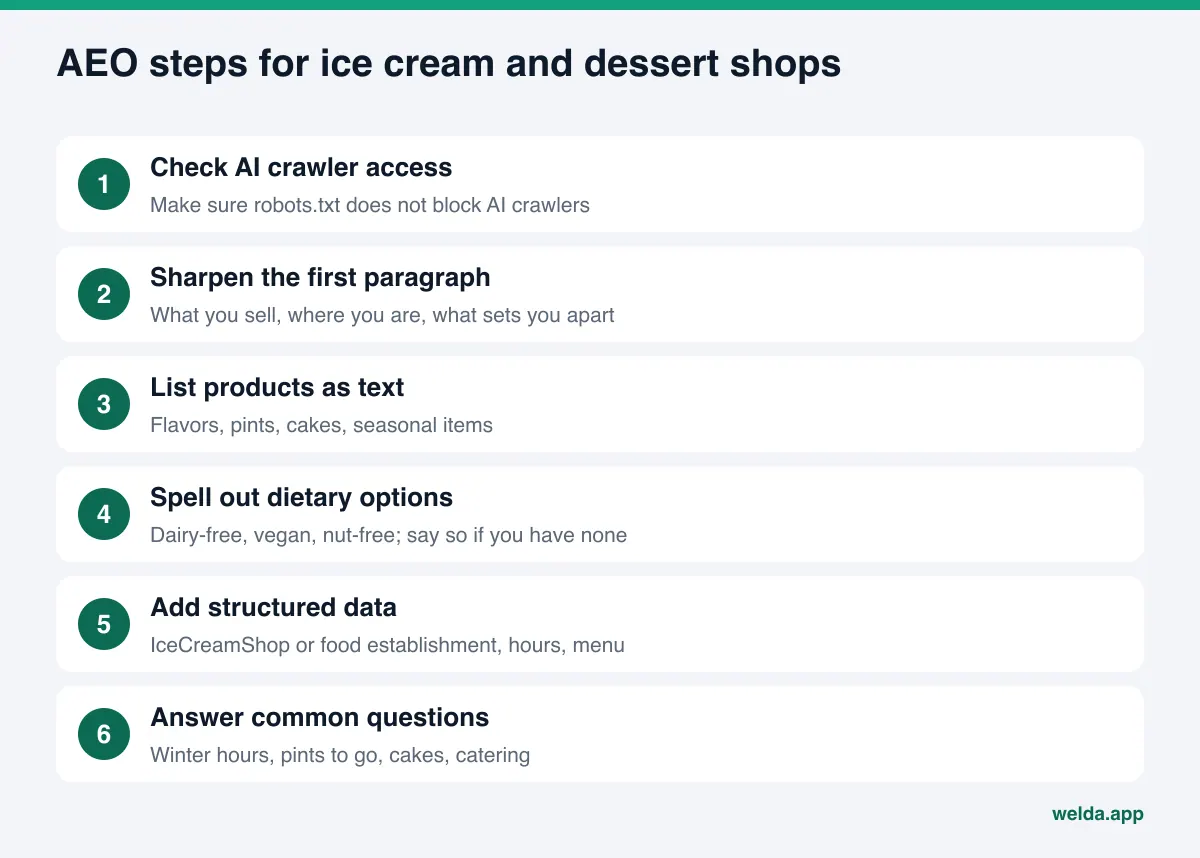
- Make sure AI crawlers can reach your site. If your robots.txt file accidentally blocks AI crawlers, nothing else on this list matters. We cover this check in detail in our guide to robots.txt for AI crawlers.
- Rewrite the first paragraph of your homepage. In one paragraph, say what you sell, where you are and what sets you apart, for example "small-batch ice cream made in our kitchen on Main Street, with dairy-free flavors every day." Every claim should be true.
- List your products as text. Flavors, pints and quarts, cakes, sundaes and seasonal items should appear as text on the page. A menu photo or PDF can be an extra, not the only version.
- Spell out dietary options. If you have dairy-free, vegan, sugar-free, gluten-free or nut-free options, say which items they apply to. If you do not, say that too. "We don't currently offer vegan flavors" is still useful information.
- Add business structured data. Schema.org has a dedicated IceCreamShop type, which inherits menu and cuisine properties from the food establishment type. A dessert bar or bakery can use the matching food establishment type. Address, phone, hours and a menu link belong in this markup.
- Write an FAQ section. Answer the five to seven questions your staff hears most: Are you open in winter? Do you sell pints to go? Can I order a cake? Do you cater? Is there seating? Is anything nut-free?
- Align profiles and review replies. Make your Google Business Profile and Yelp categories, hours and descriptions match your website. Reply to reviews briefly and specifically.
If you plan to publish prices, specials or "buy one, get one" offers, our guide to pricing claims in AI-ready content shows how to write them so they stay accurate. For cakes, pies and baked goods, see how bakeries get recommended by ChatGPT.
Ice cream shop, gelato shop or dessert bar: what changes?
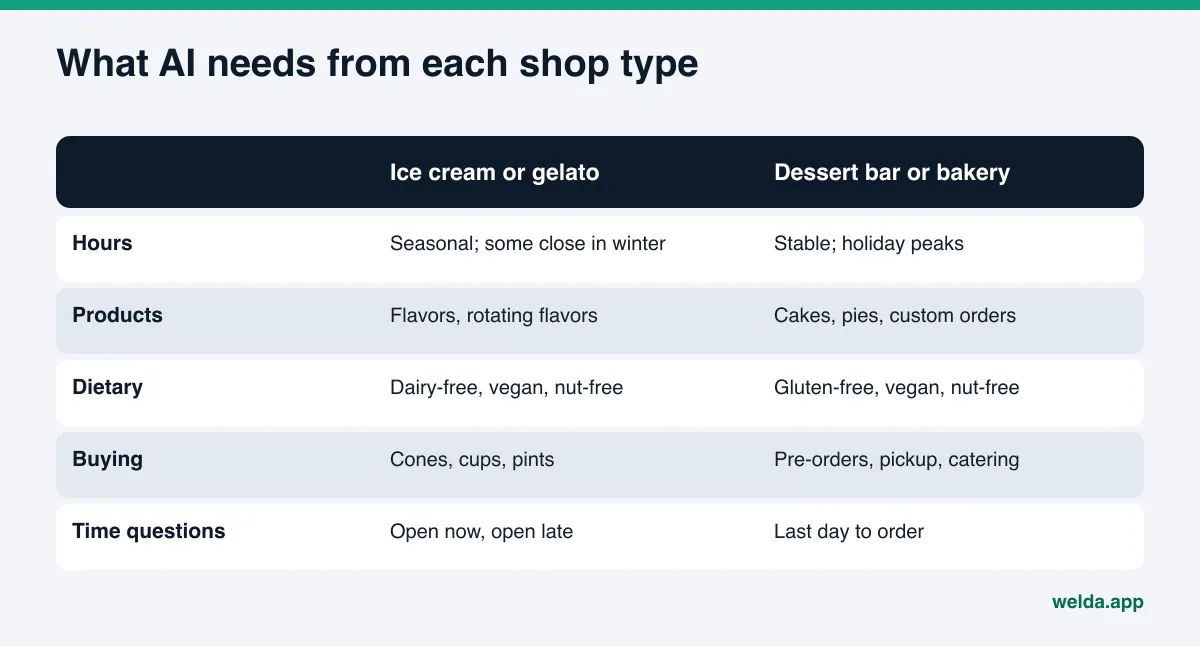
These businesses often get grouped together, but the information an AI needs from each one differs. The table below summarizes what matters most for each type:
| Topic | Ice cream or gelato shop | Dessert bar or bakery |
|---|---|---|
| Hours | Summer and winter differ; some close for the season | Mostly stable; holiday peaks and order deadlines |
| Product detail | Flavors, rotating flavors, made in-house or not | Cakes, pies, pastries, custom orders |
| Dietary options | Dairy-free, vegan, sugar-free, nut-free | Gluten-free, vegan, nut-free |
| How customers buy | Cones, cups, pints, delivery apps | Pre-orders, pickup, catering |
| Time-based questions | "Open now," "open late" | "Last day to order," "open on the holiday" |
| Sources that matter | Google Maps, Yelp, Instagram | Google Maps, Yelp, local guides |
If you do both, write each part in its own section. Combining "ice cream and desserts" into a single paragraph makes it harder for the AI to know which question you answer best. Tourist-heavy areas add another layer; our guide to AEO for Miami businesses shows how visitor questions differ from local ones.
How Welda handles AEO for an ice cream or dessert shop
Welda is software that measures where a business appears in AI answers and fills the gaps on the business's behalf. Here are the three parts that matter most for an ice cream or dessert shop.
1. The free site analysis: can AI read your hours and flavors?
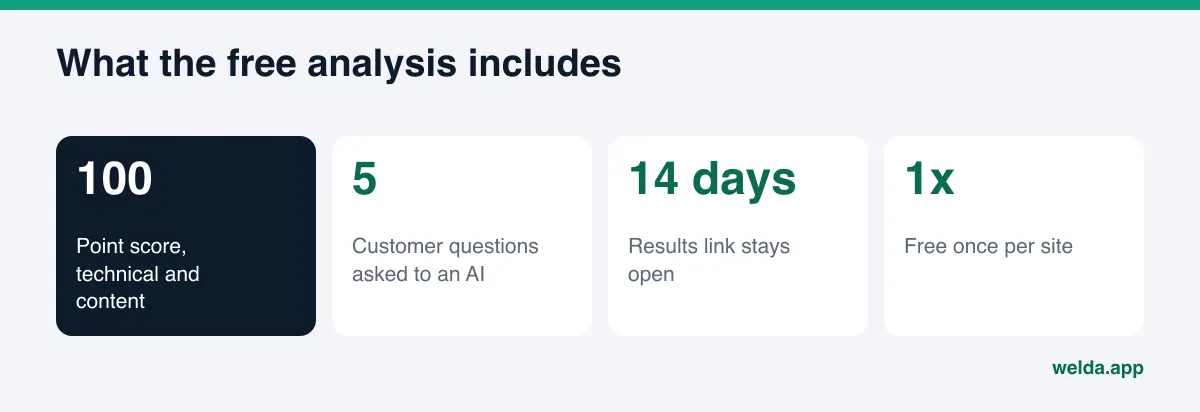
The part anyone can use today is the free site analysis, which works in English. It reads your homepage and a few inner pages such as About, Contact and Menu. For an ice cream shop, the first checks are predictable: Can AI crawlers reach the site? Are the address and phone number clear? Is there business structured data? Are your Google Maps and Instagram profiles linked from the site? Is there an FAQ section? Are the products written clearly? For each gap, the report says what it found, why it matters and how to fix it.
The analysis also gives ready-to-use text for your homepage: title, description, main heading, intro paragraph and FAQ. For an ice cream shop, that means a finding like "your seasonal hours are not mentioned on the homepage" comes with a draft you can paste in. A simulation shows how much each fix would move your score, which helps you decide what to do first. The analysis also asks five customer-style questions to an AI assistant that can search the web and checks whether your name appears in the answers. That is a one-time snapshot, not ongoing tracking, but it shows where you stand today.
2. Question tracking: which dessert questions mention you?
In the Welda dashboard, the questions view lists the questions your customers are likely to ask. Each one is asked three times in ChatGPT, Gemini, Perplexity and Google AI, and you see which engine names you and in what position. For an ice cream shop, the rows look like "ice cream open late near the pier," "dairy-free ice cream downtown" or "ice cream cake for pickup Saturday."
The decision this view supports is simple: which questions you are missing entirely, and which ones you appear in but trail. If you never show up for "open late" questions but rank second for flavor questions, the problem is your hours information, not your products. The score formula is published, and the spread across the three repeats gives a margin of error, so you can tell a real change from noise.
3. Sources and the to-do list: who fills which gap?
The sources view shows which sites AI assistants cite when they answer, and your status on each. For a dessert shop that typically means Google Maps, Yelp, local guides and Instagram. If a listing is incomplete, it appears there and lands on the to-do list.
The to-do list holds three kinds of work. Facts Welda does not know, such as your winter hours, which flavors are vegan or whether your kitchen handles nuts, are asked of you; Welda does not guess them. Content Welda prepares, such as FAQ text, product descriptions, profile copy and review replies, waits for your approval. Tasks on platforms without a connection are listed as manual tasks with the text ready. On WordPress sites, Welda connects through a separate Editor user and an application password, without installing code; new content opens as a draft and goes live only when you approve it. Content always stays on your own site. A one-page monthly report compares before and after; we describe it in our monthly AEO report guide.
Where Welda stands today
The Welda dashboard is in early access and is opening in stages, starting with businesses in Turkey. Regular four-engine tracking is being added during early access, and the sample screens show representative data. The free site analysis works in English and German and is available to anyone today. Pricing is discussed in the early access conversation.
Limits: what Welda does not do
Knowing what a tool will not do is as important as knowing what it does. For an ice cream or dessert shop, these are the limits:
- No guarantees. Welda does not guarantee rankings or "showing up in ChatGPT." AI answers vary, which is why each question is asked three times and shown with a margin of error.
- No guessing. Welda does not invent your winter hours, allergen practices or ingredient sources. It asks you. In allergy questions especially, a wrong sentence does more harm than a missing one.
- No fake reviews. Welda drafts review replies but never writes or buys reviews. The FTC has a final rule banning fake reviews and testimonials, announced in August 2024.
- Not every task. Resolving negative reviews, managing directory accounts and earning press coverage stay with your business. Welda shows where you are missing and can prepare text.
- No publishing without approval. Pricing, "best in town" claims and health-related wording such as "sugar-free" or "diabetic-friendly" are flagged before publishing. This check is not legal advice.
- No instant results. New content usually takes weeks to show up in AI answers. Publish summer hours and the summer menu before the season starts.
Checklist for AI search optimization for ice cream and dessert shops
Use this list to see where your site and profiles stand today. Every "no" adds an item to your to-do list.
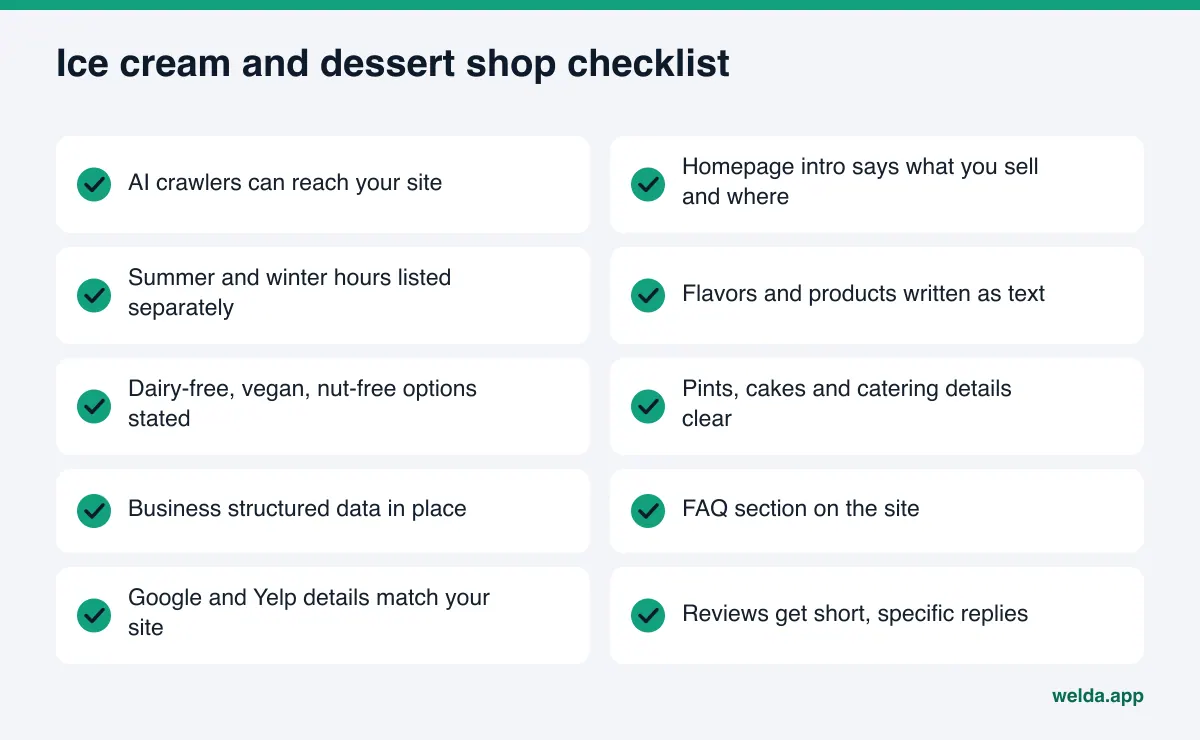
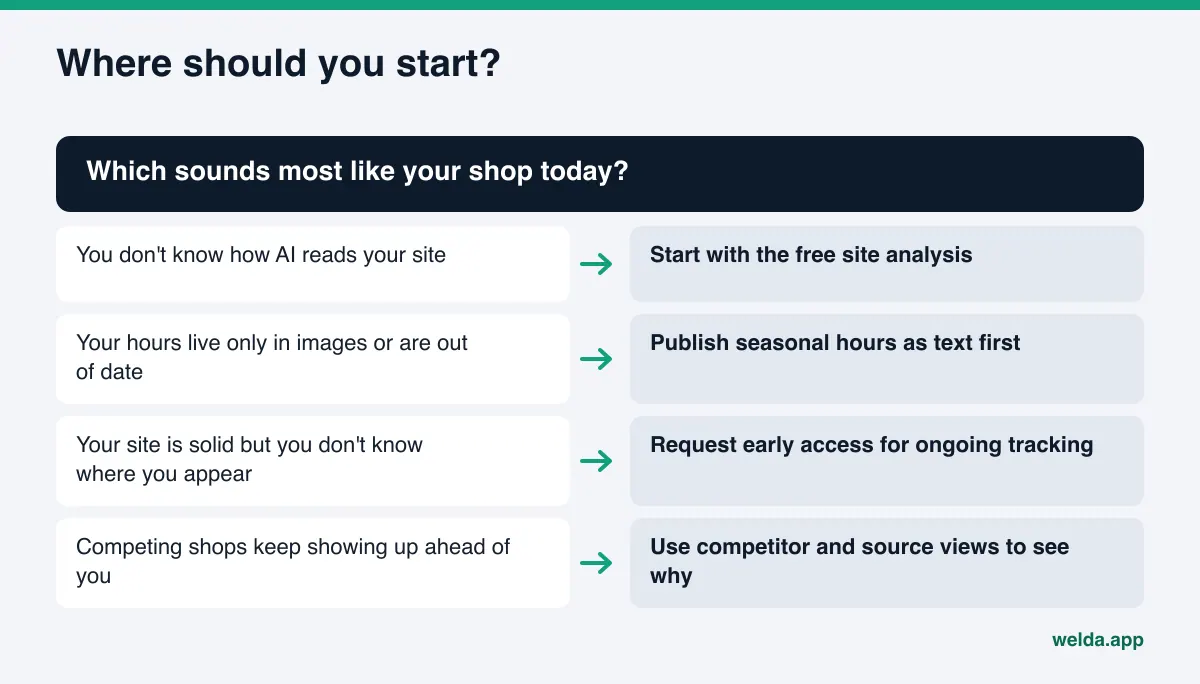
Once you have worked through the list, compare your situation with the decision chart below. Not every shop starts in the same place, but every shop should measure before fixing. If you also serve coffee, our AEO for coffee shops guide covers the questions that neighboring category gets.
Frequently asked questions
Is AEO for an ice cream shop different from regular SEO?
The foundations overlap: a fast, readable site with accurate information. The difference is that an AI gives a short answer with two or three businesses instead of a list of links. Getting into that answer depends on clear, consistent facts like hours, flavors and dietary options.
My shop closes for the winter. Does that hurt my AI visibility?
Being closed is not the problem; being unclear is. If your site and Google profile state the winter closure and the reopening date, AI assistants can recommend you with the right information in summer. Because updates take weeks to show up, publish summer details before the season.
Our flavors change daily. Do we need to list every one?
No. List your core flavors and describe the rotation, for example "classic flavors year-round, fruit sorbets in summer, rotating specials weekly." What matters to the AI is knowing what kind of products you sell.
How does the free analysis work?
It is free once per site and works in English. Your email and phone number are verified, the results link arrives by email and stays open for 14 days. You get a score out of 100, each gap with a fix, and a downloadable PDF. It does not measure rankings.
Can I use the Welda dashboard in the US today?
The dashboard is in early access and is opening first in Turkey. The free site analysis is available to anyone today in English. You can request early access from the analysis page.
Can we say "sugar-free" or "diabetic-friendly"?
If a product is truly sugar-free, you can say so, but health-related claims are regulated. Welda's compliance check flags this kind of wording before publishing. It is a warning, not legal advice; make the final call with your advisor.
First step: see how AI reads your dessert shop today
Before the season opens, before the holiday rush and before tourist traffic picks up, knowing how your site reads to AI tells you where to start. Are your hours readable, are your flavors written as text, is your structured data in place, is there an FAQ? You can see all of this in a few minutes.
Start the free site analysis and get your score, your gaps and ready-to-use homepage text. You can also request early access to the Welda dashboard from the same page.