Why doesn't ChatGPT or Gemini recommend my coffee shop? AI assistants recommend cafes based on clear facts they can find on your website, your Google Business Profile, review sites and local guides. If your cafe type, neighborhood, hours, menu and practical details like Wi-Fi or a laptop policy are missing or inconsistent, your name does not make the answer. This guide to AEO for coffee shops walks through the fixes step by step and explains which parts Welda handles for you.
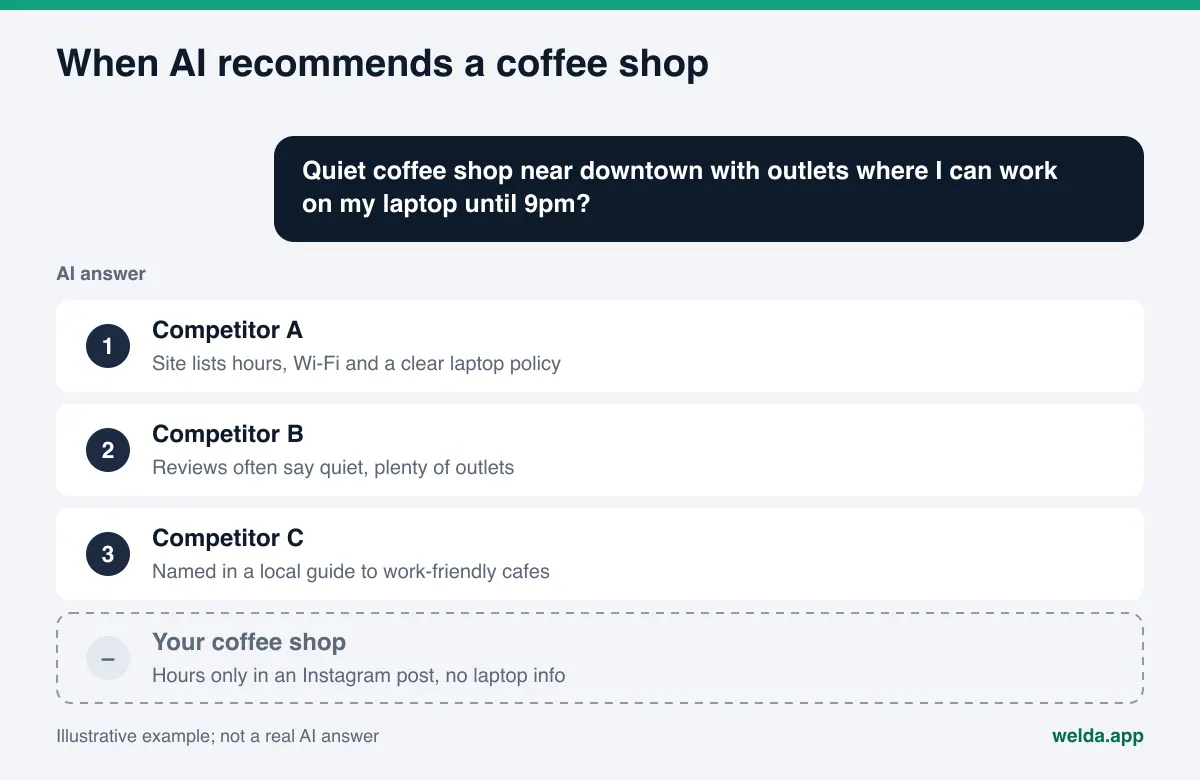
What is AEO for coffee shops, and why does it matter now?
AEO stands for answer engine optimization. It is the work of making sure your business is named when people ask AI tools such as ChatGPT, Gemini, Perplexity and Google's AI Overviews and AI Mode for a recommendation. You will also hear it called AI search visibility, AI visibility, or GEO (generative engine optimization); they all describe the same goal.
Classic search shows a map pack and ten links, and the customer compares on their own. An AI answer usually names three or four places, each with a sentence or two of reasoning. If you are not in that short list, the customer decides without ever seeing you.
Coffee shops feel this shift more than most businesses because coffee decisions are fast and specific. People rarely type "coffee." They ask for "a quiet place to work with outlets," "a coffee shop open before 6am near the train station," "somewhere dog-friendly with oat milk and a patio." The AI looks for the cafe that clearly states those details somewhere it can read. If you have not written them down, a competitor who has gets the mention.
There is a second problem: cafe information changes often. Summer and winter hours differ, seasonal drinks come and go, a laptop policy changes on weekends. Those updates often live only in an Instagram story or a sign on the door. When AI finds stale or conflicting details, it either skips you or tells a customer the wrong closing time. Both cost you a visit.
The fastest way to see where you stand is to check your site as it is today. Welda's free site analysis reads your homepage and a few inner pages the way Google and AI tools do, and lists each gap with a fix.
What do customers ask AI about coffee shops?
Coffee shop questions fall into a handful of patterns. Each pattern is answered from a different kind of information. Once you know which fact feeds which question, it becomes clear what to write and where.
Typical questions look like these (written as examples, not taken from a measurement):
- "Quiet coffee shop with good Wi-Fi where I can work for a few hours?"
- "Which coffee shops near campus are open late during finals week?"
- "Best specialty coffee in the neighborhood, not a chain?"
- "Dog-friendly cafe with outdoor seating and oat milk?"
- "Coffee shop near the convention center that opens early on Sunday?"
- "Is the pour-over at this place worth the price?"
| Question pattern | What the customer needs | What the answer relies on |
|---|---|---|
| Work and study | Laptops allowed, outlets, Wi-Fi, noise level | A stated policy on your site, FAQ, wording in reviews |
| Hours and status | Open early, open late, open on holidays | Text hours, holiday hours, schema markup |
| Location | Near a station, campus, office park or landmark | Address, map pin, neighborhood and transit cues |
| Coffee and food | Specialty beans, brew methods, pastries, breakfast | A text menu, notes on beans and roasting |
| Diet and comfort | Oat milk, gluten-free, dog-friendly, patio, accessibility | FAQ answers, Google Business Profile attributes |
| Price and trust | Is it worth it, is it a chain or independent | Menu prices, reviews, local guide coverage |
What sources does AI use to recommend a coffee shop?
When an AI assistant answers with a web search, it pulls together several kinds of sources. For a coffee shop in the US, these usually include:
- Your own website: the only source that states your cafe type, hours, menu and house rules first-hand. If a fact is missing here, the AI tries to infer it from somewhere else.
- Google Business Profile and Google Maps: hours, address, category, attributes, photos and reviews. Gemini and Google's AI features draw on this directly.
- Yelp and Tripadvisor: review text that answers questions like "is it quiet" or "is it good for working," often in the customer's own words.
- Local guides and city lists: "best coffee shops to work from" or "best cafes in [neighborhood]" articles from local publications and blogs, which answer exactly the questions people ask AI.
- Instagram: an important showcase for cafes, but much of its information sits inside images and is hard for AI to read.
The takeaway is simple: AI trusts a fact when it sees it stated the same way in more than one place. If your site says "open until 8pm" and your Google profile says 7pm, the engine either skips you or repeats the wrong time. Most AEO work for a coffee shop is not producing new content. It is making the facts you already have readable and consistent everywhere.
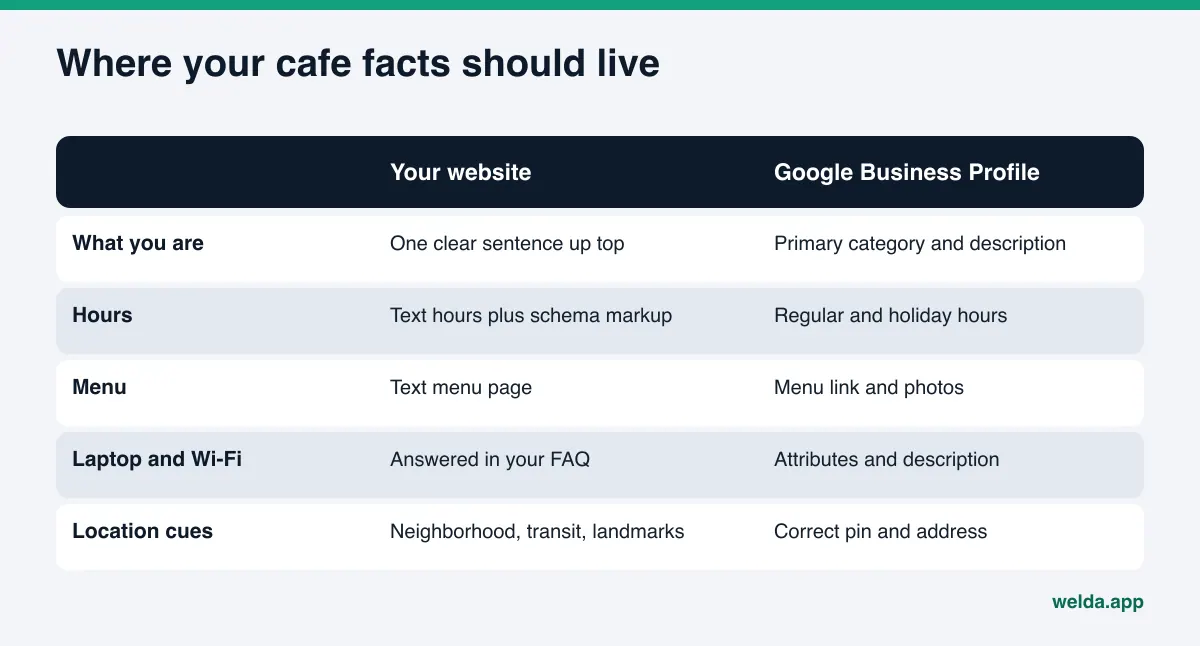
AEO for coffee shops: what to do, step by step
The order below starts with the most basic issue and moves toward detail. If step one fails, the rest does not help.
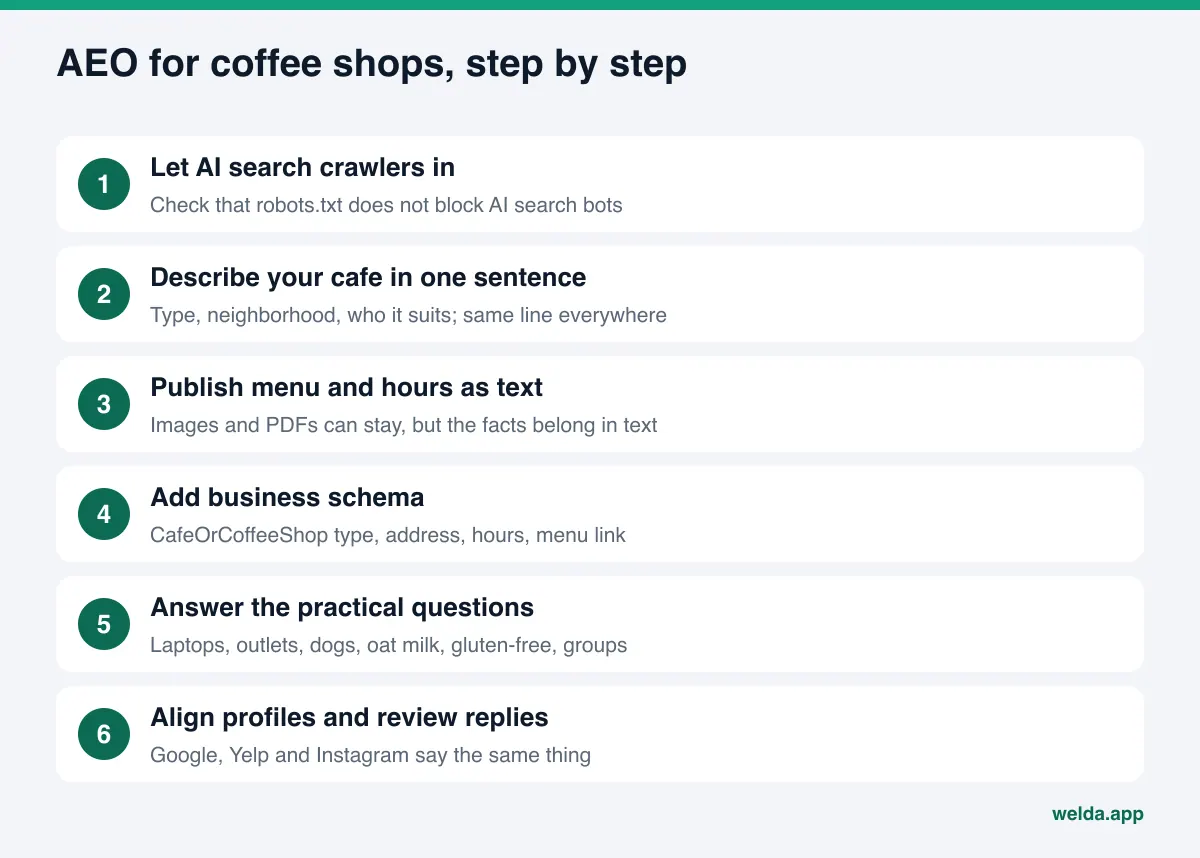
- Let AI search crawlers in. Some site setups block AI bots in robots.txt without anyone noticing. OpenAI, for example, documents that its OAI-SearchBot is used to surface websites in ChatGPT's search features; block it and your pages cannot appear in those answers.
- Describe your cafe in one sentence. Something like "An independent coffee shop two blocks from the Main Street station, roasting our own beans, with pastries baked in-house and plenty of seating for remote work." Put it in your homepage intro, and use a short version in your Google profile description and Instagram bio.
- Publish your menu and hours as text. Many cafes post the menu as a photo or PDF. AI reads text far more reliably. Put drink and food names, a short description and prices on the page as text, and keep the images as extras.
- Add business schema. Schema.org has a dedicated CafeOrCoffeeShop type. With it, your address, phone, opening hours, menu link and whether you accept reservations are written in a format machines read directly.
- Answer the practical questions. Laptops and outlets, Wi-Fi, dogs, strollers and wheelchair access, oat and almond milk, gluten-free options, group seating, mobile ordering. One or two plain sentences each. We cover how to structure this in our guide to FAQ pages for AEO.
- Describe your location the way people do. Next to the address, add cues like "across from the light rail stop" or "in the same block as the public library." Neighborhood questions often match on exactly these phrases.
- Align your profiles and review replies. Make sure category, hours, menu link and attributes on Google Business Profile and Yelp match your site. Reply to reviews briefly and specifically. A reply like "Yes, laptops are welcome on weekdays, and the outlets are along the window bar" also answers the next customer's question.
If you run a roaster or a specialty-focused shop, bean origin, roast and brew method deserve their own page; see AI visibility software for specialty coffee roasters. If pastries drive most of your business, our guide on how bakeries get recommended by ChatGPT is a better starting point.
What coffee shop websites most often get wrong
Cafe websites tend to be visual: great photos, a short tagline, an Instagram link. That makes a good first impression on a person and leaves an AI with almost nothing to read. These gaps come up again and again.
| Gap | What AI sees | How to fix it |
|---|---|---|
| Homepage has only a tagline | Cannot tell what kind of cafe it is or where | A one-sentence description in the intro |
| Menu is an image or PDF only | Does not know your drinks, food or price level | A text menu page, images as extras |
| Hours live only on Instagram | Skips you for early-morning or late-night questions | Text hours on the site plus schema |
| No laptop or Wi-Fi policy | Stays unsure for work and study questions | A clear answer in your FAQ |
| Page title is just the cafe name | Cannot tell from the title what you offer | Title and meta description with type and neighborhood |
| Maps and social profiles not linked | Cannot confirm the profiles belong to you | Link from site to profiles and back |
Each gap looks minor on its own. But when an AI answers a question, it tends to pick the businesses it can verify most easily. If a competitor spells these details out, it gets the mention even if your espresso is better. To understand why a specific competitor keeps showing up, see our guide to AI competitor analysis.
Example: rewriting a coffee shop homepage for AEO
This example is invented and does not describe a real business. Say an example neighborhood cafe has this on its homepage today:
"Good coffee. Good people. Come say hi."
It is friendly, but to an AI it is empty. It says nothing about location, what the cafe serves, who it suits or when it is open. The same intro, written for AI to read, could look like this:
"We are an independent coffee shop on Elm Street, a short walk from the university library. We serve espresso drinks and pour-over from a local roaster, plus pastries baked each morning. Open weekdays 6:30am to 8pm and weekends 8am to 6pm. Laptops are welcome on weekdays, and there are outlets along the window bar."
The second version is not much longer, just more informative. "Coffee shop near campus open late," "early coffee before class," and "where can I work on my laptop" each find an answer in that paragraph. The page title follows the same logic: cafe name plus type and neighborhood. Welda's free analysis suggests exactly this kind of ready-to-use title, description and intro paragraph for your homepage; you correct it with your own facts and publish it.
How Welda does this work
Welda is software that measures where your business appears in AI answers and fills in the gaps on your behalf. Three parts matter most for a coffee shop.
1. The free site analysis: where your site stands today. This is the part anyone can use right now, and it works in English. It reads your homepage and inner pages like menu, about and contact, and checks whether AI crawlers can get in, your page title and description, your main heading, business schema, address and hours, whether your maps and social profiles are linked, your FAQ section, review and trust signals, and page speed. You get a score out of 100, with technical and content scored separately. Each gap comes with what was found, why it matters and how to fix it. The report also includes ready-made homepage copy, a fix package you can add to your site (including the schema code), a simulation of how much each fix could move your score, and a comparison with competitors. On top of that, the analysis asks 5 questions a customer might ask to an AI assistant that can search the web, and checks whether your cafe's name appears in the answers. That is a one-time snapshot, not ongoing tracking. Our guide on how to read your AI visibility report walks through each section.
2. Question tracking in the Welda dashboard. In the dashboard, the questions your customers would ask are put to ChatGPT, Gemini, Perplexity and Google AI three times each. For a coffee shop those might be "quiet cafe to work near downtown," "coffee open before 6am near the station," or "dog-friendly coffee shop with a patio." Each row is one question, showing which engines name you and in what position. Open a row and you see the answer itself and the sources the engine cited. The decision you make here is which questions matter to your business and why you are missing from them. Often the reason is one missing fact, such as closing time never being written as text anywhere.
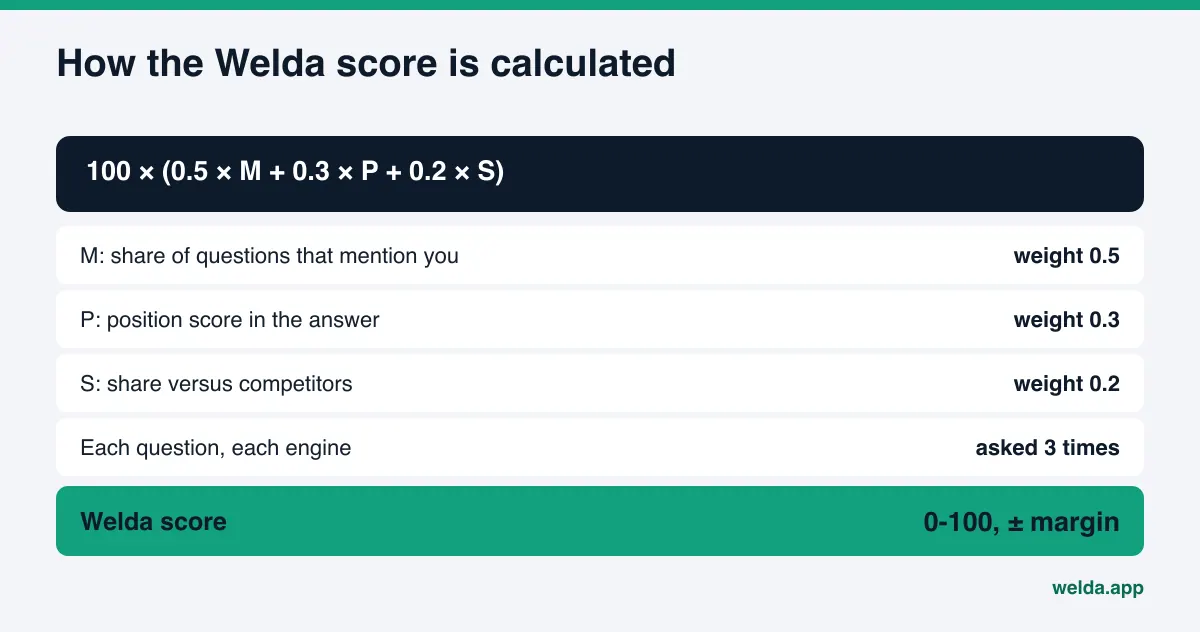
3. Ready-to-approve fixes. Welda drafts page copy, profile descriptions and review replies. On WordPress sites it connects through a separate Editor user and an application password, with no code to install; drafts open on your site as drafts and go live only when you approve them. For other platforms, Welda gives you a ready package and the changes are applied by hand. Google Business Profile, Instagram and Facebook can be connected; if they are not, the task shows up on your list as a manual step. Your content always stays on your own site, and publishing approval stays with you.
The dashboard also has a single to-do list, a competitor view that shows which topics and sources competitors win on, a before-and-after comparison and a one-page monthly report.
An honest note on early access: the Welda dashboard is in early access and is opening first in Turkey. Regular four-engine tracking is being added during early access, and the dashboard screens you may see are shown with sample data. What anyone can use today, in English, is the free site analysis. Pricing is discussed in an early access conversation.
Limits: what Welda does not do
AEO is a new field, and big promises are easy to make. Here is what Welda does not do.
- No ranking or "show up in ChatGPT" guarantee. AI answers vary by question, engine and time. Nobody can promise a specific position.
- It does not make up facts. If Welda does not know your closing time, your laptop policy or whether you have gluten-free options, it asks you rather than guessing. Wrong information does more damage than missing information.
- No fake reviews. Welda drafts review replies, never reviews. In the US, the FTC's final rule on fake reviews and testimonials bans fake reviews, including AI-generated ones, and buying reviews tied to a particular sentiment. This is not legal advice; check the rule itself or ask counsel for your situation.
- Nothing goes live without approval. Every piece of content is published only after you approve it.
- Some work stays with you. Handling negative reviews, claiming directory listings and getting featured in local guides or press are the business's job. Welda shows them on your to-do list but cannot do them for you.
Timing matters too. New content usually takes weeks to show up in AI answers. A fix made today will not appear in tomorrow's answers, which is why measurement should be repeated, not done once. If you plan to have AI write your site copy, it is worth knowing the trade-offs first; see AI-generated content and AEO.
Coffee shop AEO checklist and decision guide
Use this list to check whether your coffee shop is ready to be recommended. Answer each item yes or no.
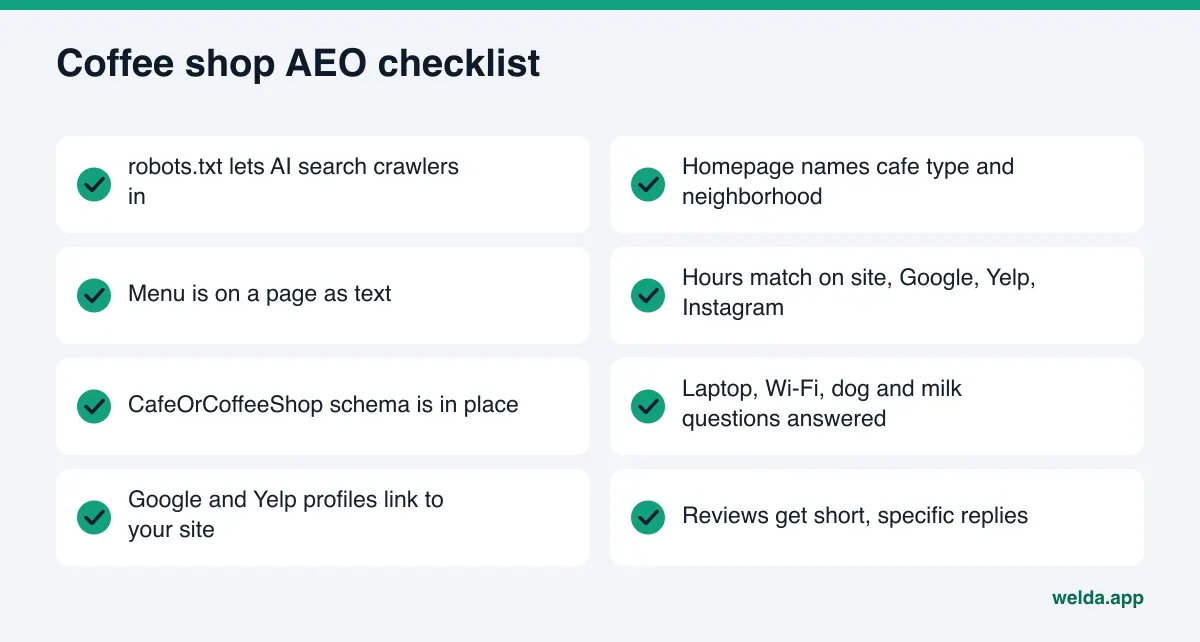
Split your "no" answers into two groups. The first is on your site: crawler access, the one-sentence description, a text menu, schema and an FAQ. These are what the free analysis flags directly, and most can be fixed in one pass. The second group is off your site: Google Business Profile, Yelp, Instagram, review replies, local guide coverage. These need ongoing upkeep.
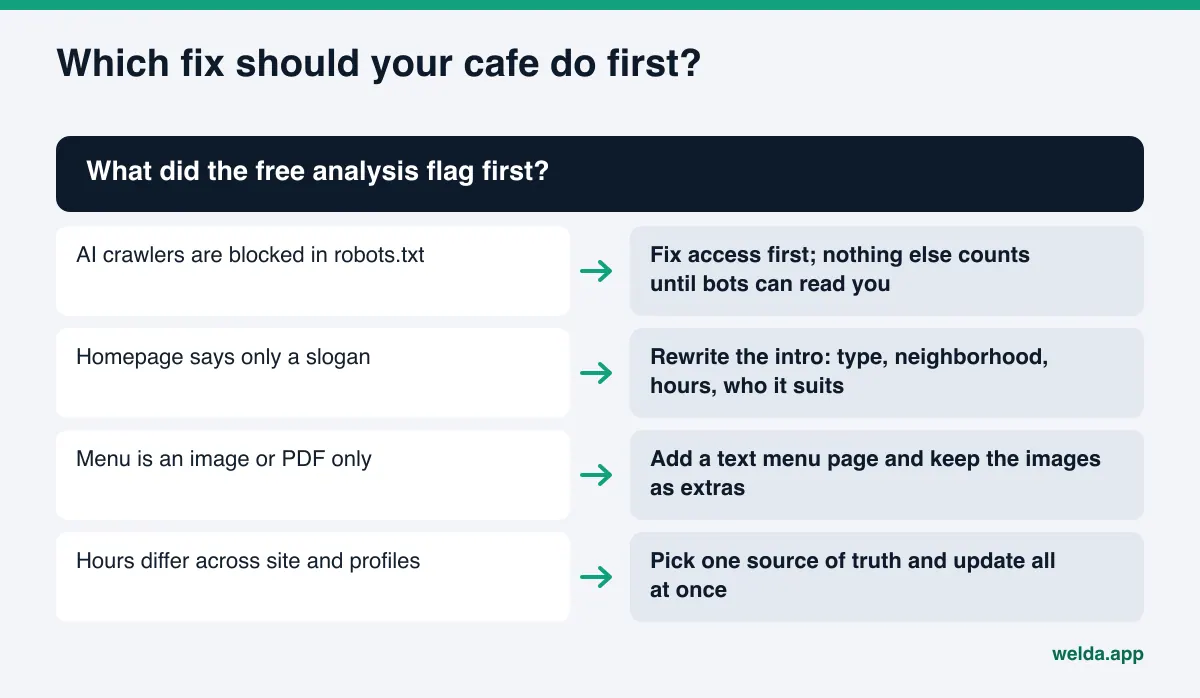
When deciding how to handle this, ask yourself:
- Can you edit your own website? If yes, you can apply the fix package from the analysis report yourself.
- Do your hours and menu change with the seasons? If yes, you need a routine that updates your site, Google profile, Yelp and Instagram together.
- Do competitors keep showing up for specific questions? If yes, a one-time snapshot is not enough; you need question-by-question tracking over time.
- Is your cafe in a tourist or business district? If yes, prioritize location cues and early or late hours, since those questions often come from people who do not know the area.
Frequently asked questions
My coffee shop has no website, only Instagram. Can it still show up in AI answers?
To some degree, through your Google Business Profile, Yelp and local guides. But without a source that states your cafe type, hours and rules first-hand, AI has to guess more. Even a simple one-page site with mostly text closes much of that gap.
Isn't a photo of the menu enough?
For people, yes. For AI, usually not. Write drink and food names and short descriptions on the page as text and keep the photo alongside. That makes it easier to match questions like "oat milk latte" or "gluten-free pastries."
Does a laptop policy really matter for AEO?
Work and study needs come up often in coffee shop questions. Whatever your rule is, stating it helps. A clear line such as "Laptops welcome on weekdays, laptop-free tables on weekends from 10am to 2pm" attracts the right customers and sets expectations.
What do I get from the free analysis?
A score out of 100, a list of gaps with fixes, ready homepage copy, a competitor comparison, a fix package with schema code, a PDF and a shareable score card. Your email and phone number are verified, the results link arrives by email and stays open for 14 days. It is free once per site.
Can Welda get my coffee shop to the top of ChatGPT?
No, and nobody can guarantee that. Welda measures which questions you appear in, prepares the copy and packages you need to fill gaps, and tracks change over time. The order inside an AI answer is the engine's own decision.
How long until changes show up?
New content usually takes weeks to appear in AI answers. Some fixes, such as correcting hours on Google Business Profile, can show up sooner, while new pages on your site wait until the engines read your site again.
Where to start
AEO for coffee shops comes down to writing clear, consistent answers to the practical questions customers already ask: what kind of cafe you are, where, when you are open, what is on the menu, and whether they can sit and work. You already know all of this. What is missing is putting it where AI can read it.
Start by seeing where your site stands. Run the free site analysis to find out which facts your cafe site is missing, how much each fix could move your score, and whether your name comes up for 5 customer questions, all in one report.