How do bakeries get recommended by ChatGPT, and why isn't mine on the list? ChatGPT, Gemini, Perplexity and Google's AI Overviews build their bakery recommendations from information that is written down clearly: on your website, your Google Business Profile, review sites like Yelp, and local "best of" lists. If your custom cake lead time, sizes, delivery area, gluten-free options and hours aren't spelled out somewhere, the AI can't describe you, so it recommends the bakery whose details it can find. This guide explains how bakeries get recommended by ChatGPT, step by step, and which part of the work Welda does for you.
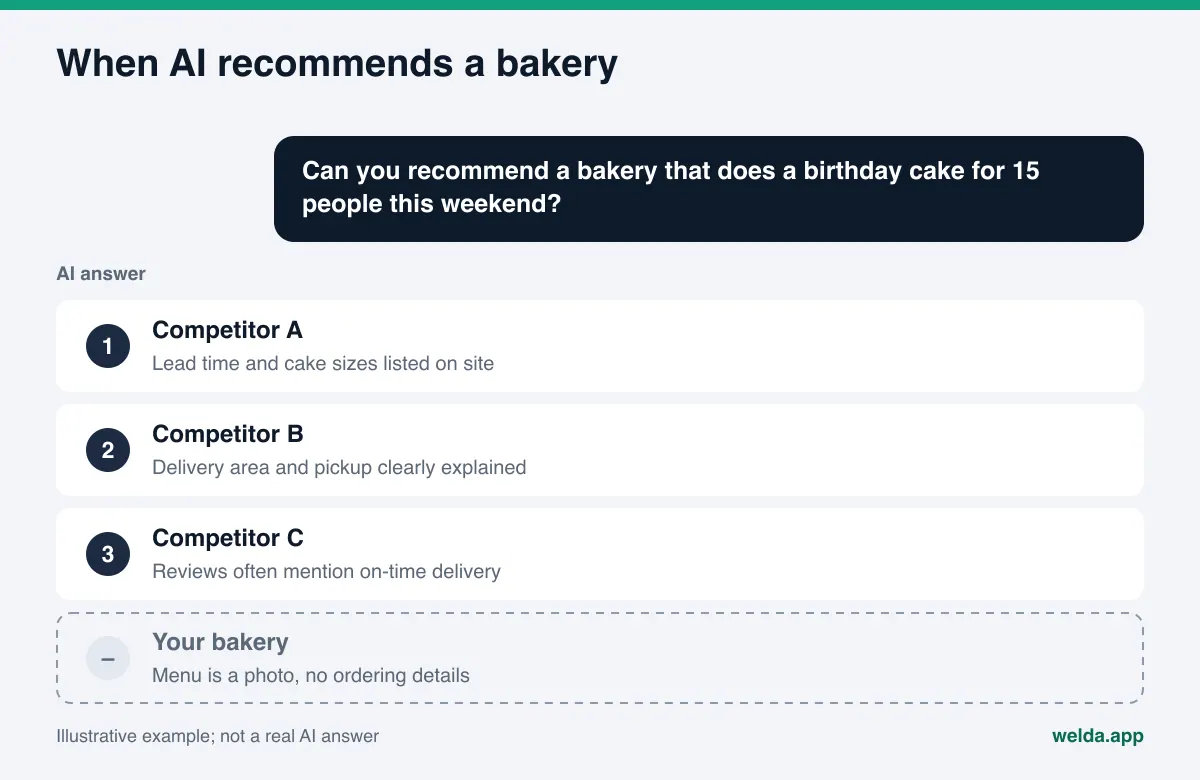
How bakeries get recommended by ChatGPT, and why it matters now
AEO (answer engine optimization) is the work of getting your business named in the answers that AI tools give. You will also hear it called AI search visibility, AI visibility or GEO (generative engine optimization); they describe the same goal. In a classic Google search, a customer sees a page of results and a map, scrolls through photos and picks. In an AI answer, they usually get a short list of three or four bakeries, each with a sentence or two explaining why. If you aren't on that list, the customer decides without ever hearing your name.
Bakeries feel this shift more than most food businesses because bakery questions are tied to a specific need and a specific date. People rarely type "bakery near me" into ChatGPT. They ask things like "Which bakery can do a two-tier birthday cake for 20 people by Saturday and deliver to Park Slope?", "Where can I order a gluten-free cake for a kid with celiac disease?" or "Is there a bakery open at 6 a.m. on Sunday with fresh croissants?" To answer, the AI looks for a business that has written those exact details down. If you haven't, a competitor who has gets the mention.
The second reason is that most bakery knowledge lives behind the counter. How many days' notice you need for a custom cake, the smallest cake you make, whether you do photo cakes, which items are ready same day, what time the second batch of bread comes out: customers learn this by calling or by asking in the shop. Menus often go up as a photo on Instagram, and prices change while the old PDF stays on the website. An AI model cannot always read text inside an image, and even when it can, it has no way to tell whether that price list is current. The result is that a neighborhood favorite can look like "a bakery we know little about" to an answer engine.
The fastest way to see where you stand is to measure your site as it is today. Welda's free site analysis reads your homepage and a few inner pages the way Google and AI tools see them, lists what is missing and tells you how to fix each item. It works in English.
What do customers ask AI about bakeries?
Bakery questions fall into a handful of patterns. Each pattern depends on a different piece of information, so mapping questions to information is the quickest way to find the gaps on your site. The questions below are examples we wrote to show the patterns, not measured data.
| Question type | Example question | What the AI needs to find |
|---|---|---|
| Custom cake order | "Bakery that does a birthday cake for 15 people this weekend" | Sizes by servings, lead time, pickup or delivery |
| Dietary needs | "Which bakery makes vegan or gluten-free cakes?" | Which items are gluten-free, vegan or sugar-free, and how they are made |
| Hours and location | "Bakery open early on Sunday with fresh bagels near downtown" | Opening hours, bake times, address |
| Signature item | "Best cinnamon rolls in Austin", "where to get a real kouign-amann" | The item named on your site and mentioned in reviews |
| Events | "Bakery that does wedding cake tastings and dessert tables" | Tasting process, minimum order, booking window |
| Corporate | "Office catering with pastries and cookies for 50" | Bulk order terms, invoicing, delivery radius |
| Price | "How much does a custom cake cost per serving?" | A price range or how pricing is set |
Every row in that table can become a paragraph on your site or an entry in your FAQ. Price questions deserve extra care because an AI answer can repeat an outdated number to a customer. We cover how to handle that in our piece on pricing questions in AI answers.
Where does the AI get its information about a bakery?
Answer engines don't rely on a single source. Engines that can search the web pull from several sites, combine what they find and write a short recommendation. For a bakery, the most common sources fall into four groups, and only two of them are directly under your control.
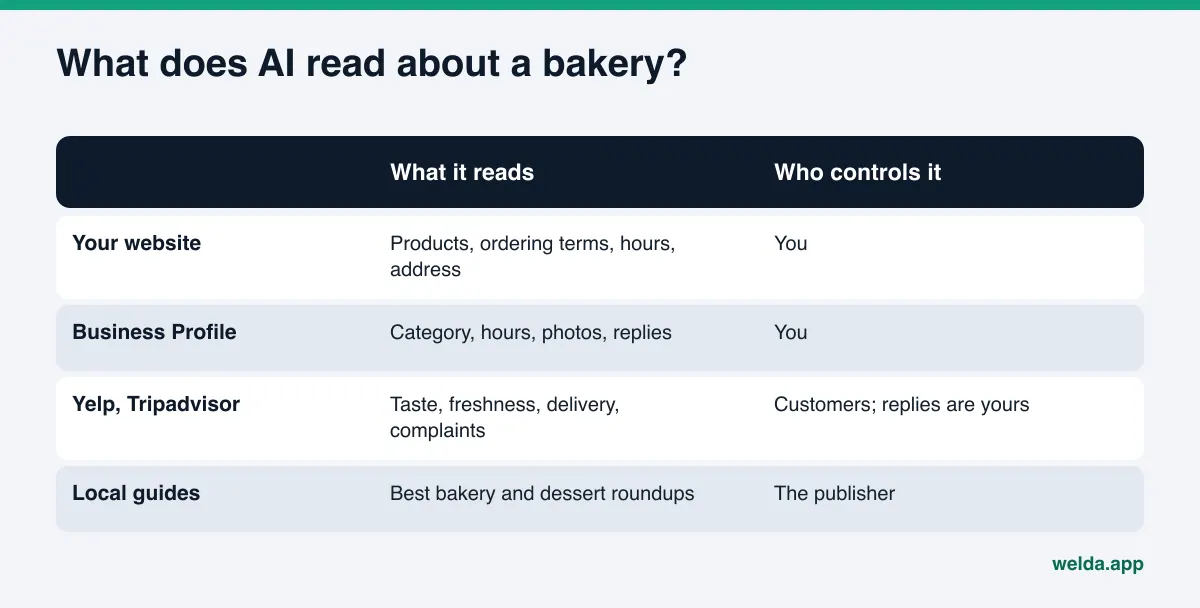
Your own website. This is the most authoritative source for your products, ordering terms, hours and address. The trouble is that many bakery sites consist of one page, a menu photo and a phone number. When an AI is answering a question about custom birthday cakes and can't find the words "custom cake", a serving count or a lead time on your site, it can't put you in that answer.
Google Business Profile and Google Maps. Your category, hours, photos, reviews and owner responses live here. Google's AI Overviews and AI Mode draw on this data directly, and other engines often cite map and listing data too. Choose the primary category that matches what you mainly sell and fill in the business description with what you actually make.
Review platforms. Google reviews, Yelp and Tripadvisor carry the customer's own language. Lines like "the cake was delivered right on time", "their gluten-free options are made separately" or "the frosting was too sweet" shape how an AI describes you. You don't write these reviews, but you do control your responses and how complaints are resolved.
Local guides and lists. City magazines, food blogs and "best bakeries in town" roundups are ready-made summaries that answer engines like to cite. Getting onto those lists depends on an editor, but when you are there, the details they print should match what your site says. Conflicting hours or an old address on a guide can make an AI hedge or repeat the wrong information; we cover that problem in wrong address or phone number in AI answers.
Step by step: how bakeries get recommended by ChatGPT
The steps below cover the basic work a bakery needs for AI search visibility, in order. The first four are entirely in your hands, and most bakeries can finish them in a day or two.
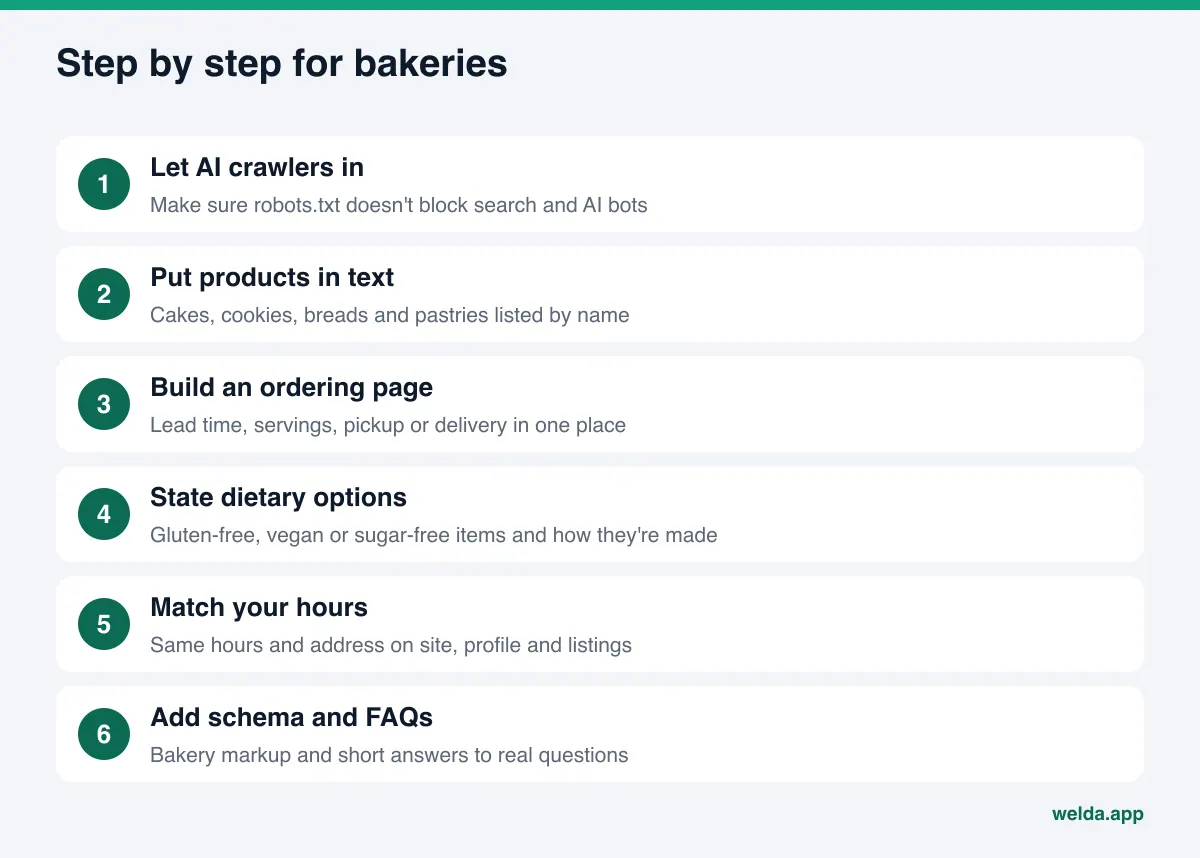
- Let AI crawlers in. Your robots.txt file shouldn't block search and AI crawlers. OpenAI, for example, states in its crawler documentation that sites that opt out of OAI-SearchBot will not be shown in ChatGPT search answers. Some website templates and security plugins block these bots without the owner knowing.
- Put your products in text. List cakes, cookies, breads, pastries and savory items under clear headings, with names and a one-line description. Keep the menu photo if you like it, but the same information needs to exist as text.
- Build one ordering page. Lead time for custom cakes, sizes by servings, whether you do photo or lettered cakes, deposit and cancellation terms, pickup and delivery options. For most bakeries this single page answers more AI questions than any other.
- Describe dietary options honestly. If you offer gluten-free, vegan, dairy-free or sugar-free items, say which ones and how they're made. If they are made in a shared kitchen, say so. Writing down what you don't do keeps you from being recommended for the wrong thing.
- Make hours and address match everywhere. Your site, Google Business Profile, Yelp, Instagram bio and any guides should show the same opening hours, closing hours and pickup windows.
- Add structured data. Schema.org has a Bakery type that lets you mark up your hours, address, phone and a link to your menu in a format machines read reliably.
- Add an FAQ section. Write short answers to the questions your staff hears on the phone every week: "Can I get a cake the same day?", "Do you deliver to my neighborhood?", "Can you print a photo on the cake?"
- Respond to reviews. Mention the item and the occasion in a calm, specific way. A reply like "So glad the graduation cake arrived on time" puts on record, once more, that you make graduation cakes and deliver them.
None of these steps requires a new website. Adding two pages and an FAQ section to the site you already have is enough of a start for most bakeries.
How to write a custom cake page that AI can use
The most common gap we see on bakery sites is ordering information written in vague, general sentences. "We make cakes for every occasion" tells neither a customer nor an AI anything it can act on. Answer engines look for concrete, checkable details. The table below sets vague and specific versions of the same information side by side.
| Vague | Specific |
|---|---|
| Custom cakes available. | We make birthday, baby shower and celebration cakes starting at 8 servings. |
| Call us to order. | Custom cakes need at least 48 hours' notice; order by phone or the form on this page. |
| Delivery available. | We deliver within 5 miles of the shop on Fridays and Saturdays; everywhere else is pickup. |
| Healthy options. | We bake gluten-free brownies and a vegan chocolate cake; both are made in a shared kitchen. |
| Fresh daily. | Croissants come out at 7 a.m. and again at 10 a.m.; sourdough is ready by 8 a.m. |
The specific versions are examples; use your own numbers. What matters is the shape: who it's for, what it is, how many it serves, how much notice you need and where you deliver. When those five facts sit together in one paragraph, an AI can put you in an answer to "birthday cake for 15 this weekend" and give a reason.
The same logic applies to signature items. If people search for your cinnamon rolls, babka or macarons by name, give that item a short section: how it's made, the sizes or box options, whether it's available every day or only on weekends. Dessert shops face the same challenge, which we cover in AI search optimization for ice cream and dessert shops. If your bakery also runs as a sit-down café, the seating, Wi-Fi and hours questions in AEO for coffee shops apply to you as well.
How Welda does this work
Welda is software that measures where a business shows up in AI answers and fills the gaps on the business's behalf. For a bakery, that work comes down to three things: seeing how readable your site is, tracking whether your name comes up in customer questions, and filling in missing details without making anything up.
The free site analysis, available to anyone today. The free analysis reads your bakery's homepage and inner pages such as services, pricing, about and contact. It checks whether robots.txt lets AI crawlers in, whether structured business data is present, whether your address and phone are readable, whether you have an FAQ section, whether your products and services are clearly described, and how fast the page loads. You get a score out of 100, split into technical and content, plus what was found for each gap, why it matters and how to fix it. It also suggests ready-to-use homepage copy: title, description, main heading, intro paragraph and FAQs. Separately, it asks five questions a customer might ask to an AI assistant that can search the web and checks whether your bakery's name appears in the answers. That is a one-time snapshot. The analysis is free once per site, and the link to your results arrives by email.
Question tracking: which questions you appear in. In the Welda dashboard, the questions your customers are likely to ask are put to ChatGPT, Gemini, Perplexity and Google AI three times each. For a bakery, those questions are built around custom cake orders, dietary options, early opening hours and your neighborhood. You see, question by question, which engines mention you and in what position. If your name appears for "best cinnamon rolls" but not for "custom birthday cake", the problem isn't your product; it's that your ordering details aren't written down. Choosing the right questions is its own topic, covered in prompts to track for AI visibility.
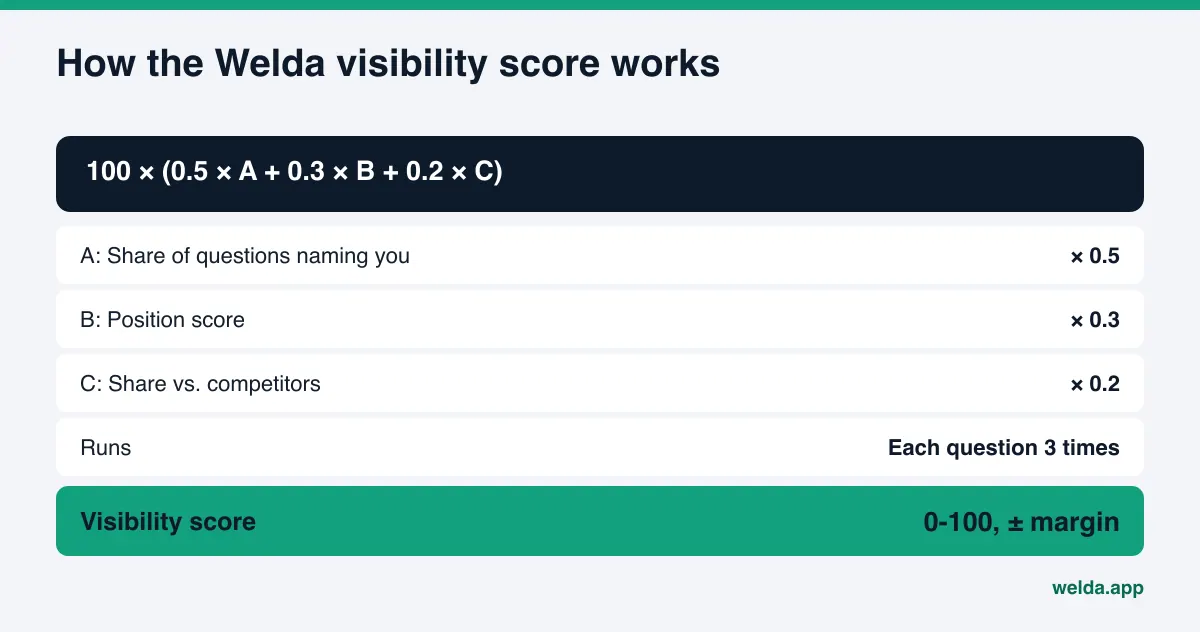
The score isn't a black box. It is 100 × (0.5 × the share of questions where you're named + 0.3 × a position score + 0.2 × your share against competitors), and the spread across the three runs gives a margin of error. So when the score drops two points in a week, you can tell whether something really changed or whether it's normal variation between runs.
The to-do list: it asks instead of guessing. Because so much bakery information never made it onto the website, this is where Welda helps most. It drafts the ordering page, FAQ answers, Google Business Profile description and review responses. But it won't guess how many days' notice you need, whether gluten-free items are made separately or which neighborhoods you deliver to. Those details appear in the to-do list as blanks for you to fill in once; after that, they flow into every draft. Tasks Welda can't publish directly, such as updating a Yelp listing, show up on the same list with the text ready to paste.
On WordPress sites, Welda connects through a separate Editor user and an application password, with no code to install. The ordering page opens as a draft on your site and goes live when you approve it. On other platforms, Welda gives you a ready package and the changes are applied by hand. Your content always lives on your own site. The competitor and sources views show which bakery is winning a given question and which guide or review site is behind it, and a one-page monthly report sums up the change.
A note on availability. The Welda dashboard is in early access and is opening first to businesses in Turkey; regular four-engine tracking is being added during early access, and the sample dashboard screens use representative data. What anyone can use today, in English, is the free site analysis. Pricing is discussed in an early access call.
Limits: what Welda does not do
AI answers don't change overnight. A new ordering page has to be crawled first, then picked up in the engines' answers. That lag varies by engine and usually takes weeks, which is why regular measurement tells you more than a single test.
- Welda doesn't guarantee rankings or a spot in ChatGPT. Nobody can guarantee what an AI model will say.
- It doesn't invent information. Lead times, delivery areas and allergen handling come from you.
- It doesn't write fake reviews. The FTC's final rule on fake reviews and testimonials bans fake reviews, including AI-generated ones. Welda only drafts your responses to real reviews.
- It doesn't publish sensitive content without your approval. The final say on publishing stays with you.
- Resolving negative reviews, managing directory accounts and press outreach stay with you. Welda prepares the text, but you own the accounts and make the calls.
There is also a limit specific to bakeries: allergen and ingredient claims. Welda can draft the copy that describes a gluten-free or sugar-free item, but you are responsible for whether that claim is accurate. Leaving out a claim you aren't sure of also keeps an AI from passing a wrong one on to a customer with an allergy. This isn't legal advice; if you're unsure how to word a dietary claim, check with your local health department or an advisor.
Bakery checklist: are you ready to be recommended?
Every item you can say yes to below gives an answer engine one more reason to describe you and include you in an answer. Every no belongs at the top of your to-do list.
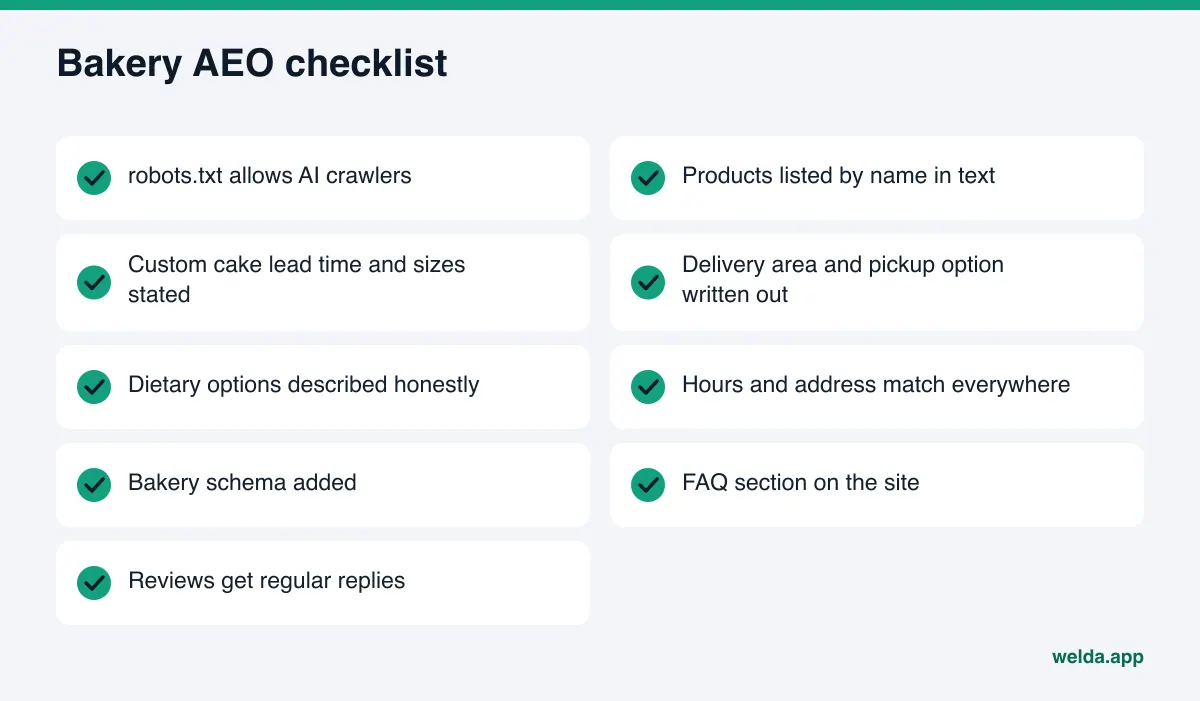
Not sure where to start? Use the decision guide below. It sorts the most common bakery situations by the first thing to fix.
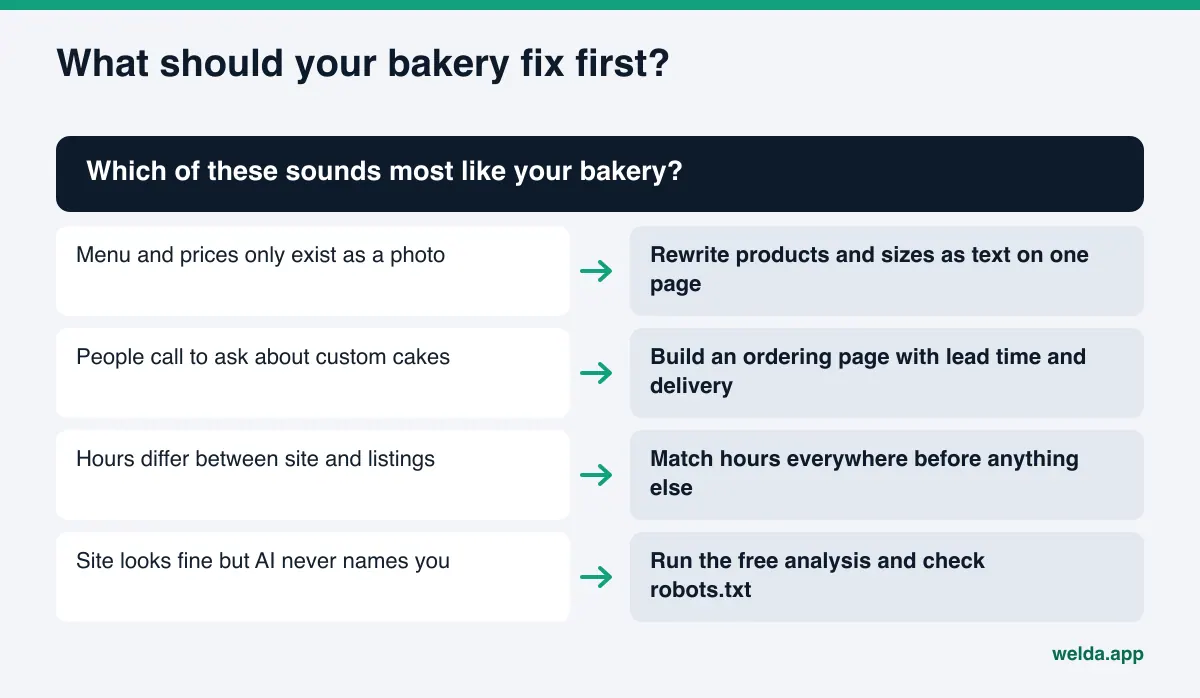
If you'd rather not check the technical items yourself, the free analysis covers robots.txt, structured data, address and phone, FAQ and page speed for you and ranks what's missing. The content items, like ordering terms and dietary details, are things only you know. Setting aside one afternoon is usually enough to write them down.
Frequently asked questions
How do bakeries get recommended by ChatGPT, do I need to pay for ads?
No. You can't buy a place in ChatGPT's or other answer engines' recommendations with ads. Recommendations are built from what's written on your site, your profile, reviews and local guides. The work is making that information clear, current and consistent.
I only have an Instagram account. Can I still be recommended?
Possibly, but it's harder. Not every engine reads Instagram content the same way. A complete Google Business Profile is the first step, and a simple website that lists your products and ordering terms gives AI tools the most reliable source.
My menu is a photo. Isn't that enough?
No. AI tools can't always read text in an image, and they can't tell whether the prices are current. Keep the photo, but write product names, sizes and ordering terms on the same page as text.
Should I put prices on my website?
You don't have to, but explaining how pricing works helps: by servings, by design, by ingredients. If you do list prices, keep them current, because an AI can repeat an old price to a customer.
How long until I see results?
New information usually takes weeks to show up in AI answers, and the timing differs by engine. Asking the same questions again at regular intervals gives you a more accurate picture than a single check.
Does the free analysis work for US bakeries?
Yes. The free site analysis works in English for any public website. The full dashboard is in early access and is opening first in Turkey.
Where to start
How bakeries get recommended by ChatGPT comes down to writing down what your bakery already knows: what you bake, how ordering works, who you deliver to and when you're open. Start by seeing where your site stands today. Run Welda's free site analysis to get your gaps, suggested copy and a five-question AI check in a few minutes.