What does AEO for Miami businesses actually involve? AEO for Miami businesses is the work of getting your hotel, restaurant, tour, clinic or home service named when someone asks ChatGPT, Gemini, Perplexity or Google's AI Overviews for a recommendation in Miami. In a city that serves both visitors and residents, in English and Spanish, across very different neighborhoods, that work starts with knowing the exact questions people ask. This guide walks through the steps, the timing, the sources that feed AI answers, and where Welda fits in.
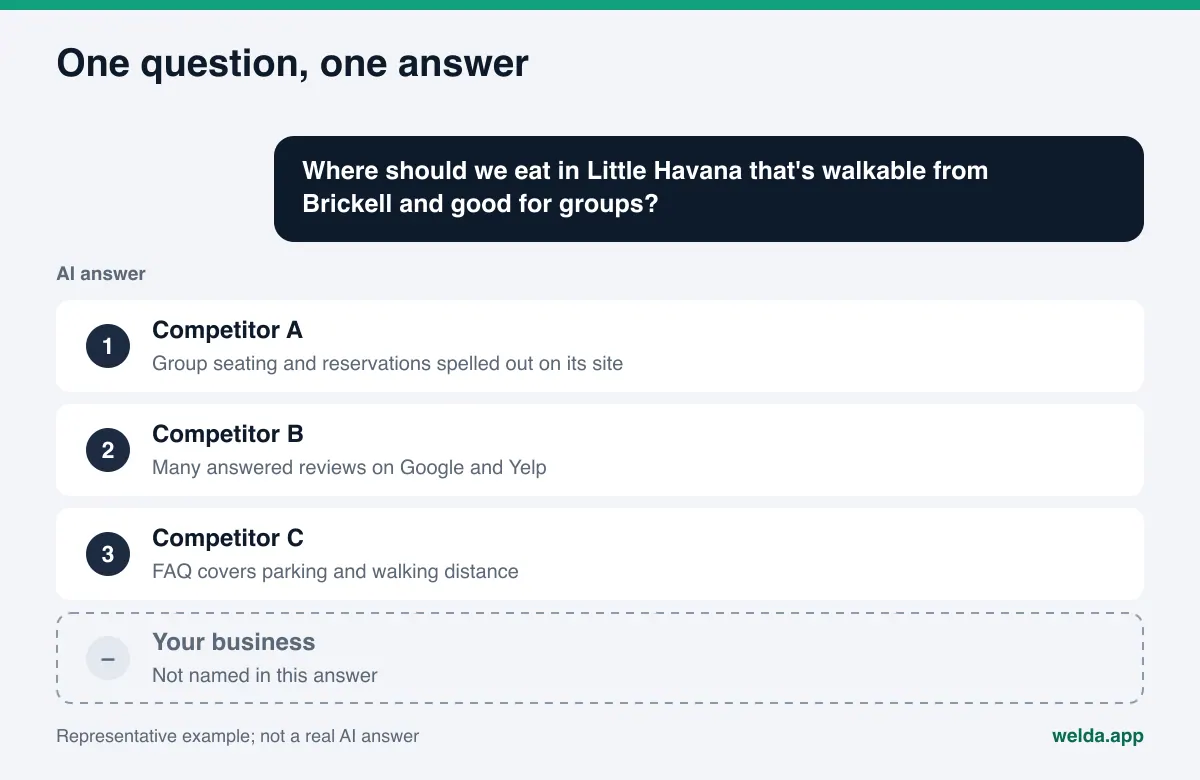
Why AEO for Miami businesses needs its own playbook
AEO stands for answer engine optimization. It is the practice of making your business easy for AI assistants to find, understand and recommend. You may also see the term GEO (generative engine optimization) for the same idea. The goal is AI search visibility: being part of the answer, not just one of ten blue links further down the page.
The fundamentals are the same everywhere. A few things make Miami different:
- Many people asking are not in Miami yet. A visitor planning a long weekend from another state or another country has never walked past your door. What an AI assistant says about you is often their first impression.
- Questions come in more than one language. Miami customers ask in English and in Spanish, and visitors bring other languages too. If your Spanish page is a two-paragraph summary of the English one, an AI tool answering a Spanish question has little to work with.
- People ask by neighborhood. Nobody asks for "a restaurant in Miami." They ask for brunch in Wynwood, a quiet hotel in Coral Gables, a family dentist in Doral, or a boat charter that leaves from Miami Beach. Brickell, Little Havana, Coconut Grove and Key Biscayne are part of the question.
- Timing follows the busy season. New content usually takes weeks to show up in AI answers. A fix made once the busy months have started may miss the first part of them.
- Locals ask too. Residents ask AI for an AC repair company that works weekends, a pediatric dentist that takes their insurance, or a dry cleaner open early. Home and health services face the same shift as hospitality.
If you want to see where your own site stands before reading further, the free AI visibility analysis reads your homepage and key pages and lists what is missing in a few minutes.
What customers in Miami ask AI assistants
In AEO, the unit of measure is the question. Not a keyword, but the sentence a customer actually types or says. The examples below are ones we wrote to illustrate common business types in Miami; they are not research results. When you build your own list, use what your front desk, phone line and inbox hear every week.
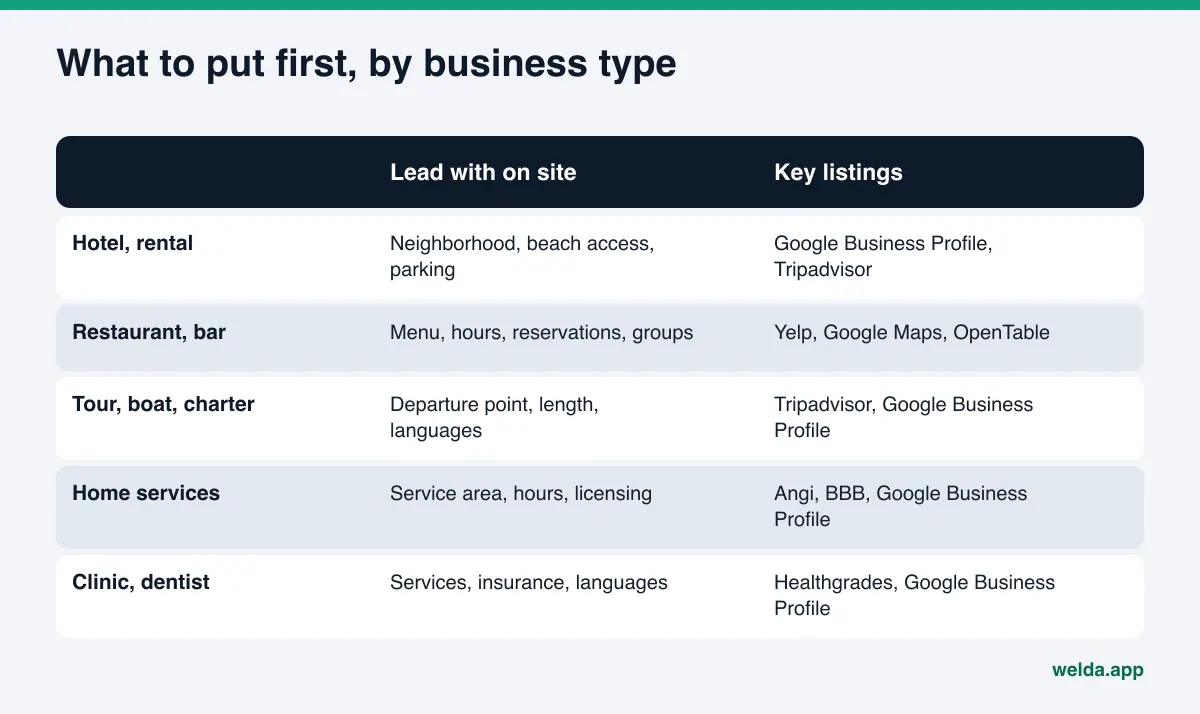
| Business type | Example question | What the page needs to answer it |
|---|---|---|
| Boutique hotel | Is there a quiet boutique hotel in Coral Gables with free parking? | Neighborhood, parking terms, room types, noise level |
| Restaurant | Where's a good Cuban spot in Little Havana for a group of eight? | Menu, group seating, hours, how to reserve |
| Boat charter | Who does private sandbar charters from Miami Beach? | Departure point, trip length, capacity, cancellation terms |
| Home services | Which AC repair companies in Kendall work on Sundays? | Service area, hours, emergency calls, licensing |
| Dental practice | Is there a bilingual family dentist in Doral taking new patients? | Services, languages spoken, insurance, new-patient policy |
| Salon or spa | Best place in Brickell for a blowout before an evening event? | Services, hours, booking method, walk-in policy |
Sort your list into three groups:
- Discovery questions, asked before the customer knows you exist: "best rooftop bar in Downtown Miami," "quiet hotel near Coconut Grove."
- Comparison questions, which put you next to competitors: "Is South Beach or Mid-Beach better for a family stay?" or two named businesses side by side.
- Detail questions, asked right before a decision: valet or self-parking, kids' menu, deposit, cancellation, pet policy, airport transfer.
Write the list in English and in Spanish if you serve Spanish-speaking customers. Write the Spanish questions the way a Spanish speaker would actually phrase them, not as word-for-word translations. The same goes for local terms: a visitor may say "Miami Beach" where a local says "Mid-Beach" or "North Beach." Your pages should use both.
Step-by-step AEO for Miami businesses
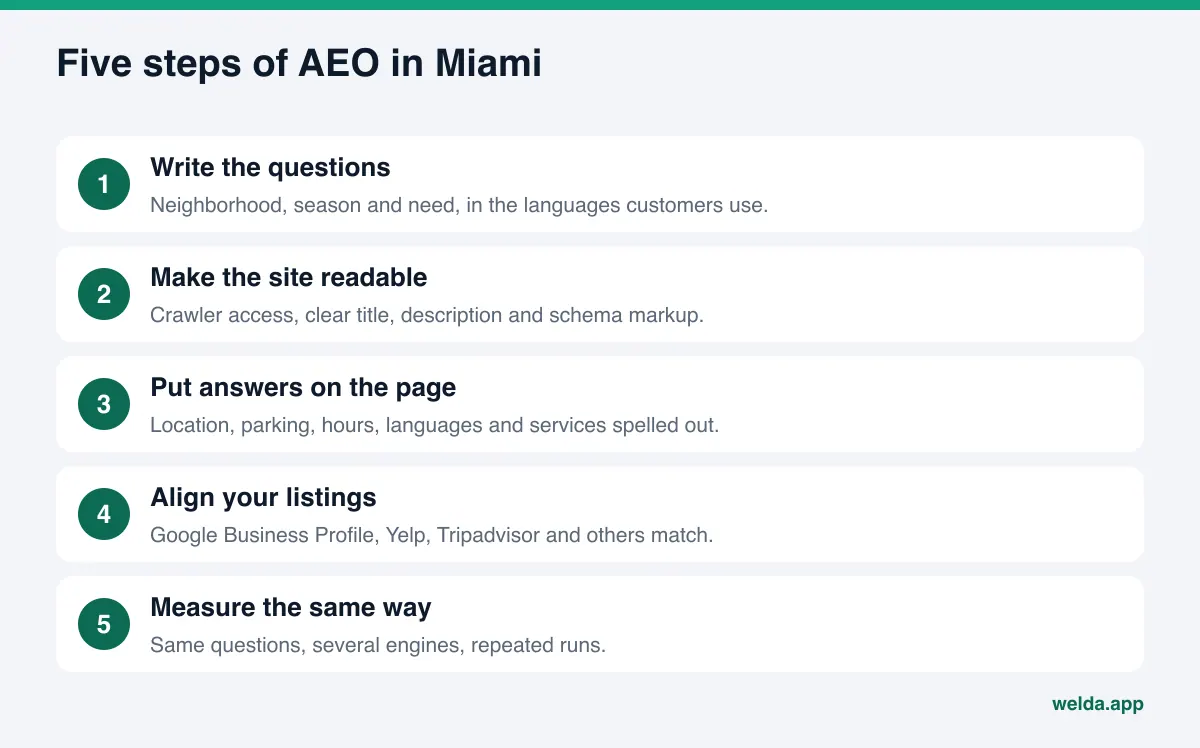
Most of these steps do not need a developer. Someone who knows the business well, working with someone who can edit the site, can do most of it. If you plan to handle it yourself, our guide to DIY AEO for small business owners has a weekly routine you can follow.
1. Make sure AI crawlers can reach your site
If your robots.txt file blocks AI search crawlers, even the best page will not be read. Some themes, hosting presets and security plugins block them without anyone noticing. Our article on whether AI bots are crawling your website shows how to check.
2. Say what you do and where in the title
The page title, meta description and main heading are where an AI tool first learns who you are. A title that only says "Welcome" or just your brand name does not say whether you are a hotel or a restaurant, or which neighborhood you are in. "Boutique hotel in Coral Gables, steps from Miracle Mile" says both.
3. Add schema markup for your business
Schema markup describes your business type, name, address, phone and location in a format machines read directly. An AI assistant does not have to guess from the page text. The right type differs for a hotel, a restaurant and a dental office, so choose it deliberately.
4. Answer the customer's question on the page
Look at the right-hand column of the table above. Is there parking, and what does it cost? How far is the beach? Which languages do your staff speak? What are the hours on holidays? Do you take walk-ins? If these details are not written on your site, an AI tool takes them from somewhere else, and that may be an old listing or a third-party page. An FAQ section is the natural home for these answers. For price ranges and how to present them, see pricing pages for AI answers.
5. Bring your Spanish pages up to the same level
On many Miami sites the Spanish version lags behind. If you serve Spanish-speaking customers, the Spanish pages need the same services, the same FAQ, the same hours and the same location details. Otherwise the AI answer to a Spanish question has less to go on than the answer to an English one.
6. Align your listings
AI assistants do not rely on your site alone. Google Business Profile, Google Maps, Yelp, Tripadvisor, OpenTable, BBB, Angi and Healthgrades are among the sources that can feed an answer, depending on your industry. When your name, address, phone or hours differ across them, an AI tool cannot tell which is correct. We cover how citations work in how to get cited by AI.
7. Answer reviews, and never fake them
Answered, signed reviews show both customers and AI tools that a business is active and attentive. Fake reviews are a legal risk as well as a trust risk: the FTC announced a final rule banning fake reviews and testimonials in August 2024, including AI-generated ones. This is not legal advice; check the rule itself if you have questions about your situation.
8. Measure with the same questions every time
Asking ChatGPT one question once is misleading. The same question can return a different list on the next run. Measurement needs a fixed question list, several engines and repeated runs. And if you do not record where you started, you cannot tell what changed later. Our guide to before and after AEO measurement covers how to set up a baseline.
Timing AEO around Miami's busy season
For many Miami businesses, especially in hospitality, the year has busier and quieter stretches. AEO work should follow that rhythm. A new page or an updated listing usually takes weeks to show up in AI answers. The information has to be in place before visitors start planning their trips.
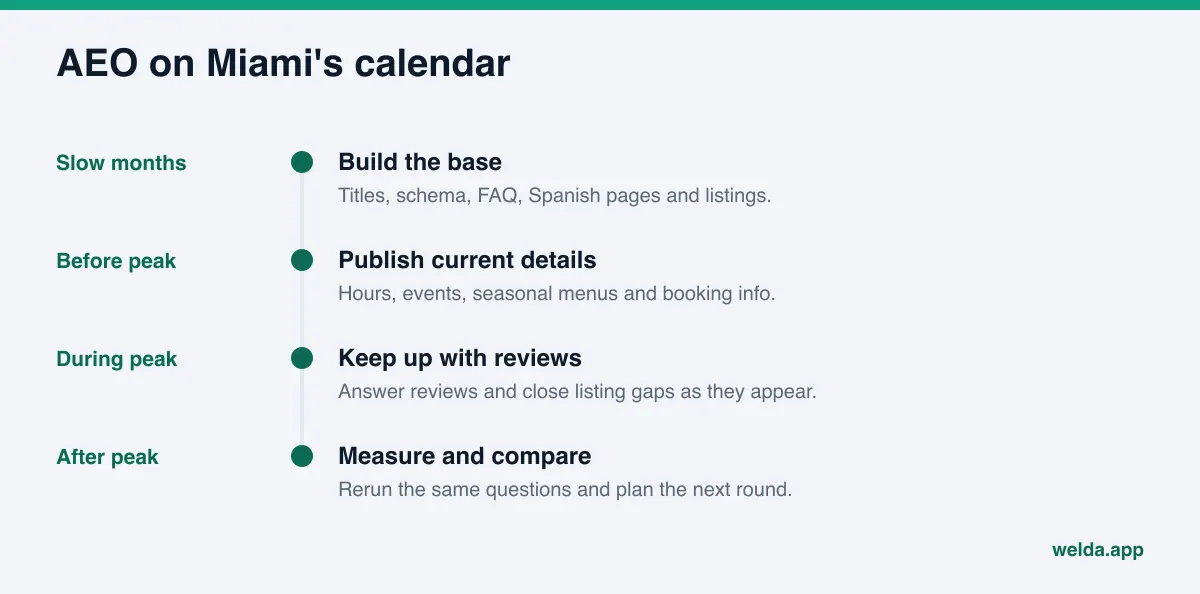
- Quieter months are for the groundwork. Titles, schema markup, the FAQ, Spanish pages and listing cleanup. Staff have more time to collect the questions customers ask.
- Before the busy months, publish current details. Seasonal hours, event-week policies, new menus and booking terms go up on your site and your listings at the same time. Last year's hours left on one listing can end up repeated in an AI answer.
- During peak, keep up with reviews. Writing big new pages is hard when you are full. Answering reviews and fixing listing gaps is realistic.
- Afterwards, measure. Rerun the same question list and compare it with your baseline. That tells you what to prioritize next time.
Year-round businesses, such as home services or dental practices, can work on a steadier schedule. Even so, the mix of questions shifts when the city fills with visitors.
Example scenario: a small restaurant in Little Havana
To make the steps concrete, take a fictional example. A family-run restaurant in Little Havana with room for groups. The site title is just the restaurant's name. The Spanish page is a short summary. The Google Business Profile still shows last year's holiday hours. Customers mostly ask about group seating, parking, whether they take reservations and how far it is from Brickell.
The order of work is straightforward. First, the title and description change to say what and where: Cuban restaurant in Little Havana for groups and families. Next, schema markup goes in with the address, phone and location. Third, an FAQ section answers group seating, reservations, parking and getting there from Brickell and Downtown, in English and in Spanish. Fourth, the hours and phone number on Google Business Profile, Yelp and any reservation platform are made to match the site. Last, the same English and Spanish questions are measured as a baseline and again a few weeks later.
None of these steps needs a big budget. What it needs is the owner's knowledge written down clearly and kept consistent everywhere. We are not claiming a result for this example. The outcome depends on competitors, sources and how the engines answer on a given day. What you get is a measurable starting point and an ordered list of work.
How Welda handles AEO for a Miami business
Welda is software that measures where a business appears in AI answers and prepares the fixes on the business's behalf. For a Miami business, two parts matter most today: the free analysis, which works in English, and the way Welda turns gaps into ready-to-use copy that you approve.
The free analysis: what it reads and what you get
The free analysis reads your homepage and a few inner pages, such as services, pricing, about and contact, the way Google and AI tools see them. It checks whether AI crawlers can get in, your title and description, main heading, schema markup, address and phone details, whether your Google Business Profile and social profiles are linked from the site, your FAQ, review and trust signals, how clearly your services are described, and page speed.
You get a score out of 100, split into technical and content, and for each gap: what was found, why it matters, and how to fix it. It also writes suggested copy for your homepage: title, description, main heading, intro paragraph and FAQ. A simulation shows how much each fix could move the score, there is a comparison with competitors, and a ready-made fix pack with schema code you can add to the site. You can download a PDF and a shareable score card.
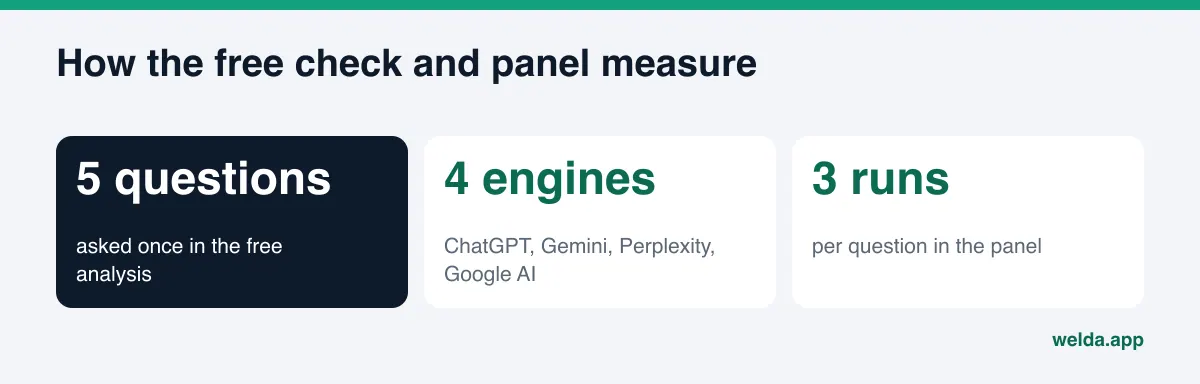
On top of that, the analysis asks five questions a customer might ask to an AI assistant that can search the web, and checks whether your business name appears in the answers. It is a one-time snapshot, not ongoing tracking. For a Miami restaurant, that might show that you appear for a broad English question but not for a detail question about group seating, which points straight at the FAQ.
From gap to approved copy
Welda does not stop at listing problems. It drafts the content: page copy, FAQ answers, profile descriptions and review replies. It does not invent facts. If it does not know whether you validate parking, it asks you. Publishing approval stays with you, and content always lives on your own site. On WordPress, Welda connects through a separate Editor user and an application password, without installing code; drafts open on your site and go live once you approve them. For other platforms, Welda gives you a ready package and the change is made by hand.
The panel: early access, opening first in Turkey
The full Welda panel is in early access and is opening first with businesses in Turkey. In the panel, customer questions are asked to ChatGPT, Gemini, Perplexity and Google AI three times each, and you see which questions name you, in what position, and where competitors lead. The scoring formula is published, and the spread across the three runs gives a margin of error. Questions can be tracked in English. Regular four-engine measurement is being added during early access, and the sample screens shown for the panel use representative data. What anyone can use today, in English, is the free analysis. Pricing is not published; it is discussed in the early access conversation.
Limits: what Welda does not do
- No guarantees. Welda does not guarantee rankings or that ChatGPT will mention you. Nobody can honestly promise that, because AI answers vary.
- It takes time. New content usually takes weeks to show up in AI answers.
- No Spanish question tracking in the panel. Question language in the panel is English or Turkish. Spanish-language questions are not a separate measurement option today.
- No fake reviews. Welda drafts replies to reviews. It does not write reviews.
- Some work stays with you. Handling negative reviews, managing directory and booking accounts, and press work remain the business's job. Welda lists these tasks and drafts what to say, but it does not open or run accounts for you.
- Health businesses get no automatic publishing. For clinics and dental practices, every piece of content comes to you for approval, and patient data is not sent to AI.
- Not legal advice. Welda flags phrases about prices, guarantees, superiority claims and diagnoses before publishing. That check is not legal advice and has not been reviewed by legal counsel.
AEO checklist and decision guide for Miami businesses
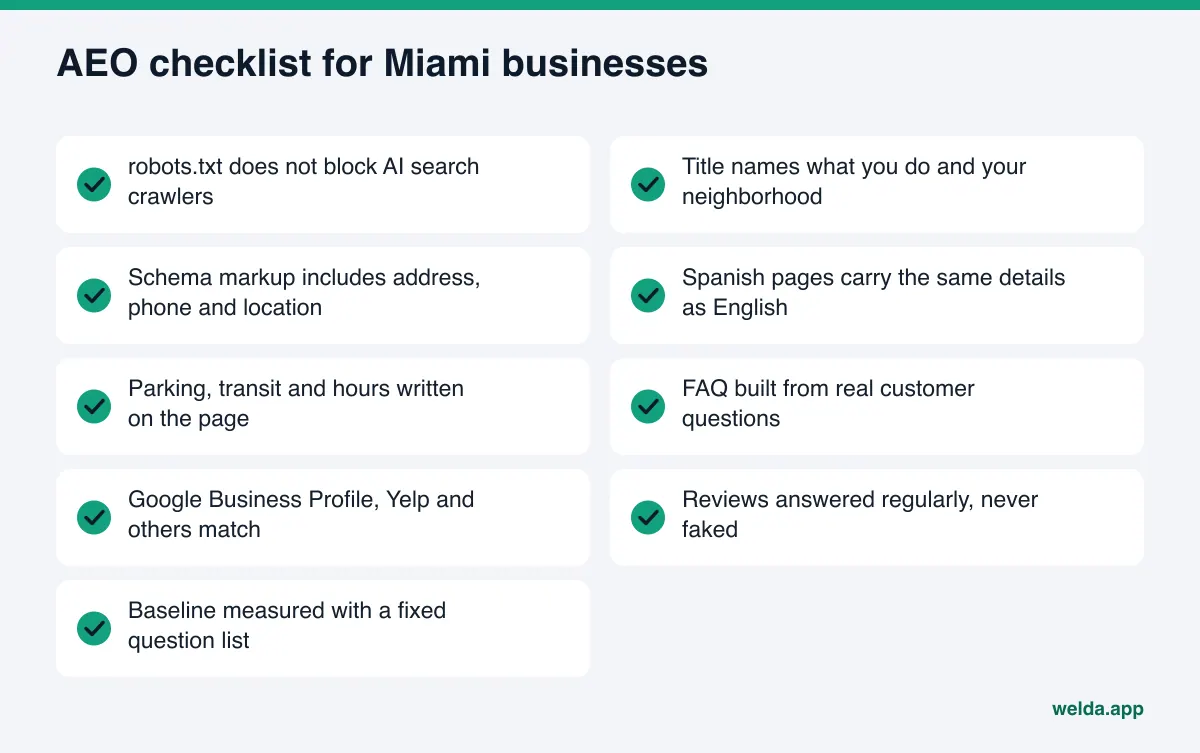
Go through the checklist once before your busy season. Then use these questions to decide where to start:
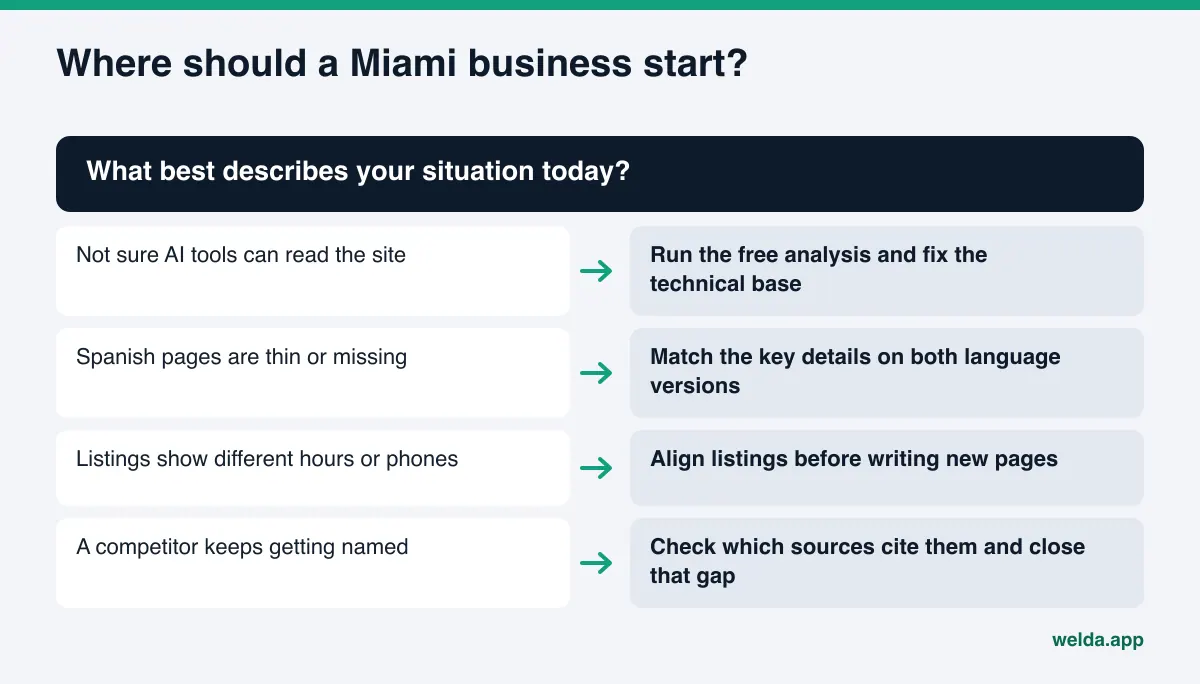
- Can AI tools read your site at all? If crawlers are blocked or the title and schema are missing, fix the technical base first. The free analysis shows this directly.
- Do your English and Spanish pages say the same thing? If not, start with the details customers ask about most: location, parking, hours, booking.
- Do your listings agree? If address, phone or hours differ across Google Business Profile, Yelp and others, fix that before writing new pages.
- Where do competitors win? When a competitor keeps getting named for a question, look at which source the answer cites. Often the difference is a complete profile on that source.
- Can you measure consistently? Checking a handful of questions by hand is doable. Dozens of questions across four engines is not.
Frequently asked questions
How is AEO different from traditional SEO for a Miami business?
SEO is about where you rank in a list of search results. AEO is about whether you are named in the single answer an AI tool gives. They share a foundation: a readable site, clear details and consistent listings. But AEO is measured by customer questions, not keywords.
Is AEO worth it for a single-location business?
Often, yes. AI assistants tend to surface the business that answers the question most clearly, not necessarily the biggest brand. A small hotel or restaurant that spells out its neighborhood, amenities and policies can be named alongside larger competitors for specific questions.
Do I need Spanish pages for AEO in Miami?
If you serve Spanish-speaking customers, yes. An AI tool answering a Spanish question looks for Spanish content. Keep the key details identical across both versions.
I'm on Tripadvisor and Yelp already. Does my own site still matter?
Yes. Those platforms are important sources, but you do not control everything on them. Your own site is the one place where you publish the most complete, current version of your details, and the listings should match it.
How long until I see a change?
New content usually takes weeks to show up in AI answers, which is why the groundwork should happen before the busy season. No one can give an exact timeline.
What does the free analysis include and not include?
It scores your site out of 100, lists gaps with fixes, writes homepage copy suggestions, compares you with competitors and gives you a fix pack with schema code. It also runs a one-time, five-question AI test. It does not measure rankings or guarantee them. It is free once per site; your email and phone are verified, and the results link arrives by email and stays open for 14 days.
Your first step
AEO for Miami businesses comes down to knowing your customers' questions, answering them clearly on your site and listings in the languages they use, and measuring the result the same way each time. Most of that knowledge is already yours. The work is putting it in the right place before the busy months arrive. Start by seeing where you stand: run your free AI visibility analysis, get the gap list and the suggested copy, and make the first fixes now.