What does AI search optimization for home goods brands actually do? It gets your brand named when a shopper asks ChatGPT, Gemini, Perplexity or Google's AI features something like "which cotton sheets don't pill" or "what are good quick-dry bath towels." That takes three things: product pages that state fiber, weave, size and care in plain text, a brand that shows up consistently on sources AI models trust, and a measurement of which questions you appear in today.
Home goods used to be a photo-and-price category. Shoppers scrolled, compared thumbnails and checked reviews. More of them now start by asking an AI assistant: "Percale or sateen for someone who sleeps hot, and which brand?", "Which bath towels are thick but still dry fast?", "Where can I buy blackout curtains that actually block light in a west-facing bedroom?" The answer usually names a handful of brands with a one-line reason next to each. That short list is the new shelf. This practice goes by a few names. In the US the most common is AEO, answer engine optimization; you will also see "AI search visibility" and GEO (generative engine optimization), which means roughly the same thing. This guide walks through AI search optimization for home goods brands step by step and shows how Welda measures and prepares the work. If you want to see where your own site stands before reading on, run the free site analysis; the results will help you put the steps below in the right order for your store.
Why AI search optimization for home goods brands is its own problem
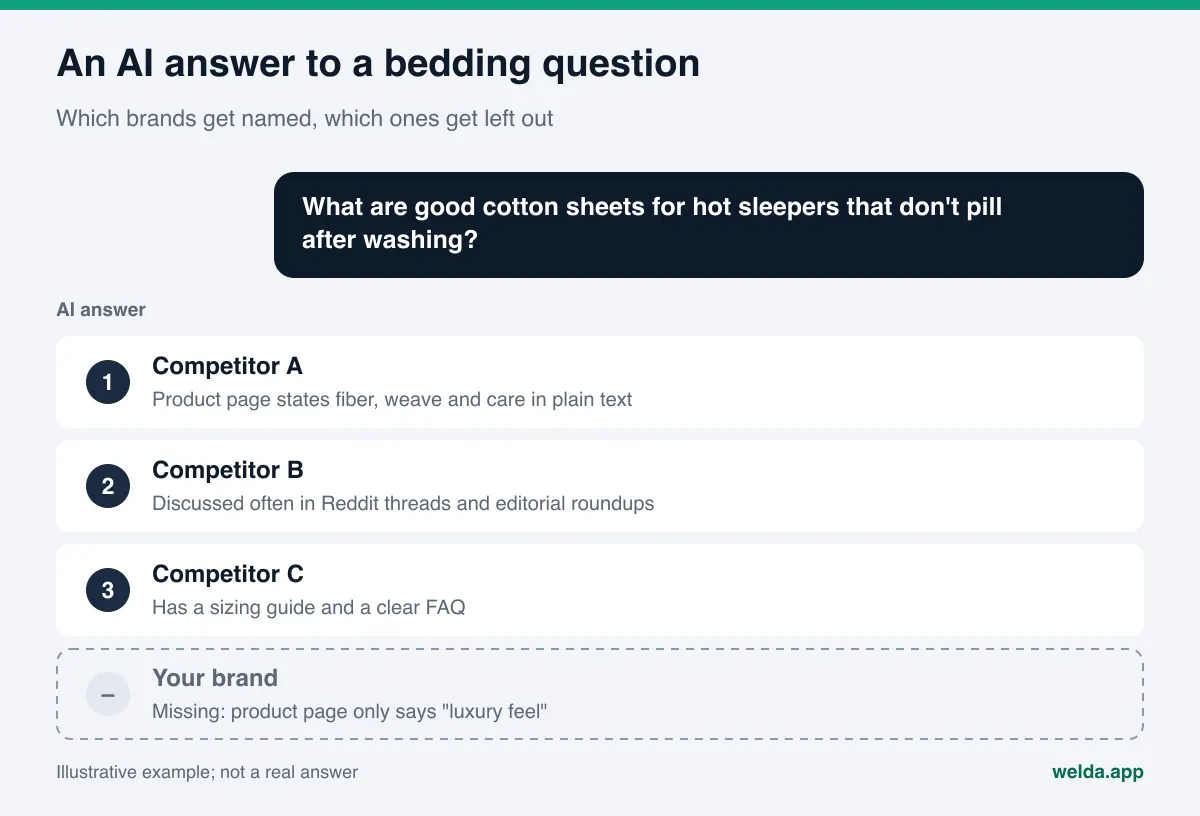
Classic search was about ranking among ten blue links. In an AI answer, the shopper often reads the brand names and reasons without clicking anything. AI visibility is therefore less about position on a page and more about being mentioned at all: are you named, in what order, and next to which competitors?
Home goods has three quirks that make this harder than in many categories. First, products look alike. A white queen sheet set in one photo is hard to tell apart from another. The difference is in the fiber, the yarn, the weave and the construction. AI models don't recommend from photos; they read text. If your page does not spell out what makes your sheets different, the model has no reason to pick you over a rival that does.
Second, shopper questions get technical fast. "Is sateen warmer than percale?", "Are bamboo-viscose towels really more absorbent?", "Will a deep-pocket fitted sheet fit a 14-inch mattress with a topper?" Answering these takes category knowledge, not just a product listing. AI answers lean on the sources that explain the category best, and they tend to surface the brands those sources mention.
Third, home goods brands usually sell in more than one place: your own store, one or more marketplaces, maybe a showroom or wholesale accounts. AI models read all of it together. If your site says "100% cotton" and your marketplace listing says "cotton blend," the model has to guess which is true, and it may simply pick a competitor whose facts line up. AEO for a home goods brand is as much about cleaning up scattered product facts as it is about writing new pages.
The same logic applies in neighboring categories. The guide on AEO for fashion brands shows how fabric and fit details play the same role in apparel, and the piece on AEO for ecommerce managers covers the broader store-level work.
What shoppers ask AI about bedding, bath and window textiles
Start by writing down the questions, because both measurement and content follow from them. The examples below are ones we wrote to illustrate the five question types that matter most for a home goods brand. They are not survey data.
| Question type | Example question (our illustration) | What the answer draws on |
|---|---|---|
| Product recommendation | What are the best cotton sheets that don't pill? | Fiber, yarn and weave facts, reviews |
| Comparison | Percale vs. sateen for hot sleepers, which brand? | Category guides, FAQ pages, roundups |
| Sizing and fit | Which sheets fit a 15-inch mattress with a topper? | Size charts, pocket depth on product pages |
| Care and durability | Which towels stay soft after a year of washing? | Care instructions, long-term reviews |
| Trust and delivery | Which online bedding brands have easy returns? | Return policy, review sites, BBB profile |
Write your list in the shopper's words, not your catalog's. You might list "Queen Sheet Set, 4 pc." Shoppers ask "sheets for a queen bed that stay on the corners" or "cooling sheets for summer." Add two or three phrasings of the same question so your measurement reflects real life. Seasonal questions matter too: lightweight quilts and linen in summer, flannel and heavier blankets in winter, wedding registry and housewarming gift sets at other times of the year.
AI search optimization for home goods brands, step by step
These steps are written for a small or mid-sized home goods brand. Order matters: writing content before you measure means working without knowing which gap you are closing.
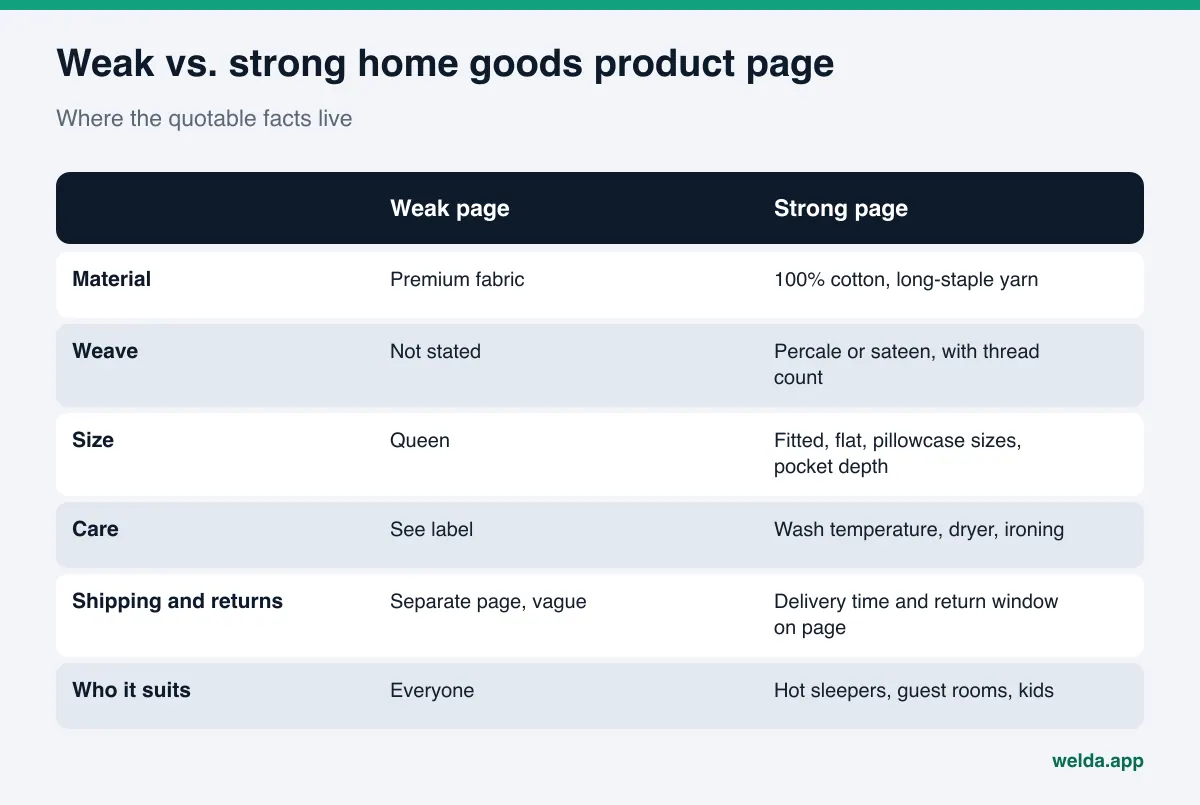
- Set your questions and competitors. Write 20 to 40 questions across the five types above, with a few for each product line (sheets, duvet covers, towels, curtains, throws, table linens). Note the three or four brands shoppers compare you with.
- Make sure AI crawlers can reach your site. If robots.txt blocks AI search crawlers, the best content in the world will not be read. OpenAI explains in its crawler documentation that OAI-SearchBot is used to surface websites in ChatGPT search features and is separate from GPTBot, which collects training data. You can block training and still allow search; the point is to make that choice on purpose.
- Put facts on your product pages. Above the fold, state fiber content, yarn, weave, sizes for every piece, care, origin and set contents in plain text. "Luxury," "hotel quality" and "buttery soft" are not facts. Without a measurable detail next to them, an AI answer has nothing to quote.
- Mark up product data. Google describes product structured data for pages where shoppers can buy, including price, availability, shipping and return details, in its Search Central documentation. The same data helps AI systems read your pages correctly. Keep your business details (Organization schema) consistent on the homepage and contact page.
- Write category guides. A sheet sizing guide, "percale vs. sateen," "what towel weight means," "how to choose blackout curtains." These answer comparison questions directly. You can feature your own products, but answer the question honestly first.
- Add an FAQ. On the homepage and key category pages, answer delivery time, return window, exchanges for the wrong size, and bulk or hospitality orders in short paragraphs.
- Close gaps on outside sources. Your marketplace listings, your BBB profile and how you respond there, Reddit threads where people compare bedding brands, editorial gift guides and roundups, and Google Business Profile if you have a showroom. Facts on these sources should match your site.
- Measure, fix, measure again. Ask the same questions at regular intervals. AI answers can change even for the same question, so look at repeated runs, not a single try.
The product facts AI answers look for in home textiles
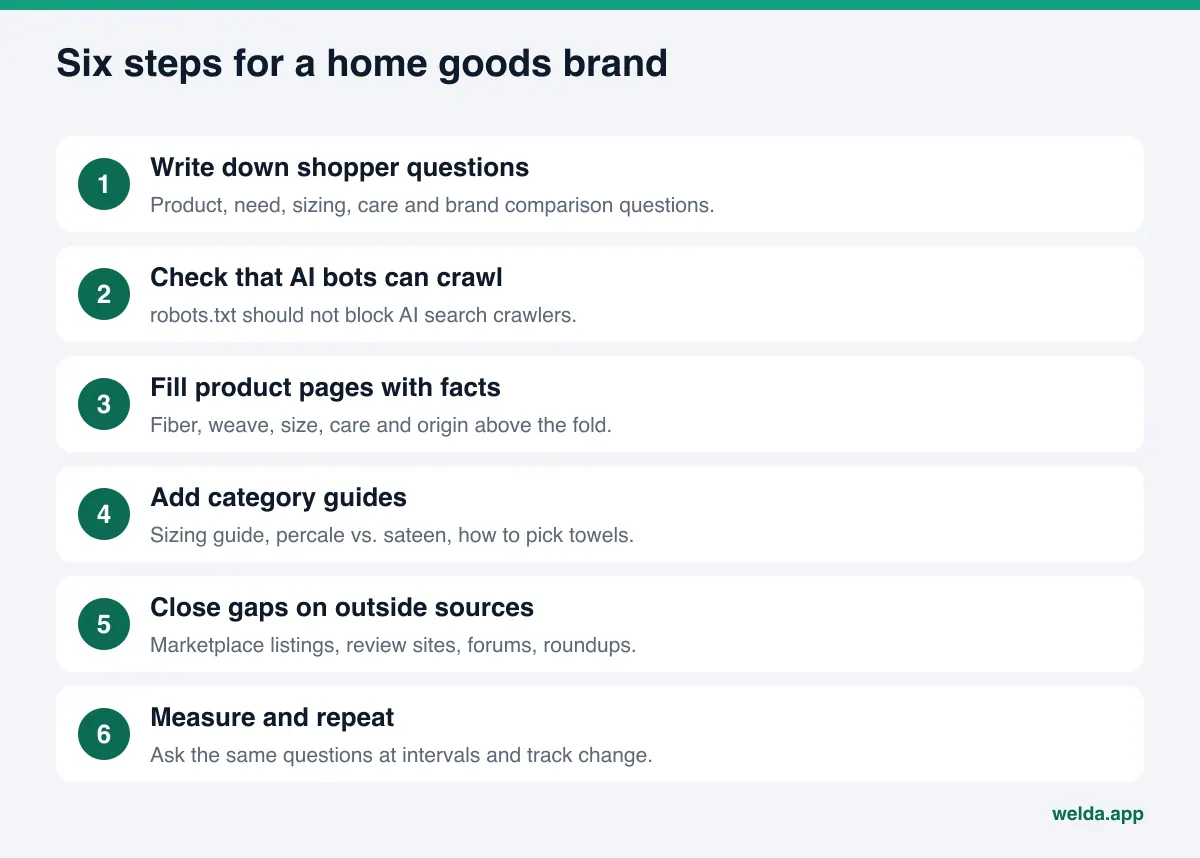
In home goods, the product page is the foundation of AI visibility. When a model recommends a sheet set or a towel, it wants to give a reason, and it takes that reason from concrete facts on your page. The table below lists the facts a home textile product page should carry and the shopper question each one answers.
| Fact | How to write it | Question it answers |
|---|---|---|
| Fiber content | 100% cotton, or 60% cotton, 40% polyester | Is it natural, will it sleep hot |
| Yarn and weave | Long-staple cotton, percale weave, thread count | Will it pill, is it crisp or silky |
| Towel weight | Grams per square meter, if you measure it | Is it plush, how fast does it dry |
| Sizes | Every piece in inches, pocket depth for fitted sheets | Will it fit my mattress |
| Care | Wash temperature, tumble dry, ironing | Is it easy to care for, will it fade |
| Set contents | Number of pieces and what they are | Is it a complete set for a gift |
| Country of origin | Matches the label and the online description | Where is it made |
| Shipping and returns | Delivery time, return window and conditions | Is it safe to order |
There is a compliance angle here too. The FTC's guide to the Textile and Wool Acts lists sheets, towels, curtains and tablecloths among covered products, treats internet advertising as written advertising, and says catalog and online descriptions must state whether an item is made in USA, imported, or both, consistent with the label. Writing these facts clearly on your product page serves shoppers, regulators and AI answers at the same time. This is a summary, not legal advice; check the rules with your own counsel.
The same caution applies to claims. If a product has an independent certification, name it, say what it covers and which products it applies to. Do not write "antibacterial," "hypoallergenic" or "healthier sleep" without evidence. Those claims carry risk and do not make AI models more confident in your brand.
Price matters as well. Shoppers often ask for "affordable" or "mid-range" bedding. A page with a clear price and a clear sense of what it includes makes it easier for an AI answer to place you in the right price band. The guide on pricing pages for AI answers covers this in detail.
How Welda does this work
Welda is software that measures where a business shows up in AI answers and prepares the missing pieces on the business's behalf. For a home goods brand, three parts do most of the work: the free site analysis, the competitor and question views, and the to-do list.
Start with the free site analysis. The analysis reads your homepage and a few inner pages (services or collections, pricing, about, contact) the way Google and AI systems see them. For a home goods brand, it answers questions like these: can AI crawlers get in, do your page title and description say what you sell, is there business schema, are your social profiles linked from the site, is there an FAQ, are your product lines described clearly, how fast does the page load. You get a score out of 100, with technical and content scored separately. Each gap comes with what was found, why it matters and how to fix it. The report includes ready-to-use homepage copy (title, description, main heading, intro paragraph and FAQ), a simulation of how much each fix would move the score, a competitor comparison, and a fix package you can add to your site, including the business schema code. It also asks five questions a shopper might ask to an AI assistant that can search the web, and checks whether your brand name appears in the answers. That is a one-time snapshot, not ongoing tracking. The free analysis works in English.
Competitors and questions: who wins, on which question, from which source. In the Welda panel, each shopper question is asked to ChatGPT, Gemini, Perplexity and Google AI three times. The questions view shows, question by question, which engines name you. The competitors view goes a step further: it shows which question cluster a rival wins and which sources the answers cite for them. For a home goods brand, that might look like this: you are named in towel questions, but a competitor leads every "wedding registry bedding" question and is cited from a marketplace listing and a home decor blog. Now the decision is concrete: write a registry and gift-set guide, and complete your listing on that marketplace.
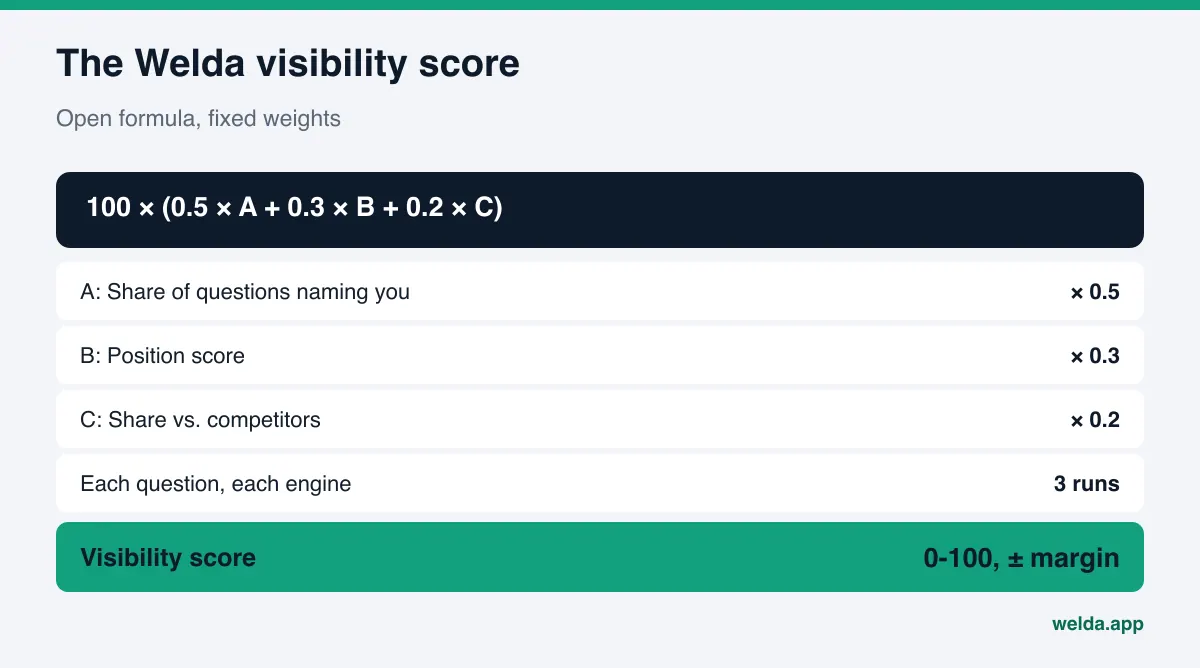
The score formula is published, not hidden. The spread across the three runs produces a margin of error that is shown with the score. That matters because AI answers can vary even for the same question, so being named or not named in a single run is not a result on its own. The guide on margin of error in AI visibility tracking explains what that number means.
The to-do list: Welda prepares, you approve. Everything the measurement surfaces lands in one list. Welda drafts product-line pages, category guides, FAQ answers, profile descriptions and review replies. It does not invent facts: if your fiber content, pocket depth or return window is not on your site, the list asks you for it under the information it needs. You answer once and the fact flows into every draft. Tasks Welda cannot publish directly, such as a marketplace listing description, are marked as manual, with the ready-to-paste text right next to them.
On WordPress sites, Welda connects through a separate Editor user and an application password, with no code to install. Drafts open on your site as drafts and go live only when you approve them. On platforms without a connection, Welda hands you a ready package and you or your developer apply it. Content always lives on your own site; Welda does not host it. The panel also has a before-and-after comparison, a sources view and a one-page monthly report.
A plain note on availability: the Welda panel is in early access and is opening first in Turkey. The free analysis works in English today, so you can check your site now; the full panel is not yet open to US brands. Regular four-engine tracking is being added during early access, and sample screens in the panel use illustrative data. Pricing is discussed in the early access conversation.
What Welda doesn't do
The most common promise in this space is "we'll get you ranked first in ChatGPT." Nobody can honestly promise that, because no outside party controls what an AI answer says. Welda does not guarantee rankings or placement in ChatGPT. The guide on guaranteed ChatGPT rankings explains why.
- It doesn't make up facts. Welda won't guess your fiber content, origin or certification; it asks you.
- It doesn't publish without approval. Every draft goes through you. The publish decision stays with the business.
- It doesn't create fake reviews. It won't post or solicit reviews on marketplaces or review sites. It can draft replies to real reviews.
- Some work stays with you. Handling negative reviews, running marketplace and directory accounts, and working with editors and press remain your job.
- Results are not instant. New guides and corrected product facts usually take weeks to show up in AI answers.
There is also a scope limit. The free analysis reads the homepage and a few inner pages; it does not audit hundreds of product pages one by one. Use its findings as a template and apply them across your catalog. It also does not measure classic search rankings.
Checklist: is your home goods brand ready for AI answers?
Run through this list for one product line. If you answer "no" to three or more, close those gaps before writing new content.
- robots.txt does not block AI search crawlers.
- Your homepage title and description say which product lines you sell.
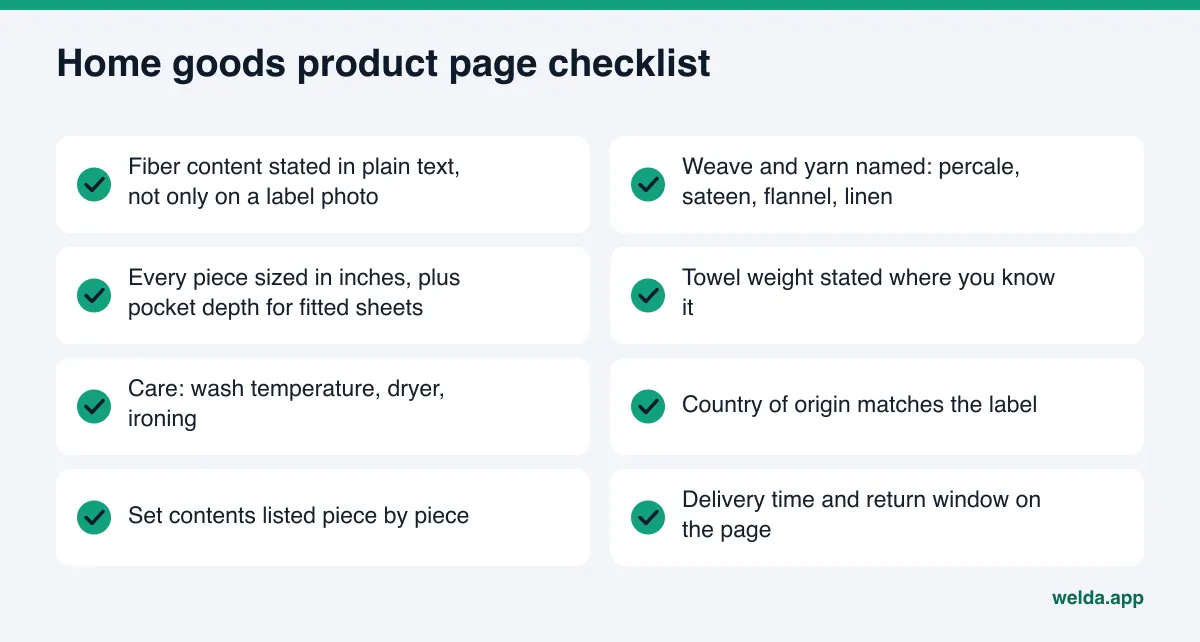
- Every product page states fiber, weave, size and care in plain text above the fold.
- You have a sizing guide and at least one category comparison page.
- Delivery time, return window and contact details are easy to find.
- Product and business data are marked up with structured data.
- Marketplace listings match your site.
- You respond to complaints on review sites and your BBB profile.
- Your social profiles are linked from your site.
- You have 20 to 40 shopper questions written down and measure them at intervals.
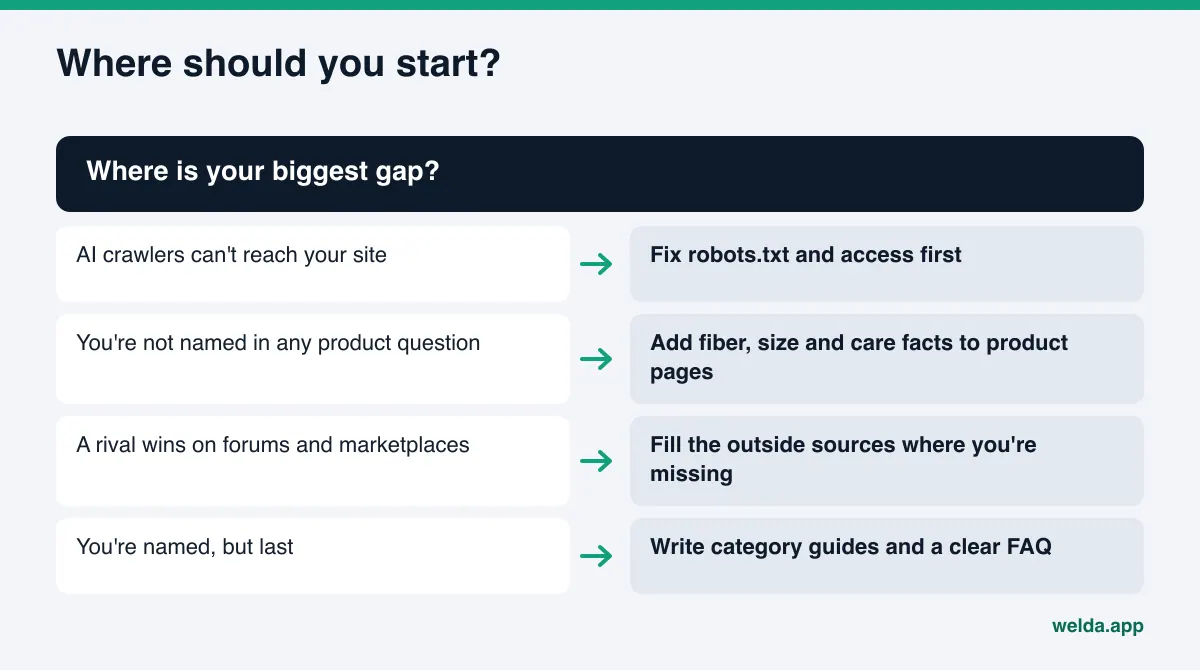
Should you do this yourself or use software? With a small catalog and one sales channel, you can take the first steps on your own: fix product pages and try a few questions by hand. Once you have several product lines, want to track several engines and competitors regularly, and have a growing pile of copy to write, handing measurement and drafting to software while keeping publish approval in-house saves time. Either way, step one is the same: see where you stand. For a parallel walkthrough in another niche, see AI search optimization for specialty food brands.
Frequently asked questions
Is AEO for home goods different from SEO?
The foundation is shared: crawlable pages, clear titles, structured data. What you measure is different. SEO looks at your position on a results page. AEO looks at whether an AI answer names you, in what order and next to which competitors.
I sell mostly on marketplaces. Do I need my own site?
AI models read marketplace listings too, but your own site is where you can explain your brand in the most detail and keep facts consistent. Category guides, size charts and FAQs rarely fit on a marketplace listing.
My product photos are great. Isn't that enough?
Photos persuade shoppers, but AI answers take their reasons from text. If fiber, size and care are not written out, the model has nothing that sets you apart.
Does the free analysis check every product page?
No. It reads the homepage and a few inner pages such as collections, pricing, about and contact. You can apply its findings to your product pages as a template.
How long until I see a change?
New content usually takes weeks to show up in AI answers. Measuring the same questions repeatedly before and after a fix is the safest way to see real change.
Can US brands use the Welda panel today?
The panel is in early access and is opening first in Turkey. The free site analysis works in English and is available to anyone today.
Your first step: see where you stand
AI search optimization for home goods brands starts with a measurement, not a content calendar. In a few minutes you can see whether AI crawlers can reach your site, whether your homepage says clearly what you sell, and whether your brand comes up in shopper questions. Run the free site analysis. Your results arrive by email and stay open for 14 days, with the gaps to close first and ready-to-use copy for your homepage.