What does AI search optimization for specialty food brands actually involve? It is the work of getting your olive oil, honey, cheese, hot sauce or coffee recommended when shoppers ask ChatGPT, Gemini, Perplexity or Google's AI Overviews where to buy. Assistants favor brands whose origin, process, ingredients, shelf life and shipping terms they can read on the brand's own site and confirm elsewhere. You start by checking whether your site states those facts in plain, readable text.
Why AI search optimization for specialty food brands is its own discipline
The practice of earning mentions in AI answers is usually called AEO, short for answer engine optimization. You will also see it called AI search visibility, and some vendors use GEO (generative engine optimization) for the same idea. Whatever the label, the mechanics differ from classic search. A Google results page shows ten links, a shopping carousel and a few marketplace listings. An AI answer typically names three or four brands, each with a one-line reason. If a shopper asks for "a small-batch olive oil producer that ships to Chicago" and your brand is not in that short list, they rarely go looking for you.
Specialty food feels this shift more than most categories, for three reasons.
First, food questions are specific. Nobody types "recommend good honey." They ask for "raw, unfiltered wildflower honey from a single apiary," "aged gouda that ships cold in summer," or "a gluten-free shortbread gift box under fifty dollars." The assistant answers with brands that state those details somewhere it can read them.
Second, trust questions come before product questions. "Is this honey real?" "Will the chocolate melt in transit?" "Does the cheese arrive cold?" When the brand's own site does not answer these, the assistant builds its answer from reviews, Reddit threads and complaint pages. Other people end up writing your story.
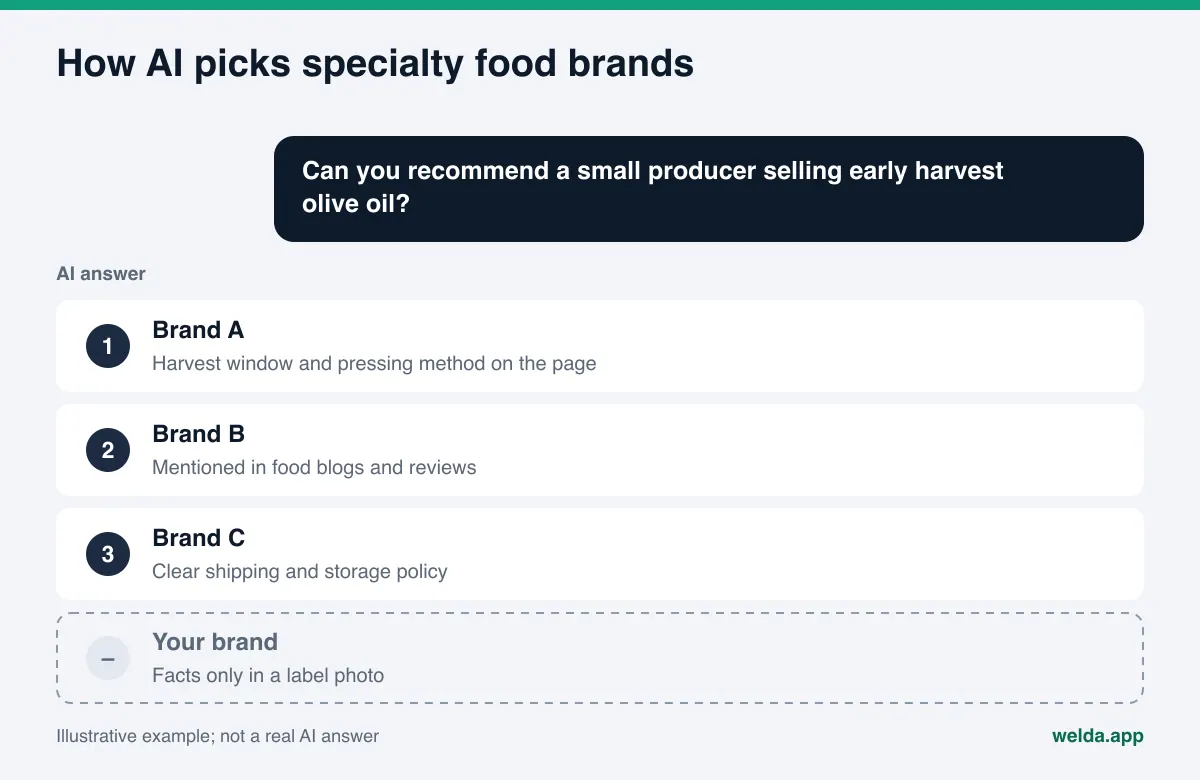
Third, specialty food sites are built for the eye. Gorgeous photography, a short product name, a founder story and an add-to-cart button. Harvest date, varietal, aging time, net weight and storage instructions live on the label or inside a photo. For a human, the page feels rich. For an AI system, it is close to empty.
The fastest way to know where you stand is to measure rather than guess. Welda's free site analysis reads your homepage and several inner pages the way Google and AI systems do, then lists each gap with a fix.
What shoppers ask AI about specialty food
When you build your own question list, it helps to group questions into clusters. The examples below are typical questions we wrote to illustrate each cluster; they are not research data.
- Origin and process: "Cold-pressed olive oil from a single California estate," "stone-ground tahini made in small batches," "farmstead cheese from Vermont that ships nationwide."
- Ingredients and dietary needs: "Jam with no added sugar," "nut-free chocolate truffles," "keto-friendly snack box from an independent brand."
- Freshness and shipping: "Cheese shop that ships with ice packs in July," "honey that arrives in two days to Texas," "chocolate that will not melt in summer shipping."
- Gifting: "Corporate holiday gift box from a local producer," "gourmet basket for a new neighbor," "gift box with a handwritten card."
- Trust and comparison: "Is Brand A's olive oil legit," "Brand A vs Brand B hot sauce," "difference between extra virgin and pure olive oil."
Each cluster draws on a different source. Origin questions lean on your About page and producer story. Dietary questions lean on the ingredient list. Shipping questions lean on your shipping policy. Trust questions lean on reviews and third-party discussion. That is why no single fix opens every cluster, and why knowing which cluster you are missing is half the job.
Which sources do AI assistants read about a food brand?
Assistants do not rely on one source. They combine your website, product pages, Instagram, marketplace storefront, Google Business Profile (if you have a shop or tasting room), Yelp reviews, Reddit threads and food blogs that mention you. You control some of these fully. On others, you can only respond.
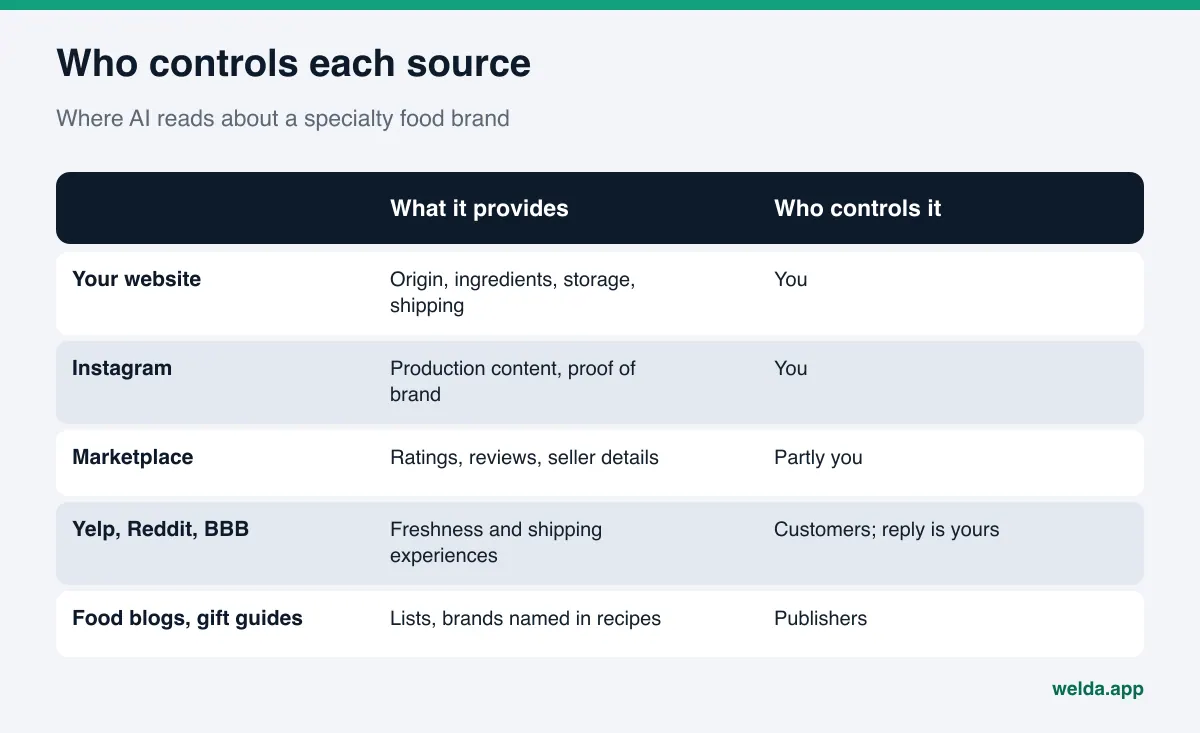
| Source | What the assistant takes from it | Who controls it |
|---|---|---|
| Your own website | Origin, process, ingredients, net weight, storage, shipping, returns | You |
| Product and organization markup (Schema) | Product name, brand, price, availability, image | You |
| Instagram and other social profiles | Harvest and production content, proof the brand is real | You |
| Google Business Profile | Shop or tasting room address, hours, reviews | You; reviews by customers |
| Marketplace storefront | Ratings, review count, seller details | Partly you |
| Yelp, Reddit, BBB complaints | Shipping, freshness and authenticity experiences | Customers; your reply is yours |
| Food blogs and gift guides | "Best of" lists, brands named in recipes | Publishers |
The first four rows are in your hands, and that is where most food brands find the quickest gains: the same facts on your site, Instagram and marketplace storefront, product details written as text, and a site that AI crawlers can actually reach.
AI search optimization for specialty food brands, step by step
The order below is designed to close the most gaps with the least effort. The first four steps take most brands a few days. The rest become ongoing work.
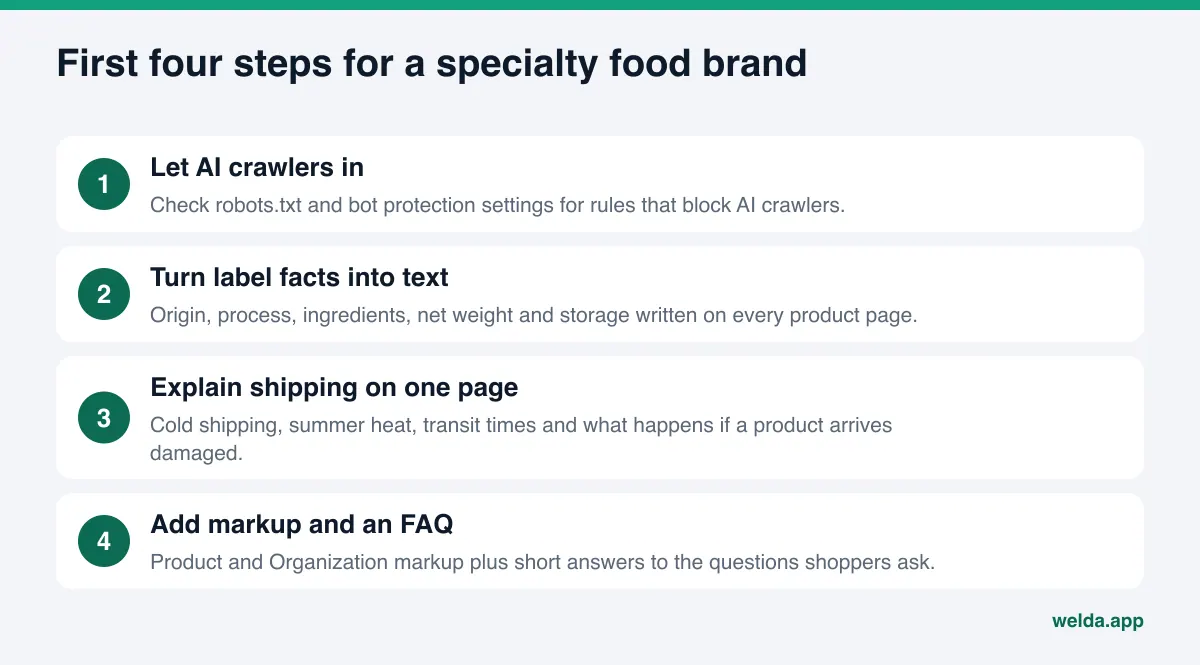
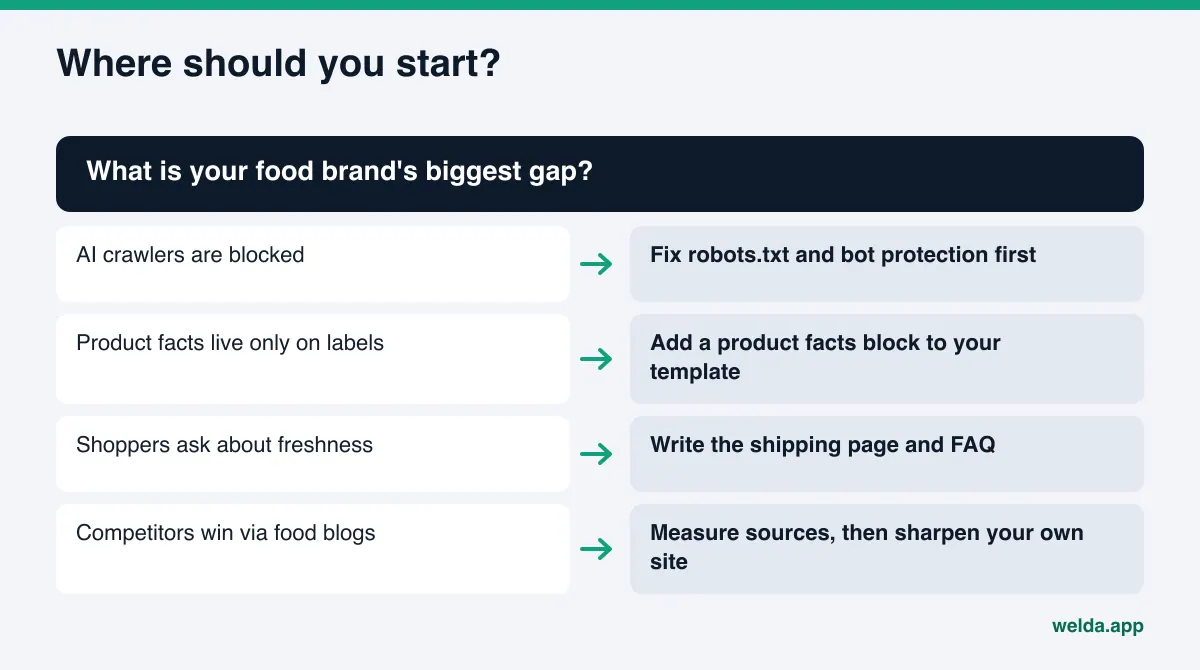
- Make sure AI crawlers can get in. Check robots.txt for lines that block AI crawlers. Some ecommerce platforms, security plugins and bot-protection settings do this without telling you. If crawlers cannot reach the site, nothing else on this list matters.
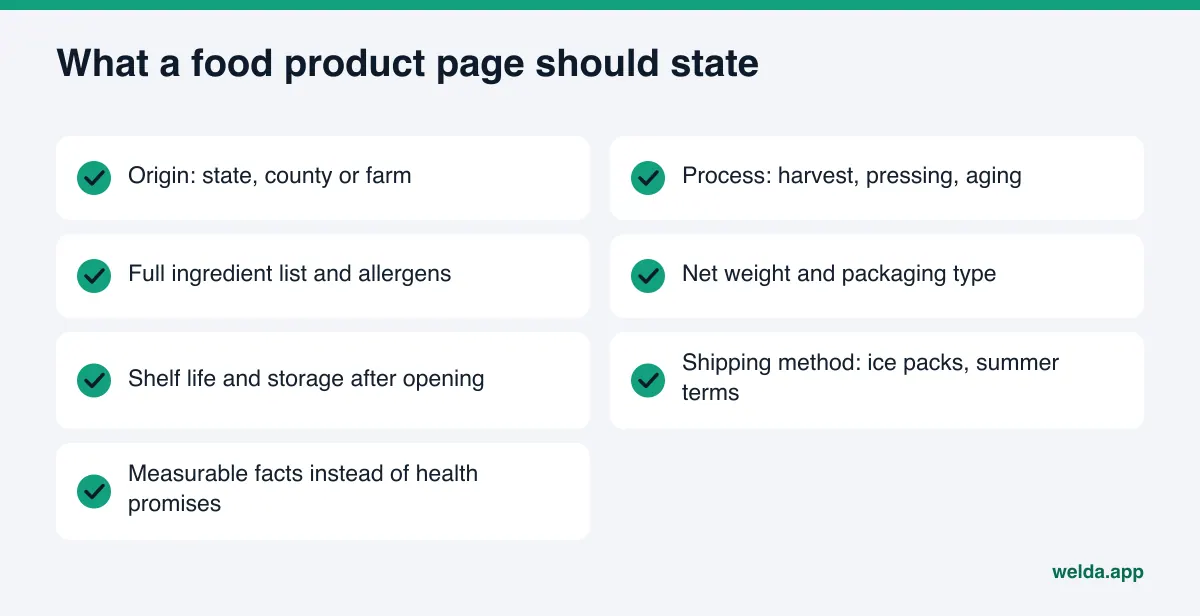
- Write product facts as text. Every product page should state origin (state, county, farm), process, full ingredient list, allergens, net weight, shelf life and storage. A photo of the label is not enough.
- Put measurable facts ahead of adjectives. Replace "unmatched flavor" with "harvested in early November, milled within hours, 500 ml dark glass bottle." Measurable facts are facts an assistant can repeat.
- Explain shipping and freshness on one page. Which products ship with ice packs, how you handle summer heat for chocolate and cheese, transit times by region, and what happens if a bottle breaks or a product arrives warm.
- Add product and organization markup. Use Product markup on product pages and Organization markup on the homepage. Google documents which product properties are required in its merchant listing structured data guide, and AI assistants can read the same data.
- Write an FAQ section. Answer the questions shoppers ask AI, in short paragraphs on your own site: "Why does raw honey crystallize?" "How should I store this olive oil?" "How long does the cheese keep?" "Can you add our logo to corporate boxes?"
- Link your profiles from the site. Instagram, your marketplace storefront and your Google Business Profile should be linked from the site, using the same brand name, address and phone everywhere.
- Publish usage and buying guides. Pages like "Early harvest vs late harvest olive oil," "How to store a wedge of aged cheese," or "Building a cheese board for eight" become the text assistants quote in comparison and recommendation answers.
- Respond to reviews. A calm, specific reply to a negative Yelp review or marketplace complaint is also read.
Product copy example: from mood to machine-readable
The comparison below was written for a sample olive oil and a sample cheese; no brand is named. The left column sounds lovely to a person but gives an assistant nothing it can repeat.
| Vague copy | Readable copy |
|---|---|
| Liquid gold from our grove | Arbequina olives from our Sonoma County grove, harvested in early November, cold-extracted the same day |
| All natural | Ingredients: olives. Nothing added. |
| Stays fresh for ages | Best within 18 months unopened; store in a cool, dark place after opening |
| Packed with care | Cheese ships in insulated boxes with ice packs from May through September |
The values on the right are examples. Write your real ones. What matters is that the information is measurable, verifiable and identical everywhere it appears.
What each specialty food category should state on the page
Every category has a detail that drives the shopper's question, and the question to the assistant is built around that detail. Use this table as a starting point when you review your product page template.
| Category | Must state | Typical shopper question |
|---|---|---|
| Olive oil | Region, varietal, harvest window, extraction method, bottle type | "When was it harvested and pressed?" |
| Honey | Floral source, region, raw or filtered, crystallization note | "Is crystallization normal?" |
| Cheese and charcuterie | Milk type, aging time, storage temperature, cold shipping method | "Will it arrive cold in summer?" |
| Spices and rubs | Origin, drying or roasting method, packaging, best-by window | "How fresh is it, when was it ground?" |
| Hot sauce, jams, nut butters | Ingredient list, added sugar, allergens, processing method | "Is there added sugar? Is it nut-free?" |
| Gift boxes | Exact contents, order cutoff dates, corporate order terms | "Will it arrive before the holidays?" |
Writing every field for every product sounds heavy. The practical route is to add a fixed "product facts" block to your product template and fill in only the values for each item. When the same structure repeats across the catalog, both shoppers and assistants find what they need in the same spot.
A note on health claims and reviews
The riskiest sentences in specialty food are health claims: "boosts immunity," "lowers cholesterol," "heals the gut." In the US, claims like these on labels and in advertising fall under FDA and FTC rules. Reviews are regulated too. The FTC's rule on consumer reviews and testimonials, effective October 21, 2024, prohibits buying or selling fake reviews and certain review suppression practices. Check any specific wording with your counsel; this article is not legal advice.
From an AEO point of view the logic points the same way. An unmeasurable health promise is not something an assistant can safely repeat. Clear ingredients, process and serving suggestions are both safer and easier to cite. We cover the same balance for a neighboring category in how supplement brands get recommended by ChatGPT.
Gift boxes, holidays and corporate orders
A large share of specialty food is bought as a gift: the winter holidays, Mother's Day, Father's Day, client gifts at year end. Shoppers want two answers. Will the box arrive on time, and what exactly is inside?
- List the contents of each gift box product by product, with sizes.
- Publish holiday order cutoff dates as text on the site, not only in an email.
- Describe corporate orders on a dedicated page: minimum quantity, logo options, invoicing.
- State whether a gift note is included and whether prices appear on the packing slip.
When these facts are on the page, the assistant has a concrete reason to name you for "corporate holiday gift box from a small food producer."
How Welda handles this for a specialty food brand
Welda is software that measures where a business appears in AI answers and prepares the missing pieces on its behalf. Three parts matter most for a food brand.
1. The free site analysis: does your site answer food questions?
The analysis reads your homepage and a few inner pages such as About, Contact and pricing. It works in English. Food brands tend to show the same gaps: bot protection that also blocks AI crawlers, one page title repeated across the site, no organization markup, Instagram not linked from the site, no FAQ section, and shipping or storage details left vague. For each gap you see what was found, why it matters and how to fix it.
You get a score out of 100, with technical and content sides shown separately. A simulation shows whether adding organization markup or writing an FAQ would lift the score more, so you can pick where to start. You also get ready-to-use suggestions for your homepage title, description, main heading, intro paragraph and FAQ, a competitor comparison, and a fix package that includes the business markup code. Finally, the analysis puts 5 questions your shoppers might ask to an AI assistant that can search the web and checks whether your brand name appears in the answers. That is a one-time check, not ongoing tracking. If you want help interpreting the output, see how to read your AI visibility report.
2. The Sources view: where does AI learn about you?
In the Welda dashboard, your shoppers' questions are asked to ChatGPT, Gemini, Perplexity and Google AI three times each. The Sources view lists the sites those answers cite, each site's share, and your status there: profile present, incomplete, unverified, or your own site unreachable. For a food brand this often reveals that the assistant leans on a marketplace listing, a food blog or a Reddit thread far more than on your own site. The next task then becomes obvious: correct your information on that source, and make your own site clearer than it.
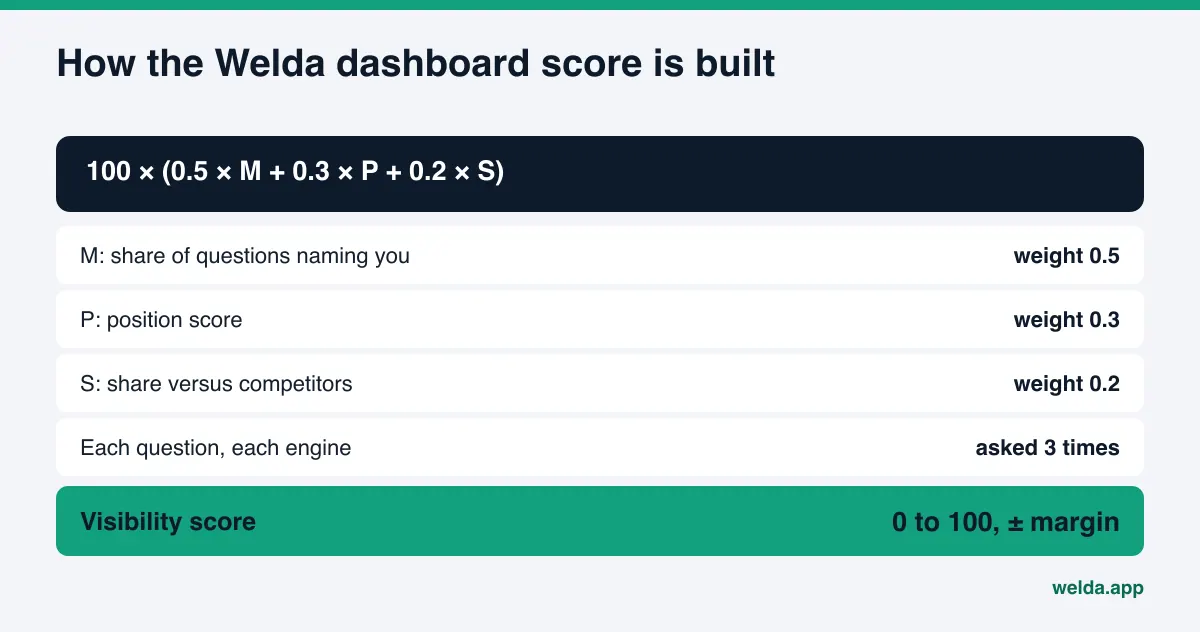
3. The to-do list: we ask, we do not guess
The to-do list has three parts. First, information Welda needs from you: if it cannot find your harvest window, aging time or cold shipping terms on the site, it leaves the field empty and asks rather than inventing a value. Once you enter it, it flows into every prepared text. Second, content waiting for your approval: product description drafts, FAQ answers and review replies. Third, manual tasks, such as a marketplace profile with no publishing connection, where Welda gives you ready text and you apply it.
Briefly, the rest: on WordPress sites Welda connects through a separate Editor user and an application password, with no code to install; content opens on your site as a draft and goes live when you approve it. On platforms without a connection, Welda gives you a ready package and you or your developer apply it. A legal check flags patterns such as price statements, guarantees, superiority claims like "best" and diagnostic suggestions before publishing; it is not legal advice and has not been reviewed by counsel. For the competitor side, see AI competitor analysis.
Where Welda stands today: early access
The free analysis is open to everyone today and runs in English and German. The full Welda dashboard is in early access and is opening first in Turkey. Regular four-engine tracking is being added during early access, and sample dashboard screens use representative data. Pricing is discussed in an early access conversation.
Limits: what Welda does not do
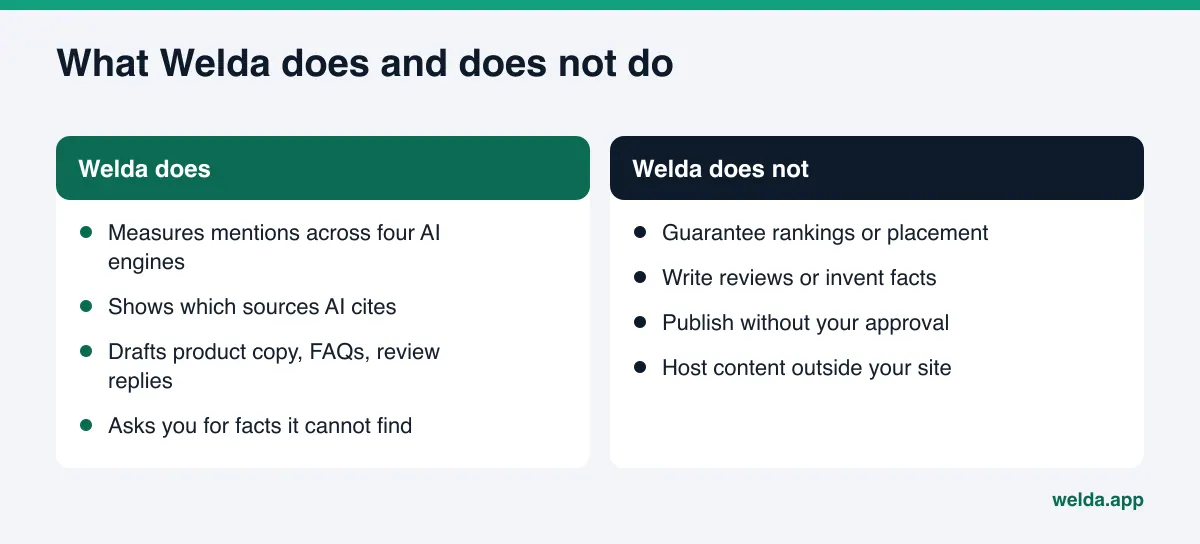
Food brand owners most often ask, "Will I show up in ChatGPT?" The honest answer is that nobody can guarantee it, and Welda does not.
- No ranking or placement guarantees. AI answers change from question to question and from day to day.
- No invented facts. Welda does not guess your harvest date, ingredients or shelf life. It asks you.
- No fake reviews. It drafts review replies; it never writes reviews.
- No unapproved sensitive content. Every piece goes through your approval.
- Some work stays with you. Handling negative reviews, managing directory and marketplace accounts, and press or blogger outreach remain the brand's job.
- No content hosting. Everything lives on your own site.
Timing matters too. New product copy or a new guide usually takes weeks to show up in AI answers. Seeing no change in week one is normal.
Checklist: is your specialty food brand ready for AI search?
Open your own site and work through the list below. Every "no" is next week's task. For the FAQ structure, FAQ pages for AEO walks through a template.
| Check | Where to look | Why it matters |
|---|---|---|
| Can AI crawlers reach the site? | robots.txt, bot protection settings | If not, nothing gets read |
| Are origin and process written as text? | Product pages, About | Origin questions are answered here |
| Are ingredients, allergens and net weight listed? | Product pages | Dietary questions need detail |
| Are shelf life and storage clear? | Product pages, FAQ | The basis of "will it go bad?" |
| Are cold shipping and transit times clear? | Shipping page | Drives trust for cheese and chocolate |
| Is product and organization markup present? | Page source | Gives structured facts |
| Are Instagram and marketplace linked? | Footer, Contact | Shows the accounts belong to one brand |
| Any health claims in product copy? | Product descriptions | Regulatory risk and unrepeatable facts |
Frequently asked questions
Can a brand that sells only on Instagram get recommended by AI?
It can, but it is harder. Assistants cannot always read Instagram content in detail. A simple site that states products, ingredients, shipping and contact details makes it easier to confirm the brand behind the account.
I already sell on a marketplace. Do I need my own site?
A marketplace storefront is one source, but you control little of it. On your own site you can tell the producer story, publish harvest details and answer FAQs the way you want. Ideally both say the same thing.
How much do food blogs and gift guides matter?
For comparison and "best of" questions, assistants may draw on them often. But if a blog contradicts your own site, it does not help. Fix your site first, then look outward.
Will Welda write my product descriptions?
Welda prepares drafts but does not invent facts like harvest dates, ingredients or shelf life. It asks you. Publishing approval stays with you, and content stays on your site.
How long until results show?
New content usually takes weeks to be reflected in AI answers. No exact timeline or placement can be guaranteed.
Does the free analysis work with my ecommerce platform?
It reads your site from the outside, the way a visitor or crawler sees it, so it does not connect to your platform. Email and phone are verified, and the results link arrives by email and stays open for 14 days.
Your first step
Getting a specialty food brand named in AI answers depends less on beautiful photos and more on plainly written facts: where it comes from, how it is made, what is in it, how to store it and how it reaches the customer. Measure your site to see where to start. Run the free site analysis and within minutes you will see whether AI crawlers can reach your site, whether your product and business details are readable, and which fix would make the biggest difference.