How do supplement brands get recommended by ChatGPT? An AI answer engine recommends a supplement brand when it can find clear, checkable facts about the product and sees the brand mentioned consistently across sources it trusts. That means ingredient, amount, form, who it suits and who makes it, written plainly and without disease claims. Before you change anything, measure which questions already name you and which do not.
Supplement shoppers no longer just type "magnesium" into a search bar. They ask full questions: "Which form of magnesium is better for sleep, and which brand would you recommend?" or "Vitamin D drops or tablets for a toddler, what's a trustworthy brand?" The answer comes from ChatGPT, Gemini, Perplexity or Google's AI Overviews and AI Mode, and it usually names a handful of brands with a short reason next to each. If your brand is not on that shortlist, the shopper never puts you in the comparison. This guide explains how supplement brands get recommended by ChatGPT and the other answer engines, step by step, while staying inside FDA and FTC rules. It also shows how Welda measures and prepares this work. If you want a baseline first, run a free AI visibility analysis of your site; the results will help you put the steps below in the right order for your store.
A quick note on terms. The work of getting named in AI answers is usually called AEO, short for answer engine optimization, or simply AI search visibility. You may also see GEO (generative engine optimization) used for the same thing. This article uses AEO.
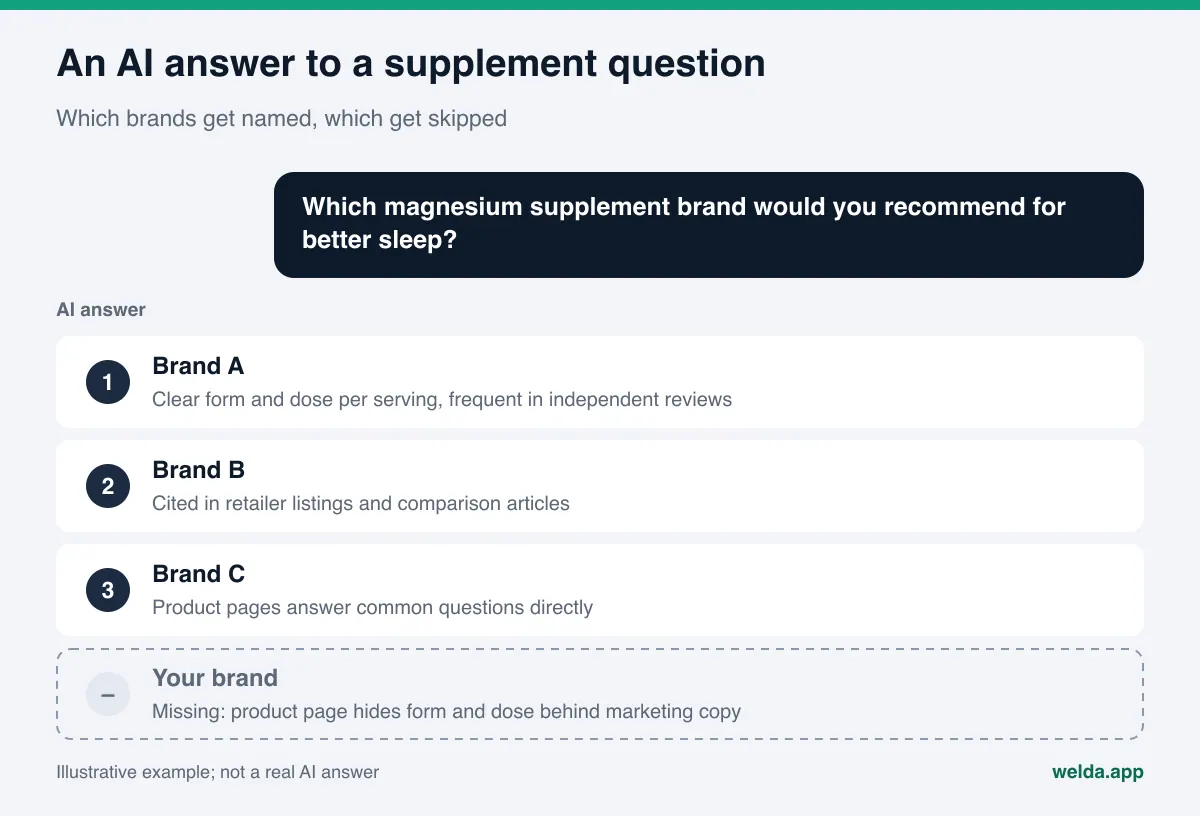
Why is AEO different for supplement brands?
Across ecommerce, AI visibility depends on two things: how clear your product information is and how many independent sources confirm it. Supplements add a third layer: health. When someone asks for a t-shirt, the model cares about price and fit. When someone asks for a vitamin, the model gets careful. That is why so many answers end with "talk to your doctor or pharmacist." Faced with a brand whose credibility is unclear, a model tends to favor brands whose facts are easy to verify and repeated consistently in several places.
The practical result is counterintuitive for many marketers: a product page packed with big promises does worse than a plain, factual one. A page that says "supercharges your immunity and ends fatigue" is a regulatory risk and gives the model nothing concrete to quote. A page that says "200 mg magnesium glycinate per capsule, one capsule daily, 60 capsules" hands the model sentences it can use directly.
The second difference is trust. Supplement buyers want to know what is in the bottle, who made it, and whether anyone outside the company has looked at it. AI engines ask the same questions on the shopper's behalf and look for answers on your site, in retailer listings, in comparison articles, on Reddit and in review profiles such as the BBB. If any of those sources is thin or contradicts the others, the answer either skips you or mentions you with hedged language.
The third difference is crowding. Dozens of brands sell the same ingredient. To tell them apart, a model looks at form, source, amount per serving, and who the product is meant for. If your pages do not state those differences, the model has nothing to separate you from the brand next to you.
What does ChatGPT look at when recommending supplement brands?
Nobody outside the AI companies knows the exact internal logic, and anyone who promises a formula is guessing. But you can observe which sources answers rely on and which facts they surface. For supplement questions, these signals come up again and again:
- Crawler access: If AI search crawlers cannot reach your site, the model only knows what others say about you. OpenAI's crawler documentation says its OAI-SearchBot is what surfaces websites in ChatGPT search, and sites that block it will not appear in those search answers.
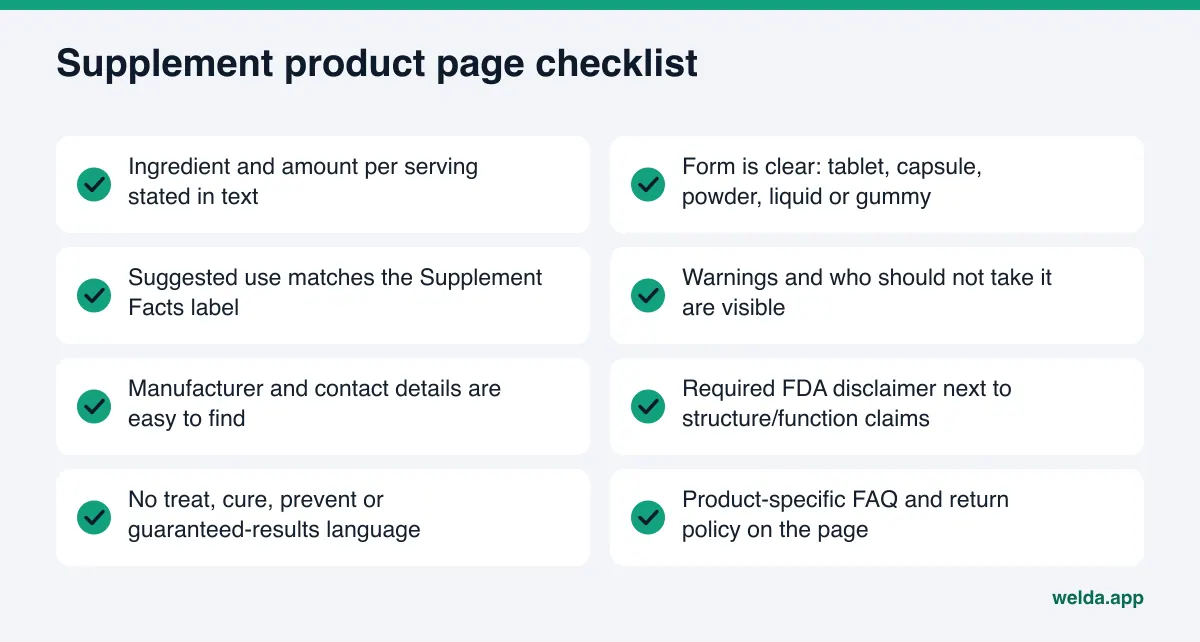
- Product facts: Ingredient, amount, form, serving size, other ingredients and warnings, written as plain sentences a model can quote.
- Brand facts: Who makes the product, where, and how to reach the company. Describing your business with structured data (Schema) helps engines recognize the brand as one entity.
- Consistency across sources: Retailer and marketplace listings, health and wellness publications, "best magnesium supplement" roundups, Reddit threads and review platforms.
- Reviews and trust signals: Real customer reviews, a visible return policy, real contact details.
- Direct answers: Clear answers to "Should I take it with food?" or "Can I take it with my multivitamin?" on the product page or in an FAQ.
Notice what is not on the list: ad spend and keyword density. An AI answer is a summary of several sources. Optimizing one page will not carry you, but your own site is still one of the most important sources the summary draws on.
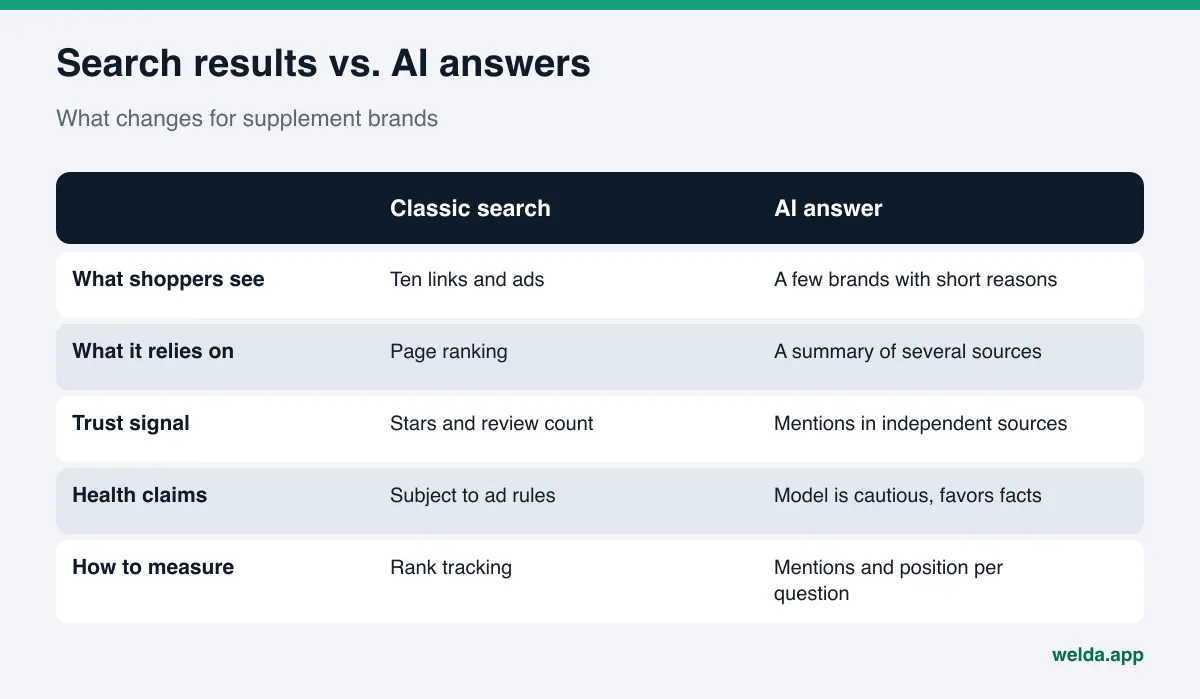
Health claims: what supplement copy should avoid
In the United States, two agencies shape what supplement copy can say. The FDA covers labeling. Its page on structure/function claims explains that supplements may describe how a nutrient affects the body's normal structure or function, that such claims must be truthful and substantiated, that the label must carry a disclaimer saying the FDA has not evaluated the claim and the product is not intended to diagnose, treat, cure or prevent any disease, and that the manufacturer must notify the FDA within 30 days of marketing a product with the claim. The FTC covers advertising. Its Health Products Compliance Guidance says health benefit claims generally need competent and reliable scientific evidence, which usually means randomized, controlled human clinical testing. This article is not legal advice; check the current rules and your counsel for your own products.
From an AEO perspective, the key point is simple: every sentence on your site is raw material for the story an AI tells about you. If you describe a product as if it treats a disease, you take on regulatory risk and also give a cautious model a reason to leave you out. The table below shows common risky patterns and the kind of factual information that can replace them:
| Risky pattern | Why it is risky | Factual alternative |
|---|---|---|
| "Cures insomnia" | Disease claim; only drugs may make it | Ingredient, amount and suggested use |
| "Works in 7 days, guaranteed" | Promise of outcome and timing | What the product is and how to take it |
| "The most effective vitamin on the market" | Superiority claim that needs strong proof | A precise description of form and source |
| "Doctor recommended" | Endorsement claim that needs support | Manufacturer and contact details |
| "Safe for everyone, no side effects" | Safety promise that erases warnings | Who should not take it, and the warnings |
The right-hand column is not a list of approved claims. It shows the difference between a claim and a fact. Have every claim you do use reviewed separately.
How supplement brands get recommended by ChatGPT: step by step
The sequence below works for a small team. Each step builds on the output of the one before.
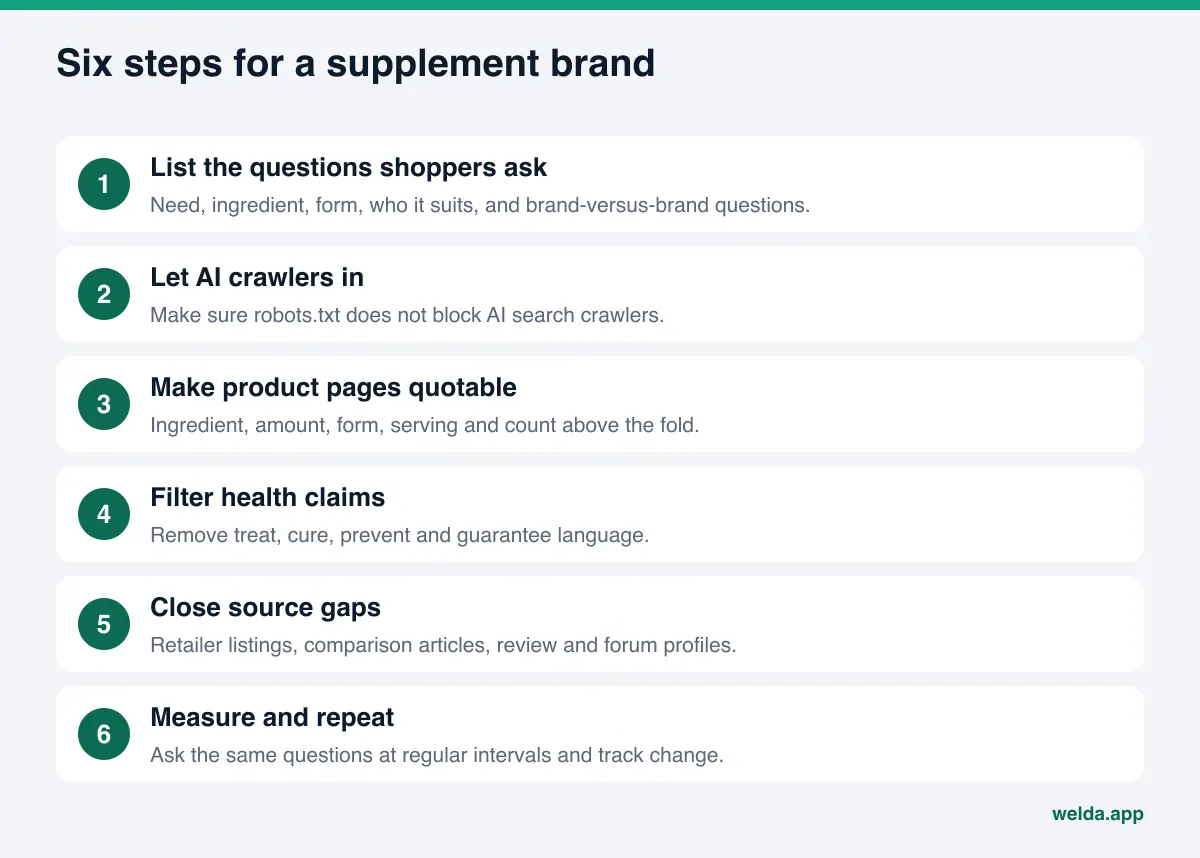
- Write down the questions shoppers actually ask. Start from the need, not your product name. Fifteen to thirty questions is a reasonable start for most catalogs. Group them: need ("best protein powder for post-workout recovery"), ingredient and form ("magnesium citrate or glycinate"), who it suits ("prenatal vitamin brand without fish oil"), trust ("is this brand third-party tested, where is it made") and direct comparison ("Brand A or Brand B"). The examples here were written for this article; they are not research data.
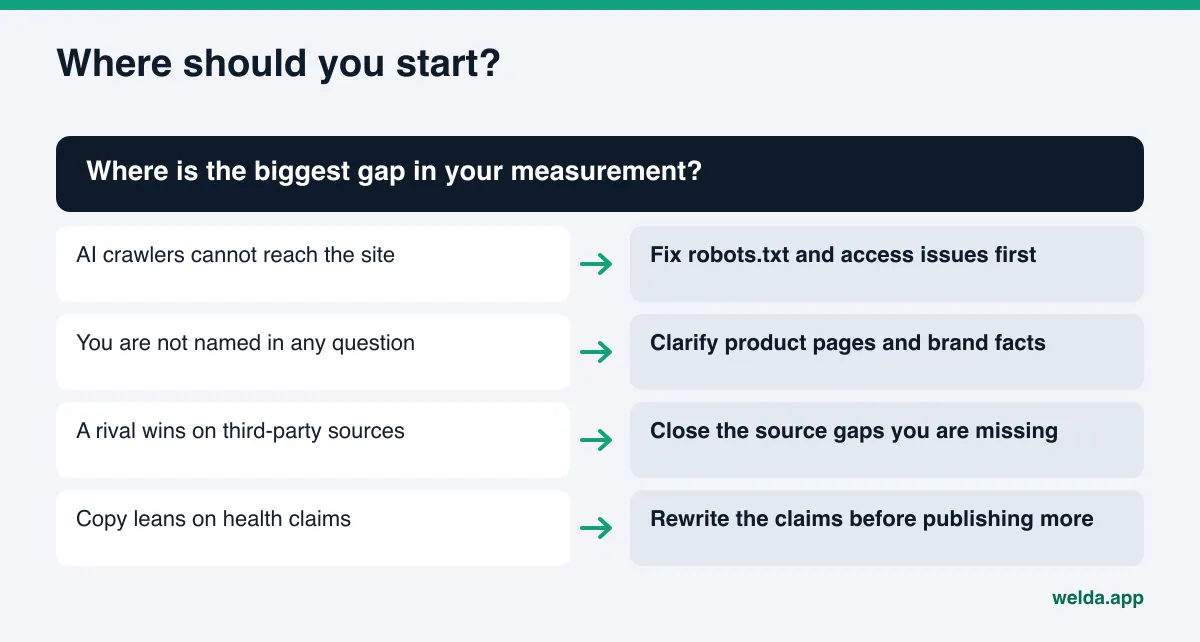
- Confirm AI crawlers can reach your site. Look at robots.txt for lines that block AI search crawlers. Ecommerce platforms sometimes ship a template file that nobody ever opens.
- Make product pages quotable. Put ingredient and amount, form, serving and count near the top in text, not only inside an image of the label. Swap long marketing paragraphs for short factual sentences. There is a deeper guide on product pages for AI shopping.
- Complete your brand page. State who makes the products, where, how quality is checked, and how to reach you. Describe the business with Schema markup and link your social profiles from the site.
- Filter health claims. Scan product copy, category pages and blog posts against the patterns in the table. Replace treat, cure, prevent and guarantee language with facts. Keep the FDA disclaimer wherever a structure/function claim appears.
- Add a product FAQ. For each hero product, answer five or six real questions: how to take it, whether it can be combined with other products, who should not take it, how to store it. Keep the "ask your doctor or pharmacist" pointer in health-related answers.
- Close source gaps. Align retailer and marketplace listings with your site. Respond to BBB complaints with a signed, specific reply. If your brand comes up on Reddit, a transparent, non-promotional answer from a named company account can be appropriate, within each community's rules.
- Collect reviews steadily. Ask real buyers for reviews and reply to negative ones calmly and concretely. Fake reviews are unethical, break platform rules and can draw regulatory attention. The link between reviews and AI answers is covered in reviews and AI recommendations.
- Measure, then repeat. Ask the same questions of the same engines at regular intervals. AI answers shift from run to run, so never decide based on one answer. Why AI answers change every time explains the reasons.
Which sources do AI engines trust for supplements?
Your site matters, but an AI answer typically blends several sources. For supplements, common source types include large marketplace listings such as Amazon, pharmacy and wellness retailer sites, health sections of news and lifestyle publications, "best of" comparison articles, Reddit threads and review profiles. Which ones carry weight changes from question to question and engine to engine.
The job here is to find the sources where a competitor gets cited and you do not appear at all. This is called citation gap analysis; the method is laid out step by step in citation gap analysis. For a supplement brand, the gap usually looks like one of these:
- The product sells on a marketplace, but the listing is thin or contradicts your own site.
- Roundup articles name competitors and skip you, because writers could not find clear product facts to cite.
- Unanswered complaints sit on a review platform, and the model summarizes them with cautious wording.
- Your brand name is spelled differently in different places, and the model treats it as two brands.
Press outreach, directory listings and community participation are your work and should never be done under a fake identity. But knowing which sources matter most lets you spend time and budget where they count.
A worked example: one vitamin D brand, one month
Here is an illustrative scenario, not a real company. A small direct-to-consumer brand sells vitamin D3 drops and gummies. It writes 20 questions, measures them, and finds a pattern: it is named for broad questions such as "good vitamin D drops brand" but never for "vitamin D drops for toddlers" or "vegan vitamin D3 brand," even though its drops are plant-based.
The cause turns out to be simple. The fact that the D3 comes from lichen sits only inside a label image. The product page never says "vegan" in text, and there is no FAQ about children. The brand rewrites the top of the page with a short factual block (source, amount per drop, servings per bottle), adds an FAQ that sends age-specific questions to a pediatrician, and updates its marketplace listing to match. It does not add any new health claim. Then it keeps measuring for several weeks, because new content usually takes weeks to show up in AI answers.
The point of the example is the method, not an outcome: find the question where you are missing, find the missing fact, publish the fact without inflating it, and measure again.
How Welda does this work
Welda is software that measures where a business shows up in AI answers and prepares the fixes on the business's behalf. For a supplement brand, three parts matter most: question tracking, the score behind it, and the compliance check before anything goes live.
Question tracking: which questions name you? In Welda, questions built around your catalog are asked on ChatGPT, Gemini, Perplexity and Google AI, three times each. Every question is a row. For each engine you see whether your brand was named and in what position. For a supplement brand, a typical reading might be: you appear in generic questions on some engines but disappear in "for kids" or "for pregnancy" questions. That is where the decision happens. Is the information missing from your site, or is it there but the engines cannot find it? Opening a row shows which sources the answer relied on.
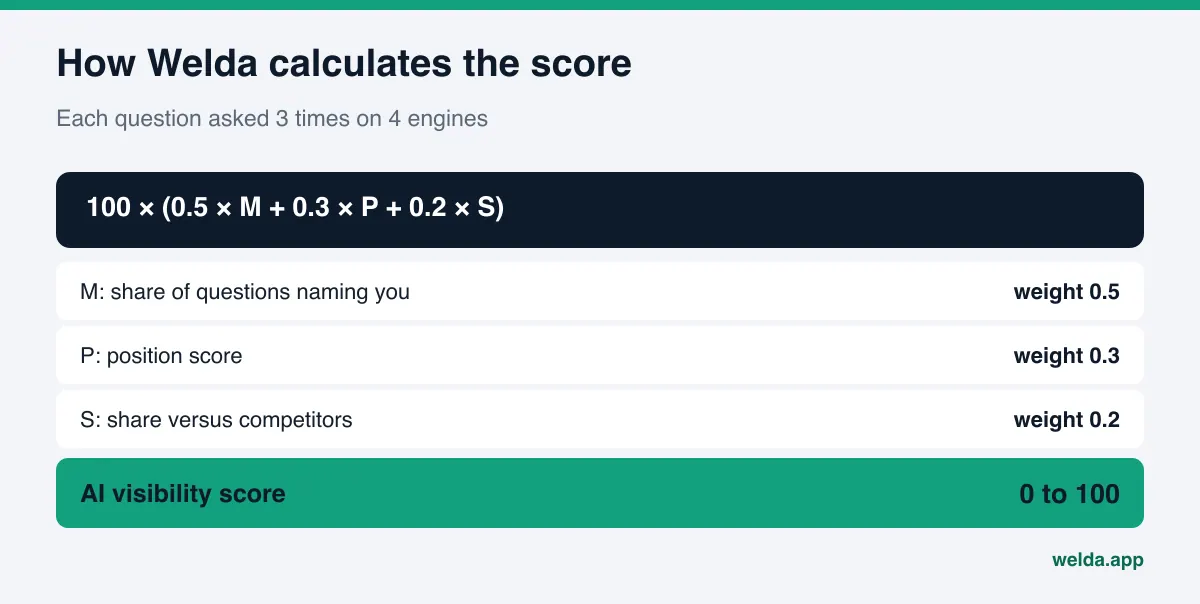
The score: a formula you can read. The score is not a black box: 100 × (0.5 × share of questions that name you + 0.3 × position score + 0.2 × share versus competitors). Because each question runs three times, the spread between runs produces a plus-or-minus margin. That keeps you from reacting to one lucky or unlucky answer. If you want context on what the number means, see what a good AI visibility score is.
Compliance check and approval: copy is filtered before it ships. Welda drafts product page copy, FAQs and review replies. Before anything is published, it flags patterns such as pricing, guarantee and superiority claims and diagnosis-style suggestions. For a supplement brand, that means phrases like "cures" or "most effective" are put in front of you before they can go live. This check is not legal advice and has not been reviewed by legal counsel; the final call is yours. Nothing goes live without your approval, and Welda never invents a fact it does not have. If it needs your vitamin D source or your testing details, it asks you.
On WordPress sites, Welda connects without installing code, through a separate Editor user and an application password you create for it. Drafts open on your site and go live only after you approve them. On other ecommerce platforms, Welda gives you a ready fix package and your team applies it. Content always lives on your own site; Welda does not host content.
About availability: the Welda dashboard is in early access and is opening first in Turkey. Regular four-engine measurement is being added during early access, and sample dashboard screens use representative data. The part anyone can use today is the free site analysis, which works in English. It reads your homepage and a few inner pages, scores what it finds out of 100, explains each gap and how to fix it, and runs a one-time check that asks five likely customer questions to an AI assistant with web search to see whether your name comes up. Pricing is discussed in the early access conversation.
Limits: what Welda does not do for supplement brands
In a regulated category, knowing what cannot be done matters as much as knowing what can.
- No ranking guarantees. Welda does not promise that ChatGPT will name you or that you will hold a given position. Nobody controls AI answers.
- No guessing. Welda does not invent ingredient amounts, testing details or manufacturing facts. It asks you.
- No sensitive content without approval. Every health-related piece comes to you before publishing.
- No fake reviews. Collecting reviews and handling negative ones stays with you; Welda drafts replies only.
- Outside work stays with you. Marketplace accounts, directory listings and press outreach are in your hands.
- No legal opinion. The compliance check scans for patterns; it does not interpret FDA or FTC rules for you.
Timing is the other limit. New content usually takes weeks to show up in AI answers. Seeing no change in week one does not mean the work failed. That is why measurement should be regular, not one-off.
Decision checklist: is your supplement brand ready for AI answers?
Fill this in with your team. Every "no" becomes a line on your to-do list.
| Check | Where to look | If no, first move |
|---|---|---|
| Can AI search crawlers reach the site? | robots.txt | Remove the blocking rule |
| Are ingredient and amount stated in text near the top? | Product pages | Add a short factual summary block |
| Are manufacturer and contact details visible? | Product and about pages | State them once, clearly |
| Does copy imply treating or curing anything? | Product, category, blog | Replace claims with facts |
| Is the FDA disclaimer next to every structure/function claim? | Product pages, ads | Add it or remove the claim |
| Does each hero product have an FAQ? | Product pages | Write five or six short answers |
| Do marketplace listings match your site? | Retailer listings | Use one shared fact sheet |
| Do you know which questions name you? | Measurement | Build a question set and measure |
If you also sell skincare or beauty products, the same claim-versus-fact line matters there; see AI visibility software for beauty and skincare brands.
Frequently asked questions
Does ChatGPT recommend supplement brands, or does it always defer to a doctor?
Often it does both: it names a few brands or product types and suggests checking with a professional. Whether a brand gets named depends on the question, the engine and the sources. The only way to know is to ask the same questions on several engines, more than once.
Can I put health claims on my supplement product pages?
FDA and FTC rules govern what you can say, and this article is not legal advice. Structure/function claims need substantiation and the FDA disclaimer; disease claims are off limits for supplements. For AEO, the safest path is to lead with facts: ingredient, amount, form and suggested use.
I mostly sell on Amazon. Does my own site still matter?
Yes. A marketplace listing is one source among many. Your own site is the single, consistent home for brand facts, product details and FAQs. If AI crawlers cannot reach it, engines only know what other sites say about you.
How long until changes show up in AI answers?
New or corrected content usually takes weeks to appear. Be wary of anyone who quotes an exact timeline. Regular measurement tells you what worked once the change shows up.
Will Welda confirm my supplement copy is compliant?
No. Welda's compliance check flags risky patterns before publishing, but it is not legal advice and has not been reviewed by legal counsel. Responsibility for claims stays with the brand.
What does the free analysis check on a supplement site?
It reads your homepage and a few inner pages such as about, pricing and contact. It checks crawler access, title and description, Schema business information, FAQ content, trust signals and page speed, and explains each gap and how to fix it. It is free once per site.
Your first step
For supplement brands, AI search visibility rests on three things: quotable product facts, consistent third-party sources and copy that stays inside the claim rules. Rather than guessing which one you are missing, start by measuring. The free AI visibility analysis reads your site the way Google and AI engines do, scores it, and gives you ready-to-use fixes. Your results link arrives by email and stays open for 14 days. Once you finish the first three fixes it suggests, come back to the checklist above.