How do you get product pages recommended when shoppers ask AI? Make every fact a shopper needs readable on the page itself: what the product is, who it is for, price, stock, shipping time, return terms and real reviews. ChatGPT, Gemini, Perplexity and Google's AI Overviews can only recommend what they can read and verify. This guide explains how to build product pages for AI shopping, step by step, and where your store's reputation outside your own site comes in.
In the US, this work is usually called AEO, short for answer engine optimization. You will also see the term GEO (generative engine optimization); both describe the same goal of being named inside an AI answer rather than ranked in a list of links. For an online store, AEO changes who your product page is written for. It still has to convince a human shopper, but it also has to give an AI assistant clear, quotable facts it can use to explain why your product fits. If you want to see how your own site reads to AI today, run a free AI visibility analysis. It lists each gap it finds, why it matters and how to fix it.
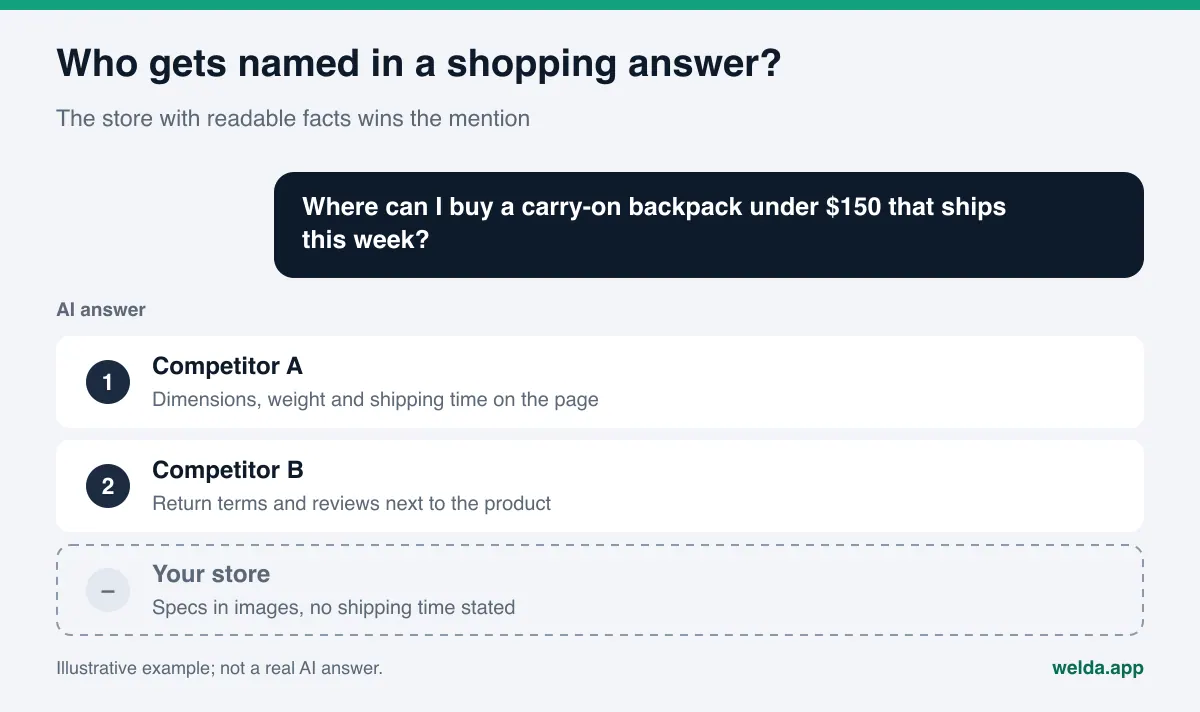
How AI shopping recommendations are built
When a shopper asks an assistant for a product, the engine usually runs a web search, reads a handful of pages and returns a short list with a reason next to each option. Those reasons come from somewhere. A line like "linen, relaxed fit, ships in two business days, free returns within 30 days" was lifted from a page the engine could read. If it cannot read your page, it cannot recommend your product. If it recommends the product anyway, it may do so through a retailer or marketplace that explains it better than you do.
Three inputs work together:
- Your own product and category pages: product name, description, specs, price, stock status, shipping and return terms.
- Third-party sources: marketplace listings, review and comparison sites, publications, Reddit threads and other forums.
- Trust signals: reviews and how you respond to them, clear company information, contact options, a visible return process, social profiles linked from the site.
Google states that there are no additional technical requirements for appearing in AI Overviews or AI Mode, and no special schema to add. A page needs to be indexed and eligible to show in Search with a snippet. That is good news, because most of the work is simply writing a complete, honest product page. It is also a warning: information that sits only in an image, behind a tab that loads late, or nowhere at all, does not exist as far as the answer is concerned.
Access is the other half. For ChatGPT search, OpenAI recommends allowing its OAI-SearchBot crawler in robots.txt; sites that block it will not appear in ChatGPT search answers. Some ecommerce platforms and security tools block unknown bots by default. However good your product pages are, if the crawler is turned away at the door, they cannot be a source.
What shoppers actually ask AI before they buy
Before you rewrite anything, decide which questions your product pages need to answer. Shopping prompts are rarely as simple as "best running shoes." They carry budget, use case, delivery deadlines and doubts about the seller. Typical examples look like this (written here as illustrations, not as measured data):
- "What's a good carry-on backpack under $150 that fits under an airline seat?"
- "Which online stores sell organic cotton baby clothes and ship within two days?"
- "Is this brand legit? Has anyone ordered from them?"
- "Best cast iron skillet for a glass-top stove?"
- "Where can I buy a standing desk with free returns?"
Notice how few of these are answered by a product description alone. Shipping speed, return terms, whether the seller is trustworthy and which product suits a specific situation are all part of the question. For AI, a "product page" is the product plus everything that makes the store believable. We cover how to collect real questions in find the questions customers ask AI.
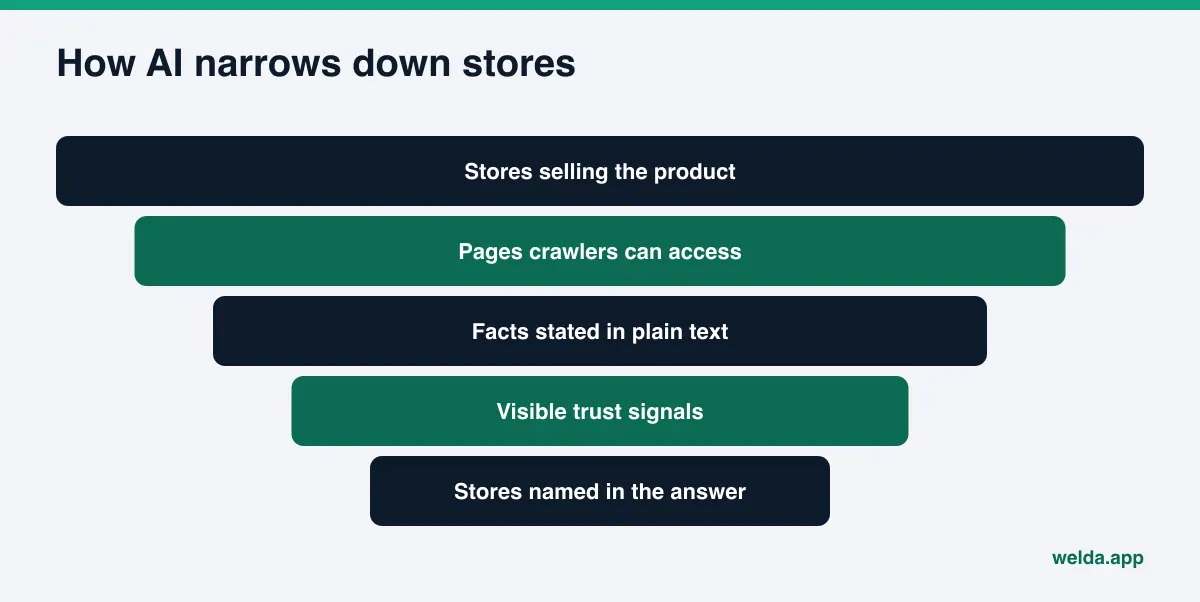
What AI looks for on product pages for AI shopping
The table below lists the information a strong product page carries, the shopper question each piece answers and the mistake that most often hides it. Every row should live on the page as readable text.
| Information | Question it answers | Common mistake |
|---|---|---|
| Clear product name and type | "What is it, exactly?" | Only a SKU or a seasonal campaign name |
| Who it suits and for what use | "Is it right for a beginner?" | Generic praise, no use case |
| Dimensions, materials, specs | "Will it fit in my car?" | Specs printed only inside product images |
| Price and stock status | "Is it under my budget and in stock?" | Price shown only after add to cart |
| Shipping time and regions | "Will it arrive by Friday?" | "Fast shipping" with no number of days |
| Returns and exchanges | "Can I send it back?" | Policy buried in the terms of service |
| Payment options | "Can I pay in installments?" | Options visible only at checkout |
| Reviews and Q&A | "Are buyers happy with it?" | Reviews load late or do not exist |
Most stores already have all of this information. The problem is where it lives. Shipping time sits in a header banner, the return window in paragraph seven of the policy page, the size chart in a JPEG. A human shopper may dig it out. An AI assistant often will not, or will summarize it wrongly.
Optimizing product pages for AI shopping, step by step
You do not need to rework the whole catalog at once. If you sell hundreds of products, start with the best sellers and the main category pages. Then work through these steps:
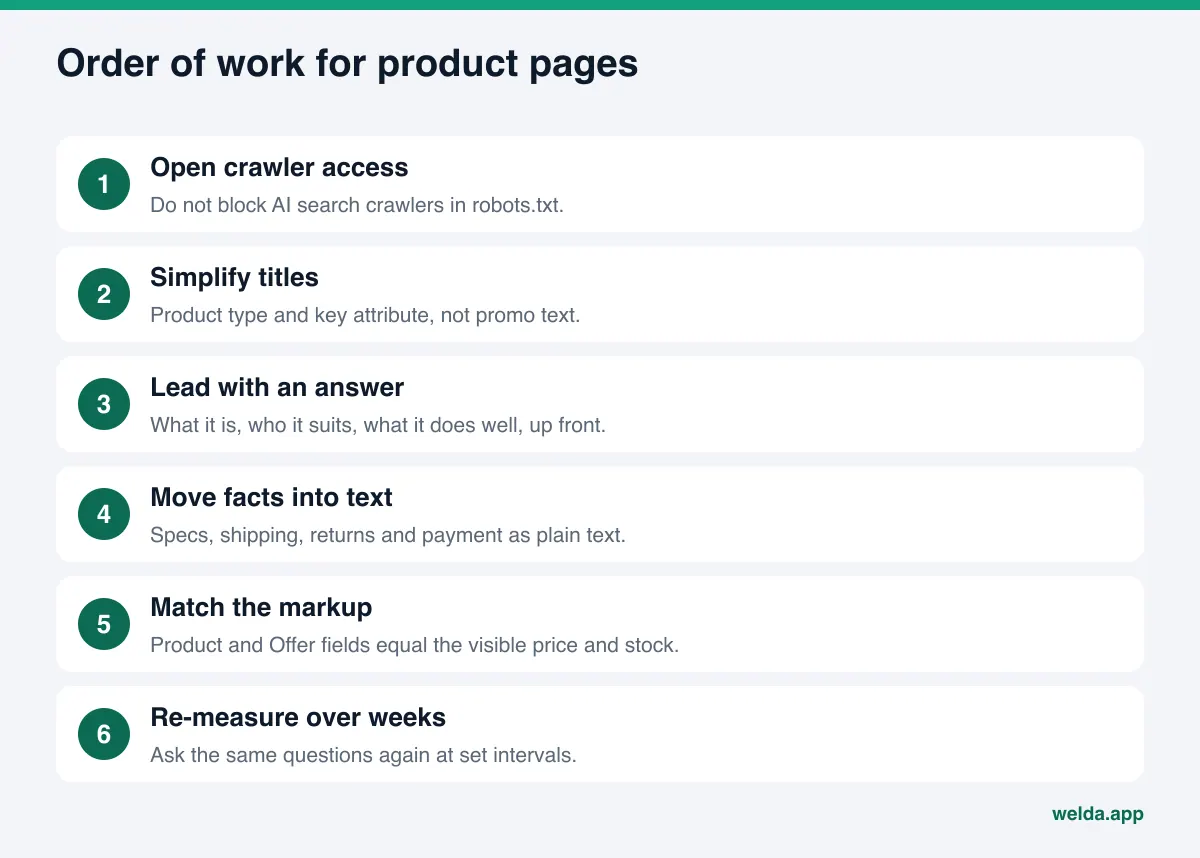
- Check crawler access. Look at robots.txt for blocked AI search crawlers. Confirm product pages open without a login and that the main content is in the page source, not only rendered later by scripts.
- Simplify product titles. Put the product type, key attribute and, where relevant, size or color in the title. Move "Black Friday deal" and other promo text out of it.
- Write the first paragraph as an answer. The opening two or three sentences should say what the product is, who it suits and what it does well. Details come after. We show this pattern in answer-first content.
- Move specs out of images. Put size charts, materials and care instructions on the page as text or an HTML table, in addition to any graphics.
- Summarize shipping, returns and payment next to the product. Link to the full policy, but give the short version on the page: ships in how many business days, returns within how many days, which payment options.
- Add product structured data and match it to visible text. Details in the next section.
- Add real questions with answers. Take the five to ten questions your support inbox gets most and answer them on the relevant product or category page. See FAQ pages for AEO for format.
- Make reviews visible and reply to them. Show genuine reviews as text on the page and give specific, signed replies to negative ones.
- Measure, then measure again weeks later. New content usually takes weeks to show up in AI answers. Do not judge the result on a single query.
Product structured data: what Product and Offer markup do
Structured data labels the facts on a page in a format machines read reliably. For product pages, the core type is Product, with an Offer inside it for price and availability. According to Google's merchant listing documentation, name, image and offers are required for the product, and price and currency are required for the offer. Availability, GTIN, brand, shipping details, return policy and aggregate rating are recommended.
Three points matter most:
- Markup must match what the shopper sees. If the page says $89 and the markup says something else, both search engines and AI see a contradiction. Google lists matching structured data to visible text as a standard best practice.
- Markup alone is not enough. Google says no special schema is needed for its AI features. Structured data supports a clear page; it does not replace the description, the shipping summary or the reviews.
- Shipping and return policies can be defined once. Google also suggests declaring these at the organization level rather than repeating them for every offer. A short, visible summary on the product page still helps shoppers and AI alike.
Most ecommerce platforms generate basic product markup automatically. The job is usually not writing code from scratch but filling the gaps the platform leaves (availability, brand, GTIN) and checking that the price in the markup matches the price on the page. Google's Rich Results Test or your platform's own preview is enough for a quick check on a few best sellers.
Example: one product page before and after
Here is an illustrative scenario. An example small home goods brand sells a cast iron skillet. Today its product page title reads "HOLIDAY SALE 12-INCH SKILLET 25% OFF." The description opens with "Crafted for the modern kitchen." Dimensions and weight appear only in a product photo, shipping details live in a site-wide banner and the return policy is a separate page. When a shopper asks AI "which cast iron skillet works on a glass-top stove and ships fast," the page offers nothing the engine can quote.
| Field | Before | After |
|---|---|---|
| Title | Promo text and discount | "12-inch cast iron skillet, pre-seasoned, flat base" |
| First paragraph | Generic praise | Size, weight, which stovetops it works on, care in one line |
| Specs | Inside an image | HTML table: diameter, depth, weight, handle length |
| Shipping | Site-wide banner | Next to the price: ships within a stated number of business days |
| Returns | Separate policy page | Short summary on the page plus a link |
| Questions | None | "Does it work on induction?", "Is it dishwasher safe?" with answers |
None of this needs new technology. It moves information the brand already has into a place where it can be read. The rewritten page gives an assistant the material for a reason such as "flat base suited to glass tops, ships in a few days, clear return terms." That is no guarantee of a recommendation, but without it a recommendation is unlikely.
Beyond the product page: categories, guides and third-party sources
AI shopping answers do not rely on product pages alone. For a question like "which standing desk should I buy," an engine often reads buying guides, comparison articles and forum threads first, then names products. If your site has no category intro or buying guide that answers the question, another site frames the answer.
Category pages earn their place here. A short block of text above or below the product grid can answer "what should I look for in this category, and which option suits whom." It does not replace the product list, but it gives the engine a reason to treat your store as a source of advice, not just inventory.
Third-party sources are separate work. Your Amazon or Etsy storefront, your Trustpilot and BBB profiles, Google Business Profile if you have a physical location, and Reddit threads about your brand all shape the answer to "is this store legit?" without your input. We cover how forums feed AI answers in Reddit and AI answers and the role of ratings in reviews and AI recommendations.
One rule applies to all review work. The FTC's final rule on fake reviews and testimonials, announced in August 2024, prohibits fake reviews, including AI-generated ones, and prohibits presenting a review section as complete when negative reviews were suppressed. This is not legal advice; check the rule with your own counsel. In practice it means asking real customers for reviews and showing them as they are.
How Welda handles product pages for AI shopping
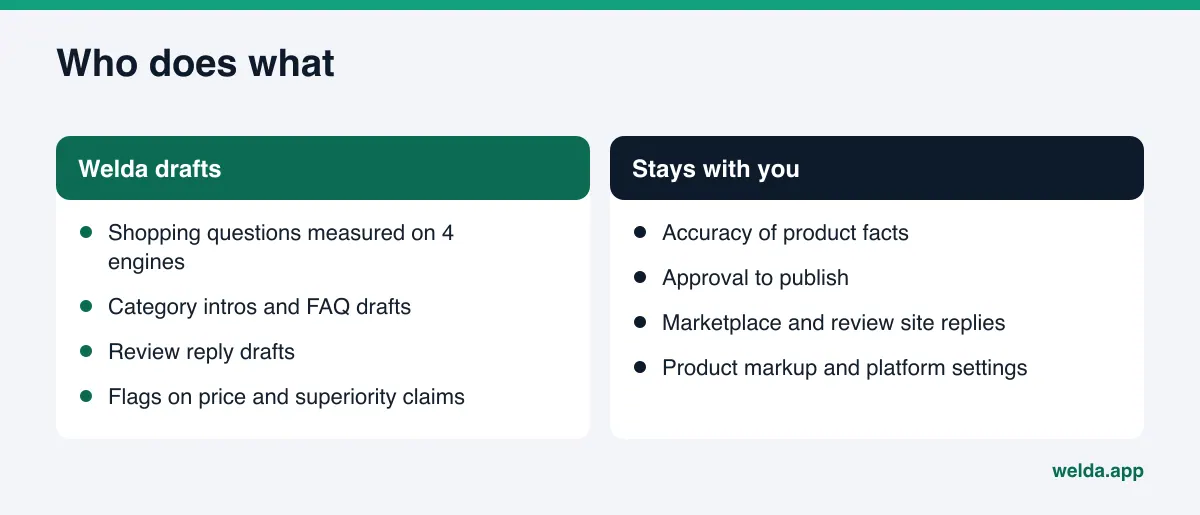
Welda's work on this topic has two parts: measure whether your brand is named in shopping questions, then prepare the missing content and put it in front of you for approval. Three parts of the product matter most here.
Question tracking. The panel lists the questions your shoppers are likely to ask, such as "where to buy ... with fast shipping" or "is ... a trustworthy online store." Each question is asked three times on ChatGPT, Gemini, Perplexity and Google AI, and you see, question by question, whether your brand is named and in what position. For a store, the value is in the pattern. If you appear in product comparison questions but never in trust or delivery questions, the gap is probably not your product copy. It is shipping, returns or company information.
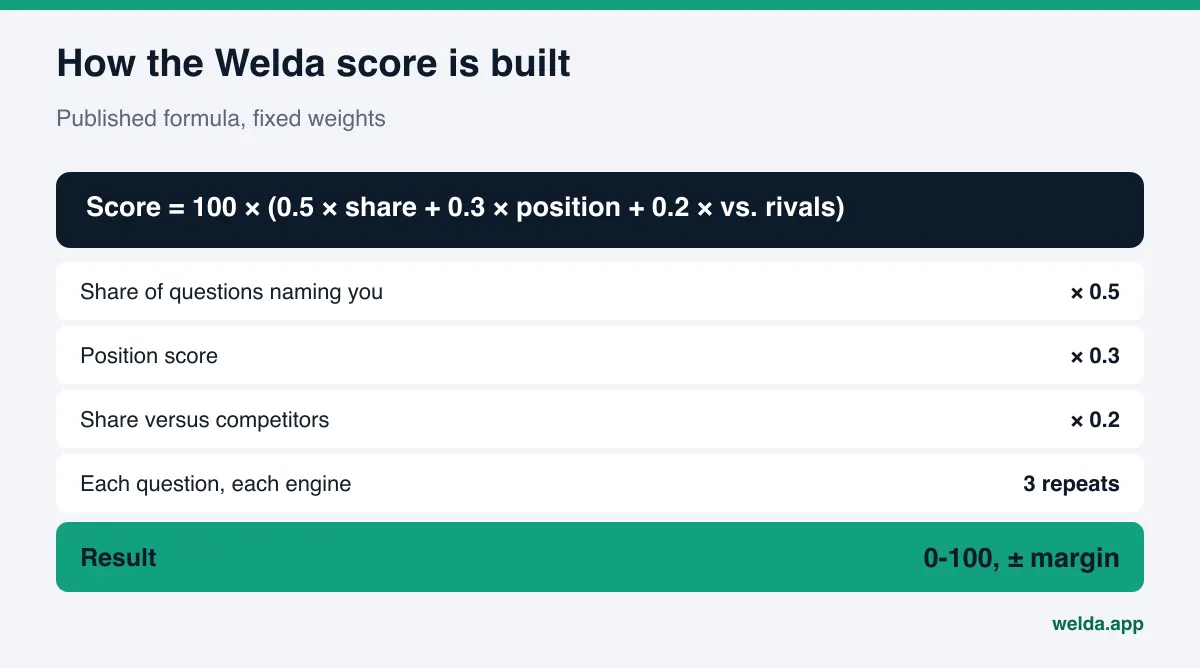
Sources and competitors. A separate screen collects the sites AI cites when it answers, and the competitor view shows which topic a rival store wins and which source carries it. Whether a competitor is lifted by its own product page, a comparison article or a Reddit thread tells you whether to work on your pages or on outside sources.
A single to-do list. The work from the measurement lands in one list. If something cannot be read from your site, such as your return window or shipping cut-off time, Welda does not guess. It asks you. Drafted content (category intros, FAQ answers, buying guide drafts, profile copy, review replies) waits for your approval. On WordPress sites Welda connects through a separate Editor user, and content opens on your site as a draft until you approve it. On other platforms Welda hands you a ready package and you or your team apply it. Content always lives on your own site; Welda does not host it.
The free site analysis is the starting point. It reads your homepage and a few inner pages, such as services, pricing, about and contact, and checks whether AI crawlers can get in, your titles and descriptions, business structured data, FAQ content, reviews and trust signals, and page speed. It does not audit every product page one by one, but it shows the site-wide issues that hold all of them back. It also asks five likely customer questions to an AI assistant that can search the web and checks once whether your brand is named.
A clear note on availability: the free analysis works in English and German today. The full Welda panel is in early access and is opening first with businesses in Turkey. Four-engine tracking on a regular schedule is being added during early access, and sample panel screens use representative data. Pricing is discussed in an early access conversation.
Limits: what Welda does not do
- No guarantees. Welda does not promise that ChatGPT or any other engine will recommend your products or rank them in a set position. The free analysis does not measure rankings.
- No invented product facts. Materials, dimensions, warranty terms and shipping times are not guessed; Welda asks.
- No fake reviews. Welda drafts review replies, never reviews.
- No publishing without approval. Every piece of content goes live only when you approve it.
- No marketplace or directory management. Amazon or Etsy listings, responses on review platforms, directory accounts and PR stay with you. Google Business Profile, Instagram and Facebook can be connected; if they are not, the task is listed as manual work.
Welda's compliance check flags price claims, guarantees and superiority claims such as "best" or "cheapest" before anything is published. It is a prompt to review, not legal advice, and it has not been reviewed by legal counsel.
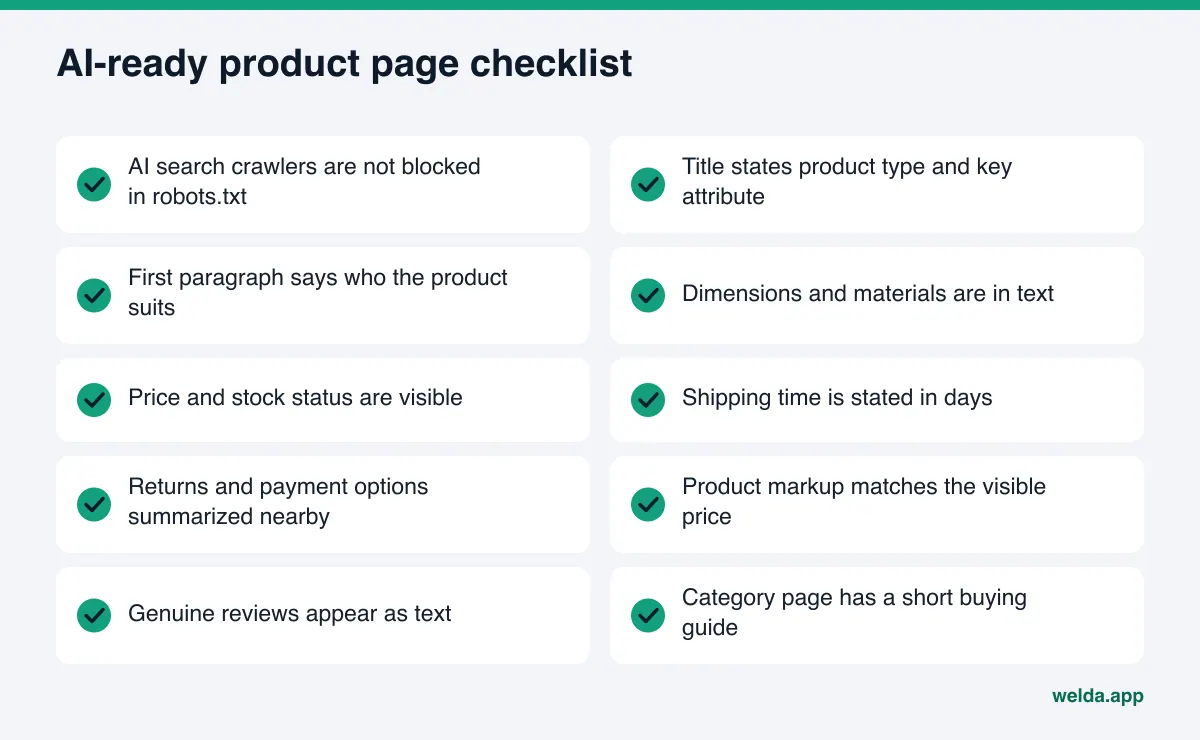
Checklist and decision guide for AI-ready product pages
Open your ten best-selling products and run through the checklist below. Every "no" is a fact an AI assistant cannot use when deciding whether to name you.
To decide where to start, match your situation to the first task:
| Situation | Do this first |
|---|---|
| AI crawlers blocked in robots.txt | Open access; nothing else matters until you do |
| Specs live inside images | Move sizes, materials and care into text |
| Never named in trust questions | Make shipping, returns, payment and company info visible |
| Competitors win through comparison articles | Write category intros and buying guides |
| Complaint threads show up in answers | Reply to open complaints; explain your process on site |
| Markup missing or inconsistent | Match price, availability and brand to visible text |
For a wider plan across the store, see AEO for ecommerce managers.
Frequently asked questions
Will adding product schema get my products into AI answers?
Not on its own. Google says no special structured data is needed for its AI features. Markup supports clear, consistent information on the page; it does not replace the description, shipping summary or reviews.
Do I need to rewrite every product description?
No. Start with best sellers and category pages. Often the bigger win is moving information that already exists, in images or policy pages, into a short summary next to the product.
I sell mostly on Amazon. Does my own site still matter?
Marketplace listings can be cited in AI answers, but the format and rules there are not yours. Your own site is where you explain who you are, how returns work and what makes your products different, in your own words.
Does Welda audit each of my product pages?
The free analysis reads your homepage and a few inner pages; it does not audit each product page individually. It shows site-wide issues, such as crawler access, business information and trust signals, that affect all product pages. The panel measures whether your brand is named in shopping questions and drafts the missing content.
How long until changes show up in AI answers?
New content usually takes weeks to be reflected. Measure the same questions at regular intervals rather than judging on one query.
Is optimizing for AI shopping different from SEO?
It overlaps. Crawlable, well-structured pages help both. The difference is that AEO cares whether an assistant can lift a clear reason to recommend you, so plain-language facts about fit, shipping and returns matter more than keyword placement.
Next step
The link between product pages and AI shopping answers usually breaks at one point: the crawler is blocked, the facts are in images, or the trust question has no answer on your site. To find out which applies to you, start a free AI visibility analysis. The report shows how AI reads your site, why each gap matters and how to fix it, with suggested homepage copy and a ready fix package for your site.