What does AI search optimization for day spas and massage studios involve? It means making sure that when someone asks ChatGPT, Gemini, Perplexity or Google's AI Overviews for "a good deep tissue massage near me" or "a day spa with a couples room," the answer has enough clear, consistent information to include your business. You start by confirming AI crawlers can read your site, then write out your massage types, session lengths, location, hours, and booking policy as plain text. Nobody can guarantee a mention or a position, but readable and consistent information makes one more likely.
This guide is for independent massage studios, day spas, wellness spas that sell packages, and hotel spas that take outside guests. The question it answers: when a customer types "massage studio open after 7pm in Midtown that takes same-day bookings" or "where can I book a spa day for my mom's birthday," does the AI assistant name you? If not, why not, and what should you fix first? This practice is usually called AEO (answer engine optimization). You will also see it called GEO, generative engine optimization; the two terms describe the same work. We cover the problem, the steps, how Welda handles the work, and what it does not do. If you want to see where your site stands right now, start with the free site analysis.
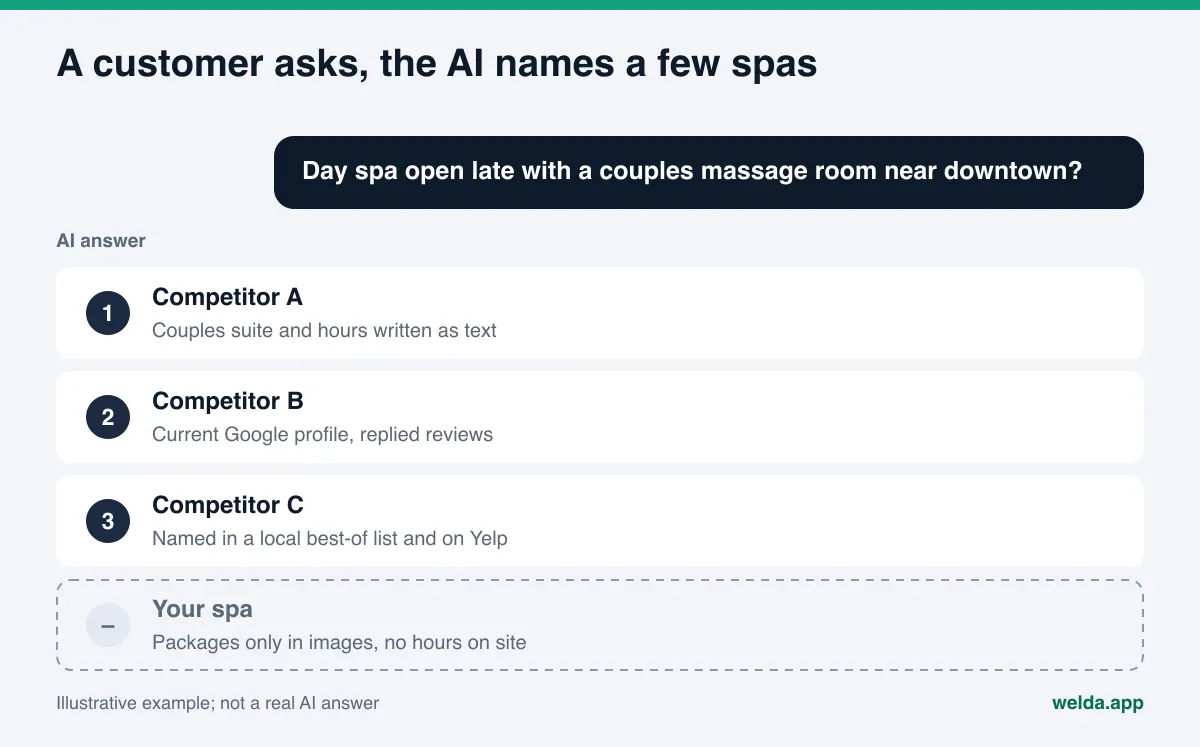
Why AI search optimization matters for day spas and massage studios
People rarely book a massage months in advance. They search when a need shows up: a stiff back after a long week, a last-minute gift, an anniversary, a bachelorette weekend, or a business trip with a free evening. They compare a few options, pick one, and book. If your business is not in that short list, you are not part of the decision.
The way people build that short list is changing. A few years ago, a customer would open a map, type "massage," and scroll through photos and star ratings. Today the same customer can describe everything in one sentence to an AI assistant: neighborhood, type of massage, number of people, budget, time of day. The assistant replies with a handful of names and a short reason for each: "known for deep tissue work in reviews," "has a couples suite," "open late on weekends." Those reasons come from what the assistant can find on your website, your Google Business Profile, Yelp, and pages that mention you.
Spas and massage studios face a few specific hurdles in AI answers:
- Service names vary. Swedish, deep tissue, hot stone, aromatherapy, sports massage, prenatal, Thai, reflexology, lymphatic drainage, cupping, CBD add-ons. If a customer asks for one name and your menu uses a branded package name, the match is weak.
- Sites are built around mood, not facts. Many spa sites are dim photos and a tagline like "escape the everyday." The service menu is often a PDF or an image. An assistant cannot reliably read "60-minute hot stone, open until 9pm" from a photo.
- Trust questions are personal. Customers ask about cleanliness, therapist credentials, whether they can request a female or male therapist, and what to wear. If your site does not answer these, the assistant answers them with someone else's pages.
- Health language carries risk. "Cures back pain" or "detoxes your body" can mislead customers and create advertising problems. Good AEO describes the service clearly without promising treatment outcomes.
Many of these steps overlap with other appointment-based beauty businesses. If you want a parallel example, see how nail salons get recommended by ChatGPT; most of the logic carries over to massage.
What customers ask AI assistants about spas and massage
The questions below are illustrative examples we wrote to show the pattern, not results from a study. The point is to see which piece of information each question depends on. Add the questions your front desk hears every day by phone, text, and email; those are the most valuable ones.
| Question type | Example question | What the answer relies on |
|---|---|---|
| Location and hours | "Massage studio open Sunday evening near downtown?" | Address, neighborhood name, daily hours, Google Business Profile |
| Massage type | "Where can I get a good deep tissue massage?" | A section per massage type, session lengths, pressure level |
| Occasion | "Day spa with a couples massage room for an anniversary?" | Couples suite, packages, how to book for two |
| Gift | "Spa gift card I can buy online for a friend?" | Gift card page, how it is redeemed, expiration terms |
| Trust | "Clean massage place where I can request a female therapist?" | Therapist preference policy, hygiene practices, reviews |
| Visitors | "Hotel spa that accepts non-guests near the convention center?" | Outside guest policy, day pass, hours separate from the hotel |
| Special situations | "Can I get a massage while pregnant, and where?" | Prenatal service description, physician note policy |
Every row needs a matching piece of text on your site. To show up for "couples massage," you need a sentence that says you have a couples room. To show up for "open Sunday evening," your hours need to be on your site and on your Google Business Profile, and they need to match. Hotel spas lose a lot of questions simply because no page says "open to non-guests."
Why AI assistants skip a spa or massage studio
When a spa is missing from AI answers, the causes tend to repeat. Use this list as you review your own site:
- Crawlers are blocked. Your robots.txt file may block search or AI crawlers. OpenAI, for example, documents that its OAI-SearchBot crawler needs access for a site to appear in ChatGPT search answers. Theme defaults and security plugins sometimes block these crawlers without anyone noticing.
- Services exist only in images. The menu is a graphic, the prices are in a PDF, and the page text says only "relax, restore, renew."
- Location is vague. The address sits in a tiny footer, with no neighborhood name, parking notes, or nearby landmark. Hotel spas often do not say whether outside guests are welcome.
- No structured data. There is no business markup that search engines and AI systems can parse. Schema.org has a DaySpa type under HealthAndBeautyBusiness, which can carry your name, address, phone, hours, and profile links.
- Profiles disagree with the site. Google Business Profile shows one set of hours, Yelp another, and the website a third. When the assistant sees conflicts, it may skip you or repeat the wrong detail.
- No FAQ. The questions people ask most (what to wear, when to arrive, cancellation policy, tipping, therapist preference) are not answered anywhere.
- Silent reviews. Reviews exist on Google and Yelp, but none have replies, and a critical one sits unanswered.
Most of these are writing problems, not technical ones. If your site is built with a JavaScript framework and you are unsure what crawlers see, JavaScript rendering and AI crawlers covers that question in detail.
AI search optimization for day spas and massage studios, step by step
The order below starts with the most basic blocker and moves toward trust signals. Order matters: if crawlers cannot read your site, new service pages will not help.
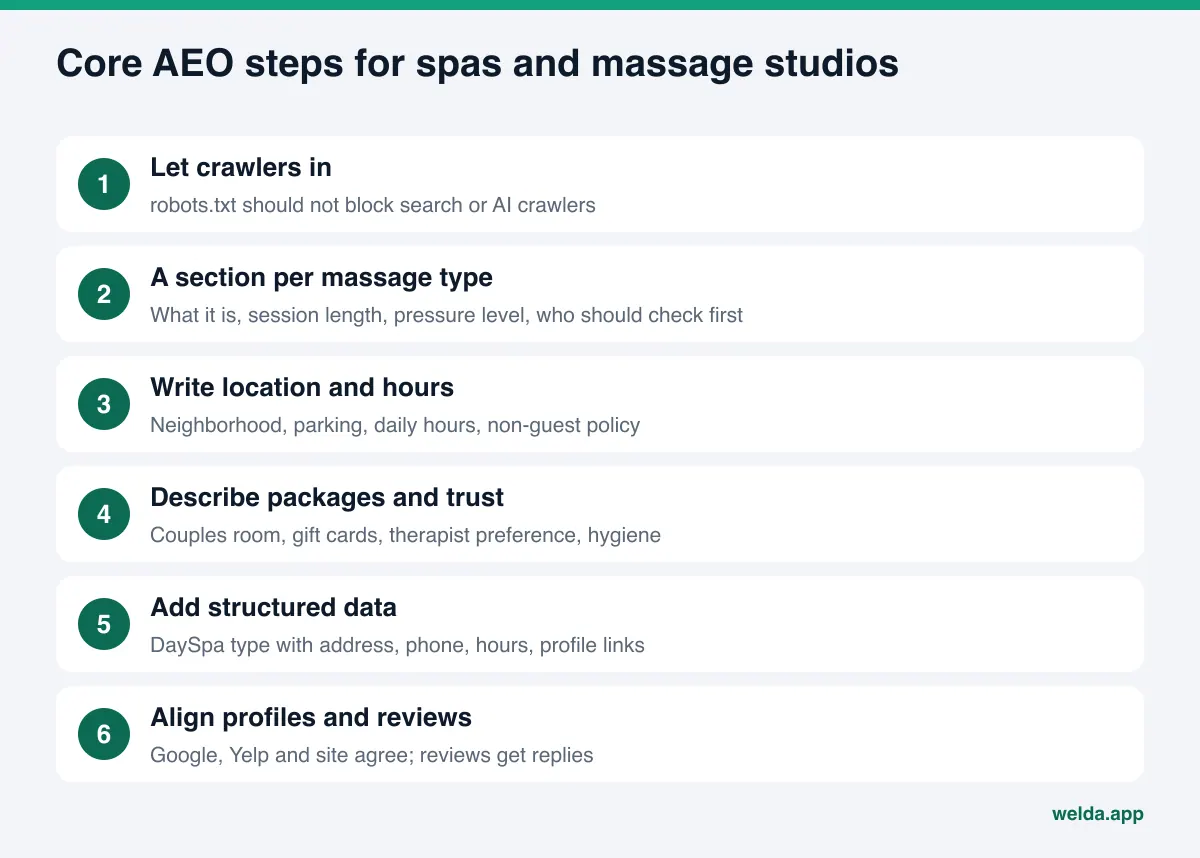
1. Check access. Open yourdomain.com/robots.txt and look for rules that block search or AI crawlers across the whole site. If you are unsure how to read it, ask whoever built the site, or let the free analysis check it.
2. Write a section for each massage type. For each service: what it is, who usually books it, session lengths, pressure level (light, medium, firm), oils or tools used, and who should check with a doctor first. A deep tissue section should say something concrete, like "a firm-pressure massage focused on muscle tension, offered in 60 and 90 minutes." Use the names customers use. If you have a branded signature treatment, add the generic name next to it.
3. Write your location and hours as text. Neighborhood, street, a nearby landmark, parking or transit notes, hours for each day, and your last bookable time. For hotel spas, one sentence like "We welcome guests who are not staying at the hotel" answers a whole category of questions.
4. Describe packages and occasions. Couples room, spa day packages, gift cards, bridal parties, and group bookings. Say who each one suits and how to book it. If you work with bridal parties, the question examples in AI search optimization for bridal hair and makeup artists may give you ideas.
5. Answer trust questions. Many states license massage therapists; if yours does, say that your therapists hold the required license, and only state what is true. Add your therapist preference policy, linen and room cleaning routine, and private treatment rooms. These fit well in a short FAQ.
6. Add structured data. Use DaySpa or another fitting business type with name, address, phone, hours, price range, and links to your profiles. The markup must match what the visible page says.
7. Align your profiles. Google Business Profile, Yelp, Tripadvisor (common for hotel and resort spas), Instagram, and any local directory where you are listed. Name, address, phone, hours, and service names should match everywhere.
8. Reply to reviews. Ask happy clients for an honest review, reply briefly and personally to each one, and respond to critical reviews calmly and specifically. Keep the rules in mind: the FTC's final rule on fake reviews and testimonials bans fake reviews and paying for reviews that express a particular sentiment. This is general information, not legal advice.
How to describe massage without making health claims
The hardest line in spa content is the one between relaxation and treatment. A customer may ask "massage for neck pain." Writing "we treat neck pain" on your site is a different matter. Claims about curing, diagnosing, or guaranteeing a result can mislead customers and can draw scrutiny under advertising rules at the federal and state level. Which wording is acceptable for your business is a question for a lawyer; this article is not legal advice.
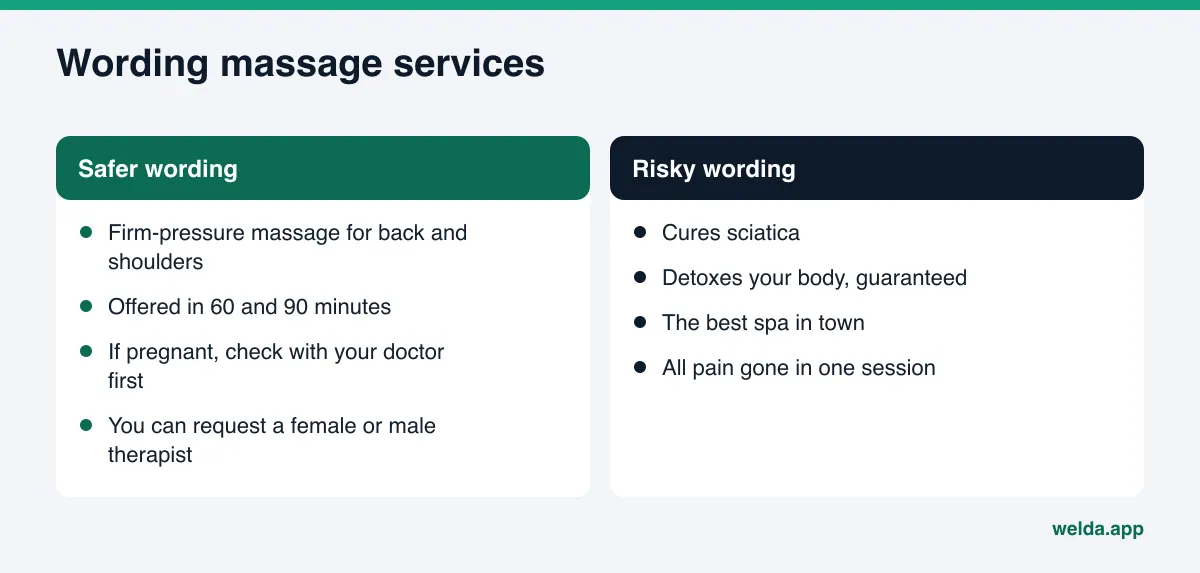
A practical approach: describe how the service is done and how it feels, and leave out outcome promises. "A firm-pressure massage that focuses on the back and shoulders" is safe. "Fixes sciatica" is not. For pregnancy, recent surgery, or a serious health condition, a line such as "Please check with your doctor before booking" protects the customer and also helps the assistant mention you in the right context.
If you are a licensed medical or physical therapy practice offering medical massage, different rules for healthcare advertising apply, and every piece of content should go through review. This guide is written for spas and massage studios that are not healthcare providers.
Hotel spa, day spa, or massage studio: what changes?
The same industry includes several business models, and each runs into a different gap in AI answers. Find the row closest to yours.
| Business model | Common gap | First thing to fix |
|---|---|---|
| Hotel or resort spa | Spa is a subpage of the hotel site; no word on outside guests | A dedicated spa page, non-guest policy, spa-specific hours |
| Day spa (package focused) | Branded package names with unclear contents | What each package includes, duration, who it suits, gift card terms |
| Independent massage studio | All services in one line; trust questions unanswered | A section per massage type, therapist and hygiene info, FAQ |
| Multi-location studio | One generic page for every location | A page per location with address, hours, and local details |
A common situation with hotel spas: the hotel itself appears in AI answers, but the spa does not show up for "spa open to non-guests downtown," because no page says outside guests are welcome. One missing sentence can hide you from a whole group of questions.
How Welda handles AEO for spas and massage studios
Welda is software that measures where a business stands in AI answers and prepares the fixes on its behalf. For a spa or massage studio, three parts matter most: tracking questions one by one, asking the business for missing facts instead of inventing them, and flagging health-related wording before anything is published.
Start with the free analysis. The free site analysis reads your homepage and a few inner pages such as services, pricing, about, and contact. It checks whether crawlers can get in, your structured data, address and hours, FAQ, whether services are clearly written, and review signals. It also asks an AI assistant with web search 5 questions a customer might ask, and shows whether your business name appears in the answers. It is a one-time snapshot, free once per site, and it works in English. For a massage studio, typical findings are "massage types appear only in images" or "no hours on the site." The report says what it saw, why it matters, and how to fix it, and it includes ready-to-use text suggestions for your homepage.
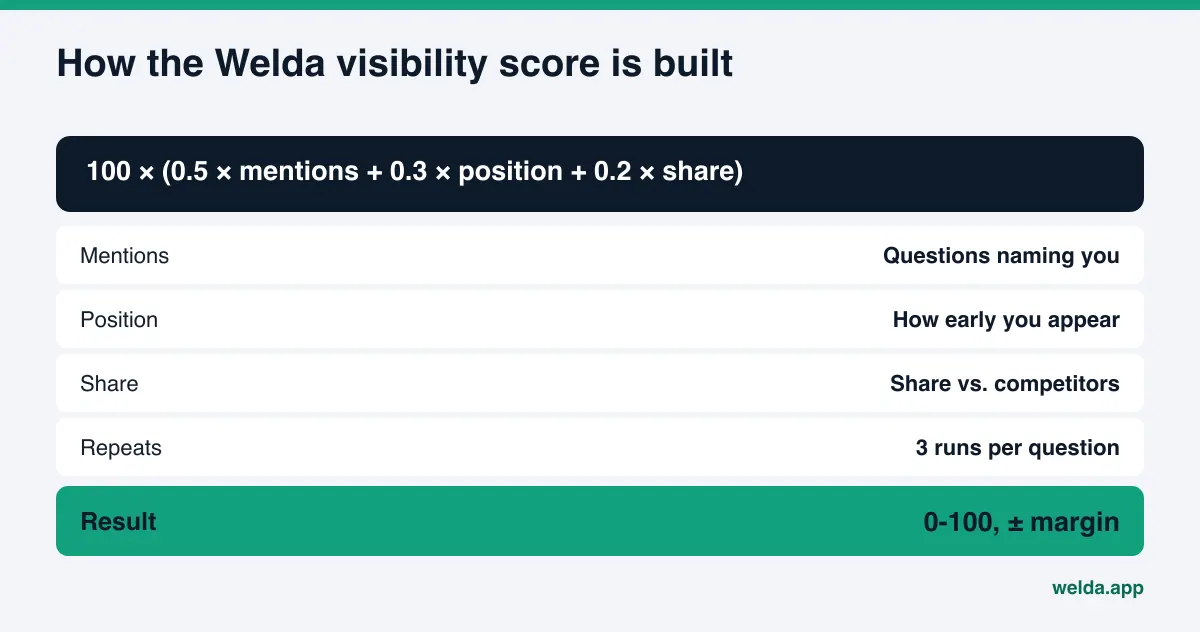
Question-by-question tracking in the dashboard. The Welda dashboard asks the questions your customers are likely to ask to ChatGPT, Gemini, Perplexity, and Google AI, three times each. For every question, you see which engine names you and in what position. For a spa, that might mean noticing you show up for "couples massage" but not for "spa day gift card." That is where the decision happens: which page or fact will answer the missing group of questions? Because each question runs three times, the score comes with a margin of error, so the trend matters more than one reading.
A to-do list that asks instead of guessing. Welda does not write facts it does not know. If it cannot find your therapist credentials, whether you have a couples room, or your gift card terms, it asks you in the to-do list. Once you answer, the fact is used in every piece of text it prepares. The same list holds items waiting for your approval and items you need to do by hand: for example, if your Google Business Profile is not connected, the profile description arrives as ready text for you to paste.
Compliance check before publishing. Every text Welda drafts is scanned for patterns such as price claims, guarantees, superiority claims, and diagnostic language. In spa content, phrases like "relieves pain," "works every time," or "the best spa in town" are flagged for you to review. This check is not legal advice and has not been reviewed by legal counsel; the final call is yours.
Welda drafts content, profile text, and review replies, and you keep the publishing approval. Content always lives on your own site. On WordPress, Welda connects through a separate Editor user and an application password with no code install, and places content on your site as a draft that goes live when you approve it. On other platforms, you get a ready package to apply yourself or hand to your web person. The dashboard also covers competitors, the sources AI engines draw from, and a one-page monthly report. For how to set up the approval step, see content approval workflow for AEO.
To be clear about where things stand: the free analysis works in English and German today, and anyone can use it. The full Welda dashboard is in early access and is opening first in Turkey. Regular four-engine measurement is being added during early access, and sample dashboard screens use representative data. Pricing is discussed in the early access conversation.
Limits: what Welda does not do
A spa's visibility does not come from its website alone. Some work belongs to the business, not to software. Knowing this up front keeps expectations realistic.
- No guarantees. Welda does not promise rankings or a spot in ChatGPT. AI answers vary, and no software controls them.
- No made-up facts. It will not invent licenses, product lines, or hygiene practices. It asks you.
- No fake reviews. Welda does not generate reviews. It drafts replies; customers write reviews.
- No unapproved sensitive content. Text that touches on health goes to you before it is published.
- Work that stays with you. Fixing the issue behind a bad review, managing your directory listings, and press outreach are yours. Welda can prepare text, but it does not do that work for you.
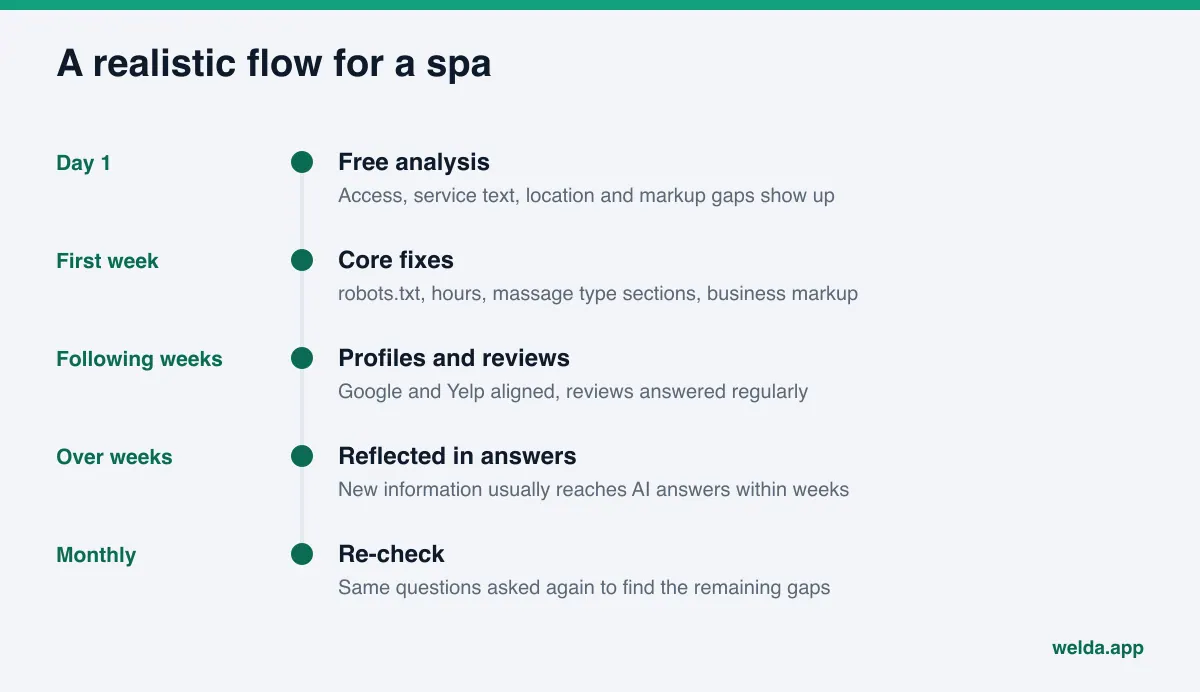
- Time. New content usually takes weeks to show up in AI answers. We cover that in how long AEO takes.
A spa and massage studio AEO checklist
Use this list as you review your site and profiles. If you can answer yes to each item, the foundation is in place; what remains is regular tracking and small corrections.
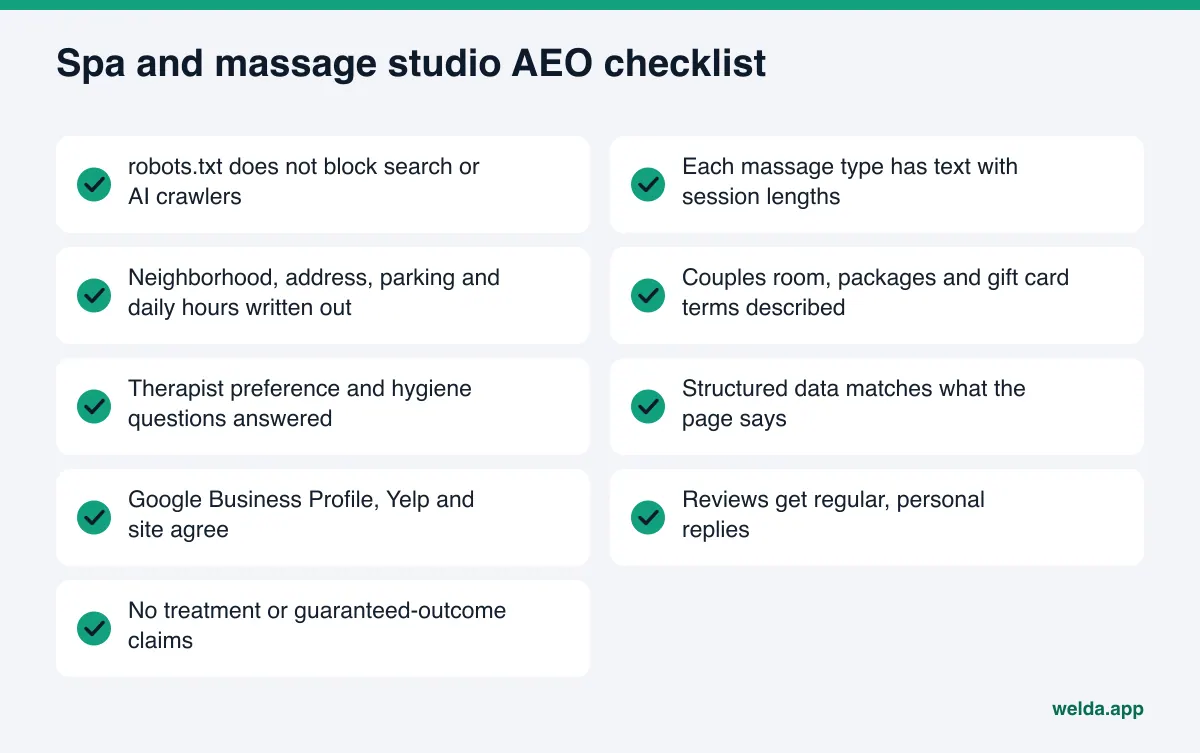
If you answer no to many items, start with access and location, then move to service sections. Reviews and trust signals take time; do not expect them to be done in the first week. If you cannot tell which items are missing, the free analysis checks the technical part of this list for you.
One more test: what does your front desk get asked most often? If the answer to that question is not written on your site, an AI assistant cannot answer it on your behalf. Logging incoming questions for a week is the best source for your FAQ.
Frequently asked questions
How is AEO different from traditional SEO for a spa?
Traditional SEO is about your position in Google's list of links. AEO is about whether an AI assistant names you in the answer it writes. The foundation is shared (a crawlable site, clear information), but in AEO, plainly written services, location, and trust details, plus consistent profiles, carry more weight.
Our massage menu is already on the site as an image. Isn't that enough?
No. AI assistants may not read text inside an image reliably. Put the menu on the page as text as well; keep the image for design if you like.
We are a hotel spa and the hotel already shows up. Do we need to do anything?
If the spa is open to outside guests, yes. The spa needs its own page with its hours, services, and non-guest policy. Otherwise you will be missing from questions like "spa open to non-guests near me."
Can we say massage "relieves pain"?
It is safer to avoid treatment claims and guaranteed outcomes. Describe how the service is done and how it feels. For a definitive answer, ask a lawyer; this article is not legal advice.
How soon will we see results?
There is no fixed timeline. New content usually takes weeks to appear in AI answers, which is why you should re-check the same questions at regular intervals after making changes.
Can we use Welda today in the US?
Yes, the free site analysis. It works in English, is free once per site, requires email and phone verification, and the results link stays open for 14 days. The full dashboard is in early access and is opening first in Turkey.
See where your spa stands today
The shortest way into AI search optimization for day spas and massage studios is to see where you stand: can crawlers read your site, are your massage types readable, are location and hours clear, and does your name come up for the questions customers ask? Run the free site analysis. The report lists each gap, why it matters, and how to fix it. You take it from there, in order, with your own approval.