Is there an affordable alternative to enterprise AEO platforms, and what should it do? Yes, but the right alternative is not a shrunken copy of an enterprise tool. A small business needs to know whether its name shows up when customers ask ChatGPT, Gemini, Perplexity and Google AI a few dozen specific questions, and it needs the gaps closed with copy that is ready to approve. Fewer dashboards, more finished work.
This guide is for owners and marketing leads at local and small businesses who went looking for an AI visibility tool and kept landing on platforms built for national brands. First we look at who enterprise AEO (answer engine optimization) platforms are designed for and why they often stall inside a small company. Then we walk through how to choose an affordable alternative to enterprise AEO platforms, which questions to ask vendors, and how Welda handles the work. If you want to see where you stand before talking to any vendor, start with the free site analysis. It reads your website the way Google and AI assistants do and tells you what is missing and how to fix it.
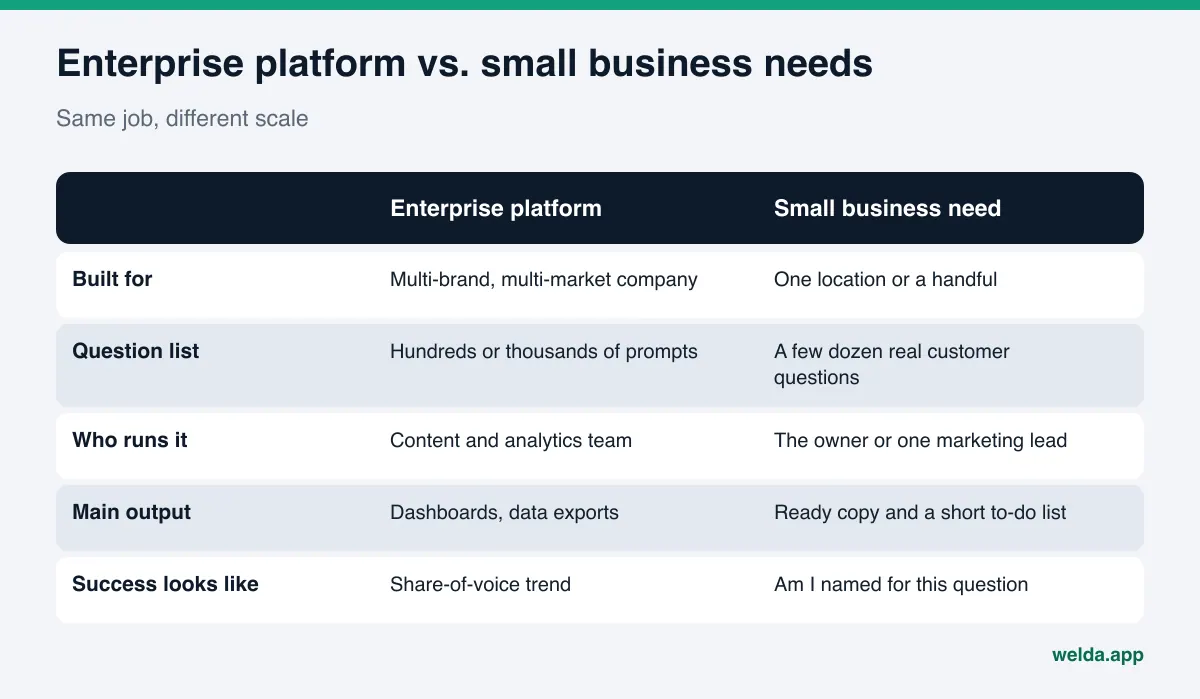
Who are enterprise AEO platforms built for?
AEO is the practice of making sure AI assistants and AI search features mention your business when customers ask questions. You will also see it called AI search visibility, AI visibility, or GEO (generative engine optimization), which is the same idea under a different name. Several companies building tools in this space started with large brands. That makes sense: a national retailer or a software company wants to know how it is described across thousands of prompts, many product lines and several countries, and it has a team to act on what it learns.
Tools in this category are usually built on one assumption: someone on your staff will sit with the data every week, interpret it, and decide what to do. Dashboards are rich, filters are many, data can be exported to other systems, and different team members get different roles. The tool shows you a great deal. What to do about it is usually left to your team.
That design is right for a large company. The problem starts when the same approach is handed to a dental practice, a boutique hotel, a neighborhood restaurant or a five-person HVAC company. In this article we are talking about a type of tool, not any specific product. When you evaluate vendors, ask them directly which of the two models below their product is closer to.
Why the enterprise model misses what small businesses need
Customers no longer look for local services only in a list of blue links. They ask an assistant, "Which family dentist in north Austin is open on Saturdays?" or "What is a quiet boutique hotel in Savannah that allows dogs?" The assistant names a few businesses with short reasons. If you are not in that list, the customer may decide without ever visiting your site. A national brand worries about share across thousands of prompts. A small business worries about being absent from the few dozen questions that actually bring in local customers.
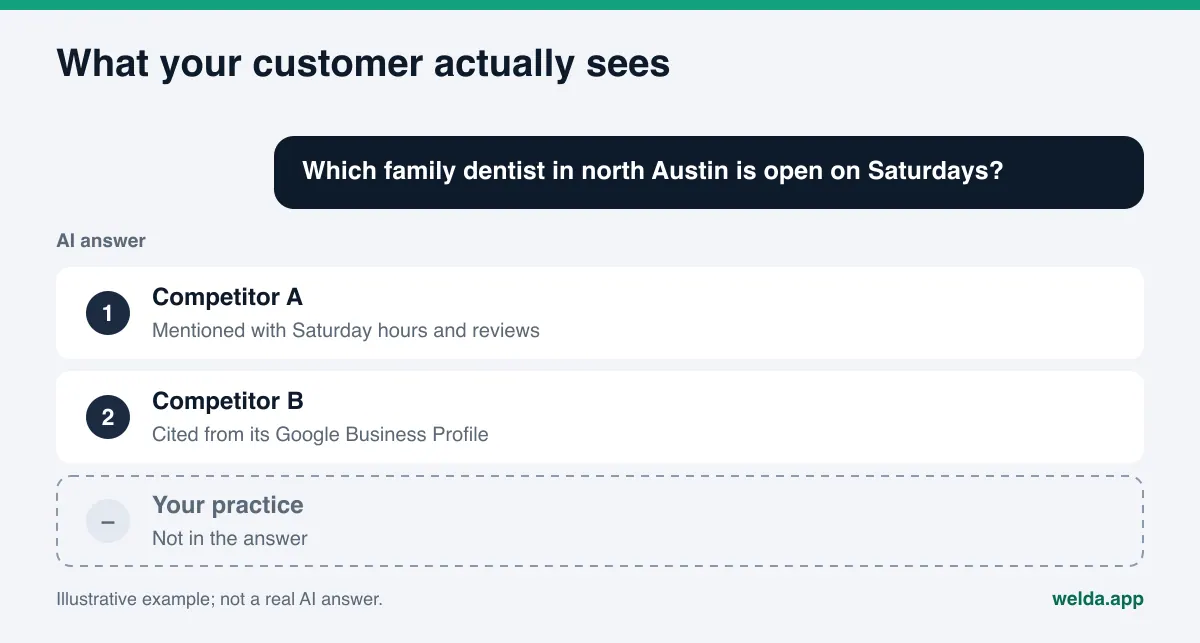
An enterprise platform usually reports on this problem with a chart, a share-of-voice number and a trend line. The chart may be accurate. But the owner is left with the real question: "So what do I write, where do I put it, and who is going to do it?" In a business without a content team, that question goes unanswered, and within a few months nobody logs in. The subscription becomes the cost of a report nobody acts on.
The second problem is scale. Enterprise tools can track huge prompt sets. For a small business, most of that is noise. The questions that matter are predictable: your service name, your city or neighborhood, price and availability questions, and phrasing like "best," "near me" and "which is better." Picking the right thirty questions is worth more than tracking three thousand.
The third problem is that the cause often sits outside your website. AI answers draw on your site, but also on your Google Business Profile, Yelp, Tripadvisor, the Better Business Bureau, Healthgrades, Angi and industry directories. A useful small business tool shows you where you are missing, not just that you are missing. Otherwise you fix your homepage and wonder why nothing changed. We cover that distinction in more depth in AI visibility monitoring vs. done-for-you AEO.
How to choose an affordable alternative to enterprise AEO platforms
Writing down what you need before you start demos keeps you from getting lost in vendor slides. The steps below fit into one afternoon.
- Write down your customer questions. List the questions you hear most often on the phone, by text and at the counter. Turn each one into the sentence a customer would type into an AI assistant: "Who does same-day AC repair in Mesa?", "Best kid-friendly brunch spot in Denver's Highlands?", "Which estate planning attorney in Raleigh offers flat fees?" Group them into service, location, comparison and price questions.
- See where you stand today. Find out whether AI crawlers can reach your website, whether your business details are marked up with Schema, and whether your name, address and phone number are consistent. The free analysis shows this in a few minutes.
- Be honest about who will do the work. How many hours a week can you spend on this? Who reads and approves copy? Who can publish to your website? Your answer tells you whether you need a dashboard or finished work.
- Question the measurement. AI answers change even for the same question. A tool should be clear about how many engines it checks, how many times it asks each question, and how its score is calculated.
- Check what a fix looks like. Does the tool hand you a list of problems, or a page, an FAQ section, profile copy and review replies that are ready to approve? Where does the content live? Who has the final say?
- Ask about limits. What does the tool not do? Does it promise results? Does it invent facts it does not know, or does it ask you? A vendor that cannot answer these clearly is a risk for a small business.
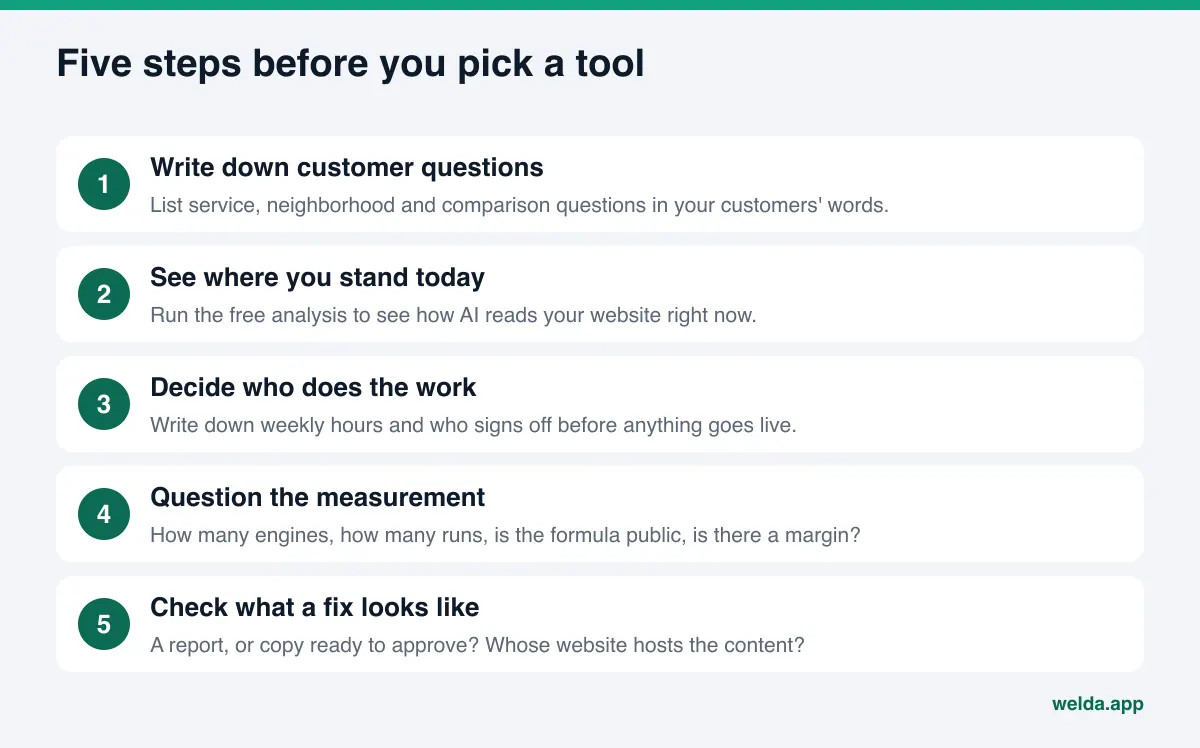
After these steps you have two documents: a short list of questions you care about and a realistic estimate of the time you can give this work. Bring both to every vendor call and ask what the tool will do with your list. An enterprise platform may suggest expanding it to hundreds of prompts. A good small business alternative should measure your list and tell you what to do about each question.
Enterprise AEO platform vs. small business alternative, side by side
The table below compares two types of tools, not specific products. The point is not that one is good and the other bad, but to see which one will actually work with the team and time you have.
| Criterion | Enterprise AEO platform (typical setup) | What to expect from a small business alternative |
|---|---|---|
| Question list | Large lists across products and markets | A short list in your customers' words, specific to your services and area |
| How results are shown | Dashboards, filters, exports | Question by question: are you named, plus a one-line summary |
| Diagnosis | Trend and share analysis; interpretation left to the team | A plain list of which competitor leads on which question and from which source |
| Fixes | Recommendations or tickets for a content team | Ready-to-approve pages, FAQ sections, profile copy, review replies |
| Who runs it | Content, analytics and web teams | The owner or one marketing lead |
| Reporting | Detailed reports for team meetings | One page a month with a before-and-after view |
| Risky claim checks | The company's own legal review | Flags on pricing, guarantees and superiority claims before publishing |
"Typical setup" is a deliberate choice of words. Some enterprise tools also suggest fixes, and some small tools only measure. Ask vendors about each row to see which column their product sits closer to. For a longer selection list, see our guide to choosing an AI visibility platform for small business.
How Welda does this work
Welda is software that measures where a business appears in AI answers and prepares the fixes on the business's behalf. Where it differs from enterprise platforms is the starting assumption: Welda does not assume a marketing department. It assumes an owner, or one person, who does this alongside everything else. So the first screen is not a chart but a short list of what happens next. Here are the three parts that matter most if you are looking for an alternative to an enterprise platform.
A to-do list instead of a dashboard
The Welda dashboard opens on your score, a single sentence describing where you stand, and the next tasks. Tasks come in three kinds: a fact Welda needs from you (your Saturday hours, say, or which insurance plans you accept), a piece of content waiting for your approval, and something you have to do by hand, such as pasting ready copy into a profile that is not connected. Every task shows what to do and, where relevant, the copy to use.
In an enterprise tool, this step belongs to your team: someone reads the data, holds a meeting and assigns the work. In Welda, this step is the screen itself. The decisions you make are small and concrete: do I approve this text, is this fact correct, will I update this profile today? Welda does not guess at facts it cannot find on your site. It asks you.
An open formula and a clear view of competitors
Welda asks the questions your customers would ask on ChatGPT, Gemini, Perplexity and Google AI, three times on each engine. Repetition matters because AI answers vary even for the same question, and a single run can mislead you. The score comes from a published formula, and the spread across the three runs gives a margin of error. When the score moves a couple of points, you can tell whether something really changed or the answers just wobbled.
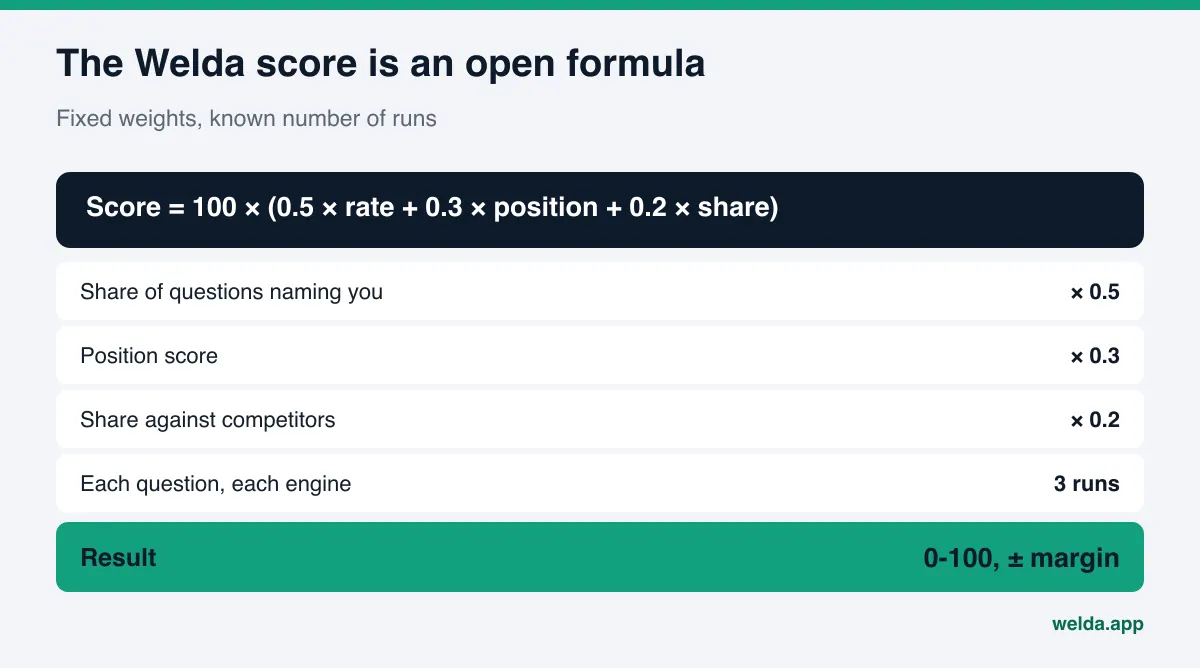
Enterprise tools do not always make their scoring this visible. For a small business, an open formula means you can read your own results without having to take the vendor's word for it. If you want to understand where spot-checking ChatGPT yourself goes wrong, read manual ChatGPT checks vs. tracking tools.
The competitors view is where diagnosis happens. It shows which competitor is ahead on which group of questions and which source the AI cited for them. Take an example boutique hotel: seeing that it never appears in "honeymoon" questions, and that the competitor winning those answers is cited from a booking site and its map listing, tells the owner exactly what to do next. Prepare a page aimed at those questions and update the relevant profile.
Ready content, your approval, your website
Once the gaps are clear, Welda drafts the missing content, profile copy and review replies. If your site runs on WordPress, you create a separate Editor user for Welda with an application password; no code to install. Drafts open on your site as drafts and go live only when you approve them. On other platforms, Welda gives you a ready package and the changes are made by hand. Google Business Profile, Instagram and Facebook can be connected; if they are not, the task shows up as a manual item.
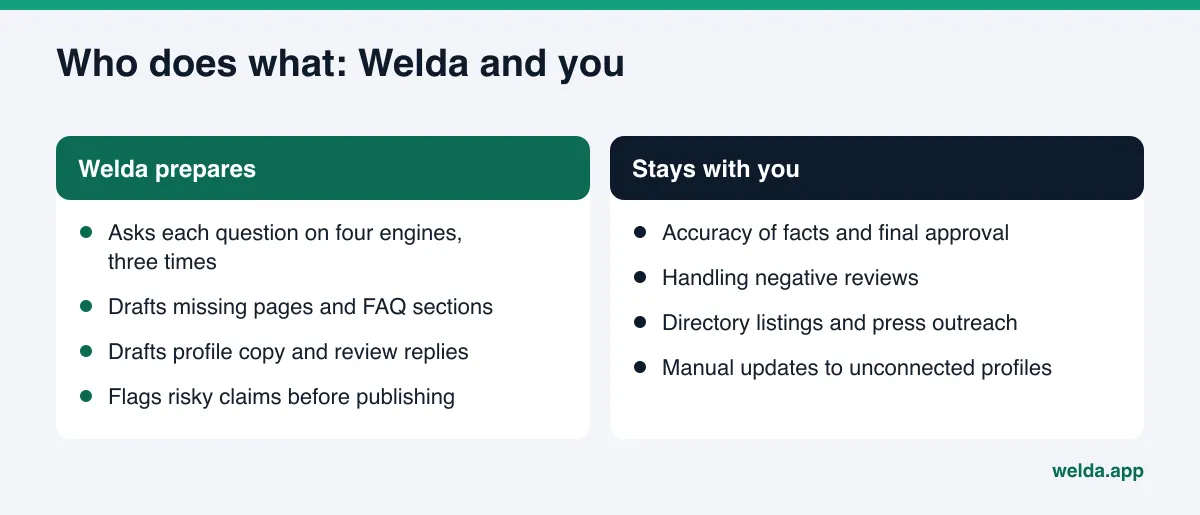
The important part for a small business: your content always lives on your own website. Welda does not host content, so if you stop using it, your published pages stay where they are. Before anything goes live, a compliance check flags patterns such as pricing, guarantees, superiority claims and diagnostic suggestions. This is not legal advice, it has not been reviewed by a lawyer, and the final call is yours. In healthcare there is no automatic publishing at all; every piece of content waits for approval, and patient data is never sent to the AI.
The dashboard also includes question-by-question tracking, the sources AI draws on, incoming inquiries, a before-and-after comparison and a one-page monthly PDF report. Question language can be set to English or Turkish.
A plain word on early access
The Welda dashboard is in early access and is opening first in Turkey, one group of businesses at a time. Regular four-engine measurement is being added during early access, and the sample screens are shown with illustrative data. What anyone can use today, in English, is the free site analysis. Welda's pricing is not published; it is discussed during the early access conversation. That is why this article compares Welda with enterprise tools on how the work gets done, not on price.
What the free analysis shows you first
You do not need a paid tool to see where you stand. The free site analysis reads your homepage and a few inner pages, such as services, pricing, about and contact. It checks whether AI crawlers can access your site through robots.txt, your page title and description, your main heading, your business details in Schema markup, your address, phone and location details, whether your social and map profiles link to your site, your FAQ section, reviews and trust signals, whether your services are clearly described, and page speed.
You get a score out of 100, with technical and content parts scored separately. For each gap you see what was found, why it matters and how to fix it. The report includes suggested copy for your homepage (title, description, main heading, intro paragraph and FAQs), a simulation showing how much each fix would raise your score, a competitor comparison, a ready-to-install fix package including business Schema code, a PDF and a shareable score card. The analysis also asks 5 customer-style questions to an AI assistant that can search the web and checks whether your business name appears in the answers. That is a one-time snapshot, not ongoing tracking.
The analysis is free once per website. Your email and phone are verified, the results link arrives by email, and it stays open for 14 days. It does not measure rankings and does not guarantee them. With that output in hand, vendor conversations get specific: "Here are my gaps. How does your tool close them?" If you want to go further on your own, our AEO audit guide explains which checks you can do by hand.
Limits: what Welda does not do
An affordable alternative should not claim to do everything an enterprise platform does for less. Here are Welda's limits:
- It does not guarantee rankings or that you will "show up in ChatGPT." No tool controls AI answers.
- It does not write facts it does not know. If your prices, services or hours are not on your site, it asks you.
- It does not publish sensitive content without your approval. In healthcare, nothing is published automatically.
- It does not create fake reviews. It drafts replies; reviews come from your customers.
- Handling negative reviews, setting up directory listings and press outreach stay with you. Welda can give you copy and a list, but it does not do that work for you.
- It is not built to track thousands of prompts for a multi-brand, multi-country company. If that is your need, an enterprise platform may fit better.
There is also a time limit. New content usually takes weeks to show up in AI answers. A flat score in the first month does not mean the work is failing, and knowing that up front keeps you from quitting too early. To plan spending around that timeline, see our piece on setting an AEO budget.
Count more than the subscription fee
Most businesses looking for an affordable alternative to enterprise AEO platforms start with price. Price matters, but it is only one line. The real cost of a tool includes the time it takes to get results from it. Think about three costs separately.
Reading cost. How many hours a week does it take to open the dashboard and make sense of it? A detailed dashboard with nobody to read it is a cost, not an asset. A one-line summary and a short task list cut that time down.
Execution cost. When the tool finds a gap, who writes the copy that fills it? A freelancer, an agency, or you after closing time? A tool that delivers ready copy shrinks this line. A tool that only reports leaves all of it with you.
Error cost. A wrong price, an inflated claim or an inappropriate health statement is hard to pull back once AI answers pick it up. The FTC's advertising guide for small business says advertising must be truthful and non-deceptive and that advertisers need evidence to back up their claims. That applies to what you publish on your own site. A setup that flags risky phrasing before publishing and leaves approval with you lowers that risk. This is general information, not legal advice.
Consider an example scenario: a three-dentist family practice in Columbus, Ohio, where the office manager handles marketing on top of everything else. An enterprise platform would give that practice a detailed share-of-voice chart. Reading the chart, figuring out why the practice is missing from "pediatric dentist" questions, writing a page aimed at those questions and checking it for risky health claims would all fall to the same office manager. With a small business alternative, that person opens an approval queue with a draft page and flagged phrases already in it. The job becomes reading, editing and approving. The difference shows up in that person's week, not in the license fee.
Decision checklist: enterprise platform or small business alternative?
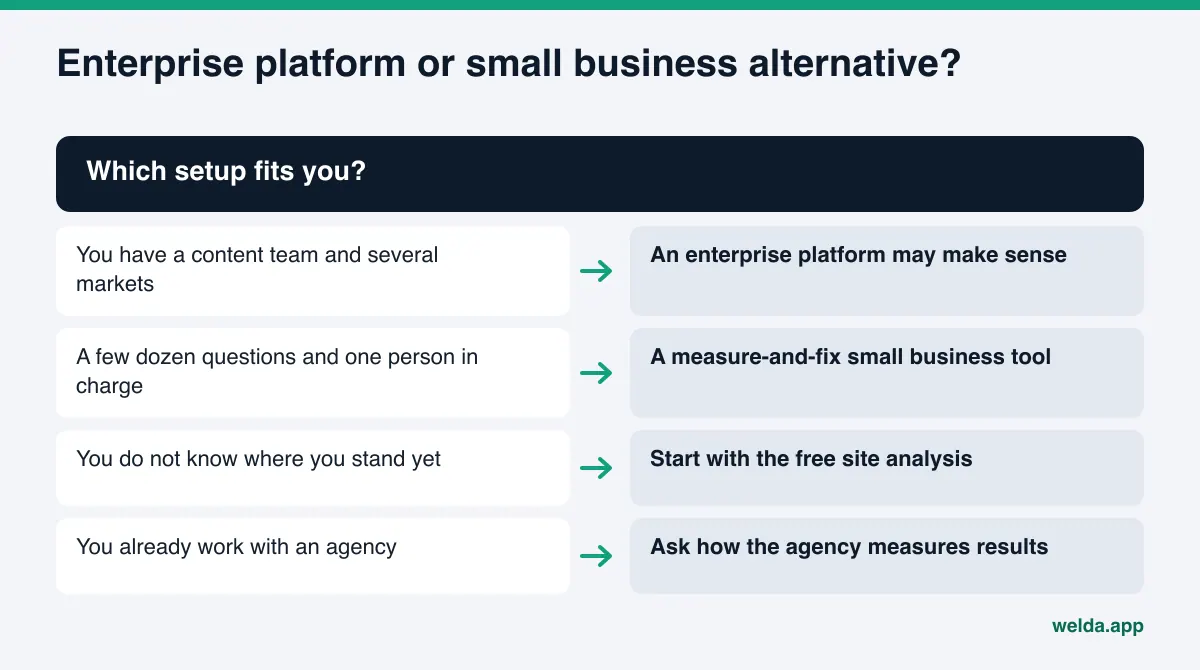
Take these questions into your vendor calls. If most of your "yes" answers fall in the second group, what you need is most likely a measure-and-fix small business tool.
Signs an enterprise platform fits:
- You have several brands, countries or language markets and want them tracked in one place.
- You have a separate content or analytics team that reads data and assigns work.
- You need to send the data into your own reporting systems.
- The questions you need to track span hundreds of products and categories.
Signs a small business alternative fits:
- The questions you care about number in the dozens and are specific to your services and area.
- One person will handle this alongside other responsibilities.
- You need an answer to "what do I do now" more than another chart.
- You want your content to stay on your own site and approval to stay with you.
- You are in a field where risky claims matter, such as healthcare, legal or financial services.
Also ask every vendor: Which engines do you check, and how many times per question? Is your scoring formula public, and do you show a margin of error? Can I see which source a competitor is winning from? Do fixes arrive as ready copy? If I cancel, does my content stay put? Do you guarantee rankings? Be careful with any vendor that says yes to the last one. Nobody in this space can guarantee what an AI assistant will say.
Frequently asked questions
Is an enterprise AEO platform ever right for a small business?
It can be. What decides it is your team, not the tool. If you have people who will read the data and produce content, an enterprise tool may serve you well. If the work falls to one person, a setup that delivers finished work alongside measurement is usually the better fit.
Does a small business alternative measure less?
It may track fewer questions, and that is not a weakness. For a local business, a few dozen well-chosen questions say more than thousands of generic prompts. What matters is that each question is checked on several engines, more than once, with the result shown alongside a margin of error.
How much does Welda cost?
Welda's pricing is not published. The dashboard is in early access, and pricing is discussed during the early access conversation. The part you can use free today is the site analysis.
Is Welda available in the US?
The free site analysis works in English and is open to businesses anywhere. The full dashboard is in early access and is opening first in Turkey.
Does Welda publish content on its own servers?
No. Content always lives on your own website, and Welda does not host it. On WordPress sites, content opens as a draft and goes live when you approve it. On other platforms, Welda gives you a ready package and the changes are made by hand.
How long until I see results?
New content usually takes weeks to show up in AI answers. Welda does not claim to shorten that or to guarantee any outcome. The before-and-after comparison and the monthly report let you follow what changes.
Where to start
The fastest way to choose an affordable alternative to enterprise AEO platforms is to see your own situation first. Picking a tool before you know which questions matter, how AI reads your site today and which gaps come first usually means picking the wrong scale. Run the free site analysis to get your score, your list of gaps and suggested copy for your homepage. Then use the checklist above to decide which type of tool fits your business.