How does a yoga or Pilates studio get recommended by ChatGPT? Answer engines recommend the studios whose class styles, levels, neighborhood, schedule and first-class process they can read clearly and find repeated consistently across the web. Writing those facts in plain text on your site, matching them on your listings and checking which questions mention you each month is the core of the work.
AEO for yoga and Pilates studios (AEO stands for answer engine optimization) is about showing up when someone asks ChatGPT, Gemini, Perplexity or Google's AI features something like "beginner reformer Pilates near me," "hot yoga studio in Austin with early morning classes" or "prenatal yoga in Brooklyn." You may also hear the same work called GEO, short for generative engine optimization; in the US, AEO and "AI search visibility" are the more common terms. This guide walks a studio owner through it step by step: which questions to track, what to fix on your site and listings, and what is outside your control. If you want to see your starting point first, the free site analysis reads your website the way Google and AI assistants do and lists each gap with a fix.
Why AEO matters for yoga and Pilates studios
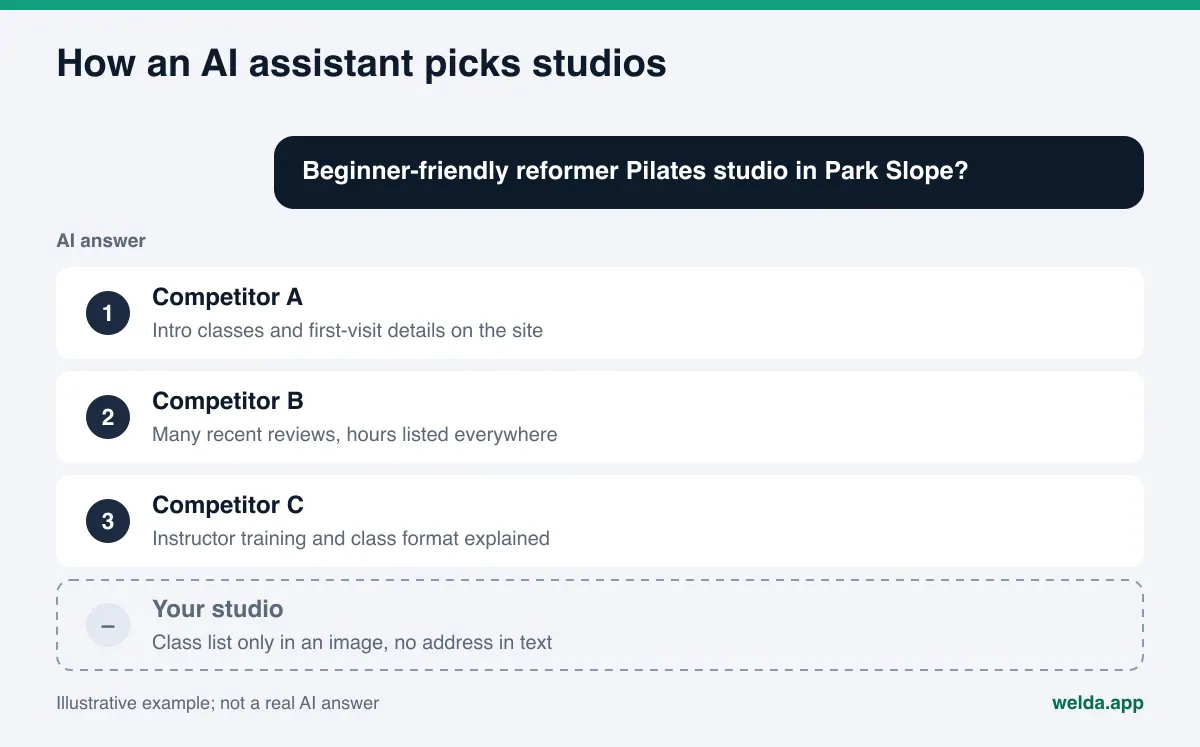
Choosing a studio is a personal decision. People want a place close to home or work, a class that matches their level and instructors they can trust. That search used to mean scrolling a map, checking a few Instagram accounts and asking friends. More and more, the same question goes to an AI assistant in one long sentence: "I sit at a desk all day and my lower back is stiff. Which kind of Pilates should I try, and where can I do it near downtown Denver?" The person describes a need, a level and a location, and expects a short list of studios with a reason for each.
An answer like that usually names a handful of studios. If yours is not on the list, that person never becomes a lead. Ranking well on the map or having a large following does not automatically put you in the answer. Answer engines rely on information they can read and that agrees across sources. A studio that keeps its class list in a graphic, its schedule in a booking widget and its address only on a map pin has not left much for a machine to read.
Studios have an extra challenge: class names vary widely and mean little to beginners. Reformer, mat, classical, contemporary, vinyasa, hatha, yin, restorative, prenatal, aerial. Customers rarely search by those labels. They describe what they want: "something gentle for stress," "help with posture," "a workout I can do while pregnant." The AI connects the need to a class style and the class style to a studio. If your site never says who each class is for, that connection cannot be made.
What answer engines look at before recommending a studio
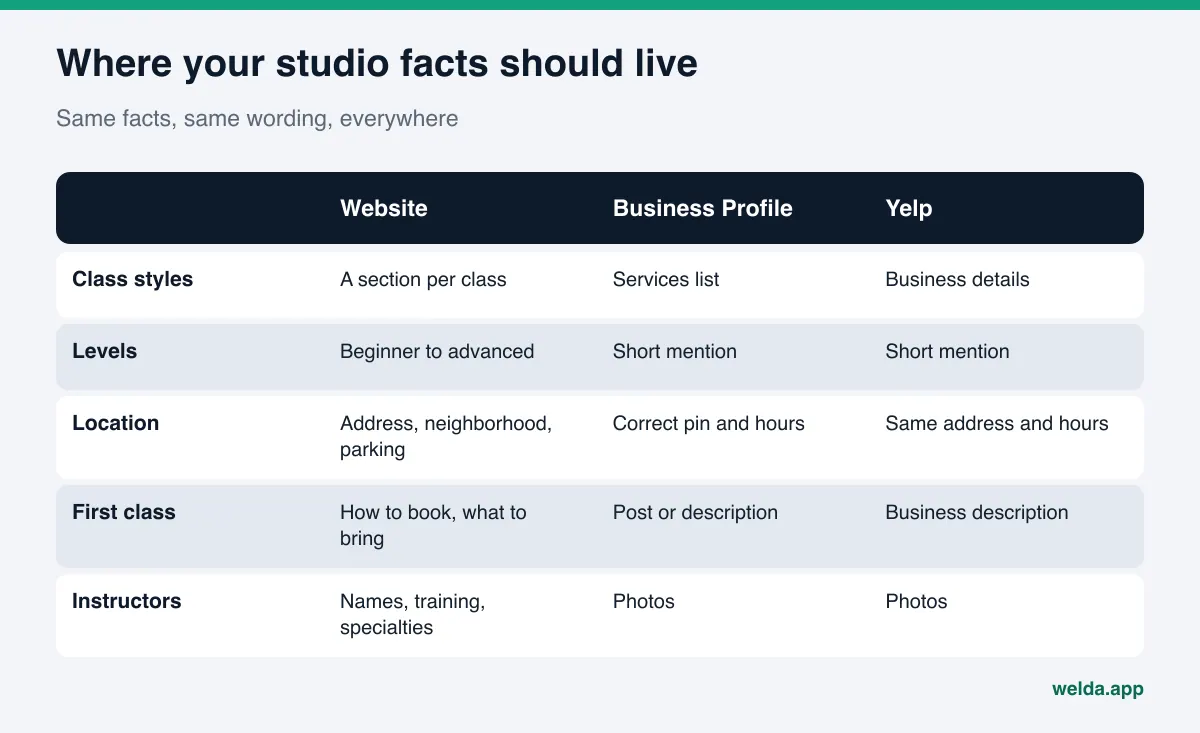
AI assistants do not decide from a single source. They read your website, your Google Business Profile, reviews, directories and sometimes forum threads together. The table below shows where each signal comes from and what a studio can do about it.
| Signal | Where it is read | What the studio does |
|---|---|---|
| Class style and level | Website, FAQ section | A section per class with who it suits and the level |
| Location and neighborhood | Website, Google Business Profile, Apple Maps, Yelp | Same address, neighborhood name and parking or transit notes everywhere |
| Schedule and hours | Business Profile, website | Current schedule in text, not only inside a booking widget or image |
| Trust | Reviews, instructor bios | Instructor training, genuine student reviews and owner replies |
| First visit | Website, listing descriptions | How to book an intro class, what to bring, what happens in class one |
| Technical access | robots.txt, page structure | AI crawlers allowed in, business schema on the site |
The last row is easy to miss. Some site setups and security settings block AI crawlers by default. If a crawler cannot get in, nothing on your pages counts. We cover how to check this in robots.txt for AI crawlers.
Which questions should your studio show up for?
Before changing anything, write down what your future students will ask an AI assistant. This list guides both measurement and fixes. Studio questions usually fall into five groups. The examples below were written for this article; swap in your own neighborhood and class styles.
- Class style plus location: "Reformer Pilates studio in Wicker Park," "yin yoga classes in Pasadena."
- Level and first steps: "Pilates studio for complete beginners in Plano," "yoga studios with an intro offer near me."
- Specific needs: "Prenatal yoga studio," "Pilates for people who sit at a desk all day." These need careful wording, which we cover below.
- Format: "Private Pilates sessions," "small-group yoga classes," "studio with 6 a.m. classes."
- Comparisons: "Reformer or mat Pilates for beginners," "best yoga studios in Seattle."
Comparison questions are the most competitive. The AI usually lists several studios and gives a reason for each. Seeing why a competitor gets named shows you what your own pages leave out. If a competitor even appears when someone asks about your studio by name, read why competitors show up when AI is asked about your brand.
Avoid two mistakes when you write the list. First, do not only track questions that include your studio's name. People who know your name will find you anyway; what matters is whether you come up for someone who does not. Second, do not just turn one-word searches into questions. Real questions are long and include a need and a place. Think about the calls and messages your front desk gets. What people ask you on their first call is close to what they ask an AI assistant.
AEO for yoga and Pilates studios, step by step
The sequence below is designed for a small team. Each step builds on the one before.
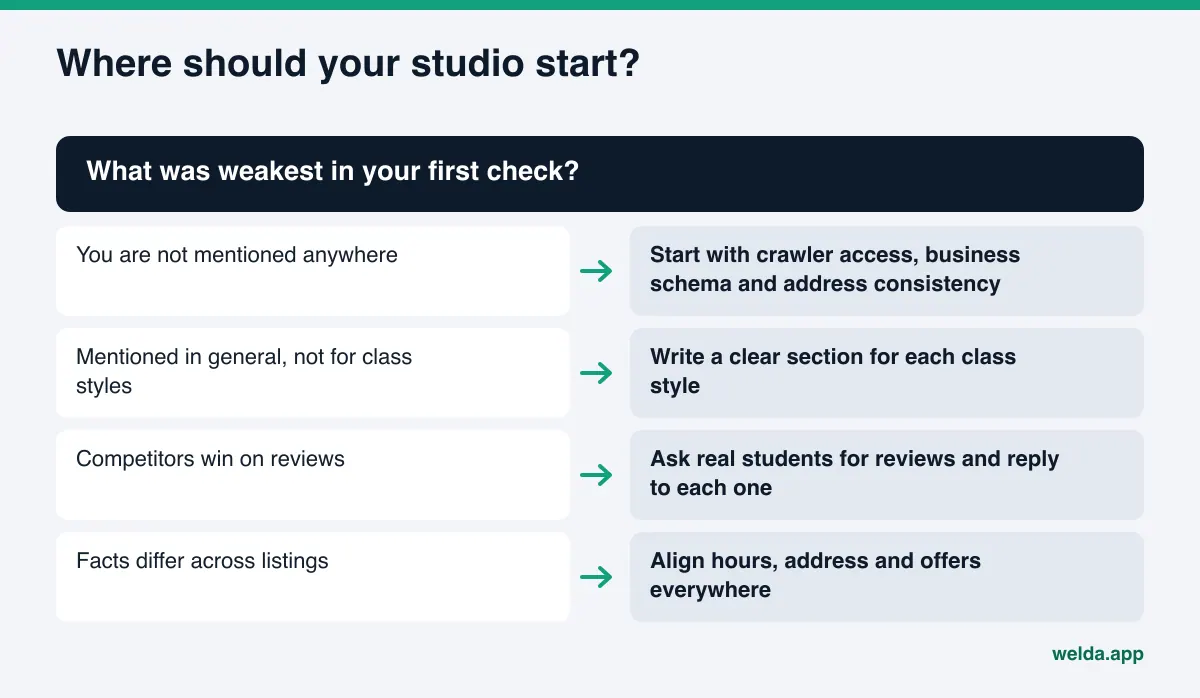
- Write your question list. Pick 15 to 20 questions from the five groups above. Each should include a class style, a neighborhood or a need.
- Measure where you stand. Ask AI assistants those questions and note whether your studio comes up. Answers change from run to run, so do not decide based on a single try.
- Fix the core facts. Studio name, address, neighborhood, phone, hours and how to get in touch should be reachable from every page. Business schema on the site gives these facts to machines in a format they can parse.
- Give each class style its own section. Reformer Pilates, mat Pilates, vinyasa, prenatal yoga: what it is, who it suits, level, length and class size. Open each section with a sentence that answers the question directly. Our guide to answer-first content shows how.
- Explain the first visit. How to book an intro class, what happens in the first session, what to bring, which level to start at. Most beginner questions are really asking for this.
- Introduce your instructors. Each instructor's name, training and the classes they teach. Write certification names accurately and only if you can verify them.
- Match your listings. Your Google Business Profile category, services, hours and description should say what your site says. Do the same on Yelp and Apple Maps. Your Instagram bio should include your address and class styles.
- Add an FAQ section. Answer real front-desk questions briefly: "I've never worked out, can I start?", "How many people are in a class?", "What is your cancellation policy?"
- Work on reviews. Ask happy students for reviews and reply to every review calmly. Do not buy reviews or have anyone write fake ones. The FTC's final rule on fake reviews and testimonials bans buying fake reviews and paying for reviews of a particular sentiment.
- Re-measure monthly. Ask the same list again. Changes usually take weeks to show up in AI answers, so track patiently instead of rewriting pages every week.
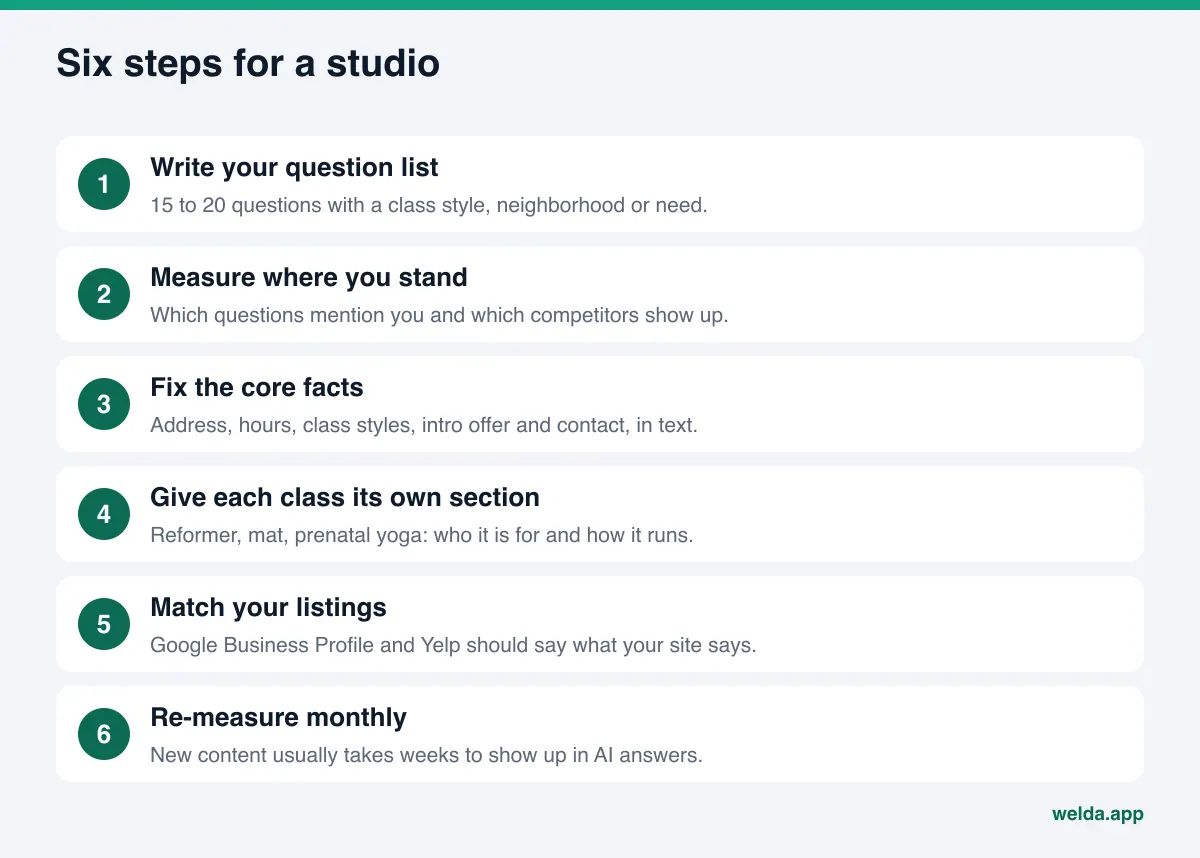
Step four is where most of the work is. On many studio websites, class styles appear in a pricing table or a schedule widget but are never explained. Even if an AI sees the words "prenatal yoga," it cannot confidently connect your studio to a related question if it does not know who the class is for, when in pregnancy people usually join or how the class runs.
Class pages, instructor bios and health claims
Yoga and Pilates are often described in health terms. Phrases like "cures back pain," "fixes scoliosis" or "guaranteed weight loss" can mislead readers and create advertising risk. AI answers also tend to be cautious on medical topics, and a page full of promises does not read as a trustworthy source.
A better approach is to describe what the class does and let the right person make the medical call. For example: "This is a slow-paced beginner class that focuses on core strength and breathing. If you have a health condition, check with your doctor before starting and let your instructor know in your first class." That sentence is honest with the reader and still lets an AI mention you when someone asks which class suits a person with back stiffness. This is not legal advice; have your own adviser review any health-related claims.
Here is a short example of a class section. It is written for a fictional studio; replace the details with your own.
Intro to Reformer Pilates. A 50-minute class for adults who are new to Pilates or returning after a long break, with up to four people per class. Your instructor starts by showing you the reformer, then works on breathing and alignment. Every exercise can be scaled to your level. Classes run weekday mornings and evenings; see the current schedule below. If you have a health condition, talk to your doctor first and tell your instructor before class. Book your first class by phone or online.
In a few lines it covers everything an answer engine needs: class style, level, who it suits, length, class size, what happens first, a health note and how to book. Repeat the pattern for every class style. For prenatal yoga, add when people can join; for yin, the pace; for private sessions, how they are planned. If you do not know a detail, ask the instructor rather than guess.
Instructor bios should be just as concrete. Instead of "our expert team," list each instructor's name, where they trained and which classes they teach. That gives students a reason to trust you and gives the AI a reason to mention you for questions like "studio with experienced Pilates instructors." Pricing is your call. Some studios publish rates, others share them in person. Either way, explaining how memberships or class packs work and whether there is an intro offer helps you get considered for questions like "drop-in yoga class" or "affordable Pilates studio."
How Welda handles AEO for a studio
Welda is software that measures where a business appears in AI answers and prepares the fixes on the business's behalf. For a studio, three parts do most of the work: the questions view, the score and the to-do list.
The questions view. Welda lists the questions your future students would ask, one by one. Each question goes to ChatGPT, Gemini, Perplexity and Google AI three times, because a single answer can be luck. For every row you see which engine mentions you and in what position. If you show up for "reformer Pilates near downtown" but not for "beginner yoga classes," you know the gap is in how you describe beginner offerings. You decide which class group to tackle first.
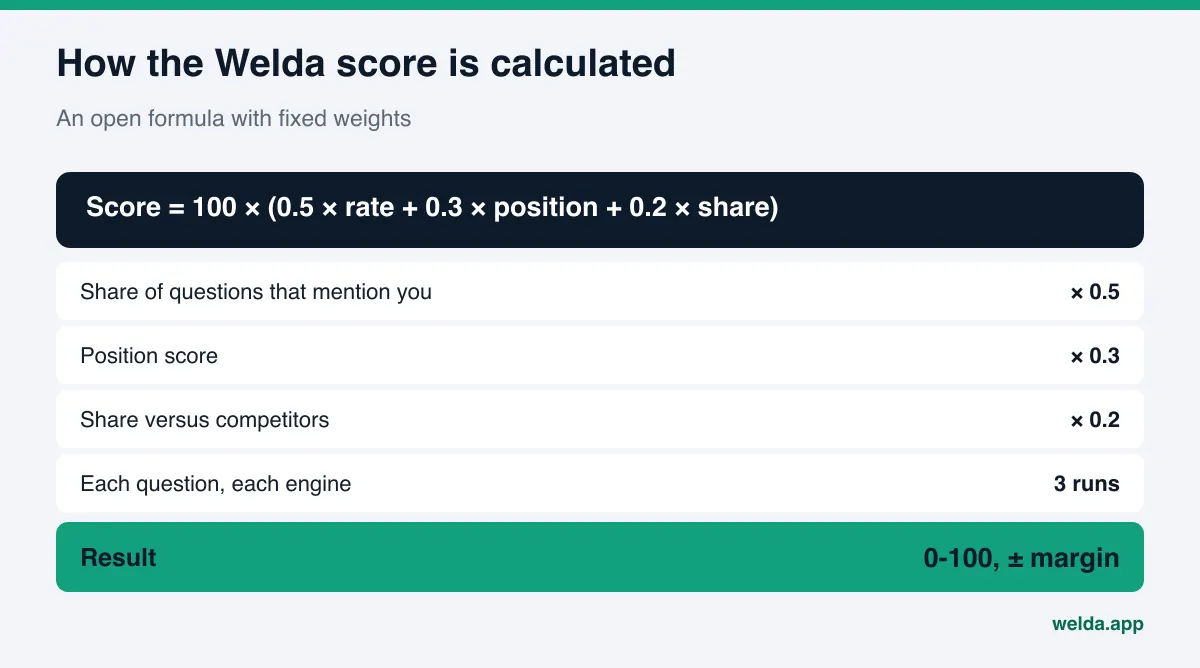
The score. The visibility score uses an open formula, so you are not looking at a black box. It combines the share of questions that mention you, your position in those answers and your share compared with competitors. The spread between the three runs gives a margin of error, which tells you whether a change is real or noise.
The to-do list. Everything the measurement turns up lands in one list. Welda does not invent facts; it asks you, for example, which trimester your prenatal class accepts or which training an instructor completed. Once you answer, it drafts the class section, FAQ answers, listing descriptions and review replies. On WordPress sites, Welda connects through a separate Editor user and an application password, with no code to install. Drafts open on your site and go live only after you approve them. On other platforms, Welda hands you a ready package and you or your web person apply it. Google Business Profile, Instagram and Facebook can be connected; if they are not, the task appears as a manual step with the text ready next to it. A compliance check flags phrases like cure claims, guarantees or superiority claims before anything is published. It is not legal advice and has not been reviewed by a lawyer. Content always lives on your own site; Welda does not host it. A one-page monthly report and a before-and-after view show which questions moved.
To be clear about where things stand: the Welda dashboard is in early access and opening in stages, starting with businesses in Turkey. Regular four-engine tracking is being added during early access, and sample dashboard screens use illustrative data. What anyone can use today, in English, is the free site analysis. Pricing is discussed in an early access call.
What the free site analysis tells a studio
The free analysis reads your homepage and a few inner pages such as services, pricing, about and contact. For studios, common findings include class styles that are never written out in text, missing business schema, an address that only appears in a footer image, no FAQ section and listings that are not linked from the site.
You get a score out of 100, split into technical and content, plus what was found for each gap, why it matters and how to fix it. You also get suggested copy for your homepage title, description, main heading, intro paragraph and FAQ, a simulation of how much each fix could raise the score, a competitor comparison and a ready-to-add fix package that includes business schema code. The analysis also asks an AI assistant that can search the web five questions customers might ask and checks whether your studio is named. That is a one-time check, not ongoing tracking. It is free once per site, your email and phone are verified, and the results link stays open for 14 days. It does not measure rankings or promise any.
Limits: what Welda does not do
AI answers are not ad space, and no one can promise that a studio will appear in a ChatGPT answer. Welda does not guarantee rankings or placement. The following are either things Welda does not do or tasks that stay with you:
- It does not write facts it does not know. Class length, class size and instructor training come from you.
- It does not publish sensitive content without your approval. Anything touching health comes to you first.
- It does not generate fake reviews. Reviews must come from real students.
- Handling a negative review, managing directory accounts and press outreach stay with you. Welda can draft text, but you own the account and the conversation.
- It cannot control timing. A new class page usually takes weeks to show up in AI answers.
These limits are not gaps in a product. They are how this work functions. Answer engines make their own choices; what you can do is make sure the facts they read are accurate, complete and consistent.
Studio AEO checklist
Run through the list once, then revisit it every quarter. Update the relevant items right away when your schedule changes, you add a class style or an instructor leaves.
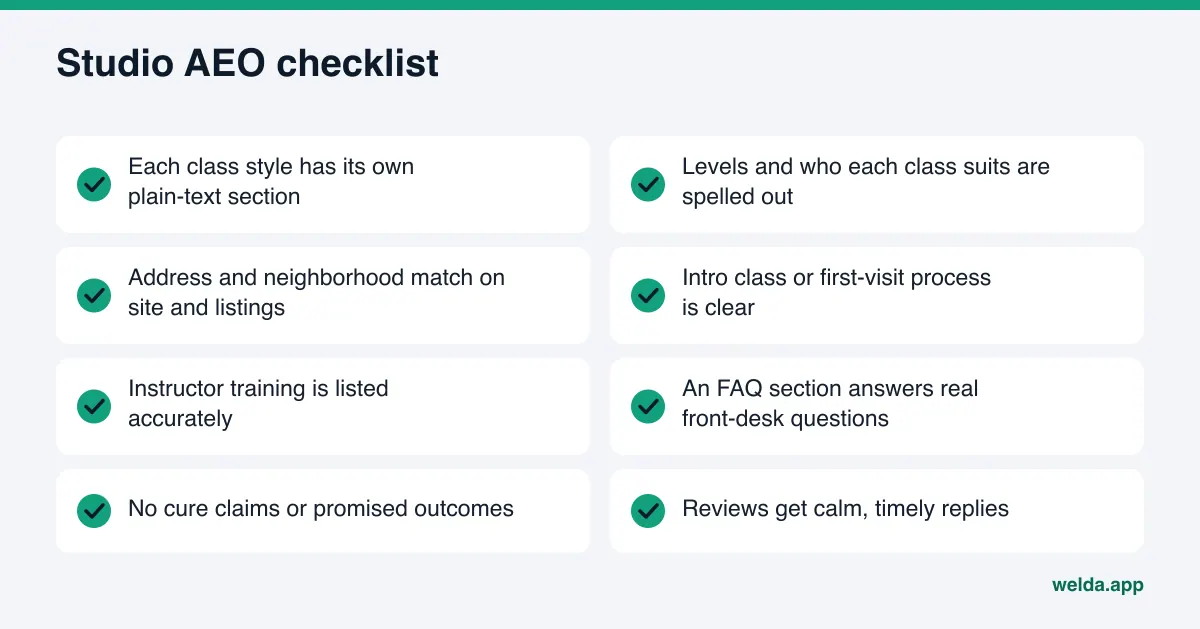
| Area | Check | Owner |
|---|---|---|
| Site access | AI crawlers are not blocked | Whoever runs the website |
| Class sections | Each style explained, with who it suits | Owner and instructors |
| Core facts | Address, hours and phone match everywhere | Owner |
| Listings | Business Profile category and services are current | Owner |
| Reviews | Recent reviews have replies | Front desk |
| Wording | No cure claims or promised outcomes remain | Owner, adviser if needed |
| Measurement | Question list re-run this month | Owner or Welda |
To see the same method in another local service business, compare AEO for driving schools or AEO for auto repair shops. Class styles become lesson types or repair services, and levels become license classes or car makes, but the logic is the same.
Frequently asked questions
I have a big Instagram following. Isn't that enough to show up in AI answers?
Not on its own. An AI may read Instagram, but it also wants class styles, levels, address and hours in plain text on your site and listings. Followers can signal popularity; they do not explain what you offer.
Do reformer and mat Pilates need separate pages?
Separate pages or clearly separated sections on one page both work. What matters is that each class style is explained on its own: what it is, who it suits and how it runs. A single "our classes" paragraph listing everything is not enough.
What can I write to show up for health-related questions?
Describe what the class does, avoid cure claims and suggest people with health conditions talk to a doctor first. That is honest and helps the AI treat you as a careful source. This is not legal advice.
How long until my studio appears in AI answers?
There is no fixed timeline and no one can guarantee it. New or updated content usually takes weeks to be reflected. Measuring monthly is more useful than rewriting pages every week.
Does Welda publish content to my site by itself?
Welda drafts the content and you approve it. On WordPress, drafts open on your site and go live after approval. On other platforms you get a package and apply it yourself.
Can US studios use Welda today?
The free site analysis works in English today. The full dashboard is in early access and opening first in Turkey, so US studios can start with the analysis today.
Where to start
AEO for a studio is not a big project. It is steady work: gathering scattered facts, explaining every class clearly and measuring on a regular schedule. Start by seeing what your site tells AI assistants today. Run the free site analysis to get your score, the gaps and ready-to-use homepage copy. The results link arrives by email.