What does AEO for driving schools actually involve? AEO for driving schools means making sure AI assistants like ChatGPT, Gemini, Perplexity, and Google's AI Overviews can read and trust the facts that decide enrollment: which programs you teach, where you pick students up, when lessons run, what cars you use, and what people say about you. When those facts are missing from your website or don't match your Google Business Profile and review sites, the answer names a different school. The work is putting your facts in plain view and keeping them consistent.
This guide is written for owners and managers of independent driving schools: schools that run teen driver's ed, adult lessons, road test prep, or defensive driving courses. We cover the questions students and parents ask AI assistants, what your site and listings need to say for you to be named, and which parts of the job Welda handles. If you want to see what your website tells AI systems today, run the free site analysis before you read on; it is easier to follow the steps below with that report open next to them.
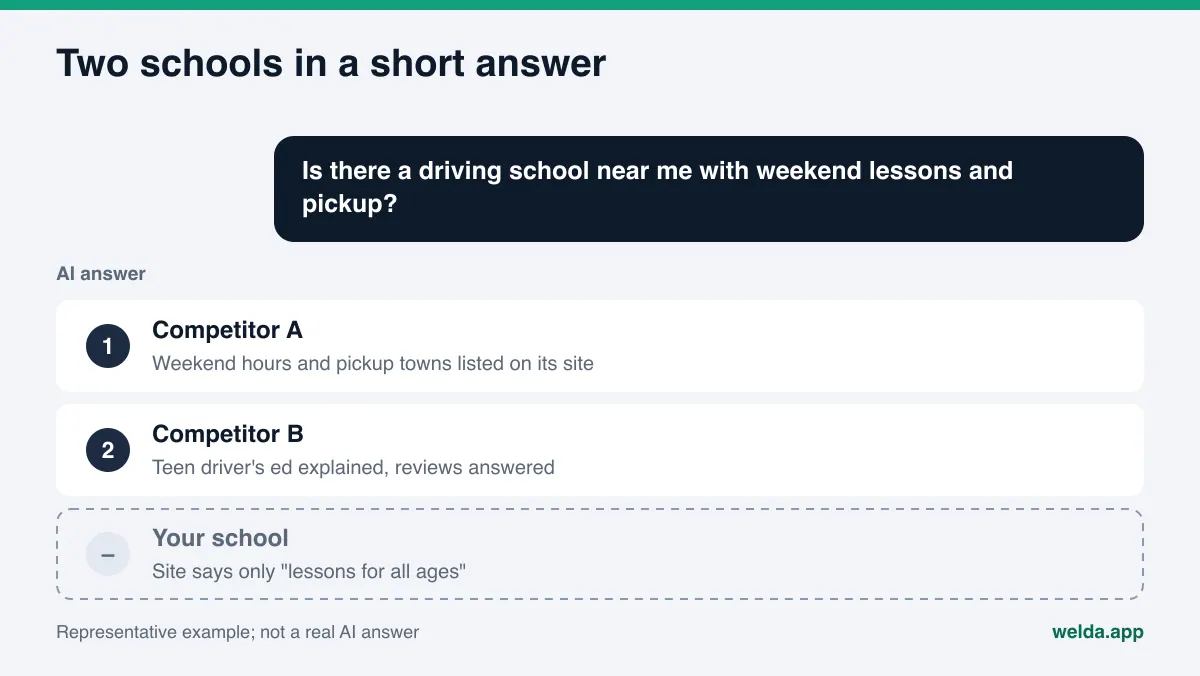
How families choose a driving school now
Picking a driving school usually happens in one sitting. A parent with a teenager about to get a learner's permit, or an adult who never learned to drive, opens their phone and looks for "a driving school near us that does lessons after school and has a good reputation." More of that search now happens inside AI answers rather than on a page of blue links. The answer isn't ten results. It's a short paragraph that names two or three schools and explains why.
That matters for driving schools for three reasons. First, the decision is local. Students go back and forth for lessons for weeks, and many schools pick up from home or school, so service area is a deciding fact. If an AI system can't read where you operate, it won't name you for that town. Second, two people often research the same decision. The teen wants flexible times; the parent wants to know about safety, instructor background, and how payment works. Third, from the outside, driving schools look alike. Similar programs, similar cars, similar packages. When options look the same, an AI assistant leans on the school that explains itself most clearly.
Answer engine optimization, or AEO (also called GEO, generative engine optimization), is the practice of making your business easy for these assistants to describe accurately. For a local business, it overlaps with good local SEO, but the test is different: the AI describes you in its own words, and if what it can read about you is thin or contradictory, leaving you out is the safer choice. We explain how local intent works in AI answers in our piece on "near me" searches in AI.
What students and parents ask AI about driving schools
The questions below are examples we wrote based on what driving schools commonly hear at the front desk and on the phone. They are not research results or measurements. Use them as a starting point for your own list.
- "Which driving schools in Plano offer teen driver's ed with home pickup?"
- "Is there a driving school near me with weekend behind-the-wheel lessons?"
- "Best driving school for nervous adult beginners in Sacramento"
- "Can I take my road test in the driving school's car?"
- "How much do driving lessons cost and do schools offer payment plans?"
- "Driving school that teaches on a manual transmission car"
- "Which defensive driving course is approved in my state?"
Read those closely and five needs stand out: place (town, pickup area), program (teen driver's ed, adult lessons, road test prep, defensive driving), schedule (after school, weekends, summer), vehicle (automatic or manual, use for the road test), and trust (instructors, safety, pricing, reviews). An AI assistant can recommend a school when it finds facts that answer those needs. The table shows what each question type asks of you.
| Question type | Example phrasing | What the AI looks for | Where it should live |
|---|---|---|---|
| Place and pickup | "Driving school with pickup in Plano" | Office address, pickup area, towns you cover | Service area section, Google Business Profile |
| Program | "Teen driver's ed near me" | Each program you run and who it's for | A section or page per program |
| Schedule | "Weekend driving lessons" | Class times, lesson availability, seasonal schedule | Schedule section, FAQ |
| Vehicle | "Lessons on a manual car" | Transmission options, road test vehicle policy | Vehicles section, FAQ |
| Price and payment | "Driving lesson packages" | What a package includes, payment plans, extra lessons | Pricing section, FAQ |
| Trust | "Patient instructor for adults" | Instructor background, reviews, replies to reviews | Instructor section, Yelp, Google, BBB |
AEO for driving schools: where AI assistants look
AI assistants combine several kinds of sources when they recommend a local school. There's no fixed formula, and engines differ, but for driving schools these sources come up again and again.
Your own website. This is where you can say most clearly which programs you teach, your schedule, your vehicles, and how pricing works. Many driving school sites are one page with a phone number and a line like "Professional driving instruction for all ages." That tells an AI almost nothing. A sentence like "We teach teen driver's ed and adult lessons in Plano, Allen, and Frisco, with home or school pickup, weekday evenings and Saturdays, in automatic cars" gives place, program, schedule, and vehicle at once.
Google Business Profile and Google Maps. These are heavily used for local questions. A correct primary category, accurate hours, a clear description of your programs, and photos of your actual cars and classroom all help. If you pick students up and have no walk-in office, the service area setting matters.
Review sites. Yelp, Google reviews, and the BBB are where parents check whether a school is reliable. AI answers often summarize the tone of these reviews. Thoughtful replies to both happy and unhappy students give the AI more balanced text to work with.
Community threads and local directories. Neighborhood forums, Reddit threads about local schools, and older directory listings can carry outdated phone numbers or addresses. If you moved or changed numbers, those leftovers can lead an AI to describe you wrongly. We cover how to correct that in ChatGPT has wrong information about my business.
Consistency across these sources matters more than any single one being perfect. A different phone number on your site, profile, and a directory leaves the AI unsure which one to trust.
There's also a technical gate: your robots.txt file may be blocking AI crawlers without anyone noticing. OpenAI explains in its crawler documentation that it uses a separate bot for ChatGPT's search features and that sites which block it won't appear in ChatGPT search answers. It's a one-time check worth doing.
Step by step: how a driving school becomes recommendable
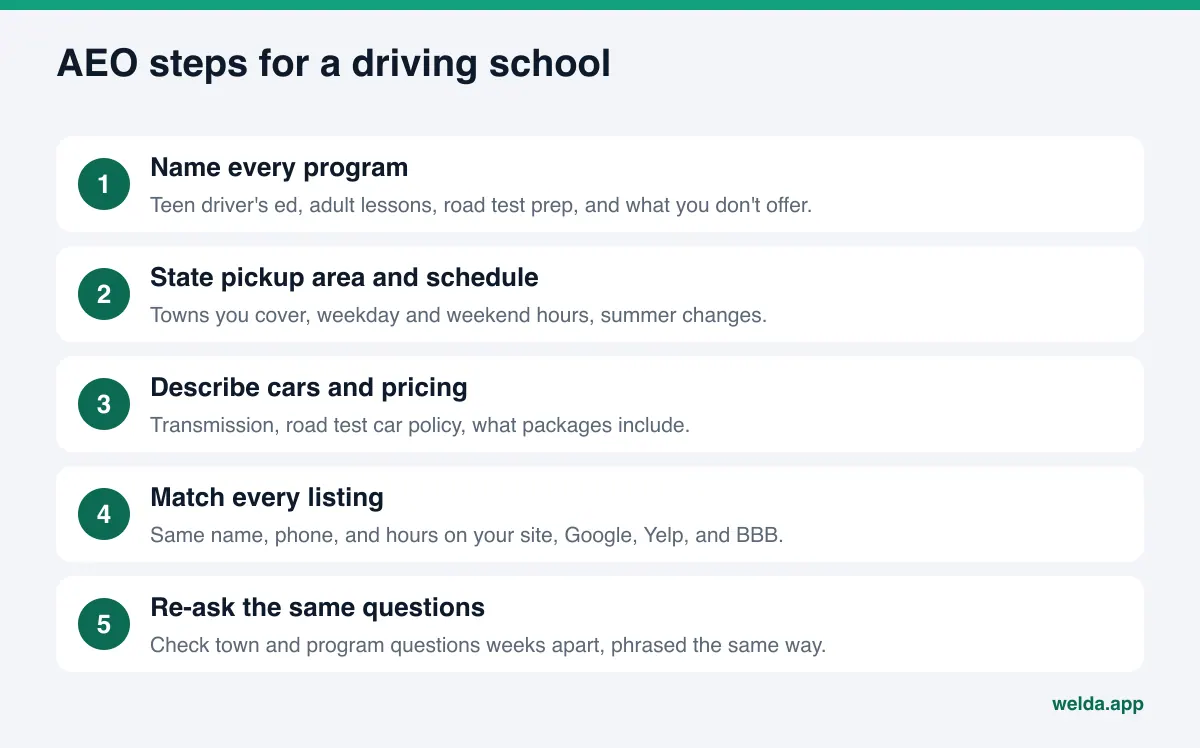
These are tasks a school owner can do alone or with help. Order matters: get the facts straight first, then fix the places they're published, then measure.
- List every program by name. Teen driver's ed, behind-the-wheel only, adult beginner lessons, road test prep, defensive driving, refresher lessons for seniors. Also say what you don't offer, such as motorcycle or commercial (CDL) training, so you aren't recommended for the wrong question.
- Say where you operate. Name the towns or neighborhoods where you pick up students, and where lessons start if you have an office. Don't list places you don't actually serve.
- Write out your schedule. Classroom or online course times, behind-the-wheel availability, weekend and summer options, and how far ahead lessons are typically booked if you know.
- Describe your vehicles and road test policy. Automatic or manual, dual-control brakes, and whether students can use your car for the road test. These are frequent questions and answers vary by school.
- Explain how pricing works. You don't have to post numbers. Say what a package includes, whether payment plans exist, and how extra lessons are handled. Licensing and course requirements vary by state; check with your state licensing agency and don't present legal requirements you haven't confirmed.
- Introduce your instructors. A few sentences on experience and the programs each one teaches. Parents look for this, and it gives the AI something concrete to say about trust.
- Add an FAQ section. Write the five or six questions you hear most, with short, honest answers: "Do you pick up from school?", "What happens if my teen fails the road test?", "Can adults with no experience sign up?"
- Add structured business data. Schema markup with your name, address, phone, hours, and service area helps machines read those facts correctly.
- Match your Google Business Profile to your site. Same name, phone, hours, and description. Link the profile from your site and your site from the profile.
- Reply to reviews. A short thank-you to the student who passed, a calm explanation to the parent who was frustrated about scheduling. Replies are text the AI can draw on.
- Measure. Ask an AI assistant a few local questions and see whether your school is named. One try gives a rough idea; tracking needs the same questions, asked the same way, repeated over time.
Example: a program section an AI can read
"Be specific" is easy advice. Here is what it looks like. The text below is written for an example driving school in a suburban area. The towns, times, and details are placeholders; replace them with your own.
What do we teach? Teen driver's ed (classroom and behind-the-wheel), adult beginner lessons, and road test preparation. We don't offer motorcycle or CDL training.
Where do lessons start? We pick students up from home or school in Plano, Allen, and Frisco. Students outside those towns can start lessons at our office.
When? Behind-the-wheel lessons run weekdays 3:30 to 8 p.m. and Saturdays 8 a.m. to 5 p.m. We add morning slots in summer.
Which cars? All lessons are in automatic sedans with an instructor brake. Students can book our car for their road test as a separate service.
How does pricing work? Packages list the number of lessons included. Payment plans are available and explained in writing at sign-up. Extra lessons are booked individually.
Those five short paragraphs answer five of the six question types in the table: program, place, schedule, vehicle, and price. The sixth, trust, comes from instructor information, reviews, and the same facts showing up everywhere. Notice that the text also says what the school doesn't do. That keeps an AI from recommending you to someone looking for motorcycle lessons.
The same approach works for an FAQ. Examples: "How soon after enrolling can my teen start driving?", "Can I choose the same instructor every time?", "Do you offer lessons for adults who are anxious about driving?", "What do I need to bring to the first lesson?" Keep each answer to two or three sentences and describe what you really do. The questions you hear at the front desk are very close to what people ask AI.
Common gaps on driving school websites
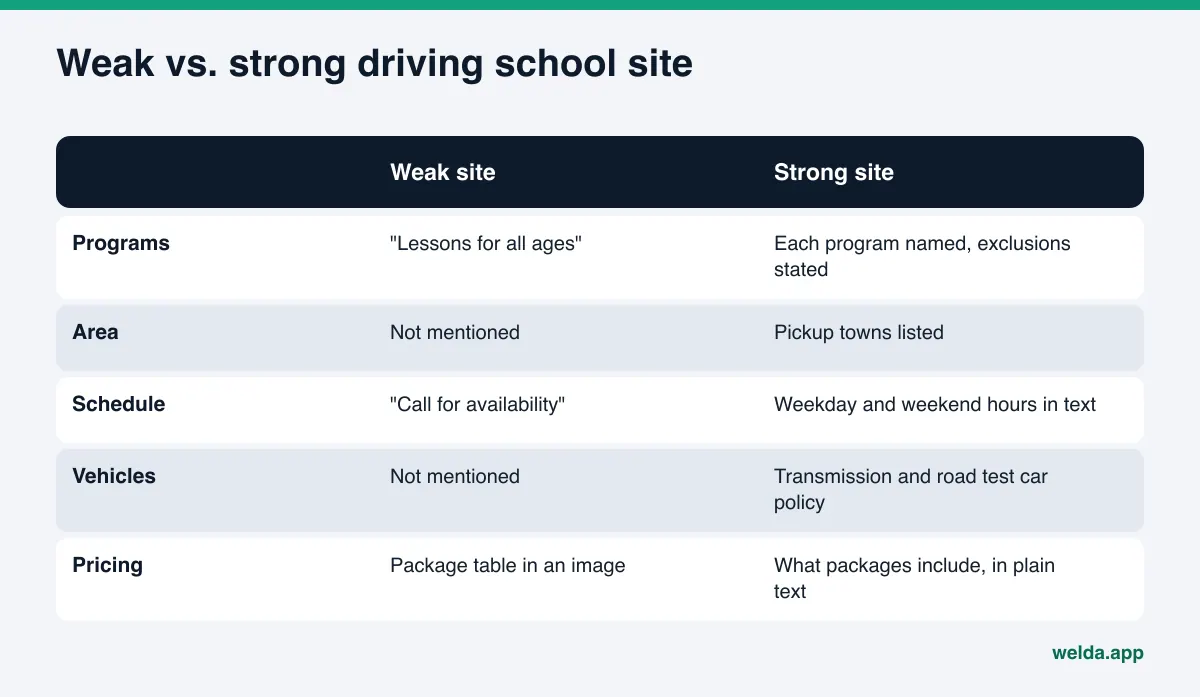
Driving school sites tend to be built once and left alone. That's why the same gaps show up again and again.
"Driving lessons for all ages." A site that doesn't name programs can't tell an AI which question to recommend it for. A parent looking for teen driver's ed and an adult looking for road test prep both get nothing specific.
Schedule only by phone. "Call for availability" is understandable, but an AI can't call. When someone asks for weekend lessons, the school that wrote down its weekend hours gets named.
Pricing hidden in an image. Package tables, schedules, and promotions placed inside images are often not read as text. Put the important facts in plain text on the page.
Claims that can't be checked. "Best driving school in Texas" or "pass guaranteed" doesn't persuade parents and gives an AI nothing to use. Replace it with facts: programs, towns, vehicles, instructor experience. If you share a pass rate, publish it only if you can verify and update it.
Old addresses and hours. The school moved, but directories still show the old address; Google says closed Saturdays while the site says open. Contradictions make it easier for the AI to skip you.
Blocked crawlers or slow pages. A robots.txt that blocks AI bots means even a great site goes unread. A slow, broken mobile page loses the parent who clicks through from an answer.
How Welda handles AEO for driving schools
Welda is software that measures where a business shows up in AI answers and prepares the fixes on the business's behalf. For a driving school, two parts matter most: question tracking, which shows which local questions name you, and the competitor view, which shows why the school down the road is ahead. The starting point is the free site analysis.
Free analysis: what your site says today. The analysis reads your homepage and a few inner pages. On a driving school site it typically flags whether programs are clearly named, whether your address and phone can be read, whether business schema is present, whether your Google Maps profile is linked from the site, whether there's an FAQ, and whether robots.txt lets AI bots in. For each gap it explains what it saw, why it matters, and how to fix it, and it drafts homepage text you can adapt. It also asks a web-search-capable AI assistant five questions a student or parent might ask and checks whether your school is named. That's a one-time snapshot, but it shows where to start. The analysis works in English.
Question tracking: which towns and programs name you? In the Welda dashboard, the questions your customers would ask are run on ChatGPT, Gemini, Perplexity, and Google AI three times each. For a driving school, those questions mix town, program, and schedule: "teen driver's ed in Allen," "weekend driving lessons near Frisco," "adult beginner driving school." The questions screen shows one question per row and one engine per column, with the position you're named in. The usual takeaway: the program or town where you never appear is the one your site explains worst. If you're absent from every road test prep question, a clear road test section is the first job.
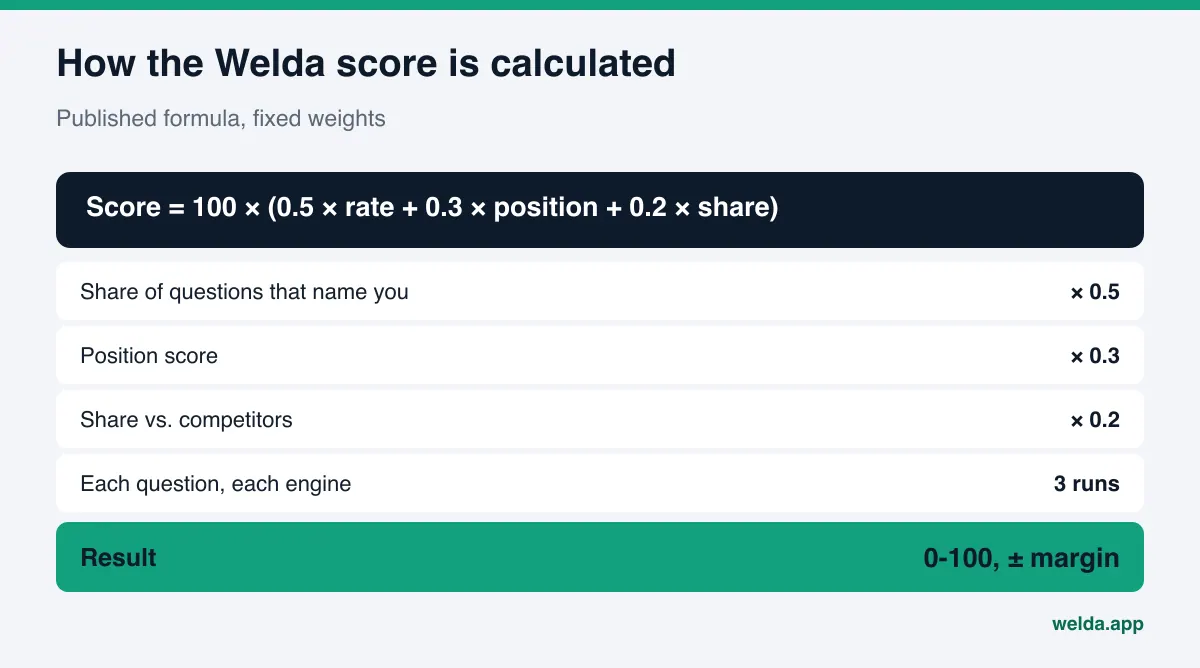
Competitors: why is the other school ahead? The competitor view shows each rival school's share of answers, plus the topic and the source it wins with. A line such as "Competitor A leads weekend lesson questions, cited from its own site and Yelp" tells you what they published and what you didn't. Welda shows where the gap is; what to do about it is your call.
Behind these screens sits a to-do list. Welda can't know which programs you run or whether you pick up from school, and it won't guess; it asks you. Your answers flow into the drafts it prepares. On WordPress sites, drafts arrive on your site as drafts and go live only when you approve them; we describe that flow in a content approval workflow for AEO. On other platforms, Welda provides a ready-made package and you apply it.
Your content always stays on your own site; Welda doesn't host it, and publishing approval stays with you. Here's where things stand: the free site analysis is available to anyone today and works in English and German. The full Welda dashboard is in early access and is opening first in Turkey; regular four-engine measurement is being added during early access, and dashboard screens shown in examples use representative data. Pricing is discussed in an early access conversation.
Limits: what Welda doesn't do
You may hear promises like "we'll get your school to the top of ChatGPT." AI answers are written fresh for every question, so no one can guarantee that. Here is what Welda doesn't do:
- It doesn't guarantee rankings or being named in ChatGPT.
- It doesn't write facts it doesn't know. It asks you about programs, schedules, vehicles, and pricing.
- It doesn't create fake reviews. It drafts replies to reviews, never reviews themselves. The FTC's rule banning fake reviews and testimonials is one more reason to keep it that way.
- It doesn't publish sensitive content without your approval.
- Handling negative reviews, opening and updating directory accounts, and press outreach stay with you. Welda can draft text for them but doesn't log into those accounts for you.
Timing is real too: new content usually takes weeks to show up in AI answers. Enrollment for teen driver's ed often peaks around school breaks, so it makes sense to fix your facts well before your busy season. We go deeper on timing in how long AEO takes.
Where should your driving school start?
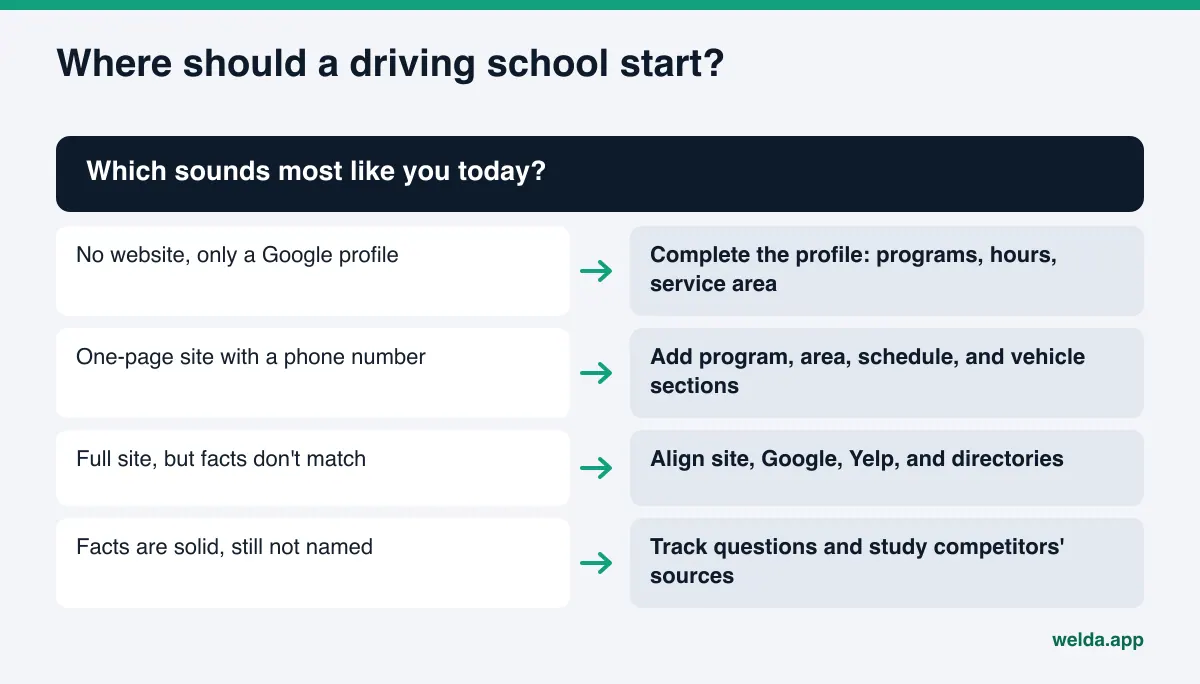
Every school is in a different spot. A school with no website has different priorities than one with a full site that still doesn't show up in answers. The chart above gives you a starting point. The general rule: get your facts right and consistent first; measurement means something only after that.
If you want to see the same approach in another vehicle-related local business, read how car rental companies get recommended by ChatGPT; location, vehicle type, and clearly stated terms decide the answer there too.
A driving school AEO checklist
Open your website and your Google Business Profile and go through this list. Every "no" is a fact the AI can't use to recommend you.
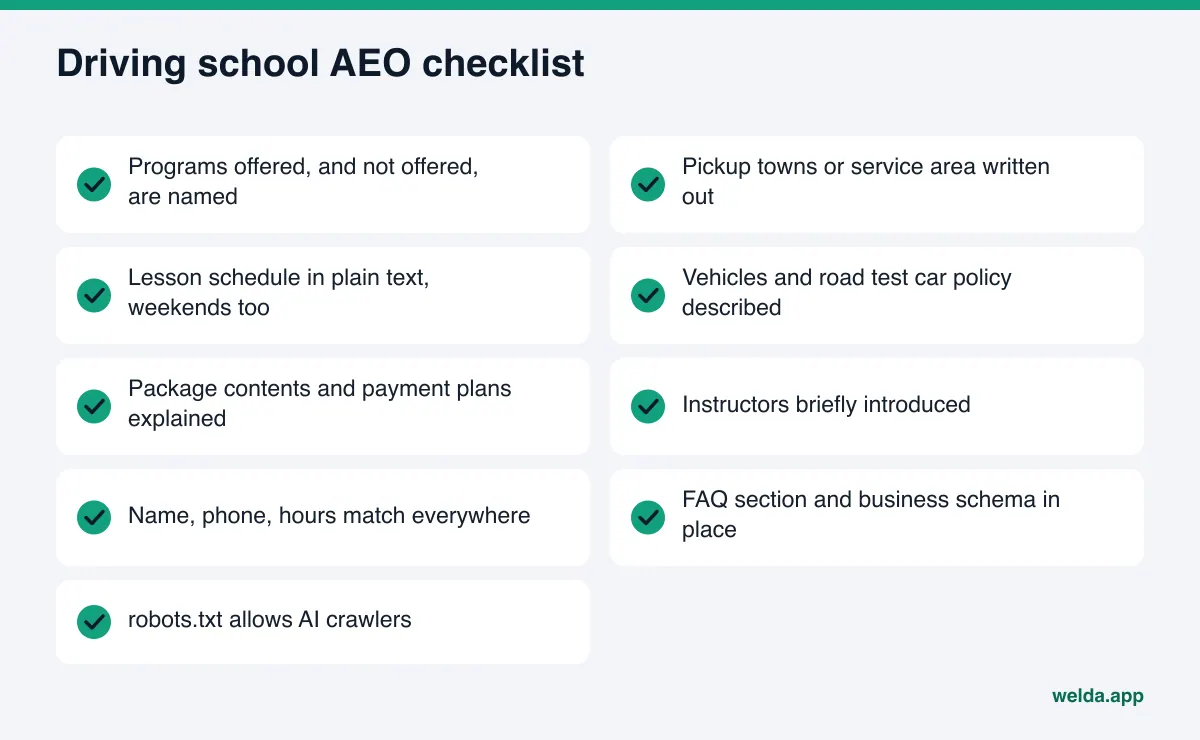
- Are the programs you offer, and don't offer, named on your site?
- Are the towns or pickup areas you serve written out?
- Is your lesson schedule in plain text, including weekends?
- Are vehicles, transmission type, and road test car policy described?
- Is it clear what a package includes and whether payment plans exist?
- Are instructors briefly introduced?
- Do name, address, phone, and hours match across your site, Google, Yelp, and the BBB?
- Is there an FAQ section?
- Is business schema on your site?
- Does robots.txt allow AI crawlers?
- Have recent reviews been answered?
Frequently asked questions
Does a driving school need a website to be recommended by ChatGPT?
It's not strictly required, but it helps a lot. AI assistants can learn about you from Google and review sites. Your own site is still where you can explain programs, schedules, and vehicles in the most detail.
Should we post our prices?
For AEO, you can explain how pricing works without posting numbers: what a package includes, payment plans, and extra lessons. Whether your state requires specific disclosures is a separate question; check with your licensing agency. This isn't legal advice.
Should we create a page for every town we serve?
Near-identical town pages don't help. A clear service area section that names the towns you actually cover is enough for most schools. A separate page makes sense if you have a second office or a genuinely different program in that area.
Should we publish our road test pass rate?
Only if you can verify it and keep it current. An unsupported number can mislead families, and an AI may repeat it on your behalf. If you're unsure, describe your process instead: how many lessons, how you prepare students for the test.
How long until changes show up in AI answers?
Usually weeks, and it varies by engine. Re-ask the same questions, phrased the same way, a few weeks apart to see real movement.
Can US driving schools use Welda today?
Yes, the free site analysis works for any driving school website, in English, once per site. The full dashboard is in early access and opening first in Turkey; pricing is discussed in an early access conversation.
Start with what your site says today
AEO for driving schools starts with facts an AI can repeat: which programs, which towns, which hours, which cars, and how pricing works. To see how much of that your website already communicates, run the free site analysis. The results arrive by email and list each gap with suggested text. What you change, and when, is up to you.