What is AEO for auto repair shops, and how do you get started? AEO (answer engine optimization) for an auto repair shop means making sure your shop gets named when a driver asks ChatGPT, Gemini, Perplexity or Google's AI Overviews and AI Mode for a mechanic. AI tools favor shops that spell out which repairs they do on which makes, keep their address and hours consistent everywhere, and are discussed well on trusted sites. Measure first, then close the gaps in order.
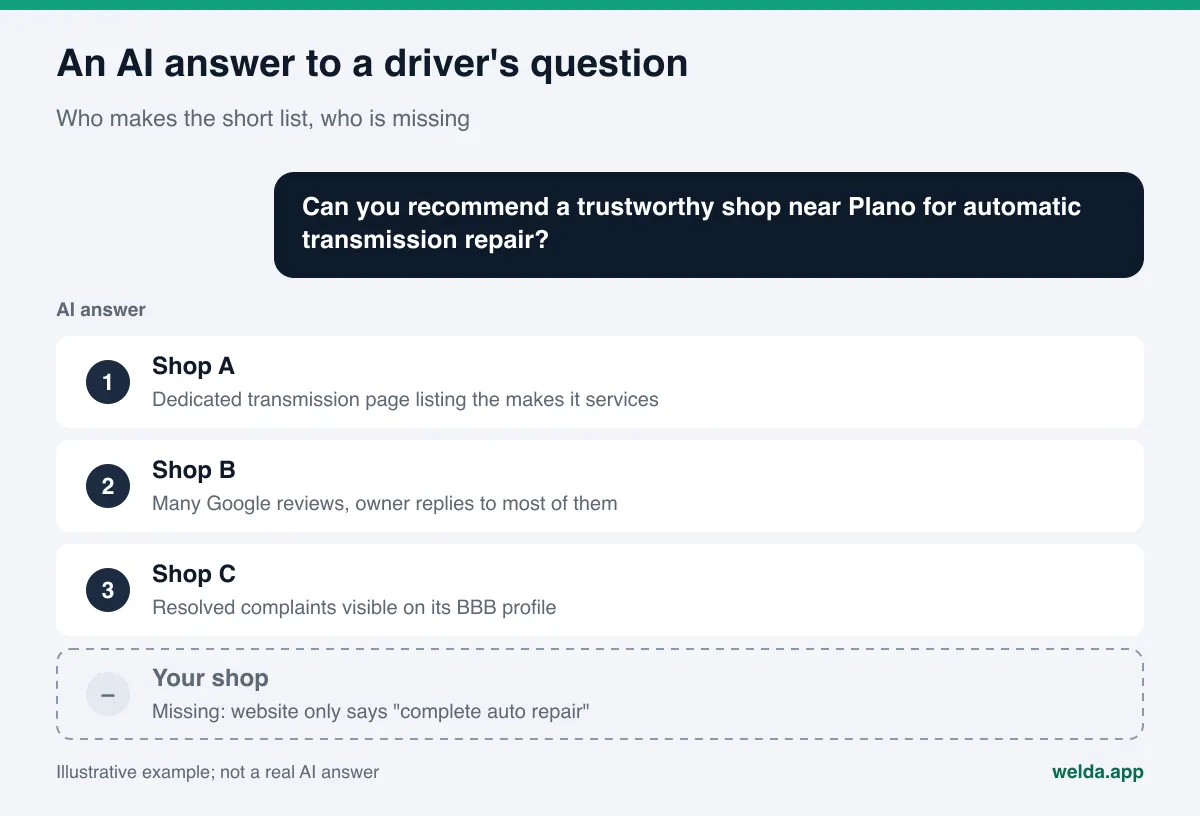
A driver whose check engine light just came on used to open Google Maps and call the three closest shops. Today the same driver types "Is there an honest shop near Plano that does automatic transmission repair?" or "My brakes squeal when I stop, what is it and where should I take it?" into an AI assistant. The answer usually names two or three shops with a short reason next to each. If your shop is not on that list, you never get the call, the estimate request or the car. This guide walks through AEO for auto repair shops step by step: what AI answers rely on, which work only the shop itself can do, and how Welda measures your position and fills the gaps. If you want to see where you stand before reading on, run the free site analysis; the result will help you put the steps below in the right order for your site.
Why AEO for auto repair shops matters now
Auto repair is one of the local services where trust decides almost everything. The questions in a driver's head rarely change: Does this shop know my make? Will they replace parts I do not need? Will they give me an estimate before they start? When will the car be ready? In classic search, the driver answered those questions by opening ten tabs. In an AI answer, the assistant does that reading and condenses it into a few sentences. Whoever gets named in that summary is who the driver compares.
That shift has two consequences for repair shops. First, ranking well in the local map pack does not guarantee you will be named in an AI answer. AI tools do not read only your Google Business Profile; they read your website, reviews, complaint records, forums and directories together. Second, the answer is usually shaped by a specific need. Few drivers ask for "the best mechanic." They combine a symptom, a make and a place. If your site only says "complete auto repair for all makes," the assistant has nothing to connect you to a transmission, A/C or hybrid question.
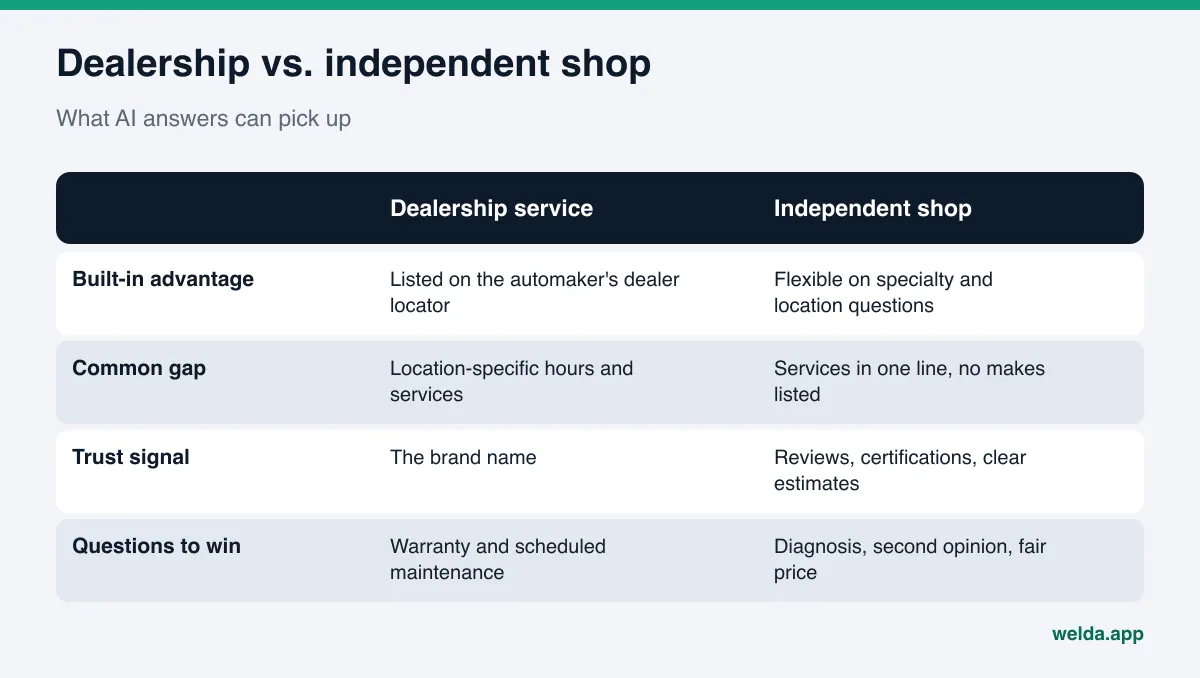
Some people call this work GEO (generative engine optimization); in the US the more common term is AEO, and we use AEO here. Dealership service departments benefit from the automaker's dealer locator and the strength of the brand name. Independent shops do not have that built-in source, but they have a different advantage: they can explain a specialty and a pricing method in plain language. In AI answers that clarity pays off directly, because the assistant is looking for a reason it can write down. The same logic applies to other local services; the guide on how car rental companies get recommended by ChatGPT shows a similar picture for rentals.
What do drivers ask AI about car repair?
It helps to sort repair questions into five groups. The examples below were written for this guide as illustrations; every shop should adapt the list to its own area and specialties.
- Symptom questions: "Grinding noise when braking, what could it be and where should I go?", "My A/C blows warm air, is it low on refrigerant?" The driver wants to understand the problem first, then get a shop name.
- Make and model questions: "Independent shop near me that works on Subarus", "Who does diesel injector service in Fort Worth?" Here the assistant needs to read which makes and systems you handle from your own site.
- Service questions: "How long does a 60,000-mile service take?", "Do I need an appointment for a timing belt replacement?" These map directly to an FAQ section.
- Location and urgency questions: "Auto repair open on Saturday near me", "Shop that will take a car towed in tonight." If your hours and address differ across listings, you may be described with wrong information or skipped.
- Price and trust questions: "How do I avoid getting ripped off at a mechanic?", "Can I ask for my old parts back?" AI often gives general advice here, but it can point to shops that explain transparent estimates as examples.
If you hold certifications such as ASE for your technicians, or your shop focuses on a few makes, that is exactly the kind of detail these questions reward. It only helps if it is true and written where a crawler can read it.
What AI answers look at when recommending a repair shop
An AI answer is a summary of sources. The assistant finds pages related to the question, then tries to build a consistent picture from them. For an auto repair shop, that picture is made of these parts:
| Signal | What the AI looks for | Where it lives |
|---|---|---|
| Service clarity | Which repairs, on which makes, how long they take | Your website, service pages |
| Business data | Name, address, phone, hours, service area | Site, schema markup, Google Business Profile |
| Trust signals | Reviews, owner replies, certifications | Google, Yelp, your site |
| Complaint handling | How you respond when something goes wrong | BBB and similar platforms |
| Independent mentions | What others recommend you for | Reddit, car forums, Angi, local directories |
| Access | Whether crawlers can read your pages | robots.txt, page speed |
One practical lesson follows from this table: some signals are in your control and some are not. You write your site, your business data and your service pages. Customers write reviews and forum posts; what you control is how you respond. Starting with the parts you control gives you fast, measurable progress.
Step by step: how to improve AEO for your auto repair shop
The order below is designed to cover the most questions with the least effort. Each step prepares the ground for the next.
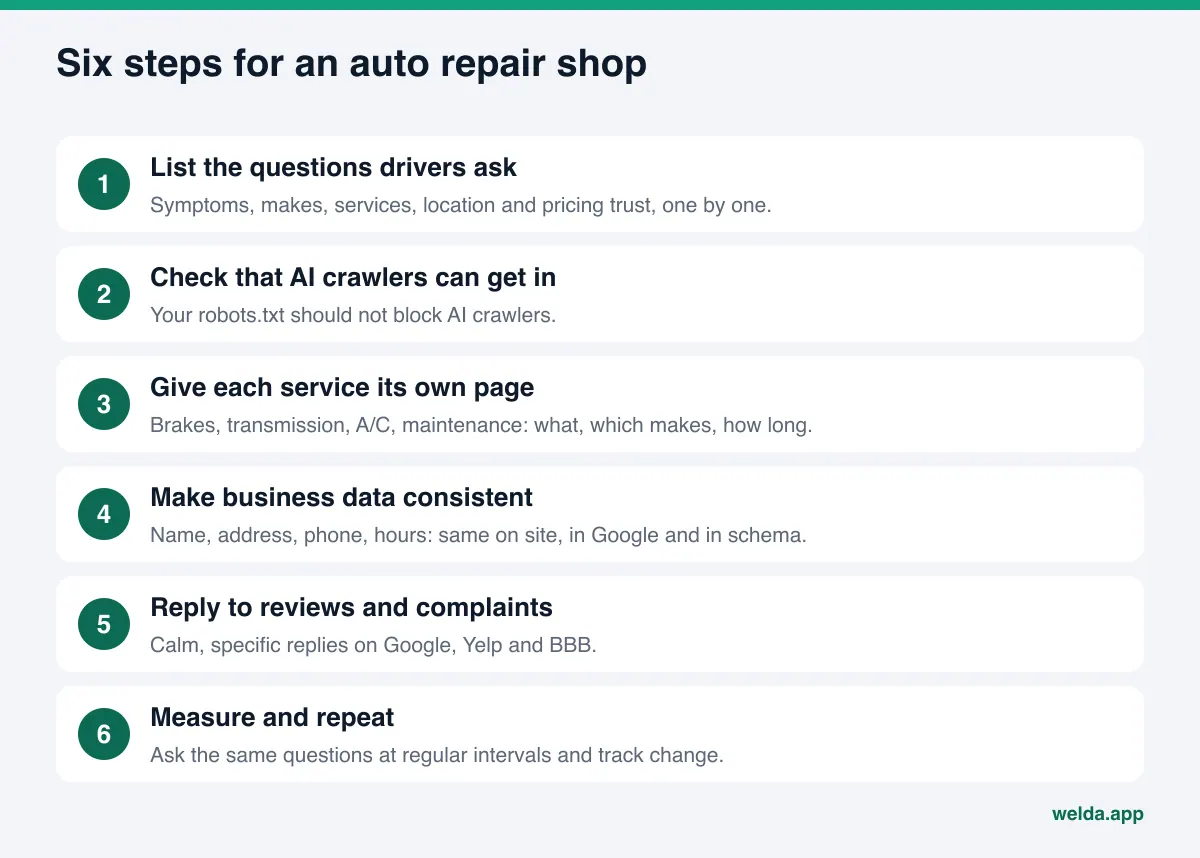
- Write down the question list. Ask your service writers for the fifteen or twenty questions they hear most on the phone. Sort them into the five groups above. Next to each question, note which page on your site answers it. If no page does, that is a gap.
- Confirm AI crawlers can reach the site. If your robots.txt blocks AI crawlers, the rest of the work has limited effect. Some website templates and security plugins block these crawlers without anyone noticing.
- Give each main service its own page. Instead of listing brakes, transmission, A/C, scheduled maintenance, diagnostics and electrical in one line, describe each on its own page. On each page, state what the service covers, which makes and model groups you work on, how long it typically takes and whether an appointment is needed. If you cannot give a fixed time, say what it depends on.
- Explain how you price work. You do not have to publish a price list. But describing how diagnosis works, whether you call for approval before starting a repair, and whether customers can see the replaced parts makes you quotable on trust questions. State your own parts and labor warranty terms exactly as you offer them; never describe terms you do not offer.
- Make your business data identical everywhere. Name, address, phone and hours should match on your site, your Google Business Profile, Yelp, BBB and other directories. Add business markup using the schema.org AutoRepair type. Google's guidelines for representing your business say not to stuff keywords into the business name and to pick the fewest, most specific categories; check them before you edit your profile. Holiday and seasonal hours matter more than most shops think; the guide on how to keep business hours accurate for AI covers that in detail.
- Write an FAQ section. Pick the most frequent questions from step one and answer each in two or three direct sentences. The guide on FAQ pages for AEO explains how to structure them.
- Reply to reviews and complaints. Write calm, specific replies on Google, Yelp and BBB. A reply that explains what was done and how it was resolved leaves a trail an AI can summarize as "this shop follows up on problems." Buying or faking reviews is not an option: the FTC's rule on consumer reviews and testimonials, effective October 21, 2024, prohibits fake reviews, buying reviews and certain review suppression practices.
- Measure and repeat. Ask the same questions again at regular intervals. New content usually takes weeks to show up in AI answers; seeing nothing after one week does not mean the work failed.
How to write a repair service page AI can quote
The service page is the most neglected part of AEO for auto repair shops. Most shops have one "Services" page listing a dozen jobs separated by commas. An AI reads that list but cannot draw a reason from it for any single job. An example transmission page could include these parts:
- Opening paragraph: "We diagnose, service and repair automatic and CVT transmissions. These are the makes we work on most." Two sentences like that give the assistant a summary it can quote directly.
- Symptoms: Situations described in the driver's own words: harsh shifts, delayed engagement, slipping, a warning light. This is where symptom questions connect to your shop.
- Process: What happens when the car arrives, when and how the customer gets an estimate, and whether work starts without approval.
- What you do not do: If you cannot perform software updates for a certain make, saying so prevents wrong matches and wasted calls.
- Page-specific questions: Two or three short Q&As such as "How often should transmission fluid be changed?" or "How many days will my car be in the shop?"
Repeat this structure for each main service. You can draft the text with an AI tool, but if you do not add the facts only your shop knows, you end up with copy that fits every shop. That kind of text gives an AI answer no distinguishing reason to name you; the article on AI-generated content and AEO explains why.
How Welda handles AEO for an auto repair shop
Welda is software that measures where a business appears in AI answers and fills the gaps on the business's behalf. For a repair shop, three parts do most of the work.
The free site analysis as a starting snapshot. The analysis reads your homepage and a few inner pages such as services, about and contact. For a repair shop the key point is that the report checks separately whether your services are clearly described, whether business markup exists, whether your address and phone are consistent and whether your map and social profiles are linked from the site. For each gap it shows what it found, why it matters and how to fix it, plus ready-to-use text suggestions for your homepage. It also asks an AI assistant with web search five questions your customers might ask and checks whether your shop's name appears in the answers. That is a one-time measurement, but it gives a concrete first answer to "Which questions am I missing?" The analysis is free once per site and works in English. When you read the competitor comparison section, the guide on AI competitor analysis helps you interpret it.
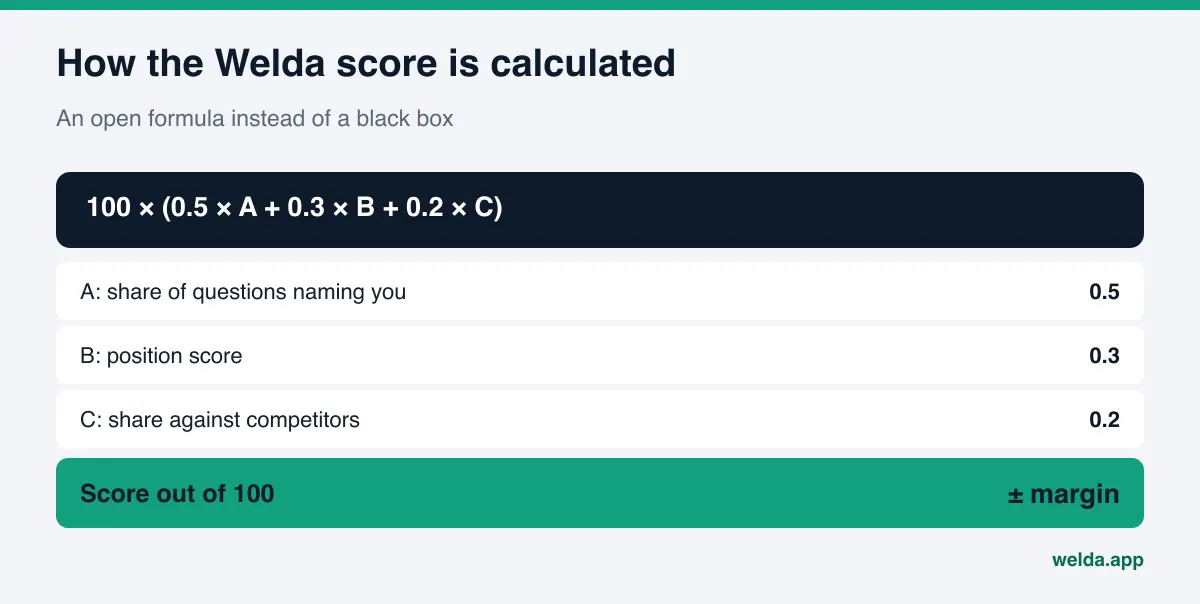
Question-by-question tracking in the dashboard. In the Welda dashboard, questions for a repair shop are organized by symptom, make, service and location. Each question is asked three times on ChatGPT, Gemini, Perplexity and Google AI. Each row shows on which engine and in what position your shop is named. If you show up for general maintenance questions but never for transmission or hybrid questions, it becomes clear which service page to write first. The score behind this view is not a black box:
The sources view and the to-do list. The sources view shows which sites AI answers lean on for repair questions and how your shop looks there: an incomplete Google profile, an unanswered BBB complaint, no listing in a directory the engines cite. Those findings become items on the to-do list. Welda drafts the service page, the profile text and the review replies. It does not invent facts it does not know, such as which makes you specialize in; it asks you. On WordPress sites you create a separate Editor user and an application password for Welda; content opens on your site as a draft and goes live only when you approve it. On other platforms Welda provides a ready-to-apply package and you or your web person apply it. If Google Business Profile is not connected, the task stays on the list as manual. Before anything is published, the compliance check flags patterns such as price claims, warranty claims and superiority claims. It is not legal advice.
The dashboard also has a competitor view, a before-and-after comparison and a one-page monthly report, but for a repair shop the core work is getting the questions and sources right.
A note on availability: the Welda dashboard is in early access and is opening first in Turkey. Regular four-engine tracking is being added during early access, and the dashboard screens shown elsewhere use sample data. What anyone can use today is the free site analysis, which runs in English and German. Pricing is discussed in the early access conversation.
What Welda does not do, and the limits of AEO
When working on AEO for an auto repair shop, it is worth setting expectations clearly. These are the things Welda does not do and the work that stays with the shop:
- Welda does not promise a ranking or a spot in ChatGPT. AI answers vary; the same question can produce different results at different times. That is why each question runs three times and the score carries a margin of error.
- Welda does not write fake reviews and does not broker paid reviews.
- Negative reviews and complaints stay with you. Welda drafts a reply, but talking to the customer, rechecking the car or settling a billing dispute is your job.
- Opening directory accounts, press work and forum participation stay with the shop.
- Welda does not host content. Every page lives on your own site, and the publishing decision is yours.
- Welda does not write technical facts it does not know. Which makes you are equipped for and what diagnostic tools you use come from you.
AEO also does not replace the work in the bays. If a shop misses promised pickup times, the best service page will not change what the reviews say. AEO makes sure the work you do well is described accurately and consistently where drivers now ask.
AEO for auto repair shops: checklist and decision guide
Use the checklist below to decide where to start. Every item you cannot check off is a task.
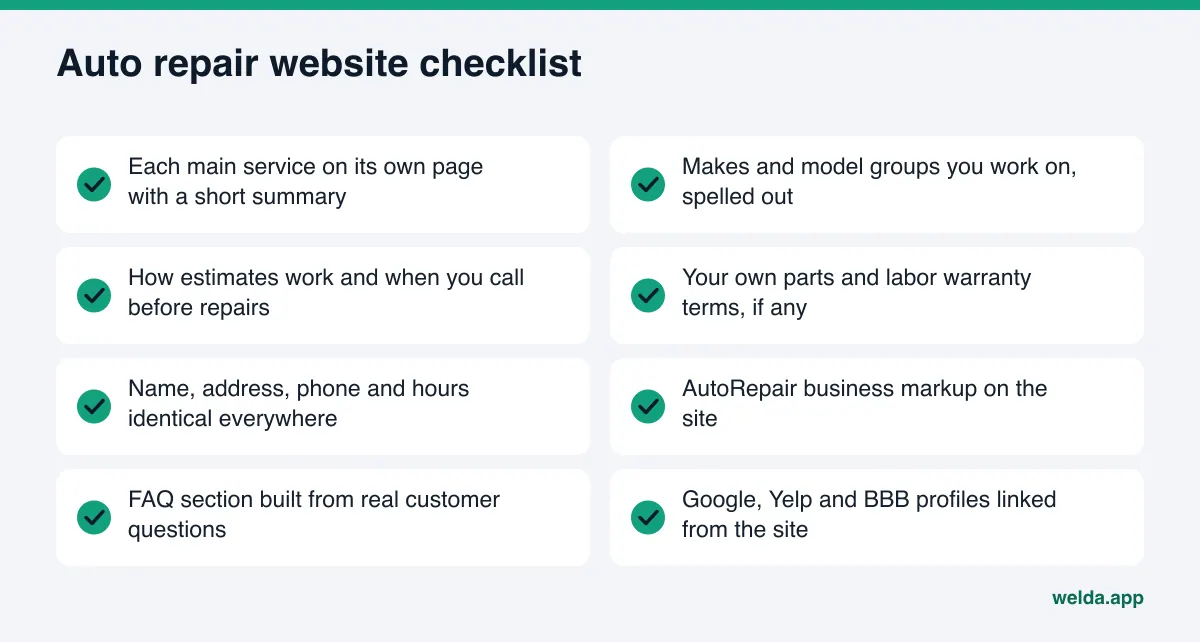
If the list looks long, let the measurement set the order. If crawlers cannot reach the site, nothing else matters much until access is fixed. If your name appears in no answers, basic data and service pages come first. If you are named for general questions but not for specialty questions, service pages are the center of the work.
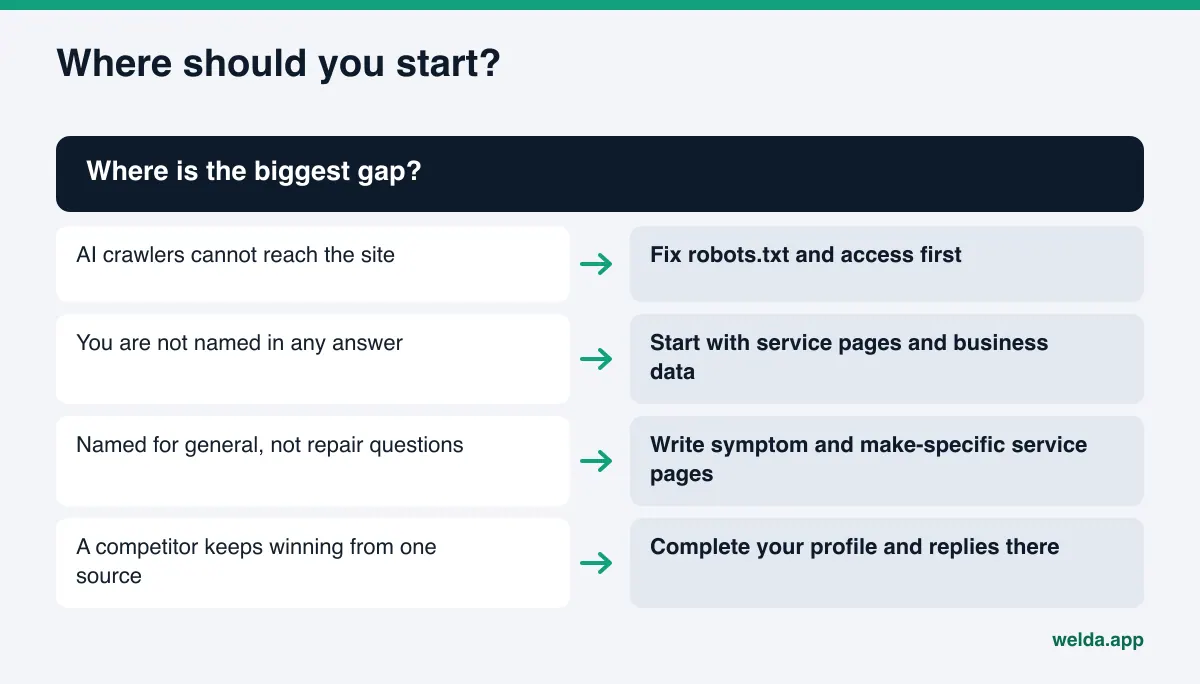
| Situation | Likely cause | First task |
|---|---|---|
| Missing from "auto repair near me" answers | Inconsistent address, hours or map link | Make business data identical everywhere |
| Another shop named for your make | Your site does not list the makes you service | Add make groups to service pages |
| Symptom question gets only generic advice | No page describing symptoms and process | Write a symptom-focused service page |
| Answer shows wrong hours or phone | An outdated directory listing | Find and correct old listings |
| Competitor used as the trust example | Missing estimate process and review replies | Publish a process page, reply to reviews |
Frequently asked questions
Is AEO for auto repair shops the same as local SEO?
No. Local rankings are one important source, but AI answers read your site, reviews, complaint platforms and forums together. A shop can rank in the map pack and still be absent from AI answers.
Do I have to publish prices?
No. Explaining how estimates work, how diagnosis is handled and when you call for approval gives AI enough to work with on most trust questions. Everything you write should match how you actually operate.
I am not a dealership. Can I still show up for make-specific questions?
Yes, if you clearly state which makes and model groups you service. Do not imply dealer authorization you do not have; it misleads customers and creates wrong matches in AI answers.
How long until I see results?
New content usually takes weeks to be reflected in AI answers, and the timing varies by engine and by how often your pages are crawled. Repeating the same questions at intervals lets you see change in data rather than guess.
What if I do not have a website?
Then AI answers rely only on your Google profile and outside sources. That can work, but there is little room to explain your services. The guide on AI visibility without a website covers that situation.
What does the free analysis tell me about my shop?
It scores your site's technical and content side out of 100, lists what to fix and how, suggests homepage text, and shows whether your name appears in a five-question AI test. It does not measure rankings or promise them.
See where your shop stands today
AEO for auto repair shops comes down to describing the work you do well in the places drivers now ask. First you need to know which questions name you and which do not. Run the free site analysis: the report shows the state of your service pages, business data and map link, the result of the five-question AI test, and the first tasks to tackle. Email and phone are verified, the result link arrives by email and stays open for 14 days.