How does a spa or wellness resort get recommended by ChatGPT and other AI assistants? AI assistants name the resorts whose details they can read and cross-check: which pools are indoor or outdoor, soaking temperatures, age rules, whether spa access is included, how day passes work, and what the resort fee covers. When those details are written clearly on your website, your Google Business Profile and your booking listings, and they agree with each other, you give the AI something to recommend. This guide walks through AEO for spa and wellness resorts step by step and shows which parts Welda takes on for you.
What is AEO for spa and wellness resorts, and why does it matter now?
AEO (answer engine optimization) is the work of getting your business named in the answers that ChatGPT, Gemini, Perplexity and Google's AI Overviews and AI Mode give to travelers. You will also hear it called AI search visibility or simply AI visibility. Some people call the same work GEO (generative engine optimization); we use AEO throughout this guide.
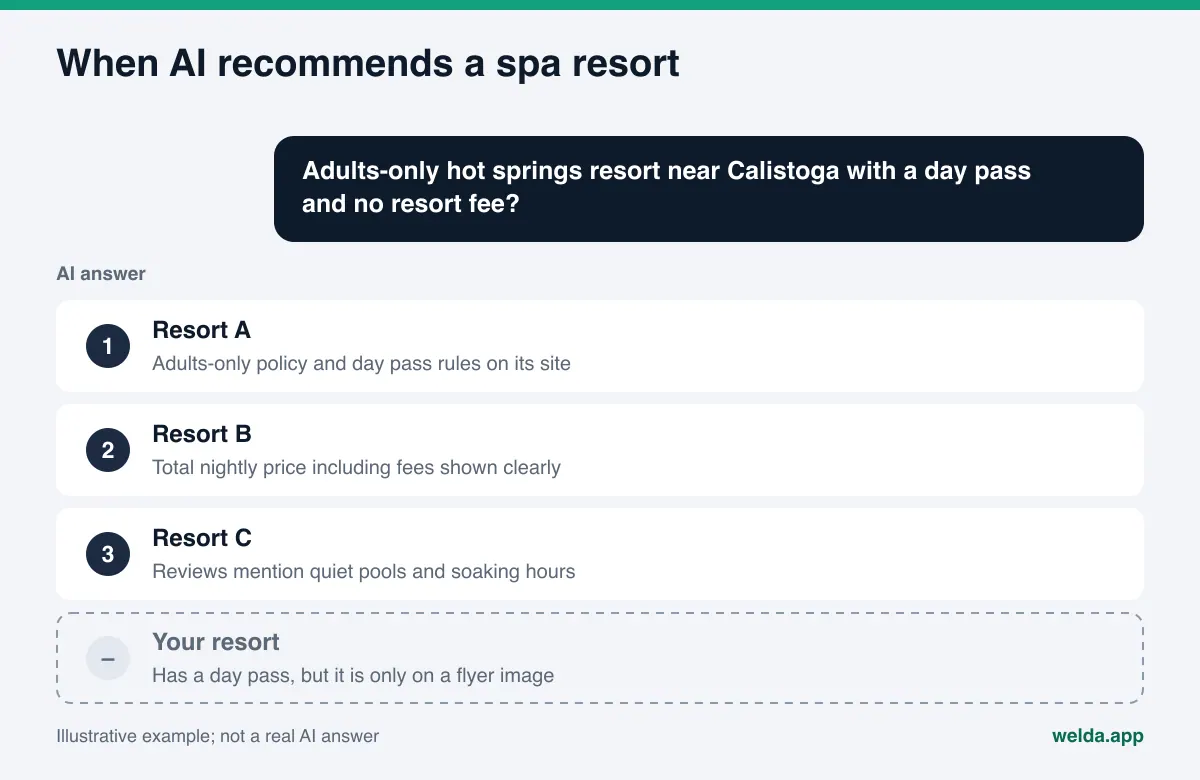
Classic search gives a traveler ten links, a map and a row of booking sites, and leaves the comparing to them. An AI answer usually names three or four properties with a sentence on each. If your resort is not one of those names, the traveler may book without ever seeing you. Ranking well on Google and being named in an AI answer are related, but they are different jobs.
Spa and wellness resorts feel this shift in a particular way. Guests rarely ask for "a resort" and stop there. They describe a need: an adults-only place to soak for a weekend, a hot springs resort where kids can use the pool in the morning, a day pass for a birthday, a couples massage that does not require a two-night stay, or a property where an older parent can reach the pools without stairs. An AI assistant can only answer that kind of question if it has read the details somewhere. If it cannot find them, it names a competitor or guesses.
The details also change often. Pools close for maintenance, spa hours shift with the season, day passes sell out on weekends, age rules relax during school holidays. When an AI finds old information, it repeats it, and your front desk hears about it at check-in.
Then there is the language around water and wellness. "Healing waters" and "relieves arthritis" read as health claims. An AI answer can quote your sentence back to a traveler, with your name attached. So AEO for a spa resort is partly about filling gaps and partly about choosing carefully what you put in writing.
The quickest way to see where you stand is to measure it. Welda's free site analysis reads your homepage and a few inner pages the way Google and AI assistants do and lists each gap with the reason it matters. It works in English.
What do travelers ask AI about spa and wellness resorts?
The questions below are illustrative examples we wrote for this guide, not survey data. They show the pattern: a traveler asks about a rule, a scope or a condition, not about "the best resort".
- "Hot springs resort in Calistoga where kids can use the mineral pool, and what hours?"
- "Adults-only spa resort near Sedona with a day pass on Saturdays?"
- "Wellness resort in Palm Springs where spa access is included in the room rate?"
- "Hot Springs, Arkansas hotel with a thermal bath and an elevator to the spa level?"
- "Couples massage resort in the Hudson Valley without a two-night minimum?"
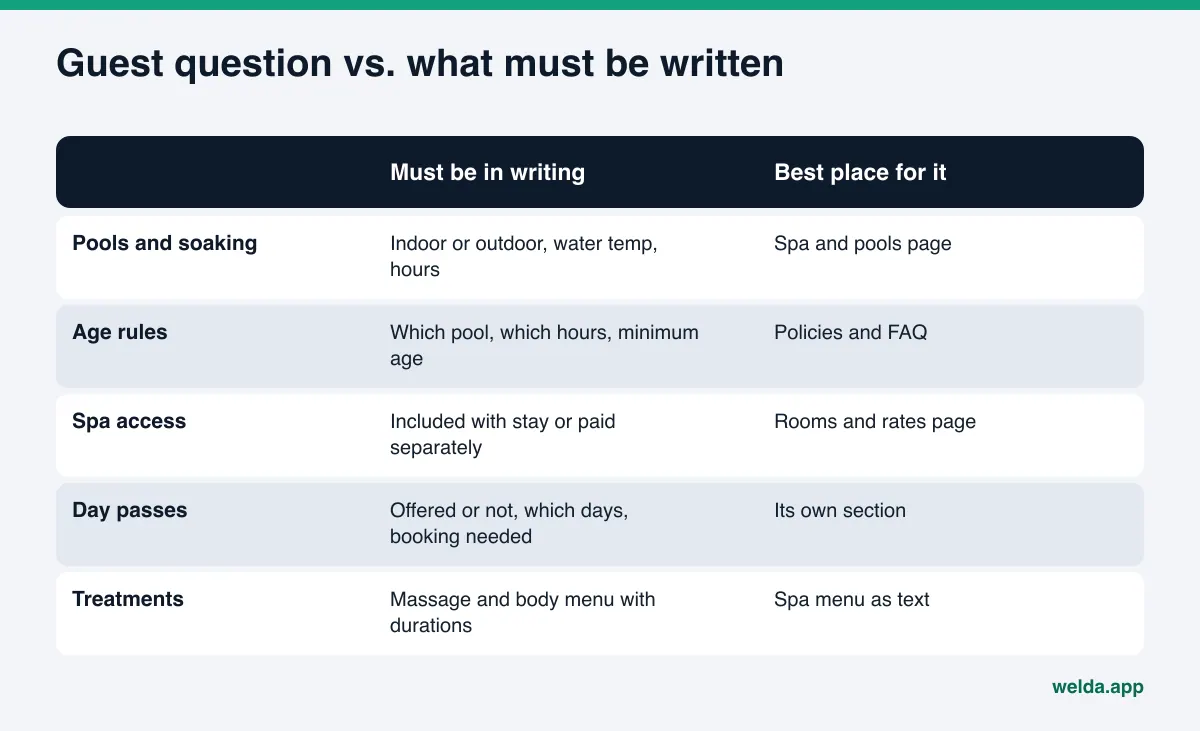
None of these questions can be answered from a slogan. Each depends on one specific detail, and if that detail is missing from every page the AI reads, it has no reason to name you. That is the core of AEO for spa and wellness resorts: write down, ahead of time, the detail the guest is going to ask about.
Where does AI read about your resort?
When an AI assistant builds an answer about a property, it reads several sources and compares them. For spa and wellness resorts, those sources usually fall into four groups.
| Source | What the AI reads there | Who controls it |
|---|---|---|
| Your website | Pools, temperatures, spa menu, policies, fees | You, fully |
| Google Business Profile | Category, amenities, hours, photos, review replies | You, mostly |
| Booking sites and OTAs | Amenity lists, room text, guest ratings | Text is yours, ratings are guests' |
| Review and travel sites (Tripadvisor, Yelp, travel guides) | Experiences, complaints, "best spa resorts" lists | Publishers and guests |
The first two rows are under your control, and they are where most spa resorts have the biggest gaps. The spa menu is a PDF. Pool hours live on a sign by the locker room. The age policy sits in a booking site's "house rules" box and nowhere else. An AI cannot reliably pass on what it cannot read as text.
In the last two rows, consistency matters most. If your site says spa access is included and an OTA listing says it is extra, the AI may repeat both or trust neither. If a Tripadvisor thread says "the pools were not as hot as advertised", a clear, dated temperature range on your own site is the best counterweight. When an AI repeats something wrong about you, the fix usually starts with these same sources; we cover that in what to do when ChatGPT has wrong information about your business.
Step-by-step AEO for spa and wellness resorts
The steps run from easiest to hardest. The first four touch only your own website and need nobody's approval.
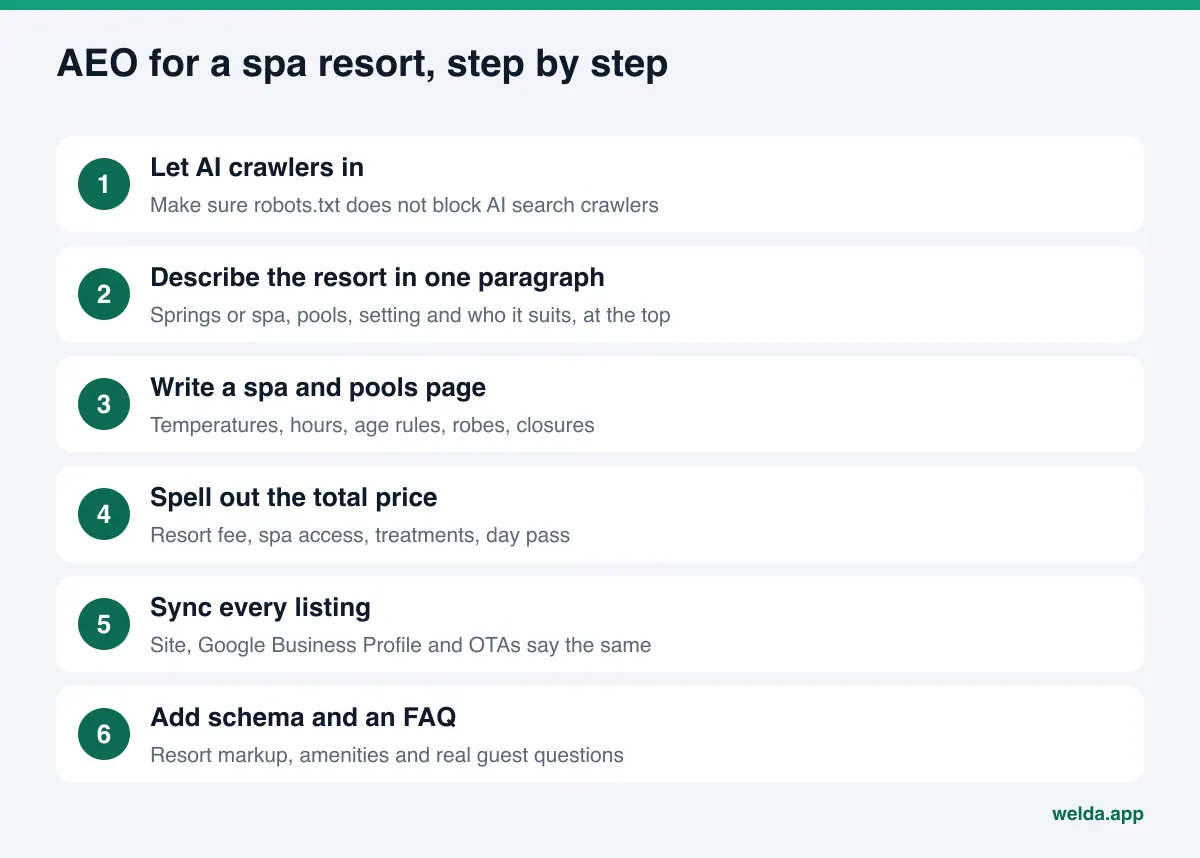
- Make sure AI crawlers can reach the site. If robots.txt blocks AI search crawlers, the best copy on your site goes unread. Security plugins and some hosting setups block them without anyone noticing. If your booking engine runs on a separate domain, at least confirm that the main site is open.
- Describe the resort in one paragraph at the top of the homepage. Where it is, whether you have natural hot springs or a built spa, how many pools, what the spa includes, who the resort suits. "Your sanctuary awaits" tells an AI nothing. A sentence like "A 60-room adults-only resort ten minutes from downtown Calistoga with three mineral pools and a full-service spa" gives it something to work with. Use your own real numbers.
- Write a dedicated spa and pools page. For each pool: indoor or outdoor, temperature range, hours, age rule, what to bring, maintenance closures. If you have a sauna, steam room or cold plunge, give each one a sentence.
- Spell out the total price and what it covers. Is spa access included with the stay? Are treatments separate? What does the resort fee cover, and how do day passes work? More on the fee side below, because US rules apply.
- Turn the spa menu into text. Treatment name, length, who it suits, whether booking ahead is required. Keep the PDF if you like, but put the same information on the page.
- Sync every listing. Same pool hours, same age rule and same spa scope on your site, your Google Business Profile and every booking site. When one changes, change the rest.
- Add structured data and an FAQ. Schema.org has a Resort type under lodging businesses, with an amenity feature property you can use for pools and spa facilities. A standalone day spa can use the DaySpa type. Add an FAQ section answering the questions your front desk really gets.
- Review every wellness and health claim. See the dedicated section below.
Several of these steps apply to any hotel. For the specifics of smaller, concept-led properties, see AEO for boutique hotels; if you run several properties under one brand, AEO for hotel groups covers how to keep details consistent across them.
How should you write the spa, pools and policies page?
For most spa resorts, the spa and pools page does more AEO work than any other page. It only needs to answer the questions a guest has, one by one. Here is what it should cover, with a vague and a usable version of each line.
| Topic | Vague version | Version an AI can use |
|---|---|---|
| Pools | "Unwind in our mineral pools" | "Two outdoor mineral pools and one indoor pool, indoor pool open year-round" |
| Temperature | "Warm, soothing waters" | "Indoor pool kept at roughly X to Y °F" |
| Age rules | "Family friendly" | "Guests under 18 may use the main pool 9 a.m. to 5 p.m.; spa is 18 and over" |
| Spa access | "Extensive spa amenities" | "Sauna, steam room and pools included with your stay; treatments booked separately" |
| Day passes | "Local guests welcome" | "Day passes Monday to Thursday, reservation required; weekends for overnight guests only" |
| Accessibility | "Something for everyone" | "Elevator to the spa level; pool entry with steps and handrails" |
The right-hand column holds example sentences; fill in your own hours, ages and temperatures. What they share is that each one answers a single question with a number or a condition, so the guest does not need to ask a follow-up.
Close the page with an FAQ. "Do I need a swim cap?", "Are robes provided in the room or at the spa?", "Can pregnant guests use the hot pools?" Each answer maps directly to a question someone will type into an AI assistant. For the last one, do not give medical advice; "please check with your doctor" is enough.
Resort fees and the total price: what US rules say
Spa resorts often have more pricing layers than other hotels: a nightly rate, a resort fee that may include spa access, separately priced treatments and day passes. That is exactly the kind of detail travelers ask AI about ("Does this resort have a resort fee?"), and it is now a regulatory topic too.
The FTC's Rule on Unfair or Deceptive Fees took effect on May 12, 2025 and covers short-term lodging, including hotels. According to the FTC's own FAQ on the rule, a business that shows a price must clearly disclose the total price, and a mandatory resort fee belongs in that total. Taxes and optional add-ons can be excluded from the total but must be disclosed before payment. This is not legal advice; check with your counsel how the rule applies to your property and your booking engine.
For AEO, the practical point is simple. When your site states the total nightly price and plainly lists what the resort fee covers (pool and spa access, fitness classes, parking, whatever applies), the AI has a clear answer to repeat. When the fee appears only at checkout, the AI is more likely to repeat a complaint from a review site instead.
Wellness and health claims: where to draw the line
Mineral and thermal waters are often the reason a resort exists, so it is tempting to write "healing waters" or "relieves joint pain". For AEO, those sentences carry two risks.
The first is regulatory. In the US, the FTC expects advertising to be truthful and not misleading, and its Health Products Compliance Guidance explains that health benefit claims generally need competent and reliable scientific evidence. That guidance is written for health-related products, but the underlying principle is a useful test for spa copy too. We are not ruling on any specific sentence here, and this is not legal advice. Show every sentence that suggests a medical benefit to counsel before you publish it, and to your medical director if the spa has one.
The second is trust. AI answers often show where a statement came from. An unsupported health claim, quoted with your name next to it, can weaken everything else the guest reads about you. Measurable facts (water temperature, number of pools, hours) are safer and more useful, because they answer the questions people actually ask.
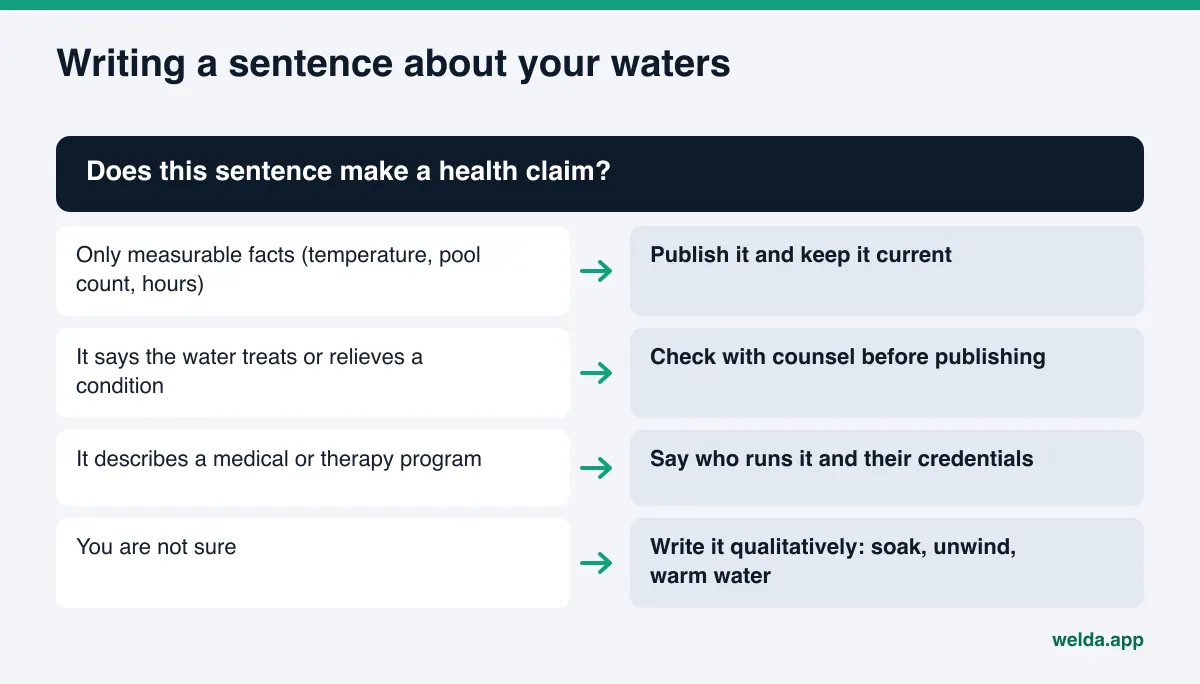
A practical rule: if you cannot answer "who says this, and based on what?", rewrite the sentence in plain, qualitative terms. "Soak in naturally warm mineral water" is a fact. "Therapeutic mineral water" is a claim.
How Welda handles AEO for a spa or wellness resort
Welda is software that measures where your business appears in AI answers and fills in what is missing on your behalf. Three parts of it matter most for a spa resort.
Question tracking: which guest needs do you show up for? In the Welda panel, the questions your guests would ask are put to ChatGPT, Gemini, Perplexity and Google AI three times each. For every question you see whether your resort is named and how early in the answer. For a spa resort, this tells you which detail is missing. If you appear for "hot springs resort with indoor pool" but never for "hot springs resort with kids", the age rule is probably not written anywhere the AI can read it. Questions can be tracked in English or Turkish.
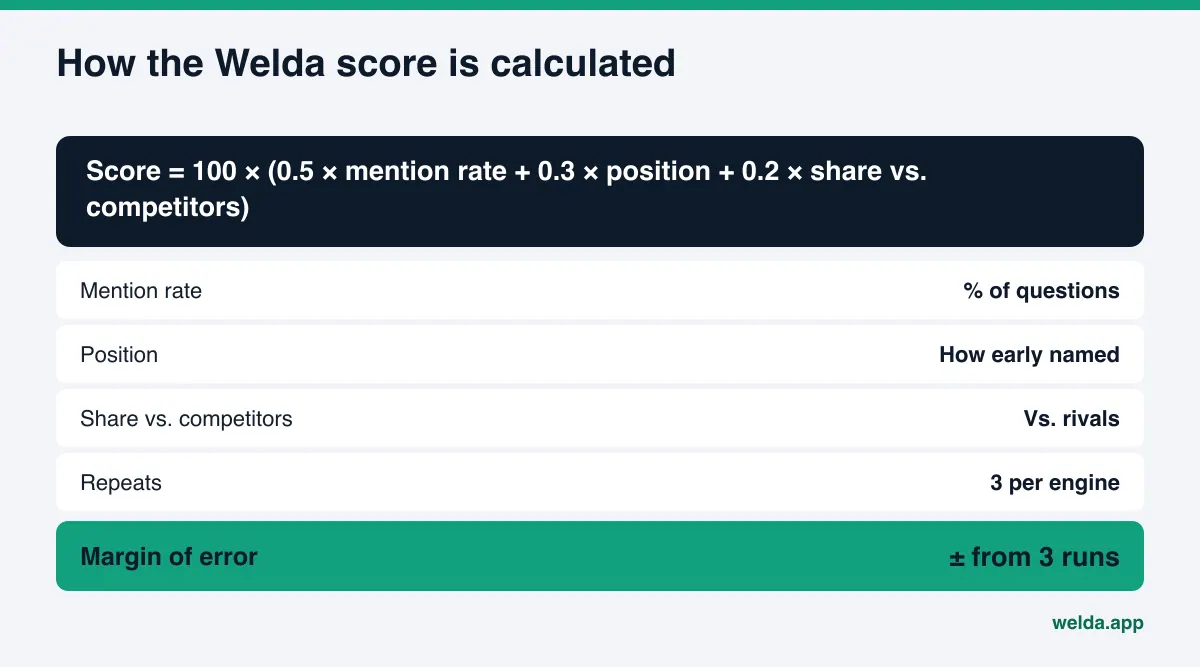
The score behind that screen uses an open formula, shown above, so you can see why it moved. Running each question three times also gives a margin of error, which matters because AI answers vary from one run to the next.
Sources: what is the AI reading? A separate view lists the sites AI answers cite and your status on each one: incomplete profile, unverified details, or a site the AI could not reach. For spa resorts this often shows that OTA amenity lists leave out the spa, or contradict your own site about what is included. Each row comes with the next action.
Drafted content with a compliance check and your approval. Welda drafts the spa and pools page, FAQ answers, profile text and review replies. Before anything is published, its compliance check flags patterns such as pricing statements, guarantees, superiority claims and diagnostic suggestions, so lines like "the most healing waters in the state" get a second look. The check is not legal advice and has not been reviewed by counsel; you decide how to rewrite a flagged line. Publishing approval always stays with you, and the content always lives on your own website.
Welda does not invent facts. If it does not know your pool temperature, kids' hours or what the resort fee covers, it adds the item to your to-do list as missing information and asks you. On WordPress sites, Welda connects through a separate Editor user and an application password you create, with no code to install; drafts open on your site and go live once you approve them. On other systems Welda gives you a ready-made package to apply by hand. Google Business Profile, Instagram and Facebook can be connected; if they are not, the task is listed as manual. Competitor comparison, before-and-after views and a one-page monthly report round out the panel.
An honest note on availability: the Welda panel is in early access and is opening first in Turkey. Regular four-engine tracking is being added during early access, and the sample screens in the panel use representative data. Pricing is discussed in an early access call. What anyone can use today, in English, is the free site analysis.
What the free analysis checks on a spa resort website
The free analysis reads your homepage plus a few inner pages such as services, rates, about and contact. For a spa or wellness resort, these findings tend to matter most:
- Whether AI crawlers are blocked in robots.txt.
- Whether your page title, meta description and main heading mention the spa, the waters and the location.
- Whether you have business schema, and whether your address, phone and location details are consistent.
- Whether your Google Maps and social profiles are linked from the site.
- Whether there is an FAQ section, reviews and trust signals, and a clear description of pools, spa and treatments.
- Page speed, which large pool and spa photo galleries often slow down.
You get a score out of 100 (technical and content scored separately), and for every gap you see what was found, why it matters and how to fix it. You also get ready-to-use homepage copy (title, description, main heading, intro paragraph, FAQ), a simulation of how much each fix would raise the score, a competitor comparison, a fix package that includes business schema code, a PDF and a shareable score card. The analysis also asks an AI assistant that can search the web 5 questions your guests might ask and checks whether your resort's name comes up. That is a one-time snapshot, not ongoing tracking. It is free once per site; email and phone are verified, and the results link arrives by email and stays open for 14 days.
If you want a broader view of what a full review covers, see what an AEO audit includes.
What Welda does not do
- No guarantees. Welda does not guarantee rankings or placement in ChatGPT. AI answers vary from question to question, and no one can promise a specific outcome.
- No health claims. Welda does not write copy saying your waters treat a condition. If you choose to publish such a claim, the decision and the responsibility stay with you.
- No fake reviews. Welda drafts replies to real reviews. Resolving negative reviews stays with your team.
- Directories and press stay with you. Travel directory accounts, press and magazine features are your work; Welda lists them as manual tasks.
- It takes time. New content usually takes weeks to show up in AI answers. We explain what to expect in how long AEO takes.
One more limit: being named in an AI answer does not mean the guest books direct. Many answers also link to booking sites. AEO gets you into the short list; your own site and booking path still have to do the rest.
Checklist: is your spa resort ready for AI answers?
Open your own site and go through the list. Every "no" or "not sure" is a guest question that AI currently cannot answer about you.
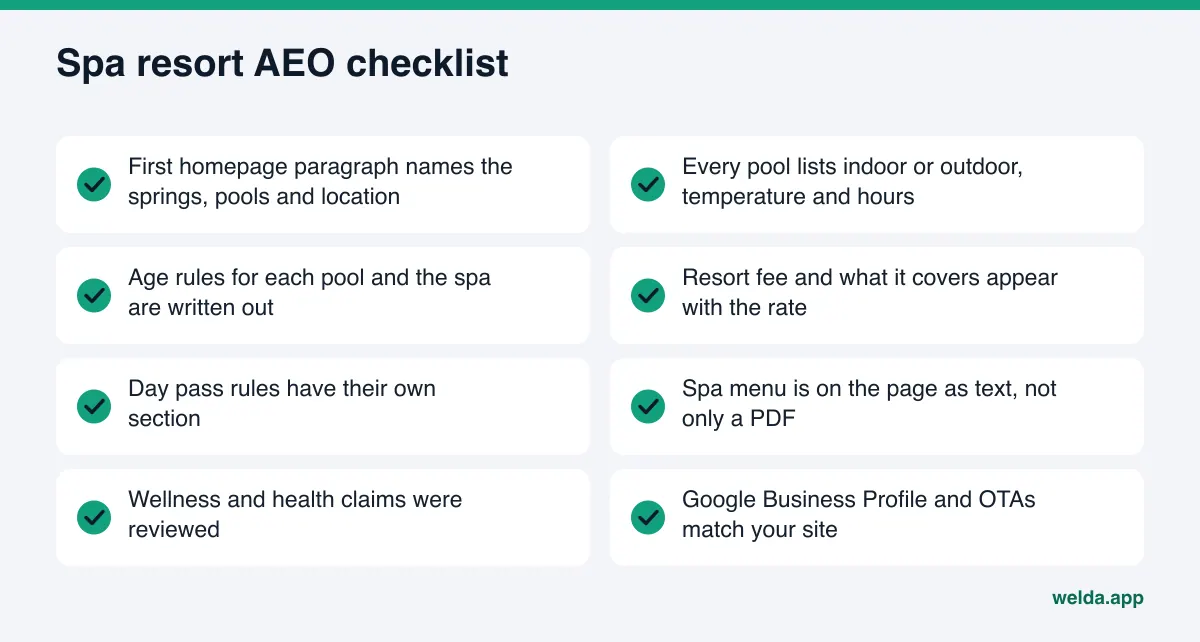
| Your situation | What to do first |
|---|---|
| No dedicated spa and pools page | Write it first; everything else builds on it |
| The page exists but conflicts with OTA listings | Sync the details before adding new content |
| Details are complete, but the copy has health claims | Review those lines, with counsel if needed |
| Fees appear only at checkout | Show the total price and what the resort fee covers |
| Everything is in place, but AI still does not name you | Measure which questions and sources you are behind on |
Frequently asked questions
Our spa menu is a PDF. Is that enough for AEO?
Partly. Some AI systems can read PDFs, but text on the page is read more reliably. Keep the PDF, and also put treatment names, lengths and who they suit in the page copy.
Do we have to publish pool temperatures?
No, but guests ask about them and AI uses that kind of concrete detail. If the temperature varies by season, give a range and note when it was last updated.
Should day passes have their own page?
If day passes are a real source of revenue, yes. Day guests ask different questions from overnight guests, and a dedicated section answers "spa day pass near me" style questions directly.
Does the FTC fee rule affect how AI describes our prices?
The rule is about how you display prices, not about AI. But when your site shows the total price and what the resort fee covers, AI has accurate information to repeat. Ask counsel how the rule applies to you.
Will Welda write about the benefits of our mineral water?
Welda writes measurable facts such as temperatures, pools, hours and rules, and its compliance check flags health-claim patterns before publishing. It does not write copy claiming your water treats a condition.
Can we use the Welda panel in the US today?
The panel is in early access and opening first in Turkey. The free site analysis works in English today, and you can use it for any site.
See where your resort stands today
AEO for spa and wellness resorts starts with writing down, accurately and in advance, the details guests are going to ask about. To see which details are missing, which fixes would matter most and whether AI names your resort today, run Welda's free site analysis. It is free once per site, and the results link arrives by email.