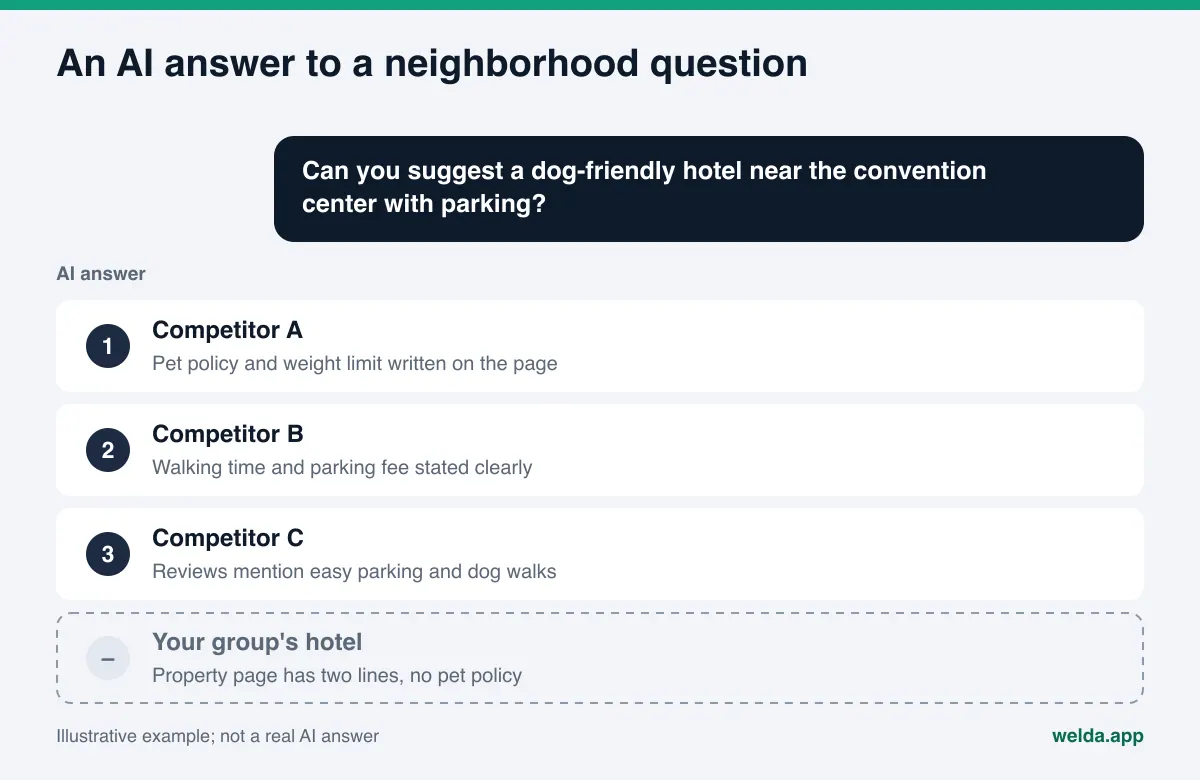
What does AEO for hotel groups involve, and why is it harder than for a single hotel? Travelers rarely ask an AI assistant about a hotel brand. They ask for a hotel in a specific neighborhood that fits a specific need, and ChatGPT, Gemini, Perplexity or Google's AI features answer with individual properties. If each of your hotels is not described on its own page, in its own profile and with its own structured data, the property that gets named is usually a competitor down the street, no matter how well known your brand is.
What AEO for hotel groups actually means
AEO (answer engine optimization) is the work of making sure AI assistants can find, understand and recommend your business. People also call it AI search visibility or AI visibility, and some use GEO (generative engine optimization) for the same idea. For an independent hotel, the scope is fairly contained: one website, one Google Business Profile, one address. For a hotel group, a management company or a regional collection, the same work multiplies by the number of properties, and the brand layer sits on top.
The structure we see most often in hotel groups looks like this. A corporate site tells the brand story and hosts the booking engine. Each property gets a page, but that page is a photo carousel, a two-line description and a "Book now" button. The things a traveler actually asks about, such as the walk to the convention center, whether there is self-parking or valet, the pet policy and weight limit, breakfast hours, meeting room capacity or whether a resort fee applies, are either missing or buried inside the booking flow. A person can call the front desk to find out. An AI assistant can only use what it can read.
The result is predictable. A brand question like "Is this hotel group any good?" may return something reasonable. The question that drives the booking, "pet-friendly hotel near the convention center with free parking," does not mention your property in that neighborhood. That second question is where the decision happens, so AEO for hotel groups is as much a property-by-property information job as it is a brand job.
A practical first step is to see how your site reads to an AI system. Welda's free site analysis reads your homepage and a few inner pages, then lists each gap and how to fix it. You can run it on the corporate site or on a single property site.
What travelers ask AI assistants about hotels in a group
Hotel questions follow a handful of patterns, and almost none of them name a brand. The examples below were written for this guide to illustrate the patterns. They are not measured data.
| Question pattern | Illustrative question | Where the answer comes from |
|---|---|---|
| Location and proximity | "Hotel within walking distance of the convention center" | Property page text, map pin, Google Business Profile |
| Trip purpose | "Quiet hotel for a work trip with early breakfast" | Room and amenity details, review themes |
| Policies | "Dog-friendly hotel downtown, 60 lb dog" | Written pet policy, FAQ section |
| Total cost | "Does this hotel charge a resort fee or parking fee?" | Fee disclosure on the property page, OTA listings |
| Groups and events | "Hotel with a ballroom for a 150-person wedding" | Meetings and events page, capacity numbers |
| Comparison | "Which of these two hotels is better for families?" | Clear differences between properties, reviews |
Notice what every row has in common. Each answer depends on a specific fact about a specific property. A hotel group may have three properties in the same metro, but each one only shows up for the questions its own page can answer.
Why hotel groups fall behind in AI answers
The gaps in hotel groups usually come from structure, not neglect. Corporate marketing owns the brand and the site template. General managers own day-to-day operations. The details that AI assistants need live between those two teams.
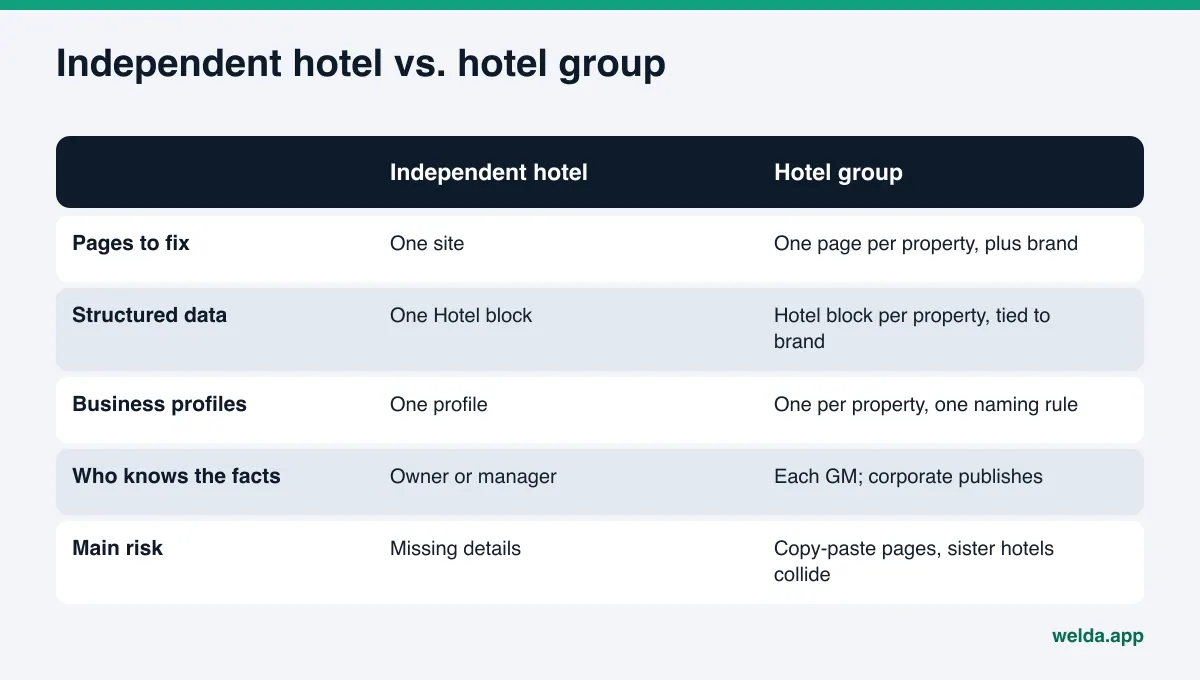
- Thin property pages. The template was designed for a booking engine, not for answering questions. Neighborhood, transit, parking, pet and fee details never make it onto the page.
- Copy-paste descriptions. When every property uses the same brand paragraph, an AI system cannot tell your airport hotel from your downtown hotel.
- Structured data only at the brand level. A single Organization block on the homepage tells AI systems the company exists. It does not tell them where each hotel is, when check-in starts or whether pets are allowed.
- Scattered Google Business Profiles. Profiles created over the years by different managers end up with different naming patterns, outdated hours and phone numbers that do not match the website.
- Rebrands and flag changes. When a property changes its name or brand affiliation, the old name tends to linger on Tripadvisor, OTAs and directories, and AI answers can mix the two.
- Sister properties competing. Two hotels in the same city with nearly identical pages compete for the same question, and sometimes neither gets named.
That last point deserves attention. If your group's brand name brings up a competitor in AI answers, it is often the same structural issue showing from the other side. We cover that case in what to do when competitors show up for your own brand questions.
AEO for hotel groups, step by step
The order below separates what corporate sets up once from what each property fills in. That way every new property drops into the same pattern instead of becoming its own project.
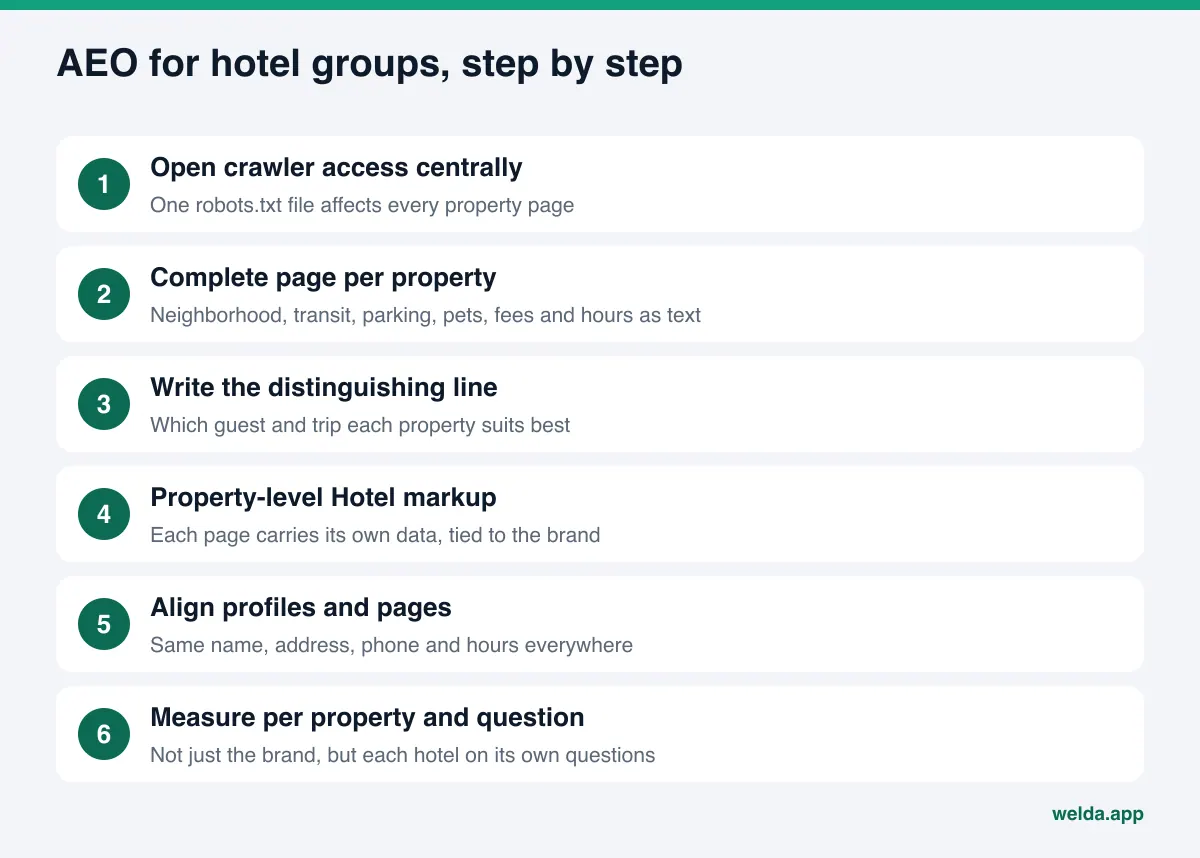
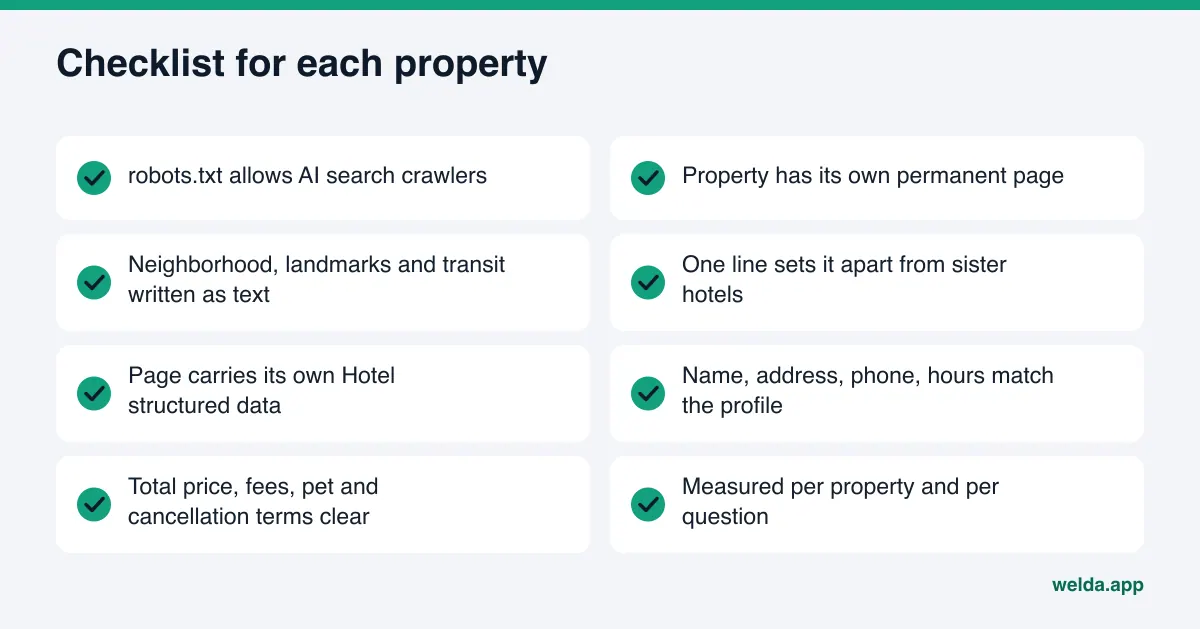
- Check crawler access at the corporate level. If your robots.txt blocks AI search crawlers, none of your property pages can be read. One file affects every hotel. See robots.txt for AI crawlers for the details.
- Give every property a permanent, complete page. Each hotel needs its own URL with neighborhood and nearby landmarks, transit and parking, room types, meeting space, dining hours, pet policy, check-in and check-out times, and accessibility notes written as plain text.
- Write the sentence that sets each property apart. "Our downtown hotel is built for business travel, with meeting rooms and a 6 a.m. breakfast" and "our lakeside property has family suites and free self-parking" tell an AI system which hotel fits which question.
- Add property-level structured data. Each property page should carry its own
Hotelmarkup with that property's address, phone, geo coordinates, check-in time, amenities and pet policy, linked to the group throughbrandorparentOrganization. - Bring Google Business Profiles under one account. Use one naming convention, and make sure hours, phone and website URL match the property page exactly.
- Answer fee and policy questions on the page. Total price, resort or amenity fees, parking charges, cancellation terms and pet fees belong in a short FAQ on each property page.
- Audit the sources property by property. Check Tripadvisor, Expedia, Booking.com, Yelp and local visitor guides for outdated names, wrong categories and missing amenities.
- Measure at the property and question level. Instead of asking whether the brand shows up, ask whether your downtown hotel shows up for the work-trip question and your lakeside hotel for the family question.
Structured data and Google Business Profile for multi-property groups
The most common structured data mistake in hotel groups is putting one Organization block on the corporate homepage and nothing on the property pages. Google's local business structured data documentation recommends defining each business location as its own LocalBusiness item, with the url pointing to that specific location's page.
For hotels, the matching type on schema.org is Hotel. It supports properties such as checkinTime, checkoutTime, petsAllowed and amenityFeature, and it inherits brand and parentOrganization from Organization, which is how you tie a property to the group. An AI system can then read both "this hotel belongs to this group" and "this is where it is and what it offers" from a single page.
Google Business Profile has a specific path for chains. According to Google's bulk verification help page, a business with 10 or more locations can verify its profiles in bulk, as long as the spreadsheet lists every profile, the account has no errors and other conditions are met. Groups with fewer than 10 hotels verify each profile individually. Either way, keeping the property name, address and phone identical on the profile and the property page makes it easier for AI systems to treat them as the same hotel.
If you want a page-level checklist for a single property, AEO for boutique hotels walks through it. In a group, you apply that same checklist to each property.
Fee transparency: a US rule that also shapes AI answers
"Does this hotel charge a resort fee?" is one of the questions an AI assistant has to answer from whatever it can read. In the US, there is also a regulatory side. The FTC's Rule on Unfair or Deceptive Fees took effect on May 12, 2025. According to the FTC's FAQ, it covers businesses that offer or advertise short-term lodging, including hotels and the platforms that sell their rooms, and requires the total price, including mandatory fees, to be shown up front. Taxes and optional add-ons can be left out of that upfront total but must be disclosed before payment.
For a hotel group, this has a practical AEO side. If fee information is clear in your booking engine but missing from the property page, an AI system answering a cost question has nothing to quote. Writing a short, accurate fee statement on each property page helps both the traveler and the assistant. This is not legal advice; check with your counsel on how the rule applies to your properties. Our guide to pricing claims in AI-ready content covers how to phrase prices safely.
Corporate or property: who owns which task?
Without clear ownership, even a good plan stalls. A two-layer model works well in practice.
| Task | Corporate team | Property team |
|---|---|---|
| robots.txt, site structure, page template | Sets up and maintains | Reports issues |
| Structured data template | Builds it | Confirms address, hours and amenities |
| Property page copy | Sets tone and structure | Supplies local facts: neighborhood, transit, policies |
| Google Business Profiles | Owns the account and naming | Sends hours changes and photos |
| Review responses | Sets response guidelines | Responds for its own property |
| Publishing approval | Gives final sign-off | Confirms its own facts are correct |
The key takeaway is that the information AI assistants look for most (neighborhood, transit, hours, policies, fees) lives at the property, while publishing runs through corporate. You need a workflow that collects facts from each property and routes them to corporate for approval. Otherwise corporate writes generic copy and the property adds nothing.
How Welda handles AEO for hotel groups
Welda is software that measures where a business appears in AI answers and fills the gaps on the business's behalf. Here are the three parts that matter most for a hotel group, seen from the group's side.
1. A baseline from the free site analysis. The free site analysis works in English today and is the part anyone can use right now. It reads your homepage and a few inner pages (services, pricing, about, contact) and checks crawler access, title and description, structured data, address and phone details, an FAQ section, trust signals and page speed. For each gap it explains what it saw, why it matters and how to fix it, and it produces a ready-to-add fix package that includes business structured data. It also asks five questions a traveler might ask to an AI assistant that can search the web, and checks whether your name appears in the answers. That is a one-time snapshot.
An honest note for groups: the analysis does not crawl every property page. It covers the homepage and a few inner pages. If the group runs one domain, it shows you the template problems on the corporate site, and those usually repeat across every property page. If each property has its own site, each site can be analyzed once for free, so you can compare properties on the same criteria.
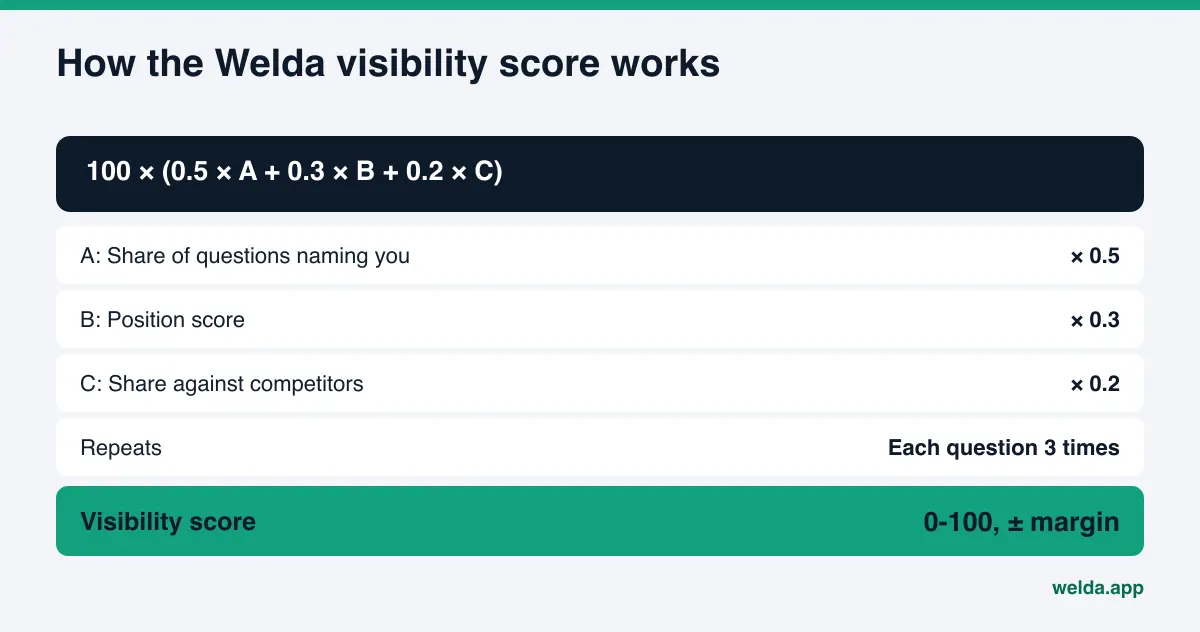
2. Question-level measurement in the Welda dashboard. In the dashboard, the questions your guests would ask are put to ChatGPT, Gemini, Perplexity and Google AI three times each. The Questions view shows, for each question, whether your name appears, in which engine and in what position. The Competitors view shows which competitor is ahead on which topic and from which source. The score formula is public: 100 × (0.5 × share of questions where your name appears + 0.3 × position score + 0.2 × share against competitors), with a ± margin taken from the variation across the three repeats. For a group, this turns "is our brand visible?" into "does our downtown hotel come up for the work-trip question?"
3. A to-do list with approval kept in-house. Welda drafts property page copy, FAQ answers, profile text and review responses. It does not invent facts it does not have; missing details show up on the to-do list as questions for you, such as whether parking is paid or what the pet weight limit is. Publishing approval stays with your team. On WordPress sites, Welda connects through a separate Editor user and an application password, with no code to install; content opens as a draft and goes live once approved. On other systems, Welda provides a ready-made package and your team applies it. Content always lives on your own site.
Beyond those three, the Sources view shows which sites AI systems draw from, and a one-page monthly report gives leadership a summary. Our monthly AEO report guide explains how to read one.
Where things stand: the Welda dashboard is in early access and opening in stages, starting with businesses in Turkey. Regular four-engine measurement is being added during early access, and the sample dashboard screens use representative data. The free site analysis works in English and German today; the full dashboard is in early access and launching first in Turkey. Pricing is discussed in the early access conversation.
Limits: what Welda does not do
Setting expectations up front matters for a group with many stakeholders. Welda does not:
- Guarantee rankings or placement in ChatGPT for any property. No one can control how answer engines choose.
- Write property details it does not know. Missing hours, policies or amenities are asked for, not made up.
- Publish sensitive content without approval. Pricing, guarantee and superiority claims are flagged before publishing, and that check is not legal advice.
- Create fake reviews.
- Handle negative review disputes, directory account setup or PR outreach. Those stay with your team.
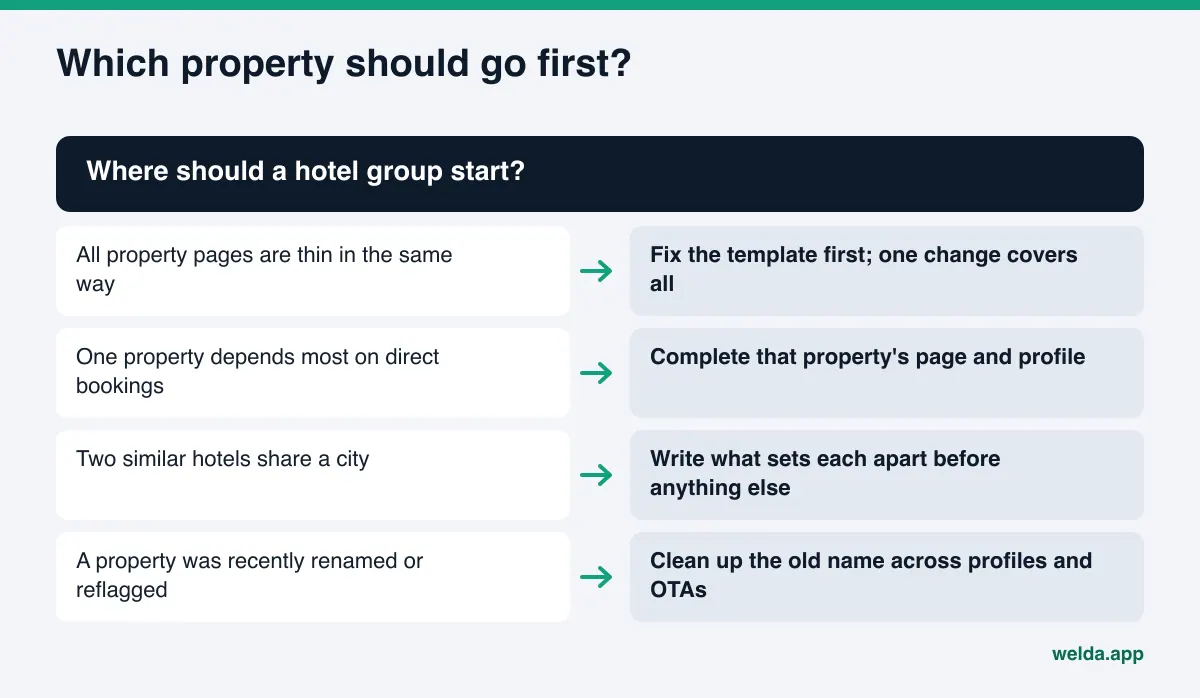
Timing should be realistic too. New property content or an updated profile usually takes weeks to show up in AI answers. The workload also grows with the number of properties, so it is sensible to start with the few hotels where direct bookings matter most, get the pattern working, then expand. If part of your portfolio is leisure-focused, the question patterns differ; AI search optimization for resorts covers that side.
Hotel group AEO checklist
Fill this in for each property. Anything that fails at one hotel often comes from the shared template, so you can fix it for all of them at once.
A worked example helps. Picture an illustrative group with three hotels in one metro: one near the convention center, one in the historic district, one by the lake. The corporate site tells the brand story, and each property page has one paragraph and a gallery. A first pass through the free analysis shows no structured data on property pages, no FAQ section and identical title patterns. Because those issues come from the template, one fix covers all three hotels. Next, each general manager supplies the facts only they know: walking time to the convention center, the quiet-floor policy, the pet weight limit. Corporate approves the copy. Then measurement moves to the question level: which hotel comes up for the business-trip question, which for the family question, which for the dog-friendly question. Each property competes for its own questions instead of crowding its siblings.
Frequently asked questions
Is AEO for hotel groups a brand job or a property job?
Both, but booking questions happen at the property level. Travelers ask for a hotel in a place with a need. Brand recognition helps, but the difference comes from each property's facts being written out clearly and separately.
Does each hotel need its own website?
No. One domain works, as long as each property has a permanent, complete page with its own Hotel structured data. What matters is that the page carries that property's details and distinguishes it from the others.
Will the free analysis read all of our property pages?
No. It reads the homepage and a few inner pages. For a single-domain group it surfaces template issues; if properties have separate sites, each site can be analyzed once for free.
Can our own hotels compete with each other in AI answers?
Yes, if their pages look alike. Stating clearly which guest each property suits helps AI assistants recommend the right hotel for the right question.
Does Welda publish content for our properties?
Welda prepares the content and your team approves it. On WordPress, content opens as a draft and goes live after approval. On other systems, you get a ready-made package to apply.
How soon will we see changes?
New content usually takes weeks to appear in AI answers. No one can promise a specific timeline or position.
Can a US hotel group use the Welda dashboard today?
The free site analysis works in English today. The full dashboard is in early access and opening first in Turkey. Pricing and timing are discussed in the early access conversation.
Check your hotel group's AI visibility today
The work looks large for a group, but most gaps trace back to one template. Start with the corporate site or your most important property's site, then separate what the template fixes from what each property must supply. Run the free site analysis to see your score, the list of gaps and a ready-to-add fix package in a few minutes.