Why doesn't ChatGPT recommend my boutique hotel, and what can I do about it? AI assistants pick hotels from what they can read and cross-check: your website, your Google Business Profile, your listings on booking sites, reviews on Tripadvisor and Yelp, and local travel guides. If the details that make a boutique hotel different (room count, concept, pet policy, breakfast, neighborhood, total price) are vague or inconsistent, the short list goes to chain hotels or to competitors that wrote things down. This guide covers AEO for boutique hotels step by step and shows which parts Welda handles for you.
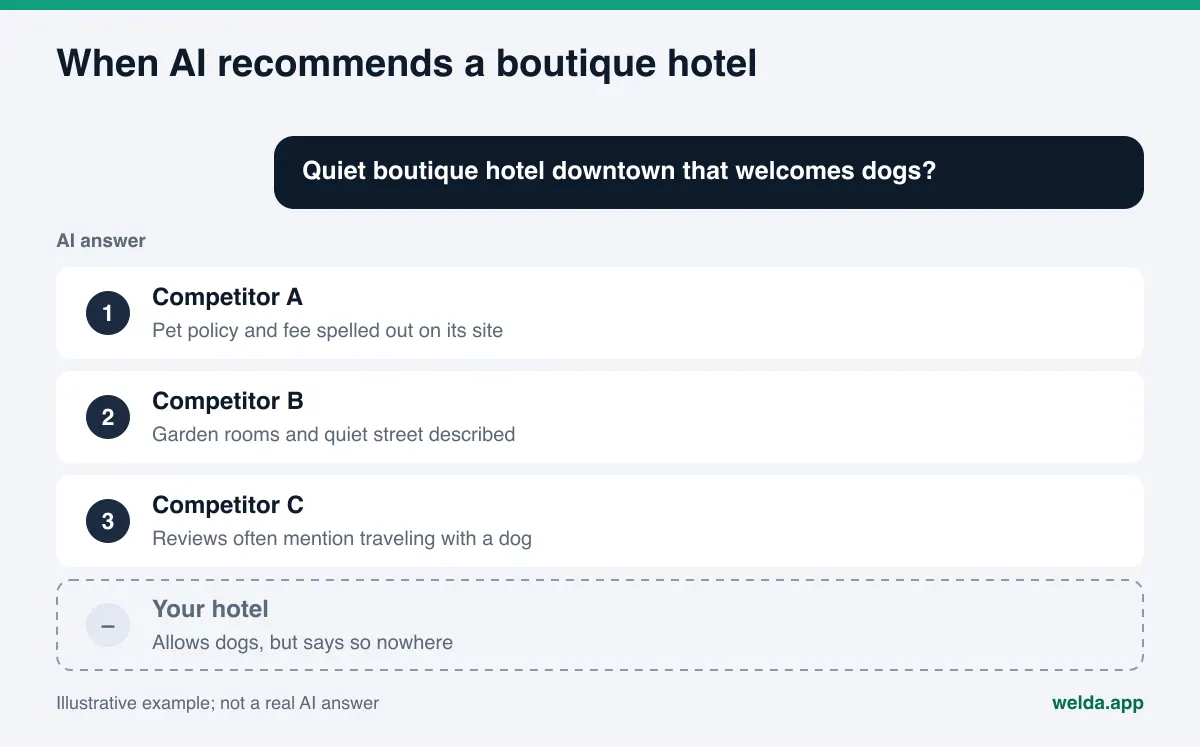
What is AEO for boutique hotels, and why does it matter now?
AEO (answer engine optimization) is the work of getting your business named in the answers that ChatGPT, Gemini, Perplexity and Google's AI Overviews and AI Mode give to travelers. You will also hear it called AI search visibility or simply AI visibility. Some people call the same work GEO (generative engine optimization); in this guide we stick with AEO. The test is simple: when someone asks an AI assistant for "a quiet boutique hotel in Savannah's historic district" or "a dog-friendly inn near Napa with breakfast included", is your property in the answer?
Classic search shows a traveler ten blue links, a map pack and a row of booking sites, and leaves the comparing to them. An AI answer usually gives three or four names with a sentence on each. If your hotel is not one of those names, the traveler may never see you. Ranking on page one and being named in an AI answer are related, but they are not the same job.
Boutique hotels feel this shift more than big brands. A national chain is mentioned on thousands of pages, so AI already knows it. A boutique property wins on specifics: a 14-room restored mansion, a rooftop bar guests actually talk about, an adults-only policy, a chef-made breakfast, a five-minute walk to the waterfront. Travelers ask questions built around exactly those specifics. If the AI cannot find them in writing, it has nothing to base a recommendation on, so it names someone else.
Boutique hotel details also change often. Seasonal rates, breakfast hours, pool season, minimum-stay rules on weekends, pet fees, parking arrangements. When an AI finds outdated or conflicting information, it either skips you or repeats the wrong detail. That is why AEO for a boutique hotel is something you maintain, not a one-time fix.
The fastest way to see where you stand is to measure it. Welda's free site analysis reads your homepage and a few inner pages the way Google and AI assistants do, and lists every gap it finds. It works in English.
What do travelers ask AI about boutique hotels?
Travelers rarely type "hotel" and stop. They describe a trip, a constraint or a worry. Questions an AI assistant might get about a boutique property look like this (these are illustrative examples, not survey data):
- "Boutique hotel in Charleston within walking distance of King Street that allows dogs over 50 pounds?"
- "Small adults-only hotel in Sedona with a quiet pool, no resort fee?"
- "Is it better to stay in the French Quarter or the Garden District for a first trip to New Orleans?"
- "Independent hotel in Portland, Maine with free parking and breakfast included?"
- "Romantic boutique hotel for an anniversary weekend in the Hudson Valley?"
Each question carries a decision point: pet weight limits, whether a fee is mandatory, which neighborhood suits which traveler, parking, breakfast, occasion. A boutique hotel that answers those points clearly on its own site gives the AI a sentence it can use. One that leaves them to the phone line or the check-in desk gives the AI nothing.
International travelers ask the same questions, often in English even when English is not their first language. If you host a lot of overseas guests, the way they search is covered in our piece on tourists asking AI for recommendations.
Where does AI learn about a boutique hotel?
AI engines do not build an answer from a single page. They search the web, read several sources, compare what they find and favor information that agrees across sources. For a boutique hotel, those sources fall into four groups.
| Source | What AI reads there | Who controls it |
|---|---|---|
| Your website | Concept, room types, policies, location, FAQ | You, fully |
| Google Business Profile and Maps | Category, address, hours, photos, reviews and your replies | Mostly you |
| Booking sites (Expedia, Booking.com and others) | Property features, room descriptions, guest scores | Listing text is yours, scores are guests' |
| Tripadvisor, Yelp, travel media, city tourism sites | Reviews, "best boutique hotels" roundups, neighborhood guides | Guests and publishers |
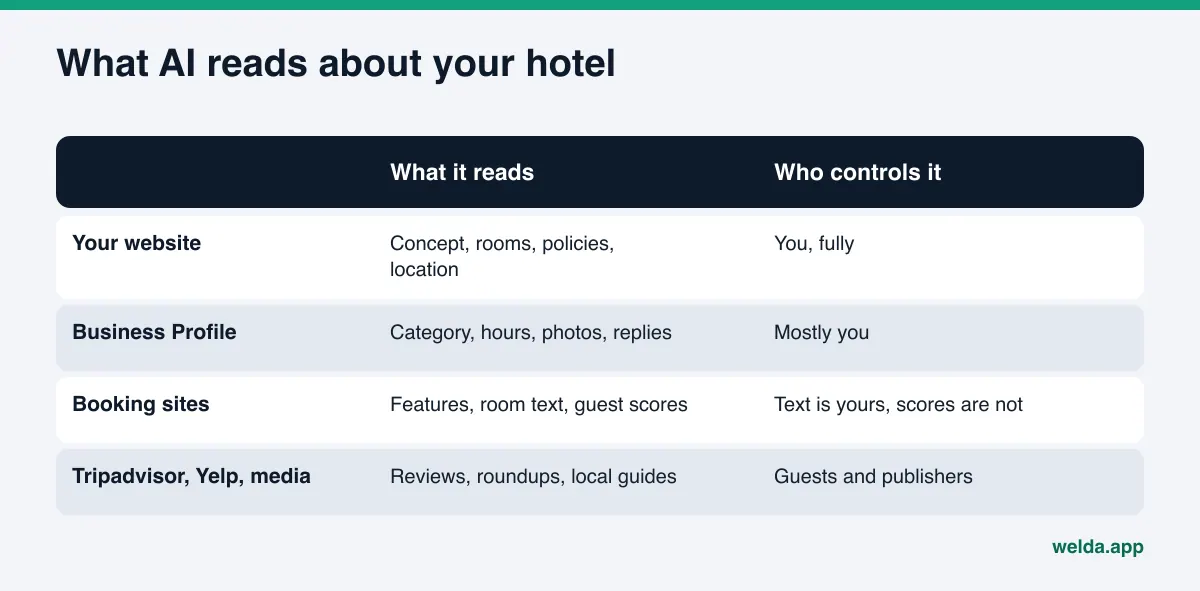
The first two rows are under your direct control, and that is where most boutique hotels leave the biggest gaps. The typical site is a gallery of beautiful photos, a short "our story" paragraph and a booking button. Photos tell AI very little. If "exposed brick, courtyard garden, harbor view" is not written in text, it will not show up in an answer, no matter how clearly the photo shows it.
Booking sites deserve special attention. AI answers cite them often, which is fine. But if your listing there is thin or contradicts your website on check-in time, pet policy or fees, the AI cannot tell which version to trust. Keep both complete and keep them in sync.
AEO for boutique hotels: a step-by-step plan
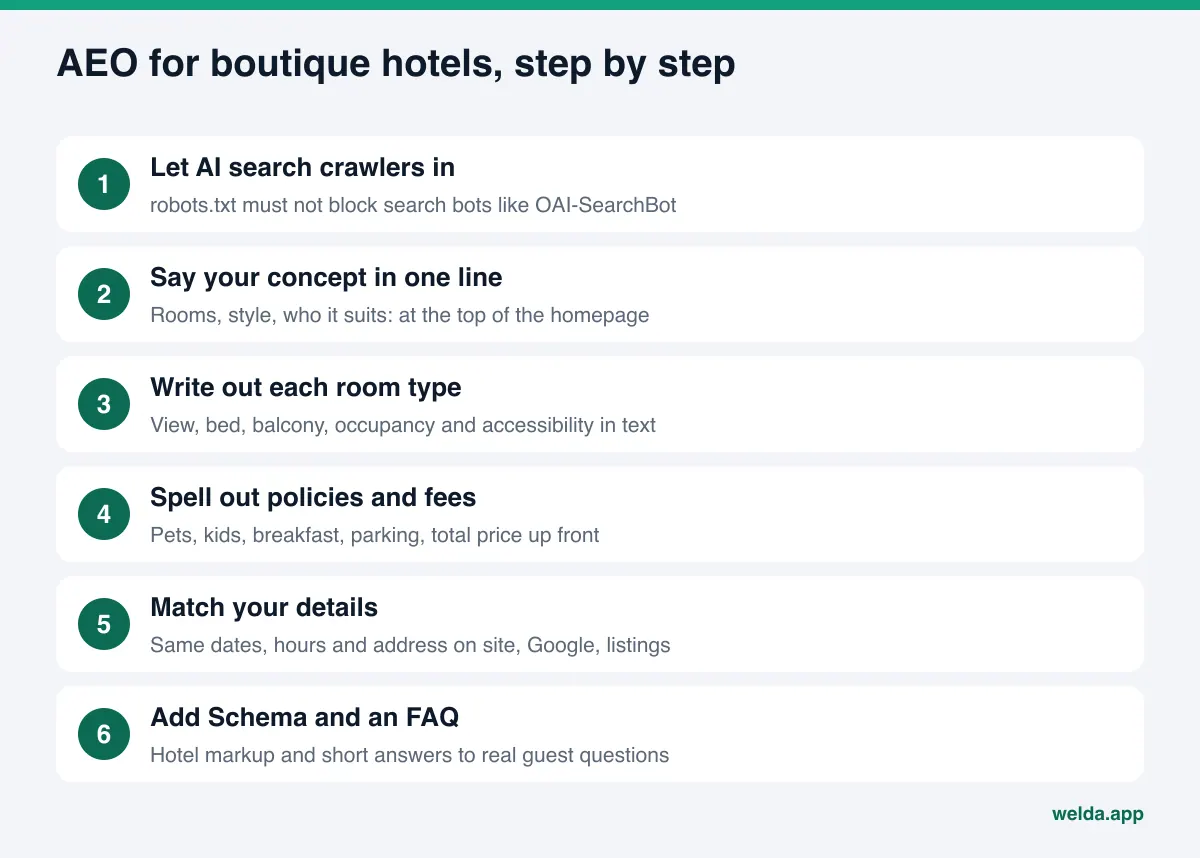
The order below is built to close the most gaps with the least effort. The first four steps are entirely about your own website and do not depend on anyone else.
- Make sure AI search crawlers can reach your site. If robots.txt blocks search bots by mistake, nothing else matters. OpenAI's crawler documentation, for example, states that sites opted out of OAI-SearchBot will not be shown in ChatGPT search answers. Blocking a training crawler is a separate decision; blocking the search crawler cuts visibility directly.
- Describe your concept in one plain sentence. "A 14-room boutique hotel in a restored 1890s mansion, two blocks from the Savannah riverfront, adults only" tells an AI exactly who you are. A tagline like "where stories begin" tells it nothing.
- Write out every room type. Square footage, bed type, view, bathroom, balcony or patio, maximum occupancy, accessibility features. Travelers ask for "a king room with a balcony and a soaking tub"; the answer comes from the hotel that wrote that sentence.
- Spell out policies and the full price picture. Check-in and check-out times, minimum stays, age policy, pet policy with weight limits and fees, whether breakfast is included, parking cost, and any mandatory fees. Since May 2025, the FTC's rule on unfair or deceptive fees requires short-term lodging to show the total price including mandatory fees up front; the FTC's FAQ on the rule explains who it covers. This is not legal advice, but clear fee language also happens to be exactly what travelers ask AI about.
- Describe your location in practical terms. Beyond the street address, say how far it is on foot to the main attractions, the nearest beach or trailhead, and how to get there from the airport. Use distances you have actually checked.
- Make your details match everywhere. Hotel name, address, phone, seasonal dates and policies should be identical on your site, your Google Business Profile, Tripadvisor, Yelp and booking sites. If one says "open year-round" and another says "closed January", AI trusts neither.
- Add hotel Schema markup. Structured data gives machines your name, address, check-in and check-out times and amenities in a format they can parse. Details below.
- Write an FAQ section. Add five to ten questions guests really ask, with short, specific answers. AI assistants reuse short, direct answers readily.
- Reply to reviews with substance. Short, specific replies on Google, Tripadvisor and Yelp help. Mentioning a real feature naturally ("glad you enjoyed breakfast in the courtyard") helps AI connect your hotel with the right topics.
- Link your social and map profiles from your site. Point to your Instagram, Google Maps and listing pages from your website so AI understands they are the same property. The method is covered in how to link social profiles with sameAs.
Do not look for a hidden setting on the Google side. Google's documentation on AI features says there are no additional requirements to appear in AI Overviews or AI Mode beyond being indexed and eligible to show a snippet. The core work is a well-written site that search engines can crawl.
Room pages, FAQs and hotel Schema for AEO
Many boutique hotel sites stack every room on one long page of photos. For AI, it works better to give each room type its own clearly labeled section, or its own page. Let the heading name the room and the first sentence say who it suits: "The Garden Suite has a private patio and is one of two rooms where dogs are welcome."
Write your FAQ in the language guests use, not your internal shorthand. For an example boutique hotel, questions like these earn their place:
- Can I bring my dog? Is there a fee or a weight limit?
- Is breakfast included, and until what time is it served?
- Do you charge a resort, destination or amenity fee?
- Is parking on site, and what does it cost?
- Do you accept children?
- Are you open in the off-season?
Keep each answer to two or three sentences and avoid vague wording. "Pets welcome" is weak. "We welcome dogs up to 60 pounds in our two Garden Suites; the pet fee is shown at booking" is information an AI can actually use.
For structured data, schema.org's Hotel type is a kind of LocalBusiness with lodging-specific properties: checkinTime, checkoutTime, amenityFeature, petsAllowed and starRating. Fill them with the same facts that appear in your page text. Markup that contradicts the page does not help; it confuses. Use starRating only if you hold an official rating.
Booking sites or your own website?
Boutique hotel owners often ask: if AI already cites Expedia and Booking.com, why bother with the website? Because the two do different jobs.
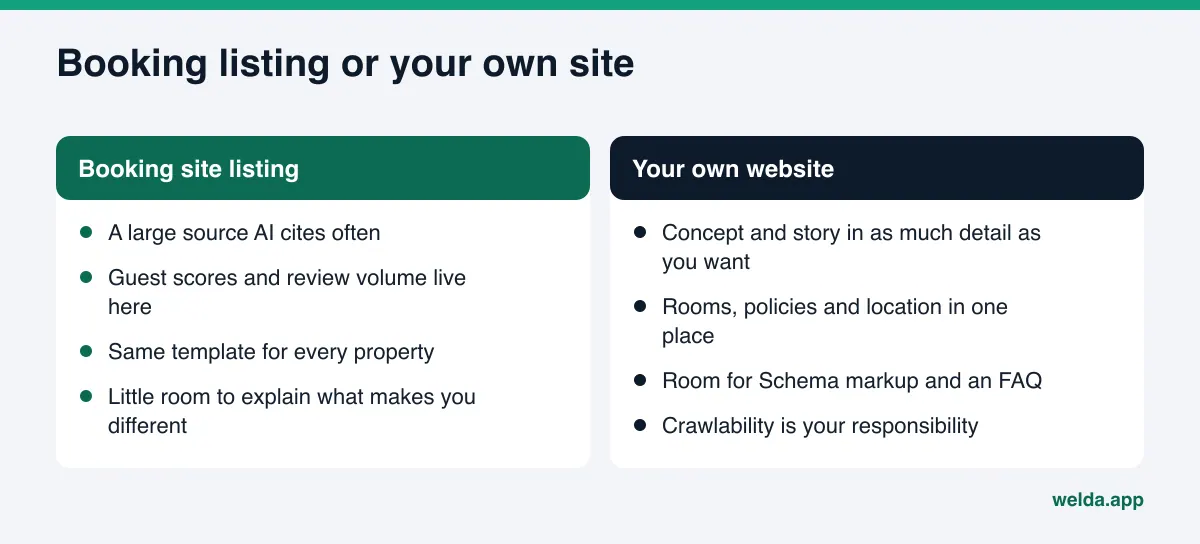
Booking sites are large, trusted sources, and AI reads guest scores and review volume there. But every listing follows the same template, and that template leaves little room for what makes a boutique hotel distinct. Your own site is the one place where you can describe your concept, history, policies and neighborhood in as much detail as you like. When AI explains "why this hotel", it often draws that sentence from your site or from the content of reviews.
The practical takeaway: fill your listings completely, write the real detail on your own site, and make sure the two never contradict each other. If you host weddings or private events, a dedicated page opens a whole new set of questions; see how wedding venues get recommended by ChatGPT. If spa services are central to your offer, the guide to AEO for spa and wellness resorts goes deeper.
How Welda handles AEO for a boutique hotel
Welda's work here comes down to three things: measuring what your site tells AI today, showing where you are named in travelers' questions, and turning the sources AI relies on into one list of gaps to close. Start with the part anyone can use today.
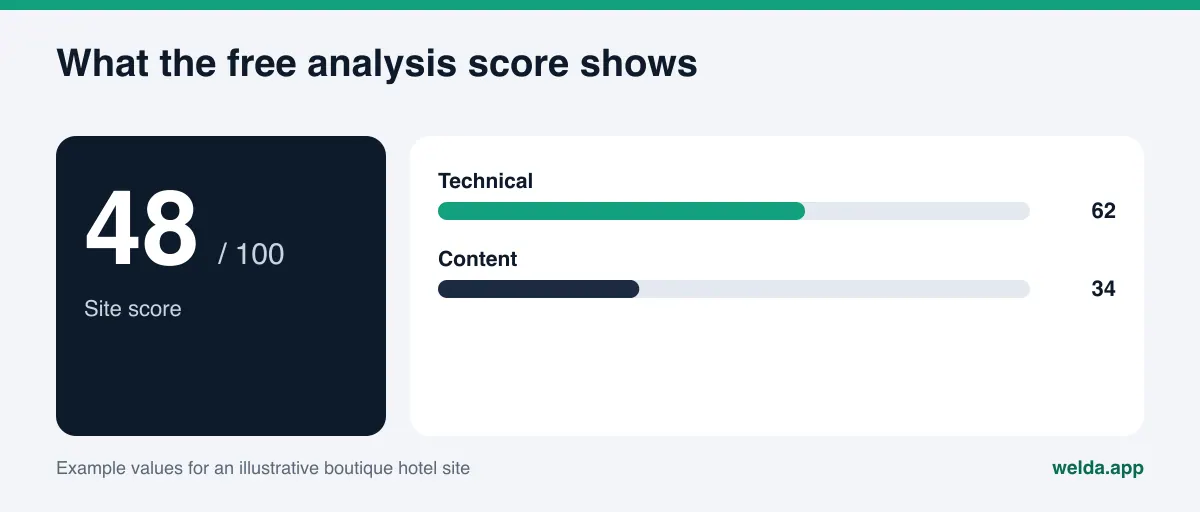
The free site analysis. Enter your hotel's URL and Welda reads your homepage plus a few inner pages such as services (for you, rooms), rates, about and contact. It checks whether robots.txt lets AI crawlers in, your page title and meta description, your main heading, your business Schema, whether your address and phone are readable, whether your social and map profiles are linked, your FAQ section, review and trust signals, how clearly your offer is described, and page speed. You get a score out of 100, with technical and content scored separately. For each gap it explains what it saw, why it matters and how to fix it. On a typical boutique hotel site, the findings read like this: the main heading is a slogan, room details exist only in photos, no hotel Schema. The analysis then drafts a homepage title, description, main heading, intro paragraph and FAQ, simulates how much each fix would raise the score, compares you with competitors and hands you a ready-to-install fix package that includes the Schema code. You can download a PDF and share a score card.
The analysis also asks a web-search-enabled AI assistant 5 questions a traveler might ask and checks whether your hotel's name appears in the answers. That is a single snapshot, not ongoing tracking.
The questions view in the Welda dashboard. In the dashboard, the questions your guests would ask are put to ChatGPT, Gemini, Perplexity and Google AI three times each. For a boutique hotel, most of those questions carry booking intent: "boutique hotel with courtyard breakfast", "honeymoon suite near the old town", "dog-friendly small hotel". For each question you see which engines name you and in what position, and you can open the answer summary and the sources it cited. The decision this view supports is simple: which group of questions never mentions you? If an example hotel shows up for honeymoon questions but never for dog-friendly ones, it probably welcomes dogs but never wrote that down. The next task is obvious.
The sources view. This lists the sites AI cites for hotel questions in your area and your status on each: listing unverified, map profile incomplete, your own site unreachable, no presence at all. Each row carries a next step, and a breakdown by source type shows how much of the citing your own website earns.
What stays with you. Welda drafts room descriptions, FAQ answers, profile text and review replies and puts them on a single to-do list. You approve what gets published. If your site runs on WordPress, Welda connects through a dedicated Editor user and an application password, with no code to install; content opens on your site as a draft and goes live when you approve it. On other systems, Welda gives you a ready package and you or your web person apply it. Google Business Profile, Instagram and Facebook can be connected; anything not connected is listed as a manual task. Changes to booking-site listings stay with your team; Welda shows what is missing and the text to use. Welda does not guess at facts it does not know, such as your pet fee or closing dates. It asks you.
The score formula is open: the share of questions that name you, your position score and your share against competitors are weighted, and the spread across three repeats becomes a margin of error. A competitors view, before-and-after comparison and a one-page monthly PDF report are also part of the dashboard.
Early access, plainly. The Welda dashboard is in early access and is opening first in Turkey. Regular four-engine tracking is being added during early access, and dashboard screens shown elsewhere use representative data. The part anyone can use today, in English, is the free site analysis. Pricing is discussed in the early access conversation.
Limits: what Welda does not do
Unrealistic expectations do more damage in this field than anything else, so here are the limits in plain terms.
- No ranking guarantee and no promise to "get you into ChatGPT". AI answers vary; the same question can get a different answer on a different day. That is why Welda asks every question three times and reports a margin. Our piece on guaranteed ChatGPT rankings explains why such promises deserve skepticism.
- No fake reviews. Welda drafts replies to real reviews. It does not write reviews or speak for guests.
- No made-up facts. Breakfast hours, pet fees and seasonal dates come from you.
- Your work stays yours. Handling negative reviews, managing directory accounts and press outreach remain with your team; Welda shows what is missing.
- No hosting. Every page lives on your own website.
- No instant results. New content usually takes weeks to show up in AI answers.
The dashboard's compliance check flags patterns such as price claims, guarantees and superiority claims ("the best hotel in town") before anything goes live. It is not legal advice and has not been reviewed by legal counsel. For fee disclosure and advertising rules, talk to your own attorney.
Boutique hotel AEO checklist: where to start
Open your website and go through the list below. Every item you cannot check off is information AI needs before it can recommend you.
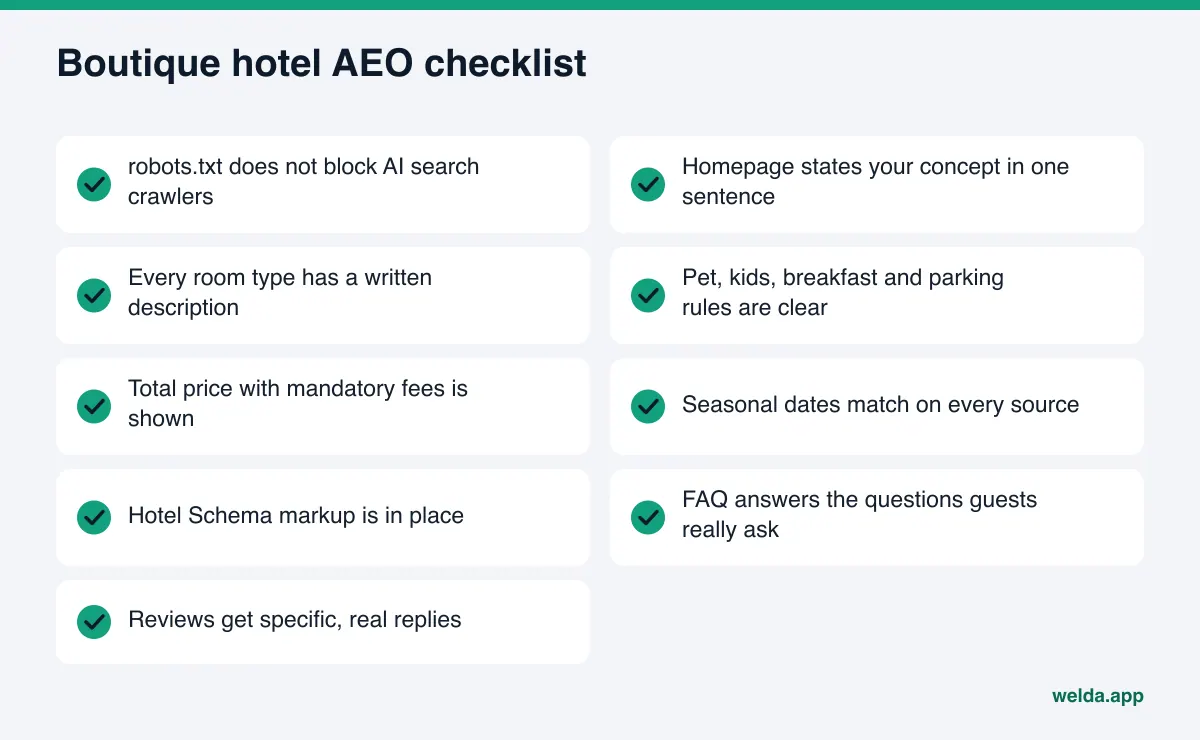
When deciding what to tackle first, this table helps:
| Your situation | First task | Why |
|---|---|---|
| Room details only in photos | Written description for each room type | AI does not pull details out of photos for its answer |
| Seasonal dates differ across sites | Sync your site, Google and listings | Conflicting facts lower trust |
| Pet, kids and breakfast rules unclear | FAQ section | These are the questions travelers decide on |
| Mandatory fees not shown with the rate | Show the total price up front | Travelers ask about it, and the FTC rule covers lodging |
| You do not know what is missing | Free site analysis | Shows the gaps in priority order |
If you close for part of the year, be careful about looking closed for good. AI can mistake a seasonal closure for a permanent one. State your closing and reopening dates in a plain sentence on your site and your Google Business Profile.
Frequently asked questions
Is AEO for boutique hotels different from hotel SEO?
They overlap. A fast, crawlable, well-written site is the base for both. The difference is that AI builds a short answer instead of a ranked list of links, so your concept, policies and location need to be stated in clear sentences and your facts need to match everywhere.
I have great scores on booking sites. Isn't that enough?
It helps, but it is rarely enough on its own. AI sees your scores, yet it often looks for the "why this hotel" sentence on your own site and in what reviewers actually say. Without your concept and policies in writing, it has nothing to describe you with.
Can a small independent hotel really get named by ChatGPT?
Yes, though no one can guarantee it. Boutique hotels have an edge in specific questions, because they fit specific needs: dog-friendly, adults only, historic building, walkable location. The more of those specifics you write down, the better your odds of being included.
How long does it take to see results?
New or corrected content usually takes weeks to show up in AI answers, and timing varies by engine. Measure the same questions before and after a change; a one-day spot check can mislead you.
What does Welda's free analysis include, and how often can I use it?
A score out of 100 split into technical and content, an explanation of each gap, draft homepage copy, a score simulation, a competitor comparison, a ready fix package and a PDF report. It is free once per site. Your email and phone are verified, and the results link arrives by email and stays open for 14 days.
Can US hotels use the Welda dashboard today?
The dashboard is in early access and is opening first in Turkey. The free site analysis works in English today for any hotel website. Pricing is discussed in the early access conversation.
What does your boutique hotel tell AI today?
AEO for boutique hotels starts with writing down what makes you different in places AI can read: your concept, rooms, policies, location and the same facts on every source. Most of that work is in your hands. The first step is seeing where you stand.
Run the free site analysis: Welda reads your hotel website, lists the gaps in priority order, drafts copy for your homepage and checks whether your name comes up in 5 questions a traveler might ask.