How do wedding venues get recommended by ChatGPT? When a couple asks ChatGPT, Gemini, Perplexity or Google's AI Mode for a venue, the answer is built from what the engine can read on the venue's own website, its Google Business Profile and the third-party sites that write about it. If capacity, indoor and outdoor spaces, timing rules, catering policy and lodging are not spelled out in text, the venue is easy to skip, however beautiful it is. The work is to publish the answers couples are asking for, in places AI can read, and to keep them consistent everywhere.
How wedding venues get recommended by ChatGPT, and why it matters now
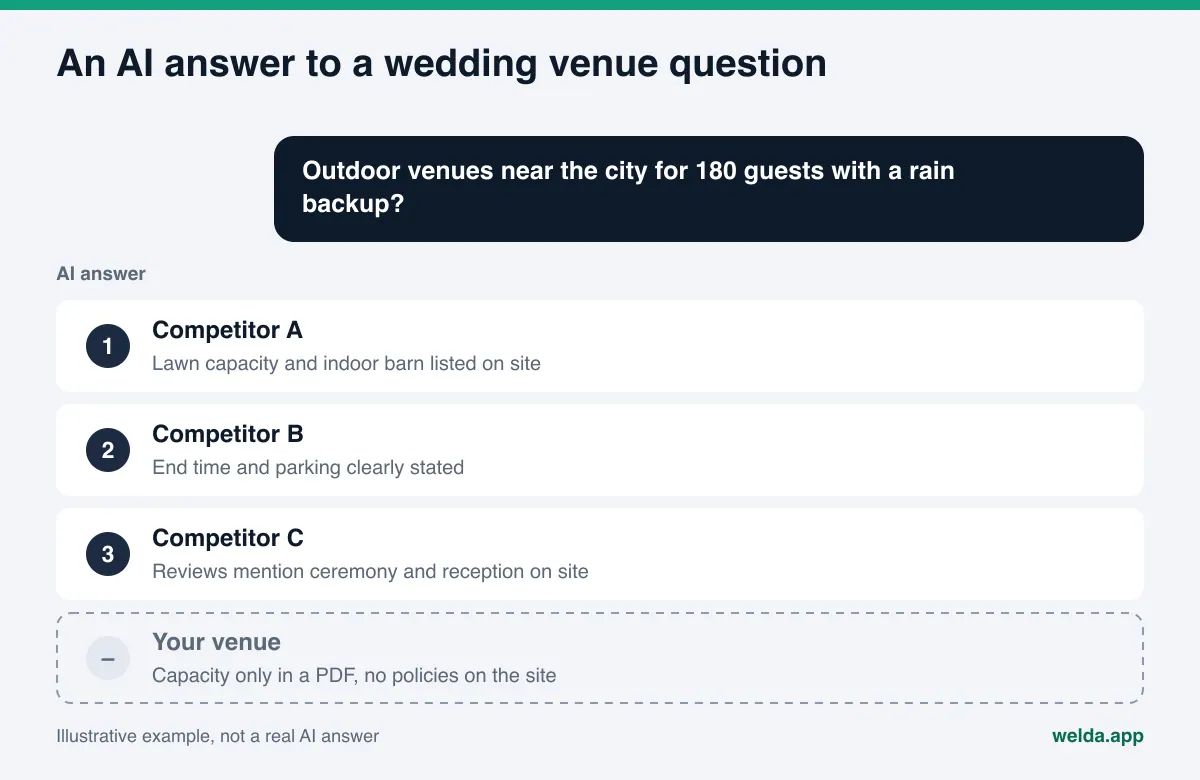
A few years ago, a couple planning a wedding would search Google, browse wedding directories such as The Knot or WeddingWire, and scroll Instagram. Today, part of that journey starts with a single, detailed question: "What are some barn venues within an hour of Nashville that hold 180 guests and allow outside catering?" The AI answer lists a handful of names, adds a reason for each, and stops. A venue that is not on that short list often never enters the comparison at all.
The discipline behind this is usually called AEO, answer engine optimization. You will also hear "AI search visibility" or simply "AI visibility", and some people use GEO (generative engine optimization) for the same idea. For a wedding venue, AEO comes down to three questions: does your venue get named when couples ask, in what position, and is the information next to your name correct? Barns, estates, vineyards, hotel ballrooms, waterfront venues and restaurants with private rooms all compete in the same kind of answer.
Wedding venues share one recurring problem. The most useful facts tend to live in a sales call, a PDF brochure or an email thread, not on the website. Capacity is "discussed on your tour", catering is "available upon request", the end time is "in the contract". That works for a human who will call. An answer engine cannot call. It uses what it can read, and when it cannot find a fact on your site, it may take it from an outdated directory listing or leave you out.
If you want to see how your site reads to AI today, Welda's free site analysis reads your homepage and a few inner pages and lists what is missing, one item at a time. It is useful to have that report open while you work through the steps below.
What do couples ask AI about wedding venues?
Wedding questions are longer and more conditional than typical restaurant or hotel questions. Couples are not looking for a place so much as a scenario: a date, a guest count, a style, a budget feeling, travel logistics and usually one non-negotiable detail. The questions below were written for this article as examples. They are not measured research data, but they reflect the shape of the questions couples type:
- "Outdoor wedding venues near Austin for 150 guests in October with a rain backup option?"
- "Venues where we can have the ceremony and reception in the same place, with on-site parking?"
- "Which venues let us bring our own caterer and alcohol?"
- "Wedding venues with on-site lodging for guests, ideally a whole-property buyout?"
- "Is there a waterfront venue where music can go past 11 pm?"
- "Small wedding venues for under 50 people that do weekday pricing?"
Each of these maps to a fact that either is or is not on your website: capacity, ceremony space, rain plan, vendor policy, alcohol policy, end time, lodging, minimum spend logic. The engine tries to match those conditions one by one. If your site says "the perfect backdrop for your special day" and little else, there is nothing to match.
Couples also rarely decide in one question. They start broad, then narrow down: "Which of these allow sparklers?", "Which ones also host rehearsal dinners?" Staying in the answer through the second and third question depends on how specific the first layer of information was.
What sources does AI use to recommend a wedding venue?
Answer engines with web search find pages that match the question, read them and summarize. For a wedding venue, the sources usually fall into four groups.
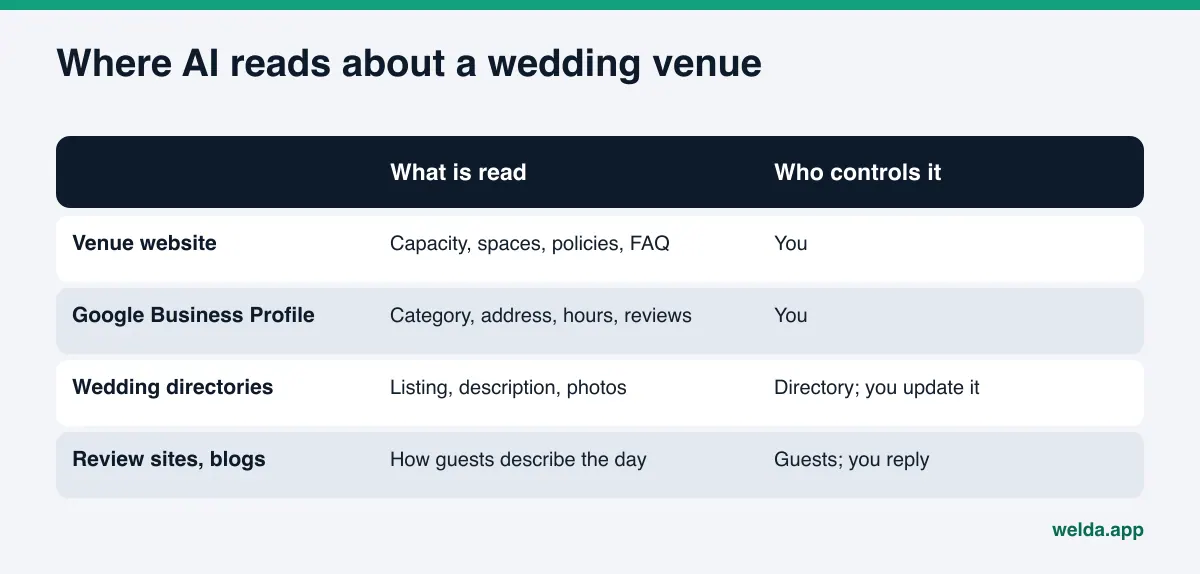
Your own website. This is the source you control most. When capacity, spaces, dates, rules and an FAQ are written as plain text, an engine can quote them directly. When those facts live only in a downloadable brochure, an image of a pricing sheet or an Instagram story, they are much harder to use.
Google Business Profile and Google Maps. Category, address, hours, photos, questions and reviews are read here, and Google's AI Overviews and AI Mode draw on this data naturally. If your profile category says "Wedding venue" while your site calls you an "event barn", and the phone numbers differ, the engine may treat them as two different businesses.
Wedding directories and local lists. Directory listings, "best venues in" roundups and local publications are third-party sources engines often lean on. If you are missing there, or your listing still shows last year's capacity, the AI tends to repeat what they say about you.
Reviews. Google reviews, Yelp, directory reviews and wedding blogs shape how your venue is described. Specific phrases like "the coordinator handled the rain switch calmly" or "parking was tight" come back in AI answers as reasons. We cover this in more detail in our piece on how reviews shape AI recommendations. Keep in mind that in the US, the FTC's final rule banning fake reviews and testimonials applies to businesses; this is not legal advice, but buying or inventing reviews is a risk, not a strategy.
There is also a technical gate. If your robots.txt file blocks AI crawlers, good content will not be read. OpenAI, for example, states in its crawler documentation that OAI-SearchBot is used to surface websites in ChatGPT's search features, and that sites which opt out of it will not appear in ChatGPT search answers. Some security plugins and hosting defaults block bots like this without the owner noticing.
AEO for wedding venues: a step-by-step plan
The order below is designed to make the most information readable with the least effort. The first two steps take an afternoon; the rest can take a few weeks depending on how many spaces and event types you offer.
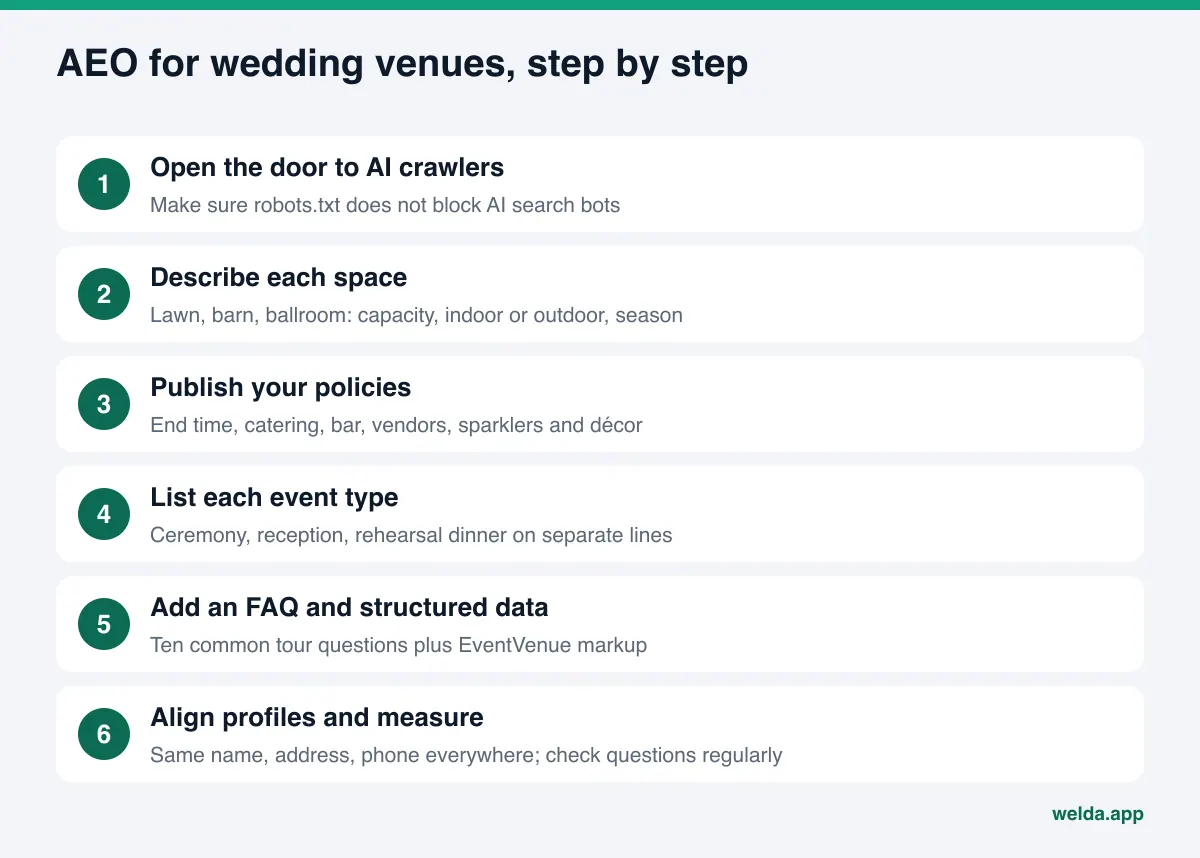
- Open the door. Check that robots.txt does not block AI search crawlers. Make sure your sitemap is current and includes your wedding pages.
- Write each space separately. For the lawn, the barn, the ballroom, the terrace: seated and standing capacity, indoor or outdoor, which months it is used, and what the rain plan is.
- State your policies. End time and amplified music rules, outside caterer and bar policy, approved vendor list, sparklers, candles, décor limits, setup and teardown windows.
- Separate event types. Ceremony, reception, rehearsal dinner, welcome party, elopement, bridal shower. List which ones you host, each on its own line.
- Cover logistics and lodging. Parking, shuttle options, distance to the nearest airport or downtown, on-site rooms or nearby hotel blocks, accessibility.
- Add an FAQ. Take the ten questions you hear most on tours and answer each in two or three sentences. This is the section AI quotes most readily.
- Add structured data. Give name, address, phone, capacity and amenities in machine-readable form.
- Align your profiles. Name, address, phone and category should match across your site, Google Business Profile, directories and social accounts.
- Measure and repeat. Check every few weeks whether you are named in the questions couples ask.
For the general structure of a page AI can quote, see our guide to service pages AI can quote. For a wedding venue, that structure splits naturally into a "spaces" page and an "events" page.
What should a wedding venue page say?
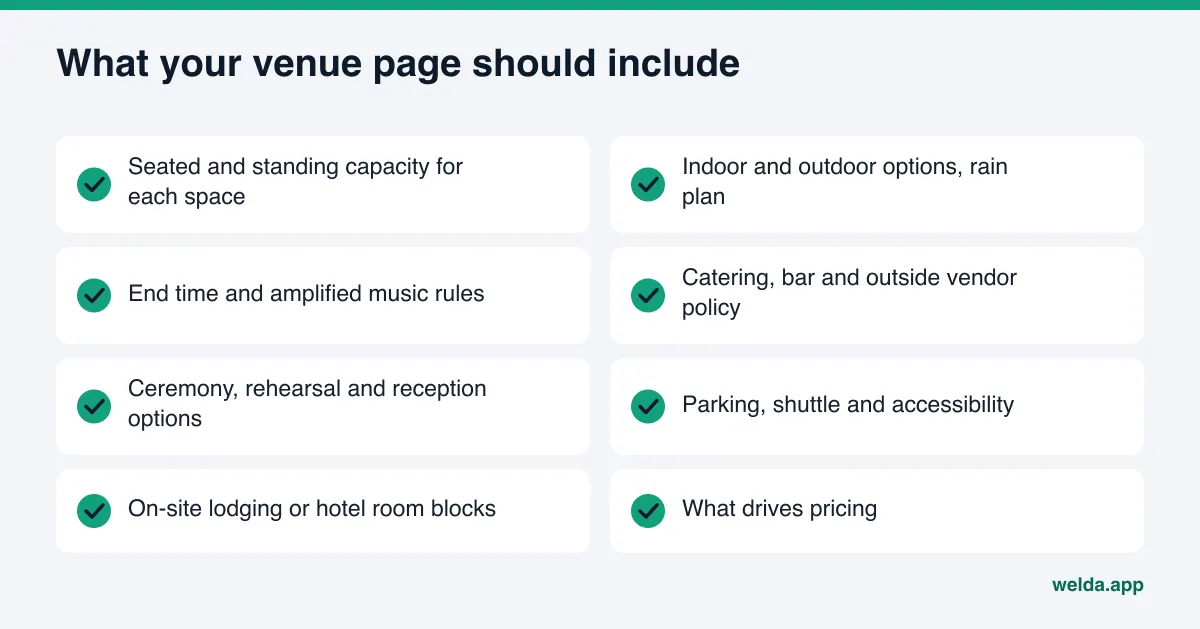
The table below lists conditions that show up again and again in couples' questions, with weak phrasing on the left and readable phrasing on the right. The examples on the right are illustrative; fill them in with your real facts and never publish something you are not sure of.
| Couple's condition | Weak phrasing | Readable phrasing (example) |
|---|---|---|
| Guest count | "Perfect for large celebrations" | "Lawn: 180 seated, 250 cocktail-style" |
| Indoor or outdoor | "Surrounded by nature" | "Outdoor lawn with a 120-seat barn as rain backup" |
| End time | "Per your contract" | "Amplified music until 11 pm, acoustic until midnight" |
| Ceremony on site | Not mentioned | "Ceremony site by the pond, chairs included" |
| Catering | "Exceptional menus" | "In-house catering only; outside desserts allowed" |
| Alcohol | Not mentioned | "Licensed bar service required; no BYO" |
| Parking and access | "Easy to reach" | "Parking for 80 cars; shuttle drop-off at the main gate" |
| Lodging | Not mentioned | "12 guest rooms on site, bridal suite included" |
The numbers in the table are made up to show the format. What matters is that each sentence is specific enough to answer a question. "Perfect for large celebrations" does not match a couple asking for 200 guests; "180 seated" either matches or tells them clearly it does not. Both outcomes save everyone time.
Pricing deserves its own thought. Many venues prefer not to publish numbers because they depend on the date, the day of the week and the menu. You do not have to publish a figure, but explaining what drives the price helps: "Pricing depends on date, day of week, guest count and menu. Send us your date and guest count for a quote." That sentence lets an engine say something accurate instead of "pricing information is not available."
If you host weddings inside a hotel or inn, keep two sets of information apart but linked: the lodging pages and the weddings and events page. Room blocks, the bridal suite and any rooms included in a package should be repeated on the events page. Smaller properties can find more ideas in our piece on how bed and breakfasts get recommended by ChatGPT, and outdoor properties in how glamping sites and cabin rentals get recommended.
How should a wedding venue use structured data?
Structured data, often called Schema markup, is code on your page that people do not see. It tells search engines and AI systems "this page describes an event venue, here is the address, here is the capacity." The schema.org vocabulary includes an EventVenue type that supports fields such as maximum attendee capacity, amenity features and opening hours.
A hotel that hosts weddings can describe the hotel and the event space separately and link them. A barn or estate that only does events can use the venue type directly; a restaurant with a private room keeps its main business type and adds the event space as a separate place. The rule is simple: everything in the code must also be visible on the page and must be true. Capacity that appears only in the markup and nowhere on the page creates a mismatch, not a signal.
Structured data alone will not get you recommended. But when the visible text and the markup confirm each other, the engine is less likely to misread you. That matters most at properties where a hotel, a restaurant and a wedding lawn share one address.
Example: an FAQ block for a rustic outdoor venue
An FAQ is the section answer engines quote most easily, because each entry is already shaped like a couple's question. The example below was written for a fictional barn venue outside a mid-sized city. It is not a real business; rewrite it with your own facts.
What happens if it rains? Our 120-seat barn sits next to the lawn. We make the call together two days before the wedding.
Can we hold the ceremony and reception here? Yes. The ceremony site is by the pond and chairs are included. Your officiant is your choice.
Can we bring our own vendors? Photographers, florists and planners, yes. Food and drinks come from our in-house kitchen and licensed bar.
How do guests get here? There is on-site parking, and we can arrange a shuttle from downtown hotels.
These four answers are short, but each one closes a question type: rain plan, ceremony, vendor policy and transport. When an engine gets "outdoor wedding venue with a rain backup", it can find and use that first sentence. If the same facts appear in your Google Business Profile and directory listings, the answer is assembled more consistently.
How Welda does this work
Welda is software that measures where a business shows up in AI answers and prepares the fixes on its behalf. For a wedding venue, three parts of it matter most.
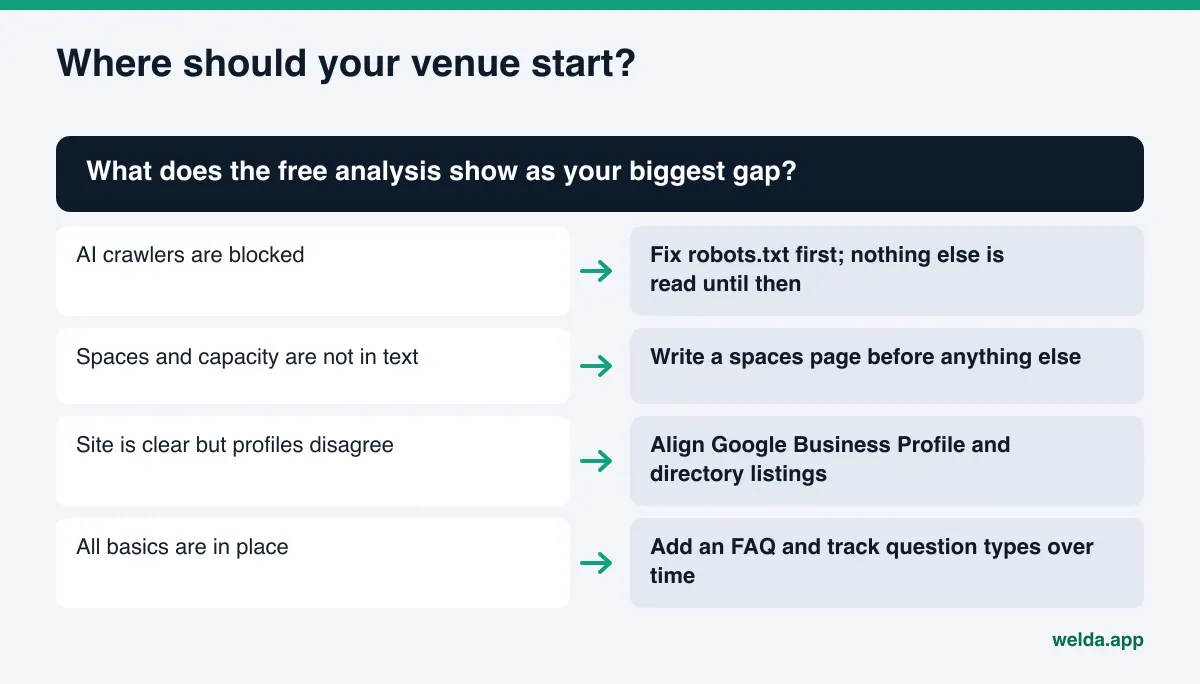
The free site analysis. It reads your homepage and a few inner pages such as services, pricing, about and contact. For a venue, the most useful findings are whether AI crawlers can get in, whether your spaces and event types are described clearly, whether you have an FAQ, the state of your structured data, whether address and phone are consistent, and whether your map and social profiles are linked from the site. Each issue comes with what was found, why it matters and how to fix it. You get ready-to-use homepage text (title, description, main heading, intro paragraph and FAQ), a simulation of which fix moves your score most, a competitor comparison and a fix package to add to your site. The analysis also asks five customer-style questions to an AI assistant that can search the web and checks whether your venue is named. That is a one-time snapshot, not ongoing tracking.
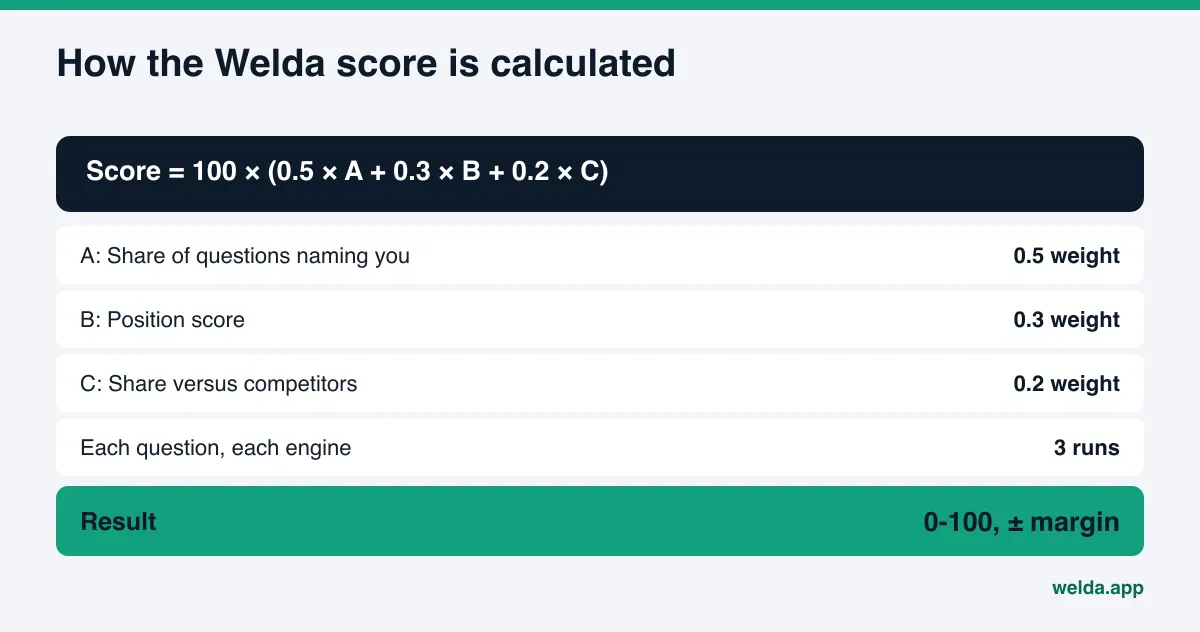
Question-by-question measurement in the panel. The Welda panel is in early access and opening first to businesses in Turkey. In the panel, the questions couples would ask are put to ChatGPT, Gemini, Perplexity and Google AI three times each. For each question you see whether you were named, in what position, and which sources the answer relied on. The decision this screen supports for a venue is clear: which question type is weak (outdoor, ceremony on site, lodging, small weddings), and what information the venue ahead of you has that you do not.
One to-do list with ready text. Welda gathers the gaps in one list and drafts the text for each job: space descriptions, FAQ entries, profile text and review replies. It does not invent facts. If it cannot read the capacity of your indoor backup space, it leaves the field empty and asks you. Your answer is then applied to every draft at once. On WordPress, Welda connects through a separate Editor user and an application password, with no code to install; drafts open on your site as drafts and go live only after you approve. On other platforms, Welda hands you a ready package and the update is done by hand. Google Business Profile, Instagram and Facebook can be connected; directories without a publishing connection stay on the list as manual tasks. Your content always lives on your own site.
Limits: what Welda does not do
- Welda does not promise rankings or a spot in ChatGPT. AI answers are each engine's own decision, and no one can promise placement.
- It does not write fake reviews or broker incentivized ones.
- Negative reviews themselves, directory accounts and press outreach stay with you. Welda drafts the reply or the listing text; you post it.
- It does not publish facts it does not know. Capacity, end times and vendor policies come from you.
- Nothing is published without your approval.
- New information usually takes weeks to show up in AI answers, which is why work for peak season should start well before it.
To be clear about where the product stands: the free analysis works in English today and anyone can run it. The full Welda panel is in early access, opening first in Turkey; regular four-engine tracking is being added during early access, and the panel screens shown publicly use representative data. Pricing is discussed in an early access conversation.
Checklist: is your venue ready for AI answers?
If you can answer "yes" to each row, the foundation is in place. Every "no" is an item for your to-do list.
| Check | Where to look | Why it matters |
|---|---|---|
| Can AI search crawlers reach your site? | robots.txt | Blocked content is never read |
| Is capacity written for each space? | Spaces page | Matches guest-count questions |
| Are end time, catering and bar policies clear? | Events page, FAQ | Avoids being filtered out |
| Are ceremony, rehearsal and reception listed separately? | Events page | Each is its own question type |
| Are parking, shuttle and lodging covered? | Contact, events page | Decisive for destination weddings |
| Are name, address, phone and category consistent? | Site, Google Business Profile, directories | Inconsistency lowers trust |
| Do you reply to reviews? | Google, Yelp, directories | Replies are read and quoted too |
| Do you explain what drives pricing? | Events page | Prevents "no information" answers |
If you run venues in several locations, the work happens location by location; we cover that in AEO for hotel groups.
Frequently asked questions
Do I need to pay for ads to get recommended by ChatGPT?
This article is about the recommendations an AI engine writes in its own answer, not about ads. Those answers are built from information the engine can read, so the work is publishing clear, current and consistent venue facts.
Do I have to publish capacity and pricing?
Publishing capacity is strongly recommended, because so many questions include a guest count. You do not need to publish a price; explaining that pricing depends on date, day, guest count and menu is a usable answer.
I post a lot on Instagram. Isn't that enough?
Photos inspire couples, but the facts inside them are often not read as text. Capacity, rules and location belong on your site in plain text, and your Instagram account should be linked from it.
How much do wedding directories matter?
Directories are among the third-party sources engines rely on. Your listing should match your website and be up to date. Welda drafts the text; updating the listing stays with you.
How long until I see results?
No one can give a fixed timeline. New information usually takes weeks to show up in AI answers, so start well before your busiest booking months.
Does a hotel need a separate website for its wedding space?
No. A dedicated, detailed weddings and events page on the hotel site, linked to the lodging pages, is enough. What matters is that each page answers its own questions clearly.
See where your venue stands today
Getting a wedding venue recommended by AI starts with answering, in plain text, the questions couples already ask. To see where to begin, run the free site analysis. One report shows which facts are not being read, which fix to prioritize and whether your venue is named in five customer-style questions. The results link arrives by email and stays open for 14 days.