Why doesn't ChatGPT recommend my bed and breakfast, and what can I do about it? AI assistants recommend lodging based on details they can read and cross-check: your website, your Google Business Profile, your listings on booking sites, and your reviews. If your breakfast, room capacity, house rules and location are not written out clearly and consistently, the answer goes to an inn that did write them down. This guide explains how bed and breakfasts get recommended by ChatGPT, what to fix first, and which parts of the work Welda prepares for you.
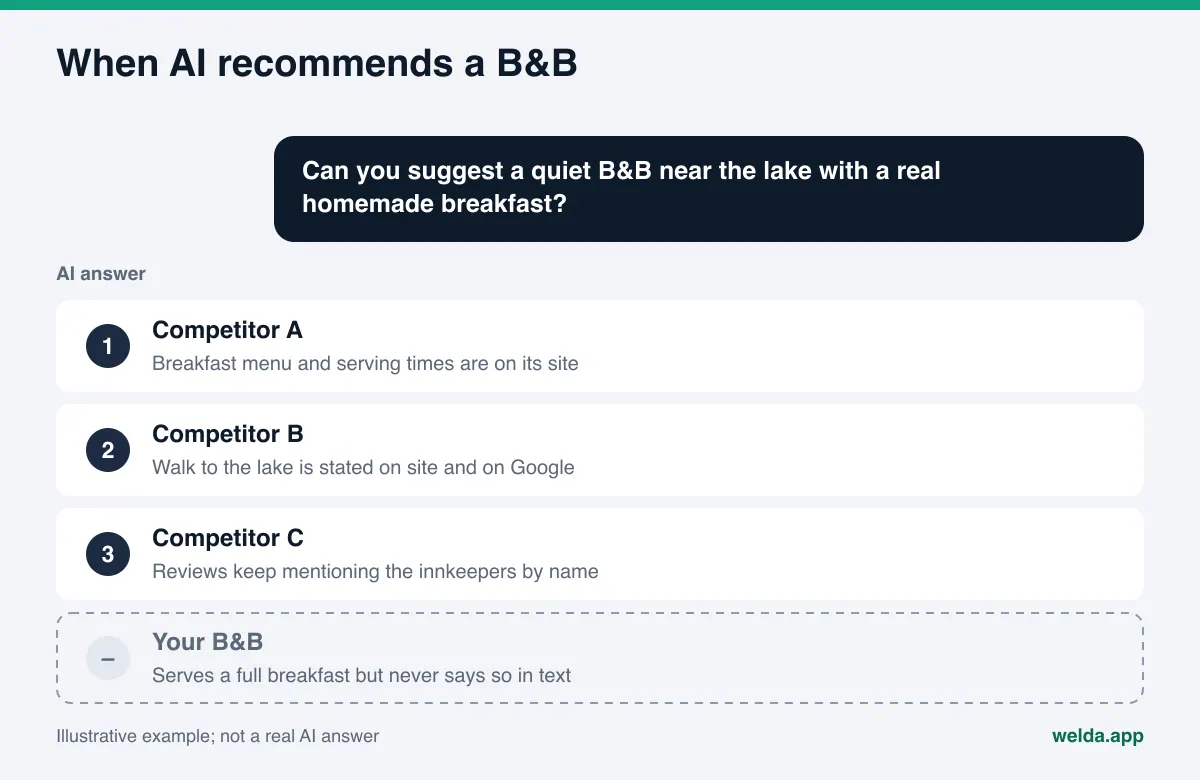
How bed and breakfasts get recommended by ChatGPT: what changed for innkeepers
AEO (answer engine optimization) is the work of getting your business named in AI-generated answers from ChatGPT, Gemini, Perplexity and Google's AI Overviews and AI Mode. You may also see it called GEO, generative engine optimization; it is the same idea under another name. For a bed and breakfast the test is concrete. When a traveler asks "a quiet B&B in the Hudson Valley with a homemade breakfast" or "an inn near downtown Asheville where we can bring our dog," does your name come up?
In classic search, travelers scan a map pack, a few booking pages and some websites, then compare on their own. An AI answer usually narrows that down to three or four names with one sentence each. That sentence is built from written information the assistant found. If your inn is not in that short list, the traveler may never see you at all.
Small inns feel this shift differently than hotel chains. A chain's name already appears on thousands of pages. A B&B's strength is in the details: six rooms in a restored farmhouse, a three-course breakfast, innkeepers who know every trail, a porch overlooking the lake. Those are exactly the details travelers ask about. But many B&B websites were built years ago, lean heavily on photos, and say very little in plain text. A fireplace in a photo is not something an AI assistant can quote.
The fastest way to see where you stand is to measure. Welda's free site analysis reads your home page and key inner pages the way Google and AI assistants do, lists every gap it finds, and shows you which fixes matter most.
What travelers ask AI before booking a B&B
Travelers rarely type "bed and breakfast" and stop there. They describe a situation and a worry. The examples below are illustrative questions we wrote to show the patterns that matter; they are not drawn from a measured dataset.
- "Romantic B&B in Vermont with a fireplace in the room and breakfast included?"
- "Is there a bed and breakfast near Cape Cod that allows kids under 12?"
- "Pet-friendly inn in Sonoma, and do they charge a pet fee?"
- "B&B that can handle a gluten-free breakfast?"
- "What time is check-in, and can I arrive late if I'm driving in after work?"
- "Does the inn have private bathrooms for every room?"
Notice what decides the booking: breakfast, children, pets, private baths, late arrival, fireplaces. None of these are about price alone, and almost all of them are answered by one sentence on a well-written site. When that sentence is missing, the assistant either skips you or fills the gap with whatever a review or a listing says, which may be out of date.
Some of your guests also arrive with questions about the area: how far to the vineyards, whether the town is walkable, where to park. A B&B that answers those on its own site becomes a useful source, not just a listing.
Which sources AI reads about a bed and breakfast
AI assistants rarely build an answer from a single source. They search, read several pages, compare what they find, and favor the details that agree. For a B&B, those sources fall into four groups.
| Source | What AI reads there | Who controls it |
|---|---|---|
| Your own website | Rooms, breakfast, house rules, location, innkeepers, FAQ | You, fully |
| Google Business Profile and Maps | Category, address, hours, photos, reviews and your replies | Mostly you |
| Booking sites, Airbnb, Tripadvisor, Yelp | Amenities, room text, ratings, review content | Text is yours, ratings are guests' |
| Travel blogs, local visitor guides, Reddit threads | "Best B&Bs in..." lists, trip reports, complaints | Publishers and users |
The first two rows are where most inns have the biggest gap and the most control. The fourth row matters too, especially for "best of" questions; we cover it separately in the guide on how to get on ChatGPT best-of lists. Reviews feed into every row, which is why AI reputation management is part of the same picture.
Classic B&B or suites with kitchens: describe what you actually rent
Many American B&Bs no longer fit a single mold. Some are classic: a handful of rooms in the main house and a full breakfast served at a set time. Others mix guest rooms with a carriage house suite, a cottage with a kitchenette, or rooms with self check-in. AI assistants know the general difference between these types, but they only learn what your property offers from what you write.
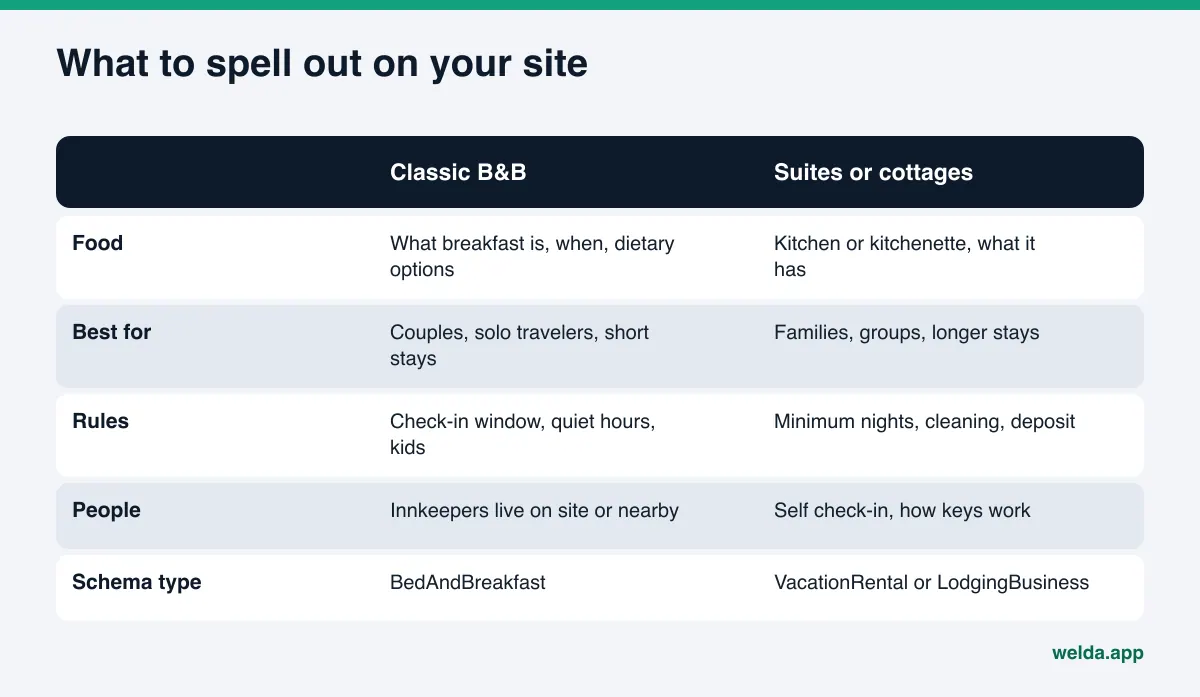
Structured data (schema markup) follows the same split. schema.org has a general LodgingBusiness type with more specific types under it. The BedAndBreakfast type describes exactly what the name says. The VacationRental type describes a lodging business that rents single properties for limited periods. Both inherit fields such as check-in and check-out times, whether pets are allowed, and amenity features. Pick the type that matches how you operate and fill it with the same facts your page text states. If your page says "breakfast is not served in the cottage," your markup should not claim otherwise.
For a mixed property, describe each unit type under its own heading and name both in your opening line. For example: "A five-room bed and breakfast in a 1890s farmhouse, plus one cottage with a full kitchen for families." That is an illustration; describe your own inn with your own numbers.
Step by step: how bed and breakfasts get recommended by ChatGPT
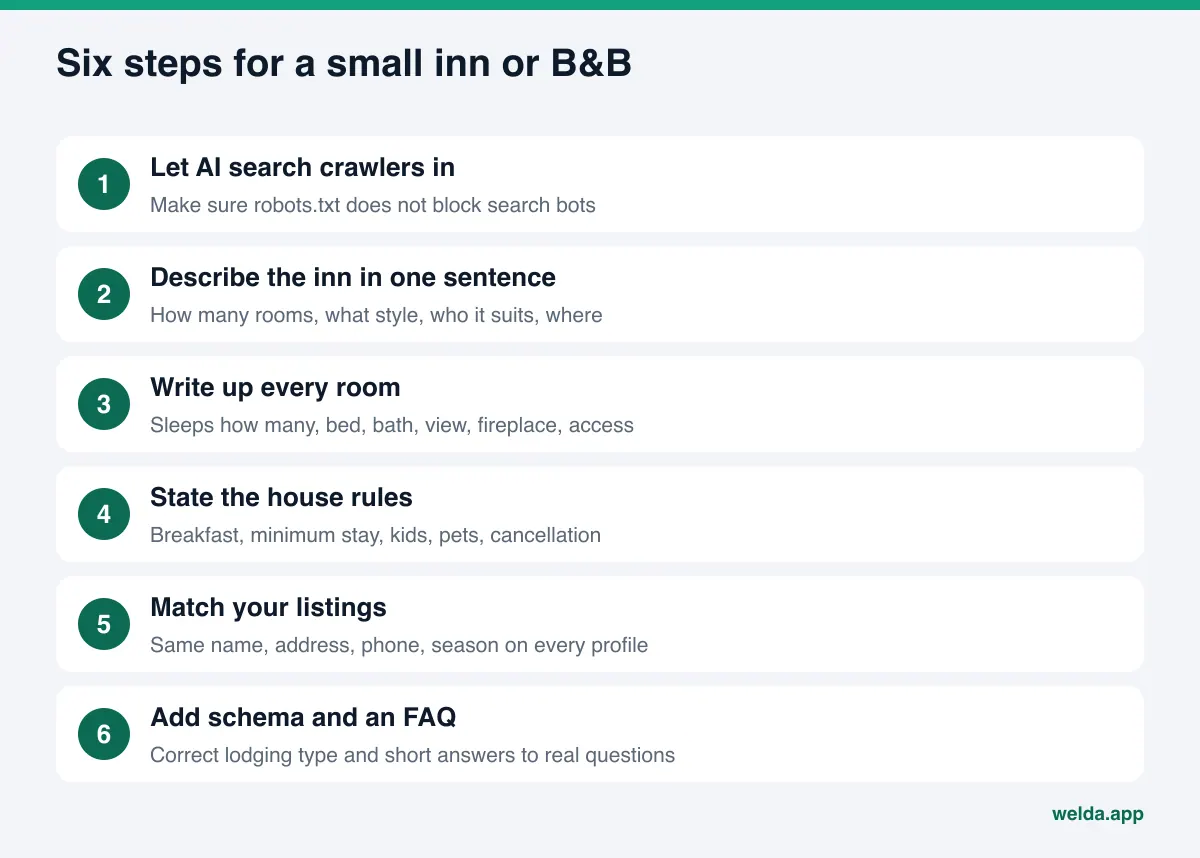
The order below is built for a small team with limited time. The first five steps happen entirely on your own site.
- Make sure AI search crawlers can reach your site. If robots.txt blocks them, nothing else matters. OpenAI's crawler documentation says sites that opt out of OAI-SearchBot will not be shown in ChatGPT search answers. Some website builders and security plugins change these settings without telling you. Our guide on whether AI bots are crawling your website shows how to check.
- Describe your inn in one sentence. Put type, size, location and who it suits at the top of the home page. "Your home away from home" tells an AI assistant nothing.
- Write up every room. How many guests it sleeps, bed size, private or shared bath, fireplace, view, stairs or ground floor access. A traveler asks for "ground floor room with a private bath," and the answer comes from the inn that wrote that sentence.
- State your house rules in plain words. Check-in window and late arrival options, minimum stay on weekends and holidays, children, pets and any pet fee, cancellation policy, quiet hours.
- Describe breakfast in text. What is served, what time, whether dietary needs can be handled with notice. For a B&B this is the single most asked-about detail, and it often lives only in a photo gallery.
- Match your details everywhere. Inn name, address, phone, season dates and rules should be the same on your site, your Google Business Profile and every listing. If one says "open year-round" and another says "closed January through March," the assistant trusts neither.
- Add lodging schema of the right type. Use the type that fits and the facts your text already states.
- Write an FAQ. Take the questions you answer by phone and email every week and put short answers on the site. AI assistants lean on short, direct answers.
- Reply to reviews with specifics. A short reply on Google or Tripadvisor that naturally mentions what guests enjoyed ("glad you liked the blueberry pancakes on the porch") helps connect your inn with the right topics.
There is no hidden switch on Google's side. Google's guidance on AI features says there are no additional technical requirements to appear in AI Overviews or AI Mode beyond being indexed and eligible to show a snippet. The foundation is a crawlable, well-written site.
No website, or just one page? What to do first
Plenty of inns today live mostly on Airbnb, booking sites, Tripadvisor and Instagram. Those channels bring guests, and AI assistants cite them often. Their shared limit is the template: every property fills in the same fields, and there is little room for the details that set you apart.
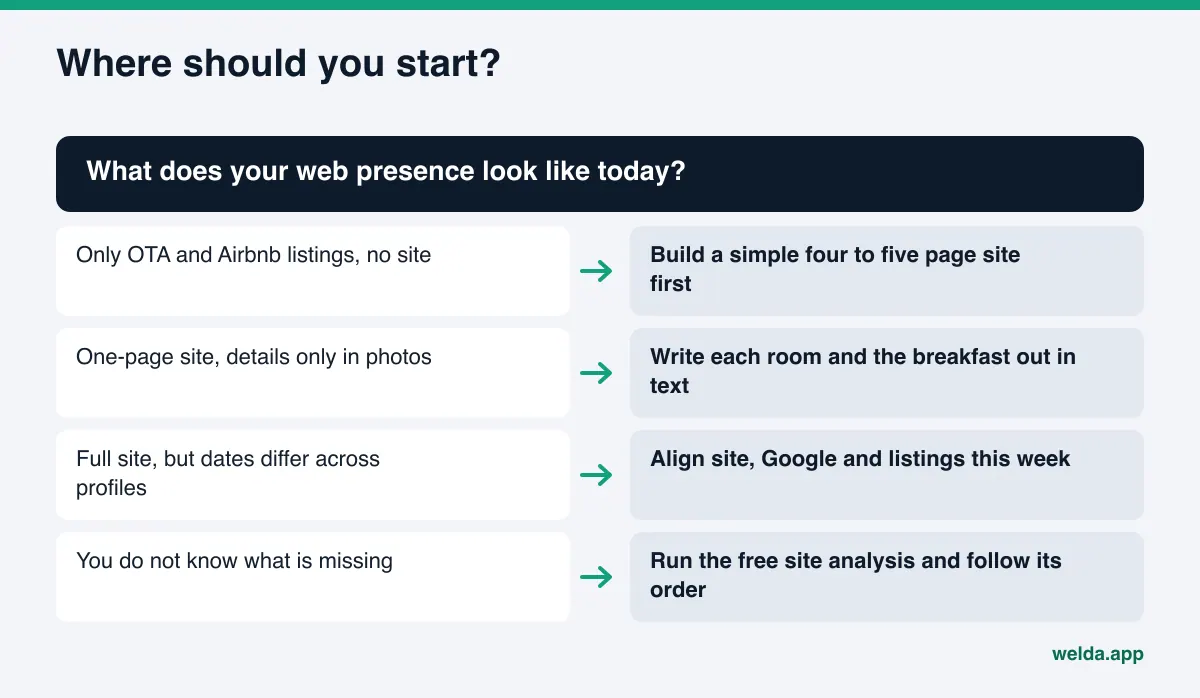
The fix is not a large website. Four or five pages are enough for most B&Bs: a home page that describes the inn, a rooms page, a page for breakfast and house rules with an FAQ, a location and directions page, and contact details. What matters is not the page count but that each page answers a real guest question in clear sentences.
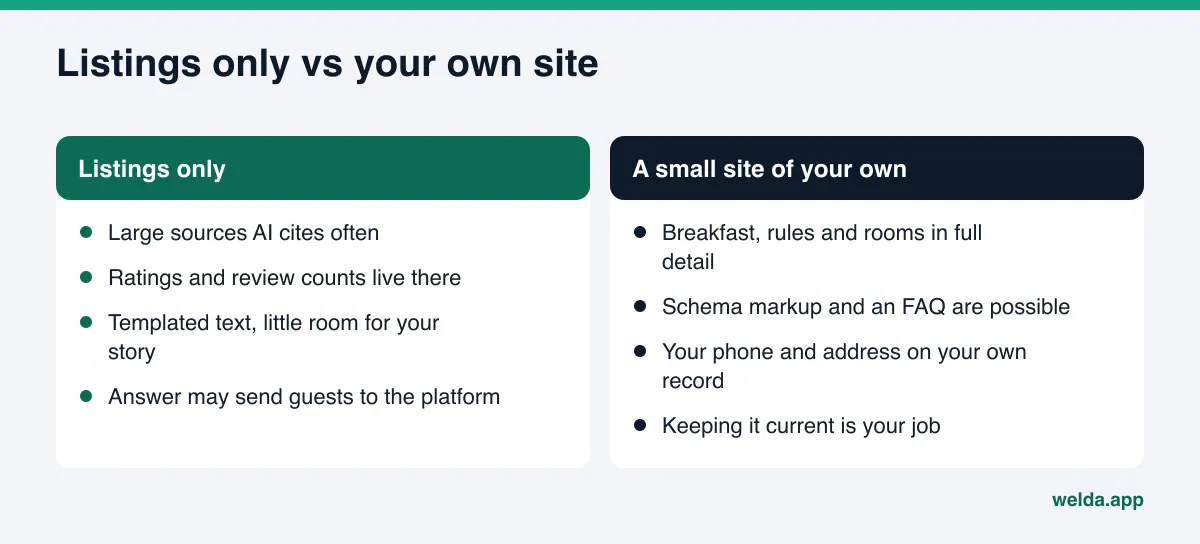
Your Google Business Profile is the second pillar. Category, address, seasonal hours, photos and review replies live there and are read often. Fill in the website field, and link back to the profile from your site so it is clear they belong to the same inn. Then make sure your listings and your site agree. A listing brings bookings, but if an AI answer names only the platform, the traveler may book through the platform rather than with you directly.
How Welda handles AEO for a bed and breakfast
An innkeeper's scarcest resource is time. So Welda focuses on two things here: measuring what your site tells AI assistants today, and turning the gaps into a short task list with the text already written. First, the part anyone can use today.
The free site analysis: what is missing, even on a one-page site? Enter your URL and Welda reads your home page and, if they exist, inner pages such as rooms, rates, about and contact. On B&B sites the pattern is familiar: a slogan as the main heading, breakfast described only in photos, the address and phone embedded in an image, no lodging schema, no FAQ. For each issue the analysis states what it found, why it matters and how to fix it, and gives a score out of 100 with separate technical and content parts. It drafts a title, meta description, main heading, intro paragraph and FAQ for your home page. A simulation shows how much each fix would move the score, so an innkeeper with an hour to spare knows which fix to make first.
For small inns the most practical output is often the ready-made fix package. If your site runs on a website builder rather than WordPress, the package includes the business schema code and the text to drop in; you or whoever manages your site puts them in place. The analysis also compares you with competitors and produces a PDF and a shareable score card. Finally, it asks five questions a guest might ask to an AI assistant that can search the web, and checks whether your inn's name appears in the answers. That is a one-time snapshot, not ongoing tracking.
What Welda asks you instead of guessing. Much of what makes a B&B bookable is written nowhere: breakfast hours, whether the cottage has a dishwasher, the weekend minimum stay, the pet fee. When Welda cannot read a fact from your site, it does not make one up. In the dashboard, missing facts are collected in one place and asked of you, and once you answer, the fact flows into every piece of text Welda prepares. Tasks Welda cannot publish itself, such as listing text on booking sites, appear in a manual task list with ready-to-paste copy.
What stays with you. Welda drafts room descriptions, FAQ answers, profile text and review replies. You approve what gets published. On WordPress, Welda connects through a separate Editor user and an application password, with no code to install; content opens as a draft on your site and goes live only when you approve it. Content always lives on your own site; Welda does not host it. Google Business Profile, Instagram and Facebook can be connected; anything not connected is listed as a manual task.
The dashboard also asks guest questions to ChatGPT, Gemini, Perplexity and Google AI three times each and turns the results into a score with a published formula and a margin of error, plus views for competitors, sources and a monthly one-page report.
An honest note on availability. The Welda dashboard is in early access and is opening first to businesses in Turkey. Regular four-engine tracking is being added during early access, and dashboard screens are shown with sample data. What anyone can use today, in English, is the free site analysis. Pricing is discussed in an early access conversation.
What Welda does not do
Innkeepers hear plenty of promises about "getting into ChatGPT." Unrealistic expectations do more harm than any missing tag, so here are the limits.
- No promise of placement. AI answers vary; the same question can get a different answer on a different day. That is why Welda asks each question three times and reports a margin of error.
- No invented facts. Breakfast times, deposits and pet fees come from you.
- No fake reviews. Welda drafts replies to reviews but never writes reviews. The FTC's final rule banning fake reviews and testimonials, announced in August 2024, covers fake and AI-generated reviews. This is not legal advice.
- No outreach on your behalf. Handling negative reviews, directory accounts and press work stays with you; Welda shows what is missing and drafts the text.
- No instant results. New content usually takes weeks to show up in AI answers.
The dashboard's compliance check flags pricing claims, guarantees and superlatives such as "the best inn in the county" before anything is published. It is not legal advice and has not been reviewed by legal counsel. For questions about lodging taxes, local short-term rental permits or advertising rules, talk to your own accountant or attorney.
Checklist: is your B&B ready to be recommended?
Open your site and your Google profile and go through this list item by item.
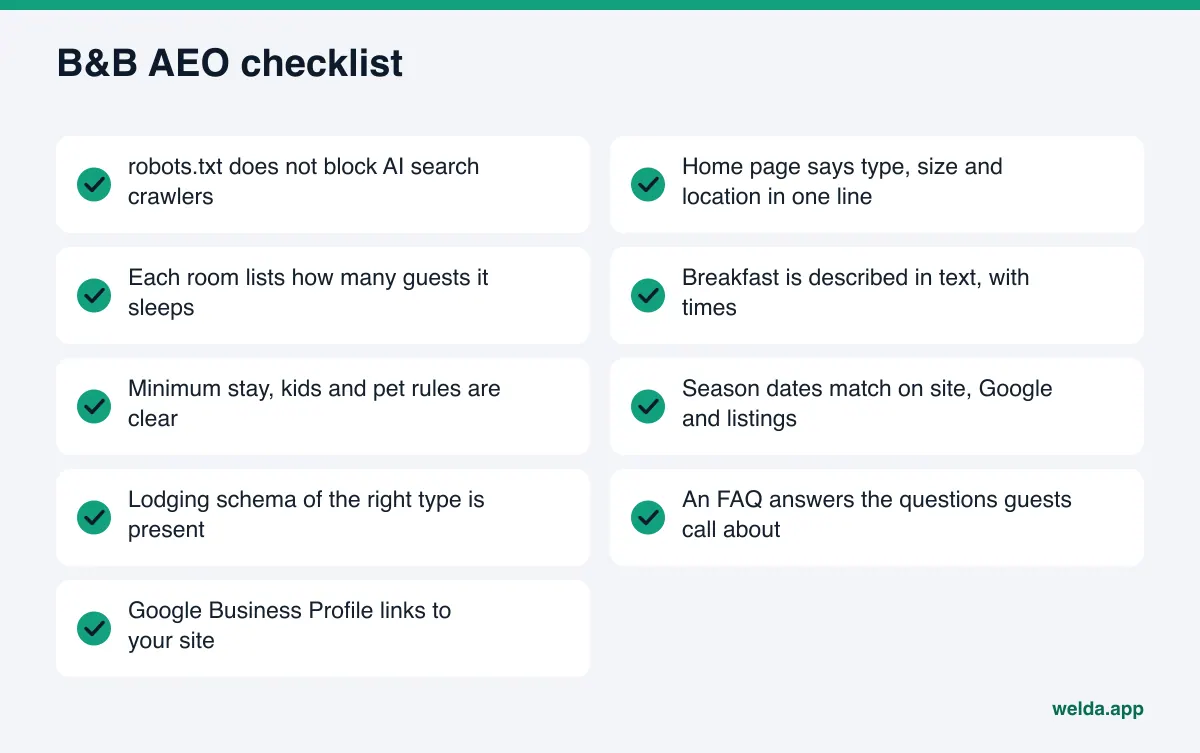
Use this table to pick your first task:
| Your situation | First task | Why |
|---|---|---|
| Listings only, no website | A simple four to five page site | Your own site is the only place to tell the full story |
| Rooms and breakfast shown only in photos | Write each room and the breakfast out in text | AI does not quote what it cannot read |
| Rules on kids, pets, minimum stay unclear | An FAQ section | These are the questions that decide bookings |
| Season dates differ across profiles | Align site, Google and listings | Conflicting facts reduce trust |
| You do not know what is missing | Free site analysis | Shows gaps and the order to fix them |
Seasonal inns should watch one more thing. If your phone goes unanswered in winter and your profile is not updated, an assistant may assume you have closed for good. Write your closing and reopening dates on your site and your profile. If you run a larger boutique property, see our guide to AEO for boutique hotels; if you also rent cabins or tents, read how glamping sites and cabin rentals get recommended by ChatGPT.
Frequently asked questions
Can a small B&B really be recommended by ChatGPT?
Yes, but nobody can guarantee it. Small inns have an edge on specific questions, because they match specific needs: a homemade breakfast, a quiet setting, innkeepers on site. The more clearly you write those details, the better your chances.
What is the single most important detail for a bed and breakfast?
Breakfast, described in text: what is served, when, and whether dietary needs can be met. After that, room capacity, private baths and house rules on kids and pets.
I only have an Airbnb listing and Instagram. Is that enough?
It can bring bookings, but it rarely gives AI assistants enough to describe your inn. Listing text is templated. A short site of your own and a complete Google Business Profile close that gap fastest.
Which schema type should I use?
BedAndBreakfast for a classic inn, VacationRental for units rented individually, or the general LodgingBusiness type if neither fits well. Whatever you choose, the markup should match your page text.
How long until I see a change?
New or corrected content usually takes weeks to appear in AI answers, and it varies by engine. Measure the same questions before and after a change; a single day's test can mislead.
What does Welda's free analysis include, and is it available in English?
Yes, it works in English. It gives a score out of 100 with technical and content parts, an explanation of each gap, suggested home page text, a score simulation, a competitor comparison, a fix package, a PDF and a score card. It is free once per site; your email and phone are verified, and the results link arrives by email and stays open for 14 days.
What is your inn telling AI today?
How bed and breakfasts get recommended by ChatGPT is not about big budgets. It comes down to small, written details: what breakfast is, how many guests a room sleeps, what the rules are, where you are, and the same facts on every profile. All of that is in your hands.
Run Welda's free site analysis: it reads your site, lists the gaps in priority order, drafts home page text, and checks whether your inn's name appears in answers to five questions a guest might ask.