How do glamping sites and cabin rentals get recommended by ChatGPT? When ChatGPT recommends a cabin or a glamping site, it leans on clear facts it can find on your website and in the places that talk about you: what kinds of units you have, how many guests each sleeps, amenities like a hot tub or a wood stove, what the road in looks like, which months you are open, and what past guests say. When those facts are readable, consistent, and current, your property is more likely to show up in answers. Nobody can guarantee a specific position.
This guide is for owners and managers of cabin rentals, glamping resorts, treehouse stays, dome and safari tent sites, and small groups of A-frames. Most of these businesses have grown through Instagram, Airbnb, Vrbo, and Hipcamp. But travelers now type full requests into AI assistants: "find me a cabin with a hot tub near the Smokies that allows dogs" or "is there a glamping spot near Joshua Tree that works for a family of four?" The answer names a handful of places. This is the territory of AEO (answer engine optimization), sometimes also called GEO, short for generative engine optimization. Below we cover how those answers come together, the work to do step by step, how Welda handles that work, and what Welda does not do. If you want to see where your site stands today, start with a free site analysis.
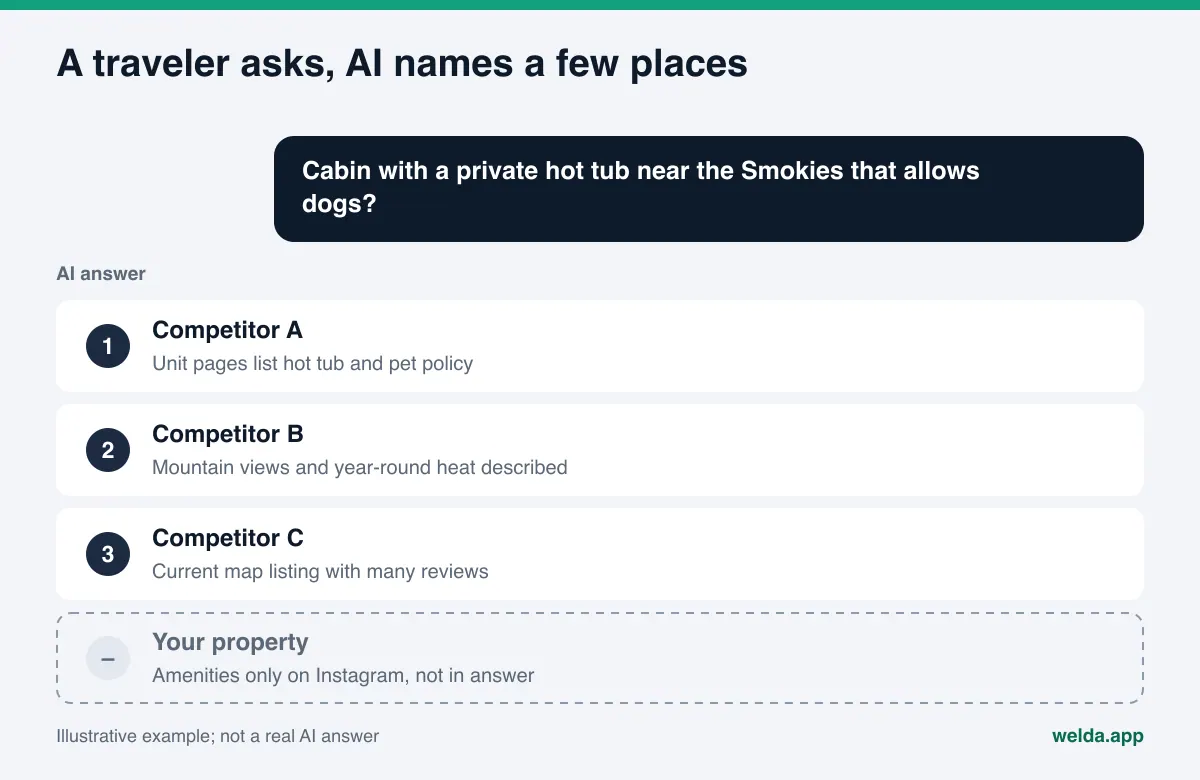
What travelers ask AI about cabins and glamping
Booking a cabin or a glamping tent is a different decision from booking a hotel room. The guest is not just looking for a bed near a meeting. They are picking an experience, and their questions show it. A single prompt often bundles location, group size, amenities, season, and rules. Typical questions fall into a few groups:
- Location and setting: "cabin rental with a mountain view in the Blue Ridge", "glamping near Zion with a short drive to the park entrance", "lakefront A-frame in the Adirondacks".
- Amenities: "cabin with a private hot tub and fire pit", "treehouse with a full kitchen", "safari tent with an en-suite bathroom".
- Who it is for: "romantic cabin for an anniversary weekend", "glamping that works with two kids under ten", "dog-friendly cabin with a fenced yard".
- Season and conditions: "cabins open in winter with heat", "do I need four-wheel drive to get there", "glamping with air conditioning in Texas Hill Country in August".
- Trust and cost: "are there cleaning fees on top", "what is the cancellation policy", "does it look like the photos".
Each of these asks for a specific fact. When an AI assistant recommends a place, it usually gives a reason: "private hot tubs on every cabin", "heated and open year-round", "dogs welcome for a fee". If it cannot find that reason anywhere, it has no basis to include you. In most cases the problem is not the property. The problem is that the facts are not written where a machine can read them.
Why cabin rentals and glamping sites get skipped in AI answers
The digital setup of a typical cabin or glamping business follows a familiar pattern. Knowing the pattern tells you where to start.
The details live on Instagram. Unit types, pet rules, what is included, directions, and winter conditions sit in stories, highlights, captions, and DMs. AI tools either cannot reach that content or reach only pieces of it.
The website is a single photo page. Beautiful images, a tagline like "Escape to nature", and a "Book now" button that sends people to a booking widget or a listing. Amenities are printed on top of images or tucked into a PDF brochure. Text inside an image is much harder to read reliably than plain text on a page.
The name changes from place to place. The same property is "[Name] Cabins" on the website, "[Name] Glamping" on Google Maps, and something else again on Airbnb. The address is a rural route on one site and a county road on another. An AI system may not be confident these records refer to the same business. We cover this in more depth in our guide to NAP consistency for AI search.
The listing is richer than the site. Your Airbnb or Hipcamp listing may be complete while your own site says very little. Answers can then mention you through the listing, which sends the booking through a channel that takes a fee, and you have no control over how the listing is summarized.
Seasonality is missing. Many glamping sites close for part of the year, and many cabins change what they offer in winter. If you do not say so, AI answers may skip you for winter questions, or suggest you for dates when you are closed. Both are bad for the guest and for you.
Small lodging businesses share many of these patterns. If you also run rooms in a house, our piece on how bed and breakfasts get recommended by ChatGPT covers the differences.
Match each traveler question to a fact on your site
The table below pairs common question types with the information your site needs to state plainly so an answer engine can use it. The example questions were written for this article.
| Question type | Example | What your site should say |
|---|---|---|
| Location and setting | Lakefront cabin in the Adirondacks | Town, county, state; distance to the lake, trailhead, or park entrance; which units have the view |
| Amenities | Cabin with a private hot tub | Amenity list per unit: hot tub, fire pit, kitchen, grill, Wi-Fi, A/C, heat |
| Group fit | Glamping for a family of four | Max occupancy, bed layout, age rules, safety notes |
| Pets | Dog-friendly cabin with a fenced yard | Whether pets are allowed, limits, fees, yard details |
| Season | Heated cabins open in winter | Open months, heating type, winter road access |
| Access | Do I need 4WD to get there | Road surface, parking, distance from the nearest paved road |
| Cost and trust | Any cleaning fee on top | What is included, fees, cancellation policy, check-in and check-out times |
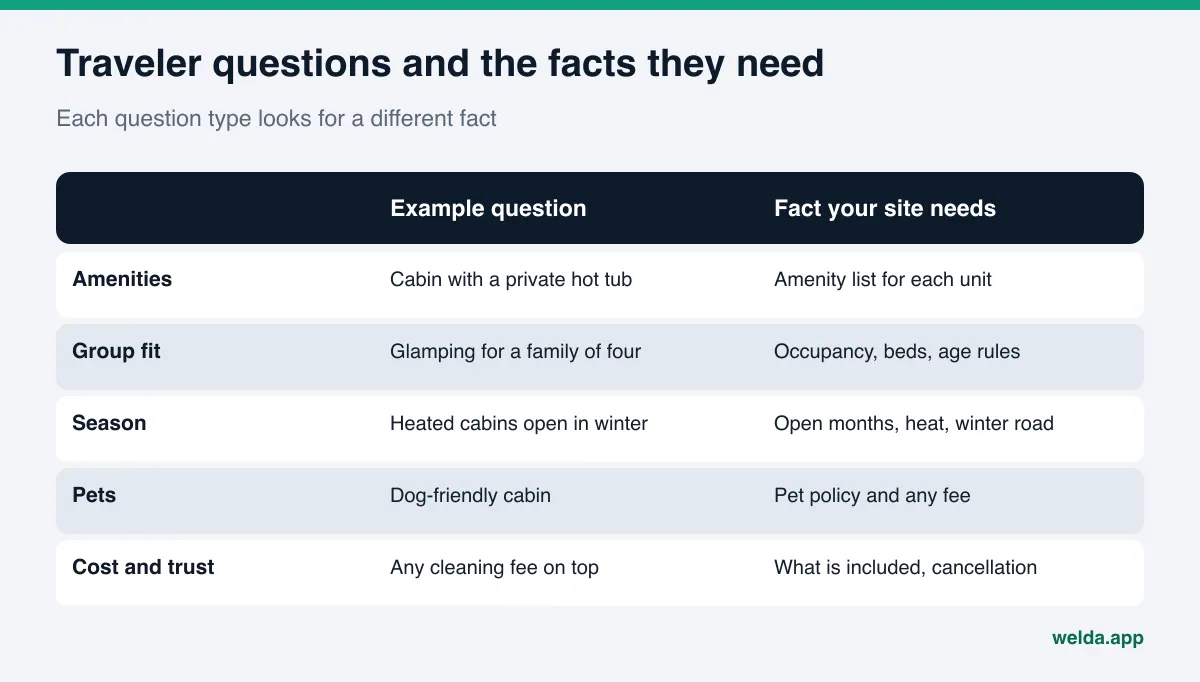
A note on rates: publishing your nightly rate is your call. But stating what is included (linens, firewood, cleaning, parking) gives an answer engine something to say when a traveler asks about hidden fees.
Step by step: how to get your glamping site or cabin rental recommended by ChatGPT
These steps work best in this order. The early ones are the foundation for everything after.
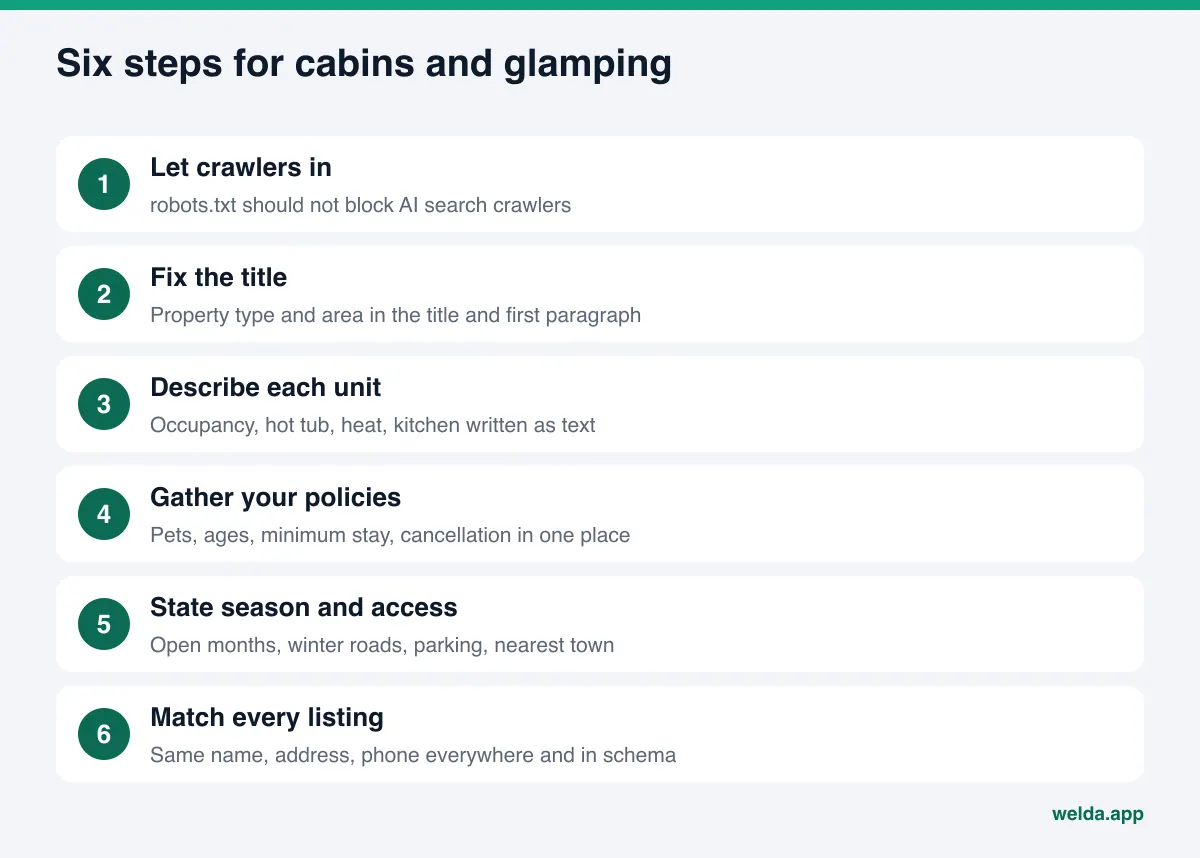
- Make sure AI crawlers can reach your site. If your robots.txt blocks search crawlers, your content will not be read, no matter how good it is. OpenAI, for example, explains on its crawler documentation page that
OAI-SearchBotis used to surface websites in ChatGPT search. Website builders and security plugins sometimes block bots like this without the owner noticing. - Rewrite your homepage title and first paragraph. Instead of "Escape to Nature", use something like "Cabins with Private Hot Tubs near Gatlinburg, Tennessee". The opening paragraph should state in plain sentences what kind of property you are, where you are, how many units you have, and your most distinctive amenities.
- Give each unit type its own page or section. "Lakeview A-frame", "Geodesic dome", "Family cabin". On each, write out occupancy, bed layout, bathroom, kitchen, hot tub, heat, A/C, and view in plain text, not as text baked into a photo.
- Put your policies in one place. Pets, minimum age, minimum stay, check-in and check-out, quiet hours, campfire rules, cancellation. Guests ask about these constantly, and most cabin sites barely mention them.
- Spell out season and access. Which months you are open, which units stay open in winter, whether the road is paved or gravel, what happens after snow, where guests park, how far the nearest town and grocery store are.
- Use one name, address, and phone number everywhere. Make your website, Google Business Profile, Instagram, Airbnb, Vrbo, Hipcamp, and Tripadvisor match. Write the address the same way each time. Our guide to business directories for AI visibility explains which listings matter most.
- Add structured data (schema). The schema.org vocabulary has a
LodgingBusinesstype for lodging, and under it aCampgroundtype for places to stay overnight outdoors. Include name, address, phone, location, hours, and amenities, and keep them consistent with the visible page text. - Write a real FAQ section. Answer the questions from the table above in short paragraphs: "Are you open in winter?", "Do you allow dogs?", "Is firewood included?", "Can a regular car make it up the road?"
- Collect and answer reviews honestly. After checkout, ask guests to leave a review on Google. Reply to reviews, especially the critical ones, calmly and with specifics. Do not buy, write, or incentivize reviews in a way that misleads: the FTC's rule on consumer reviews and testimonials bans fake reviews and paying for reviews on the condition that they be positive or negative. This is not legal advice; check the rule itself or ask counsel. How reviews feed into AI answers is covered in negative reviews in AI answers.
Most of this list is one-time work. After that, the job is keeping things current as seasons change and units are added. If you take a hot tub out of service or add a new dome and your site does not say so, AI answers will not know either.
Instagram and listings vs. your own website
This is the biggest gap for cabin and glamping businesses. Instagram is great for showing off your property and helping guests decide. On its own, though, it does little for AI search visibility. Plain text on your website can be crawled, quoted, and cross-checked against other sources by both search engines and AI tools.
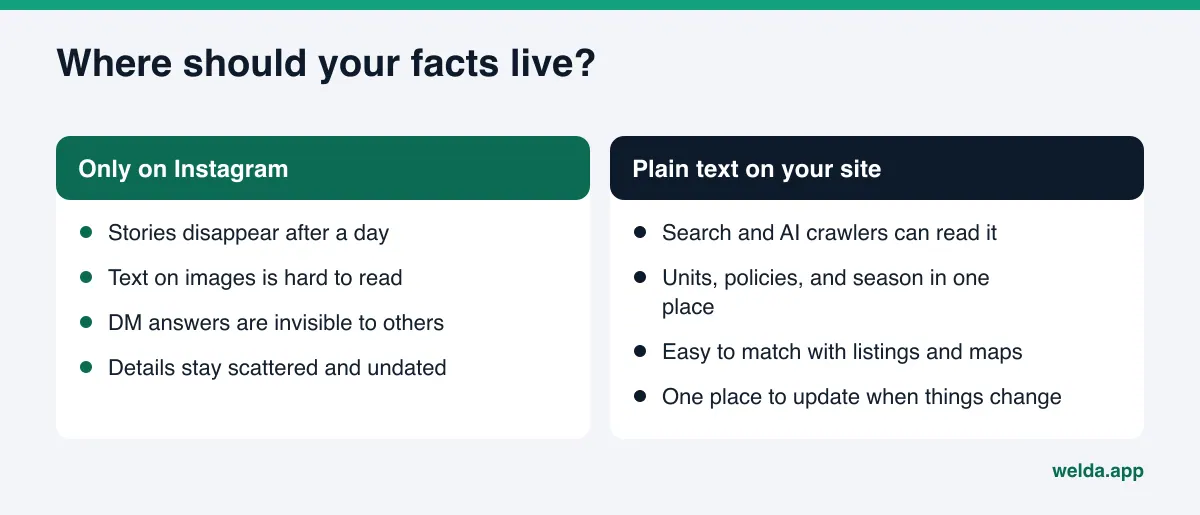
That does not mean you should drop Instagram or your listings. Linking your Instagram profile to your site, and your site back to the profile, helps AI systems connect the two records to one business. The point is that your own site should be the home of the permanent facts. Stories expire. Pages stay.
The same logic applies to Airbnb, Vrbo, and Hipcamp. A complete listing is good, but the facts there should match your site. A unit that "sleeps 6" on a listing and "sleeps 4" on your website leaves an answer engine unsure which to believe.
How Welda does this work
Welda is software that measures where a business shows up in AI answers and fills in the gaps on the business's behalf. For cabins and glamping, three parts matter most: the free site analysis, question tracking, and the sources view.
Free site analysis: what does your site say right now? The analysis, which runs in English, reads your homepage and a few inner pages such as services, pricing, about, and contact, the way Google and AI tools would. On a typical cabin site it tends to surface: whether crawlers are blocked, whether the title says what and where you are, whether structured data is present, whether your address and phone are readable, whether your social and map profiles link to the site, whether there is an FAQ, and whether your units are described clearly. You get a score out of 100, a list of what was found and how to fix each item, ready-to-use homepage copy (title, description, headline, intro paragraph, FAQ), and a fix package to add to your site. It also asks five questions a guest might ask to an AI assistant that can search the web, and checks whether your property's name appears in the answers. That is a one-time check, and it does not measure rankings.
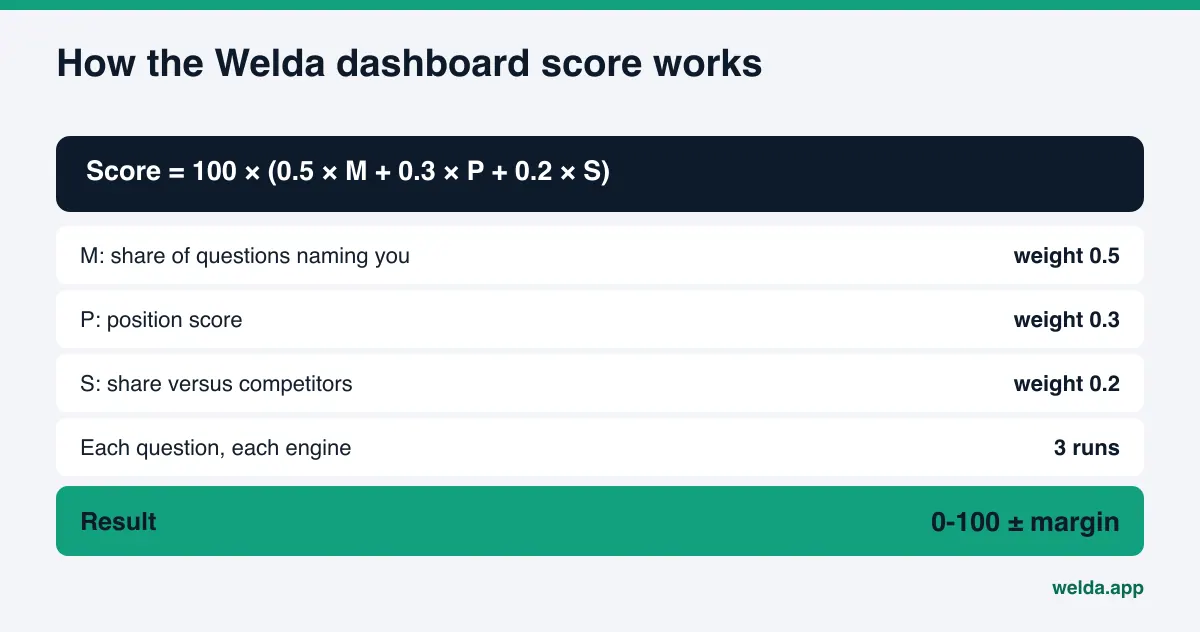
Question tracking: which questions do you show up for? In the Welda dashboard, the questions your guests would ask are put to ChatGPT, Gemini, Perplexity, and Google AI three times each. For a cabin property, those questions split by location, amenity, season, and guest type. For each one you see which engine named you and in what position. The decision is usually simple. If you show up for "cabin with a hot tub" but not for "heated cabin open in winter", the missing piece is likely your winter and heating information. The score itself uses an open formula, and the spread across the three runs gives a margin of error, so a small week-to-week wobble is not mistaken for progress.
Sources view: where does AI learn about you? For lodging questions, AI answers often lean on booking platforms, map listings, review sites like Tripadvisor and Yelp, and travel forums. The sources view lists those sites, how often each is cited, and your status on each: complete, incomplete, or missing. For a glamping business, that tells you whether to spend your next hour on your own site, your Google Business Profile, or a listing that needs finishing.
What stays with you. Welda drafts content, profile text, and review replies; publishing approval stays with you. Welda does not make up facts it does not have. If it does not know your heating type or your pet fee, it asks you through the to-do list instead of guessing. On WordPress sites it connects through a separate Editor user and an application password, with no code to install; drafted pages open on your site as drafts and go live when you approve them. Google Business Profile, Instagram, and Facebook can be connected. Anything Welda cannot connect to, such as your Airbnb or Hipcamp listing, shows up as a manual task with ready-to-paste text next to it. Content always lives on your own site.
About early access. The Welda dashboard is in early access and is opening first in Türkiye. Regular four-engine measurement is being added during early access, and sample dashboard screens use illustrative data. The part anyone can use today, including in the US, is the free site analysis, which works in English. Pricing for the dashboard is discussed during the early access conversation.
Example scenario: a cabin property that disappears in winter
This scenario is an example and does not describe a real business. Picture a property in the mountains with six wooden cabins. Summer is full. In winter three cabins stay open. The homepage says "Your peaceful escape in the woods" above a photo gallery. Winter conditions are only mentioned in Instagram stories.
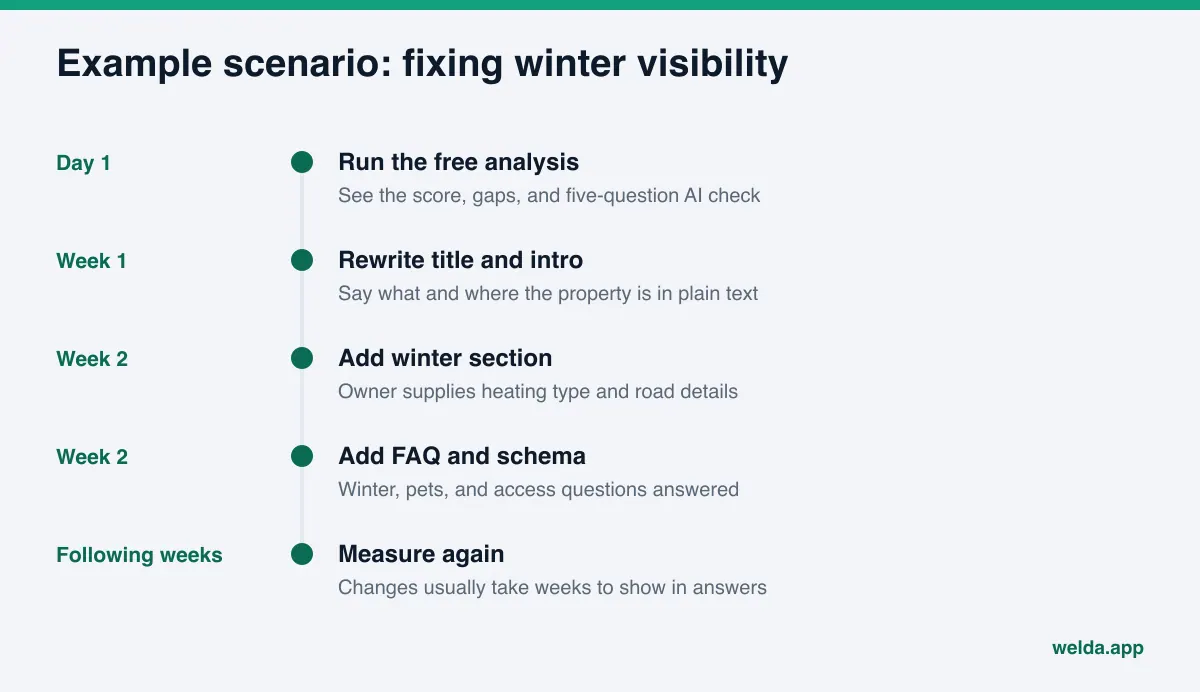
The free site analysis on a site like this would point out that the title does not say what or where the property is, structured data is missing, there is no FAQ, and unit amenities are scattered across photo captions. In the five-question AI check, a question like "heated cabins open in winter near the park" would not mention the property.
The order of work is clear: rewrite the title and opening paragraph; give the three winter cabins their own section with heating type and winter road access; add "Are you open in winter?" and "Is the road plowed after snow?" to the FAQ; add structured data. Only the owner knows the heating type and how the road is maintained, so that copy waits for their input. Changes usually take weeks to show up in AI answers, and nothing about the outcome is guaranteed.
Limits: what Welda does not do
When you choose a tool, knowing what it does not do matters as much as knowing what it does. For Welda, these are clear:
- It does not guarantee rankings or "getting into ChatGPT". AI answers vary, and no tool controls them.
- It does not write facts it does not have. Occupancy, heating, pet rules, and access details come from you.
- It does not create fake reviews. Reviews come from real guests only.
- It does not publish without your approval.
- Handling negative reviews, setting up directory and listing accounts, and press outreach stay with you. Welda can suggest text, but it does not run those accounts for you.
- It does not host content. Everything lives on your own site and your own profiles.
Timing matters too. New information on your site usually takes weeks to show up in AI answers, and the delay varies by engine. Seeing little change in the first few weeks is normal. Measuring repeatedly is how you tell a real shift from noise.
Checklist for cabin rentals and glamping sites
Use this list to review your site through an answer engine's eyes. Most items are checked individually by the free site analysis.
- robots.txt does not block AI search crawlers.
- Your homepage title names the property type (cabins, glamping, treehouses) and the area.
- The first paragraph states unit count, location, and standout amenities in plain sentences.
- Each unit type has occupancy and amenities written as page text.
- Pet, age, minimum stay, and cancellation policies are in one place.
- Open months, heating, A/C, and winter access are stated.
- Name, address, and phone match across your site, Google, Instagram, and every listing.
- Structured data is in place and agrees with the visible text.
- The FAQ answers the questions guests actually ask.
- Reviews get regular, calm, specific replies.
If your property leans toward hot springs, spa treatments, or wellness retreats, the extra items in AEO for spa and wellness resorts are worth a look.
Frequently asked questions
Can my cabins get recommended by ChatGPT without their own website?
It is possible. AI tools can learn about you from an Airbnb, Vrbo, or Hipcamp listing or from your Google Business Profile. But then you do not control what gets said, and guests often book through a channel that charges a fee. Clear facts on your own site give you more say in how answers describe you.
Should glamping tents and cabins have separate pages?
If you offer both, yes. Travelers ask for "glamping" and "cabins" as separate things. Each page should describe its own unit type with occupancy and amenities spelled out.
I have a big Instagram following. Is that not enough?
Instagram helps guests decide, but AI tools cannot always read stories or text inside images. Put permanent facts on your website and link your Instagram profile and site to each other.
If we close in winter, should we say so?
Yes. Stating your open months and which units stay open keeps AI answers from suggesting you for dates you cannot host. If you want to appear for winter questions, also describe heating and road access.
How long until changes show up in ChatGPT answers?
Usually weeks, and it varies by engine. No one can promise a date or a position. Regular measurement helps you see whether a change is real.
Does Welda edit my Airbnb or Hipcamp listing?
No. Welda does not connect to those platforms. The sources view shows how often they are cited and where your listing is incomplete, and the fix appears as a manual task with ready-made text.
Does the free analysis work for cabin and glamping sites in the US?
Yes. It reads any business website and runs in English. It is free once per site; your email and phone are verified, and the results link arrives by email and stays open for 14 days.
Next step: see your site the way AI does
Getting a glamping site or cabin rental recommended by ChatGPT comes down to writing what you offer in a form machines can read, consistently and currently: unit types, amenities, policies, season, and access; one name everywhere; steady, honest review replies. Most of that is one-time work. The rest is seasonal upkeep.
To see where to start, run the free site analysis. In a few minutes you get your score, your gaps, ready-to-use homepage copy, and the result of the five-question AI check.