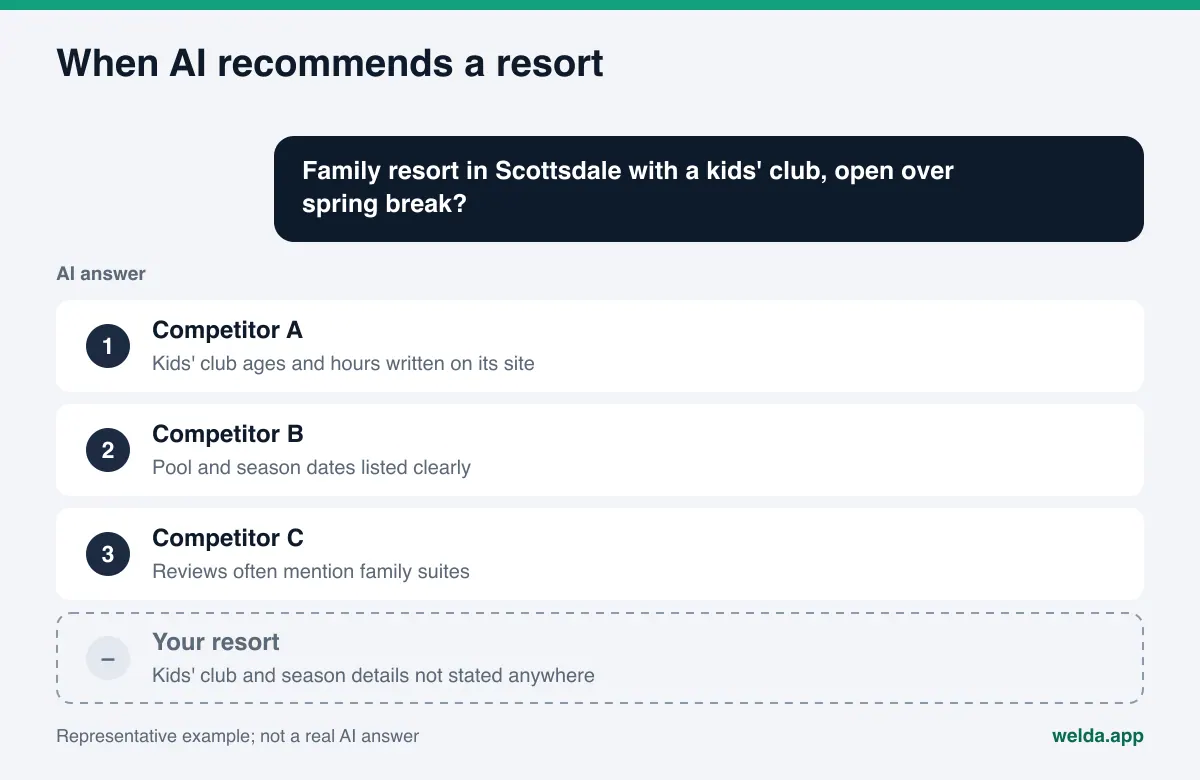
Why doesn't ChatGPT or Google's AI Mode recommend my resort? Travelers now ask AI tools long, conditional questions like "family resort in Scottsdale with a kids' club and a lazy river, open over spring break." AI answers pick the properties whose amenities, age policies, fees and seasons they can read and confirm. AI search optimization for resorts is the work of putting those facts where AI tools can find them; this guide walks through the steps and shows how Welda handles the work.
What is AI search optimization for resorts?
AI search optimization, usually called AEO (answer engine optimization), is the work of getting your business named when people ask ChatGPT, Gemini, Perplexity or Google's AI Overviews and AI Mode for a recommendation. You will also hear it called AI search visibility or AI visibility. Some people use the term GEO (generative engine optimization) for the same idea. In a classic search, a traveler sees ten links and opens a few. In an AI answer, they usually see a short list of three to five properties. If you are not on that list, they may book without ever hearing your name.
For resorts, this shift is sharper than for most businesses, for two reasons. First, a resort choice is full of conditions. Nobody types "hotel Maui" and stops. They ask for an oceanfront resort with a kids' club for a seven-year-old, a quiet adults-only pool, a reasonable drive from the airport, and no surprise fees. An AI tool tries to confirm each of those conditions in a source it trusts. If your kids' club ages, your adults-only policy or your seasonal dates are not written anywhere it can read, a competitor who wrote them down gets the mention.
Second, resorts sell heavily through online travel agencies like Expedia and Booking.com, through wholesale partners and through tour packages. The resort's own site is often built around photography and a short brand story, while the detailed facts live on third-party listings written by different people at different times. When an AI tool merges those sources and finds conflicts (one listing says the water park is open year-round, another says summer only), it either skips you or repeats the outdated version.
The quickest way to see where you stand is to measure. Welda's free site analysis reads your homepage and a few inner pages the way Google and AI tools do, and lists each gap with a fix. If your property leans toward spa and wellness, our guide on AEO for spa and wellness resorts covers that angle in more depth.
What do travelers ask AI tools about resorts?
Resort questions almost always combine a destination with several conditions. The table below sorts the most common question types and shows what an AI tool needs to confirm before it names a property. The questions are examples we wrote to illustrate each type; they are not survey or measurement results.
| Question type | Example question | What the AI needs to confirm |
|---|---|---|
| Family | Best Orlando resort with a kids' club for toddlers? | Kids' club age ranges, hours, cost, babysitting, family suites |
| Adults-only | Quiet adults-only resort in the Florida Keys? | Age policy, adults-only areas, noise and entertainment level |
| All-inclusive | Is there an all-inclusive resort in Florida? | Which meals, drinks and activities are included, and which are not |
| Amenities | Resort near Myrtle Beach with a lazy river and pickleball | Amenity list, seasonal hours, what costs extra |
| Fees and price | Which Las Vegas resorts have no resort fee? | Mandatory fees shown in the total price, parking, deposits |
| Location | Ski resort near Denver airport with ski-in ski-out rooms | Drive time, shuttle, distance to lifts or beach |
| Season and policy | Lake Tahoe resorts open in early May, and the cancellation policy | Opening and closing dates, cancellation and change rules |
Look at this table with your own front desk in mind. The questions your reservations team answers every day probably fall into one of these rows. If you answer a question by phone ten times a week but it is not written on your site, it is unanswered as far as an AI tool is concerned. For a method to gather these questions systematically, see how to find the questions customers ask AI.
Where AI tools read about your resort
AI answers are not built from one source. Engines that can search the web read several pages for each question and combine them. For a resort, most of those pages are outside your site: OTA listings, Tripadvisor, Google Maps, Reddit threads, travel blogs and "best family resorts" lists. You control some of them fully. On others, you only control a profile or a reply.
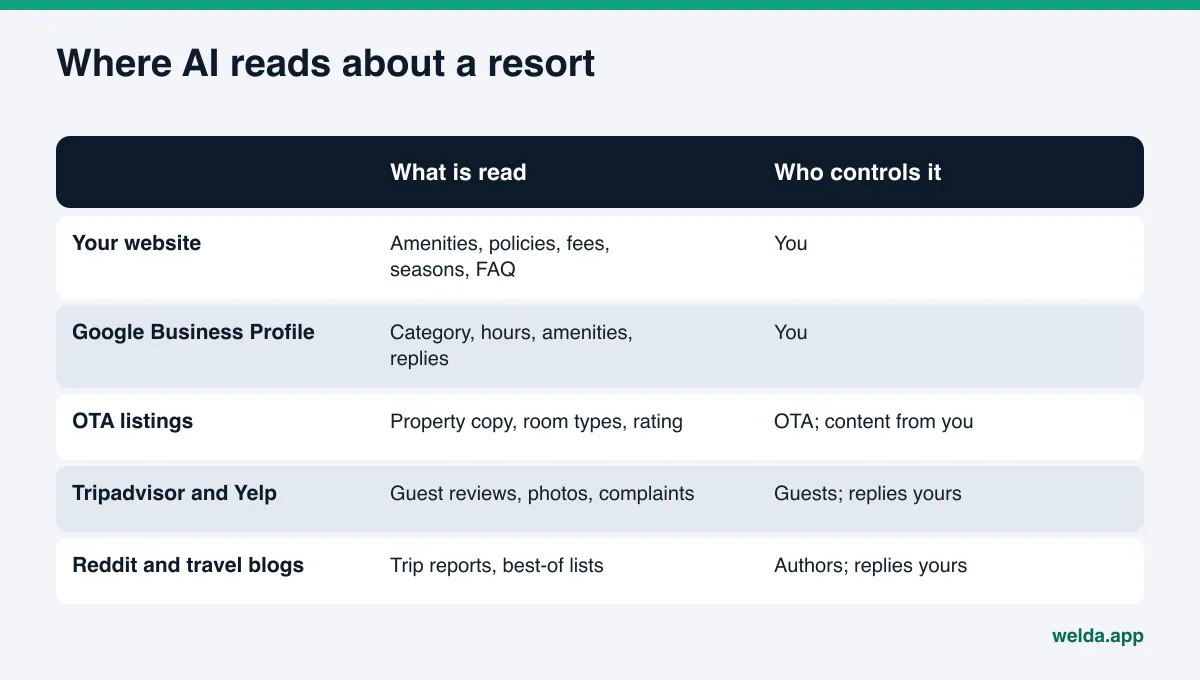
The principle is simple. Your own website should be the source of truth, and everything else should be kept consistent with it. You cannot rewrite an OTA's listing copy, but you can keep the property content you send to partners identical to what is on your site. Your Google Business Profile is entirely yours: category, seasonal hours, amenities, photos and review replies are all managed there.
Tripadvisor, Yelp and Reddit matter more than many resort teams expect. A recurring complaint about crowded pools or a surprise parking charge can show up in an AI answer as "some guests mention extra fees at checkout." You cannot delete that line. You can address the underlying issue, and you can answer reviews in a calm, specific way that adds the missing context.
AI search optimization for resorts, step by step
These steps follow roughly the same order at most properties. The first four need no technical skills; they are about writing down what your team already knows.
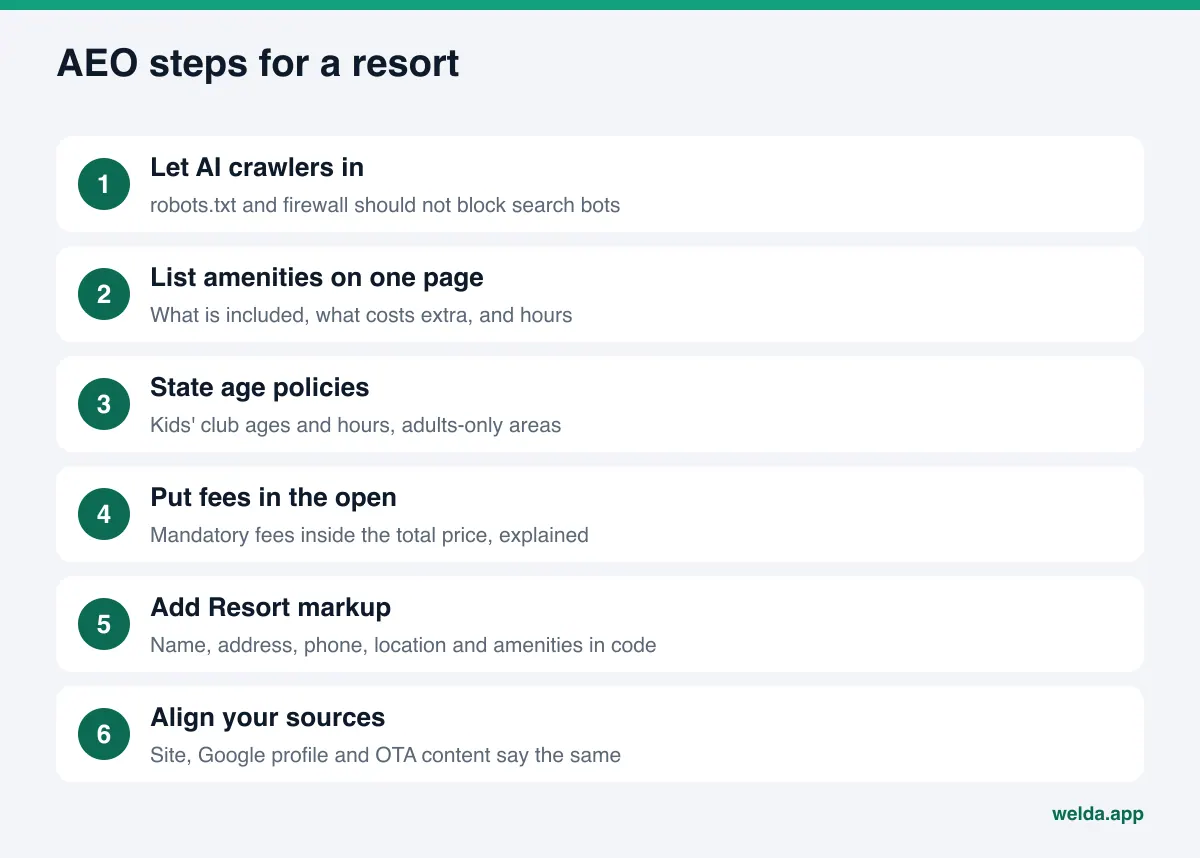
- Make sure AI crawlers can reach your site. If your robots.txt file or your firewall blocks search crawlers, nothing else on this list matters. OpenAI states that ChatGPT search relies on a crawler called OAI-SearchBot, and that GPTBot, which is used for model training, is controlled separately. Blocking one does not block the other, so check both deliberately.
- Write your amenities and inclusions on one clear page. List restaurants and their hours, pools and which are adults-only, the spa, the golf course, the water features, and whether each is included or extra. If you run an all-inclusive or meal-plan option, spell out what it covers.
- State your family and age policies. Give kids' club age ranges, hours, cost and staffing language. If you have an adults-only pool, wing or season, say so in plain words.
- Put fees in the open. Travelers ask about resort fees constantly, and the rules have changed. Under the FTC's rule on unfair or deceptive fees, in effect since May 12, 2025, the FTC's own guidance for businesses says a mandatory resort fee must be included in the advertised total price. Make your site match that, and explain what the fee covers. This is not legal advice; check your own pricing with counsel.
- Write seasons and access in concrete terms. Give opening and closing dates for seasonal amenities, drive time from the nearest airport, shuttle options and distance to the beach or lifts. "Steps from the beach" is weaker than "two-minute walk to our private beach."
- Mark up your business details. Schema.org has a dedicated Resort type for exactly this. Use it for your name, address, phone, location and amenities. Google's guidance on AI features says no special AI file or markup is required, but that structured data should match the visible text on the page.
- Align your sources. Your site, your Google Business Profile and the property content you send to OTAs and partners should use the same amenity names, dates and policies.
- Add an FAQ and reply to reviews. Write short answers to the ten questions your front desk hears most. Reply to reviews with useful detail; replies are text that AI tools read too.
Notice what is not on this list: publishing more blog posts or stuffing keywords. For a resort, most of AEO is writing down facts you already know, in a place an AI tool can find and verify.
How to write an amenities page AI can quote: before and after
The most common gap we see on resort sites is an amenities page written like a slogan. The example below is for a fictional resort and is only meant to show the difference.
Before: "Escape to a world of endless adventure and pure relaxation. Every moment is designed around you."
After: "Our pools are open year-round; the lazy river and splash pad run from Memorial Day through Labor Day. The Kids' Club welcomes ages 4 to 12 from 9 a.m. to 4 p.m. and is included for registered guests. The Cove Pool is adults-only (21 and over). Our daily resort fee is included in every rate we show and covers Wi-Fi, beach chairs and self-parking. We are a 35-minute drive from the airport."
The second version is less poetic, but it answers "kids' club for young children," "adults-only pool," "lazy river open in June," "resort fee" and "near the airport" in one paragraph. An AI tool can lift a sentence from it and pass it to a traveler. It cannot lift anything useful from the first version. Keep your photography and brand voice; just add a block of plain facts next to them.
Apply the same idea to room types. Instead of "family suite," say how many adults and children it sleeps, how many bedrooms it has, and whether it has a kitchenette or an ocean view. If you also manage villas or condos alongside the resort, our guide on AI search optimization for vacation rentals covers the questions that differ for those units.
How Welda does this work
Welda is software that measures where your business appears in AI answers and fills the gaps on your behalf. For a resort, three parts of that work matter most: seeing which questions name you, seeing which sources the AI leans on, and turning missing facts into ready-to-publish copy.
Question-by-question tracking. In the Welda dashboard, the questions your guests would ask are put to ChatGPT, Gemini, Perplexity and Google AI three times each. For a resort, those questions can be grouped by intent: family, adults-only, amenities, fees and location. You see, question by question, which engines named you and in what position. If you show up for "kids' club" questions but never for "no resort fee" questions, you know exactly which page needs work. Questions can be set in English or Turkish.
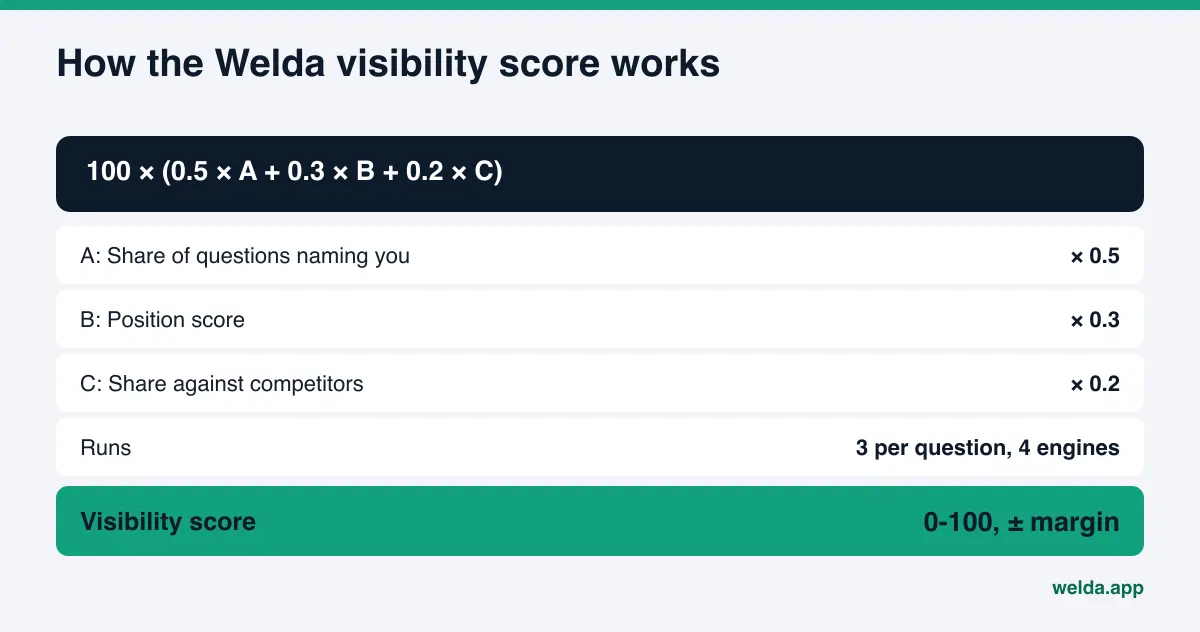
The scoring formula is public. The share of questions that name you carries half the weight, your position score carries 30 percent, and your share against competitors carries 20 percent. Because each question runs three times, the spread between runs gives a margin of error, which helps you tell a real change from normal week-to-week drift.
The sources view. For resorts this may be the most useful screen. It shows which sites AI tools cite when they answer your guests' questions, and your status on each: whether you have a profile, whether your details are complete, whether your own site can be read. If a single OTA listing gets cited often and its amenity list is two seasons old, you see that the fix sits in the content you send that partner, not on your own site. Properties with several locations can read AEO for hotel groups for how this scales.
To-do list and ready copy. After measuring, Welda builds a single to-do list. When a fact is missing, it asks you first: "Which ages does the Kids' Club accept?" "When does the lazy river close for the season?" It does not invent answers. With your reply, it drafts the amenities page, FAQ entries, your Google Business Profile description and review replies. If your site runs on WordPress, you give Welda its own Editor user with an application password; content opens on your site as a draft and goes live only when you approve it. On other platforms, Welda hands you a ready package and your team applies it. The content always lives on your own site.
Beyond that, a compliance check flags pricing, guarantee and superiority claims before anything goes live, and a one-page monthly report gives owners and management the summary.
What you can use today. The Welda dashboard is in early access and opening in stages, starting with businesses in Turkey. Regular four-engine measurement is being added during early access, and the dashboard views in our materials use representative data. What anyone can use today is the free site analysis, which works in English. It checks crawler access, title and description, business markup, address and phone details, map and social profile links, your FAQ section and page speed. It also asks an AI assistant with web search five questions your guests might ask and checks whether your resort is named. That is a one-time snapshot. Pricing is discussed in an early access call.
Limits: what Welda does not do
Nobody controls AI answers. That is why it is worth being clear about the limits of this work from the start.
- Welda does not promise rankings or a spot in ChatGPT answers. The free analysis does not measure rankings either.
- Welda does not write facts it does not know. If your fee structure, age policy or season dates are missing, it asks you.
- Welda does not create fake reviews. The FTC's final rule on fake reviews, announced in August 2024, bans fake and AI-generated reviews and undisclosed insider reviews. More in fake reviews rules and AI visibility.
- Nothing sensitive is published without your approval. The publish decision always stays with you.
- Working with OTAs and wholesale partners, resolving negative reviews, managing directory accounts and press outreach stay with your team. Welda suggests the copy; it does not contact anyone on your behalf.
- New content usually takes weeks to show up in AI answers. Starting well before peak booking season makes sense.
The compliance check is a warning tool. It is not legal advice and has not been reviewed by legal counsel.
Where to start: a decision guide and checklist
Not every resort starts in the same place. Some have a technical block, some have the facts but in scattered form, and some have everything in order while competitors are simply cited in more places. The decision guide below helps you pick a first move.
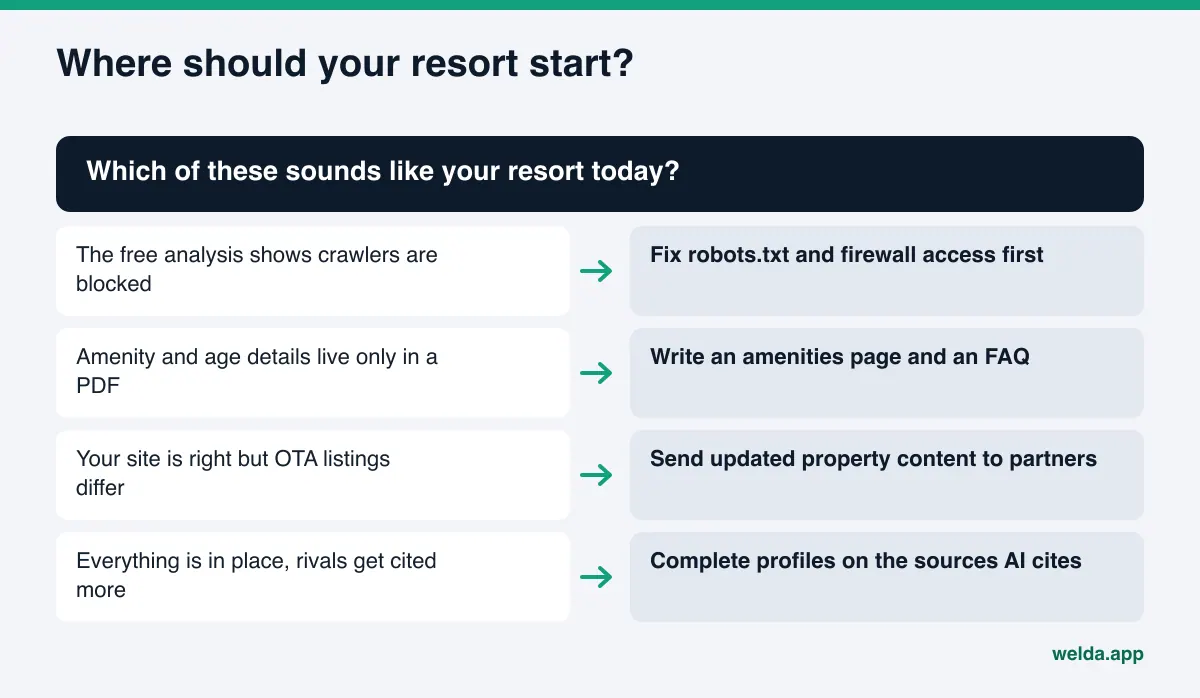
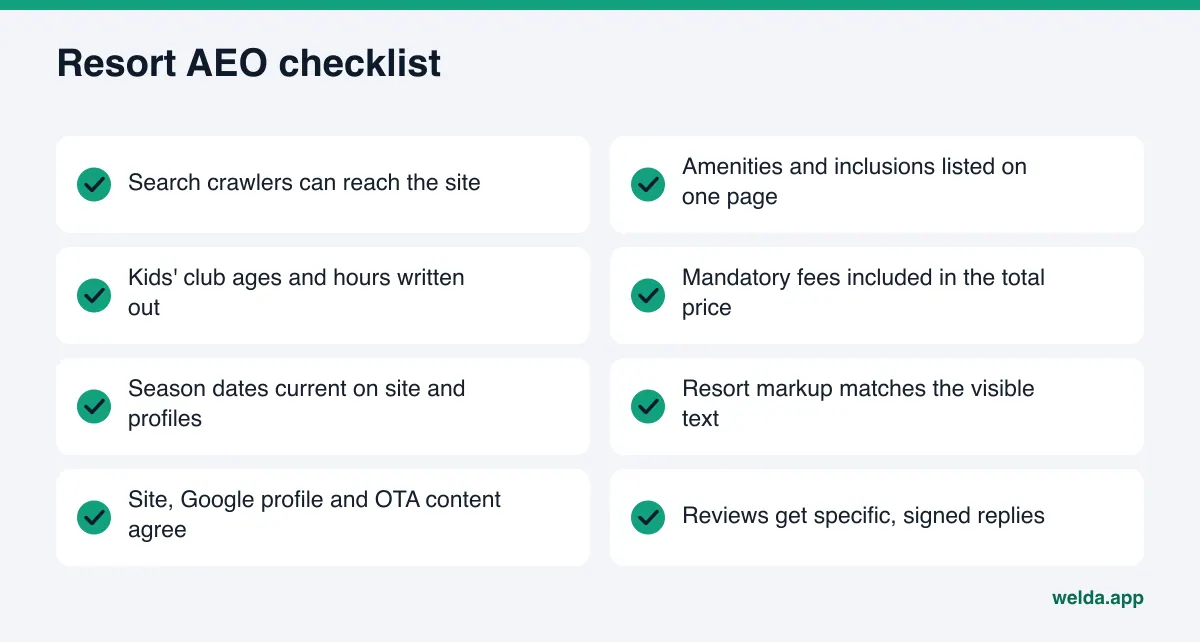
You can score your property quickly with the table below. Mark each row "in place," "missing" or "conflicting."
| Check | Where to look | Why it matters |
|---|---|---|
| Search crawlers can reach the site | robots.txt, firewall and CDN settings | A page AI cannot read cannot be cited |
| Amenities and inclusions on one page | Amenities or "resort experience" page | The most common condition in questions |
| Kids' club ages and hours written out | Family page, FAQ | Family questions need confirmation |
| Mandatory fees shown in the total price | Rate display, fee page, OTA listings | Fee questions are frequent and regulated |
| Resort markup present | Page source, business markup | Clarifies name, address and amenities |
| Season dates current everywhere | Site, Google profile, partner content | Old dates lead to wrong answers |
| Reviews get specific replies | Google, Tripadvisor, Yelp | Complaints can carry into AI answers |
The most important decision in AI search optimization for resorts is whether to start by writing or by measuring. If you have no measurement at all, start with the free analysis. It shows you what is missing instead of leaving you to guess.
Frequently asked questions
Is AEO for a resort different from regular hotel SEO?
The foundation is the same: readable, accurate, consistent information. The difference is that AI tools try to confirm individual conditions. Classic SEO looks at how a page ranks. AEO looks at whether your amenities, policies and fees are passed on correctly in the answer.
How do I fix wrong information on OTA listings?
You usually cannot edit the listing copy yourself, but you can update the property content you supply and request corrections. Welda's sources view shows which listings are cited most often, so you know where to start. The correspondence itself stays with your team.
Does the resort fee rule affect AI visibility?
Indirectly. Travelers ask AI tools about fees, and AI tools read your rate pages, OTA listings and reviews. If your total price is clear and consistent everywhere, the answer has less room for confusion. Pricing compliance is a legal matter; check it with your counsel.
Should we start in the off-season?
Yes, it is a good time. New content usually takes weeks to show up in AI answers, so updating your facts before peak booking season gives the changes time to be picked up.
Can Welda guarantee my resort will show up in ChatGPT?
No. No tool can guarantee that. Welda measures where you stand, shows the gaps and drafts the fixes. The engine decides which properties to recommend.
What do I need for the free analysis?
Your site address and a verified email and phone number. It is free once per site. The results link arrives by email and stays open for 14 days, and you can download a PDF.
See where your resort stands today
The more detailed a traveler's question, the more written facts matter for getting into the answer. When your amenities, kids' club ages, fees and season dates are written clearly, AI tools can confirm you more easily. To see where to begin, run the free AI visibility analysis. You get a score out of 100, the reason behind each gap, suggested copy for your homepage, a competitor comparison and a fix package you can add to your site, all in one report.