How do Los Angeles businesses get named in ChatGPT and Google AI answers? In Los Angeles, people rarely ask an AI assistant about "LA" as a whole. They ask about Silver Lake, Koreatown, the Valley or "near a Metro station." AEO for Los Angeles businesses means making sure the facts an AI needs to match you to those neighborhood questions (where you are, which areas you serve, how to get there and park, what you actually offer) are written down clearly on your site and your profiles. Start by measuring what AI can read about you today, then close the gaps one by one.
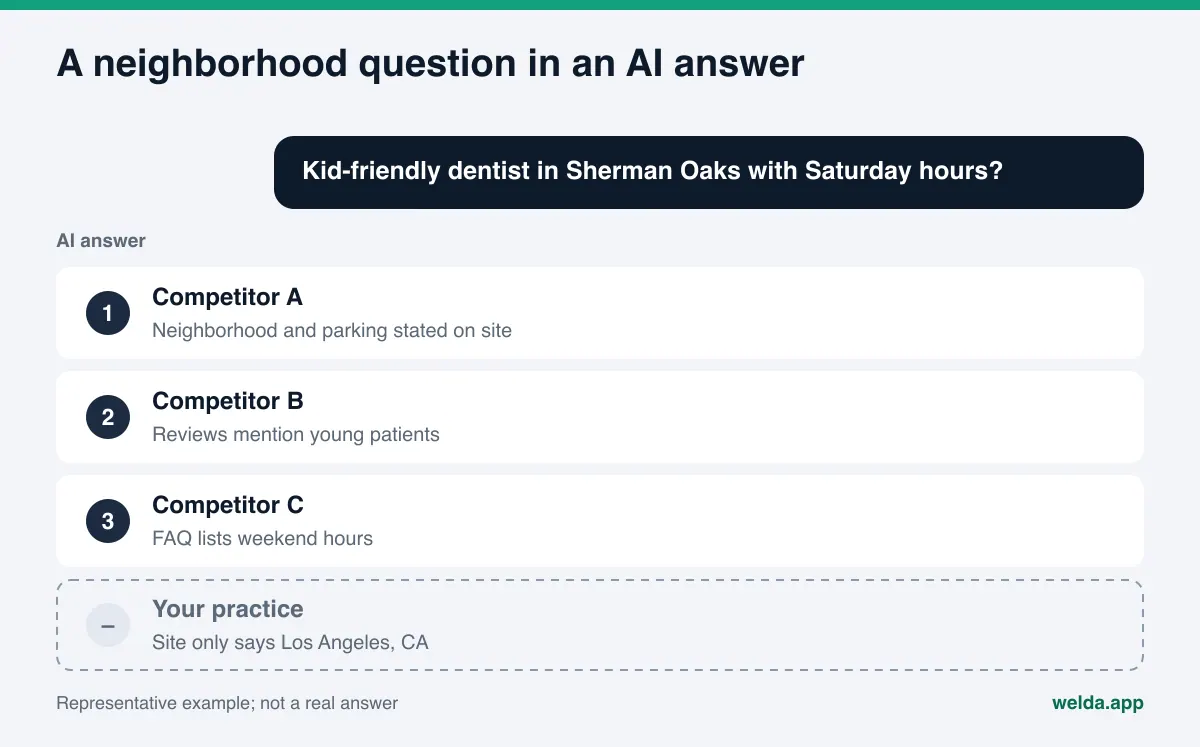
What is AEO for Los Angeles businesses, and why does it matter here?
AEO (answer engine optimization) is the work of getting your business named in the answers that ChatGPT, Gemini, Perplexity and Google's AI Overviews and AI Mode give to people. You will also hear it called AI search visibility, or GEO (generative engine optimization). They describe the same goal; in this guide we use AEO.
Classic search shows ten links and a map pack. An AI answer usually names three or four businesses with a sentence on each. If you are not one of those names, the customer may never scroll far enough to find you, because there is nothing to scroll.
Los Angeles makes this harder in a specific way. The metro area is huge, and it is not one city. Santa Monica, West Hollywood, Pasadena, Burbank, Culver City and Beverly Hills are separate cities, while Hollywood, Venice, Echo Park and Studio City are neighborhoods inside the City of Los Angeles. People rarely care about that distinction, but they do care about distance and traffic. Nobody in Highland Park wants a "great dentist in LA" if it means an hour on the 10. So the questions they type into an AI assistant tend to be local and specific:
- "Kid-friendly dentist in Sherman Oaks with Saturday hours"
- "Quiet coffee shop in Los Feliz where I can work for a few hours"
- "Plumber who serves the South Bay and can come today"
- "Korean barbecue in Koreatown with parking"
- "Pilates studio near Westwood that takes drop-ins"
These are examples we wrote to illustrate the pattern, not results from a study. The point is that each question carries a place, a need and often a constraint like hours or parking. An AI can only name you if it can find those same three things about your business in sources it reads.
AEO for Los Angeles businesses matters most for:
- Neighborhood businesses that live on local foot and car traffic: cafes, restaurants, salons, gyms, pet services.
- Appointment-based practices: dentists, physical therapists, med spas, tutors and consultants.
- Home service companies: plumbers, HVAC, cleaners, movers, landscapers. Which areas you cover decides whether you are a match at all.
- Professional and creative services that sell across the region, where the question is "who in LA does this" rather than "who is closest."
If you are not sure where to start, measure first. Welda's free site analysis reads your homepage and several inner pages the way Google and AI assistants do, and lists each gap it finds. It works in English. For the broader framework behind local work, see our guide to AEO for local businesses.
What do Los Angeles customers ask AI, and what does each answer rely on?
Questions fall into a handful of patterns, and each pattern is answered from a different piece of information. The examples below are illustrative.
| Question pattern | Example question | What the answer relies on |
|---|---|---|
| Neighborhood | "Nail salon in Echo Park open late" | Address, neighborhood name on the page, map pin, hours |
| Getting there | "Physical therapist near a Metro stop downtown" | Written directions, nearest station, parking details |
| Service area | "HVAC company that covers the San Fernando Valley" | A clear list of areas served |
| Fit and need | "Brunch in Silver Lake that's good with a stroller" | Plainly written amenities, words that appear in reviews |
| Comparison | "Best coding bootcamp in Los Angeles" | Reviews, local guides, how clearly you explain what is different |
| Trust | "Is this contractor legit?" | BBB, Yelp, Angi reviews and how you reply to them |
Look at the last column. Some of these facts are fully in your hands: your website and your Google Business Profile. Some are shared: customers write the reviews on Yelp or Angi, but you write the replies. Some belong to others: local "best of" lists and publications. The fastest path is to fix what you control first.
One more thing to know before you measure: the same question asked twice can produce a different answer. An assistant that names you on Monday may skip you on Tuesday. Judging your position from a single screenshot is misleading. We explain why in why AI answers change every time.
A step-by-step AEO plan for Los Angeles businesses
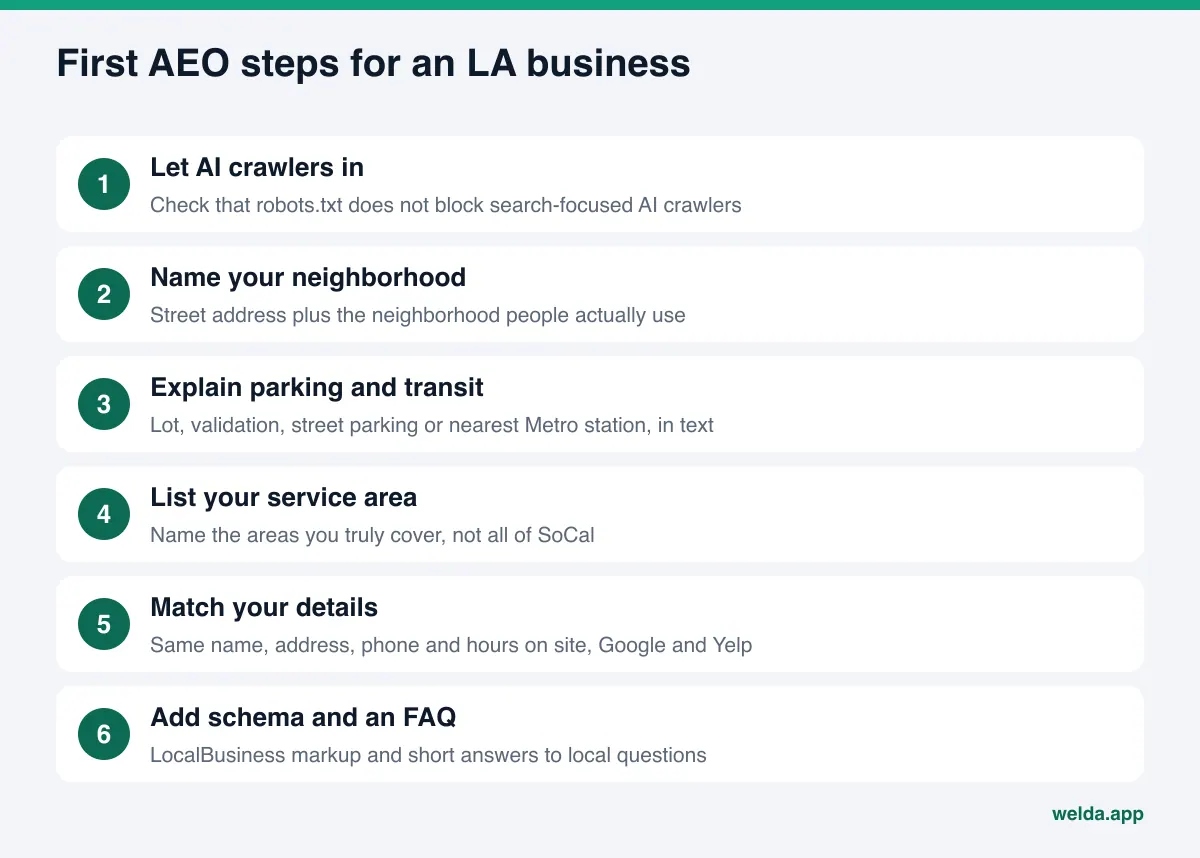
This sequence is something a small business can do on its own. Finish each step before moving on; most businesses can get through the first four in a few days.
- Make sure AI crawlers can reach your site. If robots.txt blocks search-focused AI crawlers, nothing on your site can make it into their answers. OpenAI's documentation describes OAI-SearchBot and GPTBot separately: the first is for surfacing sites in ChatGPT search, the second for model training, and each can be set independently. Our guide to robots.txt for AI crawlers walks through the settings.
- Write your neighborhood, not just your city. "Los Angeles, CA" tells an AI almost nothing. Name the neighborhood people actually use ("on Sunset Boulevard in Silver Lake") along with your street address.
- Explain parking and transit in text. In LA, parking is often the deciding detail. Say whether you have a lot, validated parking, street parking only, or a nearby Metro station. If this lives only in a map image, an AI cannot read it.
- List the areas you actually serve. If you go to customers, name the areas: "Westside, Culver City and the South Bay" is far more useful than "all of Southern California."
- Make your details match everywhere. Same name, address, phone and hours on your site, Google Business Profile, Yelp, Apple Maps and any directory you are listed in. Conflicts make an AI either skip you or repeat the wrong detail.
- Add LocalBusiness structured data. Business type, address, phone, hours and geo coordinates as schema markup on the site.
- Write an FAQ that answers local questions. "Is there parking?", "Do you serve Pasadena?", "Are you open Sundays?" Short, direct answers.
- Reply to reviews. Calm, specific, signed replies on Google, Yelp and the platforms that matter in your field. Replies are part of what gets read.
Google's own AI features do not add extra hoops. Google Search Central says a page only needs to be indexed and eligible to show with a snippet to appear as a supporting link in AI Overviews or AI Mode, and that no special optimizations are necessary. The steps above build that same foundation.
How to write location, parking and service area so AI can use it
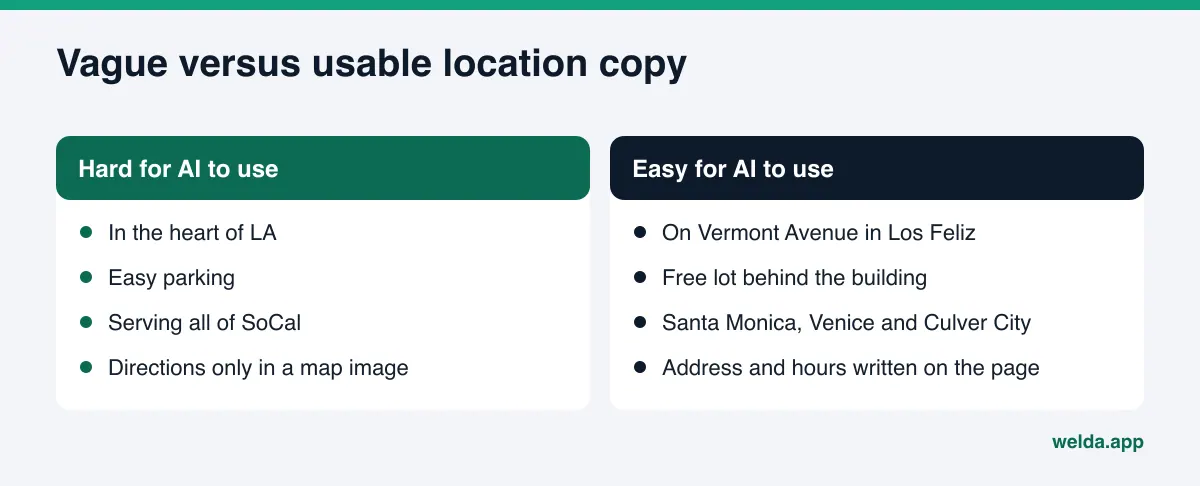
The most common gap we see in local AEO is vague location language. An AI needs a concrete sentence to carry into its answer. The table below puts weak and strong versions side by side. The examples are illustrative.
| Detail | Weak version | Strong version |
|---|---|---|
| Location | "In the heart of LA" | "On Vermont Avenue in Los Feliz, two blocks north of the Metro station" |
| Parking | "Easy parking" | "Free lot behind the building; two-hour street parking on side streets" |
| Service area | "Serving all of SoCal" | "Same-day service in Santa Monica, Venice, Mar Vista and Culver City" |
| Audience | "Something for everyone" | "Evening appointments until 8 p.m. on weekdays for people who work downtown" |
| Hours | "Open daily" | "Mon-Sat 9 a.m.-7 p.m., closed Sunday" |
Every strong version matches a question someone might actually ask. If a customer asks for a place "near the Metro in Los Feliz" and your site says "two blocks north of the Metro station," the assistant has a reason to name you. "In the heart of LA" gives it nothing to hold on to.
A warning: stuffing neighborhood names into a page does not work. A footer that reads "plumber Burbank plumber Glendale plumber Pasadena" adds no real information and reads badly. Name only the areas you truly serve, and say how you serve them. If you have more than one location, each one needs its own page with its own address and hours.
Which sources do AI assistants read for LA businesses?
Alongside your site, AI assistants read other sources. For a local business in Los Angeles, the ones that come up most are:
- Google Business Profile and Google Maps: category, hours, photos, reviews and your replies. Among the most used sources for neighborhood questions.
- Yelp: long-standing in LA for restaurants, salons and home services. Review wording often carries the details AI repeats.
- Industry platforms: Healthgrades and Zocdoc for medical practices, Angi and Thumbtack for home services, Tripadvisor for restaurants and attractions.
- BBB: often read for trust questions about contractors and service companies.
- Local guides and publications: "best of" roundups for neighborhoods. You cannot control them, but you can make sure your own facts are easy to confirm.
- Your own website: the one source you fully control. It should never contradict the others.
How much weight each source carries for your questions depends on your field and neighborhood, so it is worth measuring rather than guessing. If you want to understand how often you are named compared with competitors across those questions, our piece on AI share of voice explains the idea.
AEO priorities by business type in Los Angeles
The same checklist does not apply in the same order to every business. A cafe and a mobile HVAC company get very different questions, so the first fix differs too. The questions below are illustrative.
| Business type | Typical question | First thing to fix |
|---|---|---|
| Cafe or restaurant | "Coffee shop in Highland Park with outdoor seating" | Amenities, hours and parking written as text, not only in photos |
| Dental or medical practice | "Dentist in Studio City that sees kids on Saturdays" | Appointment hours, services list, parking and access |
| Home services | "Electrician who covers Long Beach" | A clear service-area list and how quickly you can come out |
| Fitness or wellness studio | "Yoga studio near Westwood with drop-in classes" | Class formats, drop-in policy, distance to campus or transit |
| Professional or creative service | "Post-production studio in Burbank for indie films" | A plain definition of what you do and who you do it for |
For professional and creative services, location matters less than a clear description of the work. The customer asks "who does this" rather than "who is closest." A service page that states what you do, for whom, and how a project runs will do more than a perfect address block.
How Welda handles AEO for a Los Angeles business
Welda does two things here: a free site analysis anyone can run today, and a dashboard that is in early access. Here are the parts that matter most for the neighborhood problem described above.
The free site analysis: can AI read your location and contact details?
The analysis reads your homepage plus inner pages like services, pricing, about and contact. For an LA business the key findings usually land in three places: whether your address, phone and location are readable; whether LocalBusiness structured data is present; and whether your map and social profiles are linked from the site. For every gap you see what was found, why it matters and how to fix it.
You also get ready-to-use copy for your homepage: title, description, main heading, intro paragraph and FAQs. If your site names your neighborhood and service area, the suggestions build on that; if not, it shows up as a gap. A simulation shows how much each fix would move your score, which helps you choose what to do first. A fix pack you can add to your site includes the structured data code, and the results come with a PDF and a shareable score card.
The analysis also asks five questions a customer might ask to an AI assistant that can search the web, and checks whether your business name appears in the answers. It is a one-time check: a first read on where you stand, not ongoing tracking. It does not measure rankings.
The dashboard: question-by-question tracking
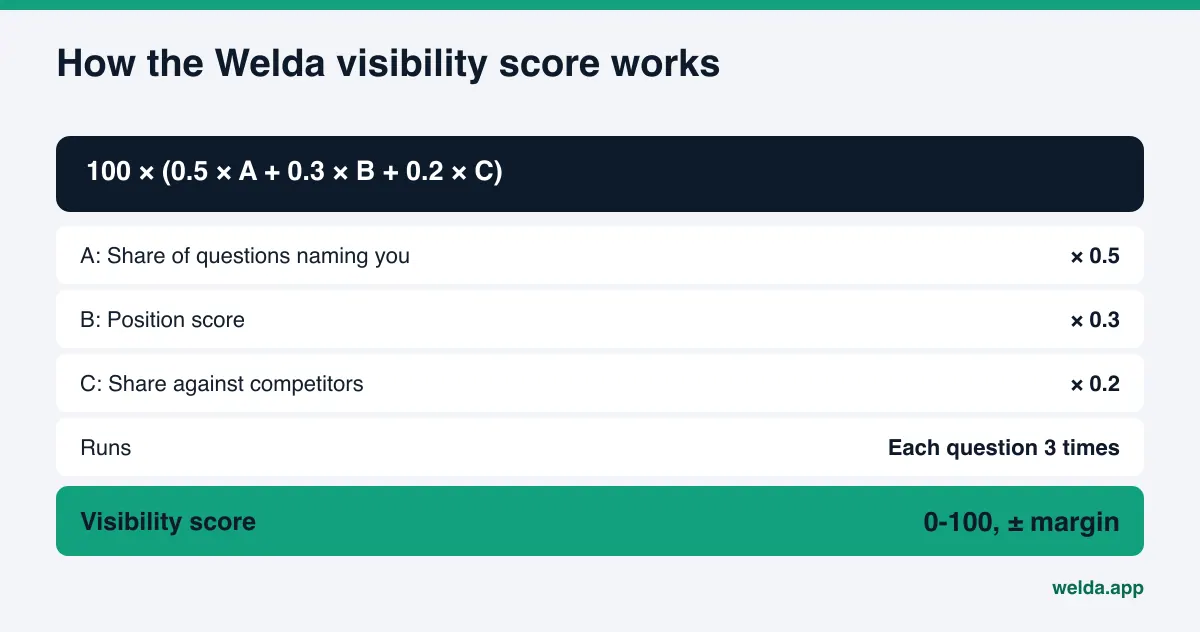
In the Welda dashboard, customer-style questions are asked to ChatGPT, Gemini, Perplexity and Google AI three times each. For a Los Angeles business, those questions would be built around neighborhoods and needs: "in Koreatown," "near a Metro station," "that serves the Valley." For each question you see which engines name you and in what position, and the competitors view shows who is ahead and which source they win from.
The useful decision here is pattern-spotting. If you are named for Silver Lake questions but never for nearby Echo Park, your site and profiles probably never connect the two. If a competitor wins every parking-related question, their Yelp reviews or site likely say something about parking that yours does not. The score formula is public, and the spread across three runs becomes a margin of error.
Fixes: Welda drafts, you approve
The to-do list puts missing facts, drafts waiting for approval and manual tasks in one place. Welda drafts page copy, profile text and review replies; publishing stays your decision. On WordPress, Welda connects through a separate Editor user and an application password, with no code to install: content opens as a draft on your site and goes live once you approve it. On other platforms Welda hands you a ready-made package to apply yourself. Google Business Profile, Instagram and Facebook can be connected; if they are not, the task is listed as manual. Content always lives on your own site. A before-and-after view and a one-page monthly report show whether changes reached your neighborhood questions.
Where things stand: the free analysis works in English and German. The full dashboard is in early access and is opening first in Turkey. Regular four-engine tracking is being added during early access, and sample dashboard screens use representative data. Pricing is discussed in an early access conversation.
Limits: what Welda does not do
- Welda does not guarantee rankings or that you will "show up in ChatGPT." AI answers vary, and the engine has the final say.
- The free analysis does not measure rankings. It checks how readable your site is and what information is missing.
- Welda does not invent facts. If it does not know which areas you serve or whether you validate parking, it asks you.
- Welda does not write fake reviews. The FTC's final rule announced in August 2024 bans fake reviews and testimonials, including AI-generated ones. Handling negative reviews, directory accounts and press outreach stays with you.
- Nothing sensitive goes live without your approval. In healthcare there is no automatic publishing at all, and patient data is not sent to AI.
- The compliance check flags patterns like price, guarantee and superiority claims before publishing. It is not legal advice.
- New content usually takes weeks to show up in AI answers. Do not expect next-day changes.
We also do not publish an "LA AI visibility rate" or neighborhood leaderboard. A number like that only means something for specific questions, specific engines and a specific date. The number that matters is the one measured on your own questions.
AEO checklist for Los Angeles businesses
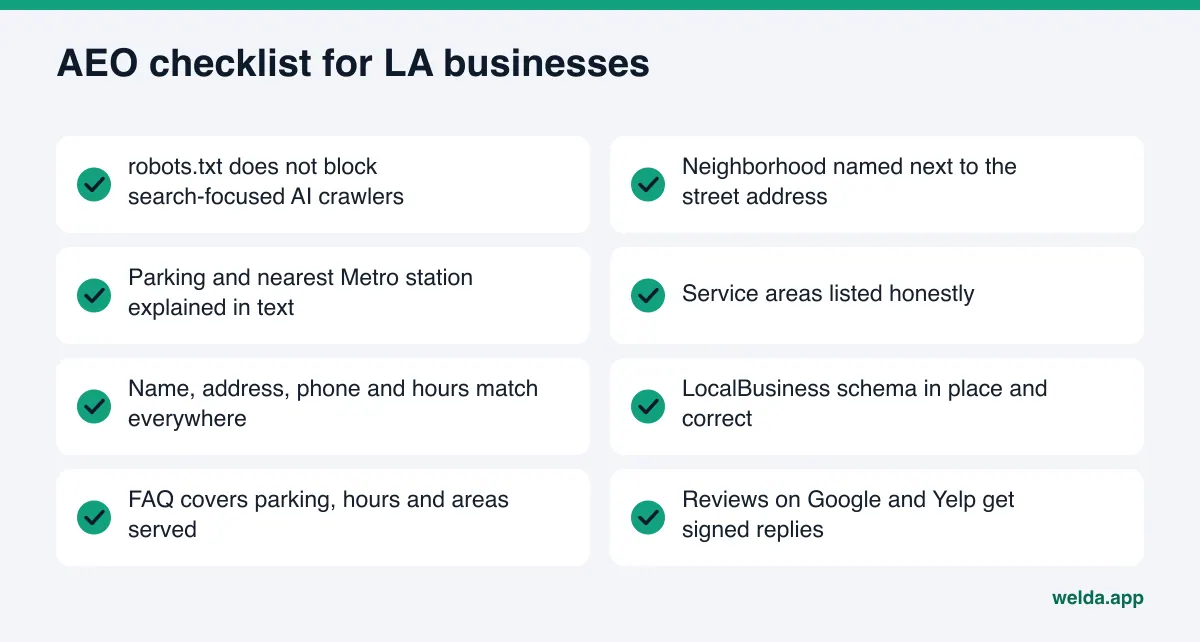
Use the list above while you review your site and profiles. If you can say yes to every item, the foundation is in place and the next job is measuring. A few decision points come up often:
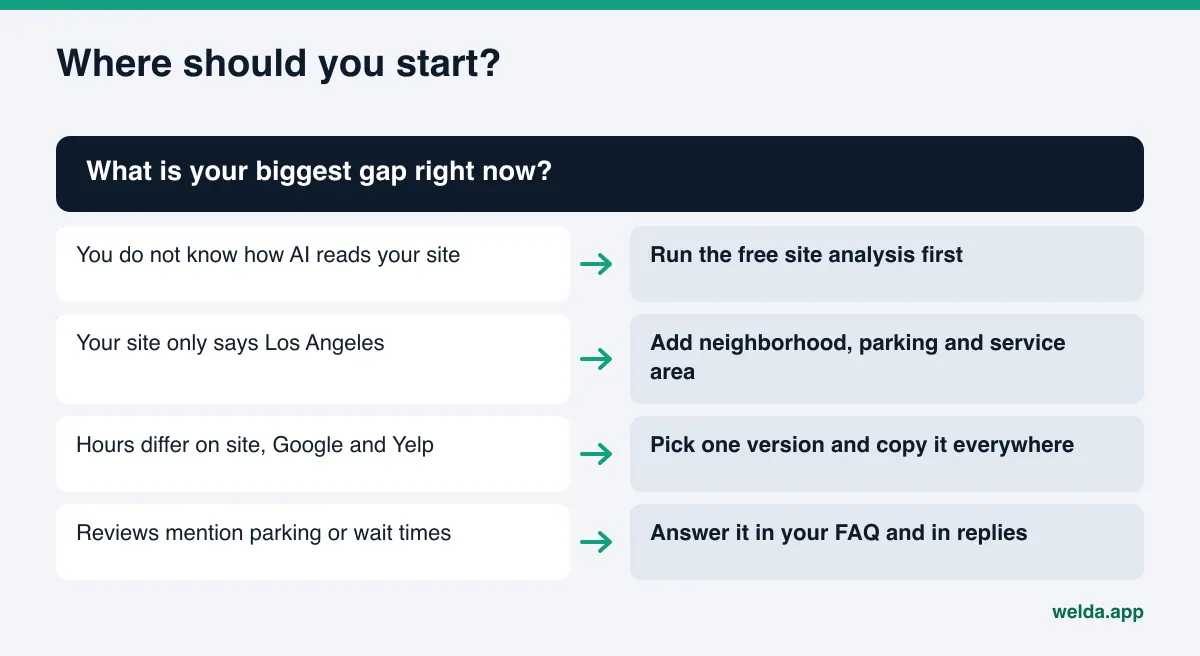
A single-location business with a small site can usually work through this list on its own; our guide to DIY AEO for small business owners covers that path. Multi-location businesses, or companies that cover many parts of the region, get more out of ongoing measurement. If you want to compare how this plays out in another dense market, see AEO for New York businesses.
Frequently asked questions
Is AEO for Los Angeles businesses different from AEO anywhere else?
The foundation is the same: a readable site, consistent facts, strong profiles. The difference is how people ask. In LA, questions usually name a neighborhood, a freeway corridor or a transit line, and parking matters, so concrete location and access details carry more weight.
My site says "Los Angeles." Isn't that enough?
Usually not. LA is spread out, and people ask by neighborhood. Without a neighborhood name, parking details and a service area, it is hard for an AI to match you to a local question.
Should I build a page for every neighborhood?
Only if you have a real location there or a service specific to that area. Cloning the same page with a different neighborhood name does not help. For home services, one clear service-area page with an honest list is usually enough.
Does the free analysis show my ranking in Los Angeles?
No. It does not measure rankings. It shows how Google and AI read your site, what is missing and how to fix it, plus a one-time check of five questions with an AI assistant that can search the web.
How long until changes show up?
New content usually takes weeks to show up in AI answers. Because answers vary from run to run, look at repeated measurement rather than a single result.
Can Los Angeles businesses use the Welda dashboard?
The dashboard is in early access and opening first in Turkey. The free site analysis works in English today, so any LA business can run it.
Start by measuring your site
The first step in AEO for Los Angeles businesses is measurement, not guessing. Is your neighborhood readable? Is your parking explained? Is your structured data in place? You can see all of this in a few minutes. Run the free site analysis; the results link arrives by email and stays open for 14 days. Then work through the checklist above, starting with the gaps that are easiest to close.