What does AEO for HVAC companies actually involve? When a homeowner asks ChatGPT, Gemini, Perplexity or Google's AI Overviews for an HVAC company, the answer is built from what is clearly written on your website, your Google Business Profile, review sites and directories: which jobs you do, which towns you cover, whether you can come out today, and how your pricing works. If that information only lives in phone calls, your name does not show up in the answer. This guide walks through the work step by step and shows which parts Welda handles for you.
Why AEO for HVAC companies matters now
AEO, short for answer engine optimization, is the work of getting your business named in AI-generated answers. You will also see it called AI search visibility, AI visibility, or GEO (generative engine optimization); they describe the same goal. In classic search, a homeowner sees ten blue links and maybe a map pack, calls two or three companies and compares. In an AI answer, they often see a short list of three or four names and start calling from the top. Showing up in that list is not a branding exercise. It decides whether your phone rings.
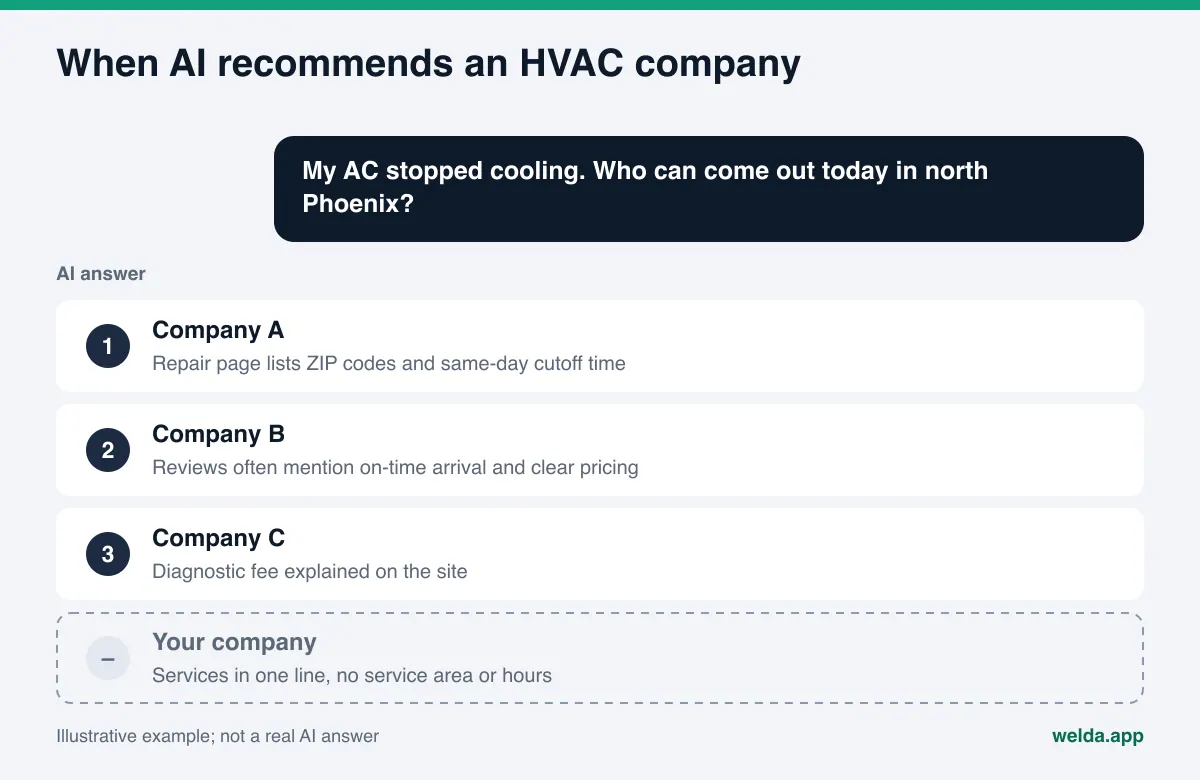
HVAC companies feel this shift differently from most local businesses because so much of the work arrives under pressure. When the AC quits on a hot afternoon or the furnace stops on a cold night, nobody spends an hour researching. They ask a quick question: "AC not cooling, who can come today in Mesa", "furnace blowing cold air, is it safe to wait until Monday", "HVAC company open Sunday near me". The assistant answers with a handful of names. If you are not one of them, you never get the call, no matter how good your techs are.
The second difference is trust. Homeowners let a stranger into the house and pay for work they cannot easily judge: refrigerant, capacitors, a new system that costs real money. So their questions carry doubt: "how do I know if my AC really needs refrigerant", "is a diagnostic fee normal", "should I repair or replace a 15-year-old system". AI assistants tend to favor businesses that address these concerns openly on their own pages.
The short version: HVAC companies that spell out their services, service area, hours and pricing logic get named. Those that do not are skipped, even if they do better work. The fastest way to see where you stand is to check your site as an AI system reads it. Welda's free site analysis reads your homepage and key inner pages (services, pricing, about, contact) and lists every gap it finds.
What homeowners ask AI about HVAC
Most HVAC questions combine three parts: a symptom or job type, a place, and a time or cost concern. "AC leaking water in the attic, who can come tonight in Plano", "how often should a heat pump be serviced", "average cost to replace a furnace, what affects the price". The assistant weighs each part separately. If it cannot find the symptom or job on your site, cannot confirm you serve that town, or sees nothing about timing or cost, it leaves you out.
The examples in this article are illustrative questions we wrote, not measured data. The best source for your own list is your phone log and text messages. Whatever a homeowner says in the first sentence of a call is roughly what they type into an AI assistant. For a full method, see our guide on how to find the questions customers ask AI.
Putting the questions into a simple table makes the next steps easier. Here is an example of how an HVAC company might group its list.
| Question type | Example question | What AI looks for |
|---|---|---|
| Urgent repair and location | AC repair today in north Phoenix | Repair page, towns or ZIP codes, same-day terms |
| Symptom | Furnace short cycling, what causes it | FAQ entries that explain common symptoms |
| Pricing logic | Is an HVAC diagnostic fee normal | How trip, diagnostic and labor charges work |
| Repair or replace | Should I replace a 15-year-old AC | How you assess systems and present options |
| Maintenance | When should I schedule an AC tune-up | Tune-up checklist, timing, duration |
| Trust | How to choose an HVAC contractor | Team, certifications, reviews, written estimates |
Each row should map to a page or an FAQ entry on your site. A single "Services" page listing "AC, heating, ductwork, maintenance" answers none of these questions.
What AI checks before naming an HVAC company
Before an assistant names a contractor, it cross-checks a few things. Does the website match the Google Business Profile? Do Yelp, BBB, Angi and other directories show the same name and phone number? What do reviews say? When those signals agree, the assistant names you with more confidence. When they conflict, for example one phone number on the site, another on Google and an old address on a directory, it may skip you or describe you with wrong details.
For HVAC companies, the details that matter most are:
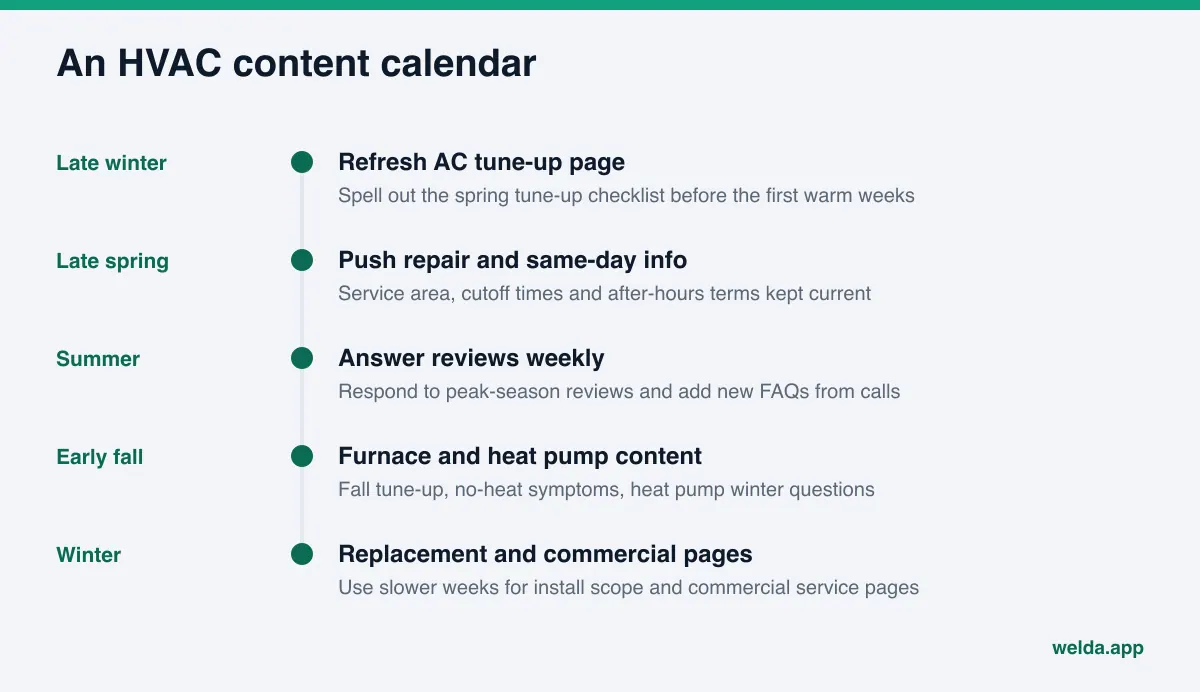
- Services and scope: AC repair, furnace repair, heat pumps, tune-ups, replacement, ductwork, indoor air quality, commercial work. What each one includes.
- Service area: the towns, counties or ZIP codes you cover. If you do not serve customers at your address, Google's service area help page says to remove the address and list service areas instead; it allows up to 20 areas and asks that they stay within about two hours of driving time from your base.
- Timing: business hours, after-hours and weekend availability, same-day cutoff.
- Pricing logic: you do not need to publish a price list, but explaining whether you charge a trip or diagnostic fee and how repair quotes are built goes a long way.
- Credentials, stated accurately: technicians who work on equipment that can release refrigerant must be certified under the EPA's Section 608 program. Saying your techs hold that certification, if they do, is a concrete trust signal. Do not imply a factory dealer or authorized status you do not have.
- Reviews and replies: reviews that mention punctuality, fixing it on the first visit and clear pricing, plus your replies to them.
Much of this lives off your site. We cover which sources AI assistants cite and how to show up there in how to get cited by AI.
AEO for HVAC companies: the step-by-step work
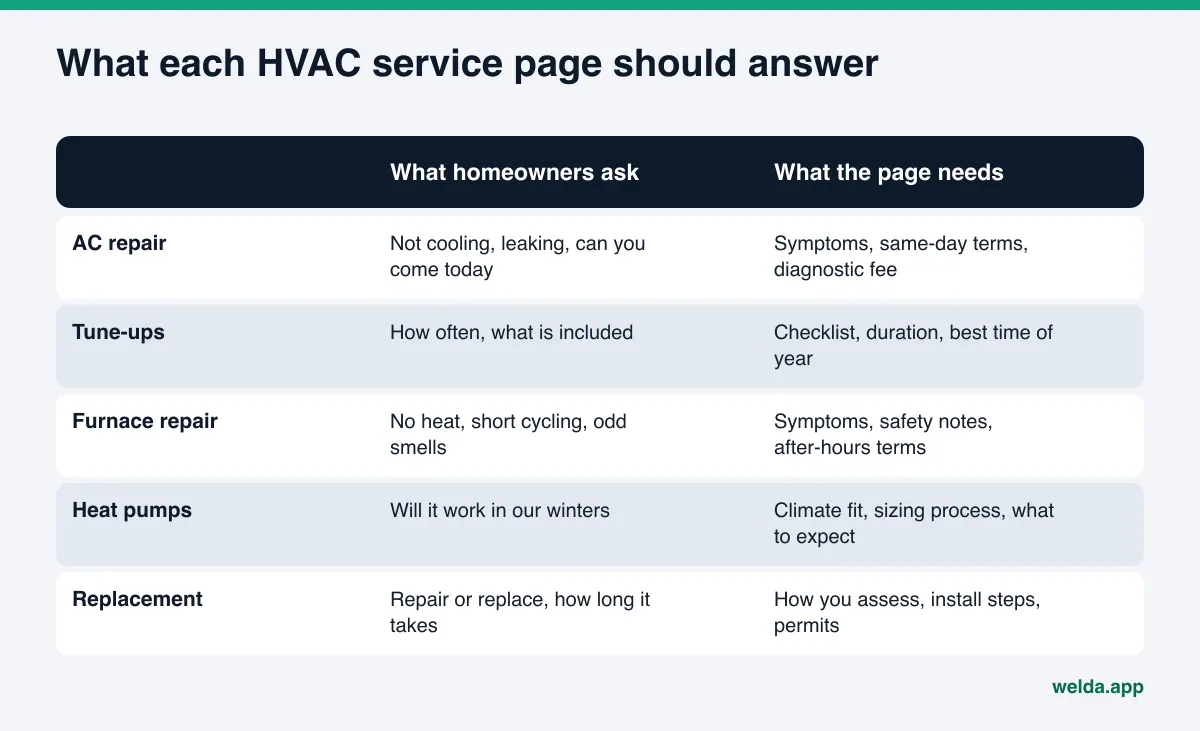
The steps below are things any HVAC company can do on its own. Order matters: questions first, then pages, then profiles, then measurement.
- Collect real questions. For two weeks, write down the first sentence of every call, text and web form. Group them by symptom (no cooling, leaking, noise, no heat), job type (tune-up, install, replacement) and town. Twenty to forty questions is enough to work with.
- Give each job its own page. Write separate pages for AC repair, furnace repair, heat pumps, tune-ups, replacement and commercial work if you do it. On each page, explain how the job is done, how long it takes, what is included and what the homeowner should do before you arrive. Replace lines like "quality service you can trust" with specifics like "a spring tune-up includes cleaning the condenser coil, checking refrigerant pressures and testing the capacitor".
- State your area and hours. List the towns or ZIP codes you serve. If you offer same-day service, say what the cutoff is. If you do not, say "usually next business day". Say whether you work nights and weekends.
- Explain how pricing works. You do not need numbers. Explain when a trip or diagnostic fee applies, whether it is credited toward the repair, and how you decide between repair and replacement. That answers the "how do I avoid getting ripped off" question better than any slogan.
- Write an FAQ section. Pick the eight to twelve most common questions from step one and answer each in two or three direct sentences.
- Mark up your business info. Use Schema to mark your name, phone, service area, hours and services. Schema.org has a dedicated HVACBusiness type.
- Align your profiles. Make sure your Google Business Profile, Yelp, BBB, Angi and any other directories you use show the same name, phone, services and area.
- Reply to reviews. Short, signed, specific replies, especially during peak season. We go deeper in review responses for AI visibility.
- Measure. Ask the same questions on a regular schedule and note whether your company is named.
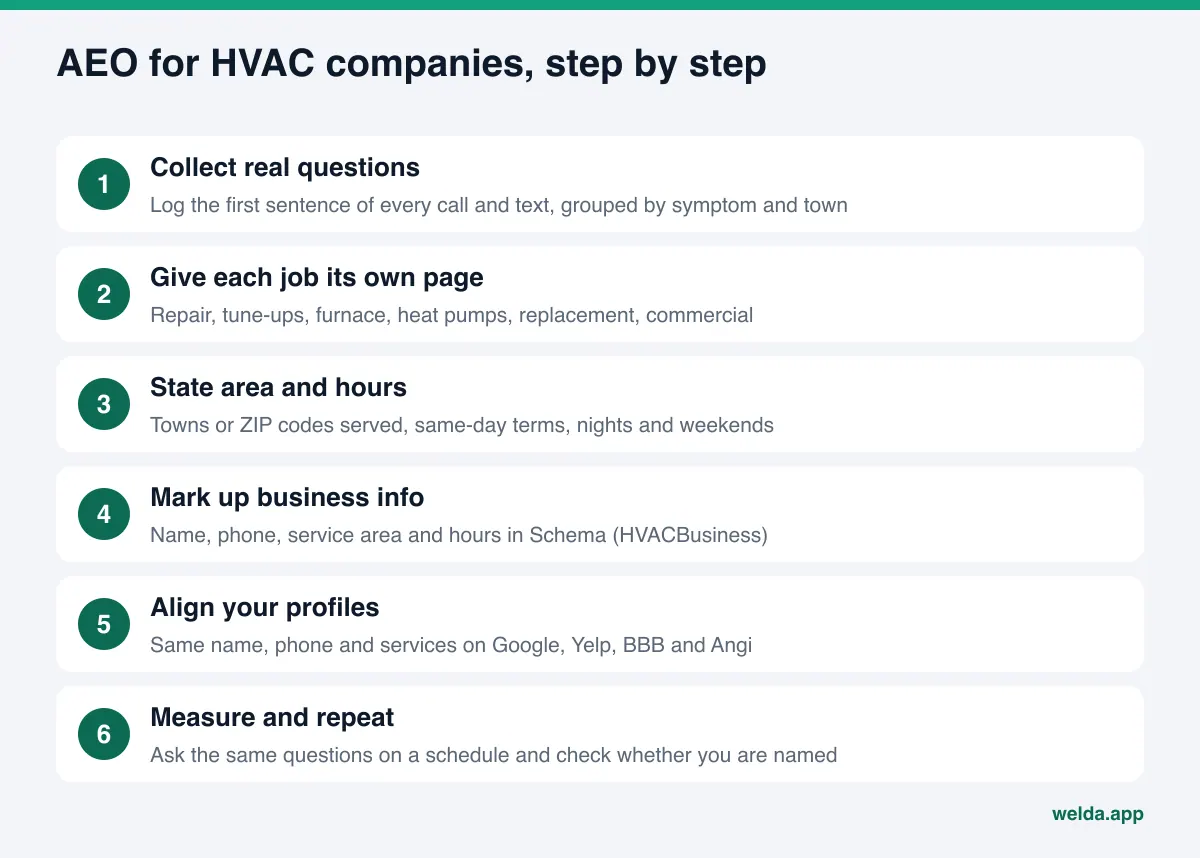
Timing matters in HVAC more than in most trades. New pages and profile updates usually take weeks to show up in AI answers. If you write your AC repair page when the first heat wave hits, you miss much of the season. Plan content around the calendar.
Common gaps on HVAC websites
A few problems show up again and again on HVAC sites. Run the free analysis to see which apply to you, or compare your site against the table below.
| Gap | Why it hurts | Fix |
|---|---|---|
| One-page site, services in a single line | AI cannot tell which jobs you take | A dedicated page per job type |
| Page title is only the company name | The title says nothing about service or location | Job type and area in the title |
| No service area listed | Location questions go unanswered | Town or ZIP list, matching your Google profile |
| Phone number only in an image | Machines cannot reliably read it | Phone as text and in Schema |
| No FAQ section | Symptom and pricing questions have no answer | Eight to twelve questions from real calls |
| AI crawlers blocked | Assistants cannot read the site at all | Check robots.txt |
| Profiles not linked from the site | Identity cannot be confirmed | Link profiles on the site and in Schema |
None of these require a big budget. Most are a few hours of writing and settings. The hard part is seeing clearly what is missing and finishing before the season starts.
How Welda handles AEO for an HVAC company
Welda is software that measures where a business appears in AI answers and fills the gaps on the business's behalf. For an HVAC company, three parts matter most: question-by-question tracking, source tracking, and a task list that comes with ready-to-use copy.
Question tracking: which questions name you? In the Welda dashboard, the questions your customers would ask, such as "same-day AC repair in Mesa", "how often to service a heat pump" or "is a diagnostic fee normal", are asked three times each in ChatGPT, Gemini, Perplexity and Google AI. For every question you see which assistant names you, in what position, and which sources the answer relied on. That split is useful for HVAC: if you show up for tune-up questions but never for urgent repair questions, the gap is probably your repair page, your hours or your service area.
The score uses an open formula: 100 × (0.5 × share of questions that name you + 0.3 × position score + 0.2 × share against competitors). Because each question is asked three times, the spread gives a plus-or-minus margin, so you can tell a real change from normal variation between runs.
Sources: where AI gets its information. For HVAC, AI answers often lean on your site plus Google Maps, Yelp, BBB, Angi and local news or forum threads. The sources view lists the sites the assistants cite and shows your status on each: complete profile, incomplete, or missing. If a competitor keeps getting cited from a directory where you have no listing, that becomes a task.
Tasks and ready-made copy: who does the work? Welda opens a task for every gap. Typical HVAC tasks: add same-day terms to the repair page, refresh the tune-up page before spring, add "how do I know if I need refrigerant" to the FAQ, complete the services list on Google Business Profile, reply to new reviews. Each task comes with draft copy. Welda does not invent facts. If it does not know whether you work weekends or which towns you cover, it asks and parks the task as missing information.
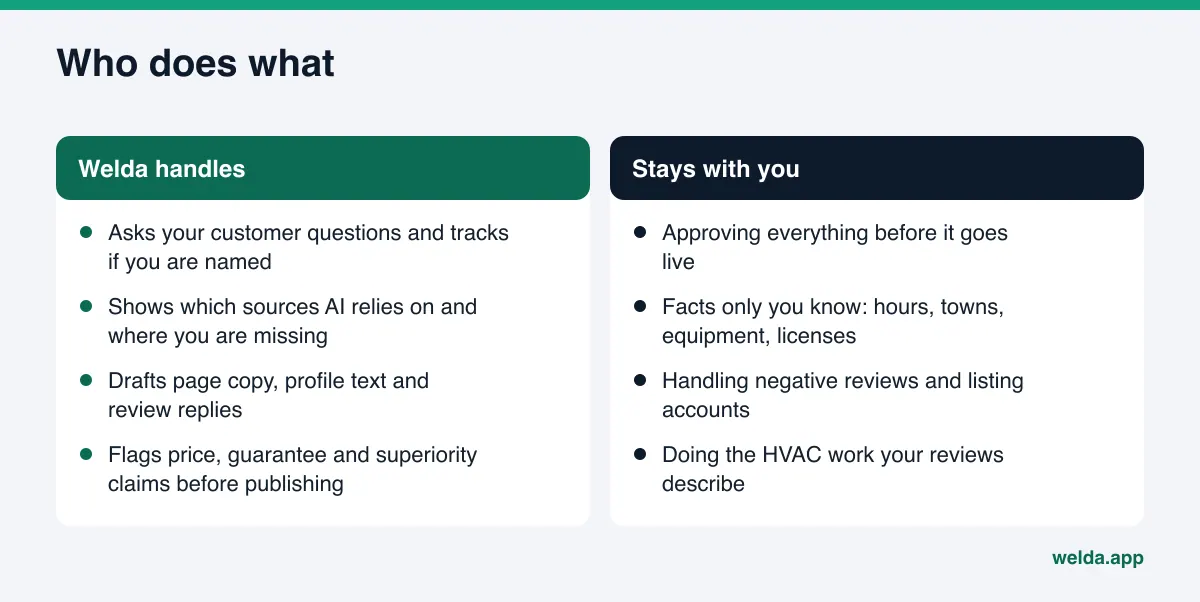
On WordPress sites, Welda connects through a separate Editor user and an application password you create, without installing code. Drafted pages open as drafts on your site and go live only after you approve them. Content always lives on your own site. On other platforms, Welda gives you a ready package and the changes are made by hand. Google Business Profile, Instagram and Facebook can also be connected; if they are not, the work is listed as a manual task.
Before anything is published, a compliance check flags price, guarantee and superiority claims such as "lowest price in town" or "guaranteed fix". This is not legal advice and has not been reviewed by a lawyer; it exists to put risky wording in front of you before it goes live.
An honest note on availability: the Welda dashboard is in early access and is opening first to businesses in Turkey. Regular four-engine tracking is being added during early access, and dashboard screens are shown with sample data. The free site analysis works in English today and is the part anyone can use. Pricing is discussed in the early access conversation.
What the free site analysis shows an HVAC company
The free analysis reads your homepage and a few inner pages and answers practical questions: can AI crawlers access your site, do your page title and description say what you do and where, is there business markup, are your address and phone machine-readable, are your Google and social profiles linked, is there an FAQ section, are your services clearly described, how fast does the page load.
You get a score out of 100, split into technical and content. For every gap you see what was found, why it matters and how to fix it. You also get suggested copy for your homepage title, description, main heading, intro paragraph and FAQ, a simulation of how much each fix could raise the score, a competitor comparison, a ready-to-install fix package that includes business markup, and a PDF plus a shareable score card.
The analysis also asks five customer-style questions to an AI assistant that can search the web and checks whether your business name appears in the answers. It is a one-time snapshot, not seasonal tracking. Each site gets one free analysis; email and phone are verified, and the results link arrives by email and stays open for 14 days.
Limits: what Welda does not do
- No ranking guarantee. Welda does not promise placement in ChatGPT or any other assistant. Nobody can; the answer is the engine's decision.
- No invented facts. Hours, towns, equipment and certifications come from you.
- No publishing without approval. You decide what goes live.
- No fake reviews. The FTC's rule on consumer reviews and testimonials prohibits buying or creating fake reviews. Welda helps you ask for and reply to real ones.
- Some work stays with you. Handling negative reviews directly, opening directory accounts and press work remain with the business.
- Results take time. New content usually takes weeks to show up in AI answers.
Licensing, permits and code compliance are your responsibility and outside what Welda does. If your site mentions a license or certification, make sure it is current. This article is not legal advice.
HVAC AEO checklist and decision guide
Use this list to check whether your site and profiles are ready for the questions homeowners ask AI. A broader version is in our AEO checklist.
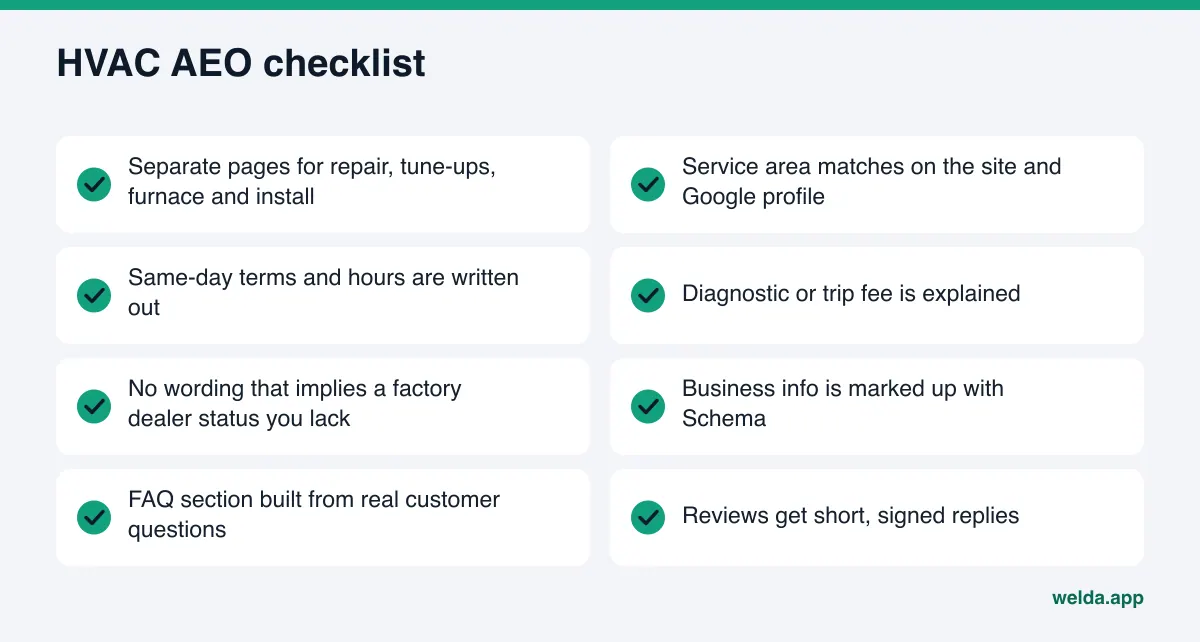
Should you do this yourself or use a tool? Ask one question: will you have time before the season to write the pages, align the profiles and check your questions regularly? If yes, the steps above are enough. If not, or if you want to see results tracked over time, a tool that measures and drafts copy shortens the work. Other home service trades face the same problem; see how we approach it in AEO for cleaning services and how landscaping companies get recommended by ChatGPT.
Frequently asked questions
Is AEO for HVAC companies different from local SEO?
The basics overlap: clear titles, a fast site, accurate business info. The difference is that an AI assistant picks a few companies inside a single answer. Pages that directly answer symptom, location and timing questions, backed by consistent profiles, have the edge.
Can I show up in ChatGPT if I am not a factory-authorized dealer?
Yes. AI assistants name companies that clearly describe their work and area. What matters is not implying a status you do not hold. State honestly which types of equipment you service.
Do I have to publish prices?
No. But explaining how pricing works, such as when a diagnostic fee applies and how repair quotes are built, helps with cost questions and builds trust.
How early should I prepare for the cooling season?
New content usually takes weeks to appear in AI answers, so repair and tune-up pages should be ready several weeks before the first hot spell. The same applies to furnace and heat pump content before winter.
Does Welda publish content directly to my site?
Welda drafts it; you approve it. On WordPress, content opens as a draft and goes live after approval. Other platforms get a ready package that is applied by hand.
What does the free analysis cover?
It reads your site, gives a score out of 100, lists gaps and fixes, suggests homepage copy and checks whether your name appears when five customer questions are asked to an AI assistant. The results link stays open for 14 days.
Can I sign up for the Welda dashboard in the US?
The dashboard is in early access and opening first in Turkey. The free site analysis is available in English today.
See where your HVAC site stands before the season
AEO for HVAC companies comes down to writing your good work in a form machines can read: what you fix, where you go, when you can come and how you price. The first step is knowing where you stand. Run the free site analysis and get your score, your gaps and suggested homepage copy in a few minutes.