How do landscaping companies get recommended by ChatGPT? AI assistants recommend a landscaper when they can clearly read what services you offer, which towns or ZIP codes you serve, what you do in each season, and what real customers say about you. When that information is consistent across your website, your Google Business Profile, and review sites like Yelp and Angi, your odds go up. When it is vague or contradictory, the answer names someone else.
Homeowners used to type "landscaper near me" and scroll a map. Now many of them ask a full question instead: "Who can redo my backyard with pavers and drip irrigation in the suburbs north of Dallas?" ChatGPT, Gemini, Perplexity, and Google's AI Mode answer with a short paragraph and a handful of company names. That shift is what answer engine optimization (AEO) is about: making sure the information an AI system needs to recommend you is easy to find and easy to trust. This guide walks through what a landscaping or lawn care company should prepare, step by step, and how Welda measures and fills those gaps. If you want a quick read on where your own site stands first, the free AI visibility analysis takes a few minutes.
Why AI search visibility matters for landscaping companies
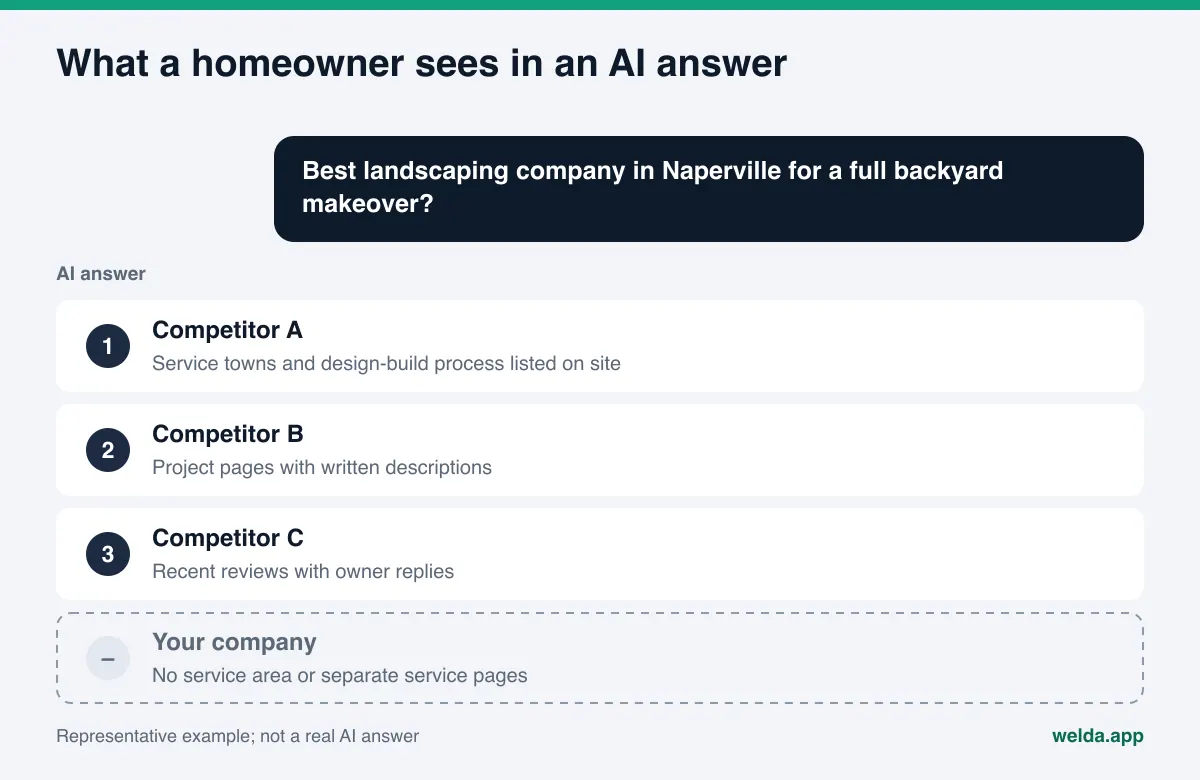
Landscaping is a considered purchase. A full yard redesign, a paver patio, a retaining wall, or a sprinkler system costs real money and changes how a home looks for years. People research before they call, and a growing share of that research now happens inside AI assistants. The questions tend to be specific. Here are examples of the kind of prompts a landscaping customer might type. We wrote these as illustrations; they are not quotes from a dataset:
- "Best landscaping company in Naperville for a full backyard makeover"
- "Who installs drip irrigation for xeriscape yards in Scottsdale?"
- "Lawn care company that also does fall aeration and leaf cleanup near Columbus, Ohio"
- "Licensed landscaper for a retaining wall on a sloped yard, Charlotte area"
- "Commercial landscape maintenance contract for an HOA in Tampa"
Every one of these combines a service, a place, and often a trust signal ("licensed," "best," "reliable"). An AI assistant answering them usually does not show ten blue links. It picks a few names and explains why. If your company is not among them, the homeowner may never see you. In classic search, ranking fifth on a page still left you a chance. In an AI answer, not being mentioned usually means you were not part of the decision at all.
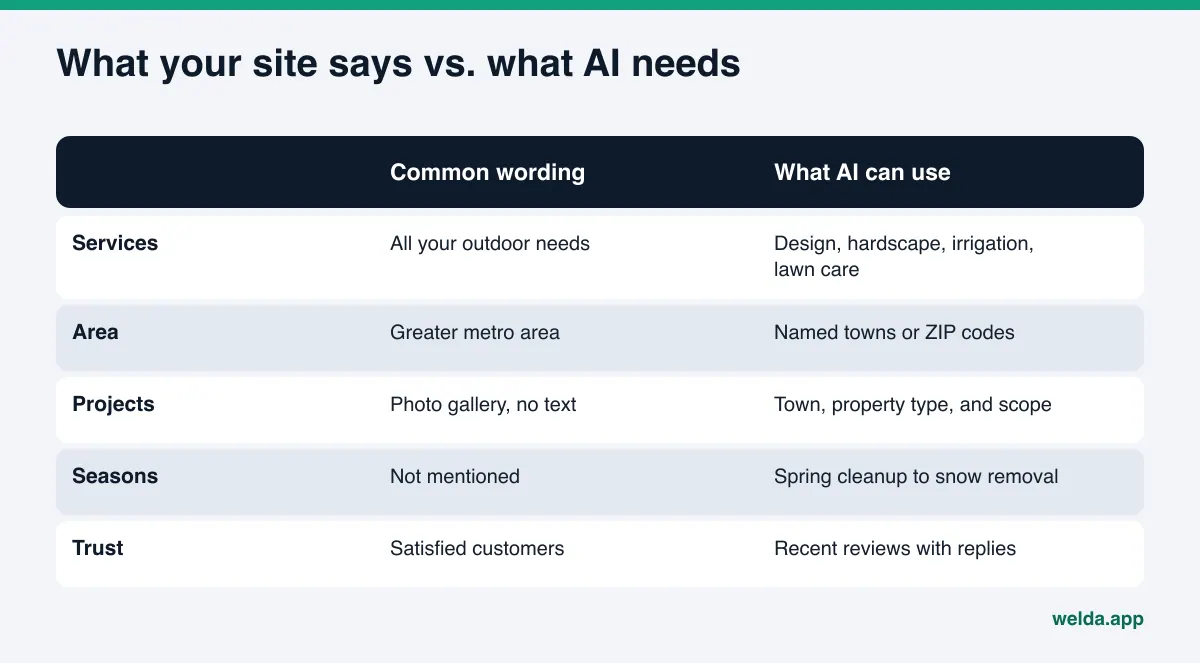
Landscapers face one extra hurdle: most of you work at the customer's property, not at a storefront. That makes your service area the single most important fact for local prompts. A site that only says "serving the greater metro area" gives an AI system very little to match against "near Columbus" or "in Scottsdale."
What AI assistants look for before recommending a landscaper
AI systems that can search the web read several sources and then summarize. For a landscaping company, the summary usually rests on the signals below. If you think in terms of AEO, these are the facts you want to be easy to quote.
| Signal | Where it lives | What happens if it is missing |
|---|---|---|
| Specific services (design, hardscaping, irrigation, lawn care, tree work) | Separate service pages, profile description | You get matched to generic "yard work" and skipped for specific prompts |
| Service area (cities, suburbs, ZIP codes) | A service-area page, Google Business Profile service areas | You disappear from "near [town]" prompts |
| Seasonal services | A seasonal page or FAQ | No proof that you handle fall cleanup or snow removal |
| Project examples | Project pages with written descriptions | The AI cannot tell what kinds of yards you work on |
| Reviews and trust signals | Google, Yelp, Angi, Nextdoor, BBB, Houzz | You lose ground on "reliable" and "best" prompts |
| Licensing and insurance, where it applies | About page, footer, profiles | "Licensed landscaper" prompts favor competitors who state it |
| Contact details and business markup (Schema) | Every page, structured data | Name, phone, and area look different across sources and trust drops |
No single row is enough on its own. A beautiful photo gallery does little if none of the images say what was built and where. A five-star Google rating helps, but if your site never mentions irrigation, an AI system has no reason to recommend you for a sprinkler question. The goal is a consistent, readable story told in several places.
You may also see the term GEO (generative engine optimization) used for the same work. In the US, AEO and "AI search visibility" are the more common names; the checklist is the same.
How landscaping companies get recommended by ChatGPT: a step-by-step plan
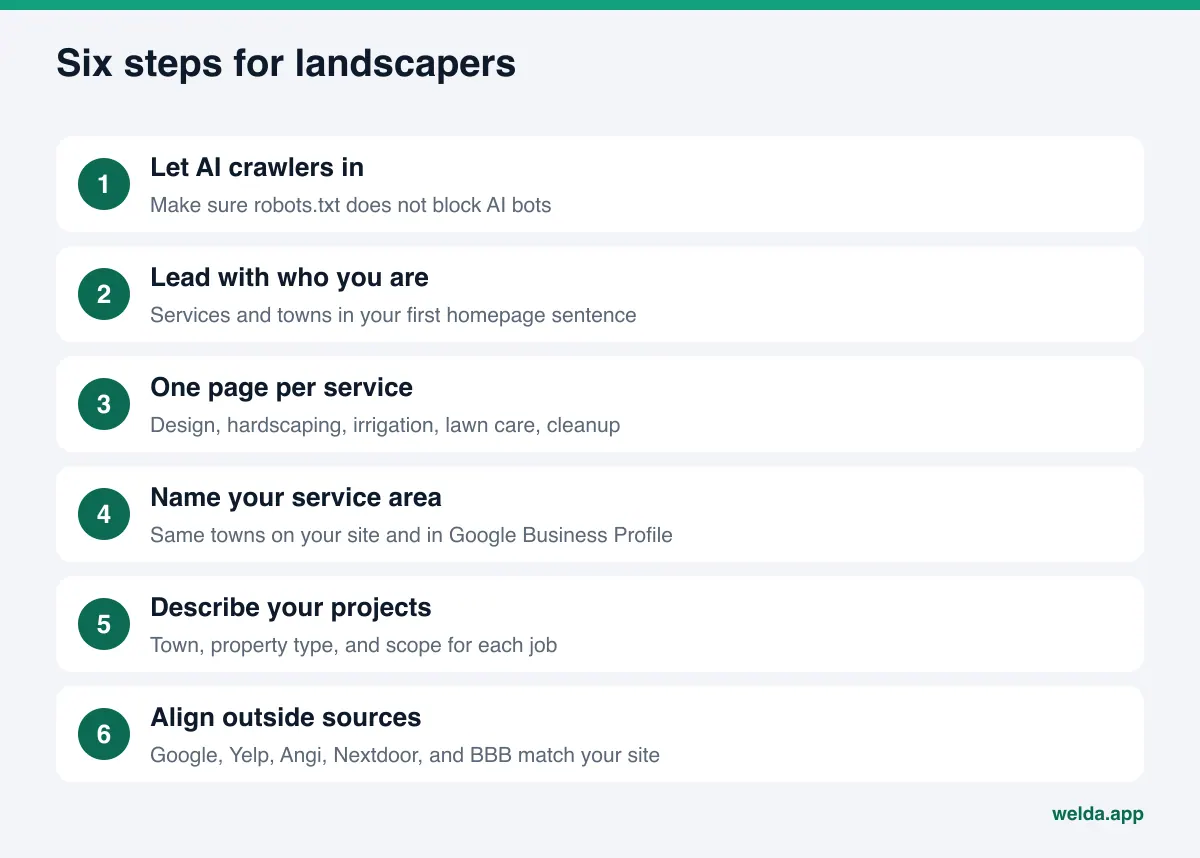
The steps below assume you have a website and a Google Business Profile. Order matters: first make sure AI crawlers can read your site, then fix the content, then align outside sources.
- Check that AI crawlers can access your site. If your robots.txt file blocks AI bots, nothing you write will be read. Some security plugins and site builders block them without making it obvious.
- Say who you are in the first sentence of your homepage. "We design, build, and maintain residential landscapes in Naperville, Aurora, and Wheaton, including paver patios, irrigation, and weekly lawn care" beats a tagline like "Bringing your outdoor dreams to life."
- Give each core service its own page or section. Landscape design, hardscaping, irrigation, sod and seeding, tree and shrub care, seasonal cleanup, maintenance contracts. Describe what the job includes, how long it usually takes, and what drives the price.
- Publish your service area by name. List the towns, suburbs, or ZIP codes you actually serve. Use the same list in your Google Business Profile.
- Write short descriptions for your projects. "Example: front yard redesign with native plants and a flagstone path in Wheaton" tells an AI system the job type and the location at once.
- Add an FAQ section built from real customer questions. When is the best time to lay sod? How long does a sprinkler install take? What is included in a maintenance contract? Do you charge for estimates?
- Add business markup (Schema). Name, phone, service area, hours, and services should exist in structured data that machines can read.
- Align outside sources. Your Google Business Profile, Yelp, Angi, Nextdoor, BBB, and Houzz listings should match your site. Ask real customers for reviews and respond to them.
None of this works overnight. New content usually takes weeks to show up in AI answers. But when the order is right, each step builds on the last. We cover similar roadmaps for other home service trades in how plumbers get recommended by ChatGPT and how locksmiths get recommended by ChatGPT. The difference with landscaping is that the work is planned, not urgent, and it follows the seasons.
Service areas and seasons: the two details landscapers usually miss
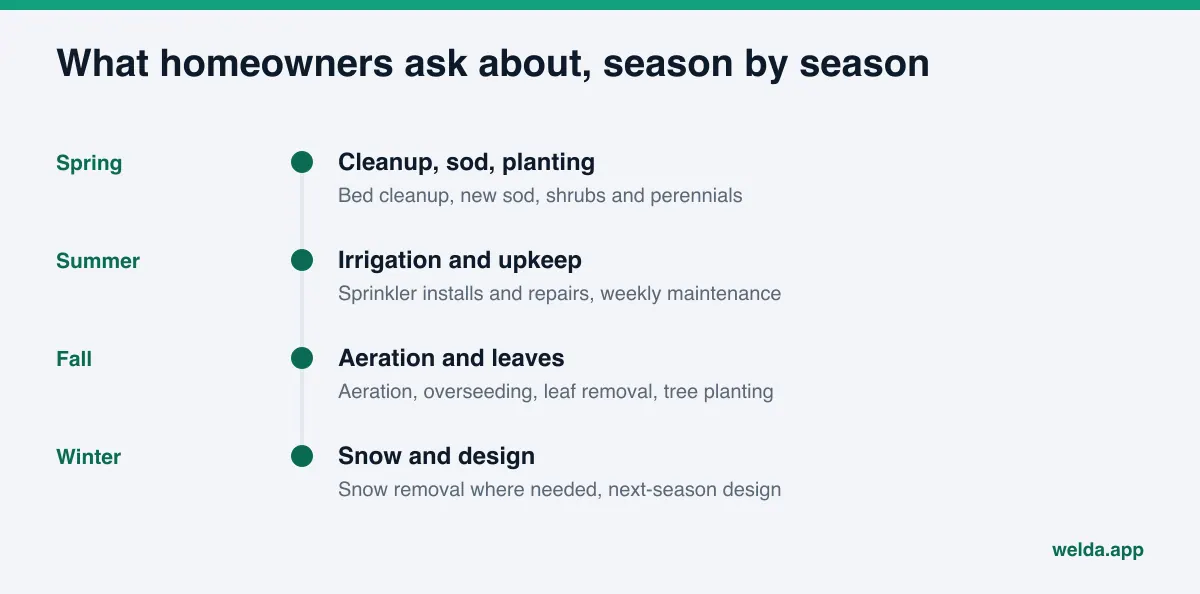
What sets landscaping apart from most home services is that the work changes through the year, and the right answer depends heavily on region. In the Midwest and Northeast, spring cleanup, mowing season, fall aeration, leaf removal, and winter snow removal make up the calendar. In the Southwest, the conversation is more about water-wise design and drip irrigation. Homeowners ask about the job in front of them right now. If someone asks in October about "aeration and overseeding near Columbus" and your site never mentions it, an AI system has nothing to cite.
A short seasonal section on your site solves this. For each season, write two or three sentences on what you do and why that timing matters in your area. It is useful for customers and gives AI systems clear evidence of every service you offer.
On service areas, Google has specific rules. If you do not serve customers at your business address, Google asks you to remove the address from your profile and list service areas instead. According to Google's help page on service-area businesses, you can add up to 20 service areas, and the overall area should not extend more than about two hours of driving time from your business. Keep that list identical to the one on your website, so an AI system can confirm your coverage from two sources. Inconsistent locations are a common reason AI answers get details wrong; see wrong address or phone number in AI answers for how to fix them.
Be honest about the edges of your area. If you only take large projects in outlying towns, say so: "In Plainfield and Oswego we take design-build projects only, not weekly mowing." That note keeps AI systems from sending you calls you do not want, and a good match is worth more than a wrong lead.
Project pages, reviews, and trust: where AI systems get convinced
Homeowners want to see what you have built. AI systems ask the same question in their own way: is there readable evidence of this company's work? Three places matter most.
Project pages. For each project: the town, the type of property (single-family home, HOA common area, commercial site), what you did, and how long it took. You do not need to name the client. Written description turns a gallery into something an AI system can actually quote.
Reviews. Google reviews, Yelp, Angi, Nextdoor recommendations, and BBB profiles all feed into "reliable landscaper" prompts. When you ask for a review, it is fine to ask customers to mention the service and the town: "They installed drip irrigation in our backyard in Mesa" carries far more information than "great job." Calm, specific replies to critical reviews are also a trust signal.
Licensing and insurance. Requirements vary by state and by the kind of work. If your state requires a license for the services you offer, or if your team holds pesticide applicator certification, say so on your site and in your profiles. Only state what is true and current.
A word of caution on shortcuts. The Federal Trade Commission's final rule on fake reviews and testimonials, announced in August 2024, bans fake reviews, including AI-generated ones, as well as buying reviews that express a particular sentiment and suppressing negative reviews through threats or intimidation. Real reviews from real customers after real jobs are the only durable path. This is general information, not legal advice.
How Welda handles AEO for a landscaping company
Welda is software that measures where a business shows up in AI answers and fills the gaps on the business's behalf. For a landscaper, it works in two parts.
Available to everyone today: the free site analysis. You enter your website, and Welda reads your homepage plus a few inner pages such as services, about, and contact, the way Google and AI systems would. The findings that matter most for landscapers are usually these: whether each service is clearly described, whether your phone, address, and service area appear on the page and in business markup, whether your map and social profiles link to the site, and whether you have an FAQ section. For each gap, it shows what it found, why it matters, and how to fix it. It drafts a homepage title, description, main heading, intro paragraph, and FAQs that you can compare against your own wording. A simulation shows which fixes would raise your score the most, and a competitor comparison shows where competitors are ahead. It also asks five questions a customer might ask to an AI assistant that can search the web, and checks whether your company is named in the answers. That is a one-time snapshot, not ongoing tracking. The free analysis works in English.
In early access: the Welda dashboard. The full dashboard is in early access and is opening first in Turkey. Regular tracking across four AI engines is being added during early access, and sample screens are shown with representative data. Price is discussed in the early access conversation. Two parts of the dashboard matter most for a landscaping company.
The first is prompt-level tracking. Each customer question, such as "landscaper for paver patios near Wheaton" or "irrigation repair company in Aurora," is asked to ChatGPT, Gemini, Perplexity, and Google AI three times each. You see, engine by engine, whether you are named and in what position. A typical pattern for a landscaper looks like this: you show up for broad "landscaping company" prompts on one or two engines, but not for irrigation or hardscaping prompts. That points straight to the service page you are missing. You also see which sources the answer leaned on, so if a competitor wins because of a strong Houzz or Angi profile, it is visible. For choosing which prompts to watch, see prompts to track for AI visibility.
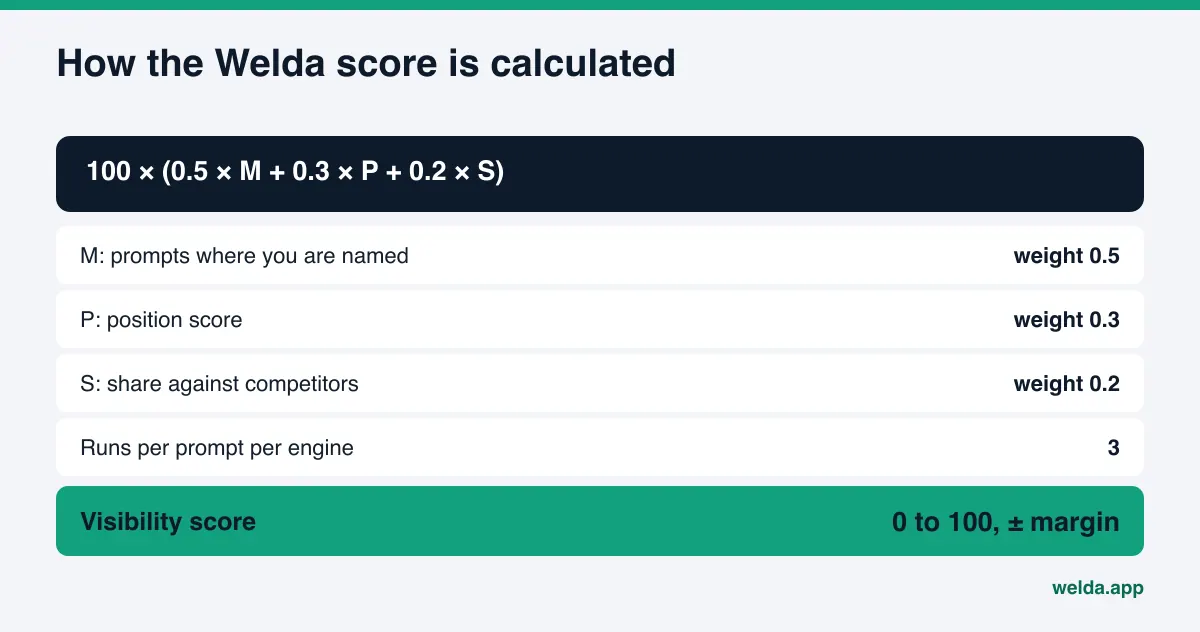
The score is not a black box. It is 100 × (0.5 × the share of prompts where you are named + 0.3 × position score + 0.2 × share against competitors). The spread across the three runs gives a ± margin of error, so you can tell normal fluctuation in AI answers from a real change.
The second is the task list. Everything the measurements turn up lands in one list, and for a landscaper it usually holds three kinds of work. First, facts Welda could not read on your site, such as which towns you cover, what a maintenance contract includes, or whether estimates are free. Welda does not guess; it asks you and uses your answer everywhere. Second, ready drafts waiting for your approval, like an irrigation service page or an FAQ section. Third, manual tasks, such as updating service areas in your Google Business Profile or fixing an old phone number on a directory, each with the text ready to paste.
If your site runs on WordPress, Welda connects through a separate Editor user and an application password, with no code to install. Drafts open on your site as drafts and go live only when you approve them. Content always lives on your own site. For other platforms, Welda gives you a ready package to apply manually. Google Business Profile, Instagram, and Facebook can be connected; if they are not, the related task stays in the list as manual. Before anything goes live, a compliance check flags patterns like price claims, guarantees, and superiority claims. It is a warning layer, not legal advice. A monthly one-page report and a before-and-after view show what changed.
What Welda does not do
AI search visibility attracts a lot of big promises, so it is worth being plain about the limits:
- No ranking guarantees. Nobody controls how AI engines answer. Welda measures, fills gaps, and shows change over time.
- No made-up facts. If your service area, pricing approach, or warranty terms are not on your site, Welda asks you rather than inventing them.
- No publishing without approval. Every piece of content waits for your sign-off.
- No fake reviews. Welda can draft review replies. The reviews themselves have to come from real customers.
- Some work stays with you. Handling negative reviews, setting up directory accounts, and press outreach remain your team's job.
- No overnight results. New content usually takes weeks to show up in AI answers.
That means part of the job will always sit with you: photographing projects, asking customers for reviews, deciding where you actually want to work. Welda's role is to show which of those pieces are missing, why they matter, and in what order to tackle them, and to draft the text.
Should you start with a one-time check or ongoing tracking?
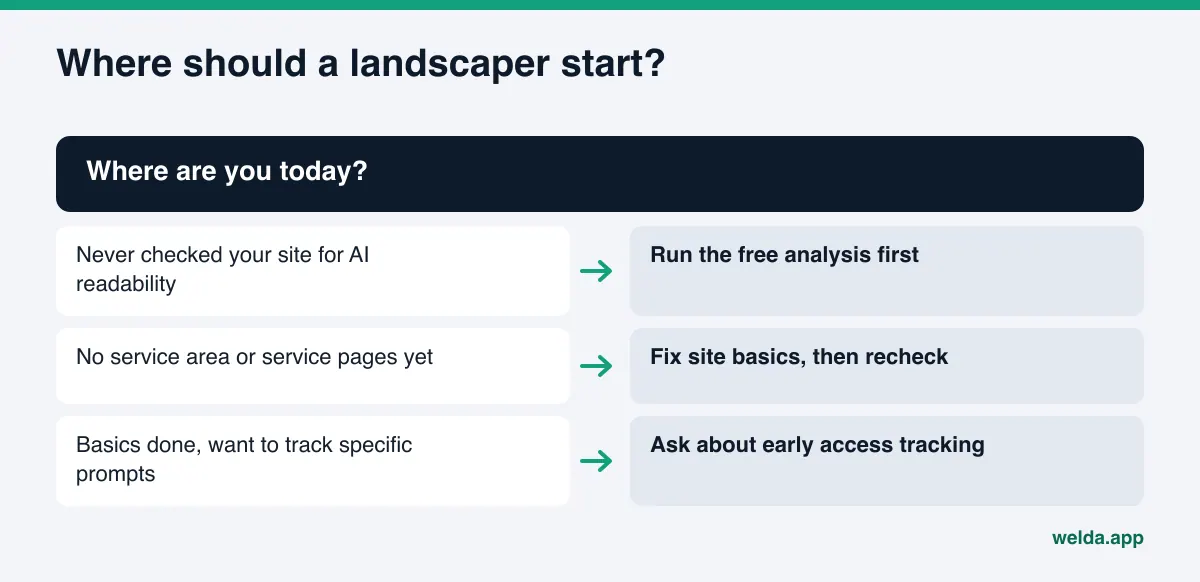
Most landscaping companies do not need to decide everything at once. Use the decision guide below to pick a starting point. If you have never looked at your site through an AI lens, start with the free analysis; it will show whether the basics are in place. Ongoing tracking makes sense once the basics are fixed and you want to see whether specific prompts, such as irrigation or hardscaping questions, start naming you.
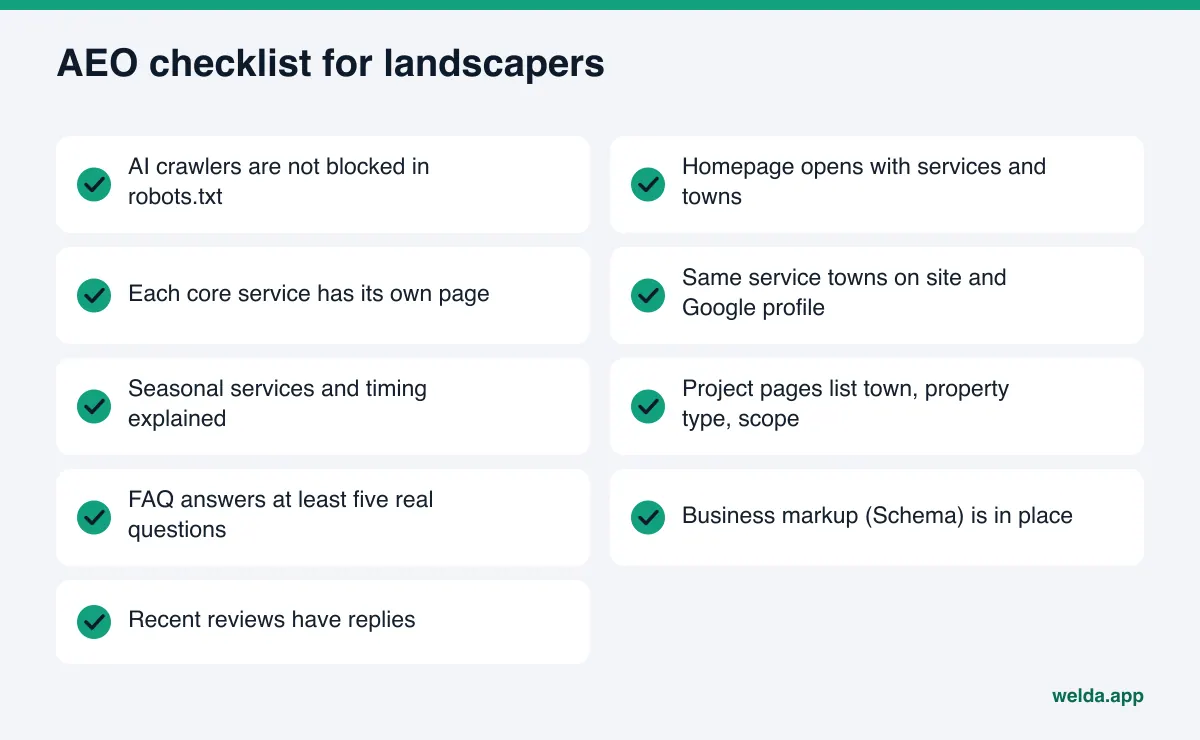
AEO checklist for landscaping companies
Set aside an afternoon, open your site and your profiles, and mark each item as done, missing, or wrong. The missing and wrong items are your to-do list.
| Check | Where to look | Done when |
|---|---|---|
| AI crawlers allowed | robots.txt | No AI bots blocked |
| Homepage first sentence | Homepage | Services and towns in one sentence |
| Separate service pages | Services section | Design, hardscaping, irrigation, lawn care, cleanup each described |
| Service area | Site and Google Business Profile | Same towns in both places |
| Seasonal services | Site | Each season's work and timing explained |
| Project descriptions | Project pages | Town, property type, and scope on each |
| FAQ | Site | At least five real customer questions answered |
| Business markup | Page code | Name, phone, area, and services in Schema |
| Reviews | Google, Yelp, Angi, Nextdoor, BBB | Recent reviews with replies |
If you would rather not do the technical checks by hand, the free analysis covers most of them and shows which fixes would move your score the most. For a related trade with similar long sales cycles and site visits, see AI search optimization for solar installers.
Frequently asked questions
We only have a Facebook page, no website. Can AI assistants still recommend us?
It is possible, but harder. AI systems rely heavily on readable text, and social posts are limited in that respect. A Google Business Profile plus a short, clear website gives you a much stronger base for describing your services and your area.
How many towns should we list in our service area?
Only the ones you actually serve. Listing everywhere does not make you show up everywhere and can lead to poor matches. Google allows up to 20 service areas on a Business Profile; keep that list identical to the one on your site.
Do we need to publish prices?
No. But explaining what drives price, such as square footage, plant selection, materials, irrigation type, or site access, can make your site the source an AI system cites for "how much does a paver patio cost" prompts. Price factors work even without exact numbers.
How long until ChatGPT recommends us?
New content usually takes weeks to show up in AI answers, and there is no fixed timeline because engines update at different speeds. That is why repeated measurement tells you more than a single check.
Will Welda change our website?
Not without your approval. On WordPress, content opens as a draft and goes live only when you approve it. On other platforms, Welda gives you a ready package that you or your web person apply.
What does the free analysis not show?
It does not measure rankings and does not track over time. It shows once how readable your site is for AI systems and whether your name appears for five sample questions. It is free once per site, and the results link arrives by email and stays open for 14 days.
Next step: see what your site tells AI today
How landscaping companies get recommended by ChatGPT is not a trick. It is careful, consistent information: what you do, where you work, what you do each season, and what your customers say, written so AI systems can read and trust it. The first step is seeing what your site says right now. Run the free AI visibility analysis to get your gaps, ready-to-use homepage copy, and a simulation of which fixes matter most.