What does AI search optimization for solar installers actually involve? It is the work of getting your company named when a homeowner or business owner asks ChatGPT, Gemini, Perplexity or Google's AI Overviews about going solar. That means clear service and service area pages, honest cost and process content, and consistent information on the outside sites AI relies on. This guide covers the questions people ask, the pages that answer them, and a step-by-step plan.
The usual name for this work in the US is AEO, short for answer engine optimization. You will also see it called GEO (generative engine optimization); the two terms describe the same goal, and this article uses AEO. For solar companies, AEO matters more than for most local businesses, because going solar is an expensive, long-term decision that people research for weeks. A growing share of that research now happens in conversations with AI assistants, and when an assistant names two or three installers with a short reason for each, the shortlist for quotes is largely set. To see how your own website reads to AI today, start with a free AI visibility analysis; it lists every gap it finds and how to fix it.
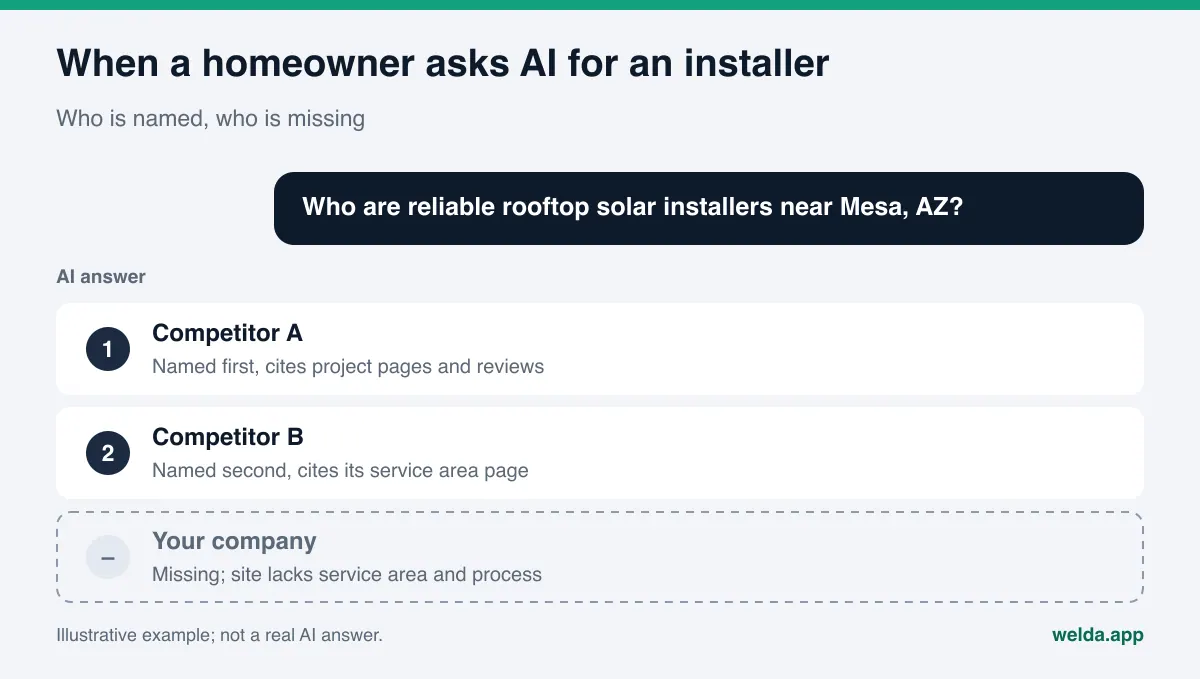
Why AI search visibility matters for solar companies
In a classic search, a homeowner sees a page of results, ads and a map pack, and clicks a few. In an AI answer, they often see one paragraph and a handful of company names. If you are not in that paragraph, the homeowner can move to the next step, comparing quotes, without ever landing on your site.
Three features of the solar market make this sharper. First, the questions are long and technical. "Do I need a battery with solar in Arizona?", "how is system size calculated?", "what happens if my roof needs replacing in a few years?" AI answers those questions by drawing on sources. If the source is your website, your name can appear in the answer. If it is a competitor's blog or a forum thread, they get the mention.
Second, trust is the whole sale. A solar system is a large purchase with financing, contracts and warranties attached, and buyers want to know who they are dealing with. They ask AI for "reputable" or "honest" installers and for companies "without complaints." The assistant looks for evidence: reviews and how you respond to them, your BBB profile, completed projects, licensing information and clear warranty terms. Scattered or missing information gives it nothing to work with.
Third, your market is local but wide. Most installers cover several cities or counties, not a single neighborhood. If your site only shows your office address, the homeowner two cities over may never see your name. Listing your real service area is one of the simplest things you can do for AI search optimization.
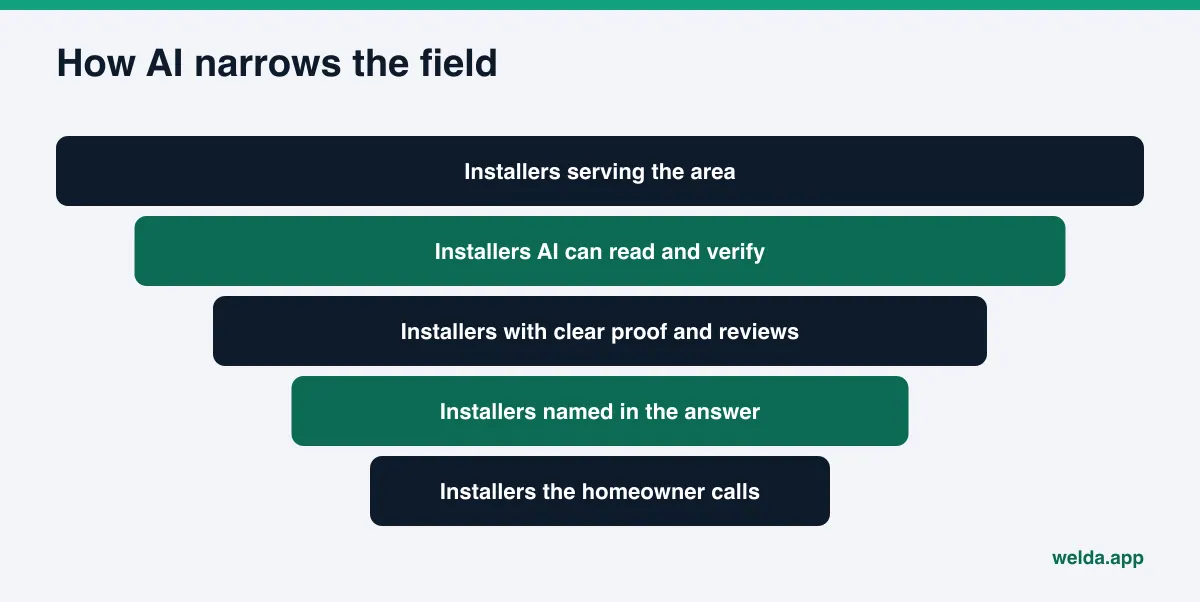
What homeowners and businesses ask AI about going solar
Solar questions fall into a few groups. The examples below were written for this article to illustrate each group; they are not measured data. To build your own list, start with what your sales team hears on the phone every week. The method is covered in more detail in our guide on how to find the questions customers ask AI.
| Question group | Illustrative question | What AI looks for |
|---|---|---|
| Cost and payback | "What drives the cost of rooftop solar for a 2,000 sq ft house?" | A clear explanation of cost factors, sizing examples |
| Choosing an installer | "How do I pick a solar company I can trust?" | Licensing, team, completed projects, warranty terms |
| Local installer | "Best-reviewed solar installers in San Antonio?" | Service area, address, Google Business Profile, reviews |
| Process and permits | "How long does it take from contract to turning solar on?" | Step-by-step process, permits, utility interconnection |
| Technical choices | "Do I need a home battery, and which inverter type?" | Plain-language explanations of when each option fits |
| Service and repair | "Who services solar panels another company installed?" | A maintenance page, service area, policy on other installs |
| Commercial | "Is solar on a warehouse roof worth it for a small business?" | A commercial page, project types, how proposals are built |
The lesson from this table is simple: each group needs its own answer on your site. A single "Services" page that says "we install residential and commercial solar" answers none of these questions well. AI wants specifics: which roof types, which cities, how many steps, what changes the price.
The two buyer types also speak differently. Homeowners ask about their bill, their roof and their HOA. Business owners ask about demand charges, roof load, tax treatment and how long the project interrupts operations. If you serve both, give each its own page and its own FAQ.
What AI checks before it names a solar installer
AI engines usually combine two kinds of sources: your own website and third-party sites that mention you. On your site, they look at:
- Access: whether AI crawlers can read your site at all. If your robots.txt blocks them, even excellent content goes unread.
- Clear services: separate, plain descriptions of residential rooftop, commercial, ground-mount, battery storage, and maintenance or repair.
- Service area: the cities and counties where you actually do site visits and installs.
- Structured business data: your name, address, phone, hours and service area in machine-readable form. Google explains this in its LocalBusiness structured data documentation.
- FAQ content: short, direct answers to the questions people really ask.
- Trust signals: completed projects, team information, license details, certifications if you hold them, and warranty terms written out.
Off your site, Google Business Profile is usually the starting point for local questions. Review platforms such as Yelp, the BBB, Angi and solar-specific review and comparison sites can also appear as sources, along with local news coverage and forum threads. Which of these carries the most weight in your market cannot be known without measuring; the right approach is to look at which sites AI answers actually cite for your questions, not to guess. The general principles are covered in how to get cited by AI.
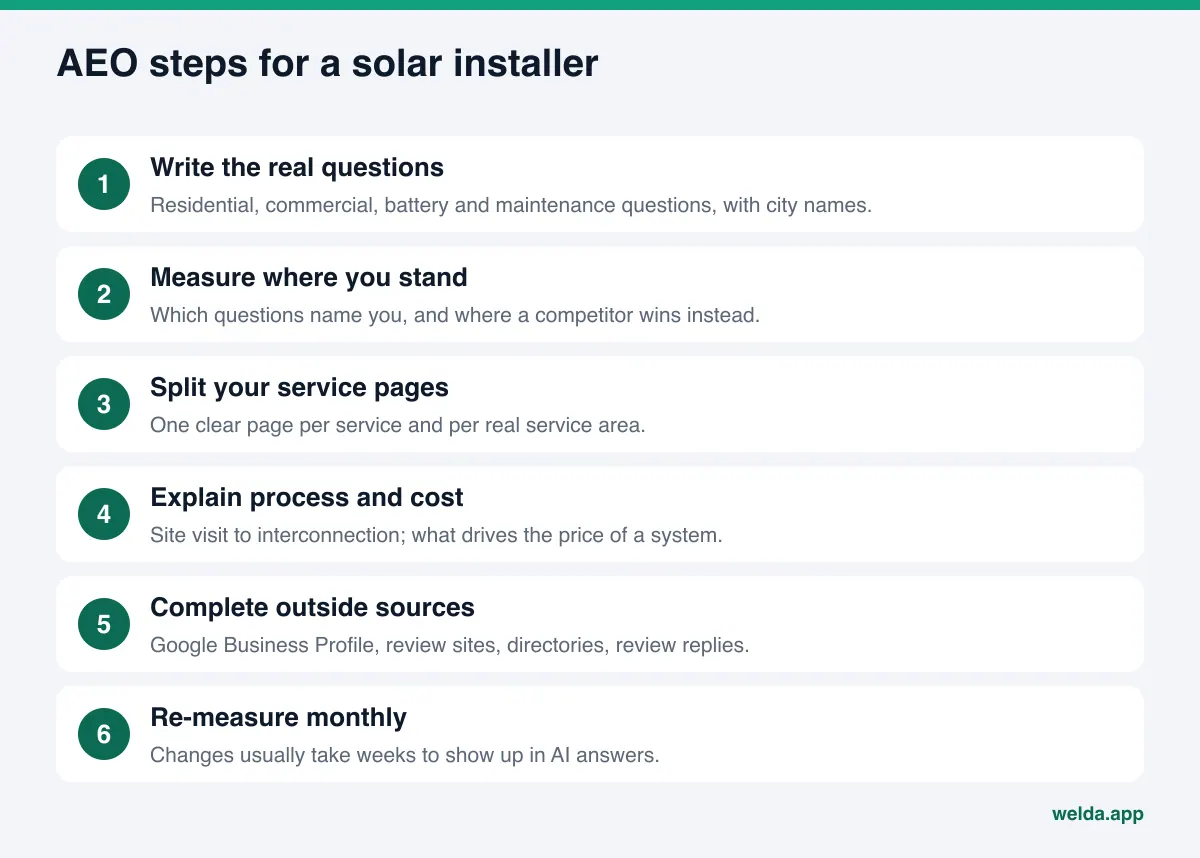
AI search optimization for solar installers, step by step
This plan works for a small residential installer and for a mid-sized company covering several metros. Each step uses the output of the one before.
- Write your question list. Pull a few questions from each group above. Add the names of the cities and counties you serve. Keep separate lists for homeowners and businesses.
- Measure where you stand. Ask those questions in different AI engines and record whether your company is named, and in what position. The same question can get a different answer on a different day, so do not decide anything based on one try.
- Fix the technical base. Check robots.txt, page titles and meta descriptions, your main heading, LocalBusiness structured data and page speed. This is quick work, but skipping it weakens everything that follows.
- Split your service pages. Give each service its own page: who it is for, when it fits, how the process runs, and an FAQ.
- Publish your real service area. List the cities and counties you cover. If you build city pages, each one needs real local substance, such as the types of projects you have completed there or how permitting typically works with that jurisdiction. Copies with only the city name swapped do not help.
- Explain the process and the cost drivers. Walk through site assessment, design, permitting, installation, inspection and utility interconnection. You do not have to publish prices, but explaining what moves the price (roof type, system size, equipment choices, batteries, electrical upgrades) is how you become a source for cost questions.
- List completed projects. City or county, system type, year and a short description are enough. Get permission before naming a customer; otherwise keep it anonymous.
- Complete your outside sources. Update services, service area and description in Google Business Profile. Reply to reviews with specific, signed answers. Respond to complaints on review platforms with a clear resolution.
- Re-measure monthly. New content usually takes weeks to show up in AI answers. Ask the same questions each month and look at what changed.
Which pages should a solar installer's website have?
A common solar website has a home page, a single services page, a gallery and a quote form. That can be enough to look professional, but it gives AI very little to answer with. The table below maps pages to the questions they answer.
| Page | Question it answers | What belongs on it |
|---|---|---|
| Residential rooftop solar | "Can I put solar on my house?" | Suitable roof types, process, battery options, FAQ |
| Commercial solar | "Does solar make sense for my business building?" | How proposals are built, project types, timelines |
| Battery storage | "Do I need a battery?" | When a battery helps, backup versus savings, sizing factors |
| Service and repair | "Who fixes solar panels near me?" | Scope, service area, whether you service other installs |
| Process | "How long does going solar take?" | Steps from site visit to interconnection, what you need from the owner |
| Cost factors | "What affects solar pricing?" | The list of factors, what to compare between quotes |
| Projects | "What has this company installed?" | Place, system type, year, short description |
| About | "Is this company legitimate?" | History, team, licenses, warranty and service approach |
Ending each page with four to six questions specific to that page gives AI short answers it can quote directly. Write them in your customers' words. Skip "Why choose us?" and use questions like "My roof faces east and west; does solar still work?"
The About page carries extra weight in solar. A system is expected to run for decades, and buyers want to know you will still be around to honor the warranty. Say who is on the team, how long you have been installing, how service calls are handled and who stands behind each warranty. Our guide to about page trust signals for AI walks through the details.
One more page is worth considering: a plain explanation of how quotes should be compared. The FTC's consumer guide Solar Power for Your Home tells buyers to get several written bids and compare system size, expected output, total installed cost, and equipment and workmanship warranties. A page that explains each of those points honestly answers exactly the questions a careful buyer brings to an AI assistant.
Savings, payback and warranty claims: what to watch
Solar marketing leans on a few familiar lines: "eliminate your electric bill," "pays for itself in a few years," "the most efficient panels available." These lines affect both buyer trust and AI visibility. AI engines may be cautious about quoting absolute promises with no stated basis, and buyers are increasingly skeptical of them in reviews.
A sturdier approach is to explain the conditions. Payback depends on usage, roof orientation, shading, system size, utility rates, net metering rules and available incentives, and those rules differ by state and utility and change over time. A page that says so plainly is a better candidate to be quoted when someone asks "how long until solar pays off?" Do the same for warranties: what panel, inverter and workmanship warranties each cover, who issues them and how a claim works.
Advertising and consumer protection rules, including FTC guidance and state laws, apply to these claims. Whether a specific sentence is a problem is a question for your own counsel, and this section is not legal advice. Welda's compliance check flags patterns like guaranteed savings or superiority claims before publishing, but it does not replace a legal review either.
How Welda handles AI visibility for a solar installer
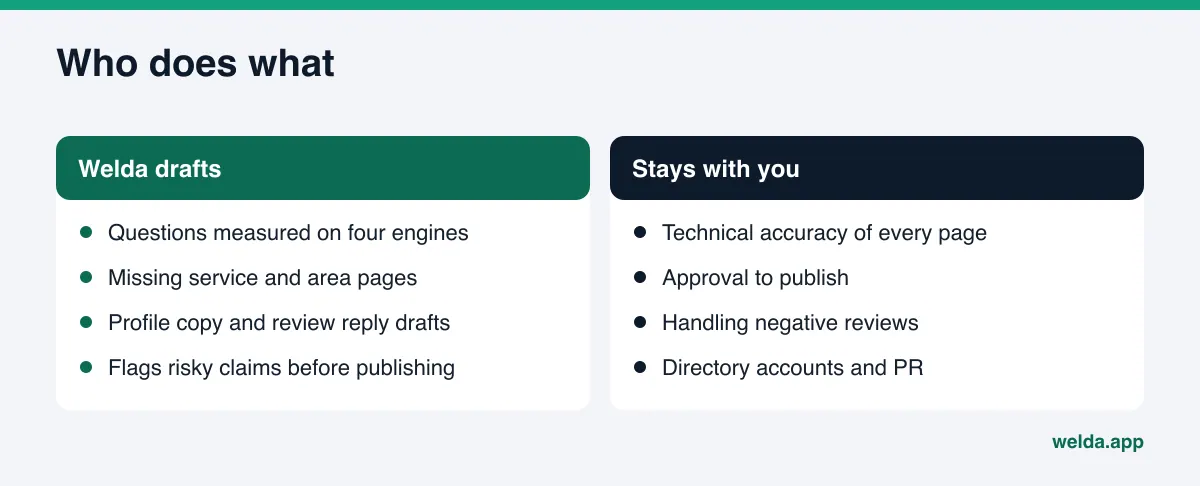
Welda is software that measures where a business appears in AI answers and drafts the fixes on the business's behalf. Three parts do most of the work for a solar company: question tracking, the sources view, and ready-made pages.
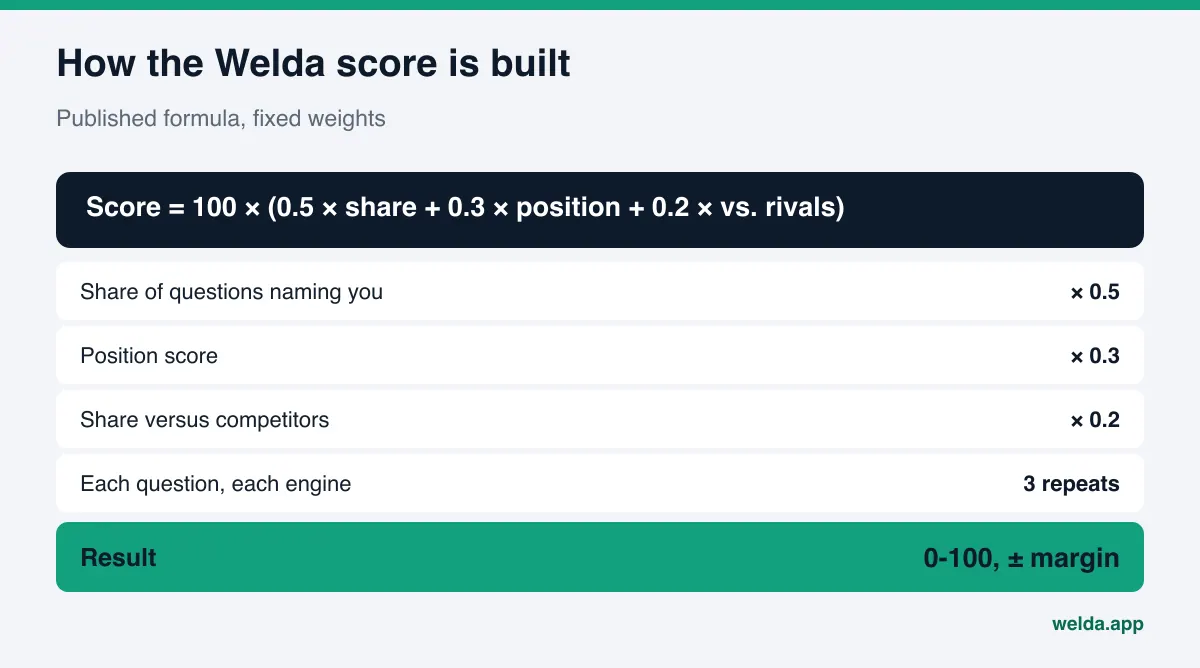
Question tracking. Your question list is built around your services and service area: residential, commercial, battery, maintenance and cost questions. Each question is asked three times on ChatGPT, Gemini, Perplexity and Google AI. For every question you see which engine names you and in what position. A typical pattern for an installer looks like this: broad "how to choose solar panels" questions cite national companies and publishers, while questions with a city name favor installers with strong Google Business Profiles and project pages. That split tells you where to start. The score uses a published formula, so you can see which part moved.
Sources view. The sites AI cites when it answers your questions are listed here, each with your status on that site: profile incomplete, listing unverified, not present, or done. For an installer, this turns "which directories should we be on?" from a guess into a short list. If a review platform and a regional news site keep appearing in answers, that is where the work starts. Where an account is connected, Welda drafts the copy. Where it is not, the task is listed as manual, with the copy ready next to it.
Ready-made pages and approval. A gap found in measurement, for example a missing battery storage page, becomes an item on your to-do list. Welda drafts the page, its FAQ and the structured data. On WordPress, Welda connects through a separate Editor user and an application password, with no plugin or code to install; the page opens as a draft on your site and goes live when you approve it. On other platforms you get a ready package to apply yourself or through your web person. Your content always lives on your own website.
Welda does not invent technical details. If it does not know which equipment brands you install, your warranty terms or your service area, it asks you through the to-do list. Before anything goes live, the compliance check flags risky phrasing.
The panel also includes an overview screen, a competitors view, before-and-after comparison and a one-page monthly report, but the three parts above are where a solar company spends most of its time early on. A practical note on availability: the full panel is in early access and is opening first in Turkey. Regular four-engine tracking is being added during early access, and sample screens use illustrative data. What anyone can use today, including in English, is the free website analysis. Pricing is discussed in the early access conversation.
Limits: what Welda does not do
An honest guide to AEO should spell out the limits.
- Welda does not guarantee rankings or placement in ChatGPT or any other engine. AI answers vary, and no software controls whom an engine recommends.
- It does not make up facts. Specifications, warranty terms and your service area come from you.
- It does not publish sensitive content without your approval.
- It does not create fake reviews. See review responses for AI visibility for how replies help instead.
- Resolving negative reviews, opening directory accounts and press work stay with your business. Welda drafts copy and suggestions; it does not open accounts in your name.
- New content usually takes weeks to show up in AI answers. Seeing no change in week one is normal.
The free website analysis is not a ranking report either. It reads your home page and a few inner pages, lists what is missing, suggests ready-to-use copy for your home page, and asks an AI assistant with web search five questions your customers might ask, once. That is a starting snapshot, not ongoing tracking.
Solar installer AEO checklist
Use this list for a ten-minute review of your site and your outside profiles. For a broader version, see the AEO checklist.
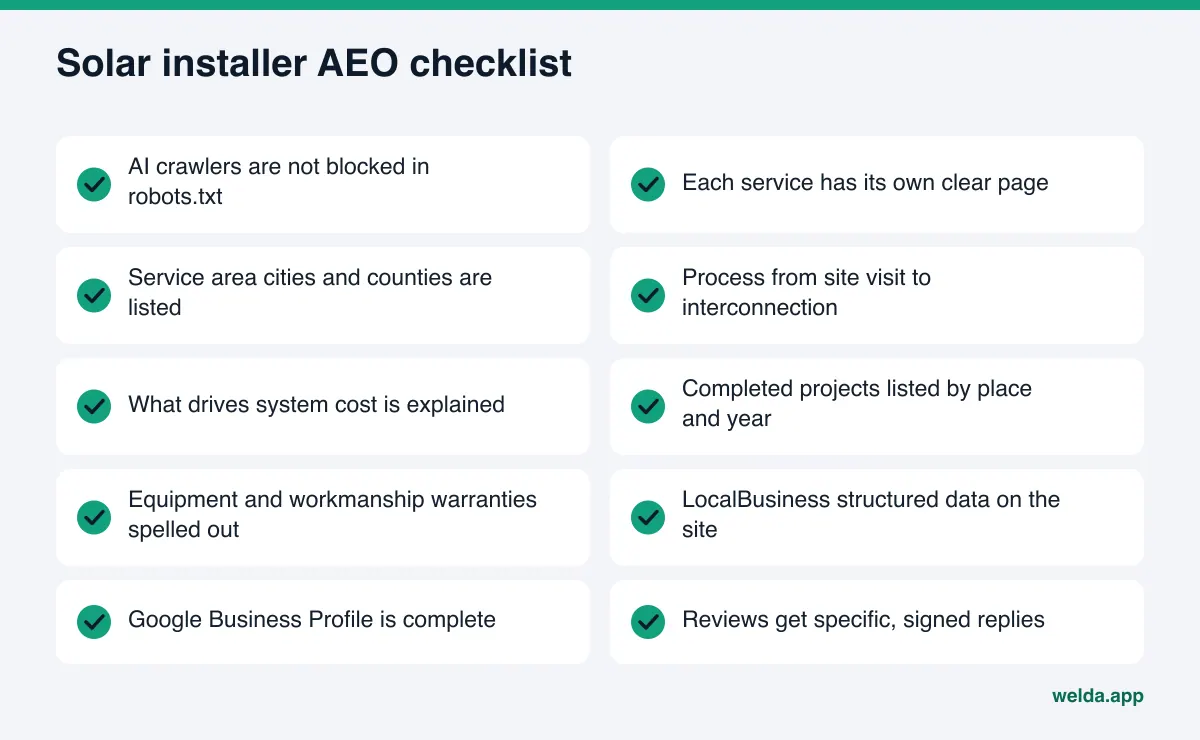
To decide what comes next, count the unchecked items. If more than half are unchecked, fix your own site first and leave outside sources for later. If most are checked and you still do not show up in answers, the gap is probably on the source side, and without measurement it is hard to know which source. That is the point where regular tracking, from a tool or a consultant, earns its keep.
FAQ
Is AEO for solar installers different from SEO?
The foundation is shared: a fast, crawlable, clearly written website. The difference is the goal. Instead of a position on a results page, you want your name inside the answer an AI engine writes. That puts more weight on question-shaped content, a clear service area and consistent information across outside sources.
Can we show up for cost questions without publishing prices?
Very likely, yes. A page that explains what drives system cost, how sizing works and what to compare between quotes can be a source for cost questions without listing a single price.
We cover several metros. Do we need a page for every city?
Only if you can add real local substance, such as the project types you have completed there or how that area typically handles permits. Otherwise, one service area page that lists all your cities and counties is the better choice.
How long until changes show up in AI answers?
Usually weeks, and the timing varies by engine. Track the same questions monthly instead of reacting to week-to-week swings.
Does Google Business Profile affect AI answers?
For local questions, map listings and profile details are commonly used sources. Keep your services, service area and description current, and reply to reviews.
Can a US solar company use Welda today?
The free website analysis works in English and is available now; it is free once per site, and the results link arrives by email and stays open for 14 days. The full panel is in early access and is opening first in Turkey.
See how AI reads your solar website today
Showing up in AI answers is ongoing maintenance, not a one-time campaign. The starting point is simple, though: how does AI read your website today, and what are the first fixes? The free AI visibility analysis reads your home page and several inner pages, gives a technical and a content score out of 100, explains each gap and how to fix it, and shows how much each fix would raise the score. Use the result to plan your first AEO steps as a solar installer.