How do locksmiths get recommended by ChatGPT? When someone asks an AI assistant for a locksmith, it searches the web and builds its answer from what it can find, read and trust about you: the areas you cover, whether you work at night, which jobs you do, how you price, and what customers say. If that information is clear on your website, complete on your Google Business Profile and consistent everywhere else, your odds of being named go up. If it is missing or contradictory, the AI picks a locksmith it can describe with more confidence.
Locksmith customers are usually in a hurry. They are locked out at 11 p.m., the key snapped in the cylinder, or the car keys are sitting on the driver's seat. For years that person opened Google Maps and called the first number. More and more of them now type the same question into ChatGPT, Gemini, Perplexity or Google's AI Overviews: "Is there a trustworthy locksmith open right now near me?" The answer is not ten blue links. It is a short list of two or three names. So the question of how locksmiths get recommended by ChatGPT is really the question of who gets tonight's call. This is what AEO, answer engine optimization, is about: making sure AI answers can find and cite your business. You may also see it called GEO, generative engine optimization; it is the same work. If you want a baseline before reading on, the free site analysis shows how your current website reads to Google and AI.
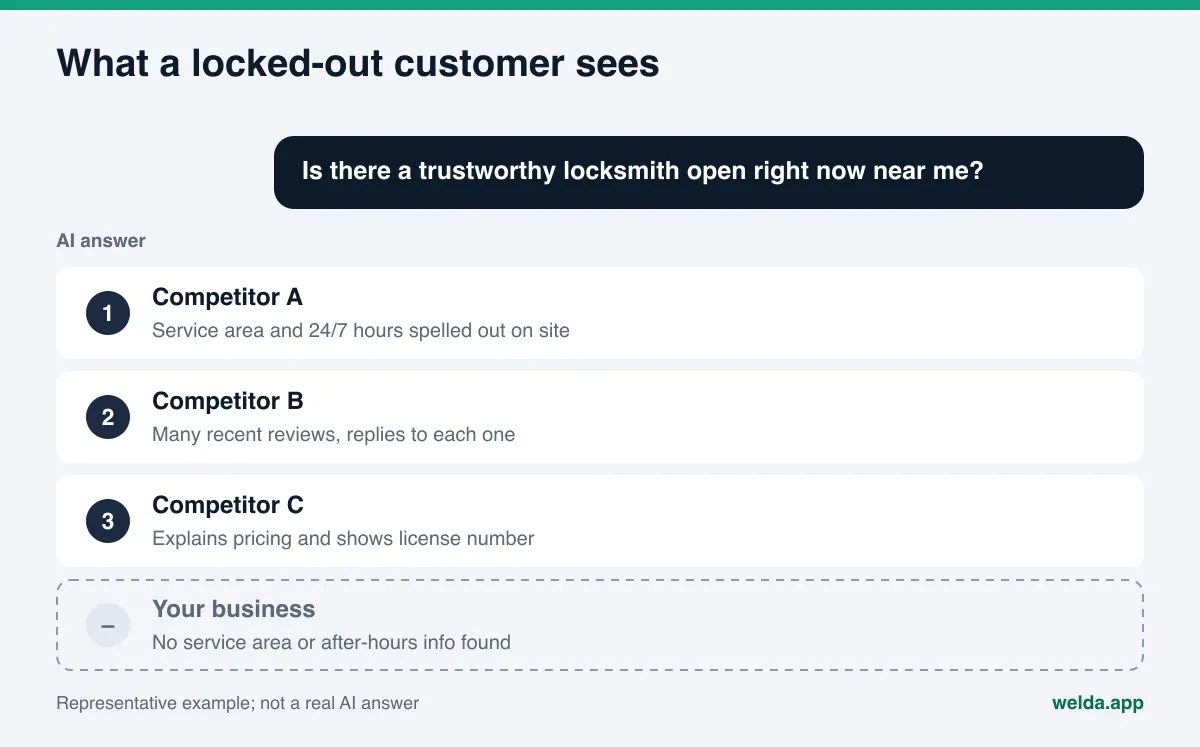
How locksmiths get recommended by ChatGPT: what the AI looks at
AI assistants do not "know" your locksmith business. When a question comes in, they run a web search, read the pages they find and assemble an answer. For your name to appear, three things have to be true: the engine can find you, it can understand what it finds, and it trusts that information enough to repeat it.
Finding you means your site is open to AI crawlers, your Google Business Profile is verified and filled in, and your name shows up on the sites people actually check for home services: Yelp, Angi, the BBB, Nextdoor and local directories. A surprising number of small locksmith sites block AI crawlers in robots.txt without anyone noticing, or consist of little more than a phone number.
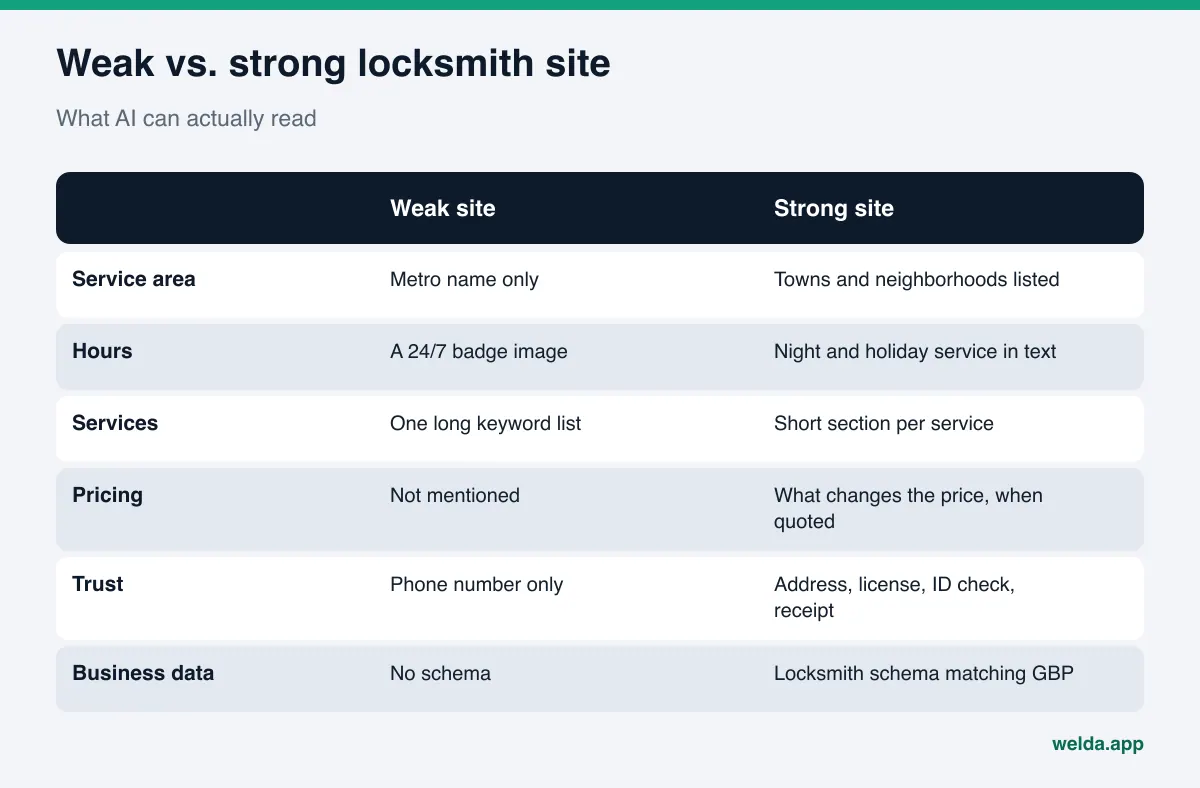
Understanding you requires plain text. A "24/7" badge in an image means almost nothing to a language model. A sentence such as "We cover Pasadena, Glendale and Burbank, including nights and weekends" can be quoted directly. Separate service sections, an FAQ with real answers and structured business data (schema) all belong here.
Trusting you matters more for locksmiths than for most trades. The industry has a long history of bait-and-switch complaints. The FTC has warned consumers that some locksmiths advertising locally may not be local at all, and AI assistants tend to fold that kind of caution into their answers. Given a choice, they lean toward a business with a real address, a consistent phone number, steady reviews and a clear pricing approach over a listing that is only a cell number. That is not a guarantee, but it tells you which information does the work.
What customers actually ask AI about locksmiths
Locksmith questions fall into a few predictable groups. Writing them down is the first real step of locksmith AEO, because every page you write later should answer one of them. Typical patterns look like this:
- Urgency: "locksmith open now near me", "24 hour locksmith in [neighborhood]", "locked out of my apartment at night, who can come fast"
- Price: "how much does a locksmith charge to unlock a door", "why is a night lockout more expensive"
- Trust: "how do I know a locksmith is legit", "does a locksmith need a license in my state", "locksmith quoted one price and charged another"
- Specific jobs: "rekey locks after moving in", "car key fob replacement near me", "smart lock installation", "safe opening"
Notice how many of these are about trust and price rather than just "who." When an AI answers "how do I know a locksmith is legit," it often lists checks: ask for an estimate on the phone, ask for ID and a license where required, get an itemized receipt. California's Department of Consumer Affairs, for example, advises consumers to verify a locksmith's state license and ask for an itemized receipt. A locksmith whose site already states that it does these things gives the AI a natural business to name inside that same answer.
Why AI visibility works differently for locksmiths
For a restaurant or a hotel, AI visibility is part of a decision that takes days. People compare, read reviews, come back later. A locksmith decision takes minutes. That changes several things.
Rank inside the answer matters a lot. Someone standing outside a locked door does not read the whole list. They call the first or second name. So for a locksmith the question is not only "am I mentioned" but "where am I mentioned."
Service area is everything. People do not ask for "a locksmith in Los Angeles." They ask for "a locksmith in Silver Lake" or "near Echo Park, tonight." If your site only says "serving the greater metro area," the AI has a hard time matching you to a neighborhood question. If you work across several towns, our guide to location pages for AI search explains how to structure them without thin, duplicated pages.
Trust language is baked into the answer. AI assistants frequently add warnings like "ask for a quote before work begins" to locksmith answers. If your site plainly says you already do that, the warning and the recommendation point to the same business.
After-hours data decides urgent questions. Many emergency questions are asked outside business hours. If your Google Business Profile shows "Closed" at night, a well-written website will struggle to overcome it for "open now" questions.
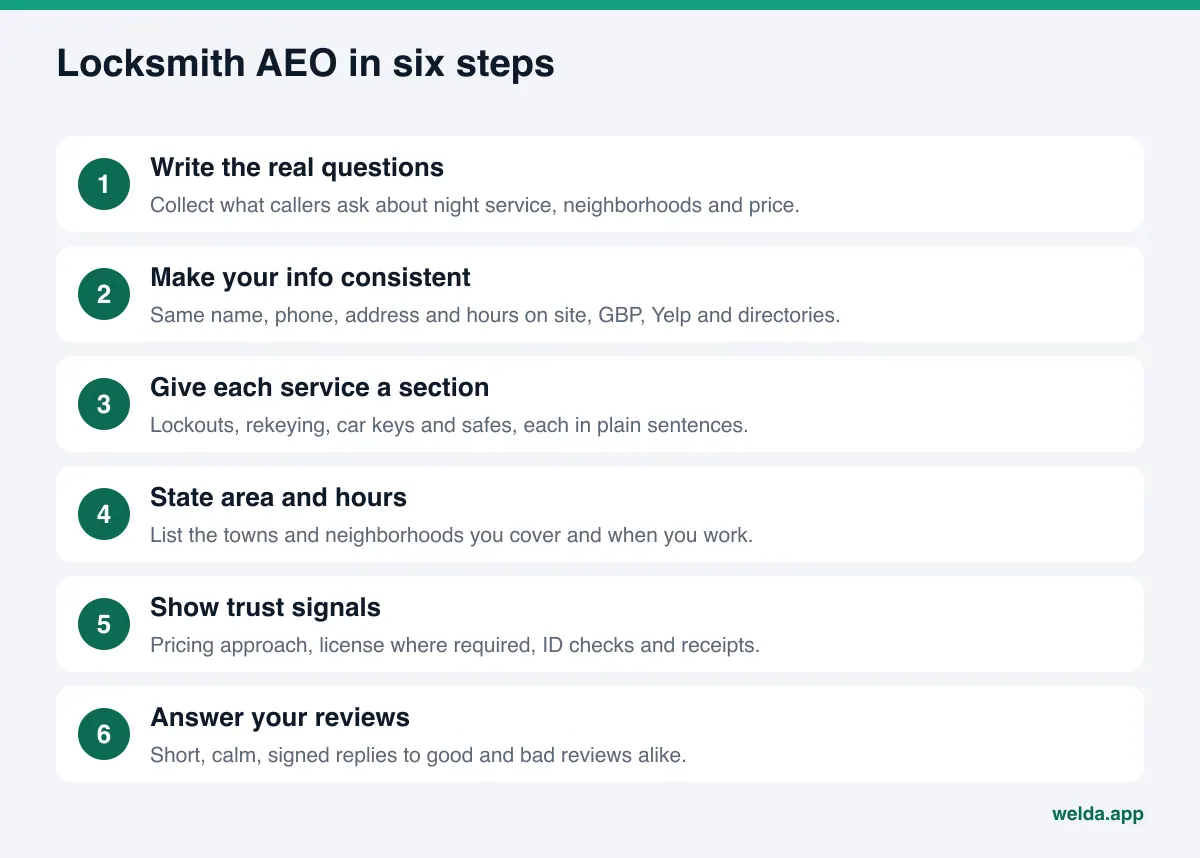
Step by step: how to get your locksmith business recommended
The order below is written so a one- or two-person shop can work through it alone or with a little help. Each step builds on the previous one.
- List the questions callers ask. What have people asked you on the phone in the last few months? "Do you come out at night?", "How much to open a door?", "Can you rekey without changing the lock?", "Do you program car fobs?" Write each one down with a neighborhood or town attached. Fifteen to twenty questions is enough to start.
- Make your business details consistent. Is your business name, phone, address and hours the same on your site, Google Business Profile, Yelp, Angi, the BBB and any directory you are listed in? An old number in one place or a different spelling in another can make an AI treat you as two businesses, or trust neither.
- Write a short section for each service. Residential lockouts, rekeying, lock replacement, high-security locks, automotive keys and fobs, safes, commercial access control. For each one: what you do, roughly how long it takes, what the customer should have ready. Leave out work you do not do.
- State your service area and hours in plain words. List the towns and neighborhoods you actually cover. If you work nights and holidays, say so in a sentence. If you do not, say that too. Honest information beats a wrong match at 2 a.m.
- Explain your pricing approach. You do not have to post a number. But explain what changes the price (door and lock type, time of day, distance) and when the customer hears the price. That is the question people ask most.
- Add trust information. A real address, your license number if your state licenses locksmiths, how you confirm the customer lives at the property before opening a door, and whether you provide an itemized receipt. These details persuade both people and AI.
- Build an FAQ section. Take the questions from step one and answer them on one page. FAQ blocks are among the most easily quoted parts of any site.
- Mark up your business data. Add Locksmith (a LocalBusiness subtype) schema with name, phone, address, service area and hours, matching your Google Business Profile exactly. Our post on schema markup for AI search walks through it.
- Complete your Google Business Profile. Correct primary category, service area, hours including special hours, photos of your van and work, and a service list. Gemini and Google AI Overviews draw on this profile heavily.
- Reply to reviews. A short thank-you on good reviews, a calm and specific explanation on bad ones, on Google and Yelp alike. AI assistants read replies as well as reviews.
How to write a locksmith website AI can use
Most locksmith sites are a big phone number and a headline that says "24/7 Emergency Locksmith." That can work for a human scanning the page. It gives an AI very little to work with. The table below shows the sections a locksmith homepage and service pages should have, and why each one matters for AI search visibility.
| Section | What to write | Why it matters for AI |
|---|---|---|
| Page title | Business name, main service, town | First signal for neighborhood questions |
| Opening paragraph | Who you are, where you go, when you work | The part most often quoted in answers |
| Services | Two or three sentences per job type | Answers narrow questions like "car key fob" |
| Service area | Towns and neighborhoods, in text | Matches local, specific questions |
| Hours | Nights, weekends, holidays | Decides "open now" questions |
| Pricing approach | What changes the price, when it is quoted | Makes you a source for cost questions |
| Trust details | Address, license if required, ID check, receipt | The signals AI looks for before recommending |
| FAQ | Real caller questions, short answers | Question-and-answer format is easy to cite |
Keep the tone plain. "Best," "cheapest" and "guaranteed" raise suspicion with people and AI alike, and broad claims can also draw scrutiny under truth-in-advertising rules. One concrete sentence like "We tell you the price before we start, and nothing changes without your approval" does more than ten superlatives.
Writing about price and trust without posting a price list
Price is the most sensitive topic in this trade. Many locksmiths avoid it because the job depends on the door, the lock and the hour. That is a fair concern. But saying nothing about price means AI will never cite you for price questions, and those are some of the most common questions people ask.
The answer is to describe your method instead of a number. For example:
Sample text: "Lockout pricing depends on the door and lock type, the time of day and how far we travel. On the phone we ask a few questions and give you an estimate. When we arrive and see the lock, we confirm the final price before any work begins. We do not start without your OK, and every job comes with an itemized receipt."
That paragraph has no dollar figure, yet it answers "will I get ripped off?" When an AI responds to "does a locksmith have to quote before starting," a business that states this practice clearly is an easy example to name. One caution: do not write legal conclusions about what locksmiths are required to do in your state. Describe your own practice and leave the legal reading to an advisor. This is not legal advice.
The same applies to trust details. Explaining how you confirm residency or ownership before opening a door protects you from bad actors and shows customers you take the job seriously. If your state licenses locksmiths, showing the license number on your site and in your profile is one of the clearest signals you can give.
A sample first month for a small locksmith
The scenario below is an example, not a real business. Picture a two-person locksmith covering four suburbs. They have a website, but the homepage holds a phone number, a "24/7" badge and a few photos.
Week one goes to consistency. An old cell number on the Google Business Profile is replaced, the business name is fixed to one spelling on Yelp, Angi and the BBB, and night hours are added to the profile. Week two rewrites the homepage: the opening paragraph names the four suburbs and night service in plain sentences, and services split into lockouts, rekeying and automotive. Week three adds the pricing paragraph, an eight-question FAQ and Locksmith schema. Week four answers every unanswered review from the past year.
At the end of the month, AI answers may not have changed yet; it usually takes weeks for new content to show up. But there is now information an engine can find, read and trust. To see the change, measure before you start. Our guide to before and after AEO measurement covers how.
How Welda handles AEO for a locksmith
Welda is software that measures where a business appears in AI answers and prepares the fixes on the business's behalf. For a locksmith, three parts matter most.
The free site analysis: what your site tells AI today. This is the part anyone can use right now, and it works in English. It reads your homepage and a few inner pages such as services and contact. On locksmith sites, the gaps it tends to surface are familiar: no written service area, hours only in an image, no business schema, no FAQ, and no link between the site and the Google Business Profile. For each gap you see what was found, why it matters and how to fix it. You also get ready-to-use homepage copy (title, description, main heading, opening paragraph, FAQ), a simulation of how much each fix could move your score, a competitor comparison and a fix package to add to your site. The analysis also asks five customer-style questions to an AI assistant that can search the web and checks whether your business name appears. That is a one-time snapshot, not ongoing tracking.
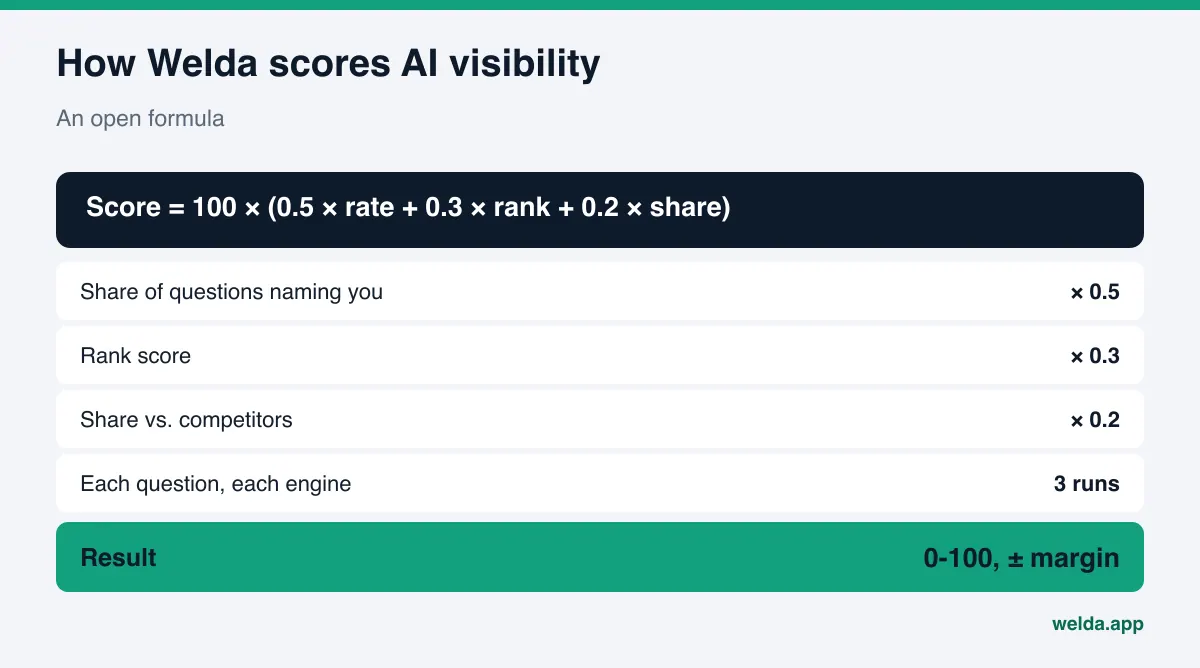
The questions view: which questions you show up for. In the Welda dashboard, customer questions are asked to ChatGPT, Gemini, Perplexity and Google AI three times each. For a locksmith the list would read like "24 hour locksmith in [town]", "rekey locks [neighborhood]", "car key fob replacement near me." Each row shows which engine named you and in what position. The decision here is simple: which town and which service never mention you? That is where the work starts. The score formula is public, shown below.
The sources view: whose pages AI relies on. For locksmith questions, the sites AI cites are often not your own: Google Maps, Yelp, Angi, the BBB, a Nextdoor thread or a local news piece about scams. The sources view lists them and your status on each, so if a competitor is winning because of a full Yelp profile, you see it.
After measuring, Welda drafts what is missing: the service-area paragraph, the pricing text, FAQ answers, Business Profile descriptions and review replies. On WordPress, content arrives as a draft on your site and goes live when you approve it; otherwise you get a ready package to apply by hand. Welda does not invent facts like which towns you cover at night; it asks you. Content always lives on your own site, and approval stays with you.
To be straightforward about where things stand: the Welda dashboard is in early access, and it is opening first in Turkey. Regular four-engine tracking is being added during early access, and the sample dashboard screens use representative data. The free site analysis is the part available to everyone today, in English and German as well. Pricing is discussed in the early access conversation.
Limits: what Welda does not do
AI answers are rewritten every time, and no software controls them. So a few things should be said plainly.
- No guarantees. Welda does not promise you will show up first in ChatGPT. It measures, prepares fixes and tracks change.
- No fake reviews. Welda does not write reviews. It drafts replies to real customer reviews.
- No guessing. Your service area, hours and services are asked, not filled in.
- Some work stays with you. Resolving negative reviews, setting up directory and marketplace accounts and press coverage are the business's own tasks. Welda provides text and direction.
- It takes time. New content usually takes weeks to show up in AI answers.
Engines also behave differently. Showing up in ChatGPT does not mean you will show up in Gemini. Our guide on how to get recommended by Gemini covers Google's side.
Locksmith AEO checklist: are you ready?
Go through this list against your own site and profiles. Every "no" is a reason an AI might pass you over.
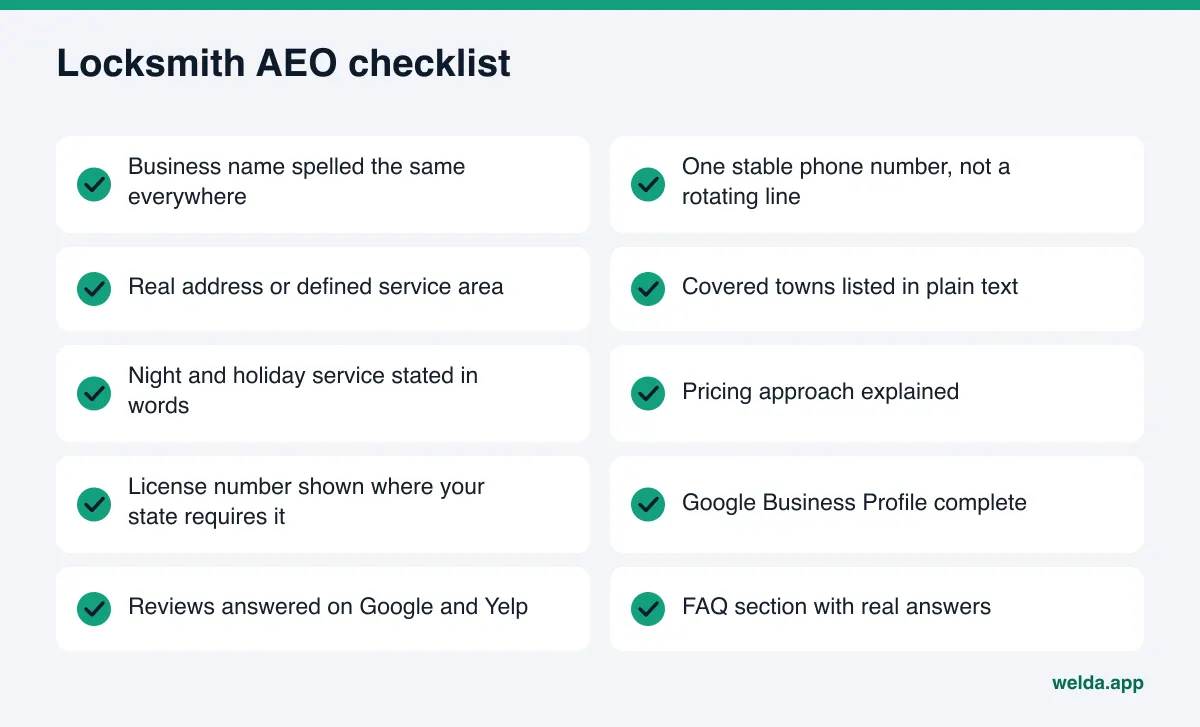
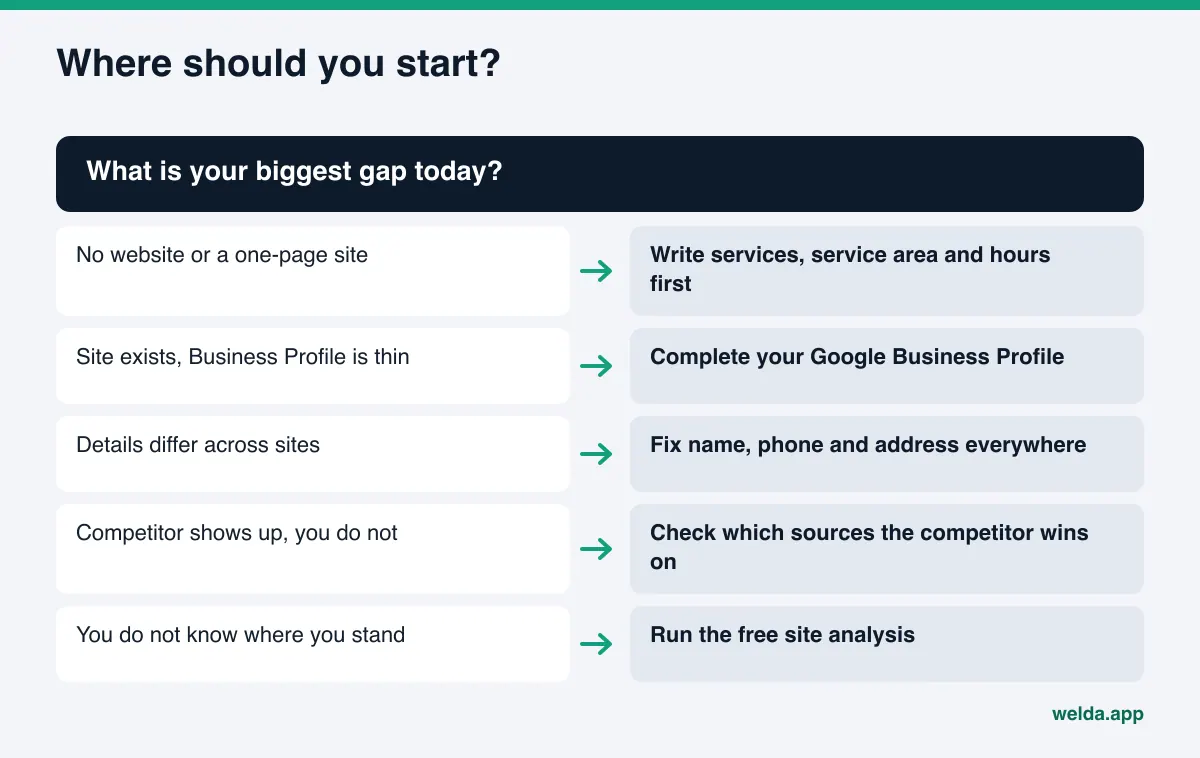
Then pick a starting point based on your biggest gap. If your details differ across sites, fix that first, because inconsistent data weakens every later step. If you have no site or a one-page site, write your services, area and hours. If a competitor appears and you do not, look at which sources they win on. For a broader frame, see AEO for local businesses.
Frequently asked questions
Do I need a website to get recommended by ChatGPT as a locksmith?
Not strictly, but it helps a lot. AI pulls from Google Business Profile, Yelp and directories too. Your own site is still the best place to explain service area, pricing approach and trust details in full.
Should I post prices on my site?
You do not need dollar figures. Explaining what changes the price and that you quote before starting is usually enough to become a source for price questions.
I cover several towns. Do I need a page for each?
Copy-paste town pages do not help. Create separate sections or pages only where you have something different to say, such as typical response time or common lock types. List the rest in your service area paragraph.
Does an old complaint on Yelp or the BBB hurt me?
AI can read those sites. You cannot remove a complaint, but a calm reply explaining what happened and how it was resolved leaves fewer questions than silence.
How long until I see results?
Changes usually take weeks to reach AI answers, and timing differs by engine. Measuring before and after is the only way to know what worked.
Does the free analysis work for locksmith websites in the US?
Yes. It reads any site against the same criteria, works in English and flags gaps common on locksmith sites, such as a missing service area or business schema. It is free once per site.
See where your site stands today
How locksmiths get recommended by ChatGPT depends largely on what their site and profiles tell AI. The first step is seeing what yours says right now. Run the free site analysis: your site is read the way Google and AI read it, and you get a score out of 100, a fix for each gap, ready homepage copy and a five-question AI test. The results link is sent to your email and stays open for 14 days.