What does AEO for cleaning services actually involve? When someone asks ChatGPT, Gemini, Perplexity, or Google's AI Overviews for a house cleaner or an office cleaning crew, the answer is built from what is clearly written on your website, your Google Business Profile, and review sites: which cleaning services you offer, which neighborhoods you cover, how a visit works, and what customers say about you. If those details live only in phone calls and text threads, your company does not make the short list. This guide walks through the work step by step and shows which parts Welda handles for you.
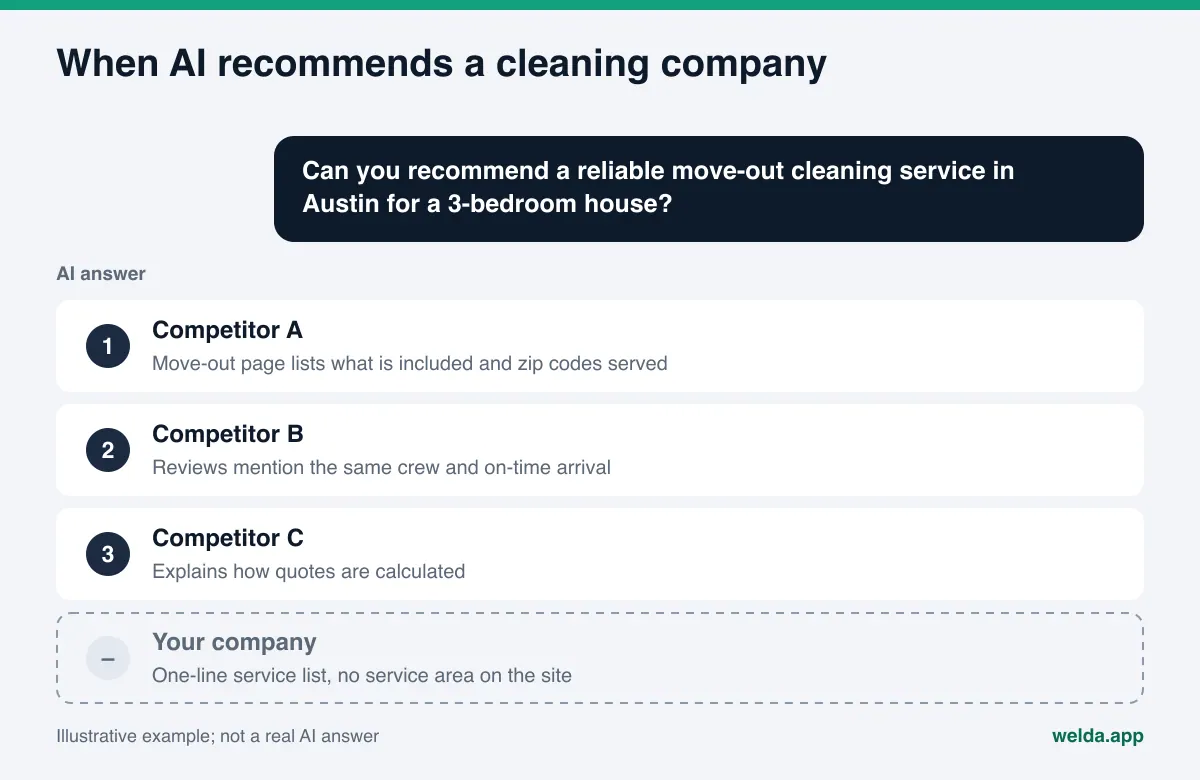
Why AEO for cleaning services matters now
AEO, short for answer engine optimization, is the work of getting your business named in AI-generated answers. You will also see it called AI search visibility, and some marketers use GEO (generative engine optimization) for the same idea. In a classic Google search, a homeowner sees ten results, opens a few tabs, calls two or three companies, and compares. In an AI answer, they often see three or four names with a sentence about each, and they start calling from that list. Being in the answer is no longer about a nice storefront. It decides whether you get the call at all.
Cleaning companies feel this shift differently from a restaurant or a retail store. Nobody walks past your office and decides to book. You go to the customer, so there is no foot traffic and no window display. And the stakes for the customer are personal: they are handing over a key or a door code, often for hours when nobody is home. That shapes the questions people type. They are long and specific: "reliable move-out cleaning for a 3-bedroom house in Austin", "biweekly house cleaner in Plano who brings their own supplies", "post-construction cleanup crew near Cherry Creek, Denver", "after-hours office cleaning for a 20-person office in Midtown Atlanta". An AI engine answering those questions looks for a company that has written those details down somewhere it can read.
The result is simple. The cleaner who spells out its services, its service area, and how it works gets mentioned. The one who does not stays invisible, even if its crews do better work. The fastest way to know where you stand is to look at your site the way an AI engine does. Welda's free site analysis reads your homepage and key inner pages, such as services, pricing, about, and contact, and shows each gap with a fix. It runs in English.
What customers ask AI about cleaning companies
Most cleaning questions combine three parts: a type of service, a place, and a worry about trust or price. "Does anyone in Scottsdale do same-week deep cleaning", "is it safe to let a cleaning service in while I'm at work", "do house cleaners charge by the hour or by the room". AI engines weigh each part separately. If they cannot find the service type on your site, cannot confirm you serve that city, or see nothing that addresses the trust question, they leave you out.
The examples in this article are ones we wrote to illustrate the pattern, not survey data. Your own best source is your inbox and call log. Whatever new customers ask you in their first message is roughly what they ask an AI assistant before they ever find you. Write those questions down, group them, and you have both a content plan and a list of questions to track.
| Question type | Example question | What the AI looks for |
|---|---|---|
| Service plus place | Post-construction cleaning in Round Rock | A service page and a listed service area |
| Trust | Cleaning service I can leave a key with | Who the cleaners are, access process, reviews |
| Pricing logic | Do maids charge per hour or per square foot | Text explaining what drives a quote |
| Timing | House cleaner available on Saturdays | Working days, booking lead time |
| Commercial | Janitorial service for a small medical office | A commercial page with hours and contract terms |
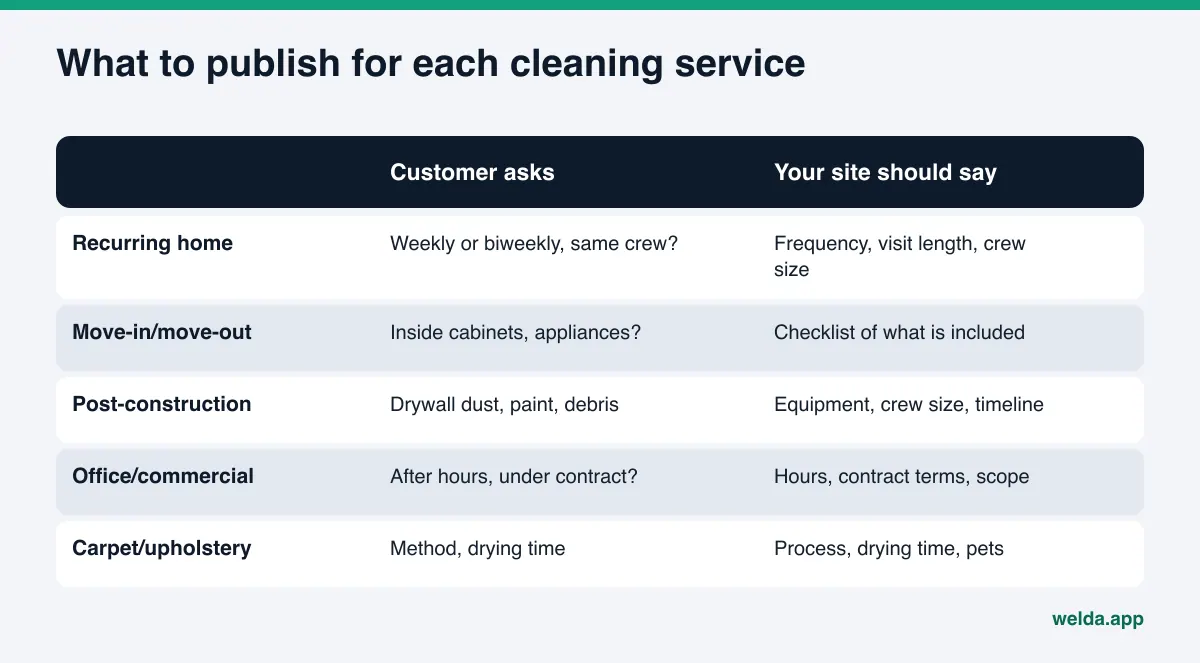
Where AI engines get information about cleaning companies
AI engines read several sources together and speak with more confidence when the same facts appear in more than one place. For a cleaning business in the US, those sources fall into four groups.
- Your own website. Services, service area, how a visit works, FAQs, and LocalBusiness schema. This is the one source you fully control.
- Google Business Profile and Google Maps. Category, service area, hours, photos, and reviews, plus your replies to those reviews.
- Home services marketplaces and directories. Yelp, Angi, Thumbtack, and Nextdoor recommendations are where many homeowners compare cleaners. A half-finished listing, or one that contradicts your site, leaves the AI unsure.
- Trust and complaint sources. Your Better Business Bureau profile and how you respond to complaints there. A calm, specific reply reads as a trust signal to people and to machines.
A common problem with cleaning sites is inconsistency. The website says "serving the greater Dallas area," the Google profile lists four suburbs, and a directory still shows a phone number from three years ago. An AI engine cannot resolve that conflict, so it leans toward the competitor whose facts line up. Linking your profiles to your site in a machine-readable way helps; we cover the method in our guide to linking social profiles with sameAs.
Pay attention to Google's own rules for businesses like yours. Google defines a service-area business as one that visits or delivers to customers but does not serve them at its address. It asks such businesses to remove the address from the profile, to list service areas by city, zip code, or similar area rather than as a radius, and it allows up to 20 service areas (Google Business Profile Help). Most residential cleaners fit that definition. When the areas on your profile match the areas on your website, the AI can answer "does this company come to Plano?" without guessing.
AEO for cleaning services, step by step
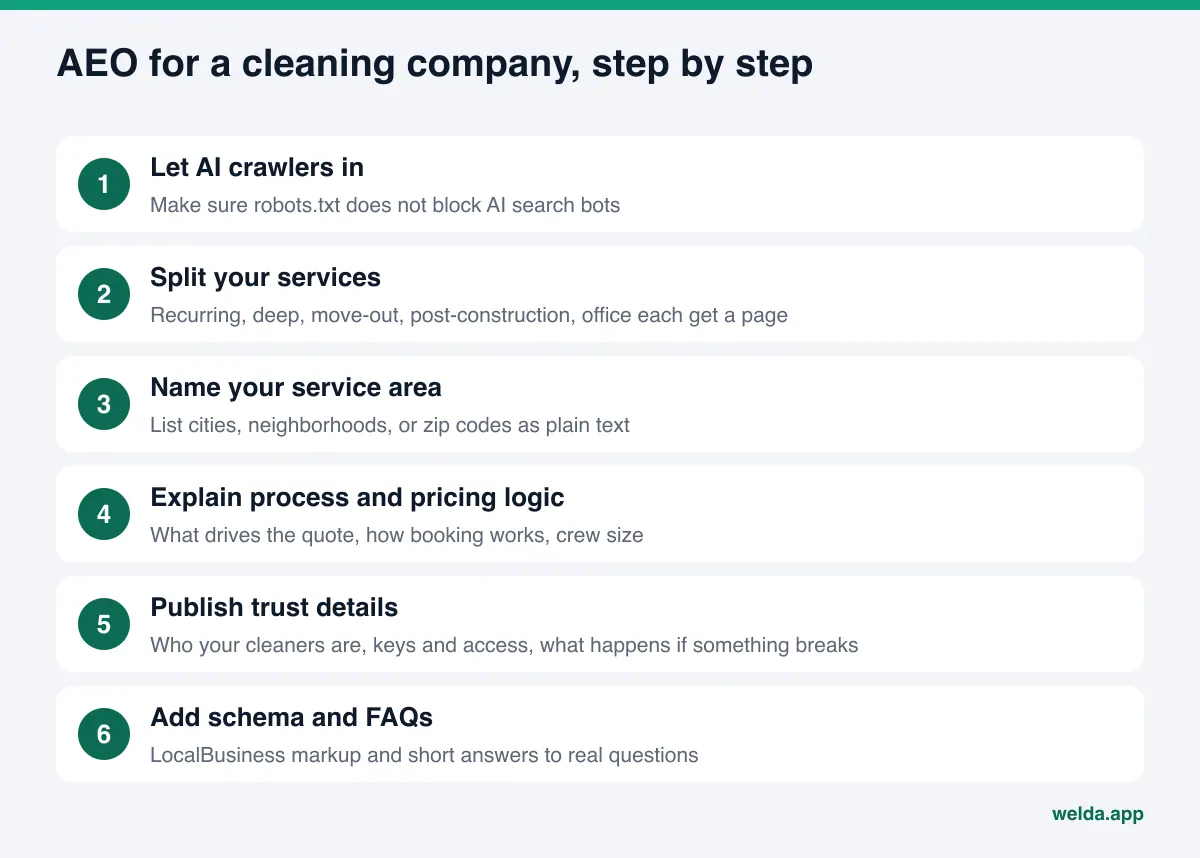
Work through these steps in order. The first is technical; the rest are about writing down what you already know.
- Let AI crawlers in. If your robots.txt blocks AI bots, your pages are not read. OpenAI documents its crawlers separately: OAI-SearchBot surfaces sites in ChatGPT search, GPTBot crawls for model training, and sites that opt out of OAI-SearchBot will not appear in ChatGPT search answers (OpenAI's crawler documentation). Some website builders and security plugins block bots by default, so check rather than assume.
- Split your services. Replace "residential and commercial cleaning" with a section or page for each service: recurring house cleaning, deep cleaning, move-in and move-out, post-construction, office and commercial, carpet and upholstery, windows. On each, state what is included and what is not.
- Name your service area in plain text. List the cities, neighborhoods, or zip codes you cover. A map image is not enough for an AI engine. A sentence such as "We serve Austin, Round Rock, Cedar Park, and Pflugerville; commercial clients only in Georgetown" does far more work.
- Explain your process and pricing logic. You do not have to publish prices, but explain what drives a quote: square footage, number of bedrooms and bathrooms, hours, crew size, condition, whether you bring supplies. Describe how booking works, how much notice you need, how many people arrive, and roughly how long a typical visit takes.
- Publish trust details. Are your cleaners employees or contractors? How do you vet them? How do keys and door codes work? What happens if something breaks or a room is missed? These are the questions customers ask most and cleaning sites answer least. Write only what is true. Do not imply bonding, insurance, or background checks you do not have.
- Add schema and an FAQ section. LocalBusiness markup, or a more specific type where one fits, gives your name, phone, service area, and profile links in a format machines read reliably. Under it, add short answers to the real questions from your inbox.
None of this requires a site rebuild. Most cleaning company websites are four or five pages; the work is putting the right facts on them. We follow a similar playbook for another trade that goes to the customer in how locksmiths get recommended by ChatGPT, where service area and trust play the same role.
Reviews, the FTC, and what not to do
Reviews matter in cleaning more than in most trades, because they are the closest thing a homeowner has to a reference. AI engines read them too, and they pick up recurring themes: "same crew every time," "showed up on time," "they missed the baseboards and came back." That is why the substance of reviews and your replies matters more than the star count alone.
It also means the rules matter. The Federal Trade Commission's rule on consumer reviews and testimonials, announced in August 2024, bans fake reviews, including AI-generated ones, prohibits paying for reviews that express a particular sentiment, and bars using threats to suppress negative reviews (FTC announcement). This is general information, not legal advice; check with your own counsel on specifics. The practical takeaway is simple: ask real customers for honest reviews, respond to every review in a calm and specific way, and never write or buy them.
How Welda handles AEO for a cleaning company
Welda is software that measures where your business shows up in AI answers and prepares the fixes on your behalf. For a cleaning company, three parts do most of the work.
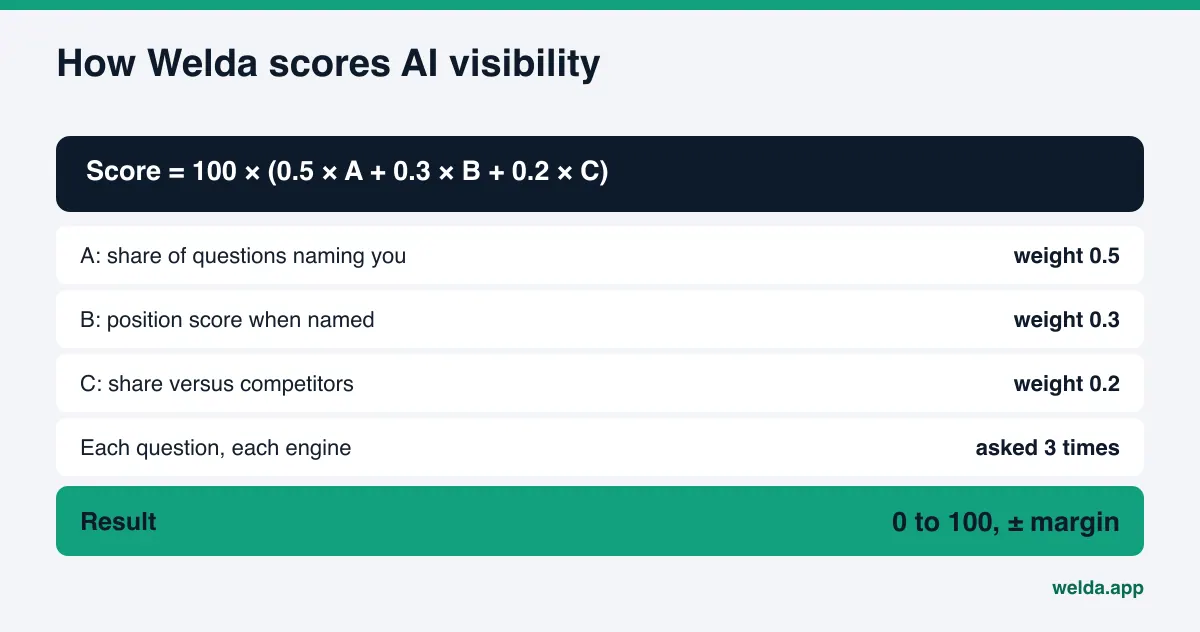
Question-by-question tracking. In the Welda dashboard, the questions your customers would ask are built by combining service type and location: "move-out cleaning in Round Rock," "office cleaning in Cedar Park," "deep cleaning in South Austin." Each question goes to ChatGPT, Gemini, Perplexity, and Google AI three times, because AI answers vary from one run to the next. For each question you see whether you are named and in what position. For a cleaning company, this view can expose a pattern such as this: you appear for recurring house cleaning but never for post-construction or commercial, or you show up in one suburb and not the next. That tells you which service page to write first, instead of guessing. We explain why three repeats matter in margin of error in AI visibility tracking.
Competitors and sources. The competitor view shows on which topics a rival cleaner is ahead and which source the AI is leaning on when it names them. The sources view lists the sites AI engines cite for your questions, such as Google Maps, Yelp, Angi, or the BBB, and whether your presence there is complete, partial, or missing. Instead of trying to keep twelve directory listings perfect, you learn which two or three actually feed the answers in your market.
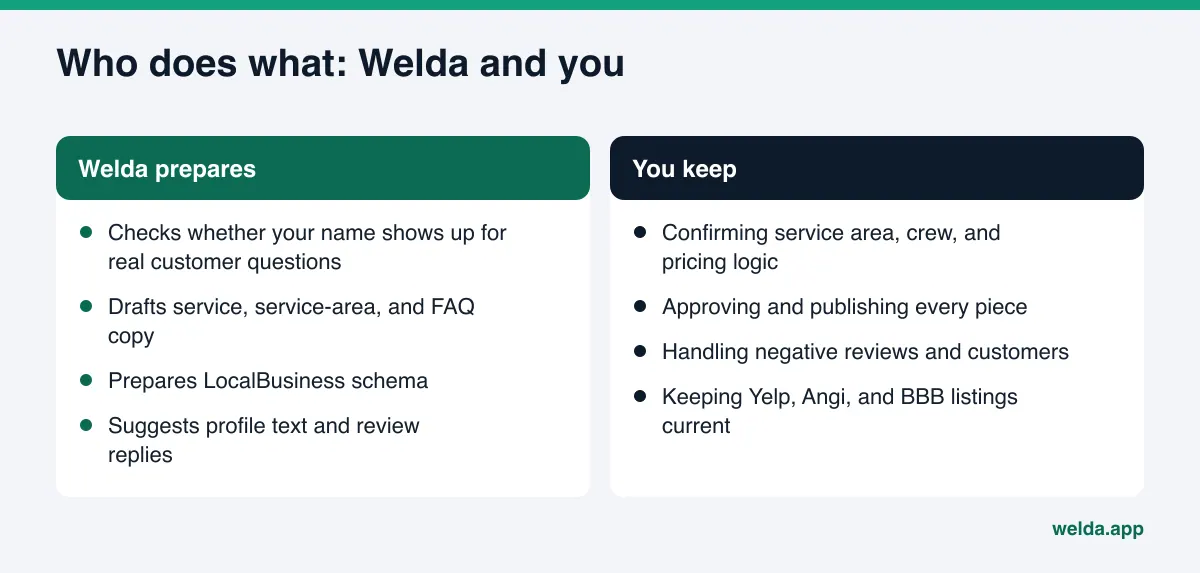
To-do list and ready-made copy. Everything the measurement turns up lands in one to-do list. Welda drafts service pages, service-area copy, FAQs, your Google Business Profile description, and replies to reviews. It does not invent facts. If it does not know how many people are on a crew, which suburbs you cover, or what you do when something is damaged, it asks you, and your answer goes into the copy. On WordPress sites, Welda connects through a separate Editor user and an application password, with no code to install; drafts open on your site as drafts and go live only when you approve them. On other platforms, you receive a ready-to-apply package. Google Business Profile, Instagram, and Facebook can be connected; if they are not, the task is listed as manual.
The dashboard also includes a one-page monthly report and a before-and-after view, but for a cleaning company the value sits in the three parts above.
Here is the honest status. The free site analysis works today in English, for anyone. It reads your homepage and several inner pages, scores technical and content signals out of 100, explains each gap and how to fix it, suggests ready-to-use homepage copy, simulates which fixes would raise the score most, compares you with competitors, and hands you a fix package that includes LocalBusiness schema. It also asks an AI assistant with web search five questions your customers might ask and checks whether your name appears; that is a one-time snapshot, not ongoing tracking. The full Welda dashboard is in early access and is opening first in Türkiye. Regular four-engine tracking is being added during early access, and dashboard examples are shown with representative data. Pricing is discussed in an early access conversation.
Example scenario: a two-crew residential cleaner
This scenario is illustrative and does not describe a real business. Picture a residential cleaner with two crews of three working the north side of a mid-sized metro. The website has three pages: a homepage headline that reads "Professional Cleaning Services," a bullet list of services, and a contact form. The Google Business Profile is live, but no service area is set and the description field is empty. The company also has a Yelp page and an Angi listing, each created years ago by different people.
The owner runs the free analysis first. It shows that the page title and meta description do not say what the company does or where, that there is no LocalBusiness schema, no FAQ section, no link to the Google profile, and that services appear only as a single list. Each finding explains why it matters and how to fix it, and the homepage gets suggested copy for the title, description, main heading, and intro paragraph.
In week one, the owner rewrites the homepage, adds separate sections for recurring cleaning and move-out cleaning, lists the six cities the crews actually cover, and installs the schema from the fix package. In week two, a "How we work" page goes up: crews are employees, keys are logged and returned, and a missed spot gets a free return visit within 48 hours (in this example; write your own policy). The same six cities are set as service areas on the Google profile, and the Yelp and Angi listings are updated to match. Changes like these usually take weeks to show up in AI answers, so seeing nothing in the first few days is normal.
Limits: what Welda does not do
- No ranking guarantees. Welda does not promise first place in ChatGPT or any other position. No software or agency controls AI answers. If someone promises otherwise, read how local SEO and AEO differ before you sign anything.
- No fake reviews. Welda does not write reviews or suggest buying them. It drafts replies to real ones.
- No invented facts. Insurance, bonding, background checks, crew size, and service area are things only you know. Welda asks.
- No publishing without approval. Every piece of copy comes to you first. Your content stays on your own site; Welda does not host it.
- Some work stays with you. Handling negative reviews, managing directory accounts such as Yelp, Angi, and the BBB, and any press outreach remain your job. Welda can suggest text, but it does not run those accounts for you.
The free analysis has its own limits: it does not measure rankings and does not guarantee them. It tells you what it found, why it matters, and how to fix it.
Checklist and decision guide for cleaning companies
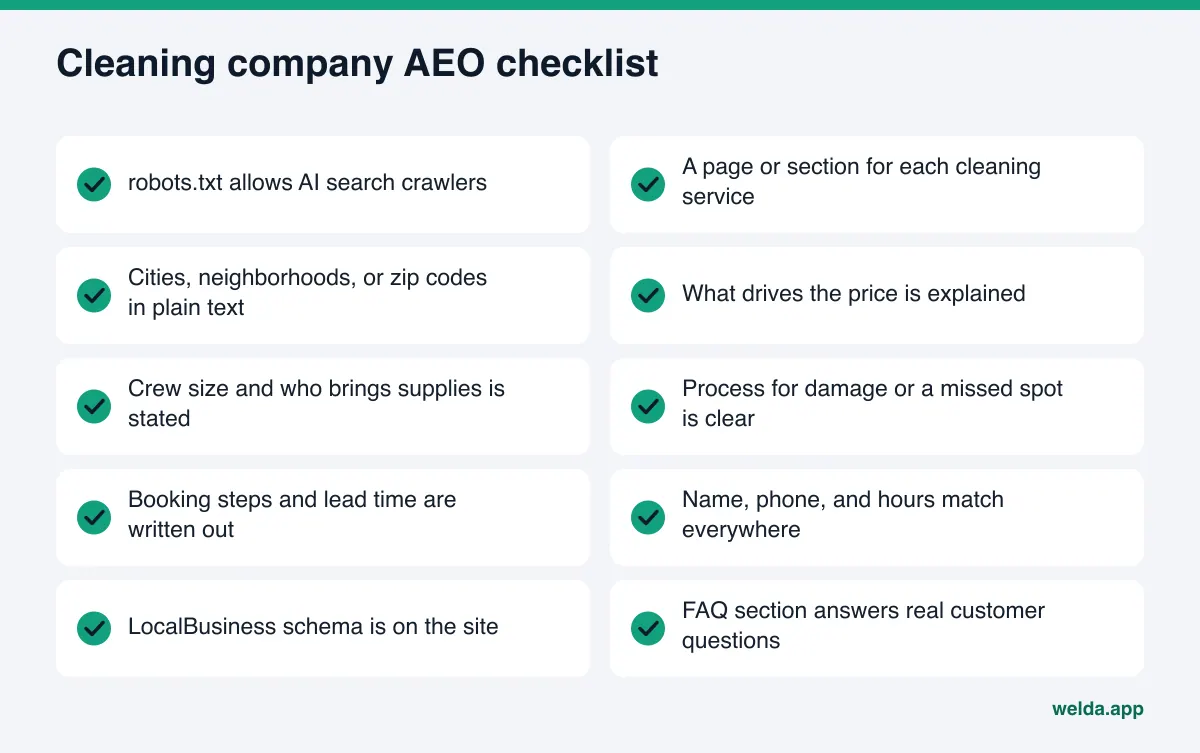
The checklist shows what is missing. The real decision is whether you handle it yourself or with software. These criteria help.
- If you can edit your own site and set aside an hour or two a week, the free analysis gives you enough to take the first steps alone.
- If you offer several services across many suburbs, tracking which question you win and lose by hand gets messy fast. That is where question-by-question measurement pays off.
- If a competitor keeps showing up and you do not know why, seeing which source it wins from is the first thing you need.
- If you know the facts but have no time to write, ready-made drafts with an approval step fit how you work.
Whichever path you choose, measure on a schedule. A new service page takes weeks to register in answers, and if you do not check afterward you will not know what worked. For a parallel walkthrough in another trade that goes to the customer, see AEO for auto repair shops.
Frequently asked questions
How long does AEO for cleaning services take to show results?
New content usually takes weeks to show up in AI answers. Timing depends on the engine and how often your pages are crawled. Measuring a few weeks apart gives a far more reliable picture than checking on a single day.
Do I need to publish my prices?
No. But explaining what drives a quote helps: square footage, bedrooms and bathrooms, hours, crew size, condition, and supplies. When someone asks how house cleaners charge, AI engines tend to name the companies that actually explain it.
Should I build a separate page for every city I serve?
Thin, near-duplicate city pages do not help. A clear service-area page listing every city or zip code works better, with separate sections only where you genuinely offer something different, such as commercial-only coverage in one area.
Is a Yelp or Angi listing enough?
It helps, but it is not enough on its own. Marketplace listings can be one of the sources an AI cites, but if your own site and Google Business Profile do not state the same facts, the AI has a harder time recognizing you. Consistency matters more than the number of listings.
Can Welda write reviews for my cleaning business?
No. Welda does not produce reviews. It drafts replies to reviews from real customers. Fake reviews are also prohibited under the FTC's rule, so the answer would be no either way.
Does the free analysis work for US businesses?
Yes. The free site analysis works in English and checks crawler access, title and description, LocalBusiness schema, contact consistency, FAQs, reviews and trust signals, service clarity, and page speed. It is free once per site; you verify your email and phone, and your results link arrives by email and stays open for 14 days.
Where does your cleaning company stand in AI search?
Homeowners and office managers are asking AI assistants for cleaners, not only scrolling search results. Getting named in those answers starts with writing down, clearly and consistently, what you clean, where you go, and how a visit works. Start by seeing where you are today: run the free site analysis and find out in a few minutes how AI engines read your site and which gap to close first.