How do you show up in Claude answers? Claude knows about a business from two places: what the model learned during training, and what it finds in a live web search when someone asks a question. To be found in that search, Anthropic's search and user bots must be allowed on your site, your site must state plainly who you are and what you do, and the third-party sources that describe you must agree with each other. All of that is in your hands. The outcome is not, and nobody can promise it.
This guide is for owners and marketing leads who have noticed that some customers now ask Claude, not only ChatGPT, for recommendations. It covers where Claude gets its information about a business, the practical steps for how to show up in Claude answers, a simple way to test Claude by hand, and where Welda fits. One honest note up front: Welda's dashboard does not track Claude today. But the groundwork that lets Claude read your business is largely the same groundwork every answer engine needs, and that is the part Welda checks. If you want to see where your site stands on that groundwork, start with the free site analysis.
Why Claude deserves its own question in your AEO plan
Claude is an AI assistant built by Anthropic. People use it to draft emails, summarize documents and write code, and a growing share of everyday conversations are buying decisions: "Can you recommend a pediatric dentist in South Austin who takes new patients?", "Which family-friendly hotels near Lake Tahoe are quiet in winter?", "What should I look for in a roofing contractor in Denver?". The assistant names a few businesses, gives short reasons and often links its sources.
The work of earning a place in those answers is usually called AEO, answer engine optimization. You will also see it called GEO (generative engine optimization) or simply AI search visibility; they describe the same job. Most AEO advice is written with ChatGPT and Google's AI Overviews in mind. Claude is worth treating separately for one reason: its audience and its retrieval are not identical to the others. A business can appear in ChatGPT and be missing in Claude, or the other way around. Two assistants answering the same question differently is normal, and so is one assistant answering differently on different days. We cover the reasons in our piece on why AI answers change every time.
The practical consequence for a US small business: you do not need a separate Claude project. You need the same fundamentals, plus one Claude-specific check. Anthropic uses named crawlers, and many sites block them by accident through a security plugin, a CDN setting or a robots.txt rule someone added years ago.
Where does Claude get information about your business?
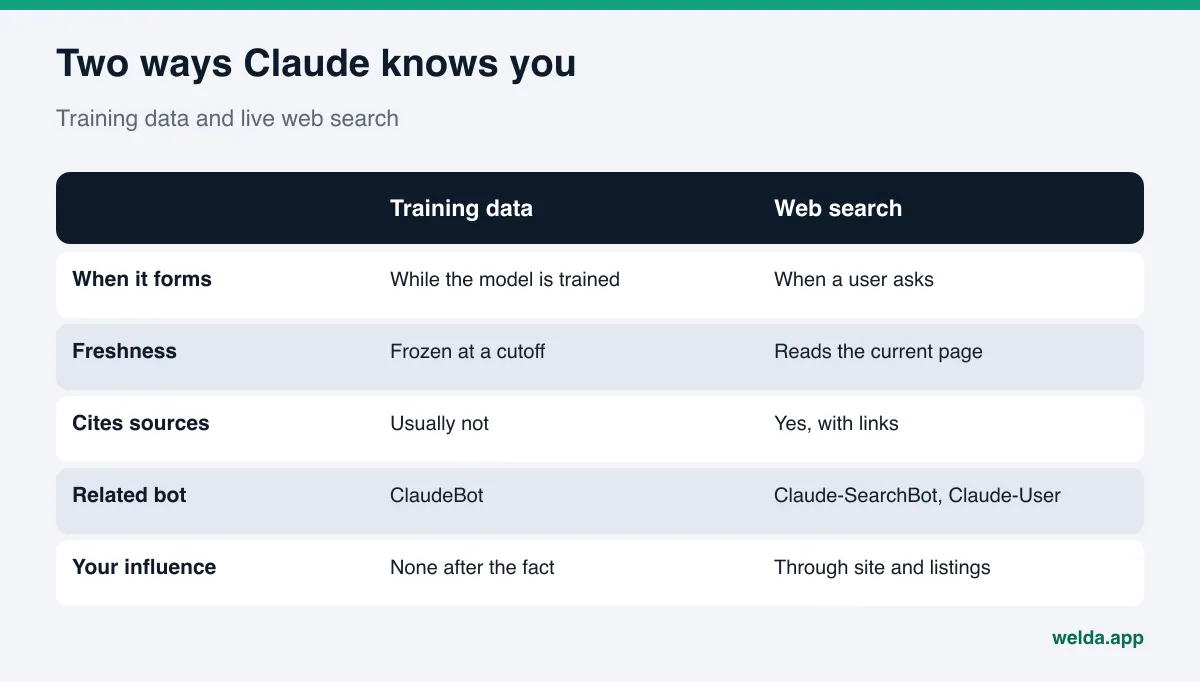
There are two paths. The first is training data. While a model is trained it reads a large amount of public web content, and that knowledge is frozen at a cutoff date. It does not know that you moved last spring or added Saturday hours last month. The second path is web search. When a question calls for current or local information, Claude can search the web, open pages and cite them in its answer.
Anthropic announced web search in Claude on March 20, 2025, and a May 27, 2025 update said it was available globally on all Claude plans. The same announcement says Claude provides direct citations when it uses web information (Anthropic's web search announcement). For a local business, this is the part that matters. Questions with "near me", a neighborhood name or "open now" are the ones most likely to trigger a search, and that is when Claude may read your site or the listings that describe you.
Anthropic's help center lists three separate bots and explains that each can be allowed or blocked on its own in robots.txt (Anthropic help center, as of November 2026). Here is what each one does.
| Bot | What it does | If you block it |
|---|---|---|
ClaudeBot | Collects web content that may be used to train models. | Your future content is excluded from training. It does not affect the other two bots. |
Claude-SearchBot | Crawls and indexes pages to improve search results for users. | Your pages are not indexed for search, which may reduce your visibility and accuracy in Claude's search results. |
Claude-User | Fetches a page when a user's question needs it. | Claude cannot read your page while answering that user. |
The decision follows directly. Blocking ClaudeBot is a legitimate choice if you do not want your content used for training. But if you want to show up in Claude answers, Claude-SearchBot and Claude-User need to be allowed. A blanket "block AI bots" rule that catches all three closes the door before anyone knocks.
How to show up in Claude answers: step by step
None of these steps is a Claude trick. Each one makes it easier for any assistant to identify you correctly. Doing them in order helps you tell which change made a difference.
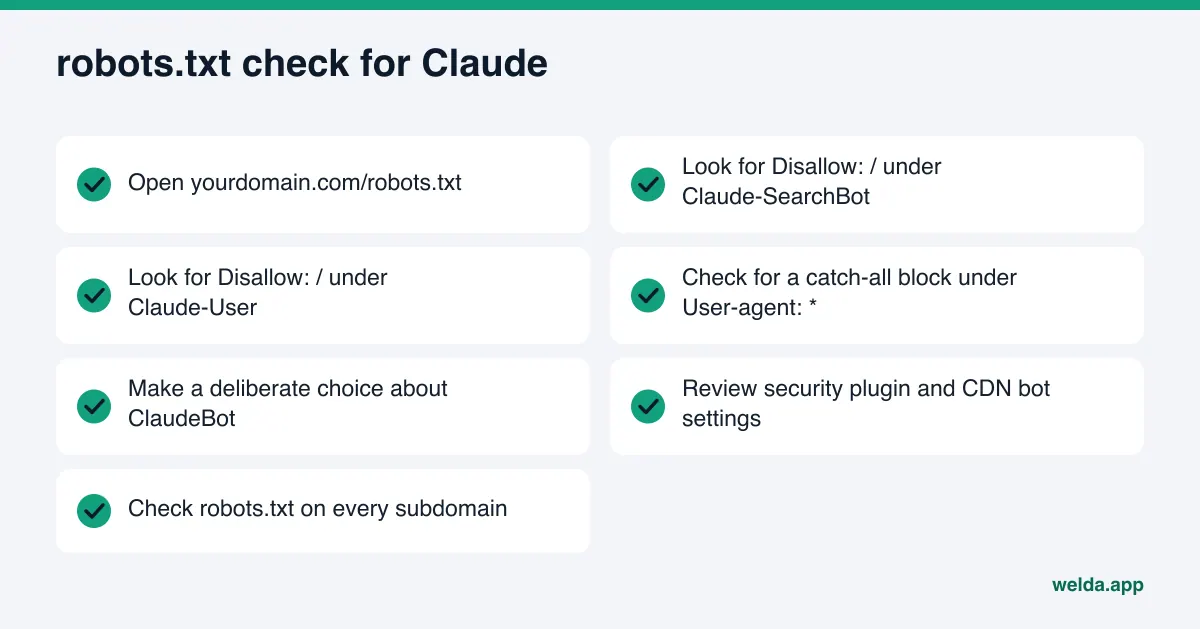
- Open your robots.txt and read it. Add
/robots.txtto your domain in a browser. Look forDisallow: /underClaude-SearchBot,Claude-User, or a catch-allUser-agent: *. Check your security plugin and CDN bot settings too; a one-click "block AI crawlers" option can add rules you never see in the file. - Say what you do in your homepage's first paragraph. Name the service, the city and the neighborhood in one or two plain sentences. Assistants find it easy to quote a clear opening line and hard to infer one from a slogan.
- Add business information as structured data. Schema markup states your name, address, phone, hours and business type in a format machines read reliably.
- Write each service as text on its own page or section. A menu image or a scanned PDF price list is hard for an assistant to read. Put the same information in plain text.
- Add a real FAQ. Answer the questions customers actually ask: Do you take walk-ins? Is parking available? Is the first consultation free? Short, factual answers are easy to cite.
- Make your listings match. Your name, address and phone should be identical on Google Business Profile, Apple Maps, Yelp, the BBB and the directories in your industry, such as Healthgrades for medical practices or Angi for home services. Mismatches lead to wrong answers; see our guide on wrong address or phone number in AI answers.
- Keep reviews and trust signals visible. Reply to genuine reviews on Yelp, Google and Tripadvisor where they apply. List licenses, certifications and memberships on your site.
- Test by hand and keep notes. Use the method in the next section and record what you see with dates.
If your site runs on WordPress, most of these changes happen in a few predictable places: the theme's homepage block, an SEO plugin's schema settings and the security plugin's bot rules. Our WordPress AEO guide walks through them.
How to test whether you show up in Claude answers
The most honest way to see your Claude visibility today is to ask Claude the questions your customers ask. One question asked once will mislead you, because answers vary. Build a small, repeatable routine instead.
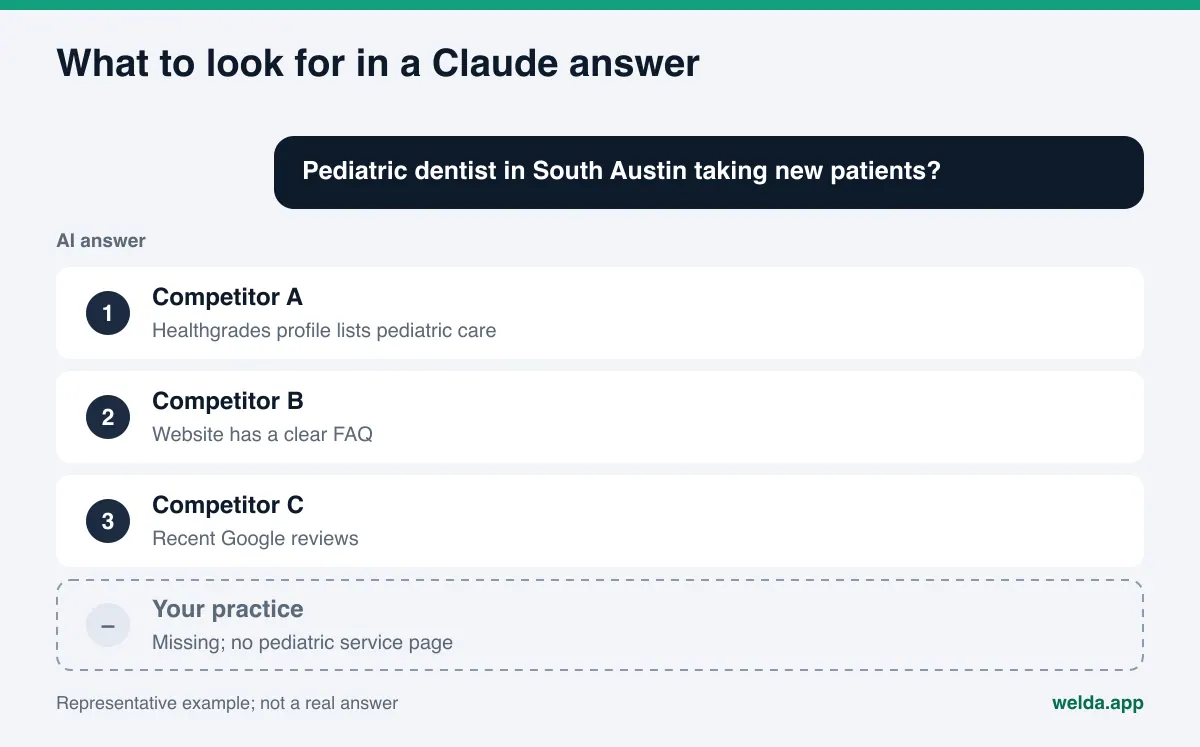
Write your question list first, in the customer's words rather than your marketing copy. "Best boutique hotel" is your phrase; "quiet adults-only hotel in Sedona with a pool" is theirs. Ask each question in a fresh chat so an earlier conversation does not color the answer. Record whether you are named, in what position, which competitors appear and which sources Claude links.
| Question type | Example | What to check |
|---|---|---|
| Service and place | "Pediatric dentist in South Austin taking new patients?" | Are you named, is the neighborhood right |
| Comparison | "Which dental offices near me are open Saturdays?" | Which competitors appear and why |
| Facts | "Where is [business name] and what is its phone number?" | Address and phone current |
| Trust | "What do reviews say about [business name]?" | Which sources Claude quotes |
| Price and terms | "Is the first visit free, and how do I book?" | Does it match your site |
These questions are examples; adapt them to your trade. Ask each one at least three times on different days and look at the pattern, not one answer. The same habit works for other assistants. Perplexity, for example, shows its sources prominently, and our guide on how to rank in Perplexity uses a similar method. For a structured routine on Google's assistant, see Gemini visibility tracking.
What Claude's citations tell you
When Claude answers from a web search, the cited links are the most useful part of your test. They do not only say "you are missing"; they hint at why. Next to each business Claude names, note the source type.
| Source cited | What it may mean | Your move |
|---|---|---|
| A competitor's own website | The competitor states its service and location clearly | Write your service pages and FAQ just as plainly |
| A directory or "best of" list | Claude leans on curated lists for this question | Check whether you are listed and whether your details are current |
| Google Maps or a business profile | Location and hours come from there | Bring your Google Business Profile in line with your site |
| Yelp, BBB or an industry review site | Customer experience is shaping the answer | Respond to genuine reviews; never buy or seed them |
| Local news or a blog post | An independent publication mentioned someone | Press is your call; if you have real coverage, mention it on your site |
We say "may mean" on purpose. From the outside, nobody can know exactly why an assistant chose a given source. But when the same source type keeps appearing across several questions, it matters for that cluster of questions. If neighborhood questions keep citing maps and directories, your gap is probably in those listings, not on your homepage.
Keep your results in a simple sheet: date, question, named or not, position, competitors, sources. Three months from now that sheet is the only fair way to judge which fixes worked.
How Welda handles this work
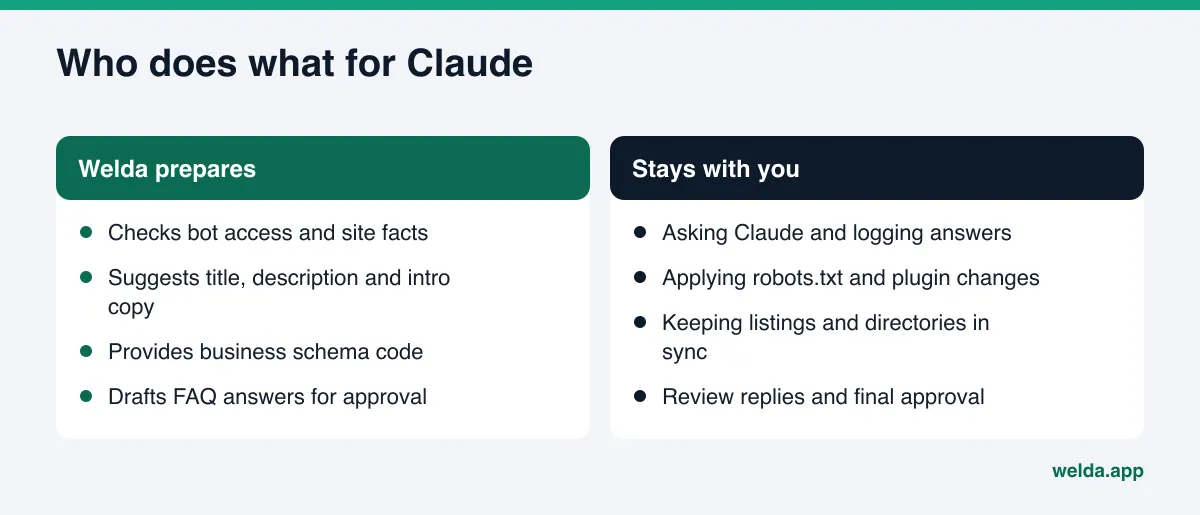
First, the boundary. Welda's dashboard runs its recurring measurement on ChatGPT, Gemini, Perplexity and Google AI. Claude is not one of the four. So Welda will not tell you "you rank third in Claude for this question". For Claude, use the manual routine above. What Welda contributes is the groundwork Claude also reads: checking it, and preparing the fixes.
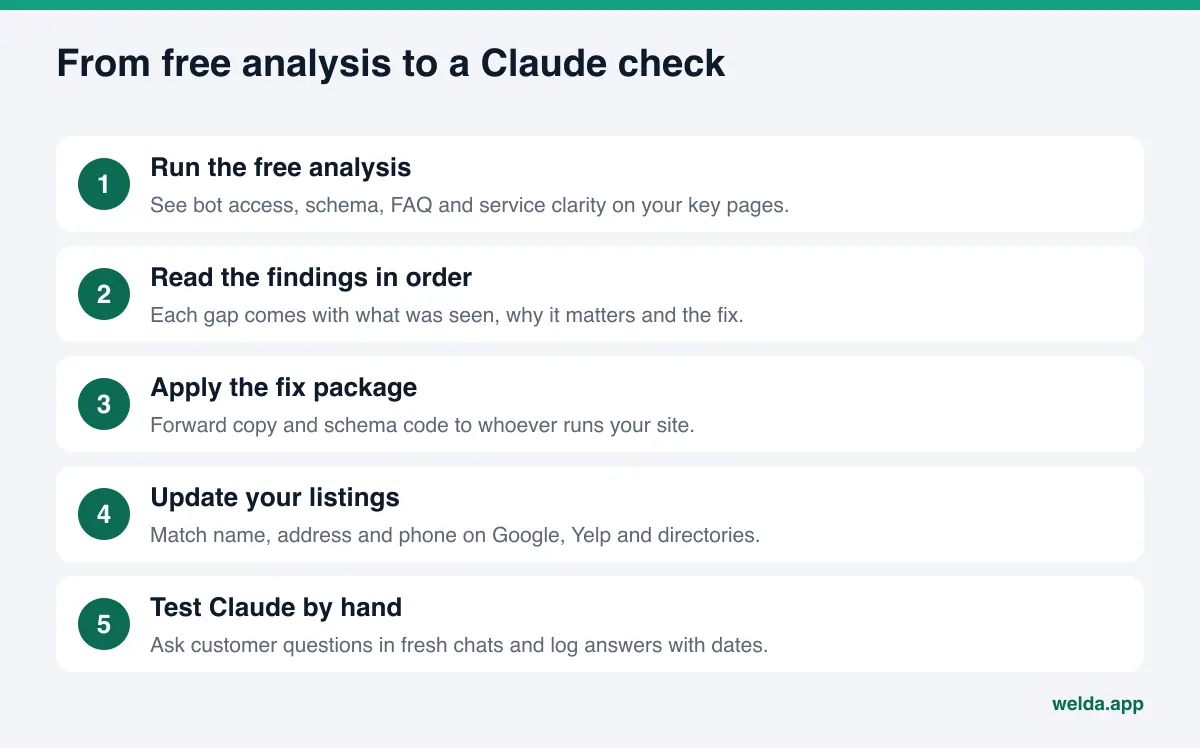
The free site analysis: is Claude stuck at your front door? The free analysis works in English and reads your homepage plus a few inner pages such as services, pricing, about and contact, the way Google and an AI assistant would. One of the first things it checks is whether AI bots can get past your robots.txt. Then it looks at your page title and description, main heading, business schema, whether your address and phone are stated clearly, whether your map and social profiles are linked, whether you have an FAQ, whether reviews and trust signals are visible, whether services are spelled out and how fast the page loads.
For each gap it tells you what it found, why it matters and how to fix it. You get suggested homepage copy (title, description, main heading, intro paragraph and FAQ), a simulation of how much each fix would move your score out of 100, a comparison with a competitor, and a ready-to-install fix package that includes the business schema code. It also asks five likely customer questions to an AI assistant that can search the web and checks whether your business name appears. That is a one-time snapshot, and it is not Claude-specific. The analysis is free once per site; you verify email and phone, and the results link arrives by email and stays open for 14 days. It does not measure rankings and makes no ranking promise.
The practical value for a busy owner: you do not have to hunt down the robots.txt rule, write the schema by hand or guess which FAQ is missing. Findings come in order, with the fix text next to them, and you can forward the package to whoever runs your site.
The Welda dashboard: early access, opening first in Turkey. The full dashboard is in early access and is opening first for businesses in Turkey. Recurring four-engine measurement is being added during early access, and dashboard examples use representative data. In it, each customer question is asked three times on each of the four engines, and you see question by question where your name appears and in what position. When a question misses you on all four, that is often a sign Claude misses you too, because the gap usually sits on your site or in a third-party source rather than in any one engine. Welda then drafts the missing page copy, FAQ and profile text for your approval. It never fills in facts it does not know; it asks you. Content always lives on your own site. Pricing is not published and is discussed in an early access conversation.
Limits: what Welda does not do for Claude
To keep expectations clear:
- It does not track Claude. Recurring measurement covers four engines, and Claude is not among them.
- It does not guarantee you will appear. No tool controls an assistant's answer. Welda prepares the work that is in your control.
- It cannot change training data. What a model learned stays learned. You can fix what search reads, not what the model remembers.
- It does not write fake reviews. It drafts replies to real ones.
- It does not do your off-site work. Handling negative reviews, managing directory accounts and press outreach stay with you.
- It does not publish sensitive content without approval. For healthcare, every piece waits for sign-off. Its compliance check flags risky phrases but is not legal advice.
Timing matters too. New content usually takes weeks to show up in AI answers. Claude's live search might read a page sooner, but nobody can say in advance which question will pick it up, or when.
Common mistakes that hide you from Claude
These are not customer stories. They are configuration problems that can make a site harder for Claude to read. Check each one on your own site.
The blanket AI-bot block. Several security plugins and CDNs offer a single switch to block AI crawlers. Flip it, and search and user bots can go dark along with the training bot. The person who flipped it usually thought they were only opting out of training.
Facts locked in images. Hours, prices or a service menu that exist only as an image or scanned PDF are hard to read reliably. Repeat them as text.
An empty first load. If page content appears only after JavaScript runs, some bots may see a blank page. What the free analysis sees when it reads your homepage is a good proxy.
Old listings. Your previous address on a directory can still be quoted. Fixing your site is not enough; update the old listing too.
Inconsistent names. "Smith Family Dental" on the site, "Smith Dental Care" on Google and "SFD" on Instagram makes it harder for an assistant to connect them.
Checklist: are you ready to show up in Claude answers?
Mark each line yes or no.
- My robots.txt does not block
Claude-SearchBotorClaude-User. - I made a deliberate choice about
ClaudeBot. - My homepage's first paragraph says what I do and where.
- Business schema is on my site, with the correct address and phone.
- Each service is described in text.
- My FAQ answers real customer questions.
- Name, address and phone match on Google, Apple Maps, Yelp and industry directories.
- I asked Claude at least five customer questions and logged the answers with dates.
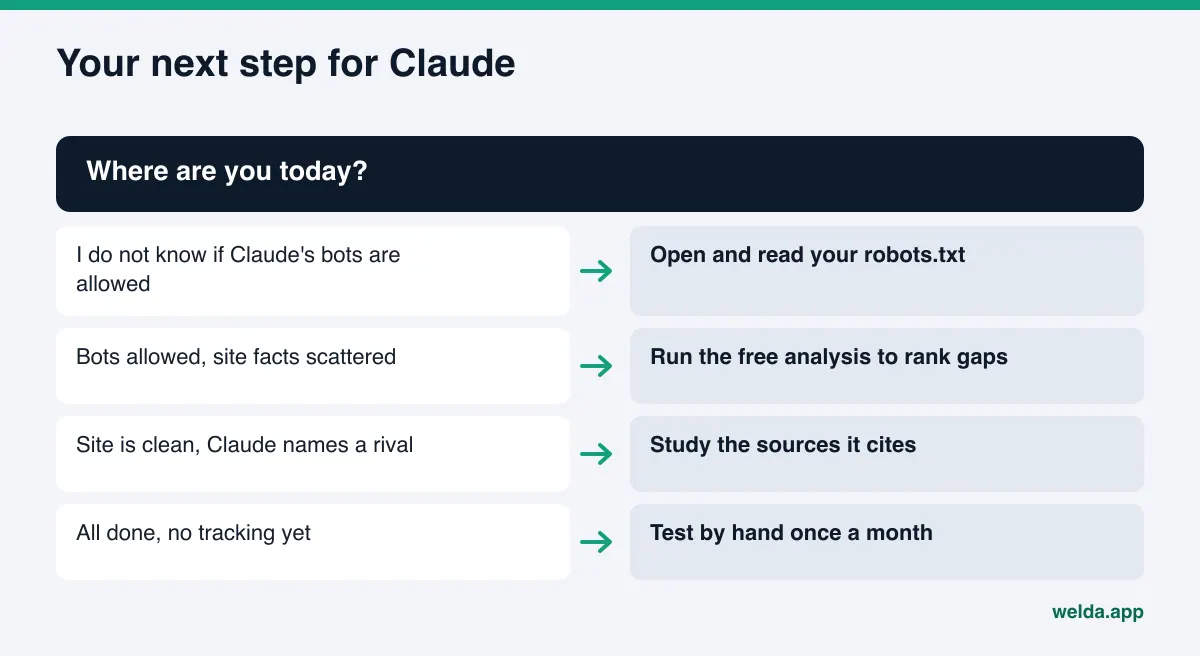
Three or more "no" answers: fix the fundamentals before anything Claude-specific. If you are not sure where to start, the free analysis ranks your gaps by importance. All "yes": keep testing Claude by hand once a month and focus on the sources it cites.
Frequently asked questions
Can I pay to appear in Claude answers?
We are not aware of a way to buy placement in Claude's answers; check Anthropic's own announcements for anything current. The work in this guide is about making your site and listings readable and consistent, and it is separate from advertising.
If I block ClaudeBot, will I disappear from Claude?
According to Anthropic, ClaudeBot collects training data. Search indexing uses Claude-SearchBot, and live page reads for a user's question use Claude-User. Blocking ClaudeBot does not affect the other two, and those two matter most for visibility.
Does Welda measure my visibility in Claude?
No. Welda's recurring measurement covers ChatGPT, Gemini, Perplexity and Google AI. For Claude, use the manual routine in this guide. The groundwork Welda fixes is the same groundwork Claude reads.
How long until changes show up in Claude?
There is no fixed timeline. Training data does not update retroactively. Pages read through live search can be picked up sooner, but new content usually takes weeks to appear in AI answers.
Is AEO for Claude different from AEO for ChatGPT?
The fundamentals are the same: crawl access, clear facts, structured data and consistent listings. The Claude-specific part is knowing Anthropic's bot names and making sure the search and user bots are allowed.
What does the free analysis tell me about Claude?
It does not measure Claude directly. It checks whether AI bots can access your site and how clearly your site states your business information. Those are prerequisites for Claude reading you correctly.
Next step: open the door, then fix the facts
Showing up in Claude answers rests on three layers. The door: Anthropic's search and user bots must be able to reach your site. The site: what you do, where you are and the answers to customer questions must be written plainly. The sources: the directories, maps and review sites that describe you must agree. None of this is unique to Claude, and all of it helps with every answer engine.
The quickest way to check the first two layers today is to run the free site analysis. It reads your site the way an AI assistant would and gives you a fix and ready-made copy for each gap. Then ask Claude your customers' questions yourself and write down what you see.