How do pet supply stores get recommended by ChatGPT? ChatGPT and similar assistants recommend a pet store when they can read, and cross-check, a few plain facts: which neighborhood you serve, which food brands and product lines you carry, whether you deliver or offer curbside pickup, your hours, and what customers say about you on Google, Yelp and elsewhere. If those facts are missing from your website, or your Google Business Profile, Yelp page and Instagram say different things, your store usually does not make the short list. This guide walks through the work step by step and shows which part Welda takes on.
Why AI search visibility matters for an independent pet store
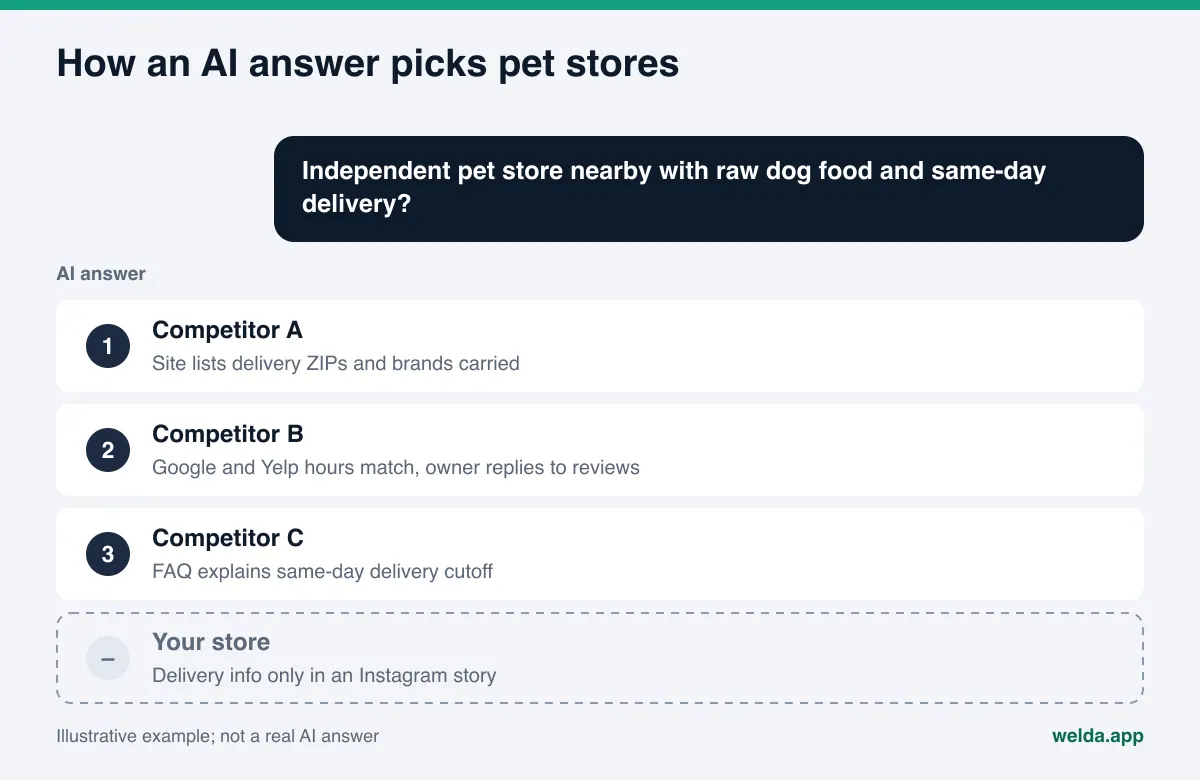
AEO, short for answer engine optimization, is the work of getting your business named inside the answers that ChatGPT, Gemini, Perplexity and Google's AI Overviews and AI Mode produce. You may also see it called GEO, generative engine optimization; in practice the two terms describe the same job. A classic search shows a map pack and ten blue links, and the shopper clicks around. An AI answer usually names three to five stores with a sentence or two of reasoning for each. If you are not on that list, the shopper may decide without ever seeing your name.
Pet owners ask very specific questions. They rarely type "pet store near me" and stop there. They ask things like "Is there an independent pet store in Austin that carries raw frozen dog food and delivers same day?", "Which pet shop near Park Slope is open late on Sunday?", or "Where can I buy live crickets and reptile supplies in Phoenix?" Each of those questions mixes three things: location, product and service. The assistant picks stores where it can find all three written down in one place.
The second reason is repeat business. Food, litter, flea and tick products and treats are bought every few weeks. A customer who finds a store they trust tends to stay for years. People who just moved, just adopted, or are unhappy with their current shop may now put the question to an AI assistant first. Missing that first moment means missing a long run of purchases.
The third reason is the shape of the competition. Your customer is comparing you with other local shops, with big-box pet chains and with online subscription retailers, often in the same answer. The things an independent store does better, such as same-day local delivery, staff who know nutrition, special orders, self-serve dog wash or nail trims, only count if they are written somewhere the assistant can read.
Start by measuring instead of guessing. Welda's free site analysis reads your homepage and a few inner pages the way Google and AI assistants do and lists each gap. If your store also sells online, our guide on how jewelry brands get recommended by ChatGPT covers the product-page side of AEO for retail in more depth.
What does an AI assistant read about a pet store?
AI assistants do not rely on a single source. Assistants that can search the web look for the answer across several sites, combine what they find and write a summary. For your store's name to appear in that summary, two things need to be true: the information has to be written somewhere readable, and different sources have to agree.
For a pet supply store in the US, the sources that tend to matter are:
- Your own website: address, phone, hours, species you serve, product lines, brands, delivery area and services.
- Google Business Profile and Google Maps: category, hours, photos, reviews and your replies.
- Yelp: reviews, photos, business attributes and how you respond.
- Nextdoor and local Facebook groups: neighbor recommendations, which often show up when people ask about a specific area.
- BBB and Reddit threads: complaints, delivery problems, how disputes were handled.
- Local "best of" lists and city blogs: roundups of independent pet stores.
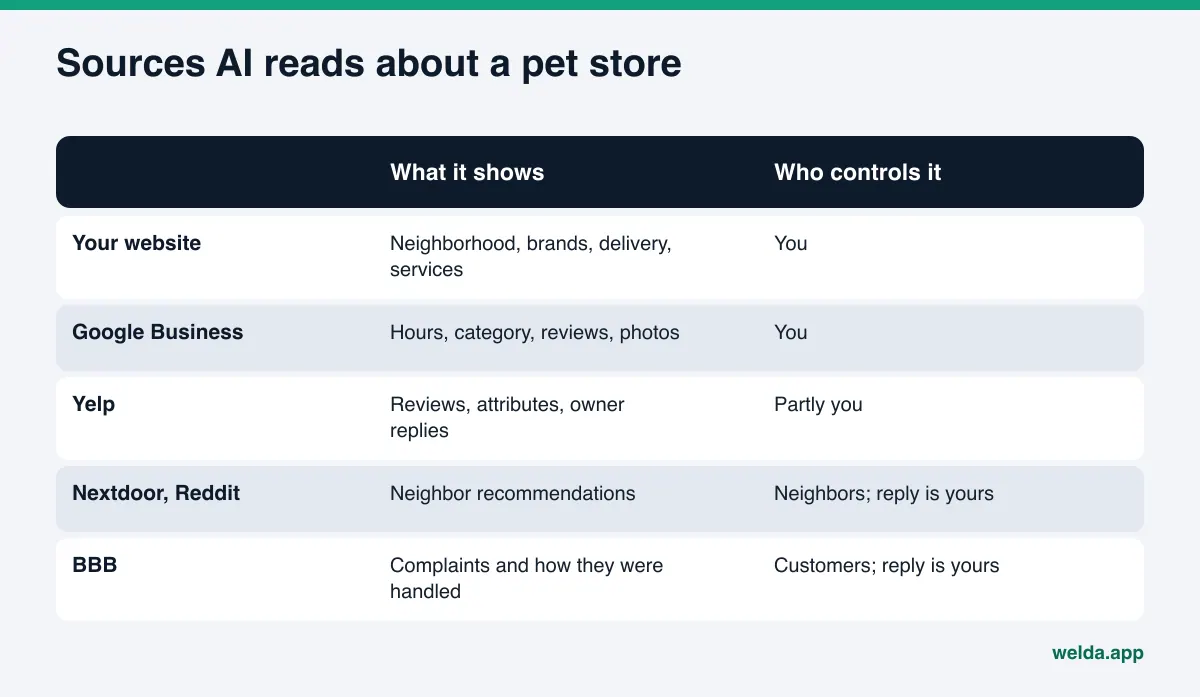
The first two are fully under your control, and that is where most pet stores have the biggest gaps. The website is often a logo, a few photos and a phone number. It does not say which brands are stocked, which ZIP codes get delivery, or whether the store is open on Sunday. Hours on Google differ from hours on Yelp. The suite number is missing in one place. We explain why that matters in our post on NAP consistency for AI search.
How pet supply stores get recommended by ChatGPT: step by step
Most stores can work through these steps in order. The first four happen on your own site and profile and do not depend on anyone else.
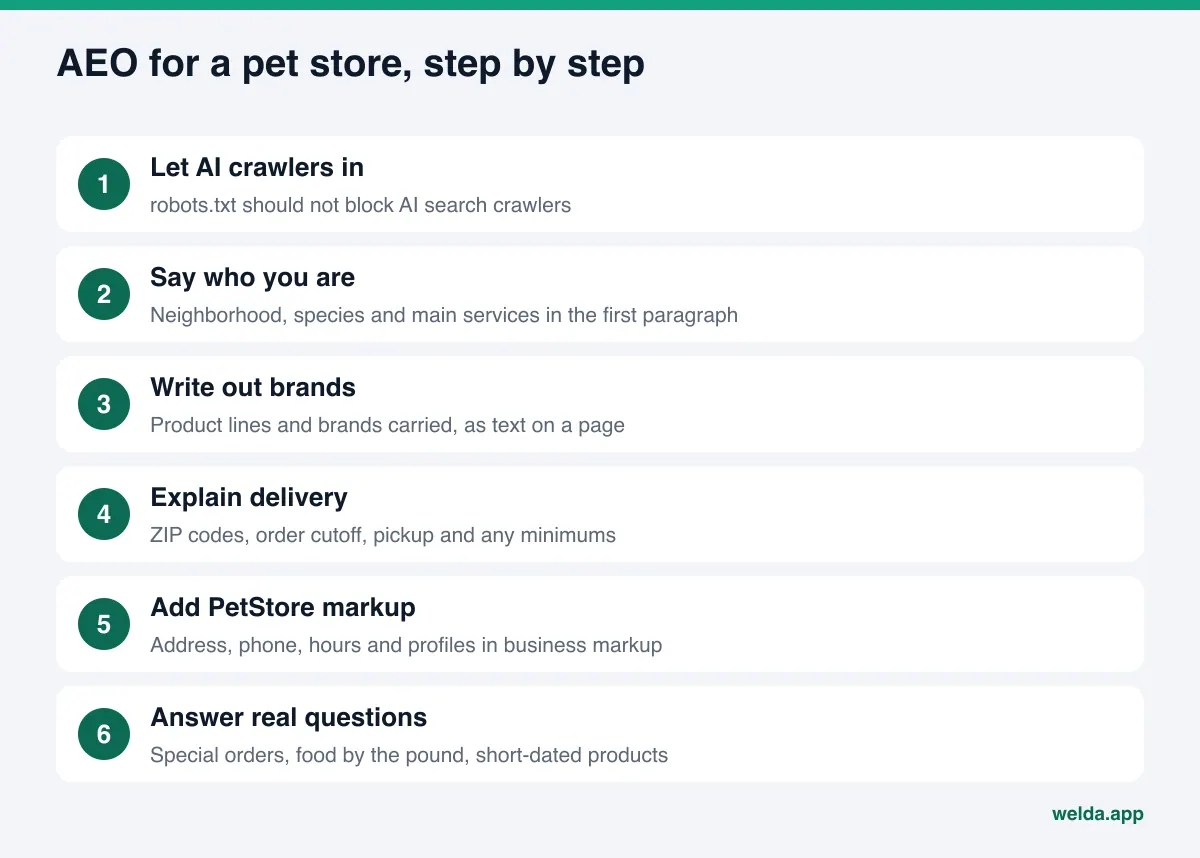
- Let AI search crawlers in. If your robots.txt blocks the crawlers that AI search tools use, the assistant cannot read your pages. OpenAI separates the crawler used for search results (OAI-SearchBot) from the one used for training (GPTBot); the details are in OpenAI's crawler documentation. If you use a hosted ecommerce platform, check once where that setting lives.
- Say who you are in the first paragraph of your homepage. A sentence like "Independent pet supply store in East Nashville carrying dog, cat, small animal and reptile supplies, with same-day delivery inside the 37206 and 37216 ZIP codes" does far more than a tagline. An assistant can reuse it almost word for word.
- Write out your product lines and brands. List the species you serve, your categories (food, litter, toys, leashes, aquarium, reptile, small animal) and the brands you stock regularly on a real page. A photo of your shelves is not information an AI can use.
- Spell out delivery, pickup and services. Delivery ZIP codes, order cutoff, any minimum order, curbside pickup, phone or text orders, special orders, self-serve wash, nail trims or a frequent-buyer program each deserve their own line.
- Add business markup. Schema.org has a dedicated type for this: PetStore. Put your address, phone, hours, geo coordinates and social profiles in that markup. If you sell online, product markup on product pages helps too.
- Answer the real questions. "Can you special-order prescription diets?", "Do you sell food by the pound?", "How do you handle expired or short-dated products?" Short, direct answers on your own site.
- Link your profiles together. Link from your site to Google Business Profile, Yelp and Instagram, and keep the same address, phone and hours on all of them.
- Reply to reviews. Especially delivery delays and freshness complaints. Calm, specific replies help. We cover this in negative reviews in AI answers.
Turning product and service details into something AI can use
The most common problem on pet store websites is not missing information. It is information that exists but cannot be read. The new brand is announced in an Instagram story but never named on the site. The delivery map is an image. The hours live only on the door.
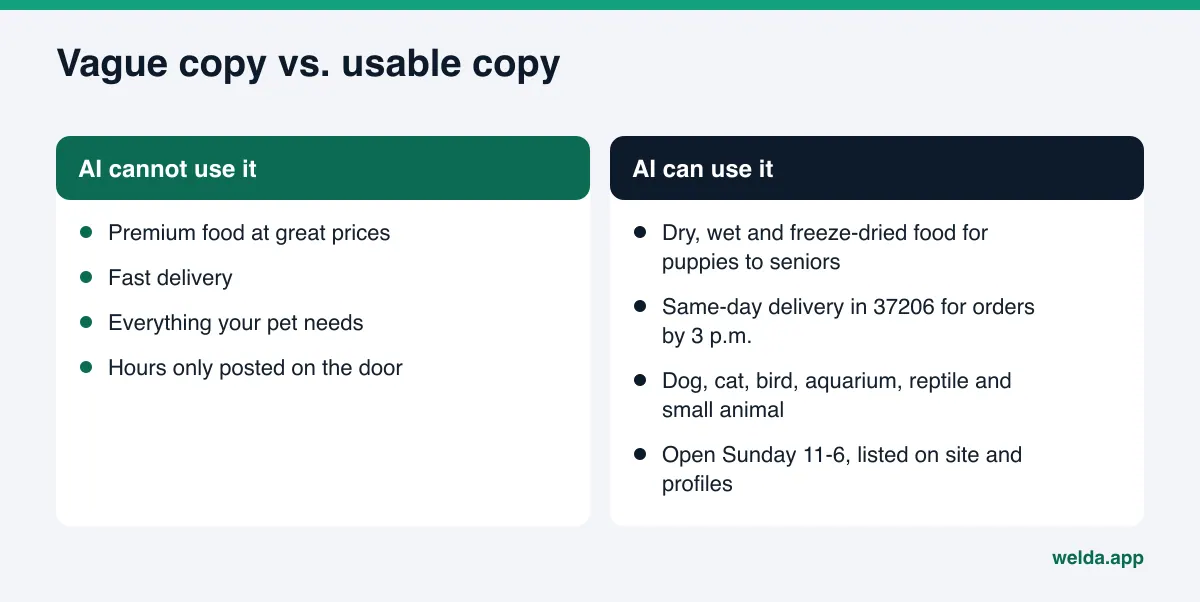
Text an assistant can use is text that answers a shopper's question. Instead of polishing the description, write the detail the customer will ask about: which species, which life stage, which need, which bag size. "Premium dog food" says nothing. "Dry, wet and freeze-dried food for puppies, adults and seniors, from 4 lb to 30 lb bags" can end up inside an answer.
There is one line to watch. Pet store copy drifts easily into health claims: "relieves joint pain", "prevents kidney disease", "cures itching". Claims like these can mislead owners and carry advertising risk. Repeat what the manufacturer states on the label, do not suggest a diagnosis or treatment, and send health questions to a veterinarian. This is not legal advice; for the general framework on superlatives and claims, see "best" claims and advertising rules in AI content.
The table below summarizes the details pet store sites most often leave out and why they matter for AI search visibility.
| Detail | Why it matters | Where to put it |
|---|---|---|
| Neighborhood and full address | Core signal for "near me" and neighborhood questions | Homepage, contact page, business markup |
| Hours, including Sunday and holidays | Answers "open now" and "open Sunday" questions | Website, Google Business Profile, Yelp |
| Species you serve | Separates dog, cat, bird, fish, reptile and small animal questions | Homepage and product lines page |
| Brands you carry | "Store that carries brand X" questions | Brands page or product lines page |
| Delivery ZIP codes and terms | Decisive for "delivers" and "same day" questions | Delivery page, FAQ |
| Extra services | Written proof of what sets you apart | Services section |
| Returns and freshness policy | Read when shoppers ask if you are trustworthy | FAQ, returns page |
Which shopper question needs which piece of information?
Grouping your customers' questions makes it easier to see what your site is missing. The questions below are illustrations, not research data, but you probably hear similar ones on the phone every week. For each group we list what the assistant is looking for and where that answer should live.
| Question type | Example question | Information that answers it |
|---|---|---|
| Location and hours | "Pet store in Midtown open Sunday evening?" | Neighborhood, address, Sunday hours, same hours everywhere |
| Product and brand | "Who near me can special-order a prescription cat food?" | Brand list, special-order policy |
| Species | "Shop that sells live insects and reptile lighting" | Species served, product lines page |
| Delivery | "Pet store that delivers dog food the next morning" | Delivery ZIPs, cutoff time, delivery window |
| Service | "Pet store with a self-serve dog wash" | Services section, walk-in or booking details |
| Trust | "Does this store ship short-dated food?" | Returns, freshness policy, review replies |
A useful test: can you point to a sentence on your site that answers each row? If not, the assistant has nothing to base a recommendation on for that type of question. If you can, the next step is making sure the same fact appears the same way on Google Business Profile and Yelp.
How Welda handles AEO for a pet store
Welda is software that measures where a business shows up in AI answers and fills in the gaps on its behalf. For a pet store, two parts matter most: seeing which shopper questions mention your name, and knowing which sources the AI leans on when it talks about you.
What you can use today: the free site analysis. It reads your homepage and a few inner pages such as services, about and contact. It checks whether your robots.txt lets AI crawlers in, whether you have business markup, whether your address, phone and location are written out, whether your Google and social profiles are linked from the site, whether you have an FAQ, whether your products and services are described clearly, and how fast the page loads. For pet stores, the gaps that show up most often are unwritten services and delivery areas and missing business markup.
For each gap you see what was found, why it matters and how to fix it. You also get ready-to-use homepage suggestions (title, description, main heading, intro paragraph and FAQ), a simulation showing how much each fix would move your score, a comparison with competitors, a fix package you can add to your site including the business markup, and a PDF with a shareable score card. The analysis also asks 5 shopper-style questions to an AI assistant that can search the web and checks whether your store's name appears in the answers. That is a one-time check, and it does not measure rankings. The free analysis works in English.
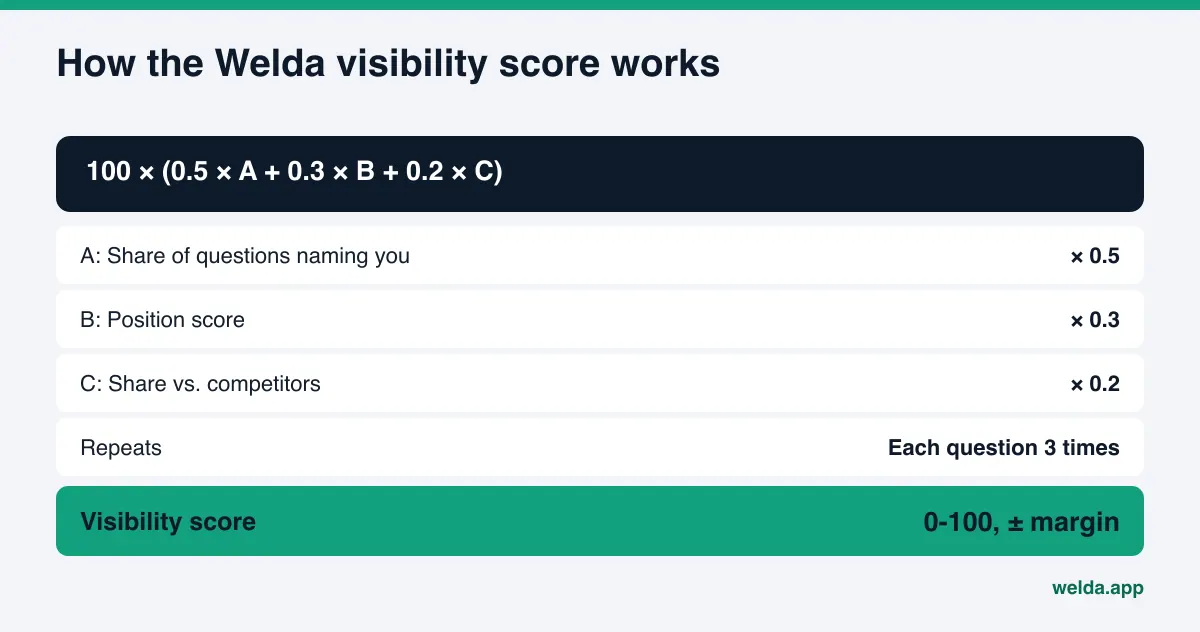
Question tracking in the dashboard. In the Welda dashboard, questions such as "pet store open Sunday in my neighborhood", "store that carries grain-free dog food" or "shop that knows aquarium equipment" are asked three times each in ChatGPT, Gemini, Perplexity and Google AI. The Questions view shows, for each one, which engine named you and in what position. The formula behind the score is public, as shown above. The decision it supports is simple: a cluster of questions where you never appear points to a topic missing from your site. If you show up on product questions but not on delivery questions, your next job is the delivery page.
The Sources view. This view shows which sites the AI relies on to build its answer and where you stand on each: profile incomplete, details unverified, or not listed at all. For a pet store that might mean your Yelp hours are missing, or that a neighborhood Reddit thread about pet shops never mentions you. Each source comes with the next action.
What stays with you. Welda drafts page copy, profile descriptions and review replies; publishing approval stays with you. Content always lives on your own website. On WordPress, Welda connects through a separate Editor user and an application password, with no code to install; drafts open on your site and go live when you approve them. On other platforms, Welda hands you a ready package and you or your developer apply it. A compliance check flags patterns such as price statements, guarantees, superiority claims and diagnosis-like suggestions before publishing; it is not legal advice and has not been reviewed by a lawyer.
Early access, plainly. The Welda dashboard is in early access and opening in stages, starting with businesses in Turkey. Regular four-engine tracking is being added during early access, and the sample dashboard screens use representative data. The part anyone can use today, including in English, is the free site analysis. Pricing is discussed in the early access conversation.
Limits: what Welda does not do for a pet store
- It does not guarantee placement in ChatGPT or any other AI answer and makes no ranking promises.
- It does not invent facts. If it does not know your brands, delivery ZIPs or hours, it asks you.
- It does not write fake reviews or suggest buying them. The FTC's Trade Regulation Rule on the Use of Consumer Reviews and Testimonials prohibits buying or selling fake reviews.
- It does not remove negative reviews; it drafts a reply, and sending it is your call.
- Directory listings, local groups and press outreach stay with you.
- It does not publish sensitive content without your approval.
Timing matters too. New information on your site usually takes weeks to show up in AI answers. Measure once, wait a few weeks, then measure again. Rewriting the whole site every week makes it hard to see what worked. If you want to spread the work over a quarter, our 90-day AEO plan gives you a structure.
Neighborhood shop or online store: does the order of work change?
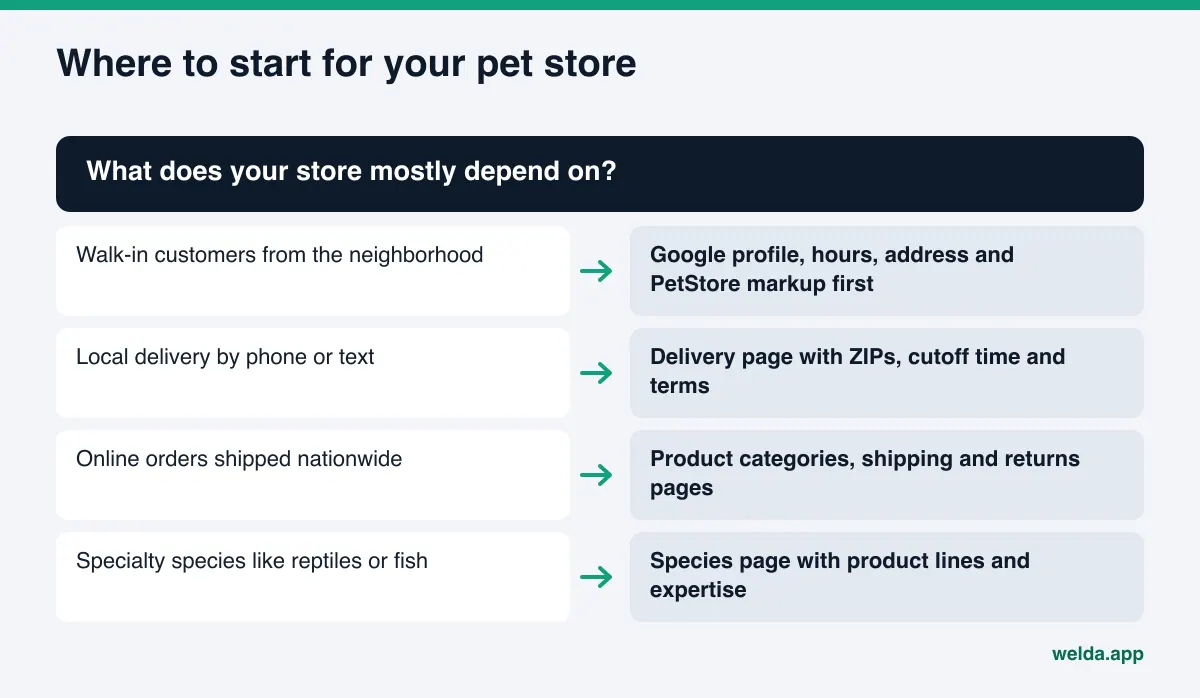
It does. For a neighborhood shop, the assistant looks hardest at location, hours and services. For an online-first pet retailer, product details, shipping times, returns and trust signals come first. Most independent stores are a mix: a physical shop, local delivery by phone or text, and a small online store.
For the neighborhood side: a complete Google Business Profile and Yelp page, the neighborhood and services in your homepage intro, PetStore markup, and delivery ZIPs listed one by one. For the online side: product categories described in text, shipping and returns on their own pages, and trust questions answered. In both cases step one is the same: crawlers can get in, and who you are fits in one sentence.
Take an example. A sample neighborhood pet store shows only a logo and phone number on its site. The analysis shows no business markup, no hours, no link to Instagram and no description of services. The owner applies the homepage suggestions, adds a delivery page and a short FAQ, and matches Google and Yelp hours to the site. This is an illustration; when and how much these changes show up in AI answers cannot be predicted in advance.
Checklist for pet supply stores
Go through this list once. Every "no" is next week's task.
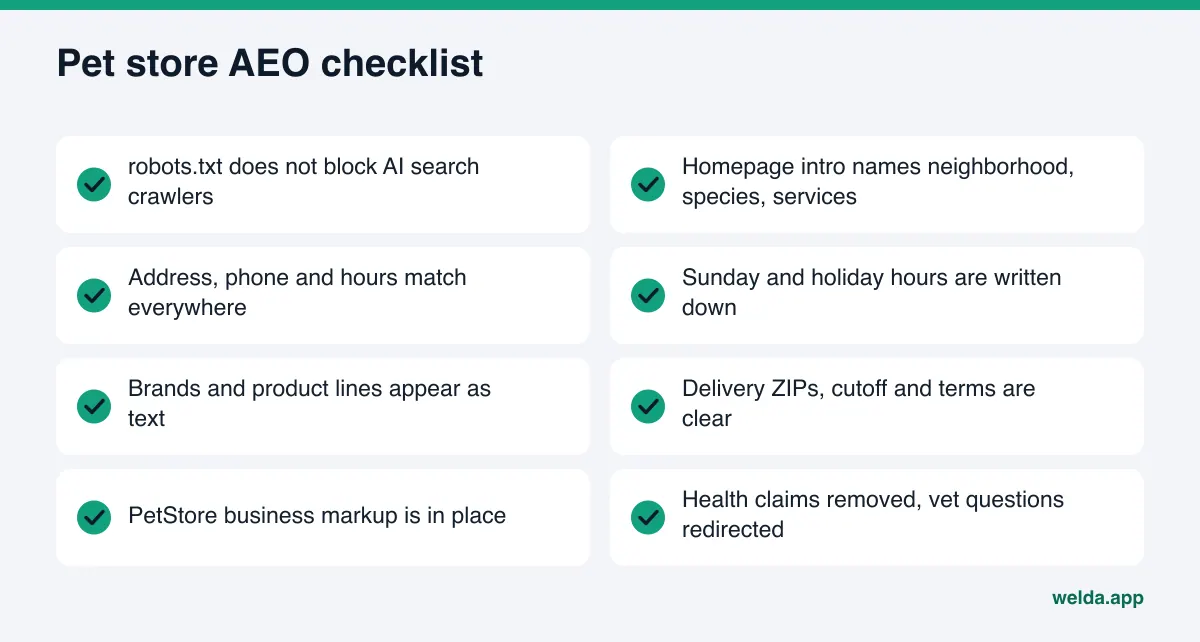
- robots.txt does not block AI search crawlers.
- The homepage intro names your neighborhood, the species you serve and your main services.
- Address, phone and hours match on your site, Google Business Profile, Yelp and Instagram.
- Sunday and holiday hours are written down.
- Brands and product lines appear as text on a page.
- Delivery ZIP codes, cutoff time and terms are clear.
- PetStore business markup is on the site.
- The FAQ answers at least five real customer questions.
- Health claims are removed and health questions point to a veterinarian.
- Negative reviews have calm, specific replies.
Frequently asked questions
Do I need to pay for ads to get recommended by ChatGPT?
No. Recommendations in AI answers are not ad slots. The assistant picks stores based on information it can read and verify. The work is making your site and profiles clear and consistent.
Can a small independent pet store compete with big chains in AI answers?
On questions that mention a neighborhood, same-day delivery or in-store services, an independent store has something concrete to offer. That only shows up in answers if it is written on your site and profiles. There is no guaranteed outcome.
Is it a problem to list the brands I carry?
Listing brands as product information is how you answer "who carries brand X" questions. Check any rules your distributors or brands set on logo and name use.
What does the free analysis show, and how long is it available?
It reads your homepage and a few inner pages, gives a score out of 100 split into technical and content, and suggests a fix for each gap. It is free once per site; your email and phone are verified, the results link arrives by email and stays open for 14 days.
My Instagram is very active but my website is thin. Is that enough?
Usually not. Instagram shows your style and that the store is active, but hours, delivery area and brand lists are scattered there. Your own website is the easiest place for an assistant to read; support it with a link to Instagram.
How long until changes show up in AI answers?
Usually weeks, and it varies by engine. Wait a few weeks after a change before measuring again.
First step: check your store for free
How pet supply stores get recommended by ChatGPT comes down to how clear, consistent and readable your store's information is. Measuring it once tells you what to fix first. Run the free site analysis; the first three gaps in your report can be next week's to-do list.