How do catering companies get recommended by ChatGPT? When someone asks an AI assistant for a caterer, it looks for plainly written facts on your website, your Google Business Profile and your reviews: which events you handle, which areas you deliver to, how many guests you can serve and what is on your menus. If that information sits in a PDF or only comes up on a sales call, your name rarely makes the answer. This guide walks through the fixes step by step and shows which parts Welda handles for you.
How catering companies get recommended by ChatGPT, and why it matters now
AEO, or answer engine optimization, is the work of getting your business named in AI answers from ChatGPT, Gemini, Perplexity and Google's AI Overviews and AI Mode. You will also see it called GEO (generative engine optimization); in practice the two terms describe the same job. The outcome people care about is AI search visibility: when a client asks an assistant for a recommendation, does your company show up?
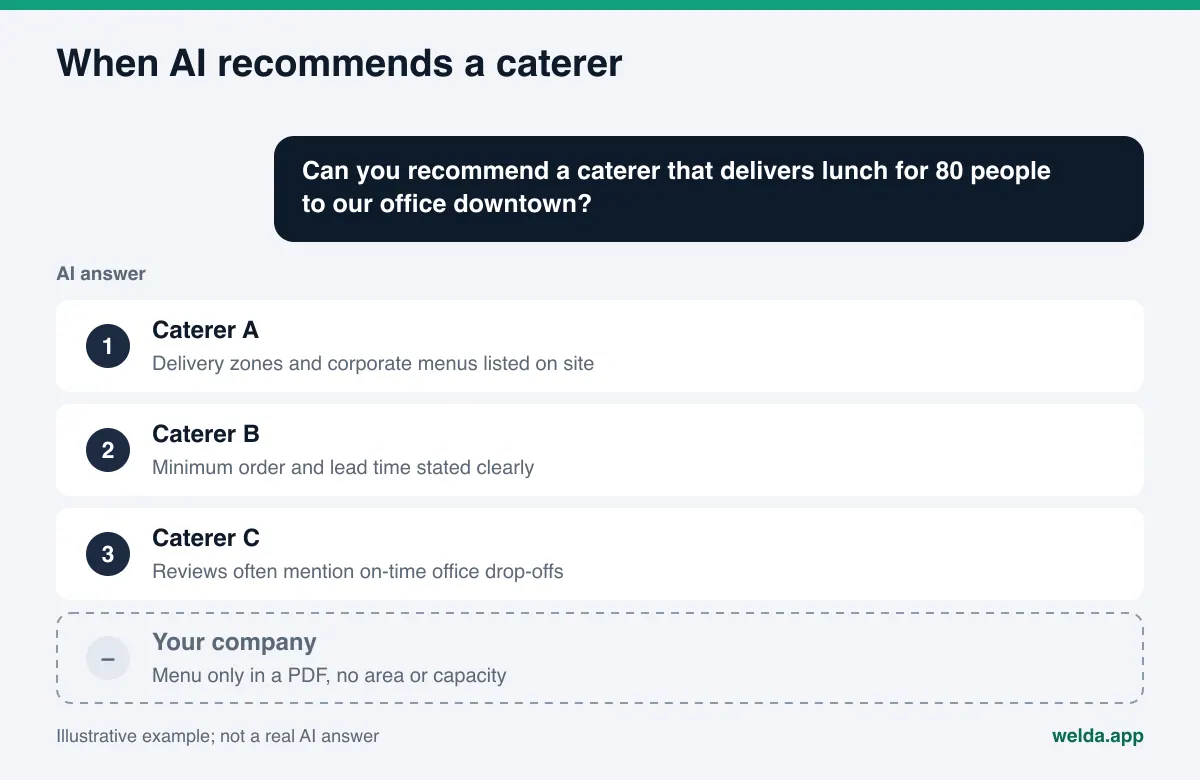
In classic search, a client sees a page of links, opens a few websites and compares. In an AI answer, the client usually sees a short list of three or four names with a sentence of reasoning for each, and the quote requests start from that list. For a caterer, that means AI visibility is less about brand awareness and more about whether you get invited to bid at all.
Catering feels this shift differently from restaurants. Diners come to a restaurant; a caterer goes to the client. Nobody walks past your kitchen and remembers your sign. The buying decision is also rarely impulsive. An office manager needs a weekly lunch vendor. A couple is planning a 150-guest backyard wedding. A marketing team needs passed appetizers for a product launch. These buyers write long, specific prompts, and they include constraints: a neighborhood, a headcount, a date, a dietary need. AI assistants answer those prompts by matching the constraints against what each caterer has actually written down.
The simplest way to see where you stand today is to run Welda's free AI visibility analysis. It reads your home page and a few key inner pages, such as services, pricing, about and contact, the way Google and AI systems read them, and lists every gap it finds. If your business also runs restaurant locations, the guide on AI visibility software for restaurant groups covers the multi-location side.
What do clients ask AI when they look for a caterer?
Catering prompts almost always carry more than one condition. Nobody types "good caterer" and stops. The groups below show the kinds of questions a catering website needs to answer. These are examples written for this article, not results from a measurement or survey.
- Corporate catering: "Which caterers deliver daily lunch to offices in the Loop?", "Who can do breakfast and lunch for a 50-person all-day meeting?"
- Weddings and rehearsal dinners: "Wedding caterer for an outdoor venue that brings its own staff and rentals", "What drives the per-person cost of wedding catering?"
- Private events: "Chef and server for a 15-person dinner party at home", "Graduation party catering for 60 guests in the suburbs".
- Dietary needs: "Caterer with real vegan and gluten-free options", "Kosher-style or halal catering for a corporate event", "Nut-free menu for a kids' party".
- Logistics: "Caterer that delivers on Sundays", "Who can handle a catering order with three days' notice?"
For each of these, the assistant looks for something it can use as a reason. To say "this caterer serves downtown and the north suburbs, handles 30 to 300 guests and offers a vegan menu," those sentences have to exist somewhere it can read. AI assistants do not guess on your behalf. When the facts are missing, they leave you out or mention you with less confidence.
Why are caterers hard for AI search to recommend?
Catering websites tend to share the same gaps. They are not careless; they come from the nature of the business. Pricing depends on the event, menus are customized, and the service happens at the client's venue rather than at your address. That flexibility is a strength in sales, but online it reads as vagueness, and an AI system cannot cite vagueness as a reason to recommend you.
| Common situation | What AI sees | What to write instead |
|---|---|---|
| Menu only as a PDF or image | It may not read the contents | Sample menus as text on the page |
| "We cater anywhere" | It cannot tell where you deliver | Named cities and neighborhoods, travel terms |
| No capacity listed | It cannot tell if you fit an 80-guest event | Minimum and maximum guest count |
| One generic "Services" page | It cannot separate weddings from office lunch | A section or page per event type |
| "Contact us for pricing" only | It cannot explain what drives cost | Pricing factors and how quotes work |
| Address hidden, no area set | It cannot match you to location prompts | Service area on Google Business Profile |
The last row deserves attention. Businesses that do not serve customers at their own address can remove the address from their Google Business Profile and set a service area instead. Google's help page allows up to 20 service areas based on cities, ZIP codes or other areas. When your profile lists the same neighborhoods your website names, the two sources back each other up. For more on how place-based pages work, see the article on location pages for AI search.
Step by step: AEO for a catering company
You can work through the steps below on your own. Each one fills in a fact an AI assistant needs before it can say "this caterer fits the request."
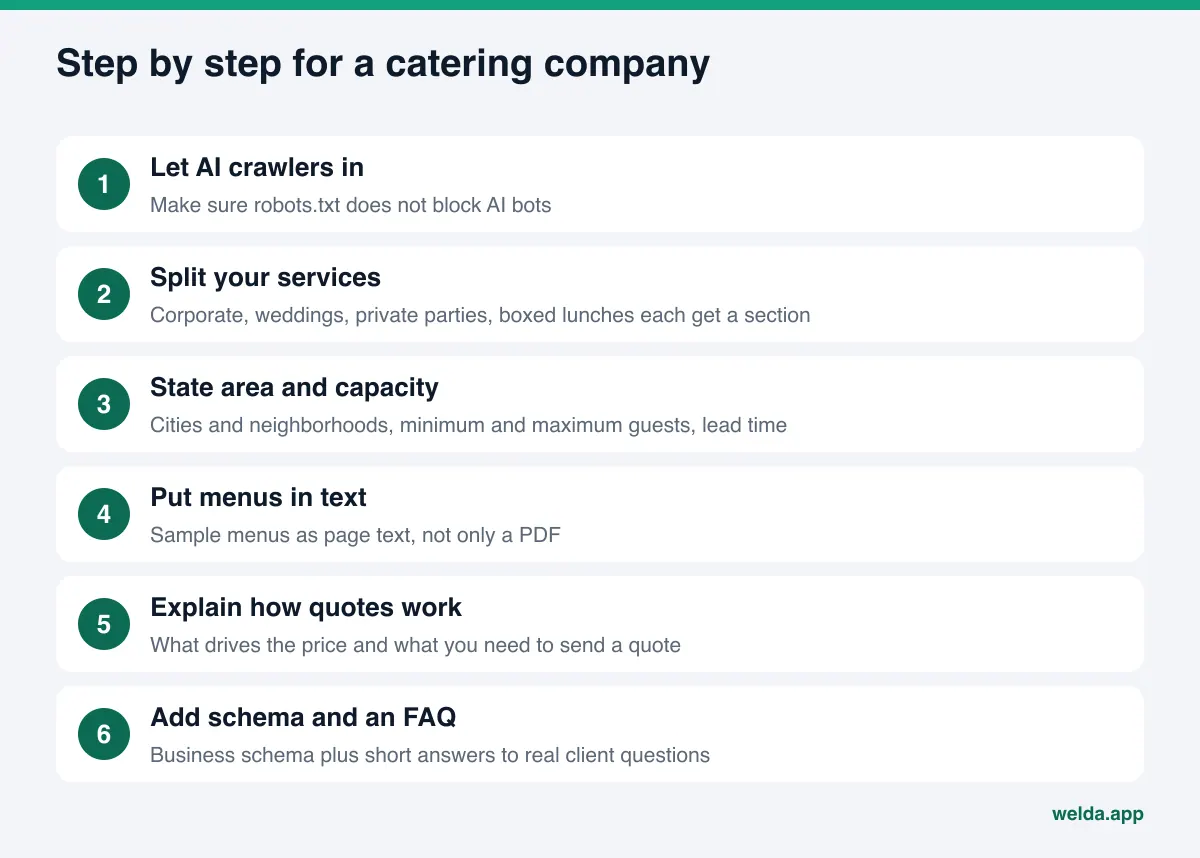
- Check that AI crawlers can reach your site. If your robots.txt blocks AI bots, your content goes unread no matter how good it is. Some themes and security plugins add these blocks without anyone noticing.
- Split services by event type. Give corporate catering, weddings, private dinners, boxed lunches and cocktail receptions their own section or page. Each one should describe its typical menu structure, service style (drop-off, buffet, plated, staffed) and usual guest range.
- Name your service area. Replace "serving the greater metro area" with the cities and neighborhoods you actually cover every week. If remote locations come with a minimum order or a travel fee, say so. If you operate in more than one metro area, give each one its own section.
- State capacity and lead time. Your smallest order, your largest event, how many days' notice you need, and how many events you can staff on one day. These four facts are direct conditions in a large share of catering prompts.
- Put menus in text. Keep the PDF if you like, but publish the content as page text too. List dish names, vegetarian and vegan swaps, and allergen notes.
- Explain how quotes work. You may prefer not to publish prices, which is a reasonable choice. But do explain what drives the cost (guest count, menu, staffing, rentals, distance) and what a client should send you to get a quote. An assistant can then answer "what affects catering cost" using your words.
- Clarify staff and equipment. Do you bring servers, bartenders, tables, linens and dinnerware, or do you only drop off food? Clients planning a backyard wedding or a home dinner decide on exactly this point.
- Add business schema. Your company name, phone, service area, service types and social profile links should also live in structured data. The schema.org FoodEstablishment type offers properties for cuisine, menu and reservations, and areaServed can describe where you deliver.
- Write an FAQ. Collect the questions your sales team hears every week and answer each in two or three sentences. "Do you offer tastings?", "When do you need a final headcount?", "What happens to leftovers?"
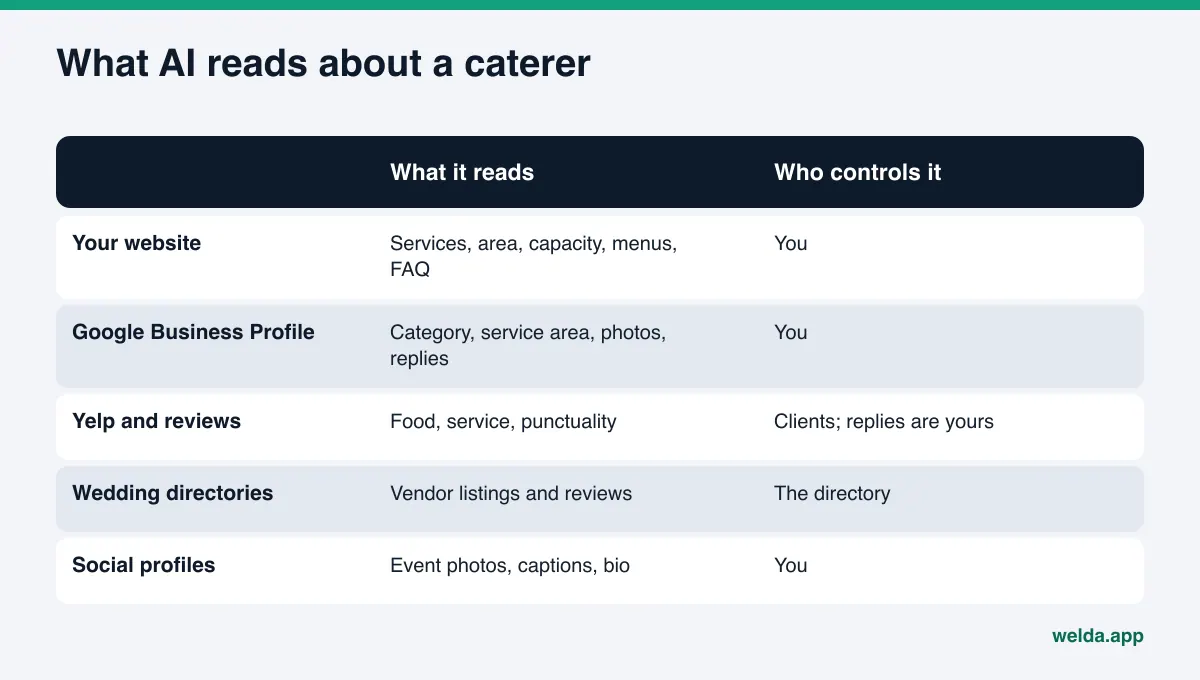
- Align profiles and review replies. Your website, Google Business Profile, Yelp listing and Instagram bio should show the same service area, phone number and service list. When you reply to reviews, mention the event type naturally.
Many caterers sell through event photos on Instagram. That is a good showcase, but the text around a photo is often too thin for AI. Captions that name the event type, the venue area and the guest count help. The article on Instagram and AI search shows how.
Example: rewriting a corporate catering section
To make the steps concrete, here is a corporate catering section from a fictional caterer. The company and details are invented; the point is to show what AI-readable copy looks like.
Before: "We bring passion and flavor to every event. Our corporate solutions are tailored to your needs. Call us to learn more."
The tone is friendly, but for an AI assistant the paragraph is nearly empty. It answers none of the questions a buyer brings: which events, which area, how many people, which menu. A client asking for "lunch for 80 at our downtown office" has nothing to match against.
After: "We deliver weekday lunch to offices downtown, in the West Loop and in River North. Daily orders start at 20 guests, and we cater single events of up to 400. The menu rotates weekly and always includes a vegetarian option; vegan and gluten-free meals are available with two days' notice. Food arrives in sealed hot boxes, and we can add servers and dinnerware on request. Pricing depends on headcount, menu and service style. To get a quote, send us your guest count, address and start date."
The second version describes the same company, but now an assistant can cite it with reasons: the area fits, the capacity fits, the dietary need is covered. There are no superlatives, only the facts a buyer needs. Apply the same approach to your wedding, private event and reception sections, and close each one with two or three service-specific FAQs.
How Welda handles AEO for a catering company
Welda is software that measures where your business appears in AI answers and fills the gaps on your behalf. For a caterer, the work concentrates in three places: the questions clients ask, the facts only you know, and ready-to-publish copy.
First, the state of your site. The free analysis checks how clearly your services are described, whether business schema is present, whether your address and phone details are consistent, whether you have an FAQ, and whether AI crawlers can get in. On catering sites, the most common finding is that services are not clearly written: the page says "events of all kinds" but never answers which events, how many guests or where. For each gap, the report explains what it saw, why it matters and how to fix it, and it drafts a title, description, intro paragraph and FAQ for your home page. It also asks a web-enabled AI assistant five questions your clients might ask and checks whether your company is named in the answers. That is a one-time snapshot that gives you a starting point.
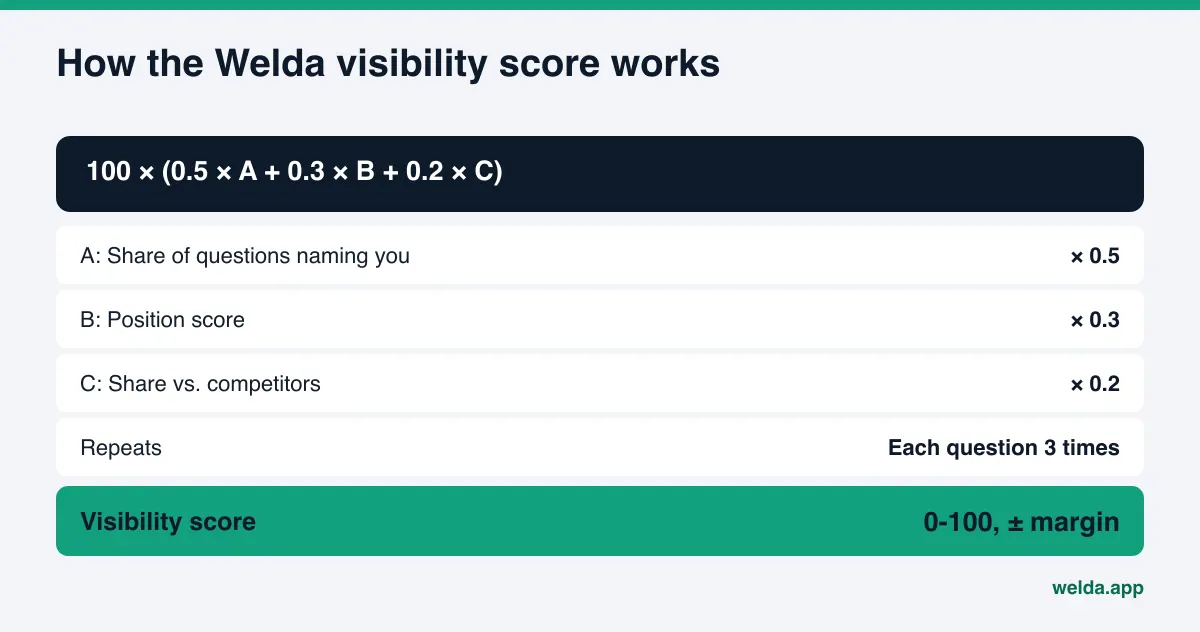
Then, question-by-question tracking. In the Welda panel, the questions a catering client would ask are grouped by intent, such as office lunch, weddings, private events and service area. Each question is put to ChatGPT, Gemini, Perplexity and Google AI three times. You see, question by question, whether you are named and in what position. You might find that you appear for office lunch in one engine but not another, or that you never come up for wedding prompts. Opening a question shows which sources the answer relied on, so you can tell whether a competitor wins through a wedding directory or through its own site.
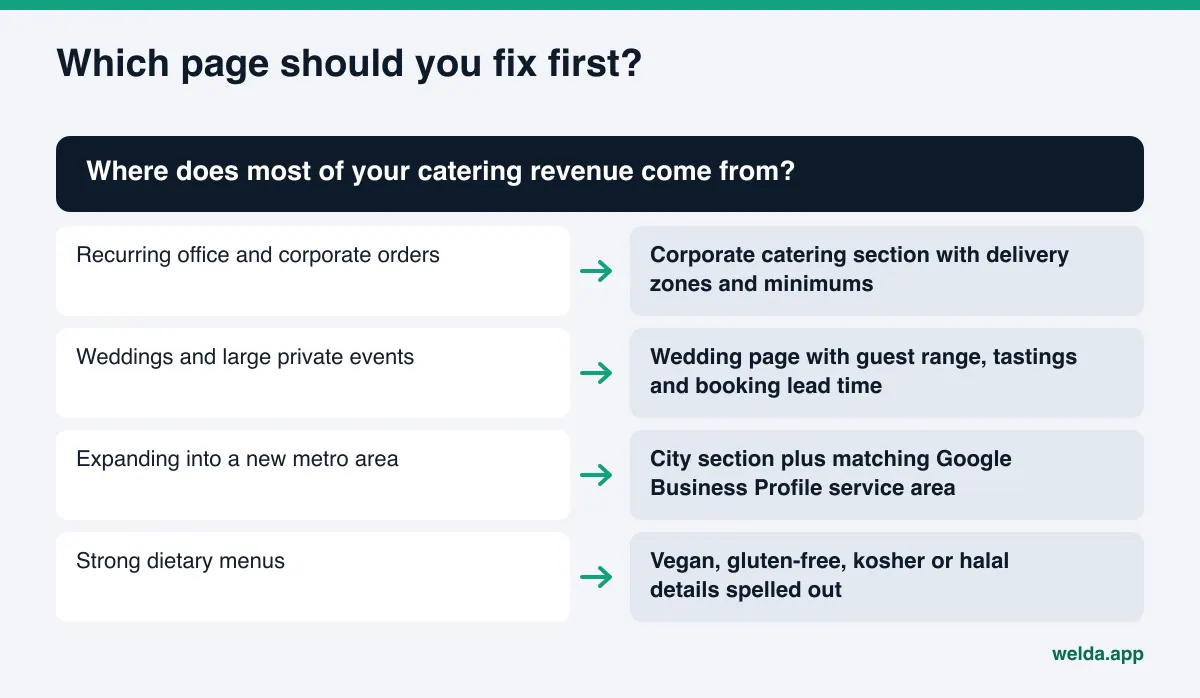
The decision you make on that screen is usually simple: which event type do I fix first? Strong on office lunch and absent on weddings means the wedding section comes first. For how to read these numbers over time, see the guide on AEO KPIs.
Missing facts and ready copy. A caterer's most useful facts, such as capacity, minimum order, service area and lead time, are often not written anywhere on the site. Welda does not invent them. Its to-do list asks you directly: "What is your minimum order?", "Which neighborhoods do you serve every week?" You answer once, and the fact flows into every draft. The same list shows drafts waiting for your approval and the tasks you need to do by hand, each with the copy already prepared.
On WordPress sites, Welda connects through a separate Editor user and an application password, with no code to install. A new service page or FAQ opens on your site as a draft and goes live only when you approve it. On other platforms, Welda gives you a ready-made package and you apply it yourself. Google Business Profile, Instagram and Facebook can be connected; if they are not, profile tasks appear on the list as manual work with the text ready. Your content always lives on your own website; Welda does not host it. The panel also includes competitor and source views, a before-and-after comparison and a one-page monthly report, but for a caterer the first weeks are mostly about the three parts above.
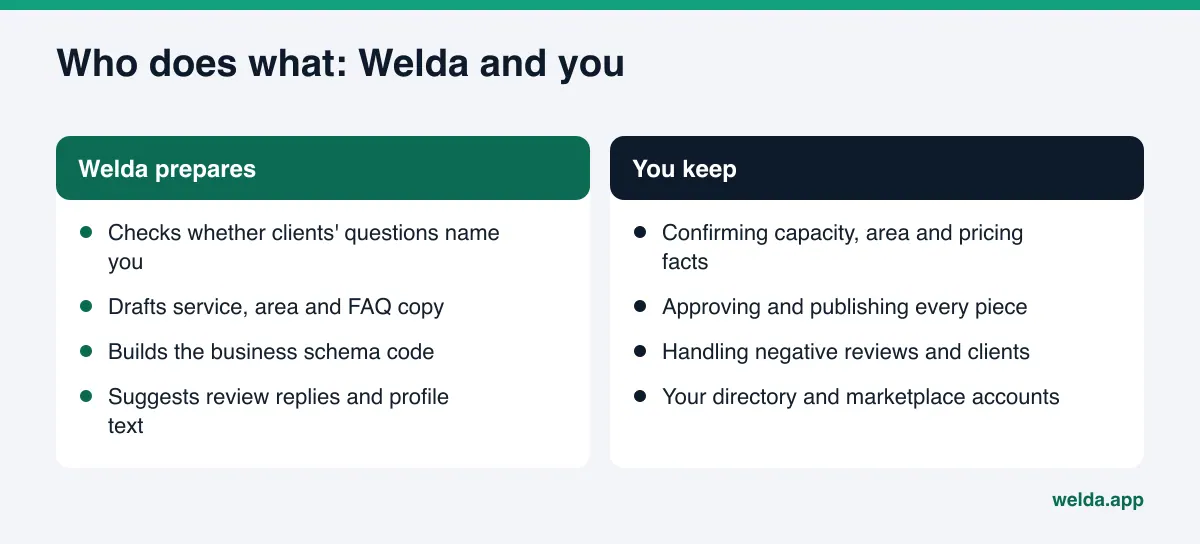
Limits: what Welda does not do
The honest expectation for a catering company is this: AI answers are not under your control, and nobody can guarantee a specific position for a specific prompt. Welda makes no such promise. Its job is to make the facts an assistant needs clear, consistent and readable, and to measure what happens.
- It does not invent facts. It will not guess your capacity, area or menu; it asks.
- It does not create fake reviews. Reviews must come from real clients, and the FTC's final rule announced in August 2024 bans fake reviews and testimonials, including AI-generated ones. Welda only suggests replies. This is not legal advice.
- It does not publish without approval. Every piece goes live only after you say yes.
- Some work stays with you. Handling negative reviews, managing your wedding directory and marketplace accounts, and press outreach remain your responsibility.
- It takes time. New content usually takes weeks to show up in AI answers, and the delay varies by engine and question.
A clear word on where the product stands today. The Welda panel is in early access and opens in stages, starting with businesses in Turkey. Regular four-engine tracking is being added during early access, and the sample panel screens use illustrative data. What anyone can use today is the free site analysis, which works in English and German. Questions in the panel can be tracked in English or Turkish. Pricing is discussed in an early access call.
Which event type should a caterer fix first?
Trying to fix everything at once is not realistic in a business with busy seasons. Use your revenue mix to decide where to start.
Caterers that are also local favorites for walk-in food, such as delis or bakeries with a catering arm, should treat the storefront and the catering business as two stories on the same site. The guide on AEO for local businesses covers the storefront side.
Checklist for a catering website
Use this list as a quick review of your site and profiles. If you can say yes to every item, the foundation is in place; what remains is measuring and filling in the questions you still miss.
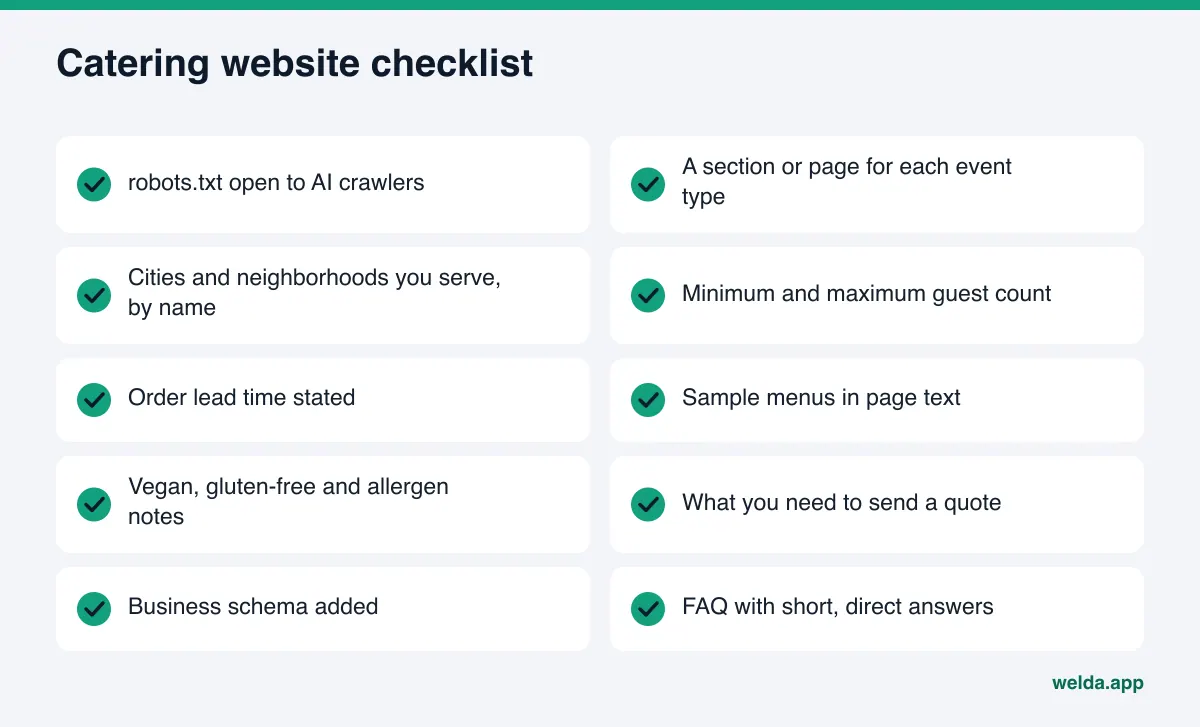
As you go through it, pay special attention to keeping each fact identical in three places: your website, your Google Business Profile and your Instagram bio. If one says "Chicagoland," another says "Chicago and suburbs" and a third names a single neighborhood, an assistant cannot tell which to trust. The same goes for your phone number, service list and minimum order. When the season changes, for example when you shift toward outdoor weddings in summer, update all three together.
You can apply the list yourself. If you want to see exactly which items you are missing, the free analysis lists them in a few minutes and drafts a fix for each one.
Frequently asked questions
Do I have to publish catering prices on my website?
No. But explaining what drives your pricing and what you need to prepare a quote helps. An assistant can use that explanation when someone asks what catering costs depend on, and it presents you as a transparent option.
My address is hidden. How does AI match me to a location?
Set a service area on your Google Business Profile and name the same cities and neighborhoods on your website. When two sources agree on your area, location-based prompts can match you more easily.
Is a PDF menu enough?
Keep the PDF if you like, but also publish the menu as page text. Text is read more reliably by search engines and AI systems, and a dish name or dietary note can be quoted directly.
Should weddings and corporate catering have separate pages?
The buyers, questions and decision timelines are different. Separate pages, or at least separate detailed sections, make it easier for an assistant to find the right facts for each prompt.
Do wedding directories and catering marketplaces matter for AI answers?
AI assistants can draw on industry directories for wedding and event prompts. Keep your listings consistent with your website. Welda's source view shows which sites the answers rely on and where you are missing; creating and managing those accounts stays with you.
Does Welda guarantee that ChatGPT will recommend us?
No. Nobody can guarantee a position in AI answers. Welda fills in missing facts, prepares the copy and measures the results so you can see changes question by question.
How long until we see results?
New content usually takes weeks to appear in AI answers. That is why it helps to record where you stand before you start and then measure the same questions again.
Where to start today
The fastest step is to see what your website tells AI systems right now. Run the free AI visibility analysis to see how clearly your services are described, the state of your business schema, which FAQs are missing and how you compare with competitors, all in one report with fixes you can apply.