How do car dealerships get recommended by ChatGPT? When a shopper asks an AI assistant which dealer to visit, the answer is built from what the AI can read about the store itself: what you specialize in, how inspections and trade-ins work, where you are, and what customers say. When those facts are clear, consistent and current on your site and your listings, your odds of being named go up. Nothing is guaranteed, but a dealership that never explains itself rarely makes the list. This guide covers the work and how Welda handles it.
Why AI answers now matter for car dealerships
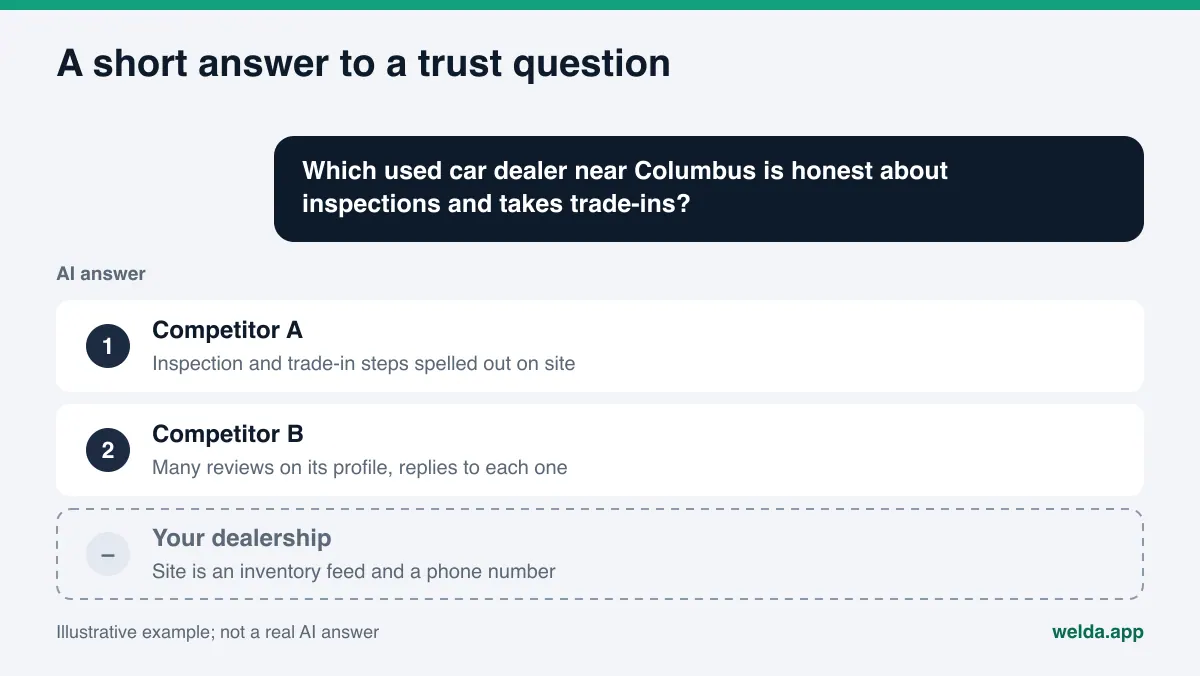
Buying a car is not something most people do often. A shopper usually knows roughly what they want ("a used three-row SUV under a certain budget, good for a family") but not whom to trust. For years, that meant hours on listing sites, reading reviews and asking friends. Now the same shopper opens ChatGPT, Gemini, Perplexity or Google's AI Mode and types: "Which used car dealer near Columbus is honest about inspections and takes trade-ins?" The answer is not ten blue links. It is two or three dealership names, each with a one-line reason.
There is a detail here that matters for dealers. AI answer engines tend to recommend the dealership, not a specific vehicle. Inventory turns over constantly; the truck on the lot today may be sold tomorrow. To recommend a store with any confidence, an AI system needs stable facts: which makes or segments you focus on, how long you have been in business and where, how you handle inspections and vehicle history, whether you take trade-ins, whether you help with financing, and what reviewers report.
Many dealership websites answer none of those questions. The site is an inventory feed, a financing form and a phone number. The About page says "family owned, customer first" and stops there. The only word about condition is "quality pre-owned," repeated on every listing. From that, an AI system cannot work out what the store does, who it suits, or why it is trustworthy. It names the competitor that explains itself better.
That is why AEO (answer engine optimization) for a dealership is not about pushing more inventory pages. Some marketers call the same discipline GEO, generative engine optimization; the work is identical. It means writing down the store, the buying process and the trust signals in a way machines can read, and keeping them the same everywhere. If you want to see where your site stands today, run the free site analysis. It reads your site the way Google and AI systems do and lists each gap with a fix.
What shoppers ask AI about car dealerships
Car shoppers' questions fall into a handful of patterns, and each one sends the AI looking for a different fact about you. The examples below were written by us to illustrate the point. They are not survey or measurement results.
| Question type | Example (written by us) | What the AI looks for |
|---|---|---|
| Trust | "Most trustworthy used car dealer in Phoenix?" | Reviews, replies to reviews, years in business, complaint history |
| Inspection | "Dealer that lets me take the car to my own mechanic" | Pre-purchase inspection policy, vehicle history reports |
| Trade-in | "Where can I trade in my car and buy used in one visit?" | Whether you take trade-ins and how appraisal works |
| Specialty | "Dealer in Denver that specializes in used Subarus" | Makes and segments you focus on |
| Financing | "Used car dealer that works with first-time buyers on financing" | What financing help you offer, which steps are involved |
| Local | "Car dealer near me open Sunday" | Address, map listing, hours |
| Process | "Can I buy a used car from a dealer out of state?" | Remote buying, paperwork, delivery or pickup options |
The takeaway is simple: each question type maps to a specific fact on your site. "Best prices, best selection" answers none of them. On a trade-in question, the AI looks for a source that explains how trade-ins work. On an inspection question, it looks for a source that says whether outside inspections are allowed. If it cannot find one on your site, it names another dealer.
How car dealerships get recommended by ChatGPT: the steps
Work through these in order; each builds on the one before. Measurement comes last, because measuring while the facts are missing only tells you that you are absent, not why.
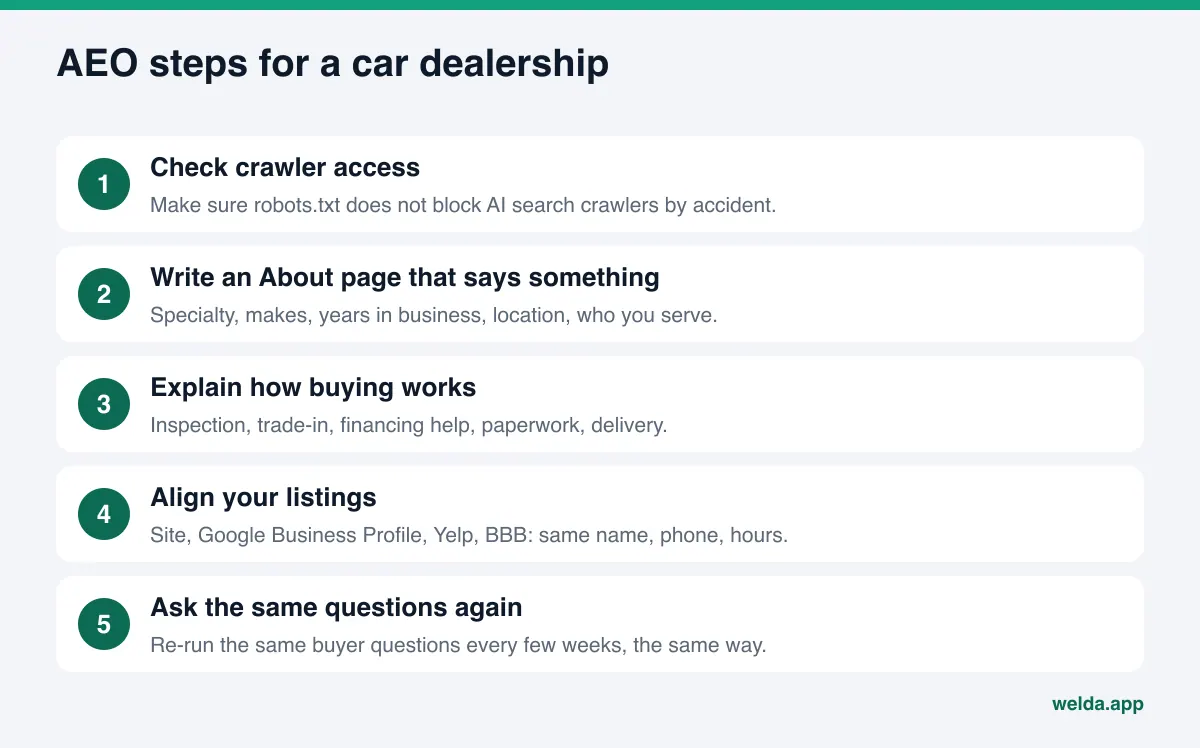
- Confirm AI crawlers can reach your site. Some dealer website platforms, themes and security plugins block unfamiliar bots in robots.txt. OpenAI's documentation says sites that opt out of OAI-SearchBot will not be shown in ChatGPT search answers, and recommends allowing it. Check robots.txt first, and ask your website vendor if you cannot edit it yourself.
- Write an About page that actually says something. City and neighborhood, years in business, which makes or segments you focus on, who you typically serve. Replace "all makes, all models" with the truth: commuter sedans under a certain age, work trucks, a particular brand's used inventory. A clear specialty lets AI match you to the right question.
- Explain your inspection approach in plain words. What gets checked before a car goes on the lot, whether a vehicle history report is available, whether buyers can take the car to their own mechanic. "Quality pre-owned" is a claim. Explaining what you check is information.
- Describe trade-in, financing and paperwork. If you take trade-ins, say how appraisal works. If you help arrange financing, say which steps you handle and what the buyer needs to bring. You do not need to publish numbers; a clear description of the process is enough.
- Make compliance visible where it builds trust. In most states, dealers selling used vehicles must post the FTC's Buyers Guide on each car; the FTC's Dealer's Guide to the Used Car Rule explains who is covered and what the Guide must show. Saying on your site that every used vehicle carries its Buyers Guide, and explaining what "as is" means in your store, answers a real shopper worry. Rules vary by state; confirm with your counsel. This article is not legal advice.
- Add an FAQ section. Write down the questions your sales staff hear every day, with real answers: "Do you hold a car with a deposit?", "Do you ship out of state?", "Can I get a quote on my trade online?" FAQ answers give AI short paragraphs it can quote directly.
- Add structured data. Schema.org has a dedicated type for dealers: AutoDealer. Use it to mark up name, address, phone, hours and location in a machine-readable way.
- Align your listings. Google Business Profile, Bing Places, Yelp, BBB and the dealer profile pages on the large listing marketplaces should carry the same name, phone, address and hours as your site. If your store name differs between platforms, AI cannot be sure they are the same business.
- Reply to reviews. Give calm, specific replies, especially to reviews about a problem after purchase or a title delay. AI systems can read review sites and complaint records, so know what they say about you.
To see the same steps applied to a related business, read how car rental companies get recommended by ChatGPT. Map listings are one of the sources AI assistants can read, so our guide to Bing Places for ChatGPT visibility is worth a look before you update your profiles.
Vehicle page or dealership page: where should each fact live?
The most common mistake on dealer sites is putting everything on vehicle detail pages. The listing says "trade-ins welcome, financing available, inspection report on request." When the car sells, the page comes down and the fact goes with it. From an AI system's point of view, your trade-in policy resets with every sale.
A sturdier approach is to sort information by type. Facts about one vehicle (mileage, trim, price) live on its page. Facts that are the same for every sale (inspection, trade-in, financing help, delivery) live on a permanent process page and in your FAQ. Facts about who the store is (specialty, history, location) live in the homepage intro and the About page. Contact details are identical everywhere.
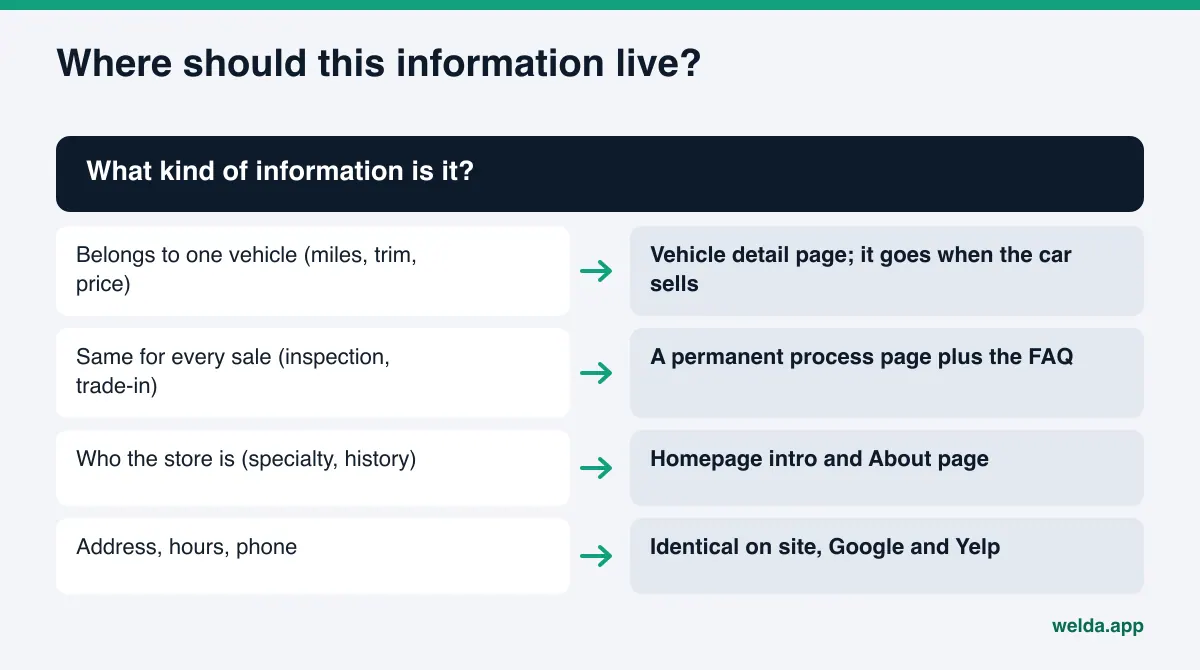
This split helps shoppers as well as machines. Even when a buyer finds a car on a marketplace, they often check the dealer before calling, either on its site or by asking an AI assistant "is this dealer any good." A clear, permanent dealership page is what they find.
What AI reads on a dealership website
The comparison below shows two example dealerships in the same metro area through an AI system's eyes. Their inventory, price range and service may be similar. The difference is what each site can say about the store.
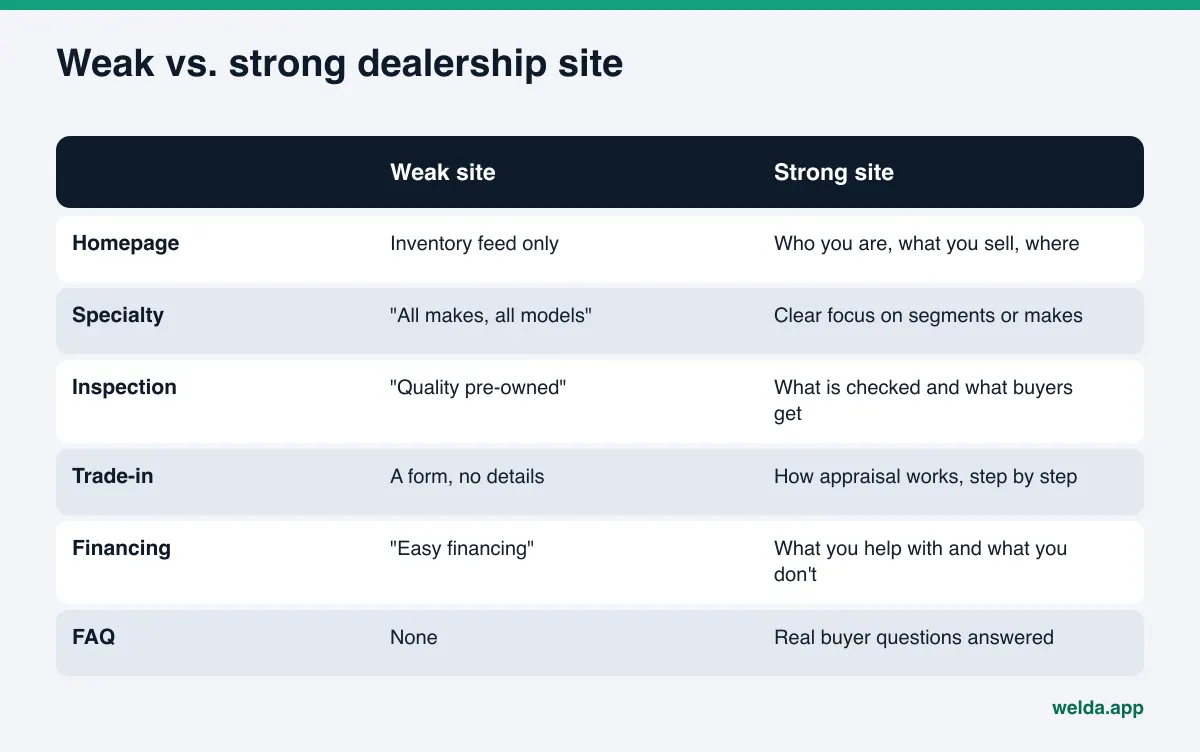
Most of what the weak site is missing already exists inside the store. Salespeople explain the trade-in appraisal, the inspection, the deposit and the paperwork to every customer who walks in. Because none of it is written down online, it does not exist for AI. Most AEO work for a dealership is not producing something new. It is writing down what you already say every day.
Consistency matters just as much. If your site says "open Sundays" and your Google Business Profile says closed, the AI compares the two and cannot tell which is right. It avoids building a recommendation on a fact it cannot trust. Pick one source of truth and use it everywhere.
Example: rewriting a dealership homepage
The example below is for a fictional independent used car dealer in Columbus, Ohio. It is not a real business. The point is to show what can replace generic slogans.
Before, page title: "XYZ Motors | Best Prices, Best Selection in Town." It names neither the city nor what the store sells, and "best" is a superiority claim nobody can verify.
After: "Used SUVs and Family Cars in Columbus, OH | Trade-Ins Welcome." City, segment and a frequent shopper question appear in the title.
Before, intro paragraph: "Come see why our customers keep coming back."
After: "We sell used SUVs, minivans and family sedans on the north side of Columbus. Every vehicle comes with a vehicle history report, and you are welcome to have it checked by your own mechanic before you buy. We take trade-ins and can walk you through financing with the lenders we work with. Open Monday through Saturday." Every sentence answers a question from the table above. The policies here are an example; write only what your store actually does.
The same approach works for your process page and FAQ. Put each topic under a question heading and answer it in two or three sentences:
- Can I take the car to my own mechanic? Say yes or no, and how you arrange it.
- How do you value my trade-in? Describe what you look at and how long it takes.
- Do you help with financing? Explain which steps you handle and what the buyer should bring.
- Will you hold a car with a deposit? State your rule, including whether the deposit is refundable.
- Do you sell to out-of-state buyers? Explain remote paperwork and pickup or shipping options.
These answers give AI short paragraphs to quote, and they cut down on the same five phone calls every day.
Which sources AI uses for dealership questions
AI does not build its answer from your site alone. For dealership questions, the sources it may draw on include Google Business Profile and Maps, Bing Places, Yelp, BBB, dealer profiles on the large car listing marketplaces, Reddit threads, local news and automotive blogs. Which source matters most varies by engine and by question, so measure it rather than guess.
If a competitor is strong on one of those sources, the AI learns about them there. That is why "where am I missing" matters as much as "how is my site." To understand how often each dealer gets named across a set of questions, see our guide to AI share of voice. For "best dealers in town" style answers, read how to get on ChatGPT best-of lists.
Reputation is especially sensitive for dealers, because post-sale problems tend to surface as reviews and complaints. Our guide to AI reputation management covers how to approach them. One warning: fake reviews, self-written forum posts or sock-puppet accounts break platform rules and, in the US, can run into the FTC's final rule banning fake reviews and testimonials. The right path is to ask real buyers for reviews after delivery and to reply openly to what comes in.
How Welda handles this work
Welda is software that measures where a business appears in AI answers and fills in the gaps on its behalf. For a dealership, three parts do most of the work.
1. The free site analysis: does your site explain the store? The analysis reads your homepage and a few inner pages, such as services, pricing, about and contact. On dealer sites, typical findings include a page title with no city or specialty, a headline that is just a slogan, no structured data, no FAQ section, a buying process (inspection, trade-in, financing) that is never spelled out, and map and social profiles that are not linked from the site. Each finding states what was seen, why it matters and how to fix it. You also get suggested homepage copy, a simulation of how much each fix could move the score, a competitor comparison, and a fix pack you can add to the site, including the business markup. The analysis then asks five likely buyer questions to an AI assistant that can search the web and checks whether your dealership is named in the answers. That is a one-time snapshot, not ongoing tracking. The free analysis works in English.
2. Questions and competitors: where you lose the shopper. In the Welda panel, the questions your buyers would ask are put to ChatGPT, Gemini, Perplexity and Google AI three times each. For a dealer, those questions can be grouped by intent: trust, trade-in, inspection, financing, specialty. The competitors view shows your share against other dealers and which question group and which source each competitor wins on. Say your store is named on specialty questions but never on trade-in questions, and the dealer who wins those is cited from its own process page. The decision is clear: write your trade-in process on a permanent page first. Three runs per question also give a margin of error, so one lucky answer does not look like progress.
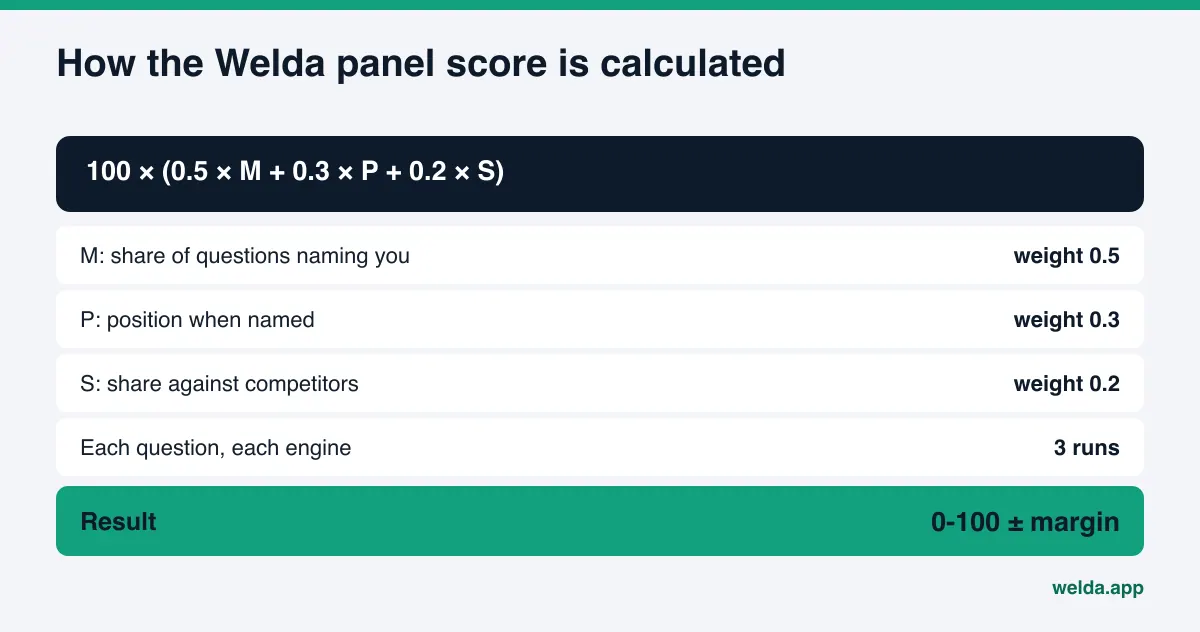
3. The to-do list: filling gaps without making things up. Welda drafts process-page copy, FAQ answers, profile descriptions and review replies. It does not invent facts. If your inspection policy, trade-in rule or Saturday hours cannot be read from your site, the to-do list shows a blank field asking you; you answer once and it flows into every related draft. Tasks Welda cannot publish directly, such as a listing profile without a connection, appear as "do it yourself" items with the copy ready. Before anything goes live, a compliance check flags price, guarantee and superiority claims such as "guaranteed," "lowest price" or "best dealer in town," so you can back them up, soften them or remove them. That check is a warning, not legal advice, and has not been reviewed by legal counsel.
If your site runs on WordPress, Welda connects through a separate Editor user and an application password, with no code to install. Drafts open on your site and go live only after you approve them. On other platforms, Welda hands you a ready pack and you or your web vendor apply it. Content always lives on your own site.
Where Welda stands today: the panel is in early access and opening gradually, starting with businesses in Turkey. Regular four-engine tracking is being added during early access, and the sample screens you may see use representative data. What anyone can use today, in English, is the free site analysis. Pricing is discussed in the early access conversation.
Limits: what Welda does not do
AI visibility attracts easy promises, so here is what Welda does not do.
- No guarantees. Welda does not promise a ranking or a mention in ChatGPT or any other engine. AI answers vary; the same question can get a different answer at a different time.
- No guessing. Welda does not assume your inspection, trade-in or deposit rules. It asks you.
- No publishing without approval. Every draft comes to you first. The decision to publish is yours.
- No fake reviews. Welda drafts replies to reviews. It does not write reviews.
- No inventory management. Welda's job is your dealership's visibility in AI answers. Listing cars, pricing them or syncing inventory is not part of it.
- Some work stays with you. Resolving negative reviews and complaints, managing your marketplace and directory accounts, and press outreach remain the dealership's job.
- It takes time. New content usually takes weeks to show up in AI answers, and the timing varies by engine and source.
Dealership AEO checklist and where to start
Open your site and your listings and work through the checklist below. Each item you cannot check is a fact AI cannot use when it recommends a dealer.
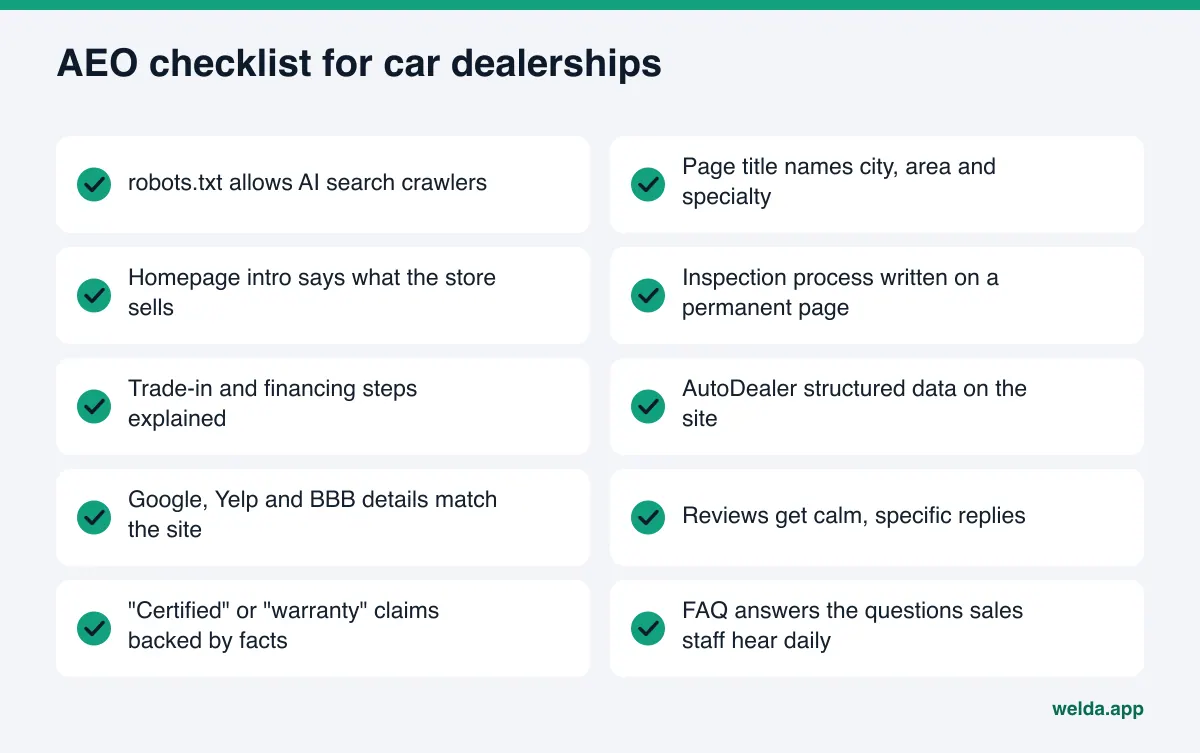
When deciding where to start, this order works for most stores:
| Situation | First move | Why |
|---|---|---|
| Site is only an inventory feed | A permanent About page and homepage intro | AI needs to understand what the store is first |
| Site exists, process is missing | Inspection, trade-in and financing page plus FAQ | These are the intents shoppers ask about most |
| Site is good, listings are stale | Align Google, Bing Places, Yelp and BBB | Conflicting facts weaken a recommendation |
| Facts are complete, few reviews | Ask buyers for a review after delivery | Reviews can decide trust questions |
| All of the above done | Re-run the same questions on a schedule | Without measuring, you cannot tell what worked |
Frequently asked questions
Does ChatGPT recommend individual cars or dealerships?
Both can happen, but because inventory changes constantly, AI tends to recommend the dealership and justify it with stable facts about the store. That makes permanent dealership pages more important than any single listing.
We already have profiles on the big listing marketplaces. Do we still need our own site content?
Marketplace profiles are a source, but they leave little room to explain the store. Your own site lets you describe your process, specialty and FAQ in a source you control.
Is it a problem to say "certified" or "warranty" on our site?
Claims you cannot back up can hurt trust and may raise consumer protection issues. Describe what you actually do: what is inspected, which warranty applies and from whom. Check your own situation with counsel; this article is not legal advice.
How long until we see results?
New content usually takes weeks to show up in AI answers. No one can promise a timeline or an outcome, which is why the same questions should be measured at regular intervals.
Does Welda manage our inventory or listings?
No. Welda focuses on how your dealership appears in AI answers: it measures, drafts the missing facts and copy, and publishes with your approval. Listing and inventory management are outside its scope.
What do I need for the free analysis?
Your website address and a verified email and phone number. The analysis is free once per site; the results link arrives by email and stays open for 14 days. It does not measure rankings or promise them.
See where your dealership stands today
The short answer to how car dealerships get recommended by ChatGPT: write down your store, your buying process and your trust signals in a form AI can read, keep them identical everywhere, and measure the result. The first step is seeing what your site says today. Run the free site analysis to get your gaps, suggested copy, and a check of whether your dealership is named in answers to real buyer questions.