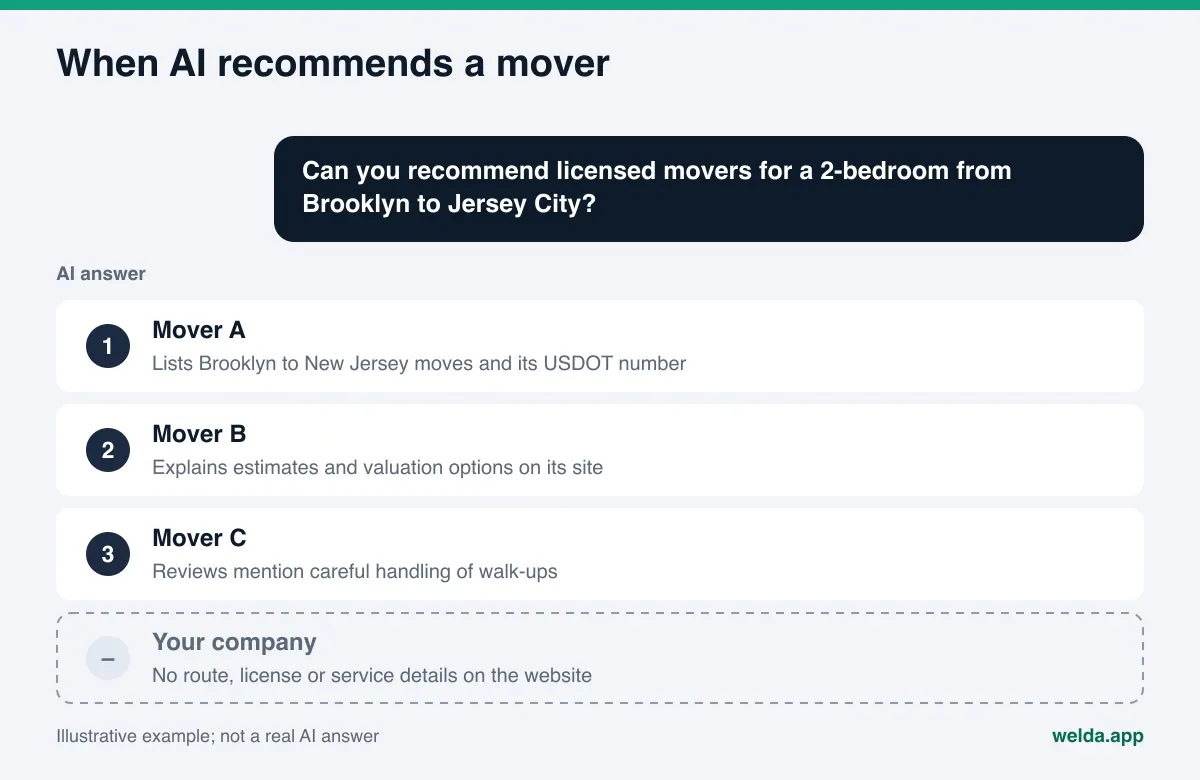
What does AI visibility software for moving companies actually do? People planning a move now ask ChatGPT, Gemini, Perplexity or Google's AI Mode something like "reliable movers for a 2-bedroom apartment from Brooklyn to Jersey City" and get back three or four company names. AI visibility software checks whether your company is one of those names and helps you close the gaps that keep it out. This guide covers what a moving company needs to publish, what to measure, and which parts of the work Welda handles.
Why AI visibility software for moving companies matters now
AI search visibility is a simple idea: when a customer asks an AI assistant for a recommendation, does your business show up in the answer? The work of earning that spot is usually called AEO (answer engine optimization). You will also see the term GEO, generative engine optimization; it means roughly the same thing. In this article we use AEO.
In classic search, a customer sees ten links, opens a handful of mover websites and compares quotes. In an AI answer, the customer often sees a short list with a one-line reason next to each name. The quote requests, phone calls and form fills go to that short list. If your company is not on it, you are not competing for the job at all.
Moving companies feel this shift more than most local businesses, for three reasons:
- Moving is a rare purchase. Most people move every few years. They rarely remember the crew they used last time, and they may be moving to a different city anyway. Every move starts with a fresh search.
- Trust questions come first. Customers do not only ask about price. They ask "are they licensed", "what happens if something breaks", "will the price change on moving day". AI assistants answer those questions using what movers publish about themselves and what others write about them.
- The questions are long and conditional. Origin, destination, home size, stairs or elevator, a piano, a move date and a storage need often appear in one prompt. A mover whose website answers none of those conditions is not a candidate for the answer.
The fastest way to see where you stand is Welda's free website analysis. It reads your homepage and a few key pages (services, pricing, about, contact) the way Google and AI systems read them and lists each gap separately, with a fix for each one.
What do customers ask AI when they need a mover?
Moving prompts almost always carry several conditions. Nobody types just "good movers". The table below groups the question types a moving company website should be able to answer. The examples were written for this article; they are not survey or measurement results.
| Question type | Example prompt | Where the answer should live on your site |
|---|---|---|
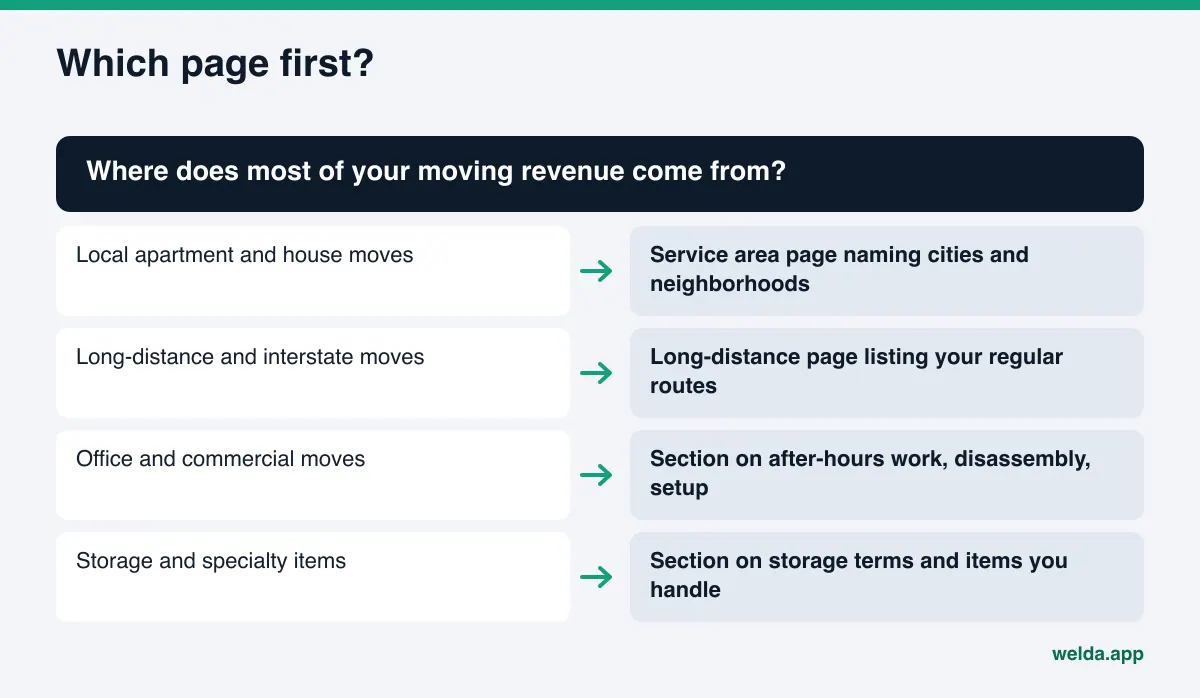
| Local route | "Movers from Capitol Hill to Ballard this Saturday" | Service area page with neighborhoods and cities named |
| Long-distance | "Best interstate movers from Chicago to Denver" | Long-distance section with regular routes |
| Logistics | "Movers who handle a fourth-floor walk-up" | Service details: stairs, elevators, packing, disassembly |
| Price | "How much do movers charge for a 2-bedroom" | How pricing works, how estimates are given |
| Trust | "Licensed and insured movers near me" | License numbers, valuation options, claims process |
| Specialty items | "Movers who move a piano or a gun safe" | Specialty items section, what you do and do not move |
Notice how much of this is local. Prompts name neighborhoods, cities and routes. That is why measuring AI visibility for a mover only makes sense with location-specific questions. We cover that approach in more detail in local AI rank tracking.
What does AI read about a moving company?
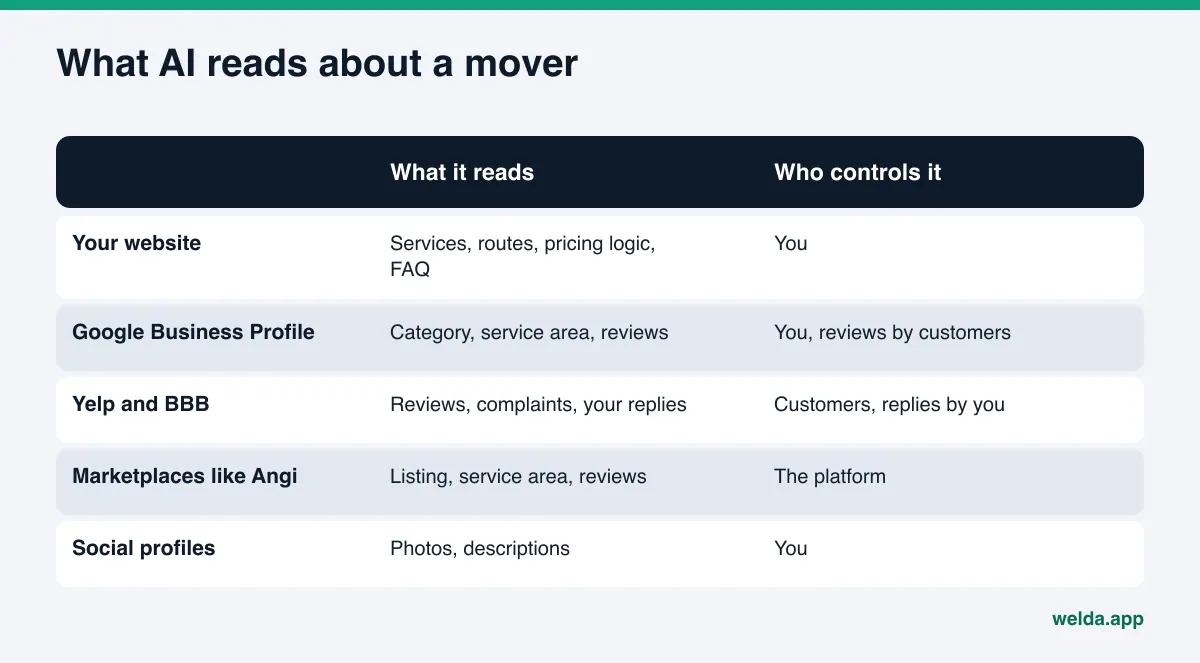
An AI answer rarely comes from one source. The assistant can pull from your website, your Google Business Profile, map listings, review sites, directories and home-services marketplaces. For a US moving company, the usual mix looks like this:
- Your website: services, service area, how pricing works, licensing, valuation options and FAQs. Fully under your control.
- Google Business Profile: category, service area, hours, photos, reviews and your replies to reviews.
- Review sites such as Yelp and the BBB: moving is a category where people write long reviews about damage, delays and surprise charges. AI assistants can read those pages, including how you responded.
- Home-services marketplaces such as Angi: your name, phone, service area and description there should match your website. Conflicting details give an assistant a reason to leave you out.
Google Business Profile has a limit that matters for movers. According to Google's help page on service areas, you can set up to 20 service areas, and the overall area should not extend beyond about two hours of driving time from where the business is based. If you run long-distance moves from Atlanta to Florida or the Carolinas, those routes usually will not fit in the profile. Your website is the one place where they can be described in full. If an assistant cannot find "Atlanta to Charlotte" anywhere on your site, it has nothing to cite.
Replies to reviews deserve the same care as marketing copy. A reply that briefly acknowledges what happened, explains how your claims process works and invites the customer to a direct channel tells any later reader, human or AI, how your company behaves when something goes wrong. A defensive reply reads just as clearly.
Step by step: preparing your moving company for AI answers
You can start on these steps before measuring anything. They are ordered from highest impact and easiest to do.
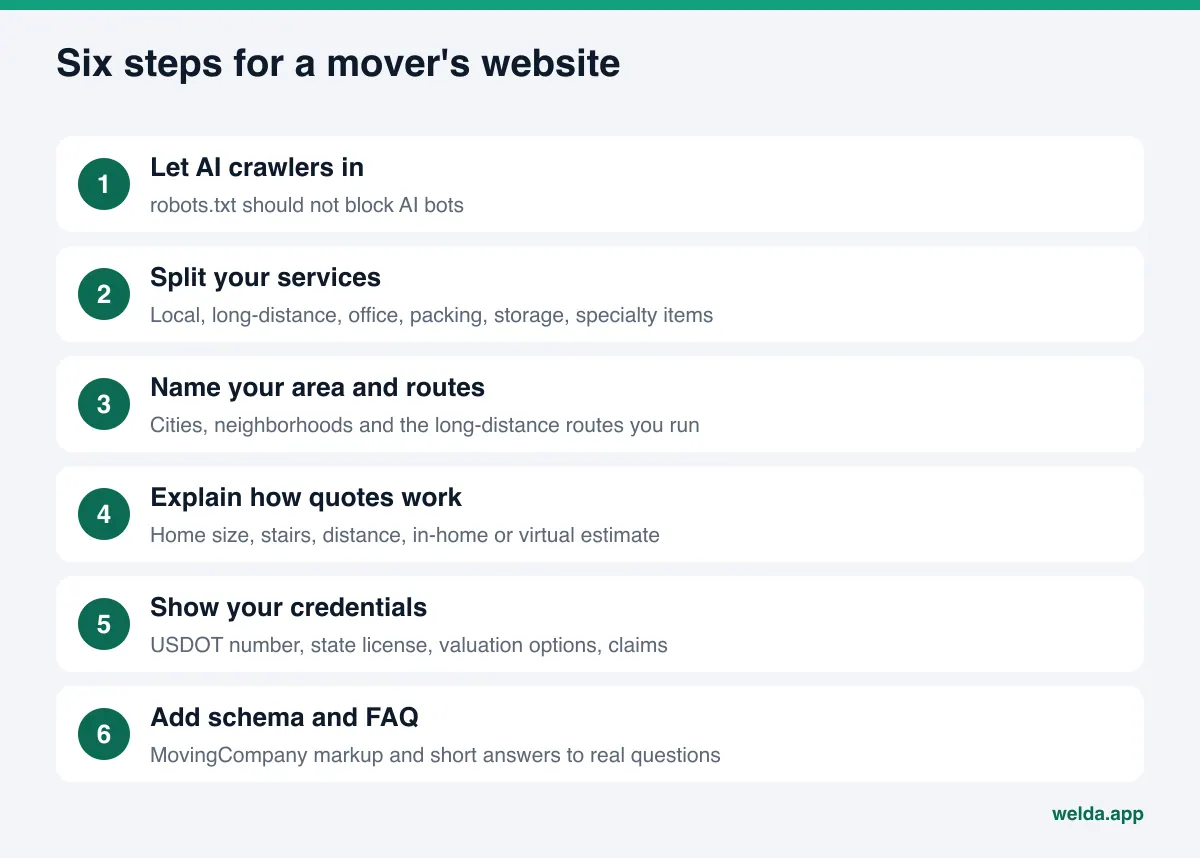
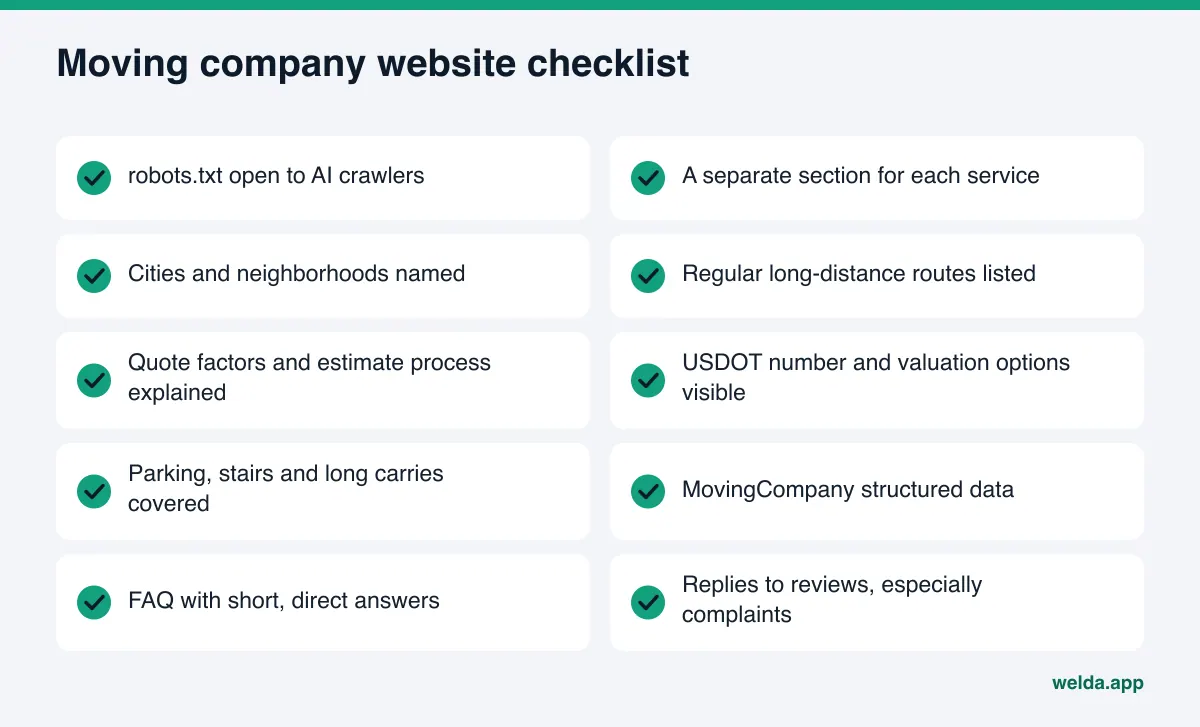
- Make sure AI crawlers can reach your site. If your robots.txt blocks AI bots, nothing else on this list helps. The check takes a few minutes.
- Give each service its own section. Local moves, long-distance and interstate moves, apartment moves, office moves, packing, storage, specialty items. A single page that says "we do it all" gives an assistant no conditions to match. For page structure, see service pages AI can quote.
- Name your service area. List the cities, neighborhoods and counties you actually serve. For long-distance, list the routes you run regularly.
- Explain how pricing works. Even if you do not publish rates, you can explain what drives a quote: home size, inventory, stairs and elevators, distance, packing, date. Say whether estimates are in-home or virtual, and whether you give binding or non-binding estimates.
- Make your credentials visible. The FMCSA states in its Protect Your Move FAQ that interstate movers must be registered with the federal government and have a USDOT number. Put your USDOT number on the site, along with any state license, the valuation options you offer and how a claim is filed.
- Add structured data. Schema.org has a dedicated MovingCompany type. Marking up your name, address, phone, service area and hours with it makes your details easier for machines to read correctly.
- Write a real FAQ. Short answers to what customers actually ask: parking and loading zones, long carries, appliance disconnection, deposits, cancellations, rescheduling.
- Reply to reviews. Especially the ones about damage or delays.
Price, parking and specialty items: what to write on your site
Three topics come up in moving prompts again and again, and mover websites often leave them out.
Price. Someone asking "how much do movers charge for a 2-bedroom in Austin" wants a number. Many movers say the price depends on the estimate, and they are right. But if your site only says "call for a quote", the assistant will build its answer from other sources. A better approach is a short section on how a quote is built: which factors raise the price, how the estimate is done, whether it is in writing, and under what conditions the final price can differ from the estimate. That last point matters. Customers worry about surprise charges on moving day, and stating your policy plainly is a trust signal for customers and assistants alike.
Parking and access. City moves come with narrow streets, no truck access, long carries and building rules about elevator reservations and certificates of insurance. You already know how you handle each of these. Write it down: when you use a smaller shuttle vehicle, how you deal with long carries, what the customer needs to arrange with the building. If you work in dense neighborhoods, name them, but only the ones you genuinely serve.
Specialty items. Pianos, gun safes, pool tables, antiques, artwork and large aquariums all generate their own prompts. If you move them, say so and explain how. If you do not, say that too. A clear "we do not move pianos" line cuts wrong-fit leads and keeps an assistant from recommending you for a job you would turn down.
How Welda handles AI visibility for a moving company
Welda is software that measures where a business appears in AI answers and prepares the fixes on its behalf. For a mover, three parts of the product do most of the work.
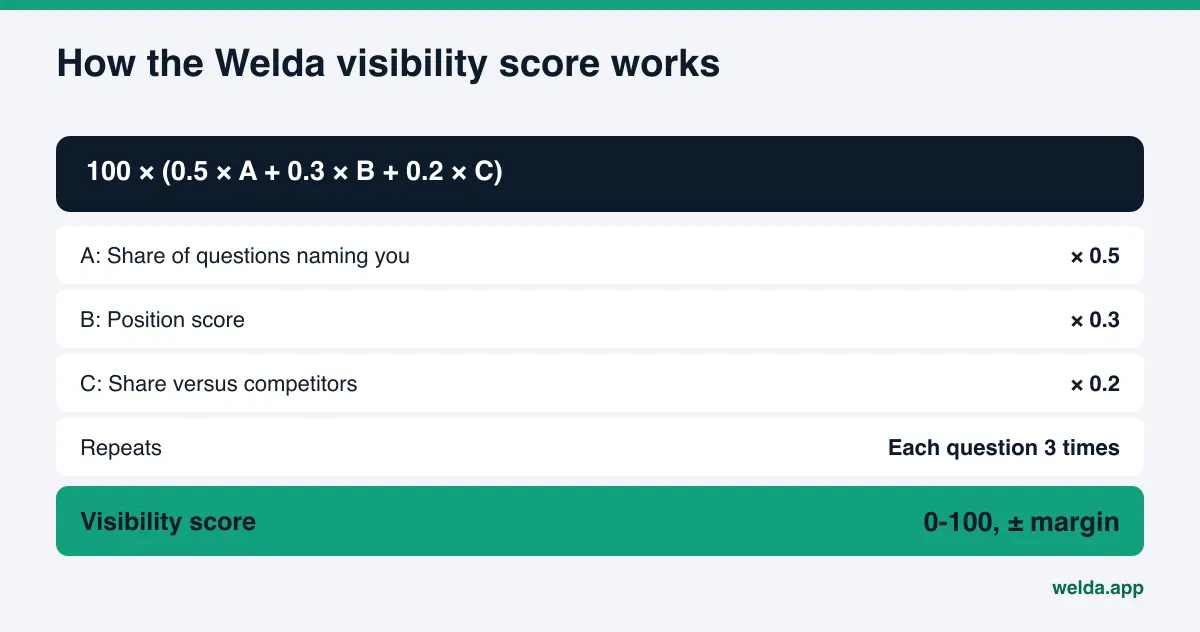
1. Question-by-question measurement. In the Welda dashboard, the questions your customers would ask ("movers from Midtown to Hoboken", "interstate movers Chicago to Denver", "licensed movers who move pianos in Brooklyn") are sent to ChatGPT, Gemini, Perplexity and Google AI three times each. For each question you see which engines mention your company and in what position. For movers, the split by question type is the useful part. Showing up for local moves while never being mentioned for long-distance routes can happen, and when it does, it points straight at the missing page.
Asking each question three times is deliberate. AI answers vary from run to run, a topic we cover in why AI answers change every time. Welda's score is calculated from the three runs, and the spread between them becomes the margin of error shown next to it.
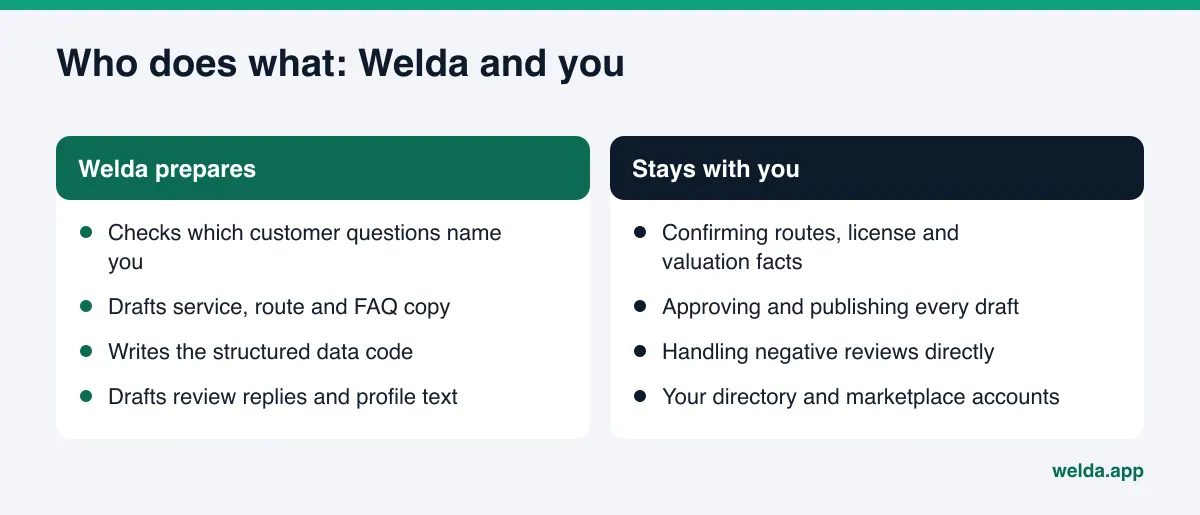
2. It asks what it does not know, then drafts the rest. The top of Welda's to-do list shows the facts it could not find on your site. For a mover, that might be your USDOT number, the valuation options you offer, the long-distance routes you run, or whether you offer storage. Welda does not guess these. It asks you. You answer once, and the answer flows into every draft. From there Welda drafts service sections, FAQs, the structured data code, your Google Business Profile description and replies to reviews.
On WordPress sites, Welda connects through a separate Editor user and an application password, with no code to install. Drafts open on your site as drafts, and nothing is published until you approve it. On other platforms, Welda gives you a ready-made package and you or your web person apply it. Google Business Profile, Instagram and Facebook can be connected; for anything not connected, the task is listed as manual with the text already written.
3. Competitors and sources. The competitors view shows which rival leads on, say, long-distance questions and which source that lead rests on. The sources view shows which sites AI assistants cite for moving questions and whether you have a presence there. The logic behind that view is covered in citation gap analysis.
Where things stand today: the free website analysis works in English and is available to anyone now. Besides scoring your site, it asks five customer-style questions to an AI assistant that can search the web and checks whether your company name comes up; that is a one-time snapshot. The Welda dashboard is in early access and is opening first with businesses in Turkey. Regular four-engine tracking is being added during early access, and the dashboard screens described here use sample data. Pricing is discussed in the early access conversation.
Example scenario: visible locally, invisible on long-distance routes
The following is an example, not a real company or a measured result. Picture a moving company based in Dallas with solid local reviews and a well-kept Google Business Profile. A large share of its revenue, though, comes from long-distance moves to Houston, Austin and Oklahoma City.
The company runs the free analysis first. It shows that all services are crammed into one paragraph, there is no long-distance section, structured data is missing and there is no FAQ. The simulation, which shows how much each fix would move the score, puts structured data and separate service sections near the top. The competitor comparison shows that a nearby rival describes each service on its own.
Once the dashboard is available to it, the company adds long-distance prompts to its question list next to the local ones. The questions view tells a clear story: the company appears for some local prompts on some engines and for none of the long-distance prompts on any engine. The sources view shows that long-distance answers lean on marketplaces and directories.
Welda's to-do list asks two things: which routes the company runs regularly, and whether long-distance shipments are consolidated with other customers' goods. The owner answers. Welda drafts the long-distance section, route-specific FAQs and the structured data. Because the site runs on WordPress, the drafts open as drafts; the owner edits one sentence and publishes. Updating directory listings stays on the manual list with the text ready.
Nothing changes overnight in this scenario. It usually takes weeks before new content shows up in AI answers. The before-and-after comparison and the monthly one-page report are how the company would see whether long-distance prompts start to move.
Limits: what Welda does not do
In a business where trust decides the sale, it helps to know what a tool will not do.
- No ranking promises. Welda does not promise placement in ChatGPT or any other engine. No one can honestly promise that; the engine decides.
- No made-up facts. Welda does not guess your license numbers, valuation terms or storage conditions. It asks you.
- Nothing goes live without approval. Every draft waits for your sign-off. Content always lives on your own site; Welda does not host it.
- No fake reviews. Welda does not write reviews to pad your count. The FTC's rule banning fake reviews and testimonials makes that a legal issue as well as an ethical one. Welda drafts replies to real reviews.
- Some work stays with you. Handling negative reviews directly, managing your directory and marketplace accounts and press outreach remain your job. Welda can draft text for them but does not log into those accounts for you.
- Results take time. New content typically takes weeks to show up in AI answers.
Welda also flags risky claims before publishing, such as "lowest price in town" or "damage-free guaranteed". That flag is a prompt to double-check, not legal advice, and it has not been reviewed by legal counsel. Decisions about advertising claims belong with your own advisor.
Checklist for choosing AI visibility software for moving companies
Whether you look at Welda or another tool, these criteria help. Moving is route- and neighborhood-driven, and a generic brand-monitoring tool may not answer the questions that matter.
| Criterion | Why it matters | Question to ask |
|---|---|---|
| Local and route prompts | Moving prompts name places and routes | Can I add my own neighborhoods and routes as questions? |
| Repeated runs | A single answer can mislead | How many times is each question asked, and is a margin of error shown? |
| Transparent score | You need to know what moves the number | How exactly is the score calculated? |
| Help with fixes | Measurement alone changes nothing | Who drafts the fixes, and what is left for me? |
| Approval control | Price and insurance wording is sensitive | Can anything go live without my approval? |
| Source view | Directories and review sites feed answers | Does it show which sites AI cites for my category? |
For a related look at another trust-heavy local service, see AI visibility software for insurance agencies, and for a home-services example, AEO for HVAC companies.
Frequently asked questions
Why doesn't my moving company show up in ChatGPT?
Often the reason is that your site does not state your service area, routes and service types clearly. When an assistant answers "movers from Midtown to Hoboken", it looks for a company that says it works there. If that information only exists on the phone, the assistant has nothing to cite.
Do I need to publish prices to show up in AI answers?
No. But explaining how a quote is built, how estimates are done and whether they are binding helps you become a candidate for price questions.
Isn't Google Business Profile enough?
It is an important source but not the only one. Because of the service area limit, long-distance routes often cannot be described there. Detailed service information and FAQs belong on your website.
What does the free analysis show?
It scores your site out of 100, with technical and content scores shown separately, and explains each gap with a fix. It is free once per site; the result link arrives by email and stays open for 14 days.
Is the Welda dashboard available in the US?
The free analysis works in English today. The full dashboard is in early access and is opening first in Turkey; questions can be tracked in English as well as Turkish.
How long until I see results?
New content usually takes weeks to show up in AI answers. The before-and-after comparison and the monthly report in the dashboard are built to track that change.
A move is usually booked after a single search, and that search is increasingly a conversation with an AI assistant. The first step is seeing how your site reads today. Run the free website analysis to get a list of gaps and ready-to-use copy suggestions for your homepage.