What does AI visibility software for electronics retailers actually do? AI visibility software for electronics retailers checks whether your store is named when shoppers ask ChatGPT, Gemini, Perplexity or Google's AI Overviews where to buy, and helps you fill the gaps that keep you out of those answers. In electronics, the gap is rarely the product. It is the store: authorized-dealer status, warranty, delivery, pickup and returns. Nobody can promise a placement, but a store whose facts are easy to read has a far better chance of being named than one whose facts are buried in checkout terms.
This guide is for independent electronics stores, online sellers of phones, laptops, gaming gear, audio and smart home devices, and regional chains that sell both in store and online. We cover why the problem looks different in electronics, the steps to take, how Welda does this work, and where its limits are. If you want to see how AI reads your site today, start with the free site analysis.
Why AI search visibility is a different job for electronics retailers
An electronics shopper makes two decisions: which product to buy and who to buy it from. AI assistants already shape the first one. Questions like "best noise-canceling headphones for flights," "lightweight laptop for a college student," or "what TV size for a small living room" are now a common first step. The second decision, the store, is where most retailers have quietly handed control to the AI without noticing.
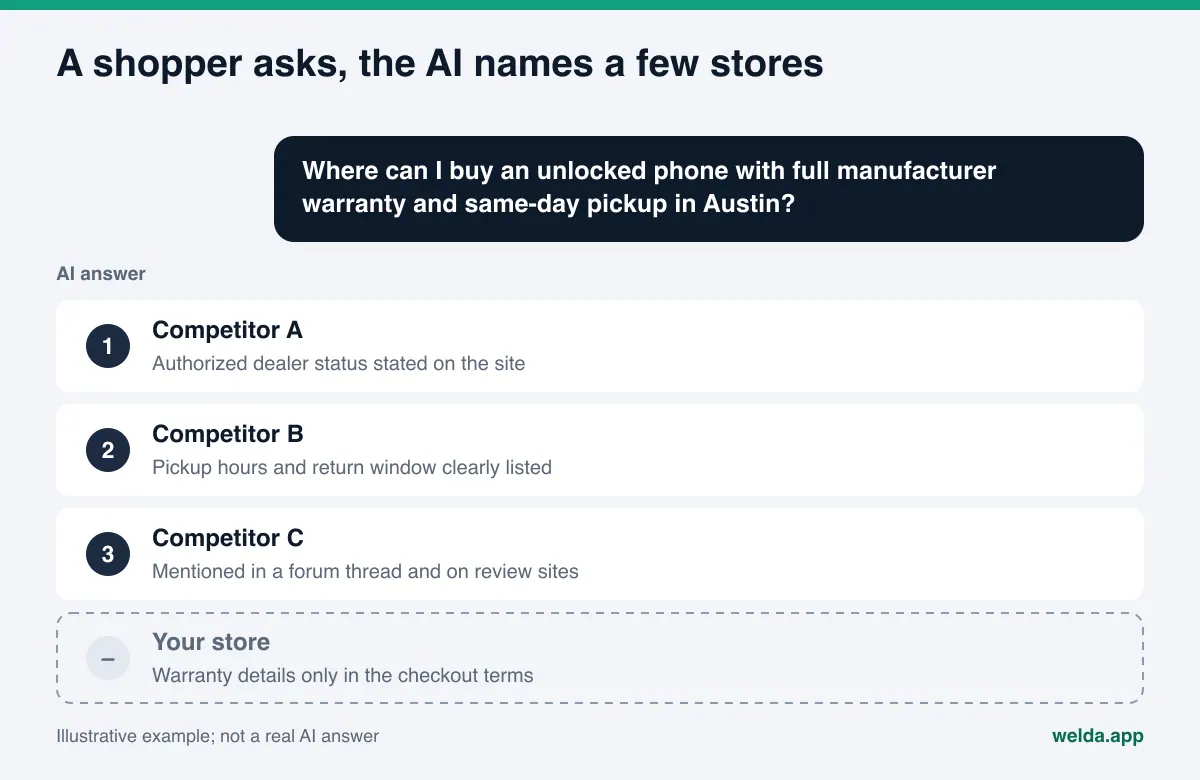
After picking a product, the shopper asks something like: "Who sells this model new, with the full manufacturer warranty, and can I pick it up today?" The answer tends to name big-box chains, large online retailers, and the smaller stores that spelled out their policies clearly. A store whose warranty terms live only in a PDF linked from the footer is usually left out, even when it has the product in stock at a fair price. If the AI cannot find a fact it can repeat with confidence, it does not name you.
Five traits make electronics retail different from most other ecommerce categories, and each one affects AI visibility:
- Trust comes before price. Electronics are expensive, and shoppers worry about gray-market imports, refurbished units sold as new, and counterfeit accessories. They ask "is this store legit," "is it an authorized dealer," "will the warranty be honored." If your site does not answer these in plain words, the AI cannot answer them for you.
- Warranty and repairs drive the decision. Shoppers want to know who handles a defect, whether they deal with you or the manufacturer, and how long a repair takes. Few stores have a page that explains this.
- Speed and local pickup matter. "Same-day," "in-store pickup," and "near me" show up in many questions. If you never state your delivery area, order cutoff time, or pickup hours, you are not a candidate for those questions.
- Catalogs are large and change fast. New models launch often and stock moves quickly. For an AI to read your product pages correctly, model numbers, prices and availability need to be marked up.
- Community sources carry weight. Forums, Reddit threads, review sites and the Better Business Bureau are read closely by electronics buyers, and they often show up as sources in AI answers.
Taken together, these traits show that answer engine optimization (AEO) for an electronics retailer is less about product copy and more about store facts. Manufacturers and review sites already describe the products. Your job is to make it easy to say why someone should buy from you.
What shoppers ask AI before they buy electronics
The questions that matter for your store fall into a handful of types. The examples below are our own illustrations, not measured data, but they reflect the kinds of questions shoppers type into AI assistants when they are close to buying.
| Question type | Example (our illustration) | What the answer needs from you |
|---|---|---|
| Category and budget | "Where can I get a good 27-inch gaming monitor under a set budget?" | Category intro, price range, availability |
| Trust | "Which stores are authorized dealers for this camera brand?" | Authorized-dealer list, new vs. refurbished labeling |
| Speed and location | "Who has this console in stock for pickup today in Denver?" | Store address, pickup hours, local inventory |
| Service | "If my laptop breaks, do I send it to the store or the manufacturer?" | Warranty and repair process page |
| Returns | "Can I return opened headphones, and is there a restocking fee?" | Return policy, open-box rules, any fees |
Each row maps to a page or a section on your site. If a question type has no page behind it, that is usually where you are missing from AI answers. Start your own list from your sales team, your customer service inbox, chat logs, and the questions people ask at the counter. Twenty to thirty real questions are enough to see the pattern.
How to improve AI search visibility for an electronics store, step by step
None of these steps need a new website or a large budget. They follow one order: first the question, then the page that answers it, then the outside sources that confirm it.
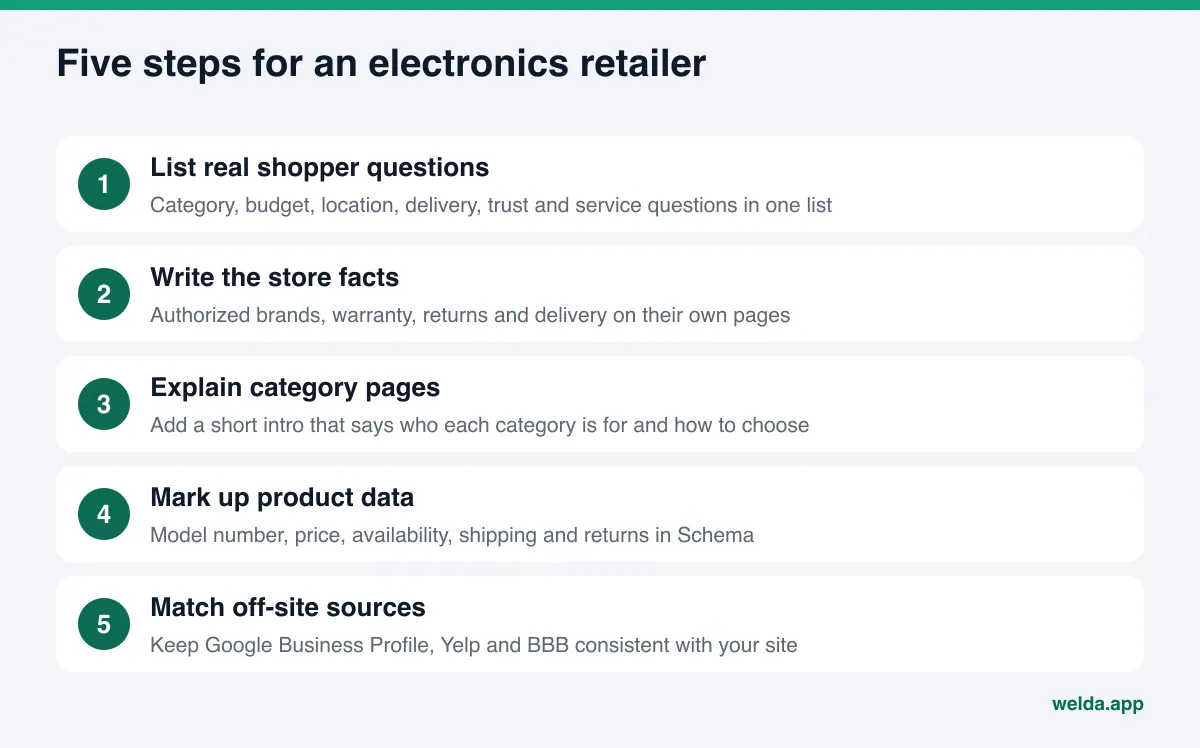
- Build the question list. Group your real shopper questions into category, budget, trust, delivery, service and returns. Flag the ones that mention a city or neighborhood.
- Make sure AI crawlers can reach your site. Check your robots.txt for rules that block AI crawlers. OpenAI, for example, explains in its crawler documentation that OAI-SearchBot is used to surface sites in ChatGPT search and that sites blocking it will not appear in ChatGPT search answers. Some ecommerce platforms, CDNs and security plugins block these bots by default.
- Write the store facts on their own pages. Which brands you are an authorized dealer for, how warranty claims work, your return window and any restocking fees, how open-box and refurbished items are labeled, your delivery area and cutoff times, and your pickup hours. Give each its own heading. Facts that appear only during checkout are invisible to an AI.
- Tighten the home page. Near the top, state in one or two sentences what you sell, where you are, and where you deliver. A promo banner does not replace that sentence, because text inside images is not always read.
- Add intro text to key category pages. At the top of "Gaming Laptops," write a short paragraph on who the category is for, the price range you carry, and what to look at when choosing. You do not need a long block of SEO text, only a few sentences that answer the shopper's actual question.
- Mark up product data. Product name, brand, model number, price, currency, availability, shipping and return policy should be in structured data. Google's merchant listing documentation lists required and recommended fields, including shipping details and merchant return policy. Add store-level Organization or LocalBusiness markup too. Our guide to schema markup for AI search walks through the setup.
- Add an FAQ section. Answer the most common questions from step one in short, direct sentences: "Are your products new and covered by the manufacturer warranty?" "How do I start a warranty claim?" "Which ZIP codes get same-day delivery?"
- Make off-site sources say the same thing. Google Business Profile, Yelp, your BBB listing, any marketplace storefront, and your replies on review sites should match your site on address, phone, hours, authorized brands and policies.
If you run on Shopify, the platform-specific parts of this list are covered in our Shopify AEO guide. If you have a physical showroom, our guide to AEO for local businesses goes deeper on the local signals.
Where AI engines find information about electronics stores
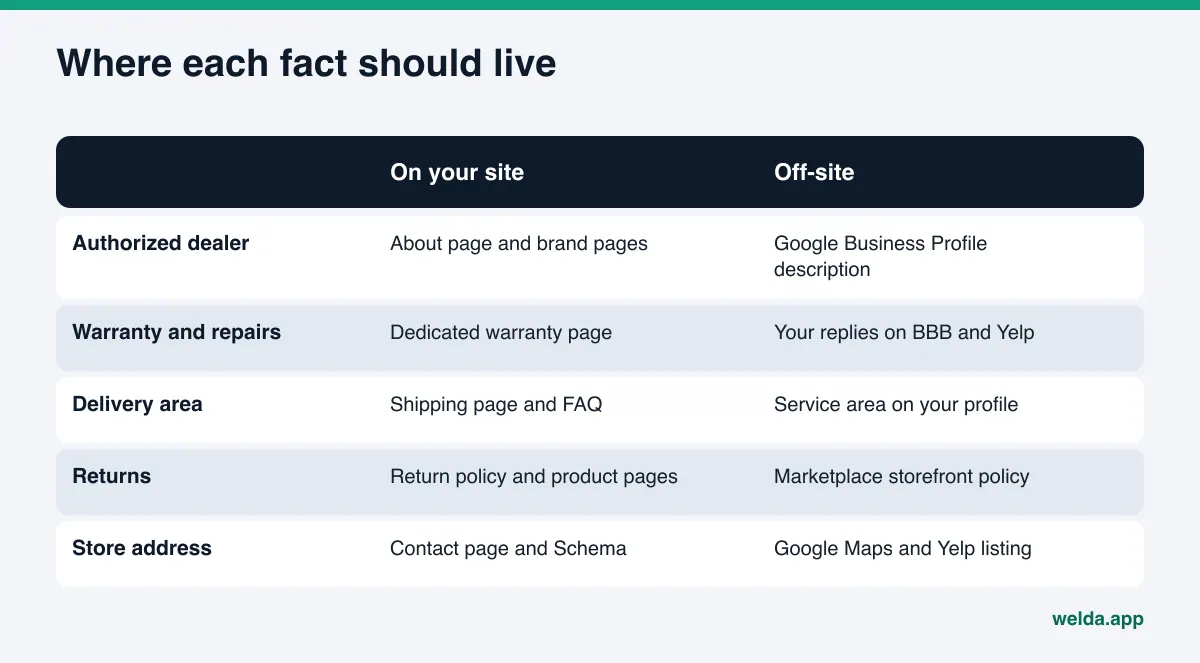
When an AI assistant answers a shopping question, it draws on what it already knows and on sources it finds through web search. For electronics stores, those sources usually fall into four groups: your own site, map and business profiles, marketplaces and comparison sites, and community and review sites. How much each one counts varies by question and by engine, and nobody can predict it precisely.
In practice, a pattern shows up. "Which is best" product questions lean on reviews and comparison content. "Is this store legit" questions lean on review sites, the BBB and forum threads. "Near me" and city questions lean on Google Business Profile, Google Maps and Yelp. That is why fixing your own site is not enough on its own: an outdated address on a map listing or an unanswered complaint on a review site will be read too.
A word on reviews. Fake reviews, paid praise and undisclosed posts by staff do not help and carry real legal risk in the US. The Federal Trade Commission's final rule on fake reviews and testimonials bans fake reviews, including AI-generated ones, buying reviews, and undisclosed reviews from company insiders. If you post on a forum or reply to a complaint, do it openly under your store's name. This is not legal advice; check with your own counsel for your situation.
How Welda works as AI visibility software for electronics retailers
Welda is software that measures where a business appears in AI answers and fills the gaps on the business's behalf, with the owner's approval. For an electronics retailer, three parts do most of the work: question tracking, the open score, and prepared pages that you approve.
Question tracking by type
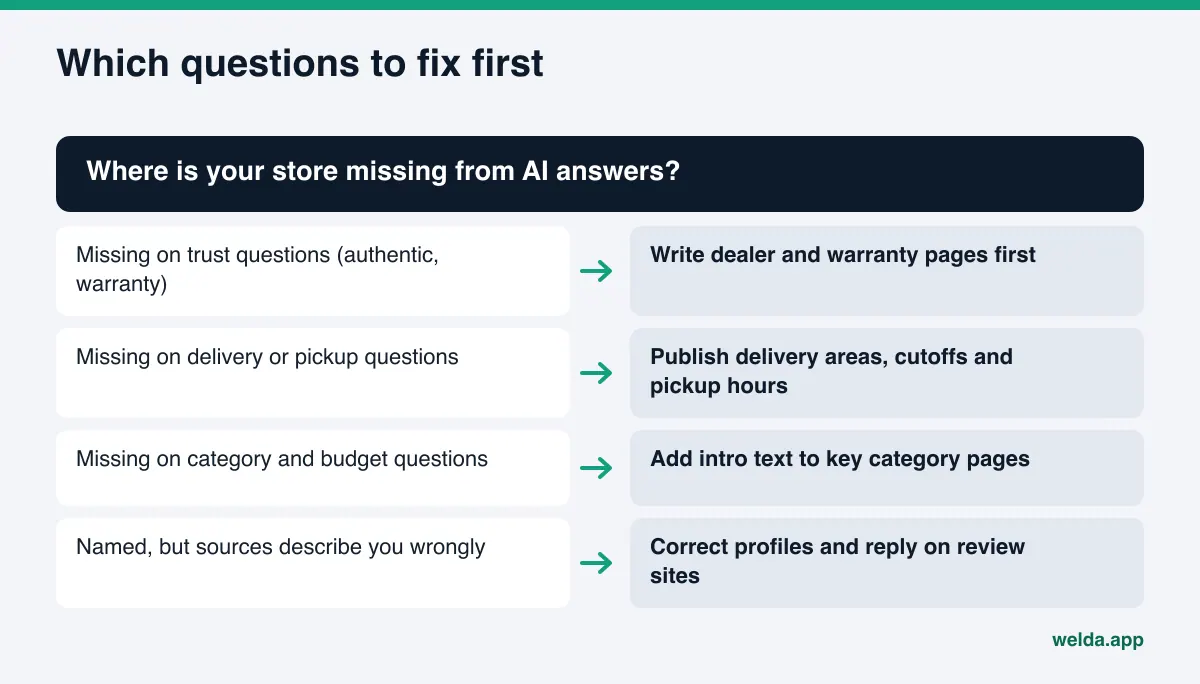
In the Welda panel, the questions your shoppers would ask, such as "who sells this phone with full manufacturer warranty near me" or "same-day laptop delivery in my city," are asked three times each to ChatGPT, Gemini, Perplexity and Google AI. For each question you see whether your store is named, where it appears in the answer, and which sources the answer leans on. For electronics, the most useful view is by question type. If you show up on category questions but disappear on trust and warranty questions, the missing piece is your store facts, not your product pages.
An open score you can read
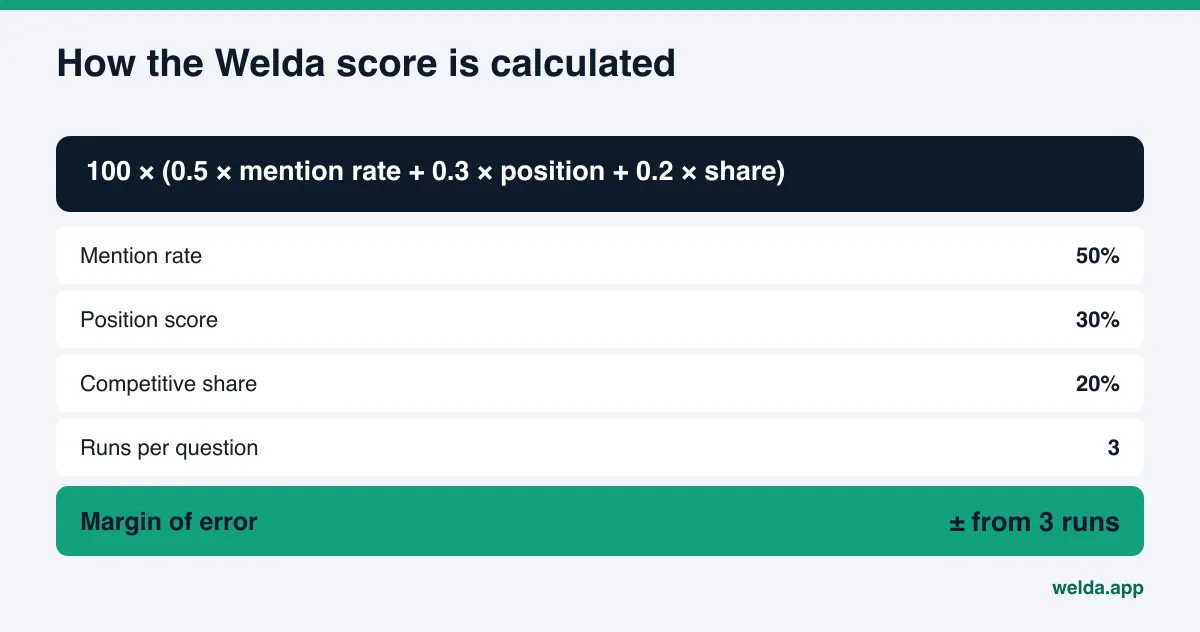
The Welda score is not a black box. It combines the share of questions that name you, how early you are named, and your share compared with competitors, with fixed weights. Because each question runs three times, the spread between runs gives a margin of error, so you do not act on one lucky answer.
Prepared pages and approval
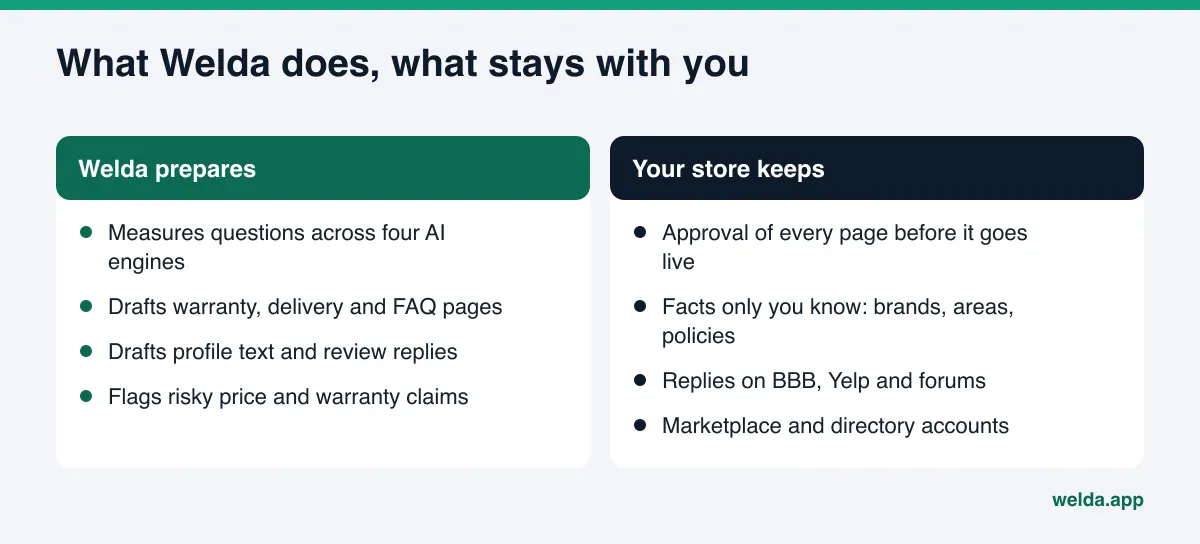
Welda drafts the missing pieces, such as a warranty and repairs page, a delivery area page, an FAQ section, profile text and review replies, using facts you provide. It does not invent facts. If it does not know which brands you are authorized for or which ZIP codes you deliver to, it asks you on the to-do list. On WordPress sites, Welda connects through a separate Editor user and an application password, without installing code; drafts open on your site and go live only after you approve them. On other platforms, Welda hands you a ready package and you or your developer apply it. Content always lives on your own site. A compliance check flags price, warranty and "lowest price" style claims before publishing; it is not legal advice.
The rest of the panel, including the sources view, competitor view, before-and-after comparison and the one-page monthly PDF report, supports the same loop: measure, fix, check again. If you are weighing a tracking-only tool against one that also does the work, our comparison of AI visibility monitoring vs. done-for-you AEO lays out the trade-offs.
Early access and what you can use today
The Welda panel is in early access and is opening first in Turkey. Regular four-engine measurement is being added during early access, and the sample screens in the panel use representative data. Pricing is not published; it is discussed in the early access conversation.
What anyone can use today is the free site analysis, which works in English. It reads your home page and a few inner pages, such as services, pricing, about and contact, and checks whether AI crawlers can get in, your page title and description, your main heading, business Schema, address and phone details, linked map and social profiles, FAQ content, review and trust signals, how clearly your offer is described, and page speed. You get a score out of 100 split into technical and content parts, an explanation of each gap and how to fix it, ready text suggestions for your home page, a simulation of how much each fix would move the score, a competitor comparison, and a fix package to add to your site, including business Schema code. It also asks five shopper-style questions to an AI assistant that can search the web and checks whether your store's name comes up. It is free once per site; your email and phone are verified, and the results link stays open for 14 days.
What Welda does not do
Setting the right expectations matters, especially in a category where every competitor promises results.
- No ranking guarantee. Welda does not promise to get you "into ChatGPT" or into a specific spot in any answer. The engines decide.
- No invented facts. Warranty terms, dealer status and delivery areas come from you. A wrong warranty statement is worse than a missing one.
- No fake reviews. Welda drafts replies to reviews. It never writes reviews or forum posts pretending to be customers.
- Nothing sensitive goes out without approval. Every page and profile change passes through you.
- Some work stays with you. Handling negative reviews, answering BBB complaints, keeping marketplace and directory accounts current, and press outreach remain the store's job.
- Change takes time. New pages and corrected profiles usually take weeks to show up in AI answers.
One limit is specific to electronics. On pure product comparison questions, such as "which earbuds are better," AI engines usually recommend products and cite review sites rather than stores. It is hard for a retailer to be named there. The real opening is the "where should I buy it" question that follows. Put your effort there first.
Checklist: is your electronics store ready for AI answers?
Use this list to check your site and profiles today. Mark each item as done, partial or missing. Missing items go to the top of your to-do list.
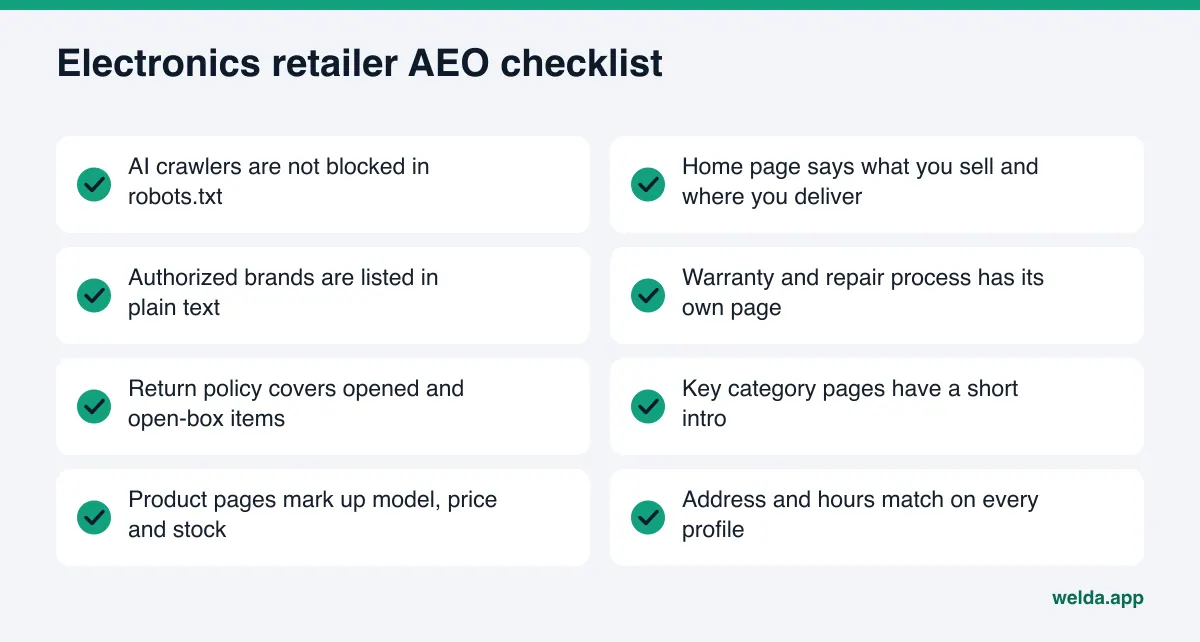
While you go through it, answer these questions honestly:
- Could a stranger tell from your home page alone what you sell, where you are and where you deliver?
- Is "are your products new and covered by the manufacturer warranty?" answered in one sentence somewhere on your site?
- Does your warranty page tell a customer exactly what to do when a device fails?
- Do your address and hours match across your site, Google Business Profile, Yelp and your BBB listing?
- Have you replied, under your store's name, to recent complaints on review sites?
If you sell other product lines, the same logic carries over. Our guide to AI visibility software for beauty and skincare brands applies it to a category where ingredients and claims replace warranty and dealer status.
Frequently asked questions
How is AI visibility software different from an SEO tool?
An SEO tool tracks where your pages rank in search results. AI visibility software checks whether AI assistants name your store in their answers and which sources they rely on. The two are related, but they measure different things.
Is AEO the same as GEO?
Mostly, yes. Answer engine optimization (AEO) is the common US term. Generative engine optimization (GEO) describes the same goal: being cited and named in AI-generated answers.
I have thousands of product pages. Do I need to rewrite them all?
No. Start with store facts, such as dealer status, warranty, delivery and returns, and your main category pages. On product pages, correct structured data matters more than rewriting copy one page at a time.
I also sell on marketplaces. Does my own site still matter?
Yes. A marketplace storefront may be cited, but your own site is where you can state who you are and what your policies are most clearly. The two should never contradict each other.
How long until my store gets recommended?
There is no fixed timeline and no guarantee. New content and fixed profiles usually take weeks to show up in AI answers, which is why repeated measurement is more useful than a one-time check.
Can I use the Welda panel from the US today?
The panel is in early access and is opening first in Turkey. The free site analysis works in English today and is available to anyone, once per site.
Next step: see where your store stands
Instead of guessing why AI assistants skip your store, measure it. Run the free site analysis, see your score and the gaps behind it, and add the fix package to your site. It does not measure rankings, but it shows clearly how AI reads your store today and what to fix first.