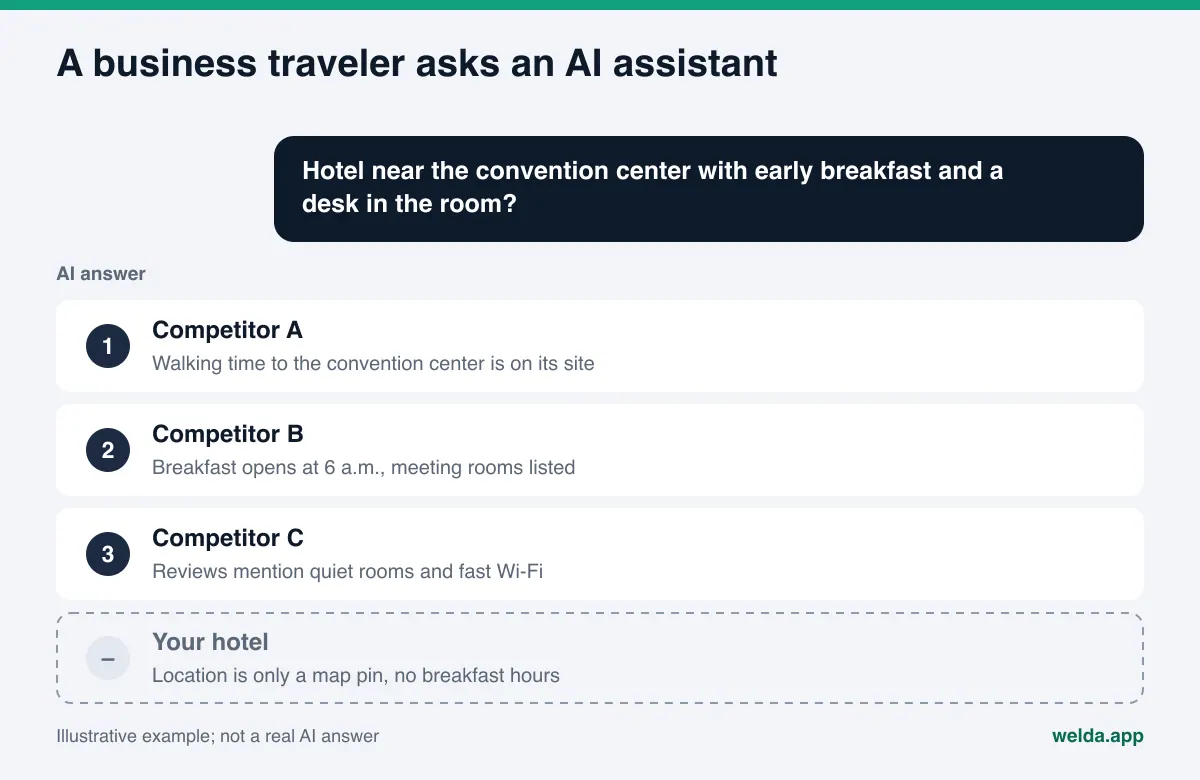
What does AI visibility software for business hotels actually do? Corporate travelers now ask ChatGPT, Gemini, Perplexity and Google's AI Overviews questions like "hotel near the convention center with early breakfast." AI visibility software for business hotels checks whether your property is named in those answers and shows which missing facts keep you out. This guide covers the questions business travelers ask, the answer engine optimization (AEO) work a city or airport hotel needs, and how Welda handles that work.
Why AI visibility for business hotels is its own problem
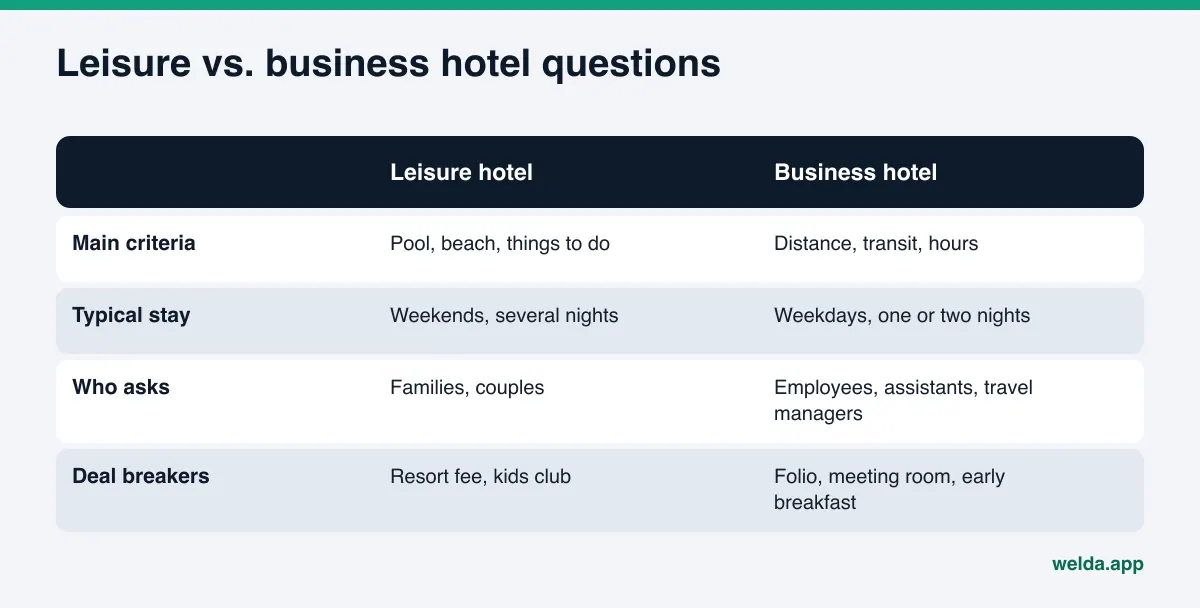
AI search visibility is whether your business is named when an AI assistant answers a question. The discipline is usually called AEO, short for answer engine optimization. You will also see the term GEO (generative engine optimization), which means roughly the same thing. For a beach resort, the questions are about the pool, the kids club and things to do. For a business hotel, they are about distance, timing and the practical details of a workday on the road.
Think about how a traveler phrases it. "Hotel within walking distance of the convention center." "Where to stay near the airport for a 6 a.m. flight." "Quiet hotel downtown with a real desk and fast Wi-Fi for a three-day client visit." "Hotel near the medical campus with free parking." Each question names a destination and a constraint. An answer engine can only match your hotel to it if your website states those facts in plain words.
That is the core issue. A map pin does not tell an AI model that you are an eight-minute walk from the convention center. Your front desk knows breakfast opens at 6 a.m., but if that is not on your site, the model does not know it. The same goes for how folios work for expense reports, whether the meeting room seats twelve or forty, and what happens when a guest arrives after midnight. The competitor who writes those details down gets into the answer. The hotel that does not is left out, even if its rooms and rates are better.
There is a second reason business hotels feel this more sharply. The person booking is often not the guest. An executive assistant, a travel manager or an office coordinator needs a short list of options that fit a policy. An AI answer is exactly that short list. If you are not on it, you are not compared at all.
The quickest way to see where you stand is to measure your site as it reads today. Welda's free site analysis reads your homepage and several inner pages the way Google and AI assistants do, lists each gap and explains how to fix it.
What do AI assistants look at when recommending a business hotel?
Answer engines pull from several kinds of sources at once. Nobody outside these companies knows the exact weighting, but the sources cited in answers make the pattern fairly clear. For business hotels in the US, these are the sources that keep showing up:
- Your own website: location, room types, amenities, hours, policies. You control it fully, and most gaps are here.
- Google Business Profile and Google Maps: address, phone, amenities, photos and reviews. Google's AI Overviews and AI Mode draw on this directly.
- Online travel agencies and metasearch: Expedia, Booking.com and Google Hotels list amenities and policies. If your OTA listing contradicts your site, the model cannot tell which one is current.
- Review sites: Tripadvisor and Yelp reviews from business travelers mention "quiet room," "fast Wi-Fi," "early breakfast," "shuttle to the airport." AI answers reuse those phrases as reasons.
- Local and event sources: convention center and visitor bureau pages often list nearby hotels. Being listed there with accurate details helps.
Two of these are fully in your hands: your website and your Google Business Profile. The first job is to make both complete and consistent with each other. OTA descriptions are also built from information you submit, so they should match as well.
How to improve AI visibility for a business hotel, step by step
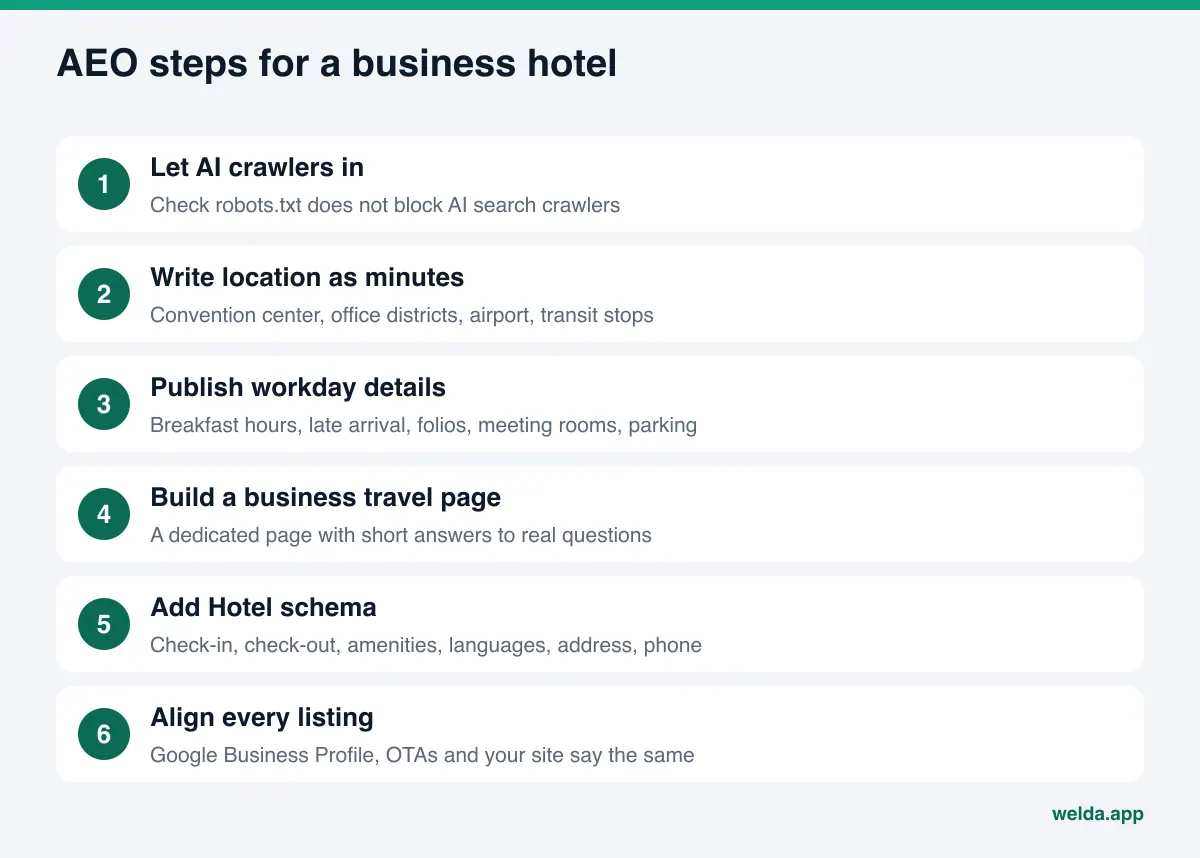
These are the basic tasks a business hotel needs before it can show up in AI answers. Order matters: first make sure the engines can read your site, then add content.
1. Make sure AI crawlers can reach your site
Your robots.txt file controls which crawlers can read your site. Some hotel sites block AI crawlers without realizing it, usually through a security plugin or an old setting from a web vendor. OpenAI, for example, says it uses a crawler called OAI-SearchBot to surface sites in ChatGPT search, and that sites blocking it will not appear in ChatGPT's search answers. The check takes minutes. Skip it and nothing else on this list matters.
2. Describe your location in minutes, not adjectives
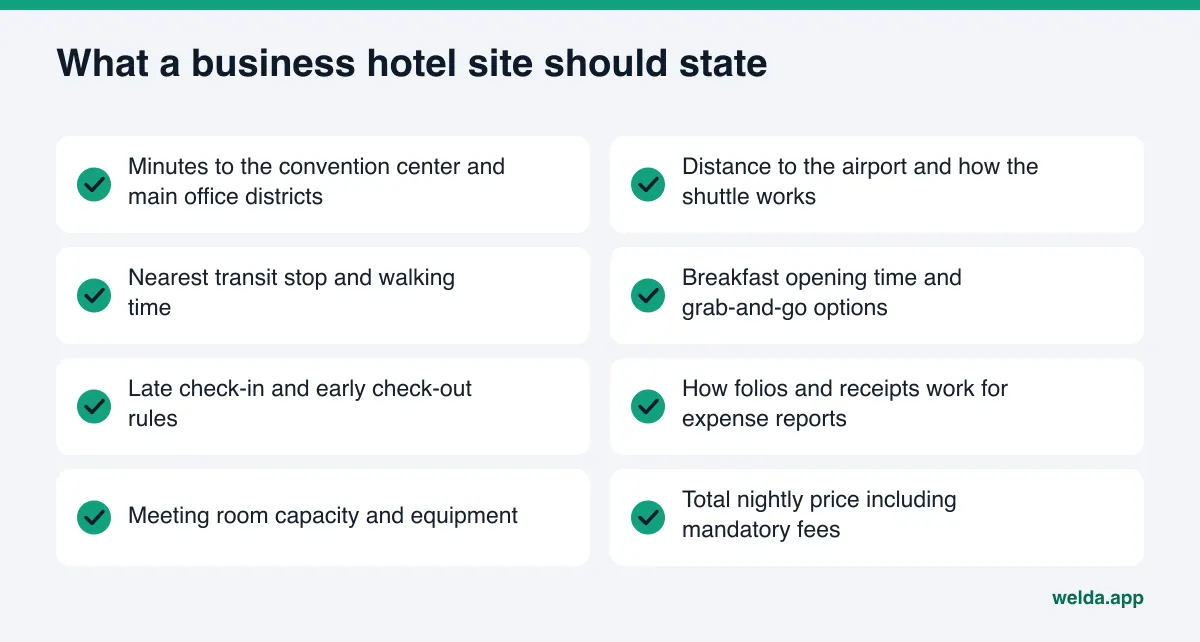
"Centrally located" means nothing to an answer engine. Write this instead: minutes on foot to the convention center, minutes by car to the main office districts, miles to the airport, the name of the nearest light rail or subway stop and how far it is. Put it in a "Location and getting here" section as a list. If you sit between several business areas, name each one. Travelers ask by neighborhood and landmark. If that name never appears on your site, the model has a hard time connecting you to the question.
3. Publish the details of a working day
The details that separate a business hotel from a leisure hotel are often the hardest to find on its site. Check these: when breakfast opens, whether there is a grab-and-go option for early flights, how late arrival works, how guests get an itemized folio for expense reports, meeting room capacity and equipment, whether rooms have a proper desk, what you can honestly say about Wi-Fi, parking cost, and how the airport shuttle runs. Do not publish anything you cannot stand behind. Every fact should be accurate and current.
4. State the total price clearly
This step matters in the US specifically. The FTC's Rule on Unfair or Deceptive Fees covers short-term lodging and requires businesses that advertise a price to show the total price, including mandatory fees such as resort or destination fees, more prominently than other pricing. The FTC's own FAQ explains what counts. Beyond compliance, a clear total price is something AI answers can quote. This is not legal advice; check your setup with your own counsel.
5. Build a business travel page with real questions
Instead of cramming everything into your homepage, create a "Business travel" or "Corporate stays" page. Answer the questions travelers actually ask: "Is there a shuttle to the convention center?", "Can I get an itemized folio for my company?", "Can the meeting room be booked by the hour?", "What time does breakfast start?" Each answer should stand on its own and stay to two or three sentences. AI answers often draw on short, clear paragraphs like these. If you run more than one property, each needs its own page; our guide to location pages for AI search covers how to structure them.
6. Add Hotel schema and align every listing
Schema markup repeats your site's key facts in a structured format machines can read. Schema.org defines a Hotel type with fields for check-in time, check-out time, amenities, pet policy, number of rooms and available languages. Filling them in gives answer engines the same facts a second time, in structured form. Our post on schema markup for AI search walks through the setup. Then make sure your Google Business Profile, OTA listings and site all say the same thing. If your site says breakfast opens at 6:30, your profile says 7:00 and an OTA says 7:30, the model cannot tell which is right and may use none of them.
Where should each business travel fact live?
Repeating the same fact in several places can look redundant. It is not, because answer engines gather facts from different places and look for agreement. This table shows where a business hotel should publish the facts travelers ask about most.
| Fact | Where on your site | Where else |
|---|---|---|
| Distance to convention center, offices, airport | Location section, business travel page | Google Business Profile description |
| Breakfast hours | Amenities page, FAQ | Google Business Profile, OTA listings |
| Check-in and check-out | Policies section | Hotel schema (checkinTime, checkoutTime) |
| Folios and receipts | Business travel page, FAQ | Booking confirmation email |
| Meeting rooms | Own section: capacity, equipment, how to book | Hotel schema amenity list |
| Total nightly price | Rates and booking pages | OTA listings, metasearch |
Pick one correct value for each row and use it everywhere. What your front desk tells guests should match what your site says, too. A review that reads "the site said breakfast at 6:30 but it opened at 7" creates a contradiction an AI model will read.
What to look for in AI visibility software for business hotels
There are several kinds of AEO tools. Some only monitor and report. Some suggest content. Some do the fixes with you. When you evaluate one for a business hotel, ask these questions:
| Criterion | Why it matters | What to ask |
|---|---|---|
| Question set | Business hotels are found by landmark and neighborhood, not "hotels in [city]" | Are questions built around your area and business travel intent? |
| Engines | Each engine leans on different sources | Are ChatGPT, Gemini, Perplexity and Google AI measured separately? |
| Repeats | The same question can get different answers at different times | Is each question asked more than once, with a margin of error shown? |
| Competitor view | You need to know why the hotel across the street wins | Does it show which source a competitor wins from? |
| Fixes | Measurement alone does not change your site | Does it supply ready text and code, and who applies them? |
For a deeper look at the difference between tool types, see AI visibility monitoring vs. done-for-you AEO.
How Welda handles AI visibility for business hotels
Welda is software that measures where a business appears in AI answers and fills the gaps on the business's behalf. For a business hotel, two parts matter most: the free site analysis you can use today, and question-by-question tracking against competitors, which is in early access.
The free site analysis: what it checks on a hotel site
The free analysis runs in English and reads your homepage plus a few inner pages such as rooms, rates, about and contact. It checks whether AI crawlers can get in, your page title and description, your main heading, your business information markup, your address, phone and location details, whether your social and map profiles link to your site, whether you have an FAQ section, review and trust signals, how clearly your services are described, and page speed.
For a business hotel, the useful part is what comes back. You get a score out of 100, split into technical and content. Each gap shows what was found, why it matters and how to fix it. You get suggested copy for your homepage title, description, main heading, intro paragraph and FAQ, so you can see what "write your location in minutes" looks like on your own page. A simulation shows how much each fix would move your score, which helps you decide what to do first. There is a competitor comparison and a ready-to-install fix package that includes business information markup. The analysis also asks an AI assistant with web search five questions a guest might ask and checks whether your hotel's name comes up. That is a one-time snapshot, not ongoing tracking. It does not measure rankings and does not promise any.
Question-by-question tracking against competitors
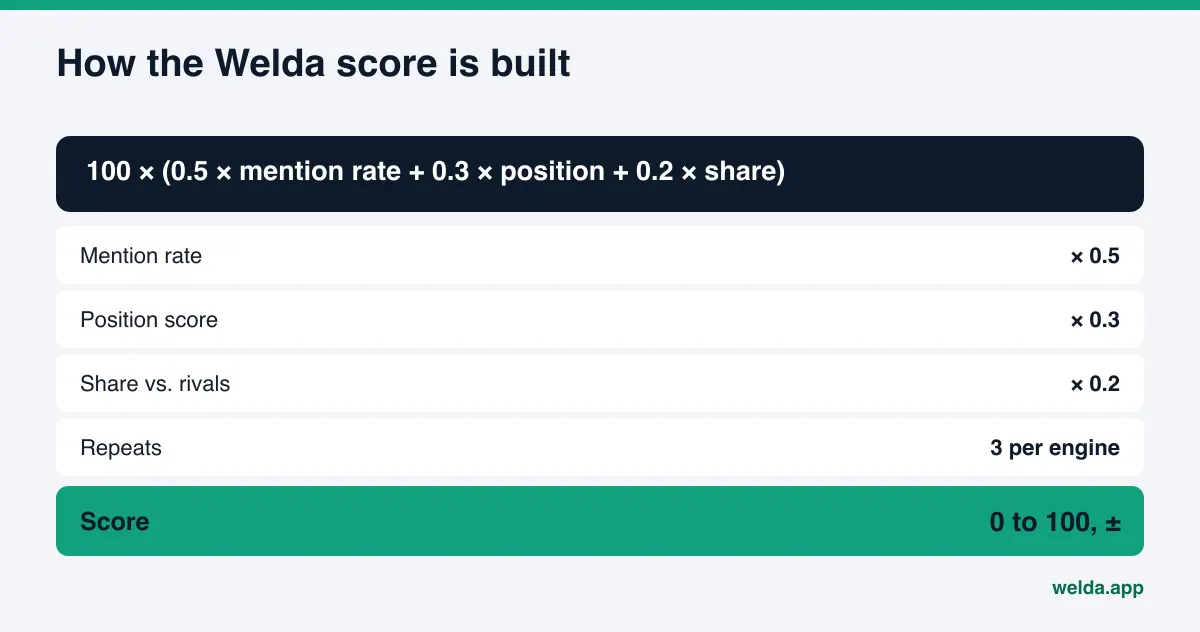
The Welda panel asks your guests' likely questions to ChatGPT, Gemini, Perplexity and Google AI three times each. You see which questions name you, in what position, and where competitors are ahead. For a business hotel that answers a practical question: "Do I show up for convention week questions, or only for generic downtown questions?" If you are absent from airport questions but named in two engines for office district questions, you know to fix your airport and shuttle information first. The competitor view goes one step further and shows which source a rival wins from, whether its own site, an OTA listing or Google Maps. That tells you whether the next job is content on your site or a fuller listing elsewhere.
When gaps are found, Welda drafts the content: business travel page copy, FAQ answers, profile descriptions and review replies. It does not invent facts. If it does not know your breakfast hours or meeting room capacity, it asks you. Publishing approval stays with you, and content always lives on your own site.
Here is where things stand. The panel is in early access and is opening first in Turkey. Regular four-engine measurement is being added during early access, and sample panel screens use representative data. The part anyone can use today, in English, is the free site analysis. Pricing is discussed during early access onboarding.
An example: a hotel near a convention center
Picture an example property: a mid-size hotel fifteen minutes by car from a convention center, with a meeting room and an early breakfast. Its homepage says "conveniently located, comfortable rooms." It does not name the convention center, give a distance, list breakfast hours or explain folios. This is an illustrative scenario, not a real business.
A free analysis of a site like this would likely flag a main heading that does not say what or where the hotel is, no FAQ section, missing Hotel markup and a map profile not linked from the site. The five-question test would likely show the hotel absent from "hotel near the convention center."
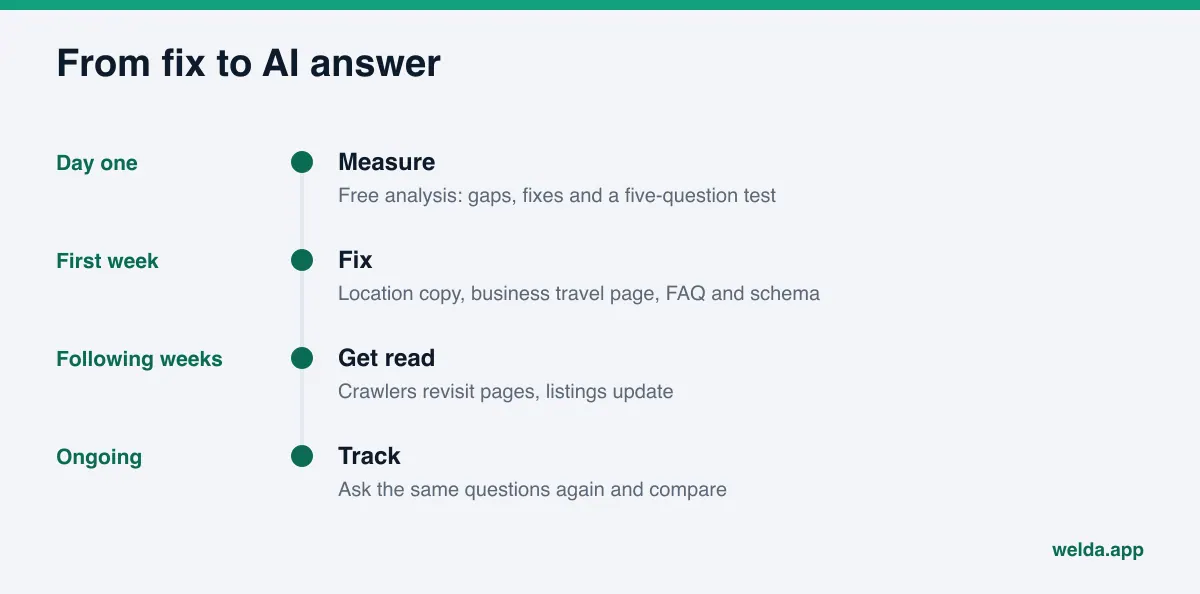
The fix list writes itself. The convention center and neighborhood go into the main heading. A location section lists minutes to the convention center, the office district and the airport. A business travel page covers breakfast hours, the meeting room, folios and late arrival. The total nightly price with mandatory fees is shown clearly. Hotel schema is added and the Google Business Profile hours are aligned with the site. These changes usually take weeks to show up in AI answers, so the same questions should be asked again at intervals. Our guide to before and after AEO measurement explains how to set that up properly.
Limits: what Welda does not do
Knowing what a tool will not do matters as much as knowing what it will. Welda's limits:
- It does not guarantee rankings or placement in ChatGPT. AI answers are the engine's decision, and nobody can promise them.
- It does not make up facts. Folio rules, meeting room capacity and breakfast hours come from you.
- It does not write fake reviews. It drafts replies to real ones.
- Removing negative reviews, creating directory and OTA accounts, and press work stay with you.
- It does not publish sensitive content without approval, and its compliance check flags patterns such as price claims and superiority claims before publishing. That check is not legal advice.
- It does not host content. Everything stays on your site.
Results also take time. New content usually needs weeks before it is reflected in AI answers, so track change over time rather than expecting movement in the first week. Hotels in other segments face the same timing; our guide on AI visibility software for ski lodges shows how seasonality changes the picture.
Checklist: is your business hotel ready for AI search?
Open your site and go through this list. Every "no" is a task.
- Are AI search crawlers allowed in robots.txt?
- Does your main heading say what kind of hotel you are and where?
- Are distances to the convention center, office districts and airport written in minutes or miles?
- Are breakfast hours, late arrival and early departure rules on the site?
- Are folios, receipts and meeting rooms explained?
- Do you have a business travel page with short FAQ answers?
- Is the total nightly price, with mandatory fees, shown clearly?
- Is Hotel schema in place?
- Do your Google Business Profile, OTA listings and site agree?
- Do you have a routine for asking the same questions again over time?
Frequently asked questions
How is AI visibility software different from an SEO tool?
An SEO tool tracks your position in Google's results list. AI visibility software checks whether you are named in AI answers, in what position, and which sources the answer relied on. They complement each other; a technically sound site helps on both sides.
We have strong OTA ratings. Isn't that enough?
It helps, but usually not enough. OTA listings cover general amenities. Details like minutes to the convention center, meeting room capacity or folio handling are often missing there. If your own site does not state them, AI assistants struggle to match you to business travel questions.
How long until changes show up in AI answers?
Usually weeks. Crawlers need to revisit your pages, listings need to update, and engines need to start using the new information. That is why ongoing measurement beats a single test.
Does the free analysis work for US hotels?
Yes. The free site analysis works in English and reads any public hotel website. It is free once per site; your email and phone are verified, and the results link arrives by email and stays open for 14 days.
Is the Welda panel available in the US?
The full panel is in early access and is opening first in Turkey. The free site analysis is available today in English.
We have several properties. Is each one measured separately?
Each property has its own neighborhood, landmarks and competitors, so each needs its own question set and its own page on your site. Separate, detailed property pages are also what make measurement meaningful.
Your first step
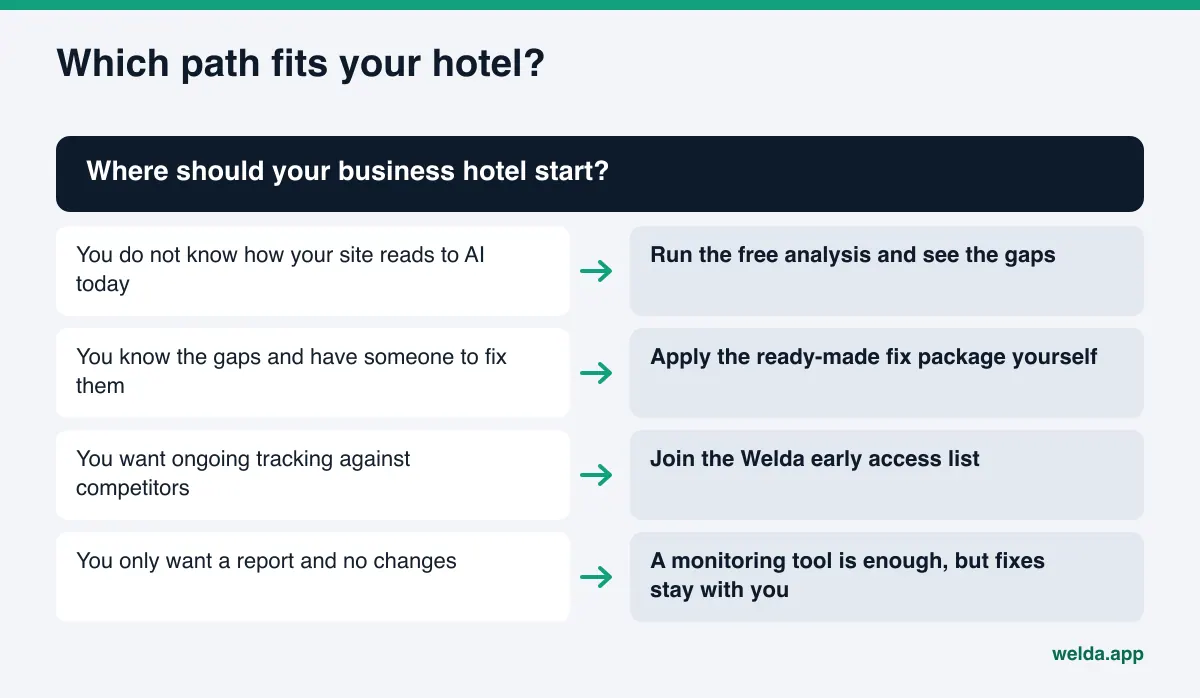
AEO for a business hotel starts by turning what your front desk knows into text your site publishes: distances, hours, folios, meeting rooms, total price. To see how much of that is missing today, run the free site analysis. It shows your gaps, gives suggested copy and a fix package to install, and checks whether your hotel is named in five questions a traveler might ask.