What does AI visibility software for barbershops actually do? It checks whether your shop gets named when customers ask ChatGPT, Gemini, Perplexity or Google's AI features things like "good barber near me," and it shows which missing details keep you out of the answer. Good software does not stop at a score; it tells you what to write, where to put it and gives you the copy. This guide covers what a barbershop should expect from such a tool, the work you can do yourself and how Welda handles it.
Why barbershops need to think about AI search visibility now
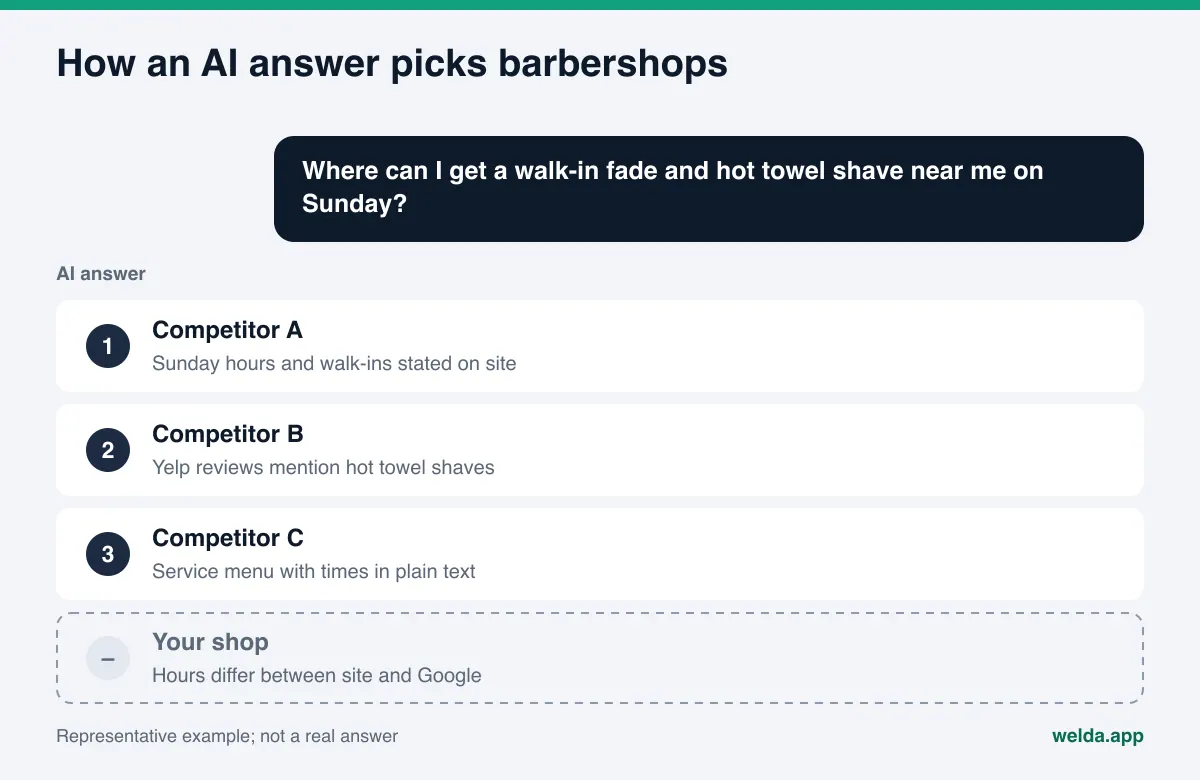
A few years ago, a guy looking for a barber either walked into the shop on his block or scrolled the map for the closest pin. Today the same customer types "walk-in barber open Sunday near me" into ChatGPT, or asks Google and gets an AI Overview on top of the results. Perplexity and ChatGPT often answer with three or four shop names and a one-line reason for each.
That changes the math for a barbershop. In a classic list of ten blue links, the customer chose. In an AI answer, the answer does most of the choosing. If your shop is not on that short list, the customer may never think of you. The work of earning a spot in those answers is called AEO, answer engine optimization. You will also see the term GEO (generative engine optimization), which means the same thing and is used more in Europe. Either way, the goal is AI visibility: being named, and named correctly.
Barbershops sit in a tricky spot for two reasons. First, customer questions are very specific. Are you open Sunday? Do you take walk-ins? Do you do straight razor shaves, beard lineups, kids' cuts? Do you take cards? An AI model can only answer those questions if the details are written down somewhere it can read. Second, most barbershops have a scattered online footprint: an old website, a Google Business Profile nobody has touched in a year, a Yelp page, an Instagram account. The hours say 7 p.m. in one place and 8 p.m. in another. When an AI model sees a conflict, it either skips the shop or repeats the wrong detail.
AI visibility software exists to make that mess visible. If you want to see where your shop stands today, Welda's free site analysis reads your website the way Google and AI assistants do and lists each gap one by one. It runs in English and is free once per site.
What do customers ask AI about barbershops?
Barber questions fall into a handful of patterns. The table below shows each pattern and what the AI looks for to answer it. The questions are examples we wrote to illustrate the patterns; they are not survey data or measurements.
| Question pattern | Example question | What the AI looks for |
|---|---|---|
| Nearby and open now | "Barbershop open right now near downtown?" | Address, regular hours, holiday hours |
| Booking style | "Barber that takes walk-ins on Saturday?" | Walk-in or appointment policy, wait time practice |
| Specific service | "Where can I get a straight razor shave with a hot towel?" | Service menu written as text |
| Skill | "Best barber for skin fades and tapers?" | Service descriptions, review wording, barber bios |
| Family | "Kid-friendly barbershop for a first haircut?" | Kids' cuts listed, good times to come, reviews |
| Trust and price | "Is this barbershop worth the price?" | Reviews, owner replies, clearly stated prices if you list them |
The last column is the point. An AI model does not pick "the best barber" based on taste. It matches the question to details it can read. For a walk-in question, the shop whose site or profile says "walk-ins welcome weekdays before noon" has an edge. For a kids' cut question, the shop that lists kids' cuts on its service menu has an edge. If that detail only exists inside an Instagram graphic, the AI usually cannot read it.
The sources matter too. For a US barbershop, AI answers tend to draw on your own website, your Google Business Profile, Yelp, Apple Maps, local "best of" roundups from city magazines and blogs, and community threads on Reddit or Nextdoor. We cover how forum threads shape answers in our post on Reddit and AI answers. If you also run a salon side, our guide to AI search optimization for hair salons covers the overlap.
What to look for in AI visibility software for barbershops
A growing number of tools say they measure AI visibility. Some are built for national brands with large marketing teams. Others only run a technical scan. For a barbershop, the right software measures local questions a real customer would ask and turns the result into a short task list. Use these criteria when you compare options:
- Does it test local questions? Not just "best barber," but questions with your neighborhood and your services in them.
- Does it check more than one AI engine? ChatGPT, Gemini, Perplexity and Google's AI features pull from different sources. Showing up in one does not mean you show up in the others.
- Does it avoid trusting a single result? AI answers vary from one run to the next. A tool that asks each question several times and shows the spread gives you a more honest picture.
- Is the score formula published? When your score moves, you should be able to see why.
- Does it turn gaps into tasks? "Your visibility is low" is not useful. Which detail is missing, where it goes and what the copy says: that is useful.
- Does it ask for your approval? Nothing written in your shop's name should go live without you signing off.
- Does it promise results? If it guarantees placement in ChatGPT, walk away. No software controls AI answers.
AEO for barbershops, step by step
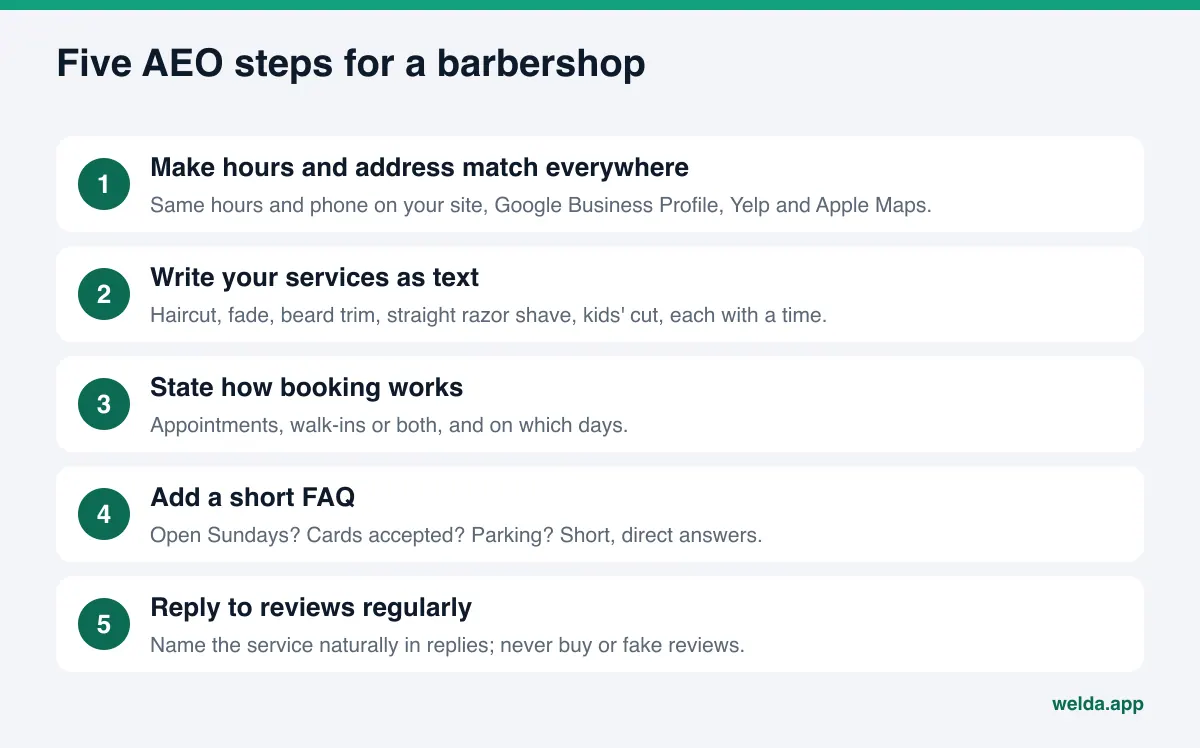
With or without software, the core work is the same. You can do most of these steps yourself in an afternoon. Order matters: fix conflicts first, then add new information.
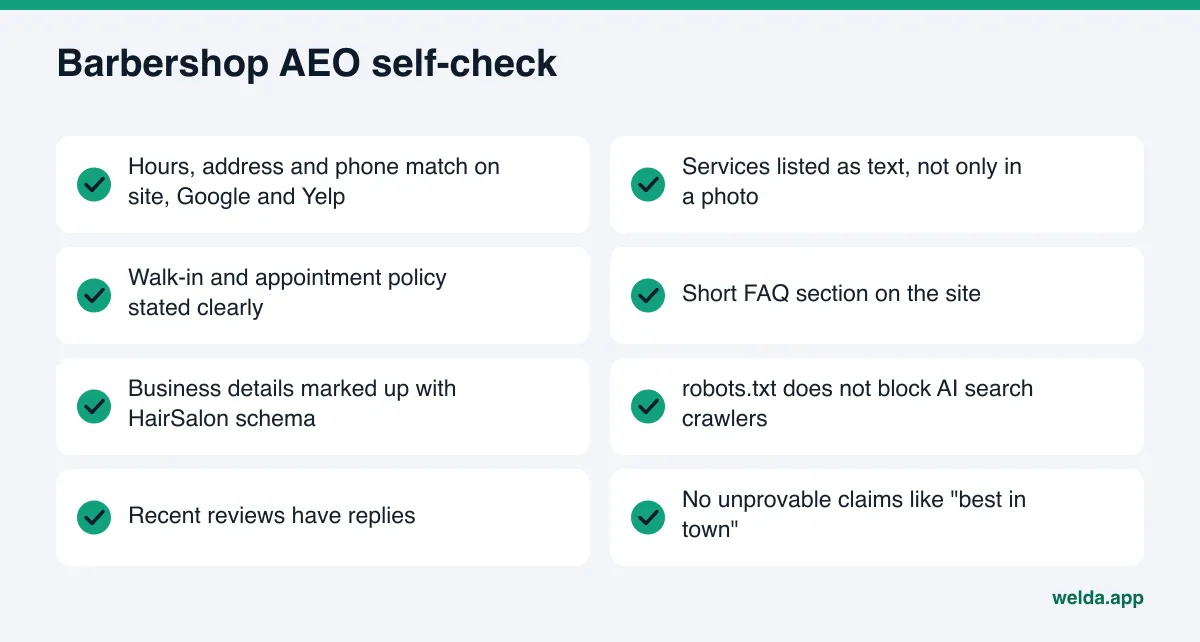
- Get one version of your basics. Write your shop name, address, phone and hours on a piece of paper. Then check your website, Google Business Profile, Yelp, Apple Maps and social accounts. Fix every place that differs. Add holiday hours as special hours on your profile.
- Write your services as text. A photo of the price board is not enough. List haircut, scissor cut, fade, taper, beard trim and lineup, straight razor shave, hot towel, kids' cut and any other services as separate lines on your site. Add a rough time for each.
- State how booking works. One sentence such as "We book appointments, and we take walk-ins weekdays before noon" lets the AI consider you for walk-in questions. Say how people book: phone, text or an online form.
- Add a short FAQ. Open Sundays? Cards or cash? Parking? How many chairs? Good with kids? Short, direct answers give the AI ready-made answer patterns.
- Mark up your business details. Structured data (schema) puts your address, hours and phone in a format machines read reliably. Schema.org has a HairSalon type under its local business family, which fits a barbershop.
- Make sure AI crawlers can get in. If your robots.txt blocks AI crawlers, your site does not get read. OpenAI's documentation says sites that want to appear in ChatGPT search answers should not block OAI-SearchBot. Details are in our post are AI bots crawling my website.
- Reply to reviews on a schedule. A short thank-you to happy customers, a calm explanation to unhappy ones. Mention the service naturally ("glad the beard trim worked out"). Asking for reviews is fine. Writing or buying fake ones is not; the FTC's final rule on fake reviews, announced in August 2024, bans fake reviews, including AI-generated ones.
Do not expect AI answers to change the next day. New or corrected details usually take weeks to show up in answers. That makes this ongoing upkeep, not a one-time cleanup. When your hours change, your Google Business Profile is the first place to update.
Example: a barbershop homepage, before and after
To see what the steps look like in practice, take the intro on a sample barbershop homepage. The shop and neighborhood are made up; they do not describe a real business.
Before: "Old-school craft, new-school style. Look sharp, feel sharp. Call us today."
It sounds good, but it tells an AI model nothing. Where is the shop? What services? Appointments or walk-ins? What hours? For "open Sunday barber" or "straight razor shave near me," this page has little chance of making the answer.
After: "Sample Barber Co. is a barbershop in the Riverside neighborhood offering men's and kids' haircuts, fades, beard trims and hot towel straight razor shaves. We are open Tuesday through Sunday, 10 a.m. to 7 p.m. We take appointments by phone or text and welcome walk-ins on weekday mornings."
The second version is not longer; it is more informative. Four sentences cover the neighborhood, services, hours and booking. When the AI reads it, it finds concrete phrases it can match to a customer's question. Repeat the same facts in your FAQ and your schema markup, and the page holds together.
Two things to watch. The "after" version makes no "best in town" claim; unprovable superlatives cost trust and can create advertising problems. And every detail has to be true. If you are closed Sundays, writing "open Sundays" means an AI answer will send customers to a locked door.
How Welda handles AI visibility for a barbershop
Welda is software that measures where a business shows up in AI answers and fills in the gaps on the business's behalf. For a barbershop, that comes down to three parts: how readable your site is, how you show up question by question, and turning gaps into a task list.
1. The free site analysis: what your site says and what it leaves out
The analysis reads your homepage plus a few inner pages such as services, pricing, about and contact. This is where the most common barbershop gaps show up: a service menu that only exists as an image, hours that appear nowhere on the page, no business schema, a Google profile that is not linked from the site, no FAQ. For each gap you see what was found, why it matters and how to fix it.
The analysis also drafts homepage copy for you: page title, meta description, main heading, intro paragraph and FAQ. For a barbershop, that means an opening line that matches what customers ask, like the "after" example above. A simulation shows how much each fix would move your score, which helps you decide where to start. You also get a ready-to-install fix package that includes business schema code, a competitor comparison, a PDF and a shareable score card.
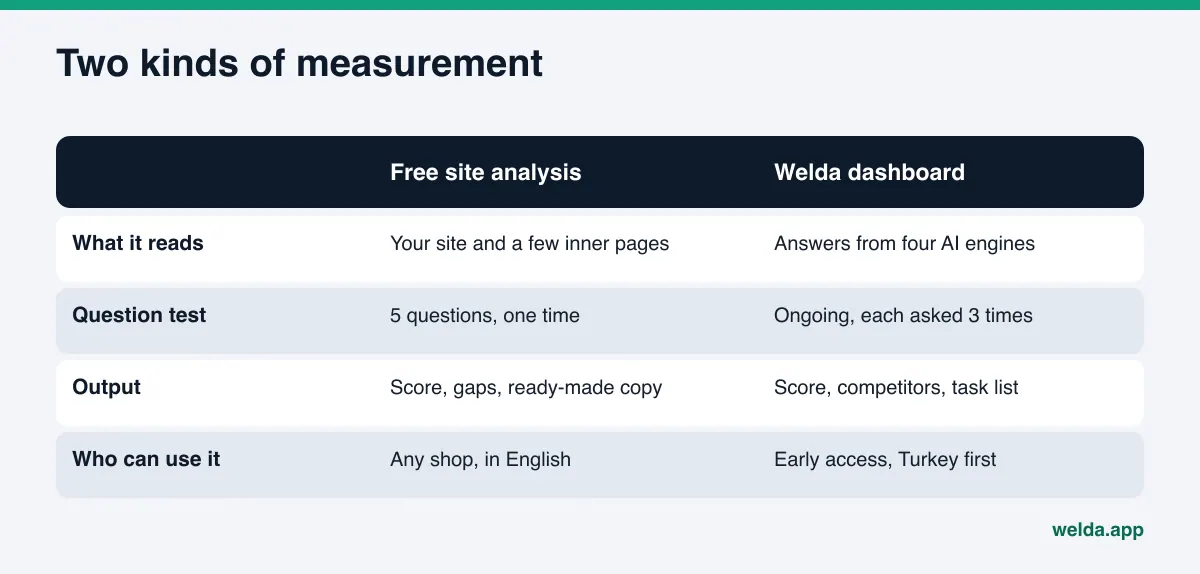
One part of the analysis is a question test. Five questions your customers might ask go to an AI assistant that can search the web, and Welda checks whether your shop's name appears in the answers. It is a one-time measurement, more snapshot than trend.
2. Question tracking in the dashboard: where you show up and where you do not
The Welda dashboard turns that snapshot into ongoing tracking. Customer-style questions go to ChatGPT, Gemini, Perplexity and Google AI three times each. On the questions screen, every question is a row, and for each engine you see whether your shop was named and in what position. Questions can be run in English.
A barbershop owner might notice something like this: the shop gets named for "beard trim in my neighborhood" on two engines but on none for "barbershop open Sunday." The problem is not skill; it is that Sunday hours are not clearly written anywhere. The competitors screen shows the other side: which topic a rival wins and which source gives it the edge. If a rival's Sunday hours appear in a local roundup, you know where to look next. Our post on AI share of voice explains how that comparison works.
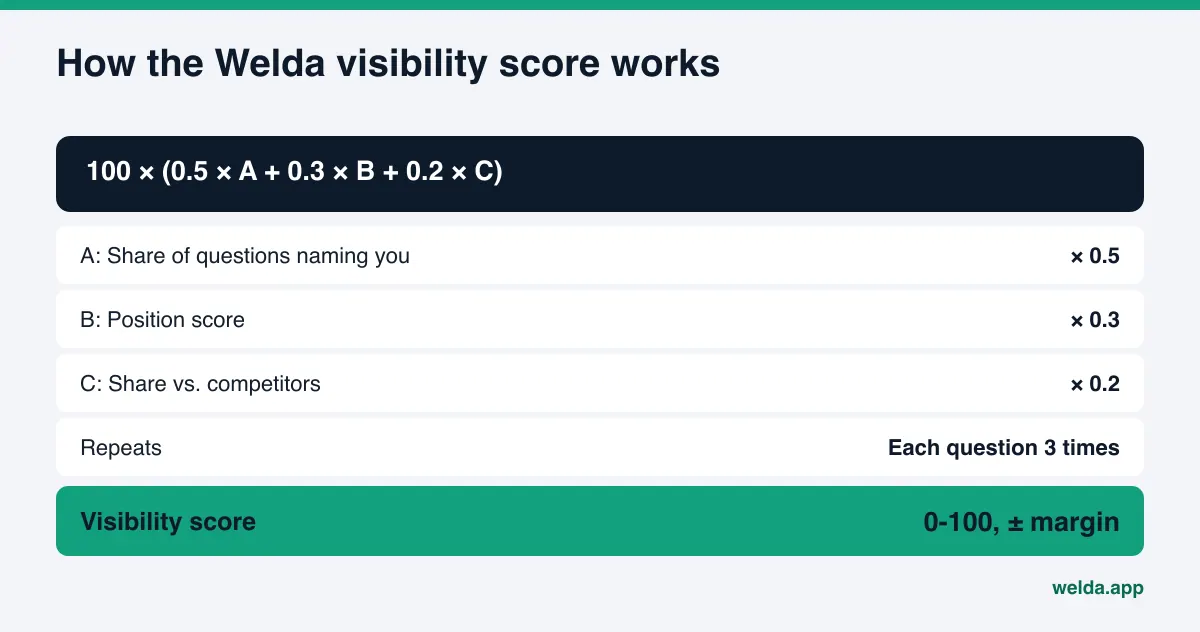
The score formula is published. The share of questions that name you, your position in the answer and your share against competitors combine with fixed weights. The spread across the three repeats gives a margin of error, shown with the score, so you do not mistake normal wobble for a real change.
3. The task list: what Welda prepares and what stays with you
Gaps end up on one task list with three kinds of work. First, information Welda needs from you. Welda does not make up facts it cannot read on your site. If it does not know whether you do kids' cuts or what your Sunday hours are, it leaves the field blank and asks. You answer once and the answer flows into every draft.
Second, content waiting for your approval. Welda drafts service page copy, FAQs, profile descriptions and review replies. You decide what goes live. On WordPress, Welda connects through a separate Editor user and an application password, without installing code; drafts open on your site and go live when you approve them. On other platforms, Welda hands you a ready package and the changes are made by hand. Your content always lives on your own site.
Third, manual tasks. If your Google Business Profile is connected, profile copy is handled there; if not, the task sits on the list as manual with the copy ready next to it. Instagram and Facebook work the same way.
The rest of the dashboard (sources, before-and-after comparison, a monthly one-page PDF report, a compliance check that flags claims like "best barber in town" before publishing) supports these three parts. The compliance check is not legal advice.
To be clear about where things stand: the full Welda dashboard is in early access and is opening first to businesses in Turkey. Regular tracking across all four engines is being added during early access, and the sample dashboard screens use representative data. What anyone can use today, in English, is the free site analysis. Pricing is discussed in the early access conversation.
What AI visibility software cannot do for your shop
AI visibility software cleans up your shop's footprint online. It does not change your barbers' skill, the feel of your shop or how you treat customers. To set expectations, here is what Welda does not do:
- No ranking guarantee. No software controls AI answers. Welda fills in the details that make you easier to name, and measures the result.
- No made-up facts. You tell it what services you offer and when you are open.
- No fake reviews. Welda drafts replies; the reviews themselves have to come from your customers.
- Nothing published without approval. Every draft comes to you.
- Some work stays with you. Handling negative reviews, claiming directory listings and building local press relationships are owner jobs.
- No instant results. New details usually take weeks to show up in AI answers.
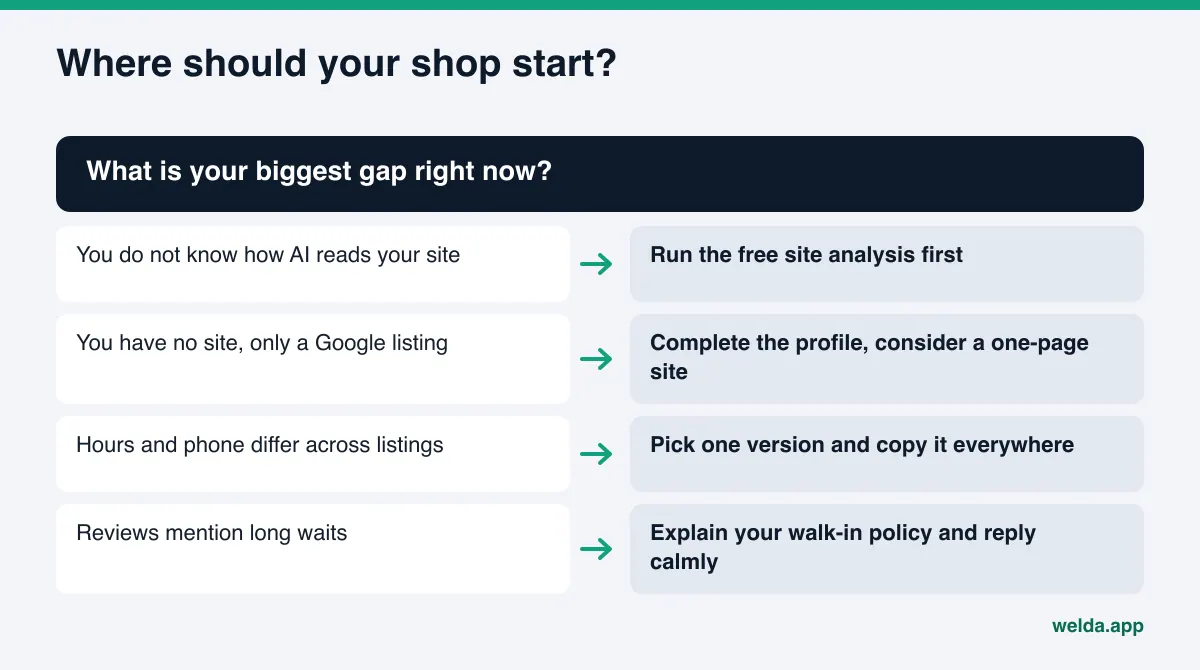
Reviews deserve a note. Your shop can be named in an AI answer with a caveat attached, such as "some reviewers mention long waits." That caveat usually comes from review text. Our guide to AI reputation management covers how to handle it.
Is AI visibility software for barbershops worth it for your shop?
Not every barbershop needs software. A one-chair neighborhood shop full of regulars may only need a single cleanup. Here is a quick way to decide.
| Your situation | Sensible next step |
|---|---|
| You have a site but do not know how AI reads it | Run the free site analysis and close the gaps yourself |
| No website, only a Google listing | Complete the profile; consider a simple one-page site |
| Busy area with many barbershops nearby | Ongoing tracking makes sense; ask about early access |
| Several locations | Each location needs its own consistent details and tracking |
| Lots of visitors from out of town | Write details that answer travelers' questions, like walk-ins and parking |
Frequently asked questions
How is AI visibility software different from an SEO tool?
An SEO tool tracks where you rank on Google's results page. AI visibility software checks whether your shop is named in answers from ChatGPT, Gemini, Perplexity and Google's AI features. They share some groundwork, but they measure different things.
Does this help if my barbershop has no website?
The site analysis needs a website. Without one, AI models only know you from your map listings and review sites. Completing your Google Business Profile comes first; a short one-page site with your services, hours and booking rules makes the job easier.
Should I list prices on my site?
Customers ask about price, and clear information helps AI answers. Listing prices is still your call. If you list them, keep them current; outdated prices cause more trouble than none.
How do I get the results of the free analysis?
Your email and phone number are verified, and the results link arrives by email and stays open for 14 days. You get a score out of 100, each gap, ready-made copy, a competitor comparison, a PDF and a shareable score card.
Will Welda change my website on its own?
No. On WordPress, content opens as a draft and goes live only after you approve it. On other platforms, Welda gives you a ready package and you or your web person apply it.
How long before I see a difference in AI answers?
The site analysis results come right away. Changes in AI answers usually take weeks, because engines need time to read and use new information. That is why ongoing measurement tells you more than a single check.
See where your shop stands today
Showing up in AI answers does not replace a good cut; it helps the right customer find one. The first step is seeing how your site reads today. Run the free site analysis to get your score, your gaps and ready-made homepage copy. From there you can also ask about early access to the dashboard.