What does AI visibility software for B2B wholesalers actually do? It checks whether your company is named when a buyer asks ChatGPT, Gemini, Perplexity or Google's AI Overviews where to source a product wholesale, and it shows you what keeps you out of those answers. For a wholesaler, the gap is rarely the catalog. It is the terms: minimum order, ship-to regions, dealer requirements and certifications that the AI cannot find on your site.
This guide is for wholesalers and distributors in foodservice disposables, janitorial supplies, packaging, industrial MRO, electrical, office products, apparel blanks and auto parts who sell to retailers, contractors, restaurants and institutions. We cover why AEO (answer engine optimization) works differently in B2B, the steps to take, how Welda handles the work, and where its limits are. If you want to see how an AI reads your site today, start with the free site analysis.
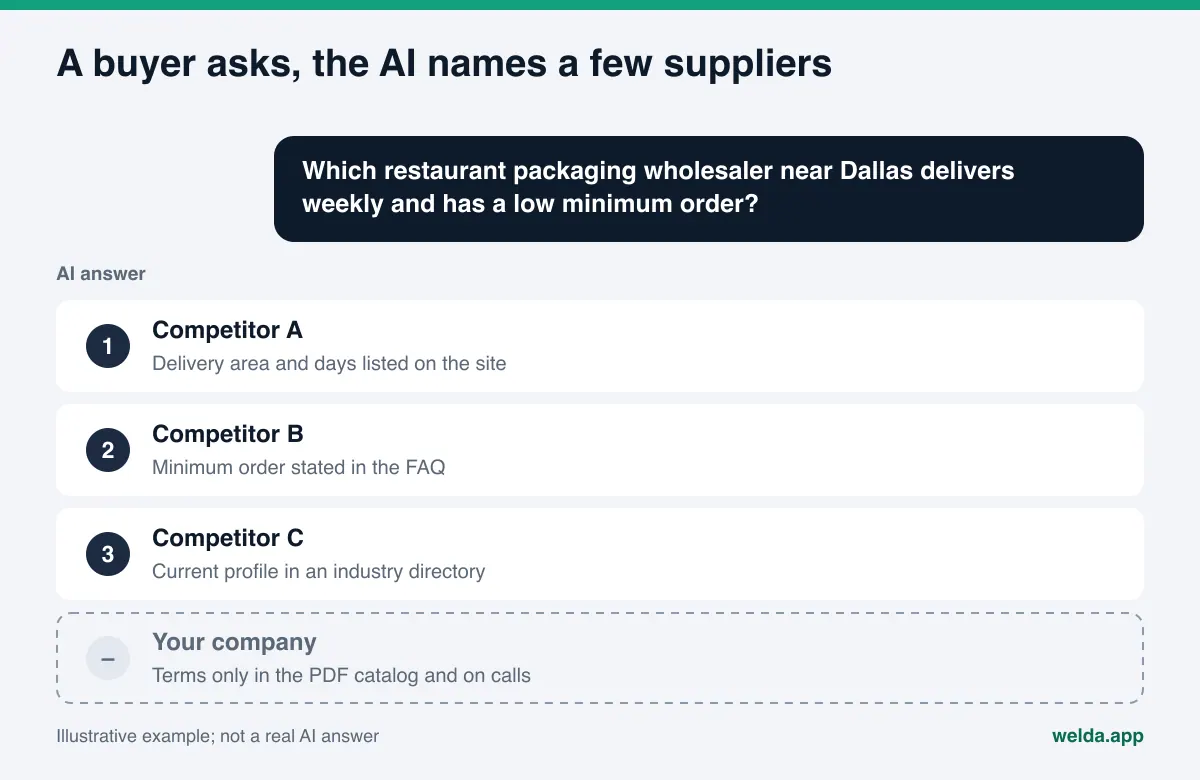
Why AI search visibility is a different job for B2B wholesalers
A consumer searches for a product. A B2B buyer searches for a supplier. The purchasing manager at a regional restaurant group, or a hardware store owner adding a new category, rarely asks an AI assistant about a brand. They ask about conditions: "Which janitorial supply distributor in the Dallas area delivers weekly, accepts net 30 terms and has no huge minimum?" When an AI tool answers that, it looks for pages where those conditions are written down, not for a product grid.
In wholesale, those conditions are usually not on the website. Pricing sits behind a dealer login. The catalog is a PDF. Freight terms are discussed on the phone. The minimum order shows up on the order form. All of that is reasonable business practice. The side effect is that an AI engine finds nothing on your site it can repeat with confidence, so it has no reason to name you.
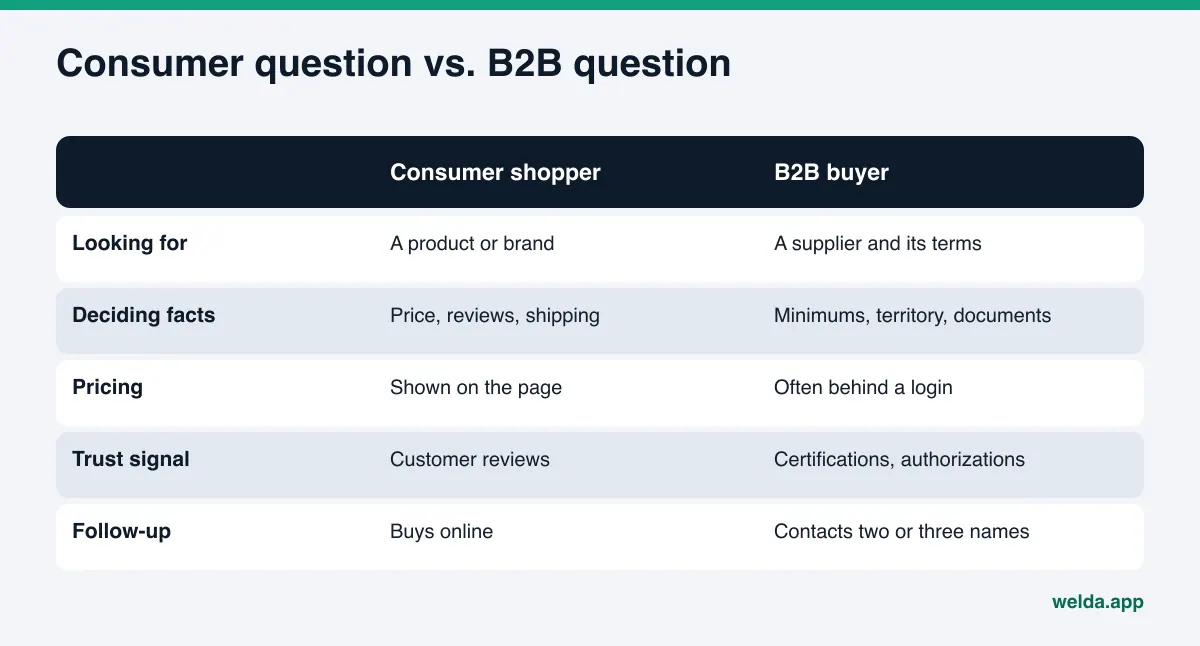
Five traits make AEO for wholesalers different from AEO for consumer brands:
- Questions come with conditions. Buyers ask fewer "best supplier" questions and more "supplier that does X" questions. To be in the answer, X has to be written somewhere the AI can read.
- Prices are private, but the pricing model does not have to be. You can keep list prices behind a login and still say "tiered volume pricing," "dealer pricing on approval" or "quote-based." That is enough for an AI to describe you correctly.
- Territory decides. Most distributors serve a defined region or ship from specific warehouses. If your service area is not stated, you cannot match a question that names a city or state.
- Trust is built on documents. Food-contact compliance for packaging, safety data sheets for chemicals, listings and certifications for electrical goods, and authorized distributor status for branded parts are what buyers check first.
- Buyers compare in one sitting. A procurement team often asks an AI tool for a short list and then contacts two or three names. Being left off the short list means you are not part of the comparison at all.
So AI visibility software for B2B wholesalers should do more than count product pages. It should match the buyer's conditions against what your site and listings actually say. If you compare this with consumer brands, for example in our piece on AI search optimization for home goods brands, the difference is clear: there the shopper asks about a product; here the buyer asks about supply terms.
A short note on terms: some people call this work GEO, generative engine optimization. In the US the more common term is AEO, and we use it here. The goal is the same either way: be named, and be described correctly, when a buyer asks an AI tool.
What B2B buyers ask AI tools
The questions below are an example list a wholesaler might write. They are not the result of a study. The point is to see what information each question expects. You can build your own list by sorting the questions your sales reps hear on the phone, by email and at trade shows into these groups.
| Question type | Example question | Information needed to answer |
|---|---|---|
| Finding a supplier | Who distributes commercial cleaning chemicals in the Phoenix area? | Product lines, warehouse location, service area |
| Conditions | Restaurant packaging wholesaler with low minimum order? | Minimum order, case quantities |
| Dealer programs | Which tool distributors take on new independent dealers? | Dealer requirements, application steps |
| Trust | Food-safe takeout container supplier with compliance documents? | Which documents you provide and how |
| Logistics | Electrical supply wholesaler with next-day delivery in Ohio? | Order cutoff, delivery days, freight terms |
| Payment | Office supply wholesaler that offers net 30 for businesses? | Payment options, credit application |
| Fit | Wholesale apparel blanks for small print shops? | Who you serve, order sizes you accept |
The last column is the to-do list. Behind every question there needs to be a sentence, a page or a listing. If the AI finds that sentence, it can name you. If it does not, it will not. It sounds simple, yet many wholesale sites are missing most of these sentences, because the site was built to push visitors to the dealer login or the phone.
Why AI tools skip a wholesaler: the common gaps
The gaps on wholesale sites look alike. None is fatal by itself, but together they leave an AI engine with almost nothing to say about you beyond your name and address.
- The home page does not say what you sell. "Quality products, reliable service" matches no question. "Wholesale foodservice disposables and janitorial supplies for restaurants and hotels across North Texas" does.
- The facts live in a PDF catalog. If product lines, brands and case packs exist only in a downloadable catalog, they are not readable text on the page. Keep the catalog, but summarize it on the page too.
- Everything is behind a login. A dealer portal is a sound decision. But if there is no public "how we work" page that visitors and crawlers can see, your terms are invisible from the outside.
- AI crawlers are blocked. Some sites block all bots in robots.txt for security reasons. OpenAI states in its crawler documentation that sites opted out of OAI-SearchBot will not be shown in ChatGPT search answers. We cover this in detail in are AI bots crawling my website.
- No structured business data. Without Schema markup for your company name, address, phone, service area and profiles, an AI engine has a harder time identifying you correctly.
- No FAQ section. You already know what buyers ask: minimums, delivery, payment terms, returns, samples. If those answers are not written as questions and answers on the site, you are not giving the AI a ready answer.
- Off-site sources disagree. An old address on Google Business Profile, an outdated phone number in an industry directory, a wrong product category on a supplier listing. When sources conflict, an AI tool either repeats the wrong fact or leaves you out.
The good news is that most of these are content and housekeeping tasks. You do not need a new system. You need to write down what you already know, in a place the AI can read.
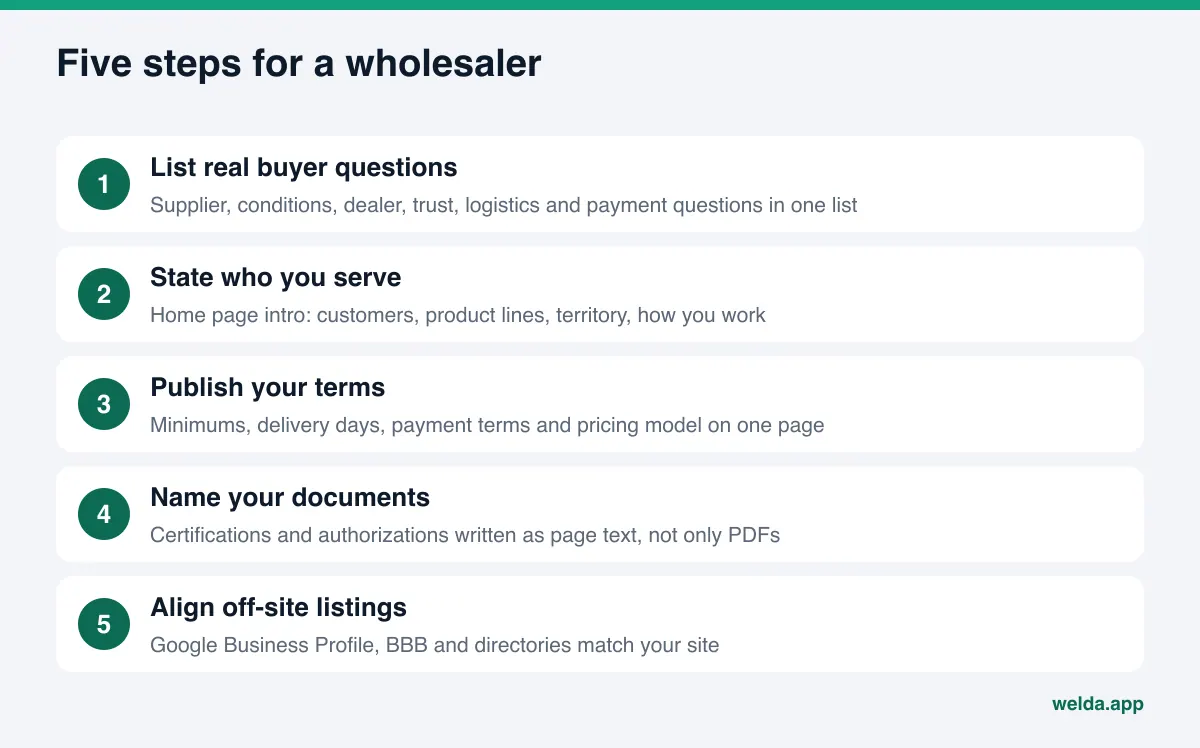
Step by step: making a wholesale site readable for AI search
The order below is one your own team can follow. Order matters: first the question, then the page that answers it, then the off-site sources that confirm it.
- Build the question list. Ask your sales reps to write down the questions they heard most in recent months. Sort them into supplier finding, conditions, dealer programs, trust, logistics, payment and fit.
- Rewrite the first paragraph of the home page. Say who you sell to, what you sell, where you deliver and how you work, in two or three sentences. Align the title tag and meta description with it.
- Publish a "how we work" page. Minimum order, case and pallet options, order cutoff, delivery days, service area, payment terms, returns and samples, all on one page in plain text. You do not have to publish prices; describe your pricing model.
- Add short intros to category pages. On each main category page, say which brands and product types you carry, who they suit and which pack sizes you offer.
- Make documents visible. Name the certifications, compliance documents and authorizations you hold in page text. A document name that exists only as an image or PDF may not be read.
- Explain your dealer program. If you take on new accounts or dealers, state who qualifies, how to apply and what you expect. "Call us to become a dealer" tells an AI nothing.
- Add an FAQ section. Pick the 8 to 12 most repeated questions from step one and answer each one briefly.
- Add business Schema. Describe your company name, address, phone, service area and profile links with Schema.org Organization markup.
- Align off-site sources. Make Google Business Profile, your BBB listing, industry directories, trade association member listings and supplier platforms match your site.
Example: the "how we work" page of a janitorial supply wholesaler
Step three is the one teams struggle with, because the facts are spread across sales reps' heads and scattered documents. The outline below is for an example janitorial supply wholesaler. The contents are placeholders; fill them with your own facts.
- Who we sell to: hotels, restaurants, property managers, schools and independent retailers.
- What we sell: surface cleaners, paper products, can liners, dispensers, and the list of brands we carry.
- How to order: phone, email or the dealer portal, plus the minimum order value or case quantity.
- Delivery: which counties we serve with our own trucks, where we ship by freight carrier, order cutoff time and delivery days.
- Payment: card, ACH, net terms, and what a credit application requires.
- Documents: which documents ship with products and how to request safety data sheets.
- Samples and returns: whether samples are available and how damaged or wrong items are returned.
This page is not a brochure. It is the written version of the answers your reps give on the phone. Keep sentences short and facts concrete. "Fast delivery" means nothing to an AI. "Delivery to Tarrant and Dallas counties on Tuesdays and Fridays by our own trucks" is a fact it can repeat. When something changes, update this page first and the off-site listings second.
Google says in its guidance on AI features that there are no additional technical requirements to appear in AI Overviews or AI Mode beyond being indexed and eligible for a snippet. There is no special trick. The page needs to be indexable and to answer the buyer's question clearly. The hard part is not technical; it is gathering the facts and keeping them current.
How Welda handles AI visibility for a wholesaler
Welda is software that measures where a business shows up in AI answers and prepares the fixes on its behalf. Below are the three parts that matter most for a wholesaler, explained with an example. The rest of the dashboard (the task list, the compliance check, the monthly report) helps you follow through on what these three parts find.
Question-by-question measurement: on which conditions are you named?
Welda asks the questions your buyers would ask to ChatGPT, Gemini, Perplexity and Google AI, three times each. The questions screen shows, for each question, which engines named you and in what position. Picture an example packaging wholesaler. On a broad question like "restaurant packaging wholesaler" it is named by a couple of engines. On conditional questions like "low minimum order" or "weekly delivery to Austin" it is not named at all. That pattern tells you the problem is not your products; it is the missing terms.
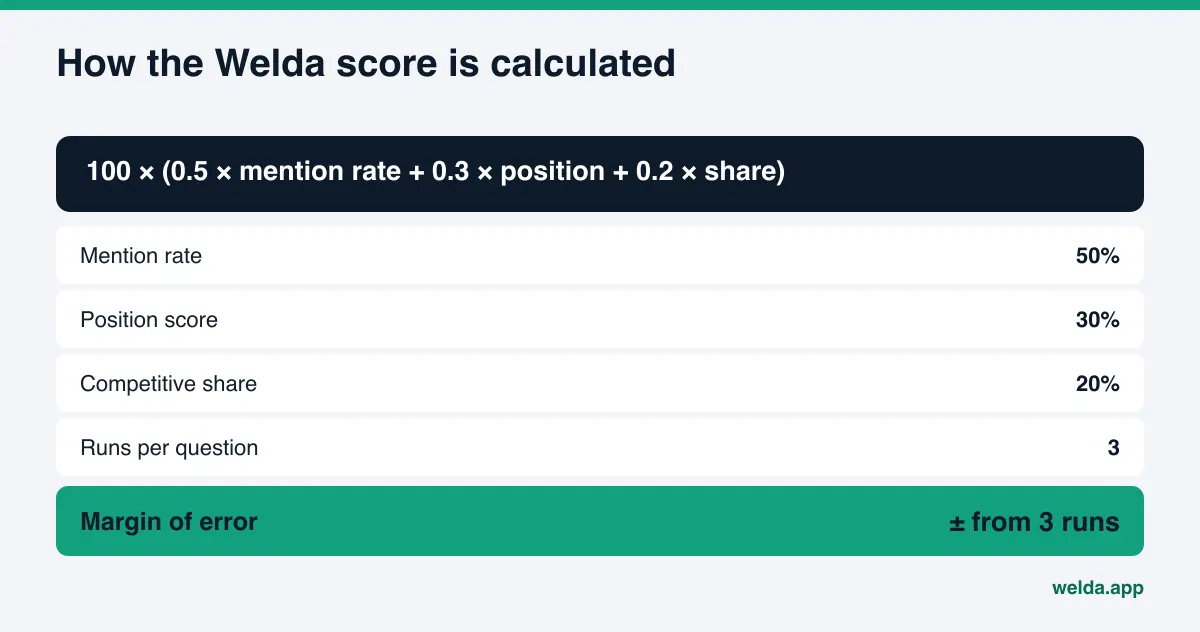
The score comes from this measurement, and the formula is open. The weights and the reason for three runs are shown below. We explain how to read this kind of number in AI share of voice.
Sources: where does the AI read about you?
The sources screen lists the sites AI engines draw on when they answer, and your status on each. For a wholesaler that list may include your own site, Google Maps and Business Profile, industry directories, supplier marketplaces and review sites. Each source gets a status such as "incomplete profile," "not verified" or "missing," along with a next step. That helps you decide what to fix first: if a directory is cited often for your buyers' questions and you have no profile there, claiming it may matter more than another blog post.
Drafted copy and ready pages: who writes it?
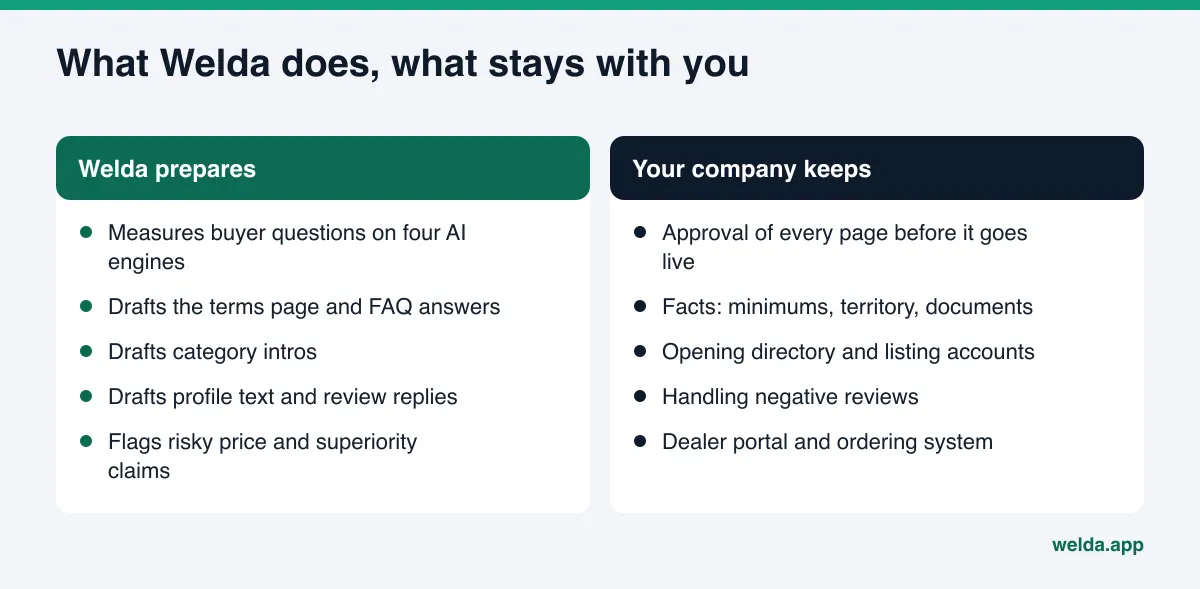
When measurement or the source list exposes a gap, Welda drafts the text: the "how we work" page, category intros, FAQ answers, Google Business Profile description and review replies. It does not invent facts. If it does not know your minimum order, delivery days or the documents you hold, it asks you on the task list.
On WordPress, Welda connects without installing code, through a separate Editor user and an application password that you create for it. The page opens on your site as a draft and does not go live until you approve it. On other platforms or custom dealer sites, Welda hands you a ready package and your team applies it. Your content always stays on your own site.
Before anything is published, the compliance check flags patterns like price claims, guarantees and superiority claims. A line such as "the lowest prices in Texas" would be flagged. This is not legal advice, and the final call is yours.
What Welda does not do, and the limits of this work
Knowing what a tool does not do matters as much as knowing what it does. For Welda:
- It does not guarantee rankings or placement in ChatGPT. AI answers vary; the same question can get a different answer at a different time. That is why each question runs three times.
- It does not make up information. Minimums, territories and documents come from you.
- It does not create fake reviews. Collecting reviews is your job; Welda drafts replies to reviews you receive.
- Handling negative reviews, opening directory accounts and doing PR stay with you. Welda lists them as manual tasks.
- It does not connect to your dealer portal, ERP or ordering system. The subject here is what your site and listings tell AI engines.
On availability, plainly: the Welda dashboard is in early access and opening in stages, starting in Turkey. Regular four-engine tracking is being added during early access, and the sample dashboard screens use illustrative data. The full dashboard is not yet open to US businesses. What anyone can use today is the free site analysis, which works in English. Pricing is discussed in the early access conversation. To plan spend, see the line items in our AEO budget guide.
Finally, timing: new pages and corrected listings usually take weeks to show up in AI answers. Wholesale sales cycles are long anyway; treat this as ongoing maintenance, not a campaign.
How to choose AI visibility software for B2B wholesalers
There are several kinds of tools: monitoring tools that only measure, AI modules added to classic SEO suites, and software that measures and also prepares the fixes. Whichever you consider, ask these questions as a wholesaler:
| Criterion | Why it matters | Question to ask |
|---|---|---|
| Can you set the questions? | B2B questions are conditional; generic prompts will not measure you | Can I add territory, minimum order and dealer questions? |
| Are several engines measured? | Buyers use different assistants | Which engines, and how many runs per question? |
| Is the score formula open? | You need to see where a change came from | What is the score made of, and is there a margin of error? |
| Does it show sources? | Directories and listings can decide B2B answers | Can I see which sites the AI cites? |
| Who does the fixing? | Measurement alone does not change anything | Does the tool draft the copy, or does my team write it? |
| Who approves publishing? | Specs and compliance facts must not go live wrong | Can anything go live without my approval? |
You can use this table as a checklist in a vendor call. If you report to leadership after the work, our AI visibility report template shows what such a report should contain.
AEO checklist for wholesalers and distributors
Before running the free analysis, check these items on your own site. Every "no" adds a task to your list.
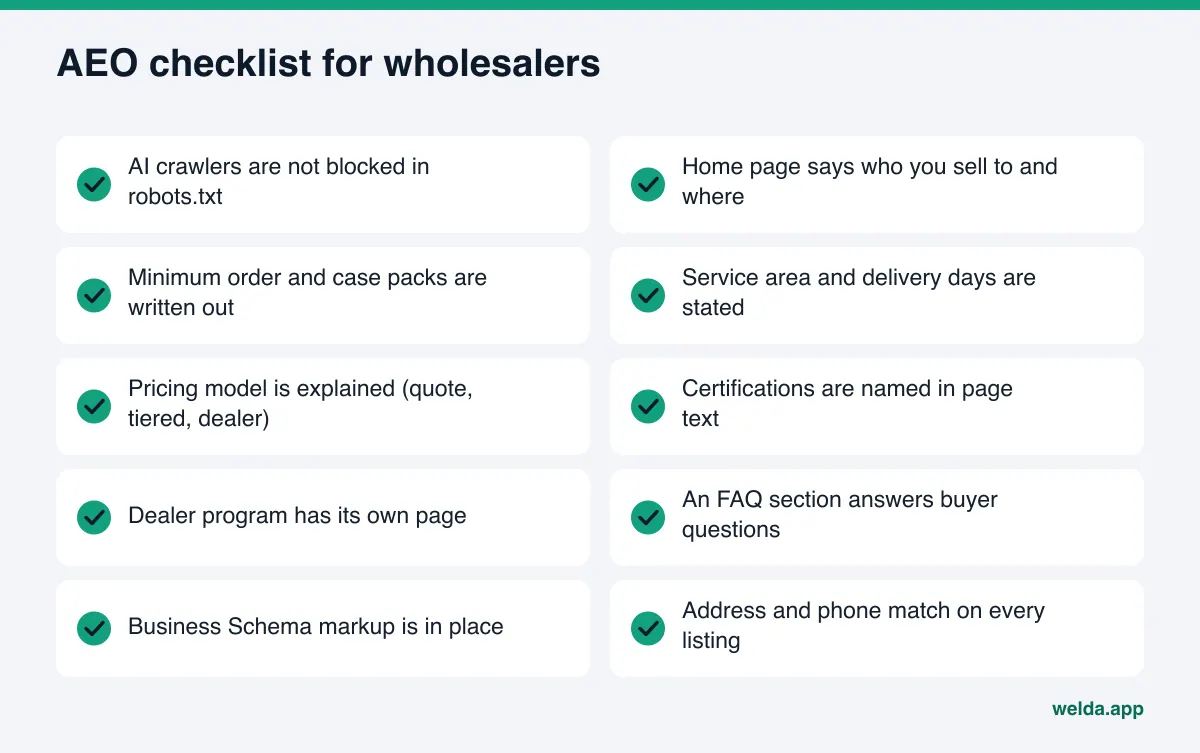
One thing to watch: do not try to fit every item onto a single page. Let the home page say who you are, the "how we work" page state your terms, category pages explain what you carry, and the FAQ cover the rest. Each fact should live clearly in one place and read the same way everywhere else.
Frequently asked questions
If we do not publish prices, will AI tools still recommend us?
Publishing list prices is not required. What matters is stating your pricing model clearly: tiered, dealer-only or quote-based. The buyer's question is usually about how you work, not the exact price.
Can AI engines see product information behind our dealer login?
Usually not. Pages that require a login are not open to crawlers. That is why a summary of your product lines, brands and terms should also be on public pages.
Isn't a PDF catalog enough?
A catalog is useful for buyers, but it should not be the only source. When product lines, case packs and brands are also written as page text, both AI tools and search engines read them more easily.
Does Welda connect to our dealer portal or ERP?
No. Welda focuses on what your site and external listings tell AI engines. It can connect to WordPress sites to create draft content; for other systems it hands you a ready package.
Can a US wholesaler use Welda today?
The free site analysis works in English and anyone can run it. Each site gets one free analysis; the result link arrives by email and stays open for 14 days. The full dashboard is in early access and opening first in Turkey.
How long until we see results?
There is no fixed timeline. New content and corrected listings usually take weeks to be reflected in AI answers, which is why regular measurement says more than a one-time check.
Next step: see how AI reads your site today
Instead of guessing why you are missing from your buyers' AI questions, start by measuring. The free analysis reads your home page and a few inner pages and checks whether AI crawlers can access your site, your business Schema, your FAQ and how clearly your services are described. For every gap it explains what it found, why it matters and how to fix it, suggests ready copy for the home page and gives you a fix package to add to your site. It does not measure rankings, but it shows clearly how your site reads today. Run the free site analysis and see which terms your wholesale pages leave out.