What does AI search optimization for real estate agents actually involve? It is the work of getting your name into the answer when a buyer, seller or renter asks ChatGPT, Gemini, Perplexity or Google AI which agent to call in a specific neighborhood. Listings are not what moves the needle. What does is durable information about you: the areas you cover, the kind of transactions you handle, who you are, and what past clients say about you, written clearly and consistently on your site and on the sources AI tools read.
This guide walks through AI search optimization for real estate agents from start to finish. You will see the questions consumers type into AI assistants, why most agent and brokerage sites stay invisible in those answers, a step-by-step plan, the Fair Housing angle you cannot ignore, and exactly where Welda fits in. If you would rather start with your own site, the free site analysis reads your homepage and key inner pages the way Google and AI tools do and gives you a prioritized list of gaps in a few minutes.
Why AI search optimization matters for real estate agents now
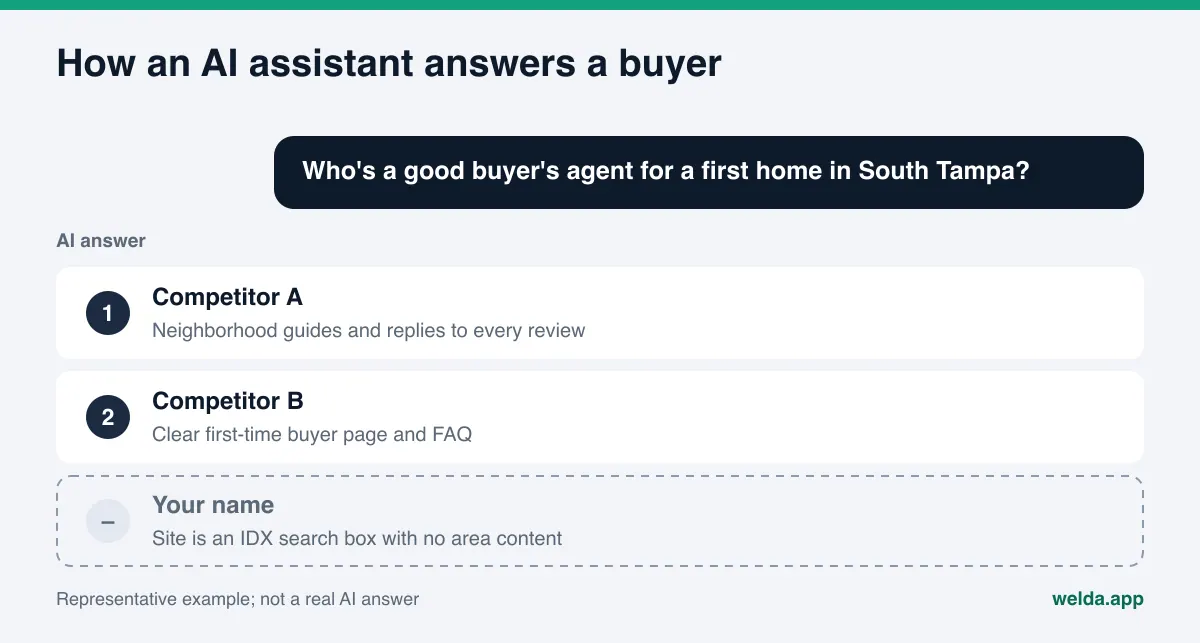
The traditional path was simple. A buyer browsed a listing portal, found a home, and called the agent attached to it. A growing share of people now start one step earlier. They describe their situation to an AI assistant: "We're relocating to Austin with two kids, we want a good school district and a short commute. Which agents should we talk to?" The assistant does not return a list of homes. It returns a few names and a sentence about each. Google is moving in the same direction with AI Overviews and AI Mode, which can place a synthesized answer above the regular results.
The industry calls this answer engine optimization, or AEO. You will also see it called GEO (generative engine optimization); the two terms describe the same job. For an agent, the stakes are personal. Real estate is a trust business. When an AI assistant says "these agents are known in this area," it is acting like a first referral. The agent named in that answer gets the first call. The agent who is not named stays one profile among hundreds on a portal.
Agents face three problems that most local businesses do not:
- Inventory turns over constantly. The house you list today may be under contract next week. AI answers lean on information about you, not on individual listings. A large IDX feed does not compensate for a thin "about" page.
- Your identity is split. You have a personal brand, a brokerage brand, a team name, and profiles on several portals. Each may show a different phone number or office address. AI tools struggle to connect those pieces into one entity.
- Your local knowledge lives in your head. You know which streets flood, which subdivisions have HOA restrictions, which elementary schools families ask about. That knowledge usually comes out on the phone, not on your website. If it is not written down, an AI model cannot cite it.
AEO addresses all three. It overlaps with classic SEO (titles, speed, structured data), but the goal is different. You are not trying to climb a ranked list; you are trying to be named inside an answer. We cover the local side of this in more depth in our piece on how near me searches work in AI.
What buyers, sellers and renters ask AI assistants
AI search optimization for real estate agents starts with understanding how people phrase their questions. The table below groups the common question types and shows what information an AI answer needs from you. The questions are illustrative; rewrite them for your own market.
| Question type | Example | What the answer needs from you |
|---|---|---|
| Area and agent | "Who's a good buyer's agent in South Tampa?" | Named neighborhoods you serve, a verified Google Business Profile |
| Property type | "Agent who specializes in condos in downtown Denver" | Clear statements of your specialties, separate service pages |
| Life situation | "First-time buyer, which agent explains the process well?" | A process page, an FAQ written for first-time buyers |
| Trust | "Most trusted listing agent in Scottsdale with good reviews" | Reviews, your responses to them, license and brokerage details, bio |
| Seller side | "I want to sell my house in Raleigh, who should I list with?" | A seller page that explains your approach, timeline and paperwork |
| Relocation | "Moving to Charlotte from New York, which agents help relocating families?" | Neighborhood guides written for outsiders, a relocation page |
Look at the pattern. Almost every question combines a place, a need and a trust signal. AI assistants try to name agents who satisfy all three. A site that is mostly an IDX search box answers none of them directly.
The seller side deserves special attention. Listings are the inventory that drives your business, and "who should I list my house with" is one of the most valuable questions you can show up for. Answering it requires a page written for homeowners, not for buyers.
Why agent websites stay invisible in AI answers
When we look at agent and brokerage sites, the same gaps come up again and again. Most of them trace back to a design choice: the site was built to show inventory, not to explain who the agent is.
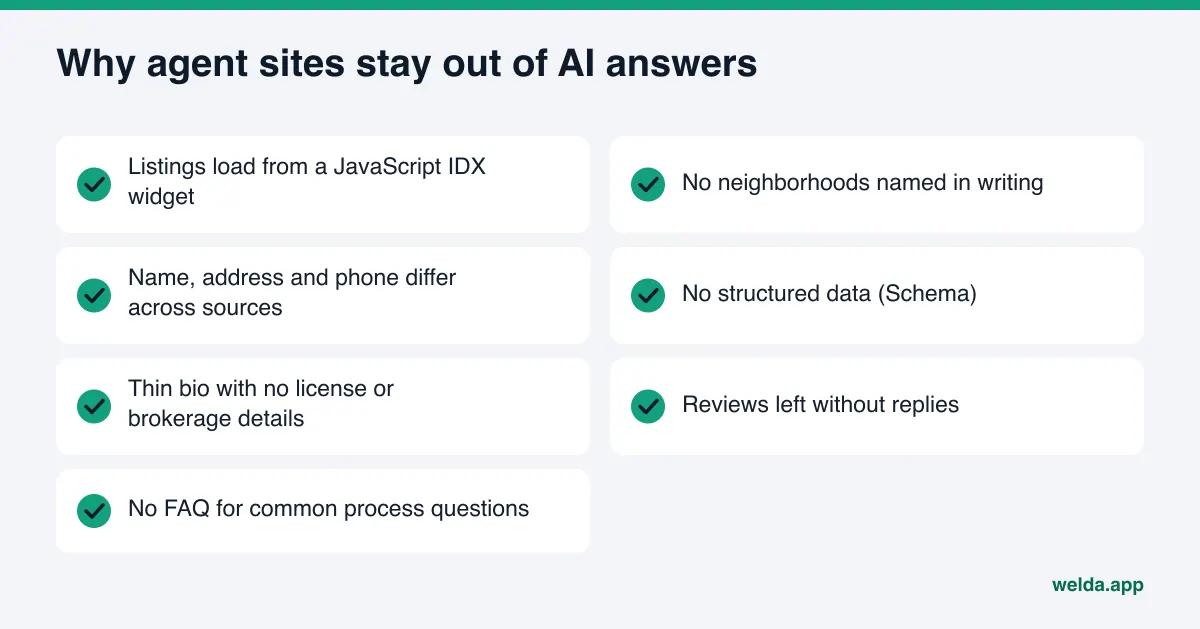
- Listings load from an external feed. Many agent sites pull listings through an IDX widget rendered in JavaScript. Some crawlers cannot read it, and even when they can, listing copy describes a house, not you. We explain the technical side in JavaScript rendering and AI crawlers.
- No service area in writing. The homepage says "serving the greater metro area." That phrase gives an AI model nothing to match against "agent in Hyde Park."
- Name, address and phone do not match. Your brokerage moved offices, an old address lingers on a directory, and your cell number appears on one profile while the office line appears on another.
- No structured data. There is no business markup (Schema) describing you as a real estate agent, your service area, your hours and your profiles in a machine-readable way.
- Thin bio. Experience, designations, license details and how long you have worked the area are missing. Trust questions hinge on exactly this.
- Unanswered reviews. Reviews sit on Google and other platforms with no reply. When a critical review goes unanswered, an AI summary may repeat it without your side.
- No FAQ. The questions you answer on the phone every week (earnest money, inspections, closing costs, what happens at closing) are nowhere on the site.
None of these require a large budget. Together, though, they stop AI tools from recognizing you as "this agent, in this area, for this kind of deal, trustworthy."
AI search optimization for real estate agents, step by step
The sequence below is built so a solo agent or a small team can work through it without outside help. Each step builds on the previous one, so keep the order.
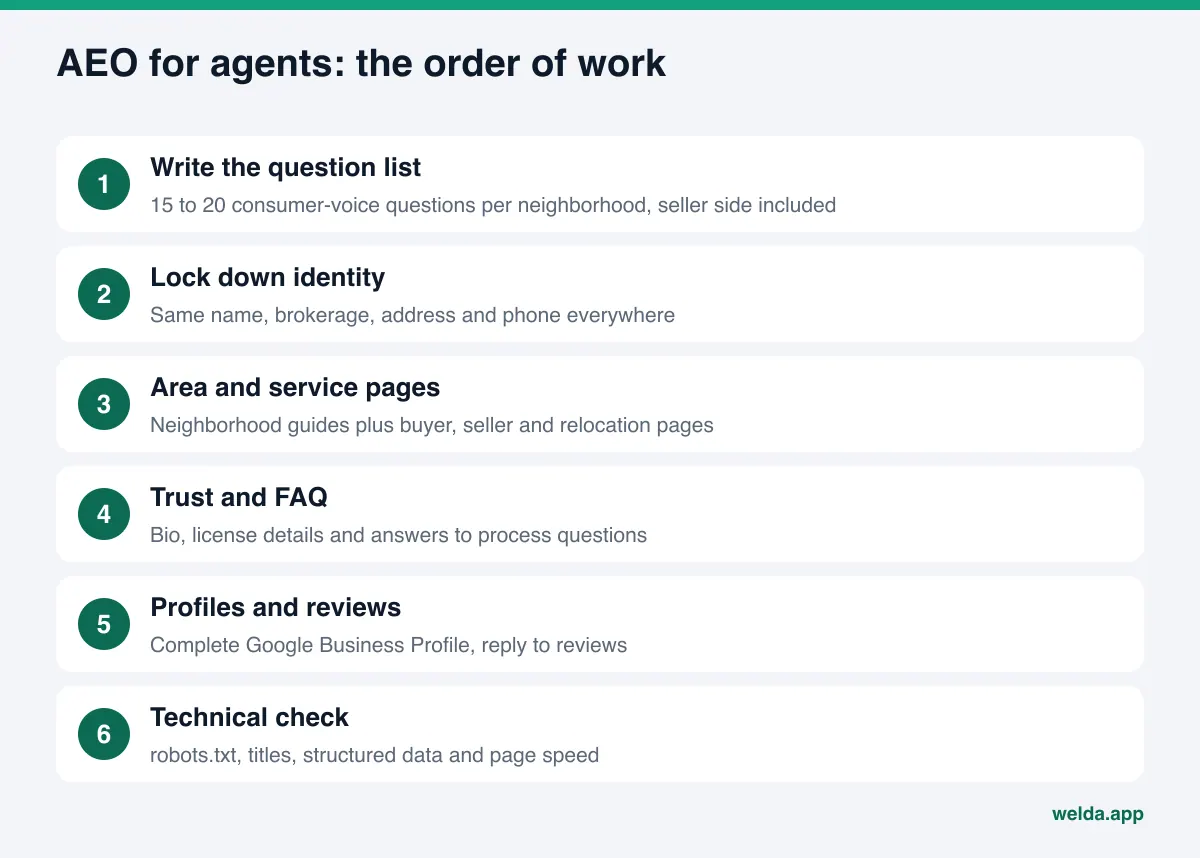
1. Write your question list
For each neighborhood you serve, write fifteen to twenty questions in the voice of a real consumer. Use the words people actually say: "starter home," "good schools," "walkable," "investment property," "55+ community." Include seller questions. This list becomes the basis for both measurement and content.
2. Lock down your identity
Decide how your name and brokerage appear and use that exact form everywhere: your site, Google Business Profile, Zillow and Realtor.com agent profiles, your brokerage roster page, social accounts. If you are on a team, make the relationship between your name, the team name and the brokerage explicit.
3. Publish neighborhood guides
Write one page per core neighborhood. This is not a listings page; it is a guide written by someone who knows the area. Housing stock, typical lot sizes, commute patterns, what families ask about, what you have seen in the market. If you cite a number, cite the source. If you have no source, describe the pattern without a figure. These pages are the strongest evidence an AI model has that you know a place.
4. Separate your services
Give buyer representation, listing services, relocation, new construction or investment property their own pages. On each one, say who it is for, how the process works and what the client needs to bring.
5. Make trust visible
Publish a real bio, your brokerage affiliation, your license details as your state requires, and clear contact options. A team page helps if more than one person answers the phone.
6. Answer the common questions
Write short, direct answers to the ten questions you hear most. Keep legal and tax topics general and point people to the right professional.
7. Clean up profiles and reviews
Complete your Google Business Profile: category, service area, description, photos. Reply to reviews on Google, Zillow, Yelp and anywhere else they appear. A calm, specific reply to a negative review often reads better than no reply at all.
8. Check the technical basics
Make sure robots.txt does not block AI crawlers, page titles and descriptions mention your area and service, structured data is valid, and pages load fast.
Which sources AI tools use for real estate answers
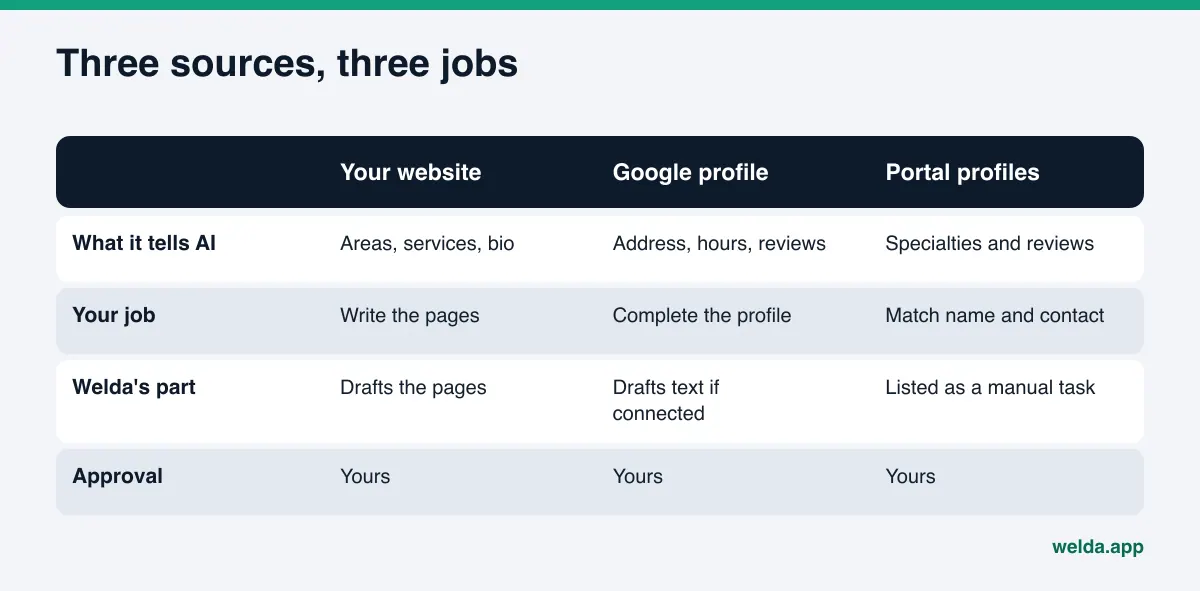
AI assistants do not rely on your website alone. They pull from several sources to build an answer, and in real estate each source plays a different role.
| Source | What AI learns there | Your job |
|---|---|---|
| Your own website | Areas, services, bio, process | Neighborhood guides, service pages, FAQ, structured data |
| Google Business Profile and Maps | Address, hours, category, reviews | Complete profile, review replies |
| Zillow, Realtor.com, Homes.com agent profiles | Specialties, areas, past activity, reviews | Match name and contact details to your site, keep bio current |
| Yelp and BBB | Reviews, complaints, how you respond | Accurate listing, measured replies |
| Brokerage roster page | Affiliation, contact, credentials | Ask the brokerage to keep it accurate |
| Local news and community sites | Your presence in the area | Check that what is published is current |
Which source carries the most weight in your market, for your questions, cannot be guessed. In one neighborhood an assistant may lean on review profiles; for relocation questions it may lean on local guides. Start source work from measurement, not assumption.
How Welda handles AI search optimization for real estate agents
Welda is software that measures where a business shows up in AI answers and prepares the fixes on the business's behalf. For an agent, the work comes down to three pieces: question-by-question measurement across engines, a clear score you can trust, and a to-do list where the draft content is already written.
Question-by-question measurement
In the Welda dashboard, each question on your list is asked to ChatGPT, Gemini, Perplexity and Google AI three times, because AI answers vary from run to run. For every question you see whether your name appeared, in what position, which competitors were named, and which sources the answer leaned on.
Here is why that matters for an agent. Picture an example agent who shows up for buyer questions in one neighborhood but is never mentioned for listing questions in the next town over. The fix is obvious once you see it: a neighborhood guide for that town and a seller page that explains the listing approach. Measurement tells you where to spend your limited writing time.
A score with a visible formula
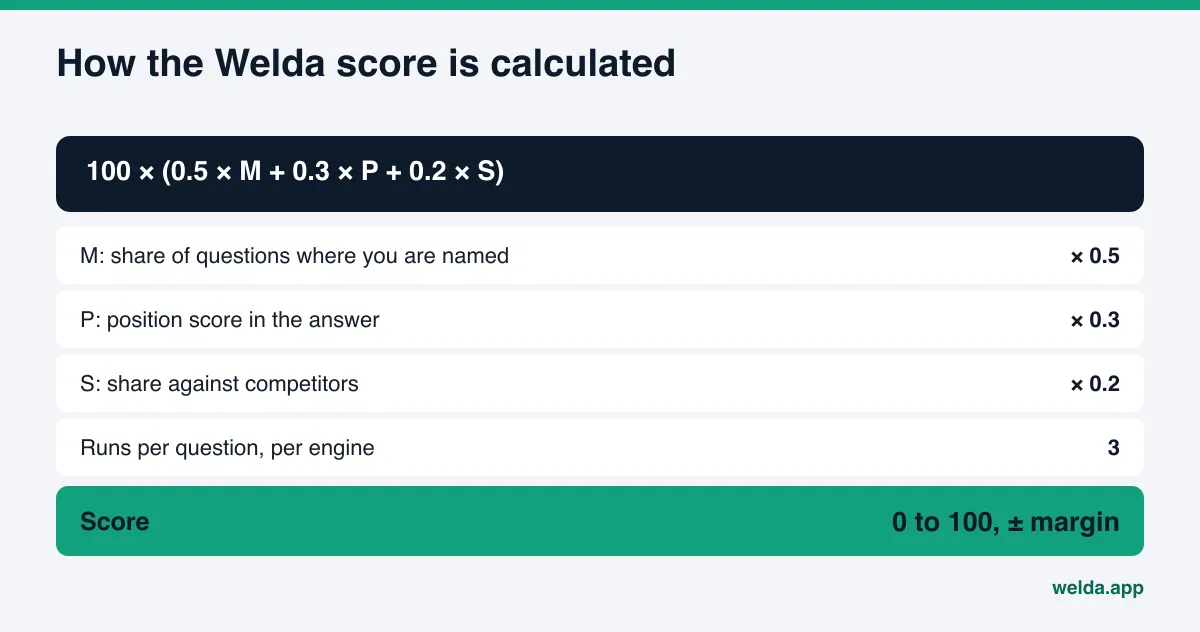
Scores are only useful if you know what is inside them. Welda's formula is published: mention rate carries half the weight, position in the answer carries thirty percent, and share against competitors carries twenty percent. The spread across the three runs produces a margin of error, so you do not mistake normal noise for real progress.
Drafts, approval and what stays with you
Every item on the to-do list comes with a draft: a neighborhood guide outline, a seller page, FAQ answers, structured data, a profile description, review replies. Welda does not invent facts. For a neighborhood guide it asks you what the housing stock looks like and which streets you actually work, then completes the draft from your answers. If your site runs on WordPress, Welda connects through a separate Editor user and an application password, with no code to install, and places the page as a draft; it goes live only after you approve it. Without a connection, you get a ready-to-apply package. Content always lives on your own site.
Competitor views, a before-and-after comparison and a one-page monthly report round out the dashboard, but for agents the weight sits in the three pieces above.
A straight word on availability. The dashboard is in early access and is opening first in Turkey. Regular four-engine measurement is being added during early access, and dashboard examples use representative data. What anyone can use today, in English, is the free site analysis. Pricing is discussed in the early access conversation.
Fair Housing and claims to keep out of your content
Real estate content carries a legal layer most local businesses do not deal with. Under the Fair Housing Act, it is unlawful to publish any notice, statement or advertisement about the sale or rental of a dwelling that indicates a preference, limitation or discrimination based on race, color, religion, sex, handicap, familial status or national origin (42 U.S.C. 3604(c)). Neighborhood guides are where this risk hides. Phrases that describe who "belongs" in an area, or steer by school demographics, can cross the line even when well meant. Describe the housing, the amenities and the commute, not the people.
The second category is outcome claims: "we sell homes faster than anyone," "guaranteed offer within days," "the lowest commission in town." These invite scrutiny under advertising rules, and they also tend to be ignored by AI models, which favor measured, sourced statements. Your state real estate commission also sets advertising rules for licensees; check them before you publish.
Welda's compliance check flags price claims, guarantees and superiority claims before anything is published. It is a warning layer, not legal advice, and it has not been reviewed by legal counsel. Neither is this article legal advice. For your process, see our guide to a content approval workflow for AEO.
Limits: what Welda does not do
- No guarantees. Welda does not promise rankings or that you will "show up in ChatGPT." AI engines make their own decisions.
- No invented facts. Market conditions, your track record and the streets you work are asked of you, never made up.
- No fake reviews. Welda does not write reviews. Asking real clients for reviews and handling negative ones stays with you; Welda drafts replies.
- Portals and directories stay with you. Your Zillow and Realtor.com profiles, directory listings and press outreach are yours to manage. Welda lists them as manual tasks.
- Nothing sensitive goes live without approval.
- It takes time. New content usually takes weeks to show up in AI answers. We break down the timeline in how long AEO takes.
The free analysis has limits too. It does not measure rankings. It asks five questions a client might ask to an AI assistant with web search and checks whether your name appears. That is a single snapshot, not a trend line.
A checklist for AI search optimization in real estate
Block an afternoon, open your site next to this list, and mark each row "done," "partial" or "missing."
| Check | Where to look | Why it matters |
|---|---|---|
| Neighborhoods you serve are named individually | Homepage, area pages | Matches neighborhood questions |
| Buyer, seller and relocation services have their own pages | Service pages | Matches the intent behind the question |
| Name, brokerage, address and phone match everywhere | Site, Google profile, portal profiles | Sources connect to one entity |
| Structured data is present and valid | Page source | Machines read your details correctly |
| Bio, license and brokerage details are visible | About page | Trust questions |
| FAQ answers real process questions | FAQ or service pages | Direct answers to process questions |
| Reviews get replies | Google, Zillow, Yelp | Critical reviews do not stand alone |
| Area guides avoid describing people | Neighborhood pages | Fair Housing |
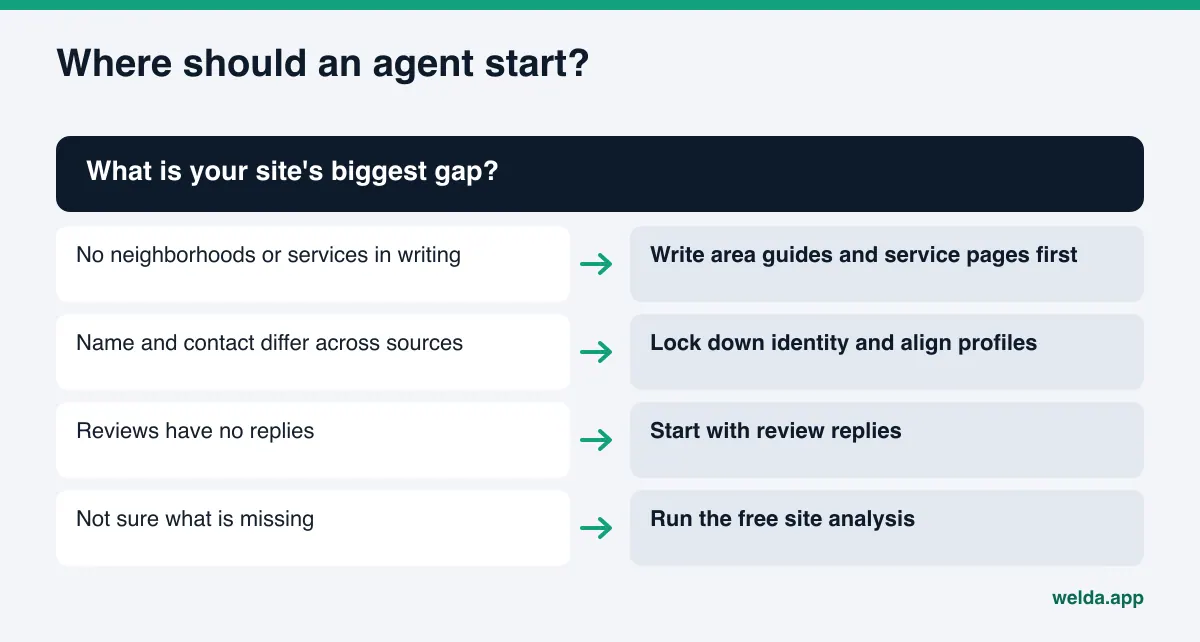
Use the decision chart below to pick your first move.
Should you do this yourself or use software? If someone on your team writes well and can update the site, the checklist may be enough. If you are out showing homes all day and nobody owns the website, a tool that handles measurement and drafting is the more realistic route. We weigh that trade-off in hiring an AEO specialist versus using software.
Frequently asked questions
Is AI search optimization the same as ranking on Zillow?
No. Portal ranking is about where your listing or profile appears inside that portal. AI search optimization is about whether an AI assistant names you when someone asks which agent to work with. One is about inventory, the other is about you.
Is an IDX feed on my site enough?
Usually not. Listings change constantly and do not describe you. AI answers rely on durable content: neighborhood guides, service pages, your bio and FAQ.
Do I need a page for every neighborhood?
For the neighborhoods you genuinely work and can speak to, yes. Copying one page and swapping the name does not help. Each page needs observations specific to that place.
Does my brokerage's website affect my AI visibility?
It can. If the roster page shows an old phone number or a different spelling of your name, sources look scattered. Ask your brokerage to keep your details aligned with your own site.
Does Welda write my listings?
No. Welda's job is the durable content and profile text that helps AI assistants name you: neighborhood guides, service pages, FAQ, structured data and review replies.
How soon will I see results?
New content usually takes weeks to appear in AI answers, and no timeline or outcome can be guaranteed. Regular measurement lets you track change with data rather than guesses.
What do I get from the free analysis?
A score out of 100, a list of gaps with explanations and fixes, ready-to-use homepage copy suggestions, and a fix package to add to your site. It is free once per site; results arrive by email and stay open for 14 days.
Your first step
AI search optimization for real estate agents is not a campaign. It is steady, practical work: stating clearly and consistently where you work, what you do and who you are. Start by seeing what your site tells AI tools today. The free site analysis reads your site the way Google and AI assistants do, explains each gap and suggests ready-to-use copy. Use the results to decide which neighborhood guide to write first.