What does AI search optimization for furniture stores actually involve? AI search optimization for furniture stores is the work of getting your store named when shoppers ask ChatGPT, Gemini, Perplexity or Google's AI Overviews questions like "where can I buy a sectional that fits a 9-foot wall" or "which store delivers and assembles bedroom furniture in Dallas." It starts with stating dimensions, materials, delivery areas, assembly, returns and showroom details in plain text, in places AI systems can read, and keeping them consistent everywhere. This guide walks through the work step by step and shows which part Welda handles.
Why AEO is different for furniture retailers
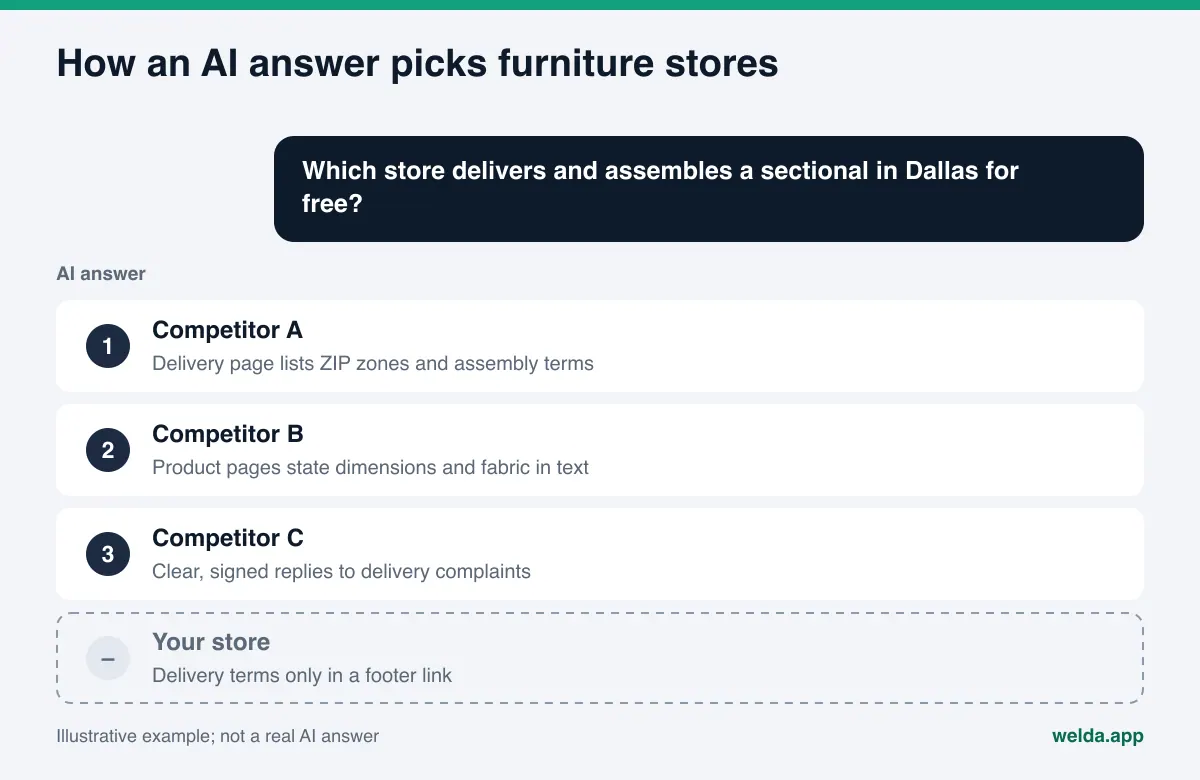
AEO, short for answer engine optimization, is the practice of earning a mention inside AI-generated answers. You may also see it called GEO, generative engine optimization; in the US the two terms describe the same job, and AEO is the one people search for more. Either way, the shift matters for furniture. In a classic search, a shopper sees ten results, a few ads and a shopping carousel, then opens tabs. In an AI answer, they usually see three to five stores or brands, each with a one-line reason. If you are not on that short list, the shopper may make a decision without ever hearing your name.
Furniture feels this change more sharply than most retail categories, for four reasons.
First, the questions are long and specific. Nobody types "recommend a couch." People ask "is there a pet-friendly performance fabric sofa under 84 inches wide," "which furniture store near Phoenix offers white glove delivery and old mattress removal," or "solid wood bunk bed with rounded corners for a small kids' room." An assistant answers by picking the stores where it can find those details written down somewhere it trusts.
Second, furniture is physical and expensive to get wrong. A shirt that does not fit goes back in a mailer. A dresser that does not fit goes back on a truck. That is why shoppers ask as much about delivery windows, stairs, assembly, haul-away and damage claims as about the product itself. They ask AI assistants those questions too, and the answers are often assembled from Yelp reviews, BBB complaints, Reddit threads and marketplace feedback.
Third, furniture websites are built for the eye. Big lifestyle photos, a short product name, a price and an "add to cart" button. Dimensions sit inside a line drawing image, fabric details live in a PDF spec sheet, and delivery terms hide in a footer link. People find that design appealing. An AI system finds very little text to work with.
Fourth, many furniture businesses run both a showroom and an online store. The showroom answers local questions ("where can I sit on recliners in Columbus this weekend"), while the online store answers product questions ("affordable solid oak dining table that ships nationwide"). When the two sides contradict each other, assistants trust neither.
The fastest way to start is to measure instead of guess. Welda's free site analysis reads your homepage and a few inner pages the way Google and AI systems do, and lists what is missing along with the reason it matters. If you sell through product feeds as well, our guide to product feeds for AI shopping covers that side.
What shoppers ask AI about furniture
Before changing any page, it helps to know which questions you want to show up for. The examples below are typical questions we wrote to illustrate the categories. They are not research data, but they reflect the kind of detail furniture shoppers put into AI chats:
- Fit and size: "Apartment-size sofa that fits through a 30-inch door," "extendable dining table for a small dining nook," "king bed frame with storage under 14 inches tall."
- Materials and use: "Performance fabric that holds up to a dog and two kids," "solid wood versus engineered wood for a dresser," "low-VOC finish nursery furniture."
- Delivery and assembly: "Furniture store in Atlanta with free in-home assembly," "do they carry it up three flights of stairs," "store that hauls away my old sectional."
- Trust and returns: "Is this furniture store legit," "what happens if my table arrives damaged," "how long does delivery actually take, and is it usually late."
- Local showroom: "Where can I try mattresses in person in Denver," "furniture showrooms open Sunday near me," "local store that does custom upholstery."
Each group draws on a different source. Fit and material questions lean on the text of your product pages. Delivery questions lean on your delivery and assembly page. Trust questions lean on reviews and complaint sites. Local questions lean on your Google Business Profile and map listing. No single fix covers all five, so knowing where you are weak tells you where to begin. For a repeatable way to build your own list, see how to find the questions customers ask AI.
Where AI gets its information about a furniture store
When an assistant runs a web search to build an answer, it reads several kinds of sources together. For a US furniture retailer, they usually look like this:
| Source | What it tells the AI | Who controls it |
|---|---|---|
| Your website | Dimensions, materials, delivery area, assembly, returns, showroom address | You |
| Google Business Profile and Maps | Address, hours, phone, photos, rating, reviews | You; reviews come from customers |
| Yelp and BBB | Service experience, complaints, how the store responded | Customers; responses are yours |
| Marketplaces | Seller rating, product reviews, shipping times | Partly you |
| Reddit and forums | Unfiltered delivery and quality stories | Customers |
| Home and design publications | "Best furniture stores" lists, comparisons | Publishers |
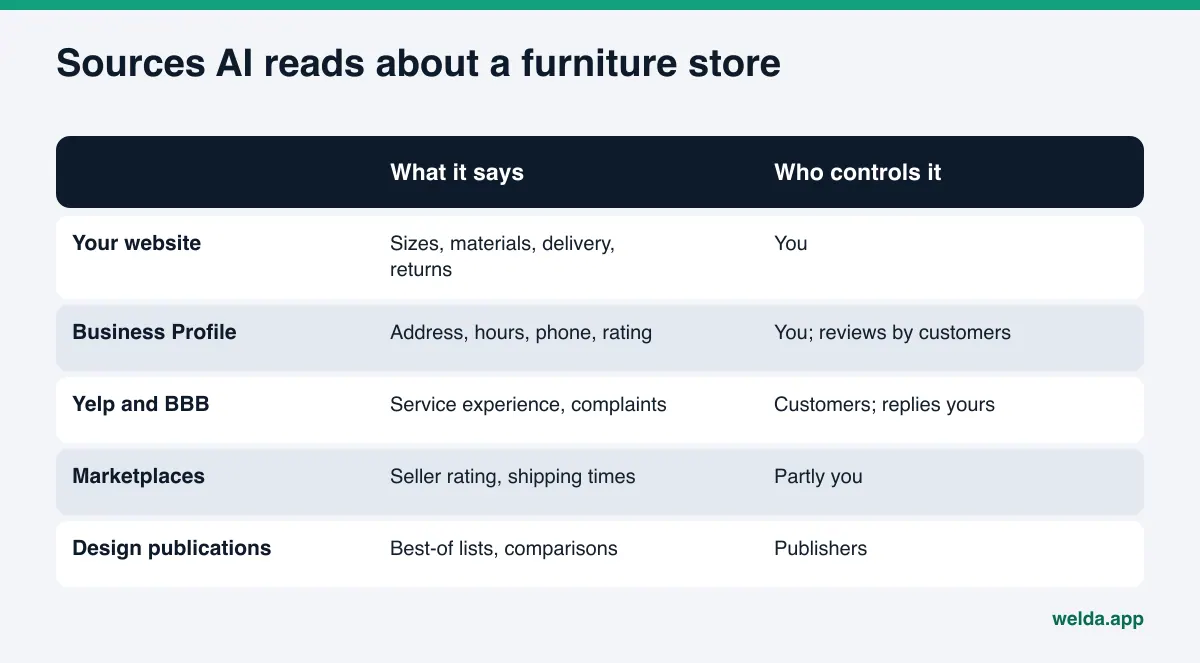
The takeaway is simple. There are only two places you fully control: your website and your profiles. For an assistant to answer delivery, sizing and return questions confidently, those two places need to be complete and say the same thing. You cannot edit what customers write on Yelp or BBB, but you can post a clear, signed reply that explains what you did. That reply becomes part of what the assistant reads.
There is also a technical precondition: AI search crawlers have to be able to reach your site. OpenAI, for example, documents that OAI-SearchBot is used to surface websites in ChatGPT's search features and that it follows robots.txt. If a security plugin or an old robots.txt rule blocks these crawlers, even your best copy goes unread.
AI search optimization for furniture stores, step by step
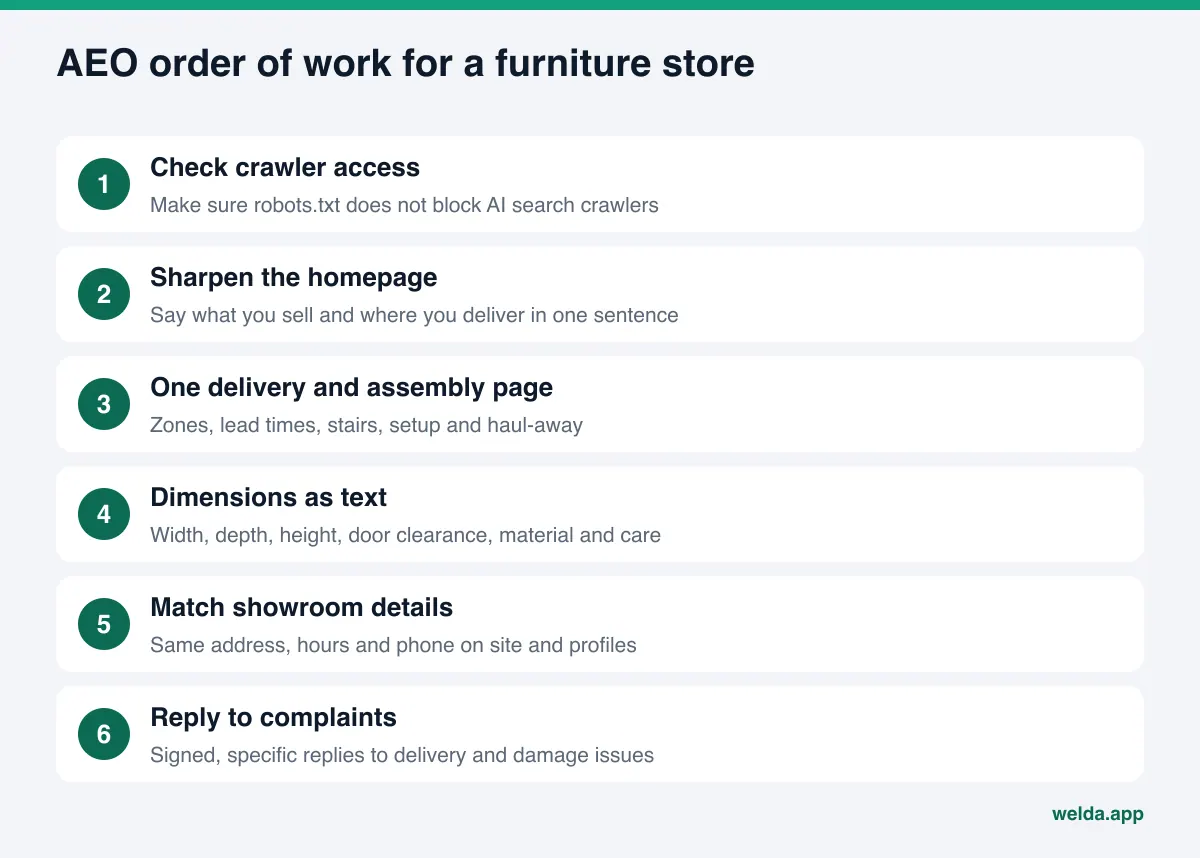
The order below starts with the work that has the most effect for the least effort. You do not need to finish it in a week; working through it in sequence is enough.
- Check access. Look at robots.txt to make sure AI search crawlers are not blocked, and confirm product pages load without a login or a pop-up wall.
- Sharpen the homepage. The page title, meta description and main heading should say what you sell and where you deliver in one sentence, for example "Solid wood dining and living room furniture, with free delivery and setup across the Twin Cities."
- Write one delivery and assembly page. Cover delivery zones, how lead times are calculated, whether assembly is included, stairs and elevator rules, haul-away of old furniture and what white glove means at your store.
- Put dimensions in text on product pages. Width, depth, height, seat height, doorway clearance, material, fabric type and care instructions. Keep the line drawing, but repeat the numbers as text next to it.
- Explain damage claims and returns plainly. What to do if something arrives damaged, how many days you have to report it, who picks it up and whether a restocking fee applies. Most trust questions land here.
- Make showroom details consistent. Address, hours, phone and location should match on your site, your Google Business Profile, Yelp and social profiles. Organization or LocalBusiness schema repeats the same facts in machine-readable form.
- Add an FAQ section. Answer real questions briefly: delivery time, assembly, measuring help, fabric swaps, financing availability and warranty registration.
- Respond to reviews and complaints. Especially delivery and damage complaints. A calm reply that says what was done helps both the customer and the AI reading the thread. We cover how to write those in review responses for AI visibility.
If you run a large online catalog, product information also needs to be structured. Google's merchant listing documentation explains how to mark up shipping details (shippingDetails), return policies (hasMerchantReturnPolicy), size and material on pages where products can be bought. That markup helps classic search and gives AI systems a clean version of the same facts your text already states.
Showroom or online store: which questions should you focus on?
Not every furniture business competes on the same questions. A store with a strong showroom and local delivery has different priorities from an online retailer that ships to all 48 contiguous states. Deciding which type of question brings you customers lets you put effort where it pays off.
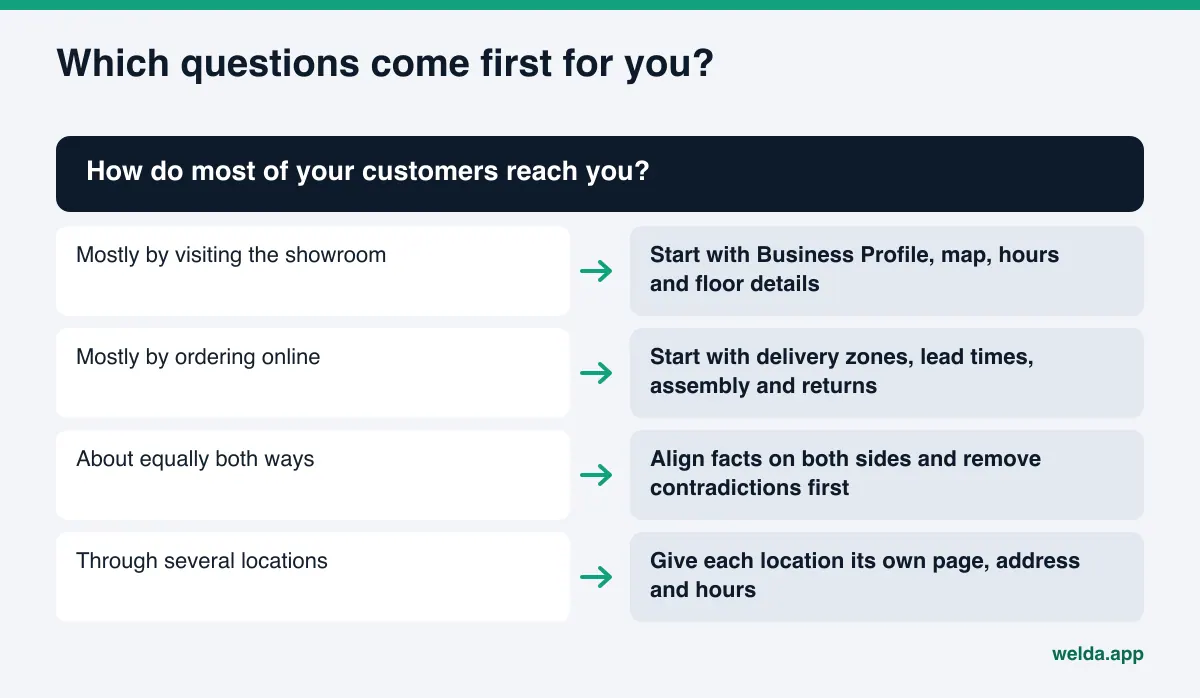
For a showroom-led store, local information comes first: Google Business Profile, map pin, hours, parking and which collections are on the floor. When someone asks an assistant "where can I test sofas in Sacramento today," that is what it looks for. For an online-led store, delivery zones, lead times, assembly and returns move to the front, because the shopper is buying sight unseen and the assistant weighs that risk.
For businesses that run both, the most common problem is contradiction. Picture an example store: its website says "free shipping nationwide," its Google Business Profile says "local delivery only," and its marketplace storefront lists a different lead time again. When an assistant pulls those three statements together, it either repeats the most cautious one or leaves the store out. The fix is to have one correct version of each fact and copy it everywhere.
Multi-location retailers have one more job. Each location needs its own page, address and hours. If the Austin store's details are mixed into the Houston page, both locations end up weak on local questions.
How Welda handles AI search optimization for furniture stores
Welda is software that measures where a business appears in AI answers and fills the gaps on the business's behalf. For a furniture retailer, that comes down to three practical things: seeing what your site leaves unsaid, seeing which sources assistants lean on, and getting the missing copy written.
Start with the free analysis. The analysis reads your homepage plus a few inner pages such as services, pricing, about and contact. For a furniture store, the findings that usually matter most are whether AI crawlers can get in, whether the main heading says what you sell and where you deliver, whether business schema is present, whether the showroom address and phone are written out clearly, whether your map and social profiles are linked from the site, whether there is an FAQ section, and whether services like delivery and assembly are spelled out. For each gap, the report shows what it found, why it matters and how to fix it. You also get ready-to-use homepage copy (title, description, main heading, intro paragraph and FAQs), a simulation of how much each fix could move your score, a competitor comparison, a fix package to add to your site including business schema, plus a PDF and a shareable score card.
The analysis also asks a web-search-capable AI assistant 5 questions a customer might ask and checks whether your store's name appears in the answers. That is a one-time snapshot, not ongoing tracking. It does not measure rankings and does not check hundreds of product pages one by one. To see whether your product template states dimensions and materials in text, open one product page and compare it with the report's findings yourself.
The free analysis works in English and German, and anyone can run it today. It is free once per site; your email and phone are verified, the results link arrives by email and stays open for 14 days.
The Welda dashboard, in early access. The full dashboard is in early access and is opening first in Turkey. Regular measurement across four AI engines is being added during early access, and dashboard screens are shown with sample data. Pricing is discussed in an early access conversation. Two parts of it fit furniture especially well.
The sources view puts the sites AI engines cite next to your status on each one. For a furniture store, those rows would typically be marketplaces, maps, review and complaint sites, design publications and your own site, each marked with a status such as missing profile, unverified or absent, and a next action. The decision it supports is direct: which source do assistants rely on most, and am I missing there? If your own site's share is low, site copy comes first. If a complaint site is leading, writing replies comes first.
The to-do list is where the work gets done. Welda drafts content such as a delivery page, FAQs, profile descriptions and review replies. It does not invent facts. If it cannot find which ZIP codes get free assembly, it leaves that blank and asks you; once you answer, the detail flows into every draft that needs it. On WordPress sites, Welda connects through a separate Editor user and an application password, with no code to install; drafts open on your site as drafts, and nothing goes live until you approve it. On other platforms Welda hands you a ready package and you or your developer apply it. Google Business Profile, Instagram and Facebook can be connected; if they are not, the task is listed as manual. Your content always lives on your own site. Welda does not host it.
The rest of the dashboard can be summarized briefly: a questions view showing where your name appears, a competitors view showing which topic and source a rival wins on, and a one-page monthly report. The score formula is published, combining the share of questions where you are mentioned, your position in the answer and your share against competitors.
What Welda does not do
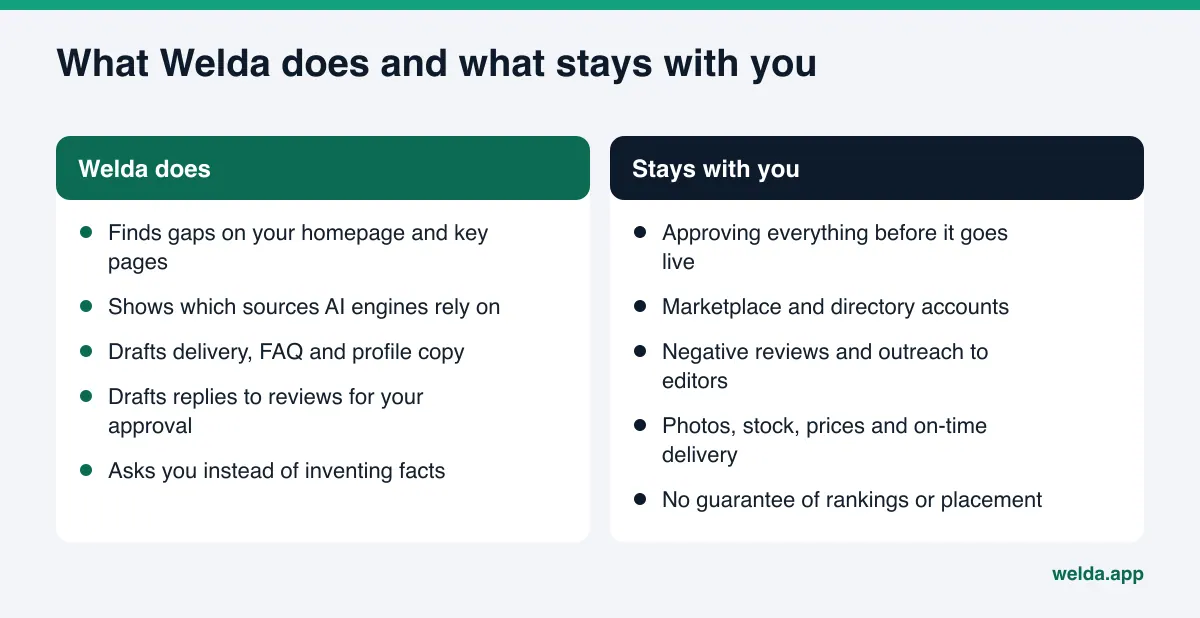
Being honest about AI search visibility means being clear about limits. Welda does not guarantee rankings or a spot in ChatGPT's answers; nobody can promise that honestly, because the engines build the answers. It does not write facts it does not know, it asks you. It does not publish sensitive content without your approval. It does not create fake reviews. The FTC announced a final rule in August 2024 that bans fake reviews and testimonials, including AI-generated ones. We cover why fake reviews backfire for AI visibility as well in fake reviews rules and AI visibility. This is general information, not legal advice.
Some work stays with you. Negative reviews themselves, your directory and marketplace accounts, and outreach to design publications are your responsibility; Welda can draft text for them, but it does not submit, verify ownership or pitch editors on your behalf. Product photography, keeping stock and prices current, and delivering on time are also in your hands, and they shape what assistants read about you.
Then there is timing. A new delivery page or a corrected profile usually takes weeks to show up in AI answers. Rather than expecting results in the first week, keep a log of what changed and check the same questions again a few weeks later.
Furniture store AEO checklist
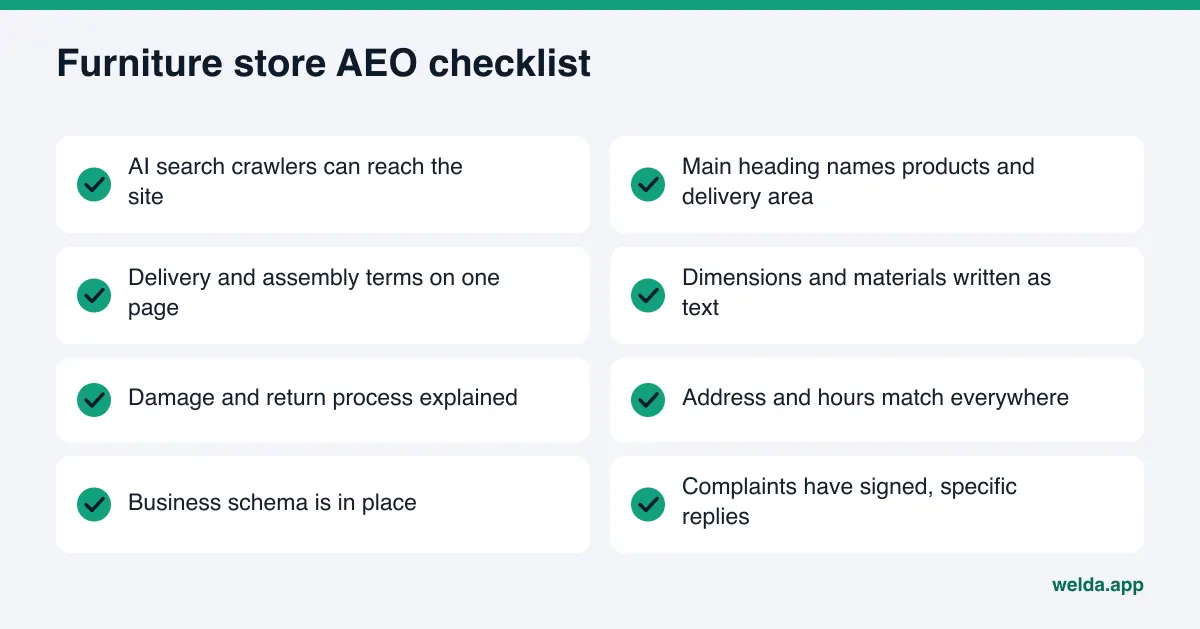
Open your site and go through this list item by item. Every "no" is a task.
| Check | Where to look | Why it matters |
|---|---|---|
| Can AI search crawlers reach the site? | robots.txt, security plugin | Blocked pages are never read |
| Does the main heading say what you sell and where you deliver? | Homepage | Assistants describe you in one line |
| Are delivery and assembly terms on one page? | Delivery page | The most common trust question lands here |
| Are dimensions and materials in text? | A sample product page | Numbers inside images are not read |
| Is the damage and return process clear? | Returns page | Assistants weigh risk on large purchases |
| Do address, hours and phone match everywhere? | Site, Google Business Profile, Yelp | Contradictions erode trust |
| Is business schema present? | Page source or analysis report | One clean definition for machines |
| Have complaints received signed, specific replies? | Yelp, BBB, Google reviews | Assistants read both sides |
For the general, industry-neutral version of this list, see our AEO checklist.
Frequently asked questions
Is AEO for a furniture store different from SEO?
The foundation is shared: readable pages, accurate titles, a fast site. The difference is the goal. SEO looks at where you rank in search results. AEO looks at whether an AI answer mentions your store and how it describes you. That is why clear text about delivery, assembly and returns carries more weight in AEO.
I have hundreds of products. Do I need to rewrite them all?
No. Fix the product page template first so dimensions, materials and care details appear as text. Then work through your best sellers and most-asked-about categories. Delivery, assembly and returns pages are written once for the whole catalog and usually have the biggest effect.
I only have a showroom and do not sell online. Does this apply to me?
Yes. Your priority is local questions: Google Business Profile, map listing, hours, which collections are on display, and consistent details on your site. Listing sizes and materials on your site still helps, because people often ask an assistant whether a store carries a certain size before they drive over.
Does Welda guarantee my store will appear in ChatGPT?
No. The AI engines build their own answers, and nobody can guarantee a placement. Welda measures where you appear, shows the gaps and drafts the copy. Changes usually take weeks to be reflected in answers.
I sell on marketplaces. Do I still need my own site?
Your marketplace storefront is one of the sources assistants read, but your control over it is limited. Your own site is the only place where you can explain delivery, assembly, showroom and return terms in your own words. When the two sources agree, the assistant has more reliable information to work with.
Can Welda measure in English for a US store?
The free analysis works in English today. In the dashboard, the question language can be set to English or Turkish, but the dashboard itself is in early access and opening first in Turkey, so US stores start with the free analysis.
Next step: see where your store stands today
AI search optimization for furniture stores is not a big campaign. It is a set of clear facts: what you sell, in which sizes, where and how you deliver, and what you do when something goes wrong. When those facts are consistent on your site and profiles, assistants find it easier to describe you. To see where to begin, run the free site analysis. The report lists the gaps in priority order, with ready-to-use copy suggestions.