Why doesn't ChatGPT recommend my bar, and what can I do about it? AI assistants pick bars from what they can read and confirm: your website, your Google Business Profile, Yelp, Tripadvisor and local city guides. If your hours, menu, events, reservation policy and vibe are vague or scattered across Instagram stories, you get left off the short list. This guide walks through AI search optimization for bars and cocktail lounges step by step, and shows which parts Welda handles for you.
What is AI search optimization for bars and cocktail lounges?
AEO (answer engine optimization) is the work of getting your business named in the answers that ChatGPT, Gemini, Perplexity and Google's AI Overviews and AI Mode give to people. You will also hear it called AI search visibility or AI visibility. Some people use the term GEO (generative engine optimization) for the same thing. In this guide we stick with AEO.
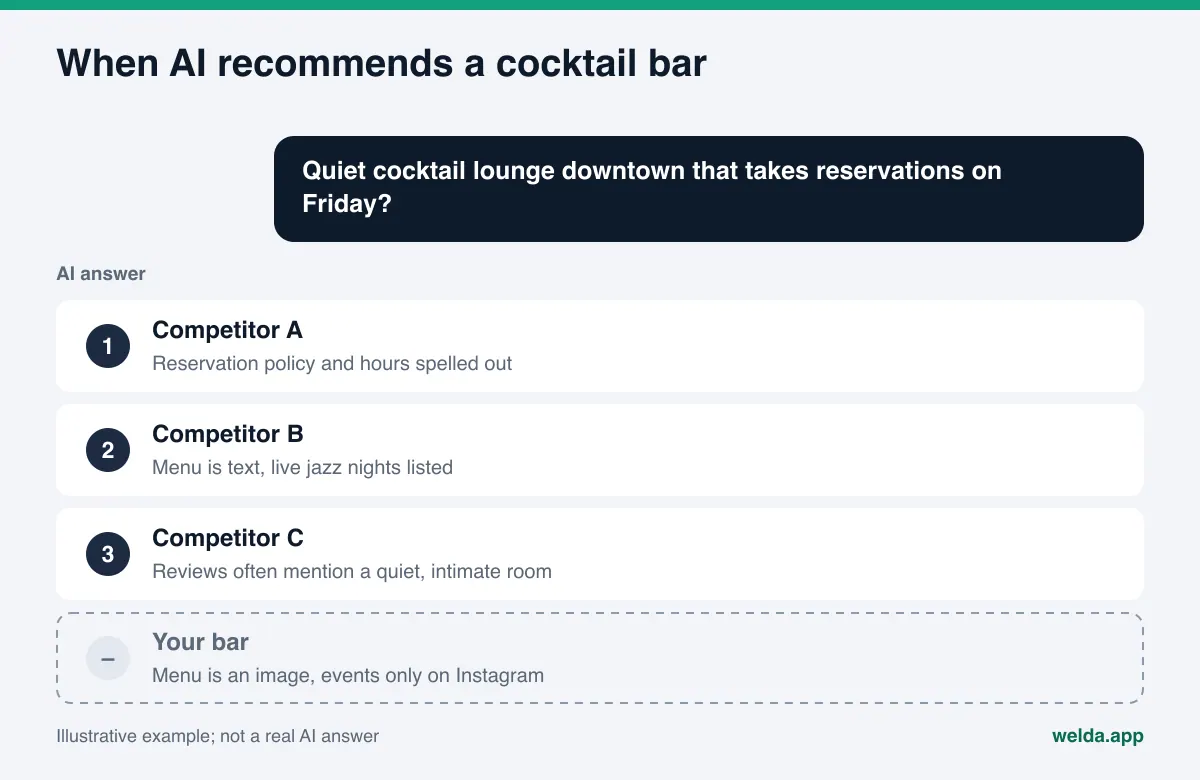
Classic search gives a guest ten links and a map pack to scroll through. An AI answer usually gives three or four names with a sentence on each. If your bar is not one of those names, the guest may never see you at all. Ranking on page one and being named in an AI answer are related, but they are not the same job.
Bars and cocktail lounges feel this more than most businesses, because guests ask very specific questions. Nobody asks an AI assistant for "a bar". They ask for "a speakeasy-style cocktail bar near the theater district that is open late", "a rooftop bar that takes reservations for eight on Saturday", or "a quiet lounge with live jazz where we can actually talk". To answer, the AI looks for a bar that has written those details down somewhere it can read. If you have not, a competitor that has will be named instead.
Bar information also changes constantly. The seasonal cocktail list rotates, the patio opens and closes, trivia moves from Tuesday to Wednesday, and holiday hours come and go. When an AI finds outdated or conflicting details, it either skips you or repeats the wrong thing. That is why AEO for a bar is not a one-time fix but something you keep an eye on.
The fastest way to see where you stand is to measure it. Welda's free site analysis reads your homepage and a few inner pages the way Google and AI assistants do, and lists every gap it finds. It works in English.
What do guests ask AI about bars and lounges?
Questions about bars fall into a handful of patterns. Each pattern is answered from a different piece of information. Once you know which information feeds which question, it is clear what to write and where. The example questions below are written for this guide to illustrate each pattern.
| Question pattern | Example question | What the answer relies on |
|---|---|---|
| Location | "Good cocktail bar near Union Station" | Address, map pin, neighborhood named on your site |
| Timing | "Bars open past 1 a.m. near me" | Hours that match across your site and profiles |
| Style and vibe | "Quiet lounge for a first date" | How you describe the room, plus review language |
| Events | "Bar with live jazz tonight" | An events page with days and start times |
| Groups | "Bar that takes reservations for 10" | Reservation policy, group size, private space |
| Menu | "Bar with good zero-proof cocktails" | A menu written as text, with categories |
| Rules and price | "Is there a cover charge on Fridays" | Cover, dress code and age policy on your site |
Look at that table and most bar owners can spot their weak row right away. The cocktail menu is a stylish image. Events live only in Instagram stories. The cover charge and dress code are never written down. When AI cannot find these details, it has no reason to name you.
Visitors ask differently from locals, too. They often add a landmark or a hotel name and ask in full sentences. If your bar sees a lot of out-of-town guests, our guide on how tourists ask AI for recommendations covers what changes.
Which sources does AI read before naming a bar?
An AI answer does not come from a single place. The engine reads several sources related to the question and condenses them into a short summary. For a bar, those sources fall into four groups.
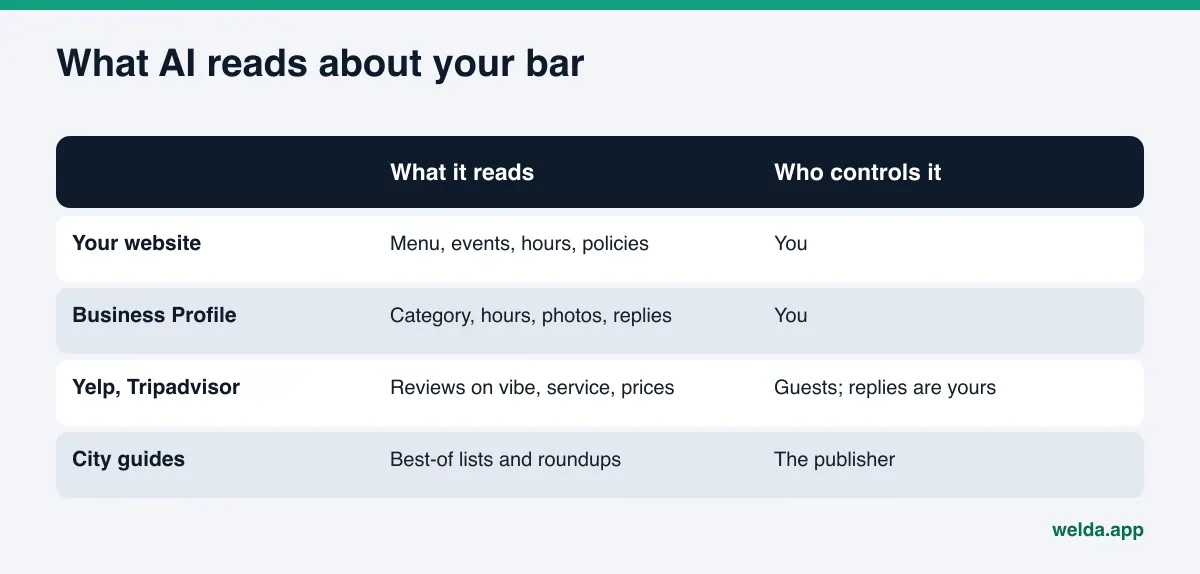
Your own website. This is where the menu, events, hours, address, reservation policy and the character of the room are written down. It is fully under your control. Details that are not on your site are hard for AI to find correctly anywhere else.
Google Business Profile. Category, hours, photos, reviews and your replies to those reviews live here. Google's own AI features lean on this information heavily. Pick the most accurate primary category (cocktail bar, wine bar, lounge, pub) and keep special hours current for holidays.
Review platforms. Yelp, Tripadvisor and Google reviews are where guests describe the vibe, the service, the prices and the noise level. You cannot write these, but you can reply. Words like "quiet", "crowded", "great bartenders" or "long wait" show up in these reviews and shape how an AI answer describes you.
City guides and roundups. Local publications and "best bars in town" lists are not in your control. But if one of them mentions you, it helps when the details match what is on your own site.
The first two groups are entirely yours. Making them complete and consistent is the shortest route into AI answers. For a related walkthrough on a food-led concept, see our guide to AEO for seafood restaurants.
AI search optimization for bars and cocktail lounges: step by step
The steps below can be done in order. The first four are about your own content and close the gaps most bars leave open. None of them requires a big development project.
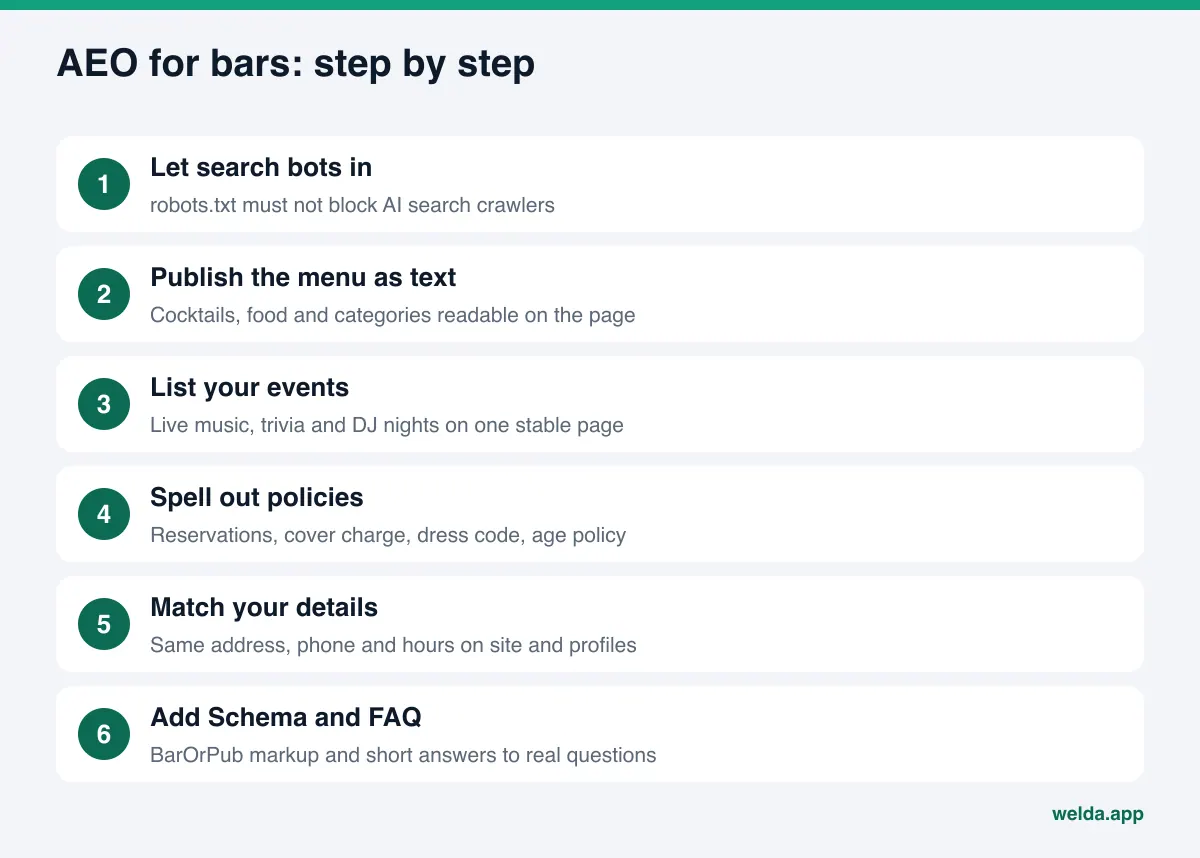
- Make sure AI crawlers can reach your site. If your robots.txt file blocks search crawlers, AI cannot read your pages. OpenAI, for example, uses a crawler called OAI-SearchBot for appearing in ChatGPT search and a separate one called GPTBot for model training, and the two can be set independently (OpenAI crawler documentation). Even if you opt out of training, keep the search crawler allowed.
- Publish your menu as text. Signature cocktails, classics, zero-proof drinks, beer and wine categories, and food should be readable text on the page. A designed PDF can stay as an extra. If the list rotates seasonally, say which drinks are permanent and how often the seasonal list changes.
- Put events on one stable page. Live music, DJ nights, trivia, tastings: which nights, what time, and whether a reservation or ticket is needed. Instagram stories disappear after a day. A page on your site stays. Update the same page when the schedule changes.
- Spell out your policies. Reservations or walk-ins only, cover charge on which nights, dress code, age policy, whether you have a kitchen and until when. Guests ask these questions before they leave home, and AI looks for clear answers.
- Write down group and private event details. How many guests you can seat together, whether you have a private room or buyout option, and how to inquire.
- Match your address, phone and hours everywhere. Your website, Google Business Profile, Yelp and social profiles should say the same thing. If one says you close at midnight and another says 2 a.m., AI cannot tell which to trust.
- Add Schema markup. Schema.org has a BarOrPub type for bars and pubs. It includes fields for the menu (hasMenu), cuisine (servesCuisine), opening hours and whether you accept reservations (acceptsReservations). A food-led lounge may also fit the Restaurant type.
- Add an FAQ section. Answer real questions in a sentence or two: "Do you take reservations?", "Is there a cover charge?", "Do you have non-alcoholic cocktails?", "What is the dress code?"
- Link your social and map profiles. Instagram, Google Maps, Yelp and any guide listings should be linked from your site. Our guide on linking social profiles with sameAs shows how.
You do not need to do all of this in one week. Once the first four steps are done, your site contains the details AI looks for when answering bar questions. The rest helps that information get read correctly and matched with other sources.
Example: an events and reservations page for a cocktail lounge
This example is not based on a real business; it shows one way to build the page. Picture an example neighborhood cocktail lounge. The page opens with a one-sentence summary: "Seated cocktail service every night, live jazz on Thursdays and Saturdays." Below it, the weekly schedule is a simple list: which nights have music, when the set starts, and whether those nights need a reservation.
The second section covers reservations: maximum party size, how long a table is held for late arrivals, whether bar seats are kept for walk-ins, and how to book. The third section covers policies: cover charge, dress code, age policy, and the kitchen's closing time. The page ends with a short FAQ.
There is nothing promotional on that page. Still, it answers everything a guest needs for the question "quiet lounge with live jazz that takes reservations on Saturday". From an AI point of view, a good page is one that gives a short, consistent answer to the guest's question.
Drink specials, reviews and the rules that apply
Two kinds of rules matter when you write content for a bar.
Drink specials. Alcohol is regulated at the state level in the US, and rules on drink specials, happy hours and how they are advertised differ from state to state. Some states restrict certain promotions. Before you put happy-hour pricing or "two for one" language on your site or in your FAQ, check with your state's alcohol beverage control agency or your attorney. For AEO purposes you rarely need promotional language at all: guests mostly ask about hours, vibe, events, location and reservations.
Reviews. The Federal Trade Commission has a final rule banning fake consumer reviews and testimonials, including AI-generated ones, and restricting incentives tied to a particular sentiment and the suppression of negative reviews (FTC announcement). That matters because reviews feed AI answers. The safe path is to ask real guests for honest reviews and reply to every review calmly.
This section is not legal advice. Welda's legal check flags patterns such as price claims, guarantees and superiority claims before publication, but it is not legal advice either and has not been reviewed by legal counsel. The final call on alcohol-related wording stays with you and your attorney.
How Welda handles AEO for bars
Welda is software that measures where a business shows up in AI answers and fills the gaps on the business's behalf. For a bar, that work has two parts: the free site analysis anyone can use today, and the Welda panel, which is in early access.
The free site analysis. It reads your homepage and a few inner pages such as services, pricing, about and contact. It checks whether AI crawlers can enter your site, your page title and description, your main heading, your business markup (Schema), your address, phone and location details, whether your social and map profiles are linked, your FAQ section, review and trust signals, how clearly you describe what you offer, and page speed.
You get a score out of 100, with technical and content shown separately. For each gap you see what was found, why it matters and how to fix it. The analysis also writes ready-to-use text for your homepage: title, description, main heading, intro paragraph and FAQ. It includes a simulation showing how much each fix would raise your score, a competitor comparison, a ready-made fix package for your site (including the business markup code), a PDF and a shareable score card.
The analysis also asks 5 questions a guest might ask to an AI assistant that can search the web, and checks whether your bar's name appears in the answers. That is a one-time snapshot. The analysis is free once per site. Your email and phone are verified, the results link arrives by email and stays open for 14 days. It does not measure rankings and does not promise any. The free analysis works in English and German.
The Welda panel. The panel is in early access and is opening first in Turkey. Regular four-engine tracking is being added during early access, and the sample screens shown in the panel use representative data. Pricing is discussed in the early access conversation.
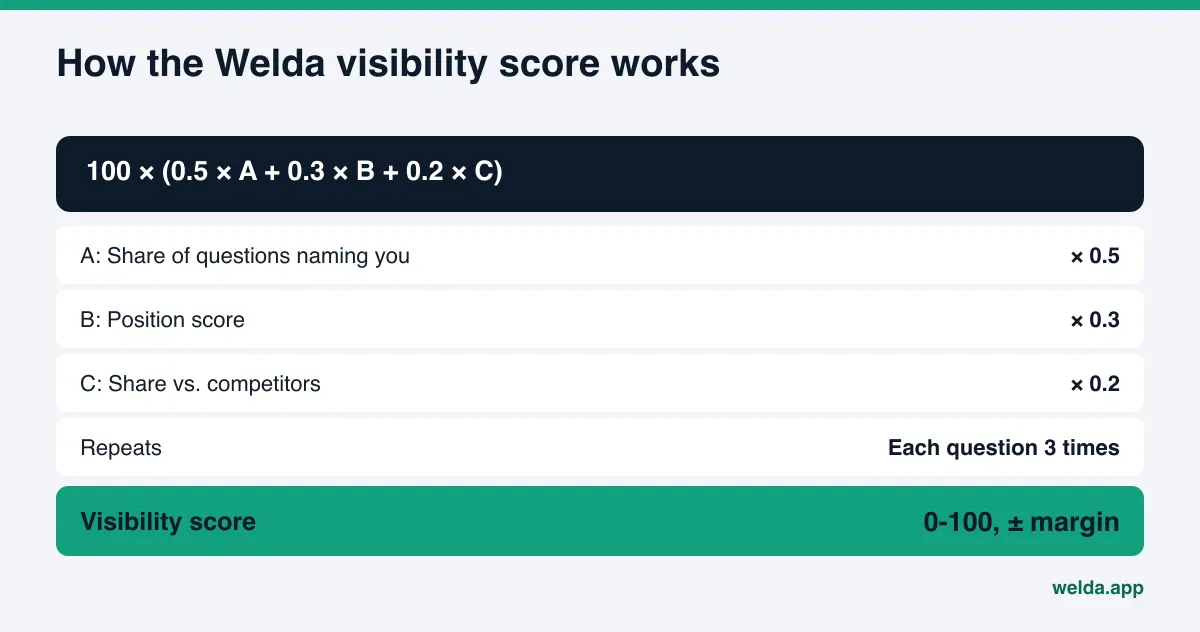
Here is how panel measurement works: the questions your guests would ask are put to ChatGPT, Gemini, Perplexity and Google AI three times each. You see which questions name your bar, in what position, and where competitors come out ahead. The score formula is open, and the spread across the three runs gives a margin of error. If you want to understand that spread, read our guide on how often to measure AI visibility.
| Panel screen | What it shows for a bar | What stays with you |
|---|---|---|
| Questions | Whether you are named for each question, such as "live jazz bar tonight" | Reviewing the question list for your neighborhood and events |
| Competitors | Which topics and which sources a competitor wins with | Deciding where you need new content |
| Sources | The sites AI draws on and where you are missing | Handling directory and guide listings |
| To-do list | Missing information, items awaiting approval, manual tasks with ready text | Supplying details Welda cannot know, approving content |
| Ready pages | Applies the suggestions and prepares a page for preview | Approving publication |
| Monthly report | A one-page PDF with a before-and-after comparison | Choosing next month's priority |
Fixes and publishing. Welda drafts content such as an events page or menu page, profile text and review replies. Approval to publish stays with you. Content always lives on your own website; Welda does not host content. On WordPress, Welda connects through a separate Editor user and an application password, with no code to install; content opens as a draft on your site and goes live once you approve it. For other systems, Welda provides a ready package and the changes are applied by hand. Google Business Profile, Instagram and Facebook can be connected; if they are not, the task is listed as manual.
Welda does not invent details it cannot find. If your event nights or cover policy are not on your site, the to-do list asks you. You enter them once and they flow into the prepared text.
What Welda does not do
It is worth being straight about the limits of AEO. Nobody fully controls AI answers. Here is what Welda does not do:
- No ranking guarantees and no "you will show up in ChatGPT" promises. Engine answers shift. Welda measures, fills gaps and shows you the change.
- No made-up information. If a detail is missing, Welda asks you.
- No unapproved sensitive content. Text flagged by the legal check comes to you for approval.
- No fake reviews. Welda drafts replies to reviews. It does not write reviews.
- Some work stays with you. Handling negative reviews, directory accounts and press outreach remain the business's job.
There is also the question of time. New content usually takes weeks to show up in AI answers. Do not expect the events page you publish today to appear in answers tomorrow. That is why regular measurement matters: asking the same questions at set intervals helps you tell real progress from normal engine fluctuation.
Checklist: where should your bar start?
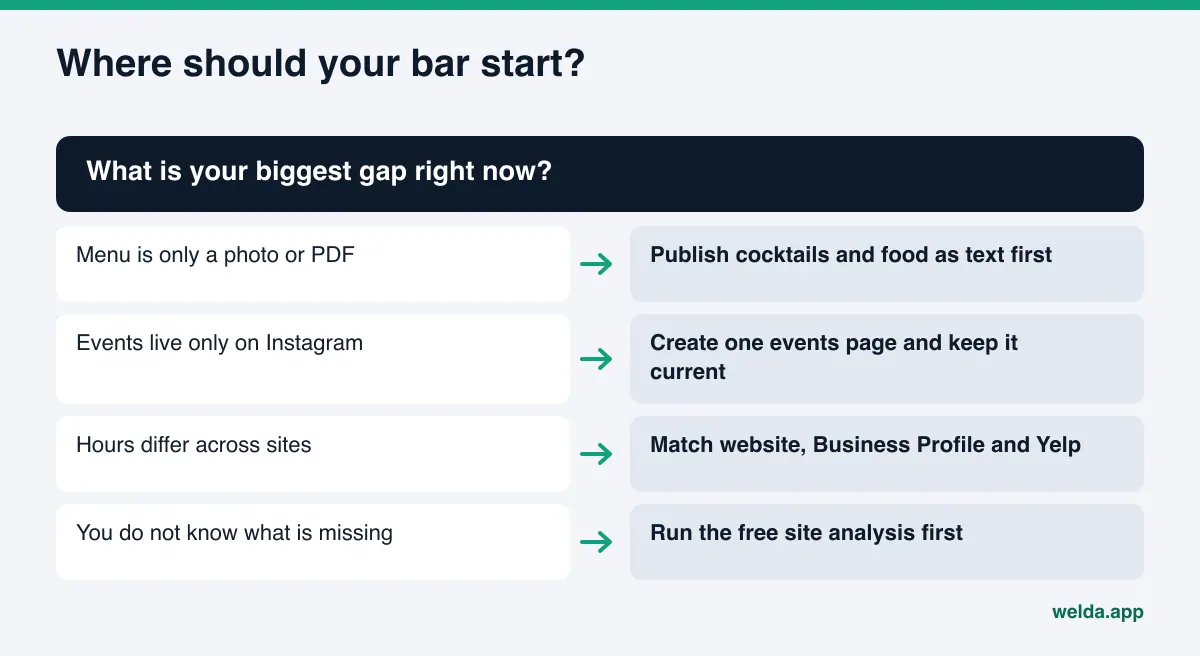
Every bar starts from a different place. Pick your biggest gap from the chart above and work through the checklist below. If your pricing is a frequent question (cover, minimums, bottle service), our guide on pricing pages for AI answers explains how to write it clearly.
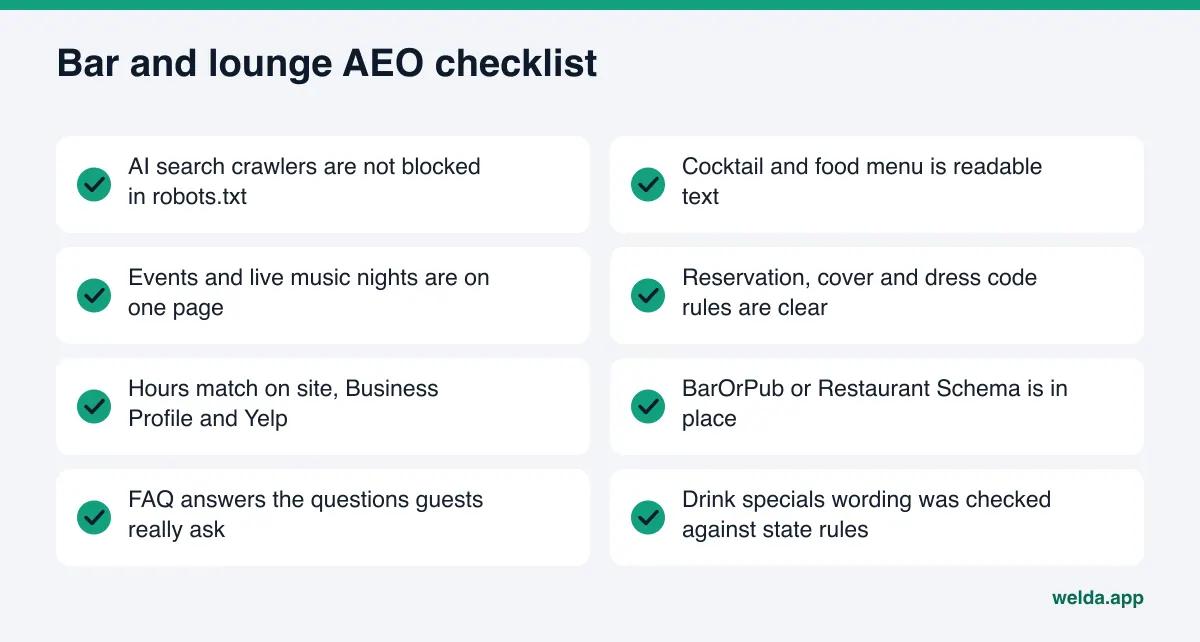
Keep the checklist next to your site and tick items off one by one. Any item you cannot tick is a detail AI needs before it can recommend you.
Frequently asked questions
Is AI search optimization for bars the same as ranking on Google?
No. They share the same foundation: clear information, consistent address and hours, a readable website. But AEO is about being named in the short AI answer. A bar on page one of Google may never be mentioned in an AI answer.
We are very active on Instagram. Do we still need a website?
Instagram helps, but it is not enough on its own. Stories disappear and details in posts are scattered. When events, menu and policies sit on a stable page, AI reads them far more easily.
Should I list happy-hour prices on my site?
Rules on drink specials and how they are advertised vary by state. Check with your state alcohol regulator or your attorney first. For AEO, the details that matter most are hours, events, location, vibe and reservations. This is not legal advice.
How long until we see results?
New content usually takes weeks to be reflected in AI answers. Nobody can promise an exact timeline. That is why measuring regularly with the same questions matters.
Can bars in the US use the Welda panel today?
The panel is in early access and is opening first in Turkey. What anyone can use today is the free site analysis, which works in English. Pricing is discussed in the early access conversation.
Does Welda write reviews for us?
No. Welda does not create fake reviews. It drafts replies to the reviews you receive, and you decide whether to post them.
Your first step: the free analysis
AI search optimization for bars and cocktail lounges starts with clear answers, on your site and your profiles, to the questions guests actually ask. When your events, menu, hours, policies and reservation details are written down properly, AI has a reason to name you. To see where to begin, run Welda's free site analysis: your score, the gaps, ready-to-use text and a fix package arrive by email.