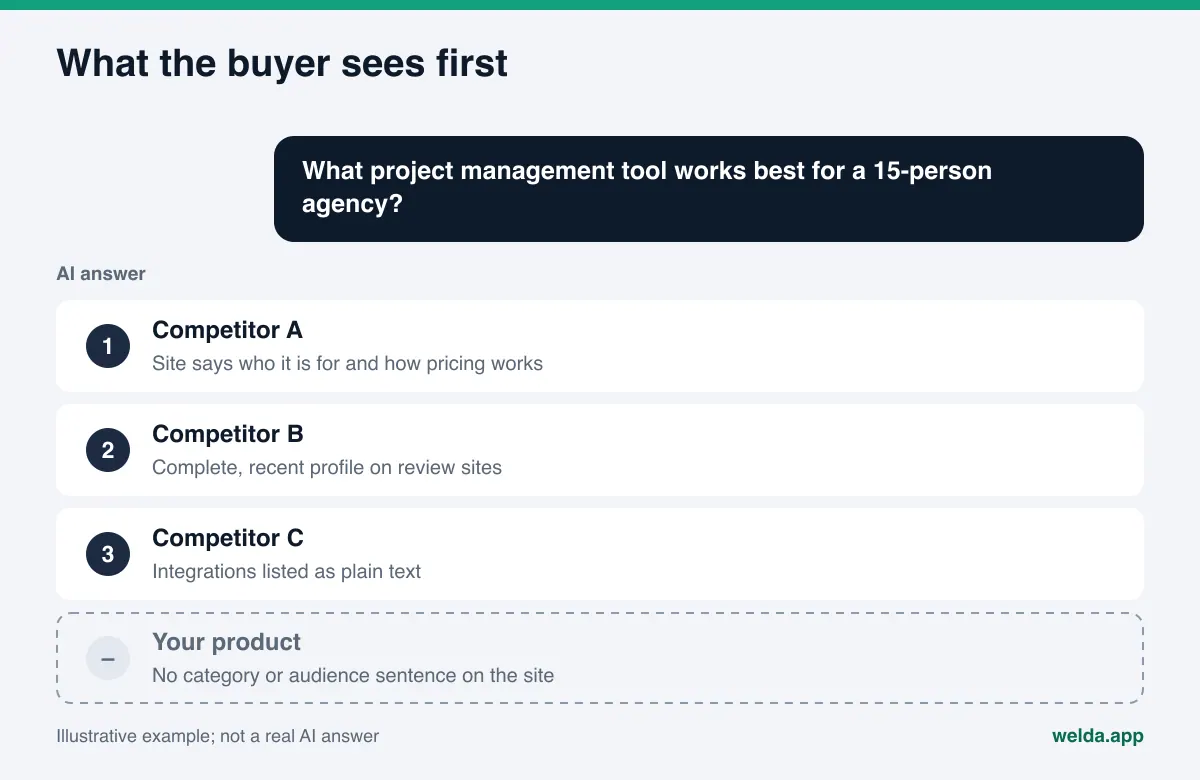
What is AI search optimization for B2B SaaS companies, and why does it matter now? AI search optimization for B2B SaaS companies is the work of making sure your product is named when a buyer asks ChatGPT, Gemini, Perplexity, or Google's AI Overviews which tool fits their needs. The AI builds that answer from your website, review sites, and what others write about you. If those sources do not clearly say what your product is, who it is for, and what it connects to, a competitor takes the slot.
The B2B software buying journey used to start with a search results page, a dozen open tabs, and a few "best tools" listicles. Increasingly, it starts with a conversation. An operations lead, a founder, or a department head types two or three sentences about their situation and gets back a shortlist. That shortlist is usually short. A product that does not make it onto the list rarely gets considered by that buyer, no matter how good it is. Marketers have started calling this work AEO, answer engine optimization. You will also see it called AI search visibility, and in some circles GEO (generative engine optimization), which means roughly the same thing. This guide walks through what buyers ask, which sources AI reads, what to fix on your site, and how Welda handles the work. If you want to see how your own site reads to AI before you continue, you can run the free site analysis first.
Why AI search optimization for B2B SaaS companies differs from local AEO
For a restaurant or a dental practice, AI visibility is mostly about place: "near me," "in Austin," "open now." For a SaaS company, location barely matters. Your buyer might be in Ohio and your team in three time zones. Three other things carry the weight instead.
Category. An AI model has to know which shelf to put you on. If your site never says "project management software for agencies" or "accounts payable automation for mid-market companies" in plain words, the model cannot match you to the buyer's question. Many SaaS homepages lead with lines like "The operating system for modern teams." That works as a feeling for a human. For a language model it carries almost no category signal.
Fit. Buyers rarely ask for "the best" tool in the abstract. They ask what suits their situation: "for a 15-person agency," "for an online store with two warehouses," "for a healthcare group with strict access controls." To answer, the AI looks for who you built the product for, what team size it handles well, and which industries you focus on. If those facts are scattered or missing, you are not in the answer.
Detail. Once a buyer has a shortlist, the questions get specific. "Does it integrate with our CRM?" "Where is the data hosted?" "Is it priced per seat?" Those answers should live on your pricing page, your integrations page, and your documentation. When the AI cannot reach those pages, or cannot find a clear sentence on them, it either skips the question or answers from another source, sometimes an outdated one.
Some fundamentals carry over from local businesses. The consistency principle we describe in AI search optimization for electricians applies here too. But for software, the emphasis shifts from location to category, fit, and product detail.
What do B2B software buyers ask AI?
Buyer questions narrow from broad to specific. At each stage the AI leans on a different part of the web. Before you change anything, write these questions down for your own product.
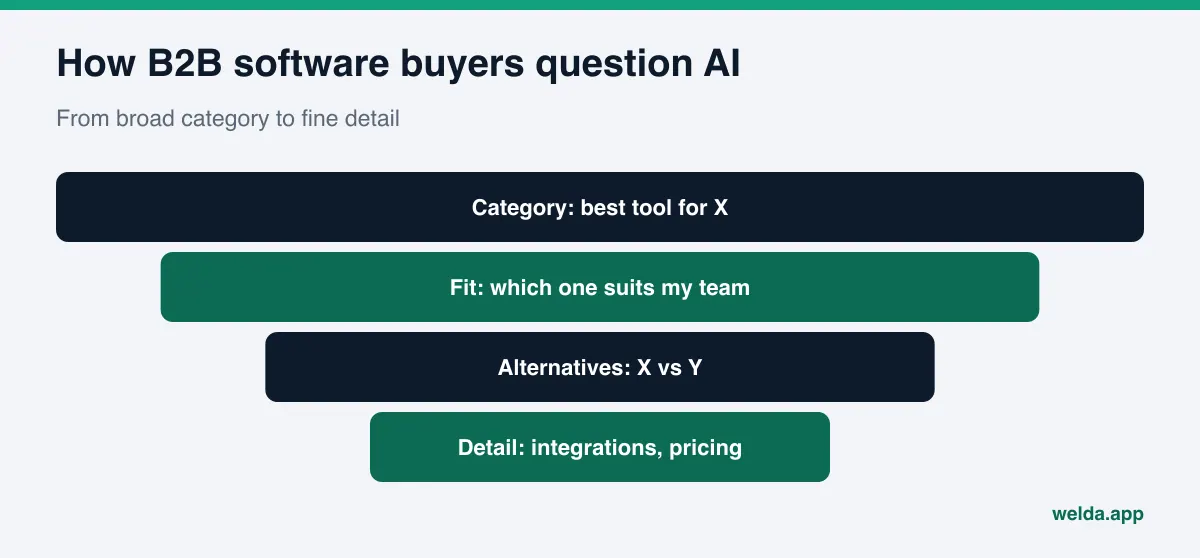
- Category questions: "What are the best accounting tools for small businesses?" "Recommend a CRM for a B2B startup." Here the AI reads your homepage, your category sentence, and third-party "best of" lists that mention you.
- Fit questions: "Which field service app works for a 30-person HVAC company?" "What should a remote-first team use for async standups?" Use-case and industry pages matter most.
- Alternative questions: "What is a good alternative to Competitor A?" "Competitor A vs Competitor B?" Comparison pages, review-site profiles, and community threads carry weight.
- Detail questions: integrations, SSO, data residency, SOC 2 status, pricing model, onboarding time, support hours. The AI looks for answers on your pricing page, integrations list, trust or security page, and docs.
The best source for this list is your own revenue team. Pull the questions prospects ask most often in discovery calls and demos, then add the questions that show up in support tickets during onboarding. AI prompts are not that different from what people ask a sales rep. They are just longer and more specific. Instead of "CRM," a buyer types "I run a 10-person sales team and need something simple to track proposals and follow-ups."
Which sources does AI use to recommend software?
Most AI assistants run a web search when a question needs current information and build the answer from what they find. For a SaaS product, those sources usually fall into four groups.
| Source type | Examples | Your control |
|---|---|---|
| Your own site | Homepage, product and use-case pages, pricing, integrations, trust page, docs, blog | Full |
| Software review sites | G2, Capterra, TrustRadius, Gartner Peer Insights | You manage the profile; customers write the reviews |
| Communities | Reddit threads, industry forums, user communities | You can participate; you do not control the content |
| Press and analysts | Trade publications, tech news, funding announcements, analyst roundups | Indirect, through PR |
The first row matters most because it is the only one you fully control. But when AI recommends a product, it often looks for confirmation outside the vendor's own site. Your homepage might call the product "the easiest tool on the market," yet if your G2 profile is half-filled and the only Reddit thread about you is a complaint, the model has little reason to put you on the list. We cover the earned-media side in more depth in digital PR for AI visibility.
AI search optimization for B2B SaaS companies, step by step
The steps below use facts your product and marketing teams already have. Most of them are not redesigns. They are clear sentences added to pages you already run.
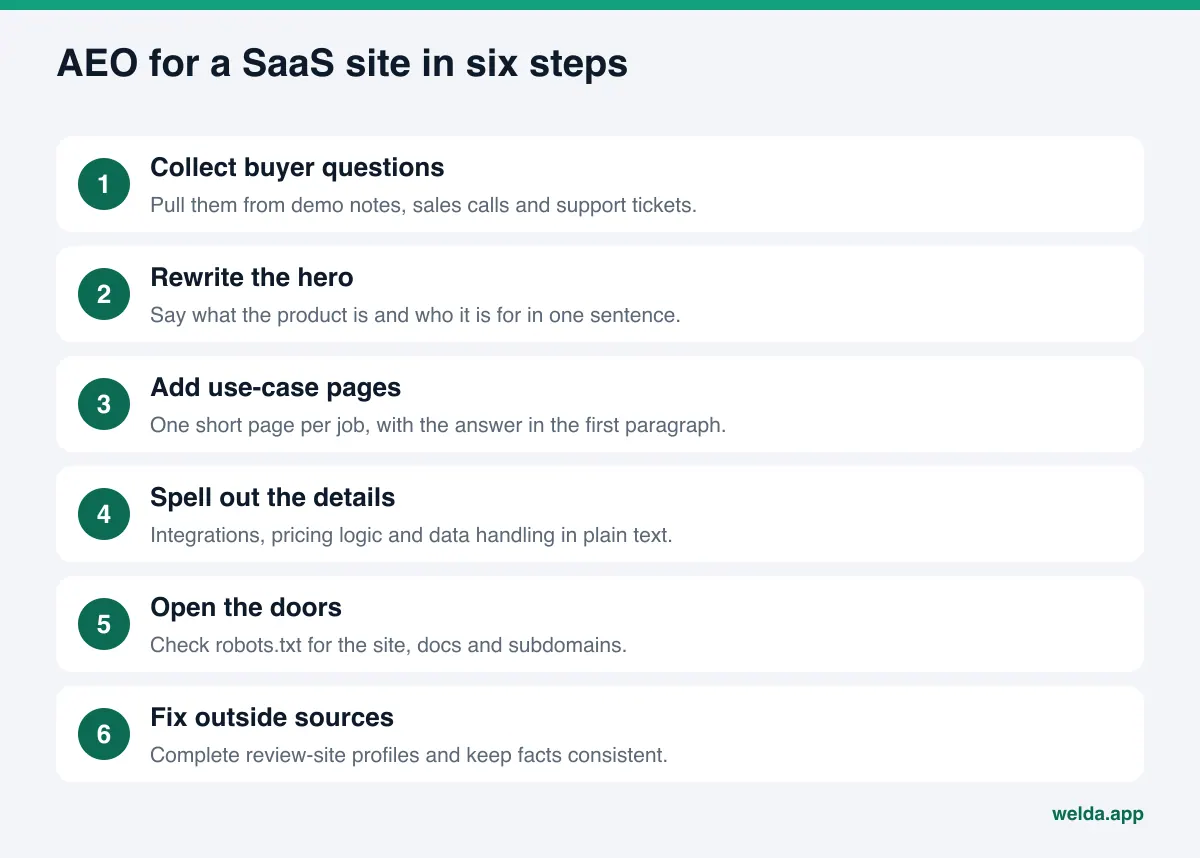
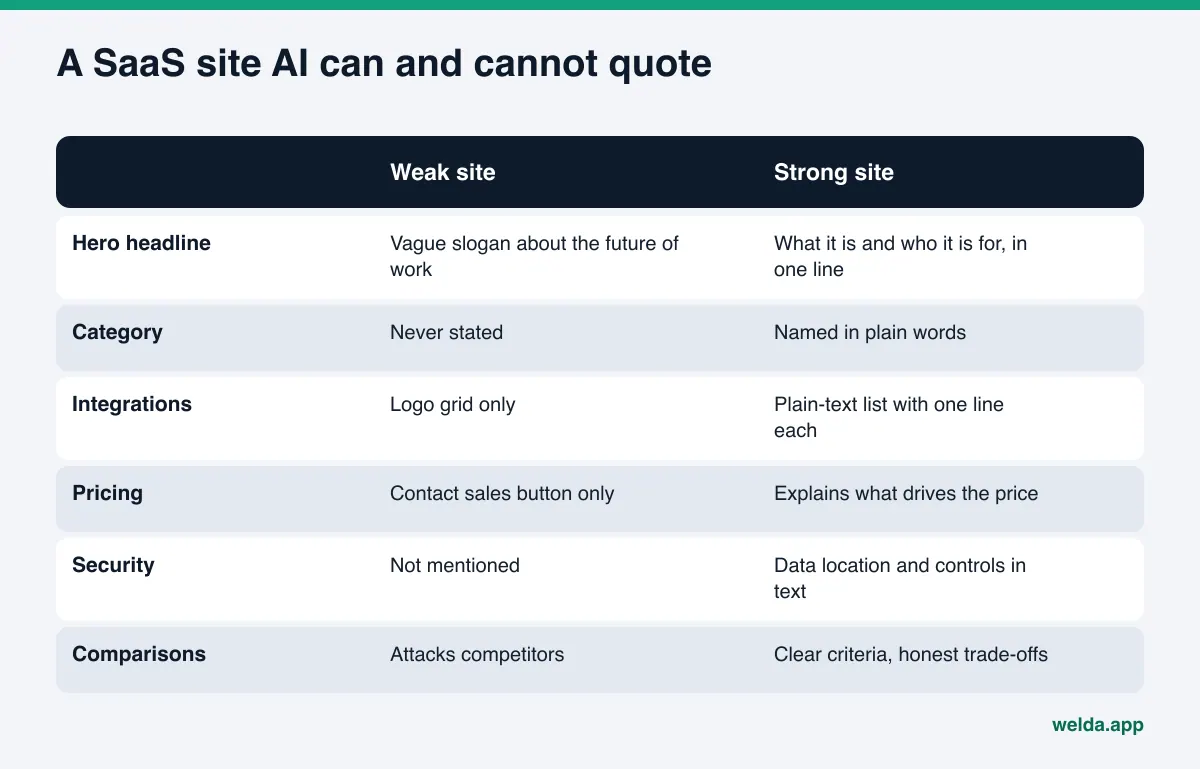
- Turn the hero headline into a category statement. The first heading on your homepage should say what the product is and who it is for. "Cloud accounts payable automation for mid-market finance teams" works for both people and machines. Keep the slogan if you like, below that line.
- Give each core use case its own page. If your product solves five jobs, do not bury all five in one features page. Write one short page per job, ask the buyer's question in the heading, and answer it in the first paragraph. We show this pattern in answer-first content.
- Say who it is for, and who it is not for. A line like "Built for teams of up to 50; not designed for multi-entity consolidation" helps AI recommend you to the right buyer. Honest limits increase trust.
- List integrations in plain text. Integration pages are often a grid of logos. AI may not read logos reliably. Write each integration's name and what it does in one sentence.
- Explain how pricing works. Publishing prices is a business decision. But explaining what drives price (seats, modules, usage volume) beats silence when a buyer asks "how much does it cost."
- Write down data and security facts. Hosting region, backups, SSO, and any audit reports you actually hold are early questions for B2B buyers. Only list certifications and controls you really have.
- Check crawler access. SaaS robots.txt files can get complicated across the marketing site, docs, and app subdomains. See robots.txt for AI crawlers for the details.
- Mark up the company and product. Alongside Organization data, describing the product with the SoftwareApplication type, including fields such as application category and operating system, tells machines what the product is.
How should SaaS comparison and alternatives pages be written?
"What is an alternative to Competitor A?" is one of the most common software questions. To show up in those answers, many SaaS companies publish "vs" and "alternatives" pages. These pages can help, but they carry two risks.
The first risk is trust. An AI model may not treat a vendor's own "we win on every row" table as a neutral source. A comparison with clear criteria, a date, and honest notes on where the other product is stronger is more quotable. "Competitor A offers more granular permissions for large enterprises; we focus on a faster setup for teams under 50" is both accurate and useful to the buyer.
The second risk is legal. In the U.S., the FTC's policy statement on comparative advertising encourages truthful comparisons that name competitors, but requires that they be clear and not deceptive. Unsupported superiority claims are where trouble starts. This is not legal advice. Have counsel review comparison pages before you publish them.
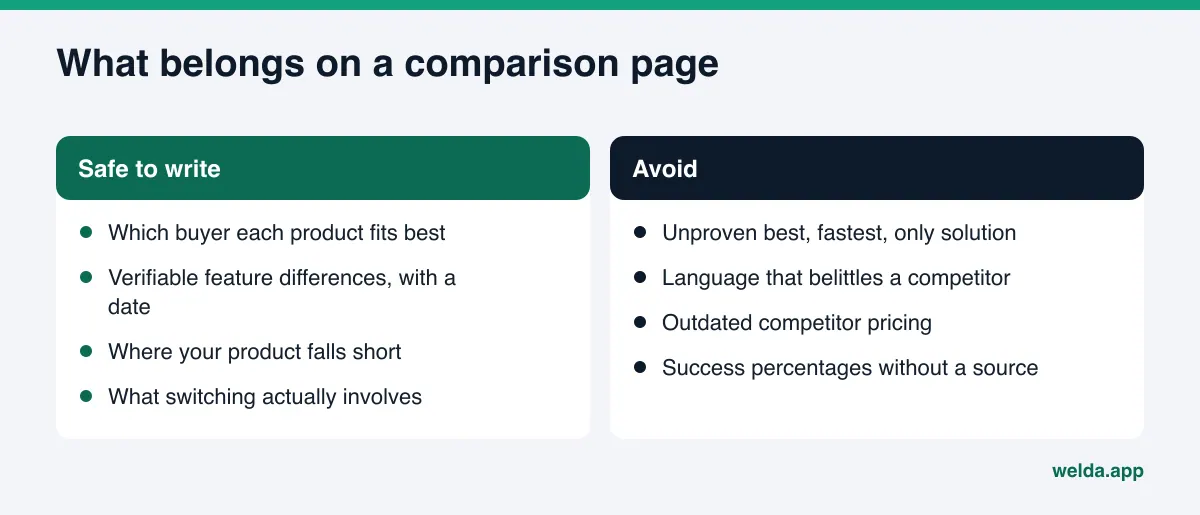
Before writing comparison pages, check whether AI already names a competitor when someone asks about your own brand. It happens often in software: a buyer types your product name and the answer brings up a rival as well. We walk through the causes in competitors show up when AI is asked about my brand.
How Welda handles AEO for a SaaS company
Welda is software that measures where a business appears in AI answers and fills the gaps on the business's behalf. For a SaaS company, three parts do most of the work: question tracking, the competitor and source views, and a compliance check before anything goes live.
Question tracking: where does your product name come up? In the Welda dashboard, the questions your buyers are likely to ask go to ChatGPT, Gemini, Perplexity, and Google AI, three times each. For a SaaS company, that question set covers category, fit, alternatives, and detail. Each row shows whether your product was named and in what position. The score formula is published, and the repeat runs produce a plus-or-minus margin, so a small change is not mistaken for a trend. Questions can be tracked in English or Turkish.
Competitors and sources: why is the other product ahead? The competitor view shows which question group a rival wins and which source feeds that win. A typical finding for a SaaS company might be: on alternative questions, Competitor A leads because its review-site profile is complete and recent, while yours is half-filled. The sources view lists the sites AI cites and where you are missing. The decision on that screen is simple: which source do you fix first.
Ready-to-use copy and a compliance check. Where Welda finds gaps, it drafts the text: a category headline, a use-case page draft, FAQ answers, a product description for a review-site profile. Before publishing, the compliance check flags patterns such as pricing claims, guarantees, and superiority claims. On a SaaS site, that matters most on comparison pages and lines like "the fastest" or "the only." The check is not legal advice and has not been reviewed by legal counsel. You make the final call on every flagged line.
If your marketing site runs on WordPress, Welda connects through a dedicated Editor user and an application password, with no code to install. Content opens as a draft on your site and goes live after you approve it. Many SaaS marketing sites run on a custom stack or another CMS. In that case Welda gives you a ready package and your team applies it. Content always lives on your own site; Welda does not host it. A one-page monthly report shows what changed and what comes next.
What anyone can use today is the free site analysis, which works in English. It reads your homepage and a few inner pages such as pricing, about, and contact. It checks crawler access, title and description, Schema markup, FAQ coverage, and how clearly you describe what you offer. For each gap it explains how to fix it, suggests ready-to-use homepage copy, and compares your site with competitors. It also asks an AI assistant with web search five questions your buyers might ask and checks whether your name appears. That is a one-time snapshot. The analysis does not read your documentation site or your app.
The full Welda dashboard is in early access and is opening first in Turkey. Regular four-engine tracking is being added during early access, and the sample dashboard screens use representative data. Pricing is discussed in the early access conversation.
Limits: what Welda does not do
A SaaS company's AI visibility does not depend on its website alone. It helps to know up front where Welda's role ends.
- Welda does not guarantee that your product will appear in ChatGPT or any other engine. It makes no ranking promises.
- It does not write facts it does not know. Integration lists, hosting region, and certifications are asked of you, and nothing goes into the copy until you answer.
- It does not write fake reviews or buy reviews. Asking customers for reviews and managing your G2 or Capterra accounts stays with your team.
- It can draft replies to critical reviews, but the decision to post them and the customer relationship stay with you.
- PR, analyst relations, and getting into industry roundups are your work. Welda shows how much those sources matter in AI answers.
- New content usually takes weeks to show up in AI answers. Expecting results within a week is not realistic.
For a software team these limits will feel familiar. You also tell your customers which parts your product automates and which parts stay with them. The split here works the same way: measurement, drafting, and checks with Welda; facts, approvals, and outside relationships with you.
Example scenario: a small HR SaaS gets into the answer
The scenario below is an example and does not describe a real company. An example company sells cloud HR software for businesses with 20 to 200 employees, covering time off, time tracking, and employee records. Its sales team notices that many prospects open demo calls with "I asked an AI tool and it suggested a few products."
Week one: questions. The team pulls fifteen questions from demo notes and support tickets, including "HR software for a mid-sized company," "PTO tracking app," "HR tool that works with our payroll provider," "alternative to Competitor A," and "where is employee data stored." They group them into category, fit, alternatives, and detail.
Week two: the site read. The free analysis shows that the homepage hero says "A better experience for your people," that no heading mentions HR software, that there is no FAQ section, and that the company is not marked up with Schema. The integrations page is a logo grid.
Weeks three and four: fixes. The hero becomes "Cloud HR and time-off software for companies with 20 to 200 employees." Three short pages cover time off, time tracking, and employee records. Integrations are listed in text, and a single page explains hosting region and data handling. The half-finished review-site profile gets completed.
The weeks after: tracking. Changes take time to reach AI answers. The team re-asks the same questions at intervals and checks which question group is moving and where a competitor still leads. There is no promised outcome in this scenario. The point is the loop: measure, fix, measure again.
B2B SaaS AEO checklist: where to start
Use this list to see where your site stands before you begin. A simple yes or no per item is enough.
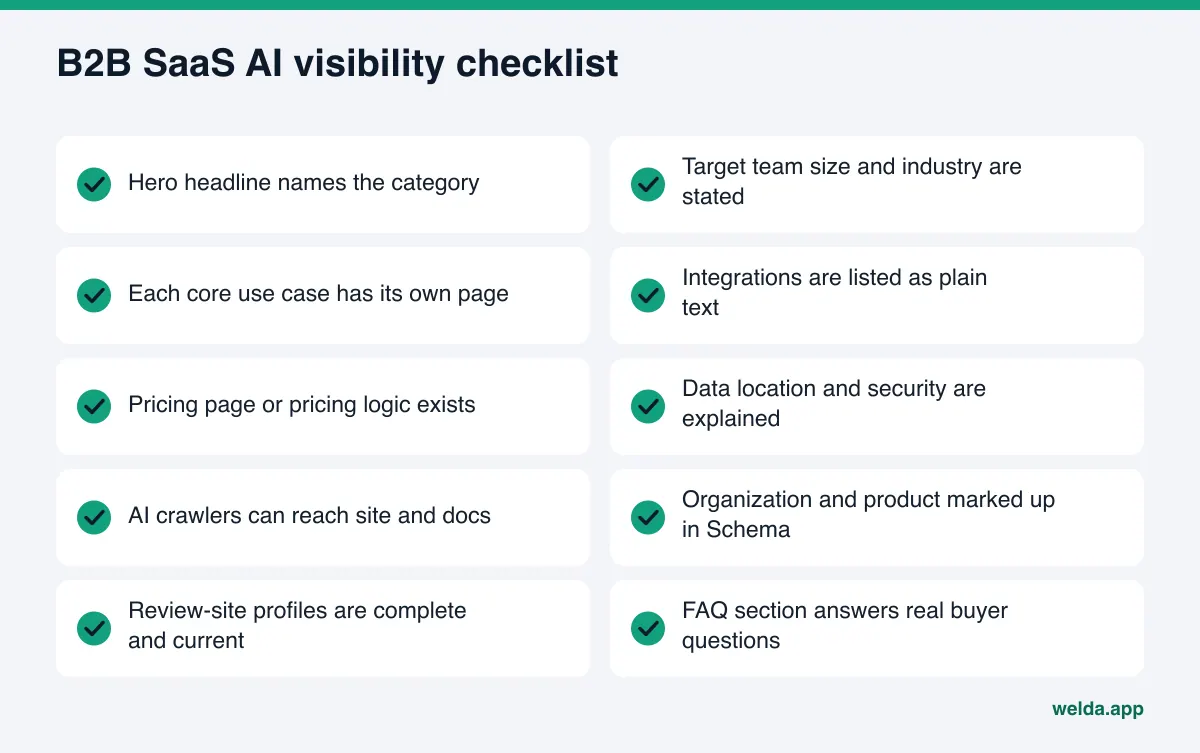
If you have more than one "no," use this table to pick the first task.
| Your situation | First task | Why |
|---|---|---|
| Hero is a slogan with no category | Rewrite the hero and intro paragraph | AI cannot tell which questions to match you with |
| You appear in category answers but not alternatives | Complete review-site profiles and publish an honest comparison | Outside sources weigh heavily on alternative questions |
| AI quotes wrong details about you | Update pricing, integrations, and security pages | The model is pulling from an old or third-party source |
| Crawlers cannot reach the site or docs | Fix robots.txt | A page AI cannot read cannot be cited |
| You do not know where you stand | Run the free site analysis | Measure first, then set the order of work |
Frequently asked questions
How is AEO different from SEO for a SaaS company?
SEO aims for a position in search results. AEO aims for your product name to appear in the answer an AI builds. The technical foundation overlaps a lot. The difference is that content must be quotable as a single sentence and consistent across outside sources.
If we do not publish pricing, will AI ignore us?
Not necessarily, but you will be silent on pricing questions, or the AI may answer from another source, possibly an outdated one. Explaining what drives price is a reasonable middle ground.
Does our documentation site affect AI visibility?
It can, especially for detail questions. Integration and setup questions are often answered from docs, so check that your docs are open to AI crawlers.
Do review sites like G2 and Capterra matter?
They are among the outside sources AI can use to confirm what your site says. A complete, current profile helps. Welda does not manage those accounts or create reviews; it shows how much such sources matter in the answers it tracks.
Are comparison pages risky?
A comparison with clear, verifiable criteria that does not disparage the competitor helps buyers. Unsupported superiority claims can hurt trust and raise legal issues. Have counsel review them; this article is not legal advice.
How long until we see results?
New or corrected content usually takes weeks to show up in AI answers. Welda does not guarantee outcomes. It measures what changes and shows it to you.
First step: see how AI reads your site today
AI search optimization for B2B SaaS companies is not a campaign. It is the ongoing work of describing your product clearly and consistently everywhere a buyer, or a model, might look. Start by seeing how your site reads to AI right now. Run the free site analysis to get your score, your gaps, and suggested homepage copy, with the results link sent to your inbox.