What is AI search optimization for electricians? AI search optimization for electricians, often called AEO (answer engine optimization), is the work of making your services, service area, hours, license and pricing approach clear enough that ChatGPT, Gemini, Perplexity and Google's AI Overviews can recommend you when someone asks for an electrician. Answer engines only name businesses they can read and confirm in more than one place. This guide explains what to fix and how Welda takes on that work.
Why AI search optimization for electricians matters now
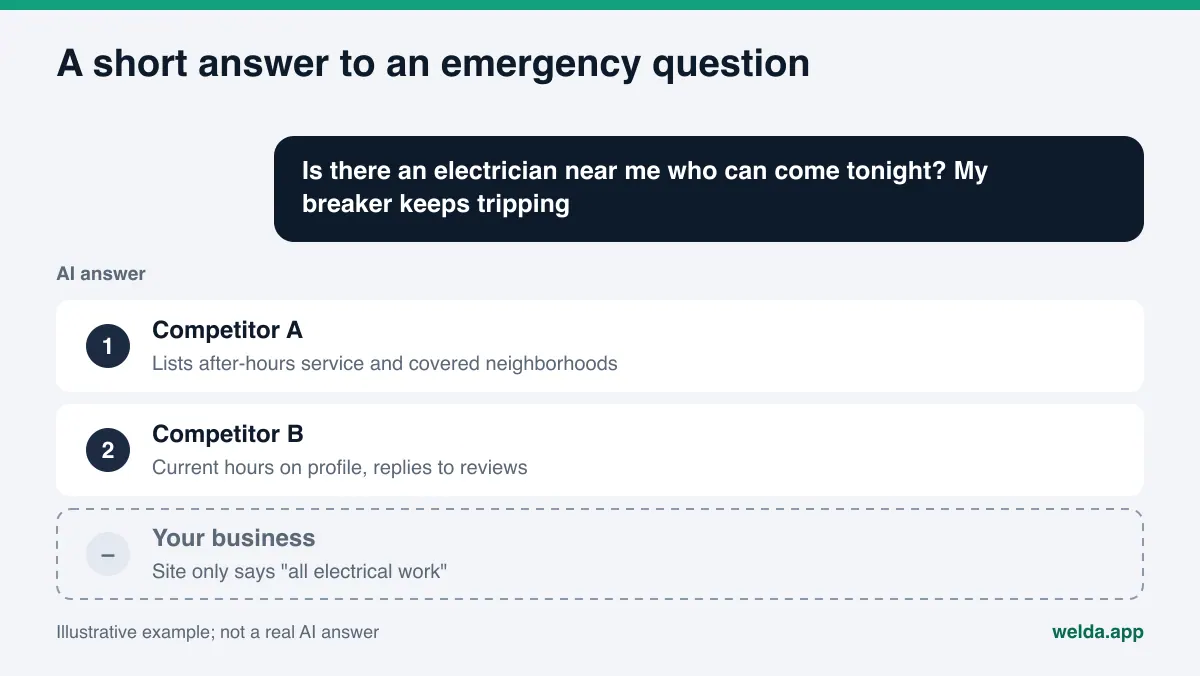
Electrical problems rarely wait. When a breaker keeps tripping, an outlet smells hot, or half the house goes dark, homeowners do not spend an evening comparing contractors. They pick up their phone and search a map, or, more and more often, they ask an AI assistant: "Is there an electrician near me who can come tonight?" The assistant usually does not return ten blue links. It names two or three businesses and gives each a one-line reason. If you are not on that short list, you do not exist for that customer.
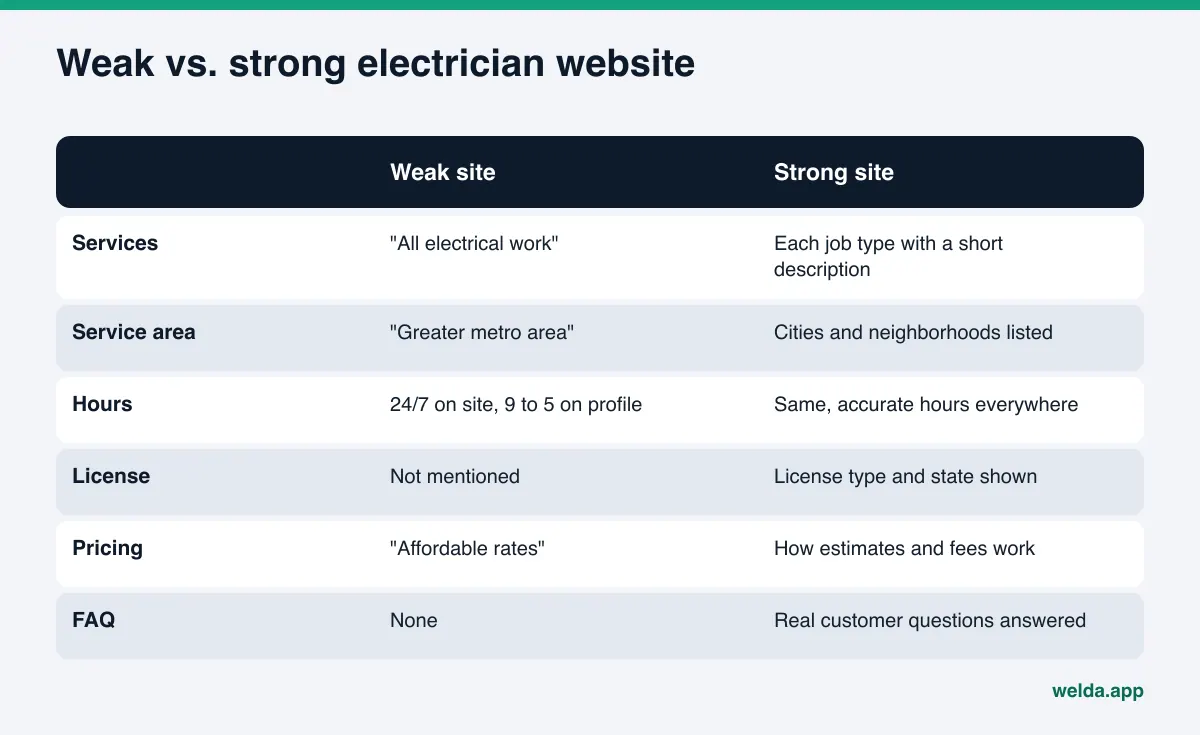
Those names are not picked at random. The answer engine pulls together what it can read about who serves which towns, who works after hours, which jobs each contractor handles, and what customers say about them. This is where many electricians fall short. The website is a single page that says "all electrical work" next to a phone number. The Google Business Profile still lists last year's hours. A directory listing shows an old cell number. From that scattered information, an AI cannot conclude "this electrician comes out at night to this neighborhood," so it recommends the competitor whose facts are clear.
Electrical work adds one more layer: safety and trust. Homeowners want to know the person entering their home is qualified. Answer engines also look for trust signals when they build a recommendation: a license, reviews, a real business address and consistent contact details. So AEO for an electrician is not just "add your city name to the homepage." It is stating your jobs, area, hours, credentials and pricing approach clearly, and making them match everywhere they appear. You may also see this work called GEO (generative engine optimization); in the US the two terms describe the same goal.
If you want to see how ready your own site is today, run the free site analysis. It reads your site the way Google and AI systems do and lists each gap, along with how to fix it.
What homeowners ask AI about electricians
Questions about electricians fall into a handful of patterns, and each pattern sends the answer engine looking for a different piece of information. The questions in the table below are examples we wrote to illustrate the point; they are not survey data.
| Question type | Example (written by us) | What the AI looks for |
|---|---|---|
| Emergency | "Electrician near me open now in Arlington" | After-hours policy, cities served, phone |
| Recurring fault | "Why does my breaker keep tripping and who should I call?" | A troubleshooting page, a clear FAQ |
| Upgrade | "Who does 200 amp panel upgrades in my area?" | A dedicated service section, permit and inspection process |
| New installation | "Licensed electrician to install a Level 2 EV charger" | The job named explicitly, license details |
| Price and trust | "Do electricians charge for estimates? How do I find a reliable one?" | Pricing approach, license, reviews |
| Commercial | "Electrician for a small office build-out" | Whether you serve businesses and landlords |
The takeaway is simple: each question type maps to a specific fact on your site. "All electrical work" answers none of them. For an EV charger question, the answer engine looks for a source where that job is named. For a "tonight" question, it looks for a source where the hours are spelled out. This is the answer-first content approach applied to a local trade: lead with the answer, then add detail.
AI search optimization for electricians, step by step
Work through these steps in order. Each one builds on the last. Measurement comes at the end, because while facts are missing, a measurement can only tell you that you are absent, not why.
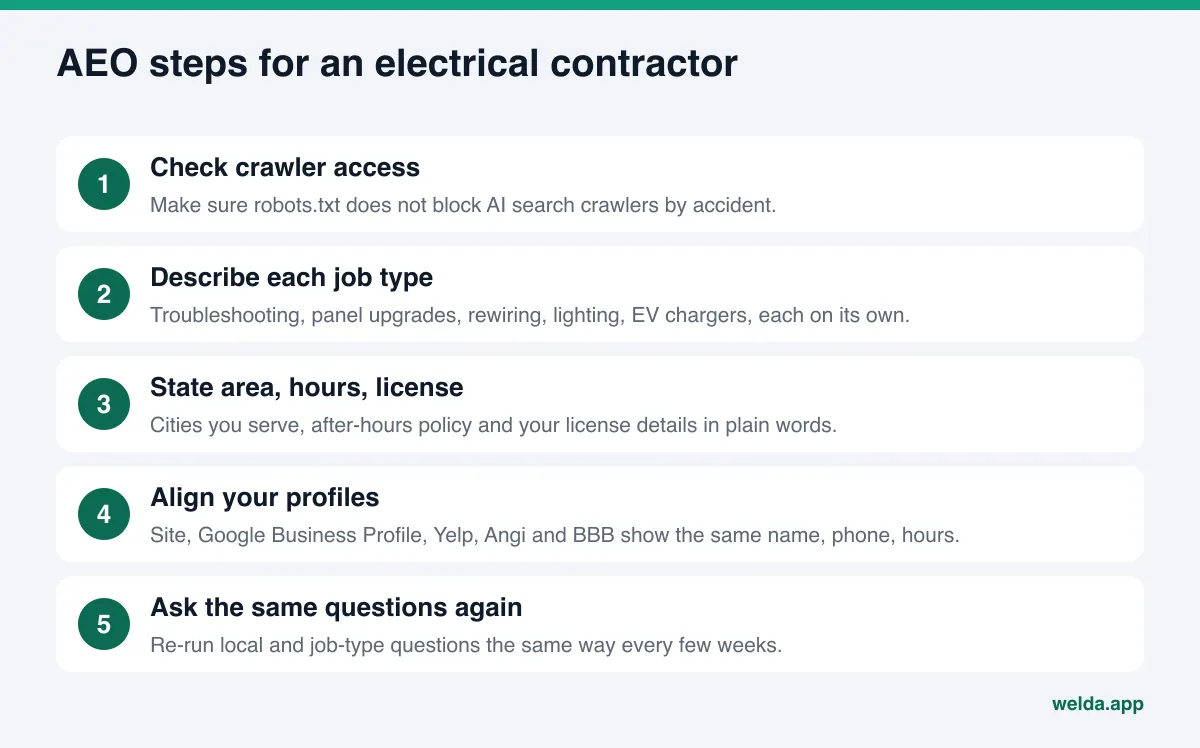
- Confirm AI crawlers can reach your site. Some themes and security plugins block unknown bots wholesale through robots.txt. OpenAI states that its OAI-SearchBot crawler needs access for a site to appear in ChatGPT search answers. If it is blocked, your site cannot be used as a source there. Run the same check for the crawlers of other engines.
- Describe each job you do. Troubleshooting, panel upgrades, rewiring older homes, outlet and switch replacement, lighting, GFCI and AFCI protection, EV charger installation, generator hookups, commercial work. Give each two or three sentences: what the job involves, roughly how long it takes, and what the customer should prepare. Leave out work you do not take on. If an AI recommends you for the wrong job, it wastes your time and the customer's.
- Spell out your service area. Instead of "the greater metro area," list the cities and, where it helps, the neighborhoods you cover. Say separately where you go after hours. Keep this identical on your site and your Google Business Profile.
- Keep hours accurate and consistent. "24/7" on the website and 9 to 5 on the profile is one of the most common conflicts answer engines run into. If you take emergency calls at night, say so. If you do not, "no after-hours service" is still useful information and prevents a bad match.
- State your license clearly. Licensing rules for electricians are set at the state level and sometimes locally, so name the license type you hold and the state that issued it. Many homeowners will look it up. Mention insurance if you carry it. Never imply a credential you do not have.
- Explain how pricing works. You do not need to post a rate card. Say whether you charge a service call or estimate fee, when you give a firm price, and how materials and permits are handled. Avoid "lowest price in town" style claims; our piece on pricing claims in AI-ready content explains why those claims carry risk.
- Add business schema markup. Schema.org has a dedicated type for this trade: Electrician, a subtype of local business. It carries your business name, address, phone, hours and service area in a format machines can read. Everything in the markup should match what is visible on the page.
- Write an FAQ section. Take the five or six questions you hear most on the phone and answer each in a few sentences. "Do you charge for estimates?", "Do you pull permits?", "Do you work weekends?" These are answers an AI can quote directly.
- Align your listings. Check name, phone, address and hours on Google Business Profile, Apple Maps, Yelp, Angi, BBB and any trade directories you use. Remove leftovers like disconnected numbers or an address from before you moved.
- Handle reviews honestly. Do not write, buy or incentivize fake reviews. The FTC's rule on consumer reviews and testimonials, in effect since October 21, 2024, prohibits fake reviews and certain review practices. This is not legal advice; read the rule or ask your attorney. Reply to real reviews briefly and specifically: what job was done and, if something went wrong, how it was resolved.
Trust signals for electricians: what answer engines look for
An AI that recommends an electrician tries not to recommend the wrong one. There is no published rulebook for how it decides, but the short reasons that appear next to recommended businesses give a clue: "offers emergency service," "reviews mention quick response," "licensed and insured." Each of those notes was read somewhere. If there is no source to read, there is no note.
For an electrician, trust information usually comes down to these points:
- A real business identity: a legal or trade name, an address or at least a defined service area, and one stable phone number. AI systems struggle to connect sources that show the same contractor under three different numbers.
- License details: the license type and issuing state. Whether to publish the license number is your call, but many homeowners expect to see it.
- Examples of work: short descriptions without customer names or unapproved photos, such as "panel upgrade in a 1960s ranch home: what we replaced and how long it took."
- Reviews with replies: a reply next to a review shows how problems get handled.
- Responsible safety language: brief, accurate advice like "turn off the breaker and do not touch the outlet until it is inspected" signals a serious business. Avoid statements that diagnose a problem sight unseen.
Keep the balance in mind. Trust is built with evidence, not adjectives. "Best electrician in town" and "100% guaranteed" may mislead customers and give an answer engine nothing it can use. "We test GFCI outlets after installation and show the homeowner the result" is a concrete fact.
How Welda handles AEO for an electrician
Welda is software that measures where a business appears in AI answers and fills in the gaps on the business's behalf. For an electrician, two parts matter most: the competitor view and the sources view. The usual problem is not "we never appear." It is that a rival leads on certain kinds of questions, and wins them through certain sources.
How measurement works. The questions your customers would ask, for example after-hours troubleshooting, panel upgrades and EV charger installs by city, are asked to ChatGPT, Gemini, Perplexity and Google AI three times each. Welda records which questions mention you, in what position, and where competitors lead. The score formula is open: the share of questions that mention you carries 50 percent of the weight, your position carries 30 percent, and your share against competitors carries 20 percent. The spread across the three runs is shown as a margin of error, so you do not mistake one lucky answer for progress.
What the competitor view shows. Which rival leads in which question cluster, and which source drives that lead. Picture an example: "Competitor A" wins the emergency cluster, and the answers cite its Google Business Profile and its Angi listing. You do better on panel upgrade questions because your site has a detailed page on that job. The screen does not tell you to fix everything. It tells you where the gap is and which source the competitor wins on. The decision stays with you: if you do take night calls, make that clear on your profile and site; if you do not, leave that cluster alone on purpose. If a competitor even shows up when people ask about your own business by name, our article on competitors showing up when AI is asked about your brand covers that case.
What the sources view shows. Which sites the AI relies on when it answers electrician questions, and your status on each one: missing, incomplete, or unreachable, with a one-line next step beside every row. For an electrician the list typically includes map profiles, home services marketplaces, review sites and your own website. Seeing which sources carry weight in your trade lets you spend limited time where it counts.
How gaps get filled. Welda drafts the missing service descriptions, the FAQ section, profile text and review replies. It does not invent facts: which cities you serve, whether you take night calls and which license you hold are questions it asks you, and the field stays empty until you answer. On WordPress sites, Welda connects through a separate Editor user and an application password, with no code to install; drafts open on your site and go live once you approve them. On other platforms, Welda provides a ready-made package and the changes are applied by hand. Content always lives on your own site. Before anything is published, a compliance check flags price, guarantee and superiority claims. It is not legal advice and has not been reviewed by counsel; it surfaces risky phrasing before publication. A one-page monthly report sums up what changed, as described in our piece on the monthly AEO report.
What the free analysis checks on an electrician's site
While the Welda panel is in early access, the part anyone can use today is the free site analysis, and it works in English. It reads your homepage and a few inner pages such as services, pricing, about and contact. Here is what each finding means for an electrical contractor.
| What the analysis checks | What it means for an electrician |
|---|---|
| AI crawler access (robots.txt) | If crawlers are blocked, other fixes have limited effect. Check this first. |
| Title and meta description | Do "electrician" and your city appear together, or only the company name? |
| Main heading | Does it say in one line what you do and where? |
| Business schema | Is the Electrician type present with address, phone and hours? |
| Address, phone, location | Visible on the page and identical to your listings? |
| Social and map profiles | Does the site link to them? |
| FAQ section | Are estimates, permits and after-hours questions answered? |
| Reviews and trust signals | Are license, reviews and work examples on the site? |
| Clear service descriptions | Is each job described, or is everything in one sentence? |
| Page speed | Can a homeowner on a phone, in a hurry, open it without waiting? |
You get a score out of 100, with technical and content sides shown separately. Each gap comes with what was found, why it matters and how to fix it. Ready-to-use homepage text arrives with it: title, description, main heading, intro paragraph and FAQ. A simulation shows how much each fix would move the score, and the report includes a competitor comparison and a fix package for your site, schema code included, plus a PDF and a shareable score card. The analysis also asks an AI assistant with web search five questions your customers might ask and checks whether your name appears in the answers. That is a one-time snapshot, not ongoing tracking. Each site gets one free analysis; email and phone are verified, the results link arrives by email and stays open for 14 days.
Limits: what Welda does not do
This work deserves an honest description. The Welda panel is in early access. It is opening in stages and launching first in Turkey, so US businesses can use the free analysis today and join the early access list for the panel. Regular measurement across all four engines is being added during early access, and the sample screens in the panel use illustrative data. Pricing is discussed in an early access call.
- No ranking guarantee. No software or agency can guarantee that an electrician will appear in ChatGPT. Welda does not either; it measures, shows the gaps and fills them.
- No made-up facts. Your hours, license and service area come from you.
- No publishing without approval. Every piece of content waits for your sign-off.
- No fake reviews. Ever.
- Some work stays with you. Resolving the issue behind a negative review, creating directory accounts and earning local press are yours to do. Welda can draft text, but you own the accounts and the decisions.
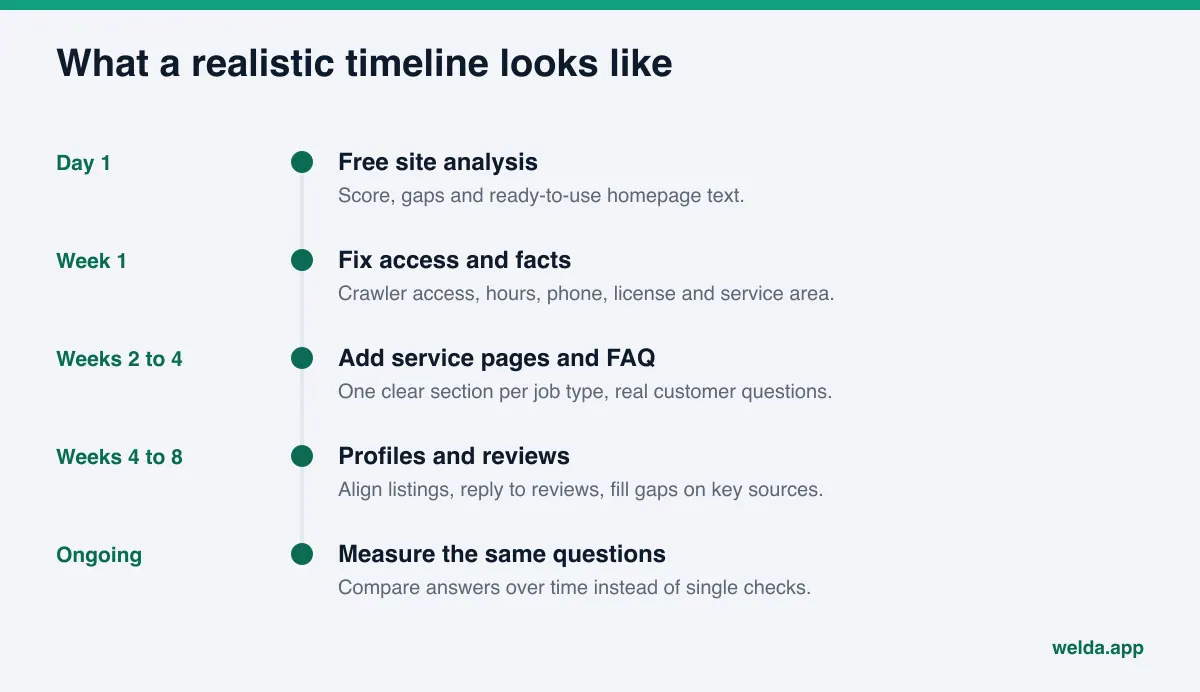
- Results take time. A new service page or corrected profile usually takes weeks to show up in AI answers. Seeing no change in week one is normal.
AEO checklist for electricians
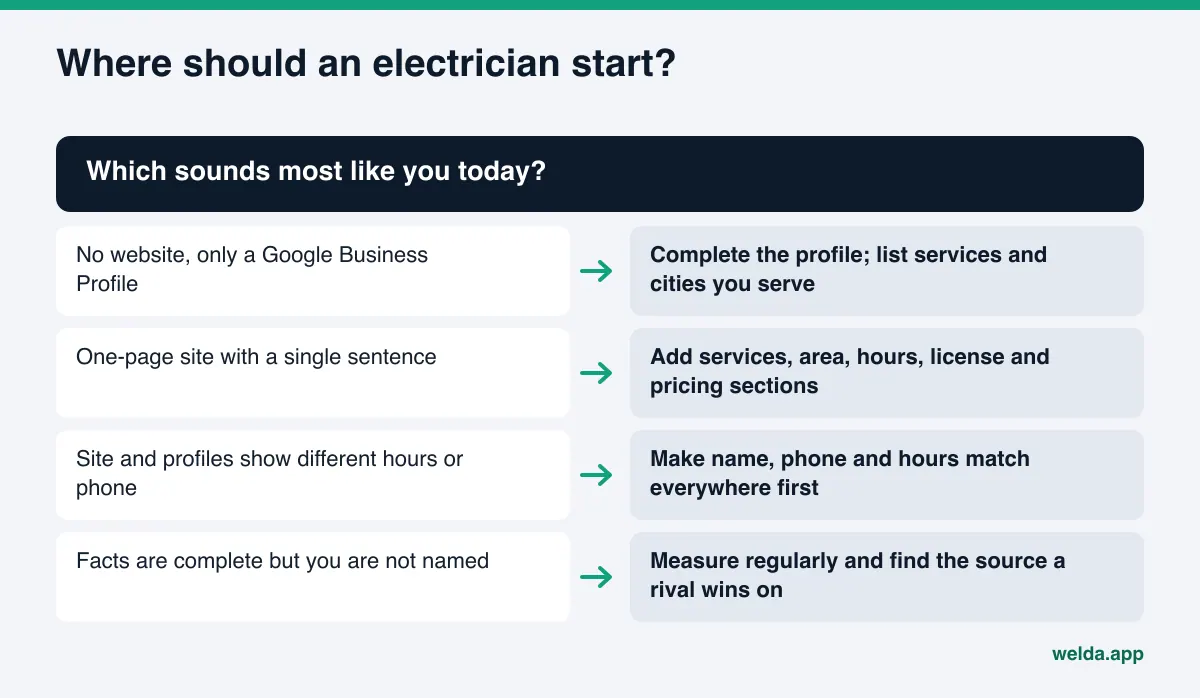
Go through the list once from top to bottom. Every "no" is a fact an answer engine is missing when it decides whom to recommend.
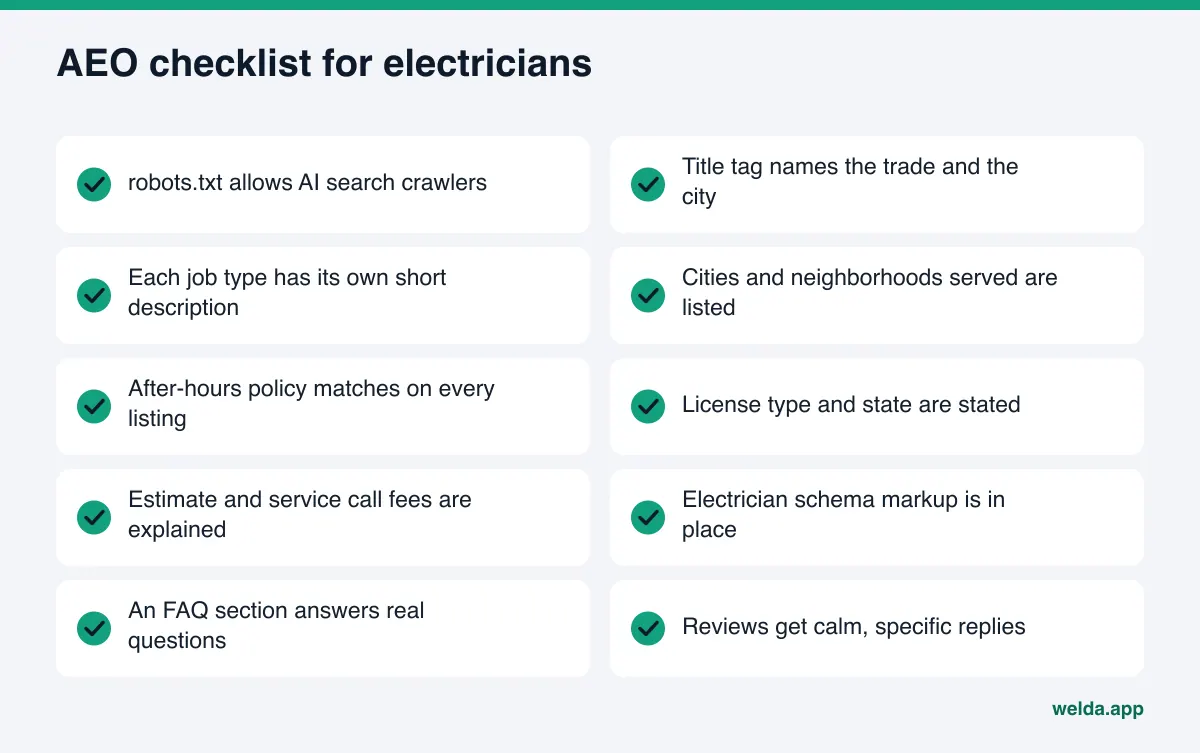
Work in priority order. Access and consistency first: if crawlers cannot get in, or your phone number differs across three listings, everything else is wasted. Then services and area: which jobs you do, and where. Then trust: license, reviews, replies. Fine-tuning comes last: expanding the FAQ and adding detail to service descriptions.
A note on how often to check. AI answers can change even for the same question. Looking at one result and concluding "we are in" or "we are out" is misleading. Ask the same questions the same way, at regular intervals, more than once. That is why Welda asks every question three times.
Frequently asked questions
How is AEO for electricians different from traditional SEO?
The foundations overlap: crawler access, clear titles, accurate business data. The difference is the goal. SEO aims for a spot in a list of results; AEO aims for your name in the short answer an AI writes. That requires facts that are consistent across several sources and easy to quote.
Can I show up in AI answers without a website?
Your Google Business Profile and directory listings help to a point. But your website is where you can describe job types, service area, hours and common questions in detail. Even a simple one-page site with accurate facts gives an answer engine far more to work with than none.
Should I say so if I do not offer emergency service?
Yes. Stating your actual hours prevents mismatched expectations and keeps AI from recommending you for questions you cannot serve. Being strong in daytime clusters has real value too.
Do I have to publish prices?
No. Explaining how pricing works is enough: whether there is a service call fee, when you give a firm quote, how materials and permits are handled. That directly answers questions like "do electricians charge for estimates?"
How fast will I see results with Welda?
Nobody can promise a timeline. New content usually takes weeks to show up in AI answers. Welda shows before-and-after comparisons and a monthly report along the way, but it does not promise outcomes.
Can US electricians use the Welda panel today?
The free analysis works in English and is available today. The full panel is in early access and is opening first in Turkey; you can request early access, and pricing is discussed in that conversation.
See where your site stands today
AI search optimization for electricians is not a long marketing project. It is a set of clear facts: which jobs you do, where you go, when you work, why you can be trusted, and how pricing works. When those facts are visible and consistent on your site and listings, an answer engine has something to read when it decides whom to name. To find your starting point, run the free site analysis and get your score, your gaps, ready-to-use homepage text and a fix package in one report.