What is AEO for tutoring centers, and how does it work? AEO (answer engine optimization) for tutoring centers is the work of getting your center named when a parent asks ChatGPT, Gemini, Perplexity or Google's AI Overviews to recommend a tutor. The AI builds its answer from what it can find about you online: which subjects and grade levels you cover, how big your groups are, when you meet, how pricing works and what parents say about you. When that information is clear on your site, complete on your Google Business Profile and consistent everywhere, your odds of being named go up.
Tutoring is a seasonal decision. Parents start looking in late summer, again after first report cards, and in the weeks before the SAT, the ACT or state tests. A few years ago that parent would ask other parents, check a school Facebook group or scroll through the map. Today more of them type the whole question into an AI assistant and get back two or three names with reasons attached. That short answer is where AEO for tutoring centers matters: it decides which centers a parent even calls. In this guide we cover what parents ask AI, what the AI looks for when it recommends a center, the steps you can take this season, the rules on reviews and results claims, and how Welda handles the work. If you want to see where your own site stands first, you can run the free site analysis before you read on.
Why AEO for tutoring centers matters now
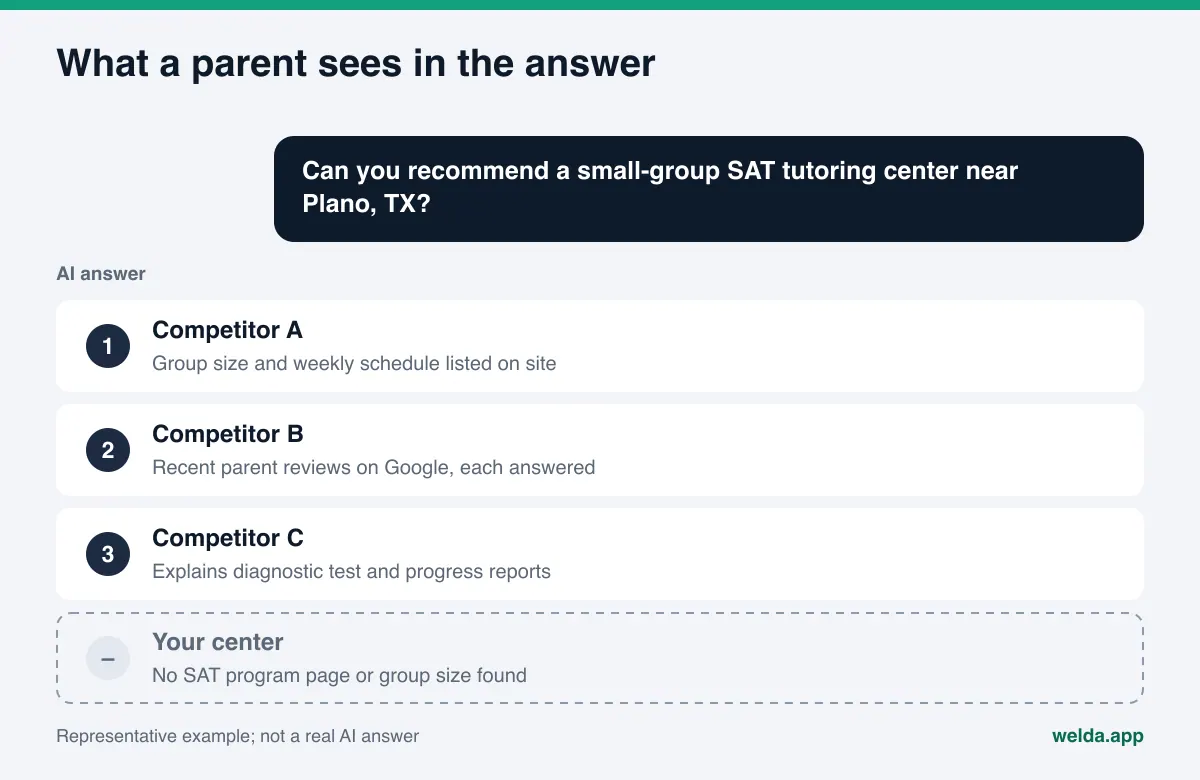
Choosing a tutoring center is not a casual purchase for a parent. They are handing over a school year, sometimes a test score that affects college applications. So they ask questions, compare and build a shortlist. AI assistants are very good at producing exactly that shortlist: they take the question, search the web, read the pages they find and name a handful of options with a reason for each.
That has three consequences for a tutoring center. First, the answer is short. A map search may show a dozen centers; an AI answer usually names two or three. Second, the answer comes with reasons. The AI highlights concrete details like "small groups of six", "free diagnostic test" or "weekly progress reports to parents". A center that never wrote those details down online cannot be cited for them, even if it offers the same thing. Third, after reading the answer, many parents contact only the centers it named. If you are not in the answer, you were never on the list.
Independent centers feel this most. A national franchise is mentioned on many websites already. A single-location or two-location center usually has its own website and Google Business Profile as almost the only places an AI can learn about it. The same logic applies to other neighborhood businesses; we walked through a similar case in AEO for yoga and Pilates studios.
You will also see this work called GEO (generative engine optimization). In the US, AEO is the more common term, and the two describe the same goal: being cited correctly in AI-generated answers.
What parents actually ask AI about tutoring
A question typed into an AI assistant is much longer than a map search. Grade, subject, test, neighborhood, budget and the child's situation often arrive in one sentence. The questions below are examples we wrote, not data from a measurement, but they will probably sound familiar from your intake calls:
- "Can you recommend a small-group SAT prep center near Plano, TX? My daughter is a junior."
- "Who offers one-on-one Algebra 1 tutoring in Naperville for a 9th grader?"
- "Is there a reading tutor near me who works with kids with dyslexia?"
- "After-school homework help for a 4th grader in Brookline, with pickup from school?"
- "Online vs. in-person tutoring for ACT math: which is better, and what does it cost?"
- "How much does a tutoring center charge per hour, and do they offer packages?"
Each of those questions needs a specific piece of information to exist somewhere online. An AI can only recommend a center "with pickup from school" if it has read that you offer pickup. It can only answer "small group" if your group size is written down. The table below matches question types to the information that answers them.
| Parent's question type | What the AI looks for | Where that information should live |
|---|---|---|
| Grade and test ("junior", "SAT", "ACT") | Which grades and tests each program serves | A separate page or section per program |
| Format ("small group", "1:1", "online") | Group size, private option, online or in person | Program pages and FAQ |
| Learning needs ("dyslexia", "ADHD") | What support you offer and who delivers it | Program page, tutor bios |
| Timing ("after school", "weekends") | Weekly hours, session length, term dates | Plain-text schedule, Google Business Profile hours |
| Location ("near me", "pickup") | Address, areas served, transportation | Contact page, schema, Google Business Profile |
| Price ("per hour", "packages") | What drives the price, how to get a quote | Pricing section or page |
| Trust ("is it good", "reviews") | Parent reviews, replies, credentials, method | Google, Yelp, BBB, Nextdoor, About page |
Pricing deserves a note. Many centers prefer to discuss price on the phone after an assessment. That is fine, but if nothing is written, an AI may skip you for a price question or pull an outdated number from some other site. Even without numbers, explaining what changes the price (subject, hours per week, group or private, package length) gives the AI something accurate to say. We cover this in more depth in pricing pages for AI answers.
How AI decides which tutoring center to recommend
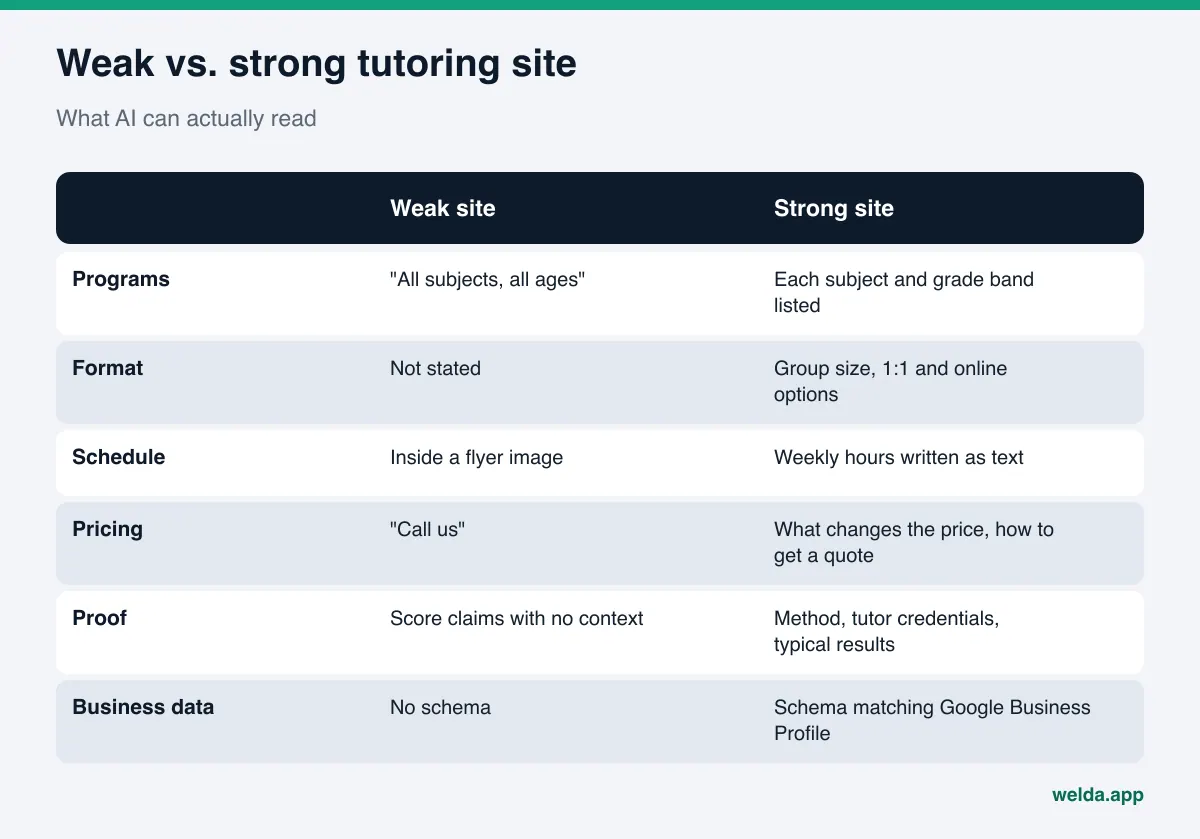
AI engines do not "know" your center. When a question comes in, they search the web, read what they find and assemble an answer. For your center to appear, three things have to be true: the engine can find you, it can understand what it finds, and it can trust it.
Finding you starts with letting AI crawlers in. OpenAI, for example, documents that its OAI-SearchBot crawler is used to surface sites in ChatGPT search, and that sites blocking it in robots.txt will not be shown in ChatGPT search answers. Some website templates block crawlers like this without the owner realizing it. Beyond that, a verified and complete Google Business Profile and listings on the sites parents actually check (Yelp, BBB, Nextdoor, local parent directories) make you findable.
Understanding you requires plain text. The most common mistake we see on tutoring sites is putting the whole schedule and program list inside a designed flyer image. "Monday to Thursday 3:30 to 6:30 homework help, Saturday SAT practice tests" inside a JPEG is often invisible to an AI. The same sentence written on the page can be quoted directly. Structured data (schema) helps too: your name, address, phone and hours in a format machines read reliably.
Trusting you depends on consistency and outside confirmation. If your website lists one phone number, Google another and an old directory listing a third, the AI cannot tell which is right. Parent reviews, your replies to them, and social profiles linked to your site all add trust. The technical side of linking profiles is in link social profiles with sameAs.
AEO for tutoring centers, step by step
These steps fit into one enrollment cycle. Order matters: new pages do little if your basic information conflicts, and outside listings do little if your own pages are thin.
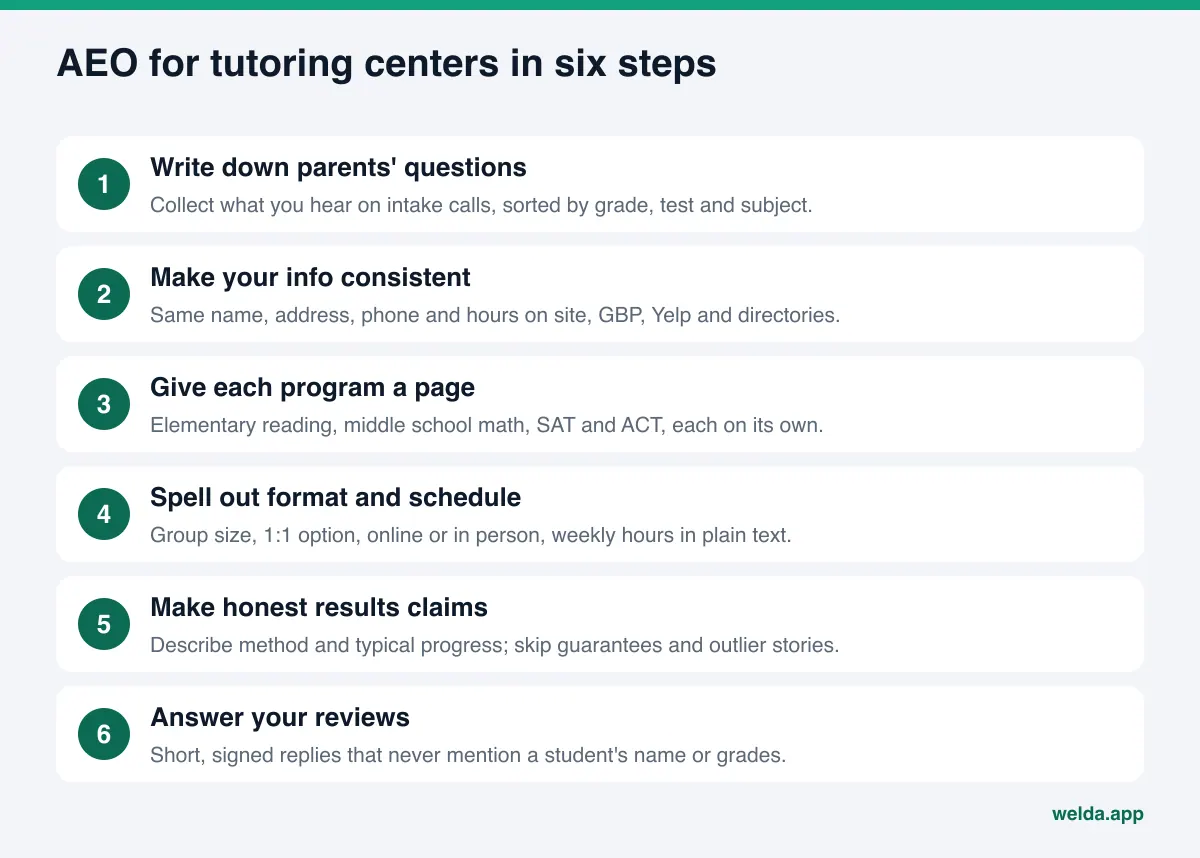
- Collect parents' real questions. Write down the fifteen to twenty questions you hear most on intake calls, emails and texts. Group them by grade band (elementary, middle, high school), by test (SAT, ACT, state tests, AP) and by topic (format, schedule, price, location). This list becomes both your content plan and the basis for measuring.
- Make your core information match everywhere. Center name, address, phone and hours should be identical on your site, Google Business Profile, Yelp, BBB, Facebook and any directory. If you run a second location, give it its own address, profile and page.
- Give each program its own page or section. Elementary reading, middle school math, SAT prep, ACT prep and one-on-one tutoring should not share a single bullet list. For each, say who it is for, how many hours a week it runs, the group size and the term dates, in a few direct sentences.
- Write out format and schedule. Copy what is on your flyer into plain text on the page. A sentence like "Groups are capped at six students" belongs on the page only if it is true and you know the number. It is the best possible answer to a parent who asks for small groups.
- Explain your pricing approach. If you publish rates, keep them current. If you do not, explain what changes the price and how a family gets a quote.
- Describe results honestly. Explain your diagnostic process, how you track progress and how you report to parents. The next section covers why outlier score stories are a risk.
- Add an FAQ section. Take the most common questions from step one and answer them briefly on the page. AI engines quote well-written FAQ answers readily.
- Answer your reviews. Reply to parent reviews on Google and Yelp with calm, signed responses. Never mention a student's name, grades or scores in a public reply.
- Measure, then repeat each season. Enrollment has a calendar, so measurement should follow it. We discuss cadence in how often to measure AI visibility.
Reviews, score claims and the FTC: what tutoring centers should know
Tutoring marketing leans on results: "students raise their SAT scores by hundreds of points", a wall of acceptance letters, glowing parent quotes. When you rewrite your site for AI answers, it is worth checking these against federal rules. This is general information, not legal advice; talk to your own counsel about your specific claims.
In August 2024 the FTC announced a final rule on consumer reviews and testimonials. It bans, among other things, fake reviews (including AI-generated ones and reviews from people with no real experience of the business), buying reviews that are conditioned on a positive or negative sentiment, and undisclosed reviews from company insiders. For a tutoring center, that means no reviews written by staff or tutors without disclosure, and no gift cards offered only in exchange for five-star reviews.
Results claims are covered separately by the FTC's Endorsement Guides. The FTC's guidance for businesses explains that when a testimonial describes results better than what most people get, the ad generally needs to make clear what results people can typically expect. A single student who gained an unusual number of points is exactly that kind of testimonial.
From an AEO point of view, outlier stories are also weak content. A parent asking "is this center right for my kid" is better served by information an AI can quote:
- Which grades, subjects and tests each program covers
- Group size and the one-on-one option
- How you assess a student at the start and how often you measure progress
- How and when you report to parents
- Tutors' subject areas, training and background checks
Phrases like "guaranteed score increase" or "the best tutoring in town" raise the risk of a misleading claim and are not the kind of information an AI can rely on anyway. Also, ask for written permission from parents before you use a student's name, photo or story anywhere on your site.
How Welda does this work
Welda is software that measures where your business shows up in AI answers and prepares the fixes on your behalf. For a tutoring center, three parts of it do most of the work.
Question tracking, engine by engine. The first step in the Welda panel is turning parent questions like the ones above into a question set, organized by grade band, test and neighborhood. Each question is asked three times on ChatGPT, Gemini, Perplexity and Google AI. On the questions screen, each row is a question and each column an engine: is your center named for "small-group SAT prep near Plano", and if so, in what position. Click a row and you see a sample answer and the sites the AI leaned on. The decision this screen supports is simple: which of your programs are visible and which are not. If you show up for SAT questions but never for elementary reading, the work is on the reading program page.
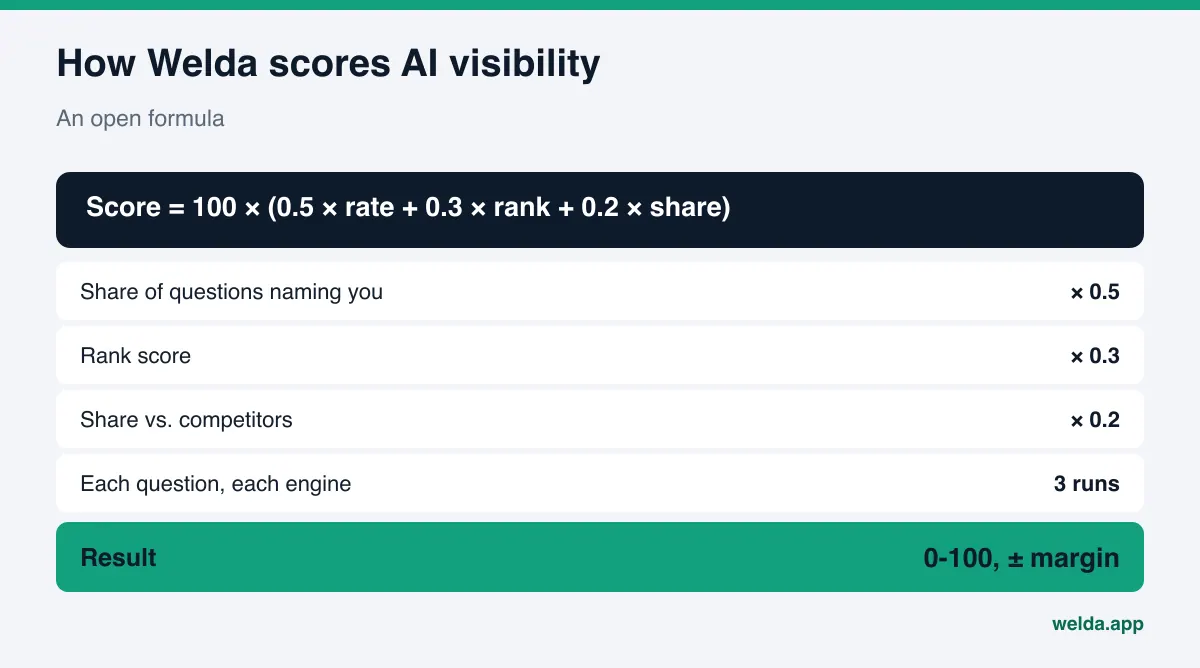
The score formula is open: the share of questions that name you counts 50 percent, your rank score 30 percent and your share against competitors 20 percent. The spread across three runs gives a margin of error, so you do not react to one lucky or unlucky answer. The competitors screen shows which question group a rival center wins and which source it wins from: maybe its review count on Google, maybe a clear program page.
A to-do list where Welda asks instead of guessing. Gaps from measurement land in one list. Welda drafts program page copy, FAQ answers, profile descriptions and review replies. But the details that matter most for a tutoring center (group size, weekly hours, whether you offer pickup, what support you provide for learning differences) are things only you know. Welda does not invent them; it lists them as information it needs from you. You enter each once and it flows into every draft. For places without a connection, such as a directory listing, the text comes ready to paste.
Compliance check and your approval. Every draft is checked before publishing. The check flags patterns like pricing, guarantee and superiority claims, so "guaranteed score increase" or "best tutoring center in town" comes back to you with a warning. It is not legal advice and has not been reviewed by legal counsel; the final call is yours. Publishing approval always stays with you. On WordPress, Welda connects through a separate Editor user and an application password, with no code to install; drafts open on your site as drafts and go live when you approve them. Your content always lives on your own site.
The panel also has a sources screen, page previews, a before-and-after view and a one-page monthly PDF report. For a tutoring center, the first months are mostly about the three parts above. Questions can be tracked in English.
Where things stand today: the Welda panel is in early access and opening in stages, starting with businesses in Turkey. Regular four-engine measurement is being added during early access, and sample screens in the panel use representative data. What anyone can use today is the free site analysis, which works in English and German. Pricing is discussed in an early access conversation.
Limits: what Welda does not do
AEO is a new field, and big promises are easy to make. So here is what we do not do:
- No ranking guarantees. AI answers vary, and no software controls them. We explain why to be skeptical of such promises in guaranteed ChatGPT rankings.
- No made-up facts. We do not guess your group size, tutor count or rates; we ask you.
- No fake reviews. We do not write parent reviews or suggest buying them. We draft replies to real ones.
- No publishing without approval. Drafts with sensitive claims never go live without your sign-off.
- Some work stays with you. Talking with an unhappy parent, claiming directory listings and building relationships with local press or schools are your job. Welda prepares the text; you own the relationship.
Timing matters too. New content typically takes weeks to show up in AI answers. Starting a week before back-to-school is usually too late for that season. The best time is a few months ahead of your busiest enrollment window.
Checklist: is your tutoring center ready?
Use this checklist to see quickly how ready your center is to be named in AI answers. Every "no" is a task.
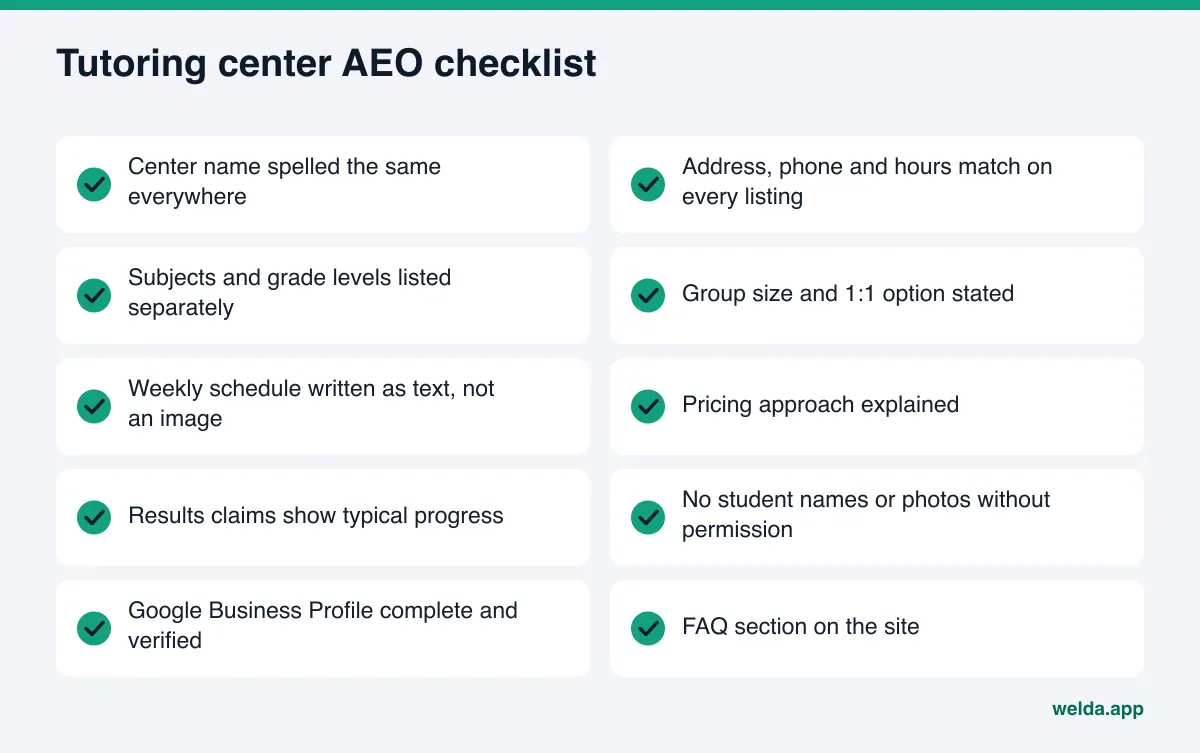
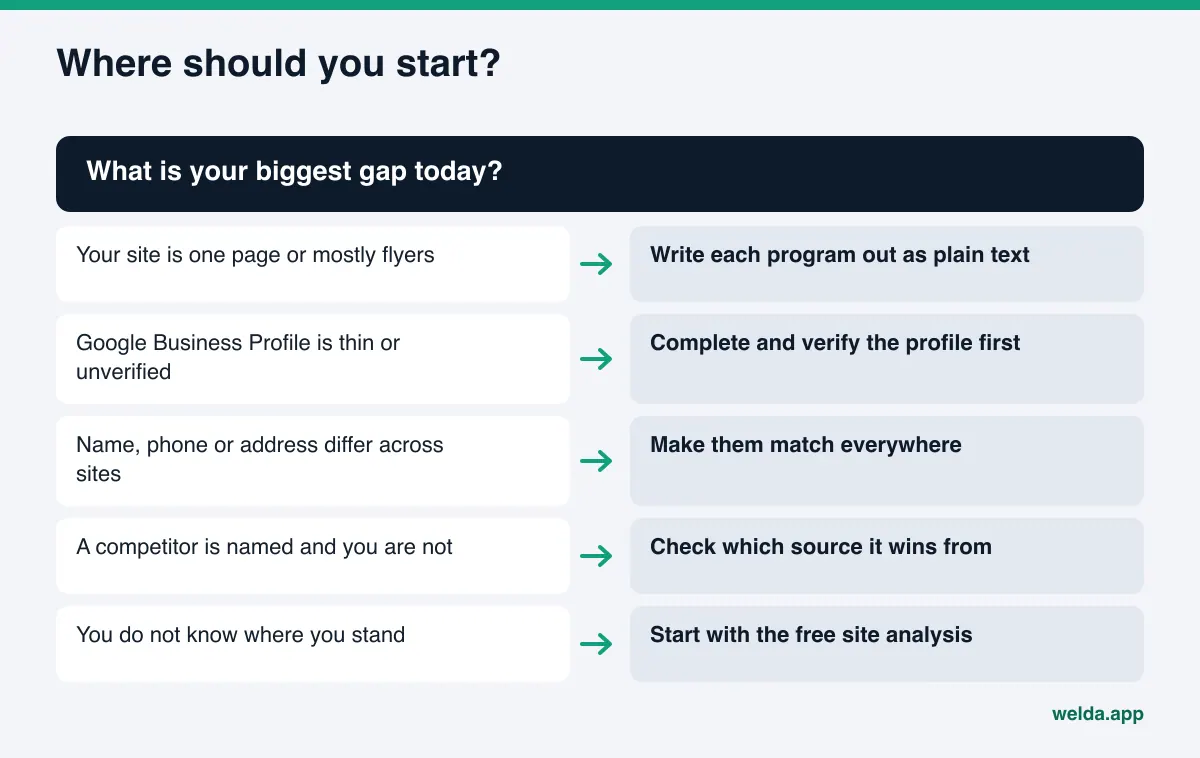
If you are not sure where to start, use the decision chart below. Most centers find that one gap explains most of their absence.
The free analysis reads your homepage and a few inner pages (programs, pricing, about, contact). It checks whether AI crawlers can access your site, your title and description, your schema, your contact details, your FAQ section and how clearly your services are described. You get a score out of 100, what was found for each gap, why it matters and how to fix it, plus ready-to-use homepage copy suggestions. It also asks an AI assistant with web search five questions a parent might ask and checks whether your center is named. That is a one-time measurement, and it does not measure rankings.
| What you get from the free analysis | How a tutoring center uses it |
|---|---|
| Score out of 100, technical and content separately | See whether the gap is crawler access or missing program details |
| Each issue with a fix | Hand the list to whoever maintains your site |
| Homepage copy suggestions | Rewrite the headline and intro around grades and subjects |
| Fix simulation | Pick the changes that move the score most first |
| Competitor comparison | See what a nearby center's site does that yours does not |
| Five AI questions | A first look at whether parents' questions surface your name |
Frequently asked questions
Can a small independent center compete with national franchises in AI answers?
For questions that include a neighborhood, grade or subject, yes, you have a real chance. An AI answering "small-group SAT prep near Plano" looks for the center that fits the question, not the biggest brand. If your information is clear and consistent, you can be named; there is no guarantee.
Can we post student score improvements on our site?
The FTC's Endorsement Guides generally expect ads to make clear what results are typical when a testimonial shows above-average results. Get parent permission before naming a student, and check specific claims with your own counsel. This is not legal advice.
Do we have to publish our prices?
No. But explaining what drives the price (subject, hours, group or private, package) partly answers the parent's question and makes it less likely an AI pulls an old number from another site.
We have several locations. What should we do?
Give each location its own address, phone, Google Business Profile and its own section on your site. AI matches locations by address for "near me" questions; a single generic contact page makes that harder.
How long until we see changes?
New content usually takes weeks to show up in AI answers. To be ready for back-to-school or test season, start a few months ahead.
Does Welda use student or parent data?
Welda reads your website and AI answers. It does not connect to your student records. Review replies it drafts avoid student names and grades.
What do I need for the free analysis?
Your site address and email and phone verification. It is free once per site; the results link arrives by email and stays open for 14 days.
Before the next enrollment season, find out whether parents asking AI for a tutor hear your name. Run the free site analysis and see your score, your gaps and your first fixes in a few minutes.