What does AEO for tourism businesses actually involve? It is the work of getting your tour company, activity, attraction or travel agency named when a traveler asks ChatGPT, Gemini, Perplexity or Google's AI Mode what to book. That means product pages AI can quote, consistent listings on the travel sites AI relies on, and up-to-date seasonal details. This guide covers the questions travelers ask, the pages that answer them, and a season-by-season plan.
In the US this work is usually called AEO, short for answer engine optimization. You will also see the term GEO (generative engine optimization); it describes the same goal, and this article sticks with AEO. Whatever the label, the idea is simple: when someone plans a trip by talking to an AI assistant, the assistant names a handful of operators, and the traveler's shortlist is set before they open a single website. To see how your own site reads to AI right now, start with a free AI visibility analysis. It lists every gap it finds and explains how to fix each one.
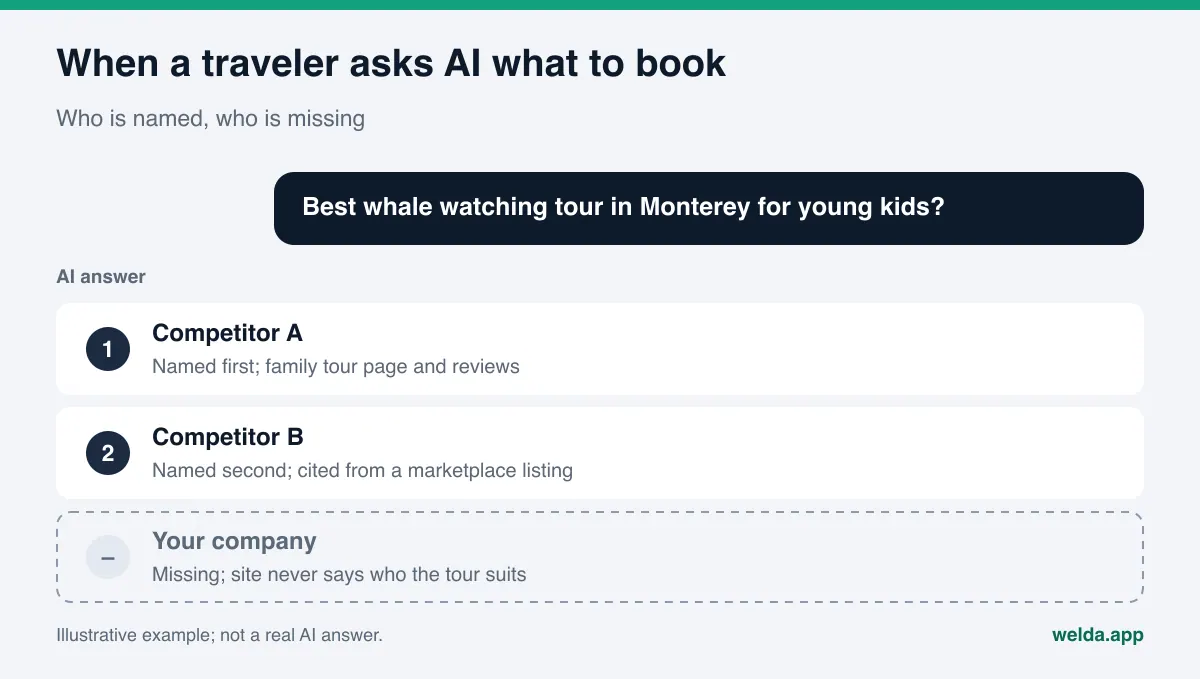
Why AEO for tourism businesses is its own problem
A plumber or a dentist is usually found by someone nearby. A kayak tour in the Florida Keys or a food walk in New Orleans is found by someone hundreds or thousands of miles away who has never been there. That difference shapes AI search visibility for travel in three ways.
Travelers ask broad questions first. Because they do not know the area, they start with "what should we do in Sedona with kids?" or "is a helicopter tour on Kauai worth it?" The AI answers by drawing on sources that describe the place and the experience in detail. If your site has a "Tours" grid with photos and a booking button, but no sentences that explain what happens on the tour, there is nothing for the AI to quote.
Travel marketplaces carry a lot of weight. Online travel agencies, tour marketplaces, review sites and map listings are among the sources AI answers lean on most for travel. If your listing on one of them is thin, outdated, or contradicts your own site, the assistant either leaves you out or repeats the wrong details.
Everything is seasonal. Departure times, meeting points, operating months, weather policies and cancellation terms change every year. When an AI assistant repeats last season's meeting point, the guest waits at the wrong dock and the bad review lands on you. So AEO for tourism businesses is not only about being visible. It is about being described correctly. We cover that failure in detail in wrong address or phone number in AI answers.
What travelers ask AI before they book
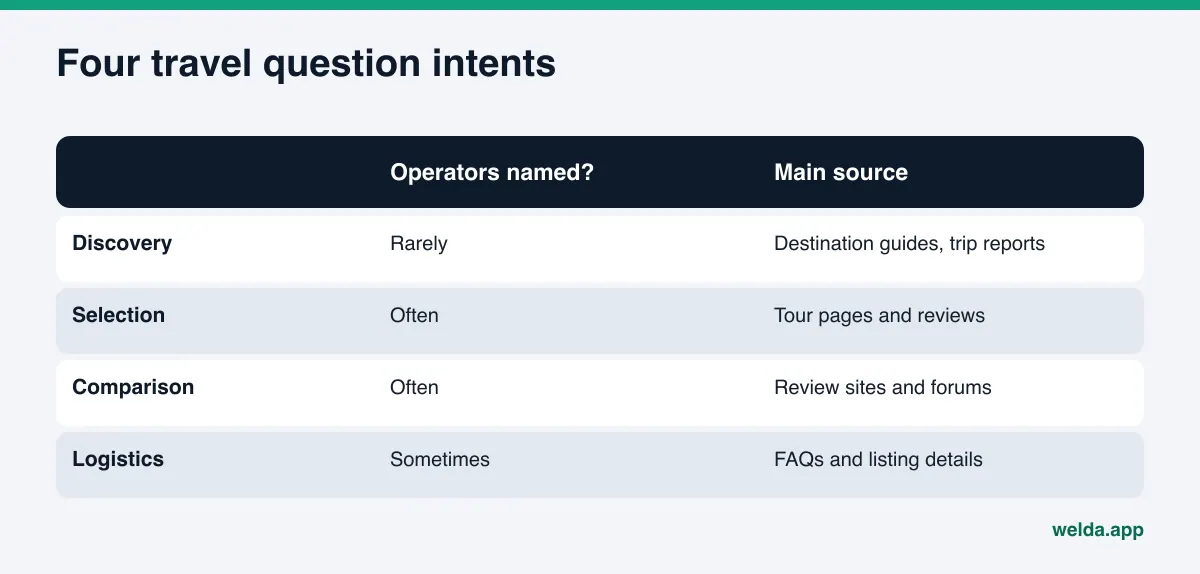
It helps to sort travel questions into four intents. Each intent pulls from different sources and rewards a different kind of page.
| Intent | Sample question (illustrative) | What the answer draws on |
|---|---|---|
| Discovery | "What can we do in Asheville in a weekend?" | Destination guides, trip reports, pages that describe experiences |
| Selection | "Best whale watching tour in Monterey for young kids?" | Tour pages, who the tour suits, reviews |
| Comparison | "Which swamp tour near New Orleans has better reviews?" | Review sites, forums, safety and licensing details |
| Logistics | "Do Grand Canyon day tours pick up from Las Vegas hotels?" | FAQ sections, policy pages, listing details |
These are examples; your own list depends on your destination and product. What matters is whether your site holds a clear, quotable answer for each intent. Discovery answers often describe the place rather than name companies. Selection and comparison answers are where operators get named outright, so that is where most of the AEO effort for tourism businesses should go.
International guests add another layer. If you sell to visitors from abroad, they may ask in their own language, and the assistant often leans on sources in that language. Even a few core pages in a second language can matter for a tour company in Miami or San Francisco.
Which tourism businesses should prioritize what
"Tourism business" covers a lot of ground. A hot air balloon company and an airport shuttle do not face the same questions. The table below is a starting point by business type. Treat it as a rule of thumb; your own question list and measurement are the real guide.
| Business type | What travelers ask most | First priority |
|---|---|---|
| Tour operator (day tours, multi-day) | Route, duration, who it suits, what is included | One detailed page per tour |
| Activity provider (diving, ziplining, rafting) | Safety, experience needed, weather | Safety and certification page, weather policy |
| Attraction or museum | Hours, tickets, time needed, accessibility | Visitor info page and accurate Google Business Profile |
| Travel agency or advisor | Trustworthiness, specialties, how to reach you | About page, credentials, review responses |
| Shuttle or transfer service | Which airport, which areas, late-night service | Service area list and structured business data |
| B&B or small inn | Location, quiet, getting there, what is nearby | Map listing and location content |
If you fit more than one row, start with the product that brings in most of your revenue. Spreading limited pre-season time across everything at once usually means nothing gets finished. Lodging teams will find more specific guidance in AEO for hotel marketing teams.
AEO for tourism businesses, step by step
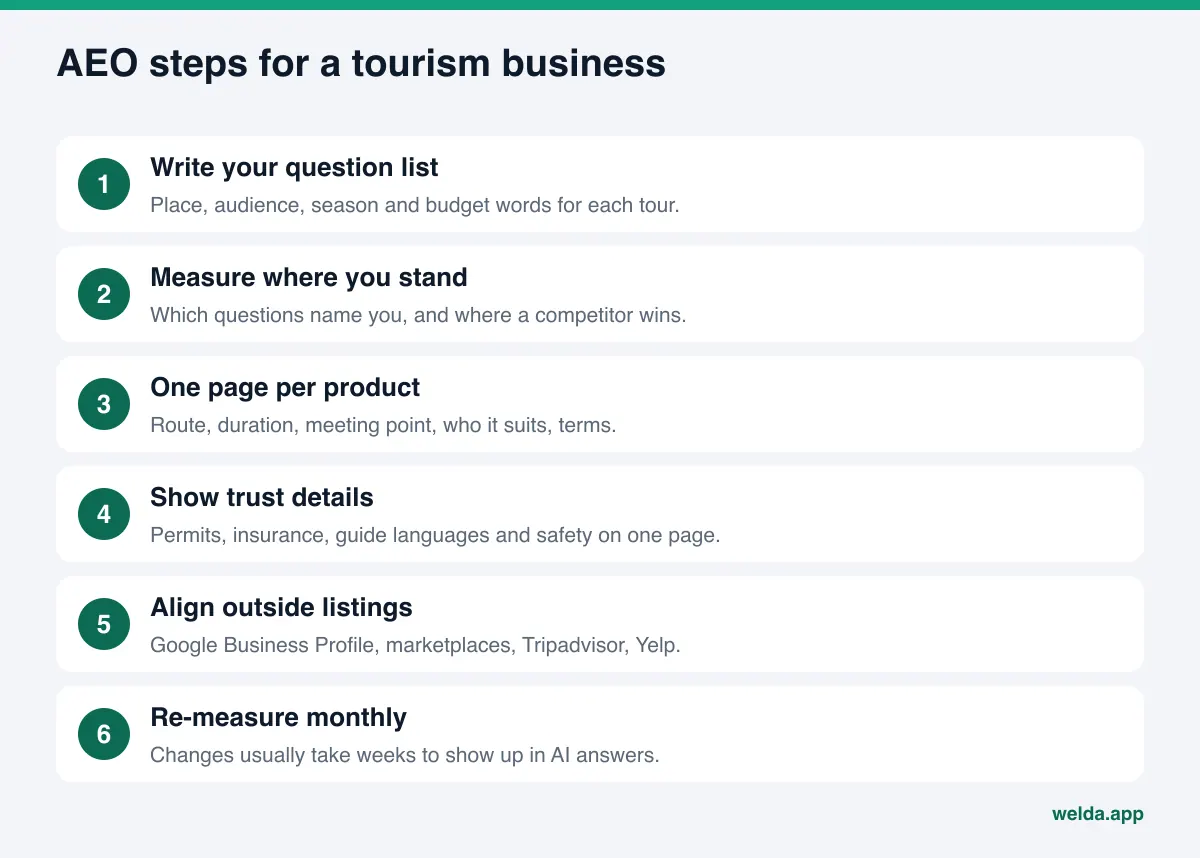
The sequence below works for a two-person kayak outfitter and for a regional tour company alike. Order matters: measure first, fix your own site second, then work on outside sources.
- Write your question list. For each tour or experience, write 5 to 10 questions a traveler would ask. Include the place, the audience (couples, families, groups, solo travelers), the season, and budget words like "affordable" or "private."
- Measure where you stand. Ask those questions on AI assistants and note which ones name you and which name a competitor. One try is misleading, because answers shift from run to run.
- Give every product its own page. A list of tours is not enough. Each tour needs a page with the route, duration, meeting point and time, who it suits, what is and is not included, operating season and cancellation terms.
- Spell out pickup and service areas. Name the neighborhoods, hotel zones or cities you pick up from. "We pick up from most hotels" gives the AI nothing to match.
- Make trust details visible. Licenses and permits that apply to your activity, insurance, guide languages and certifications, vessel or vehicle details, and your safety practices belong on one clear page. If your state requires seller-of-travel registration for your business, show that number too.
- Add a real FAQ section. Answer the practical questions guests actually send you: what happens if it rains, minimum age, what to wear, whether there is a restroom on board.
- Mark up your business details. Name, address, phone, hours and service area marked with LocalBusiness structured data, so machines read them without guessing.
- Align outside listings. Google Business Profile, the marketplaces you sell through, Tripadvisor, Yelp and your social profiles should show the same name, phone, season and meeting point.
- Reply to reviews with specifics. AI reads your replies along with the reviews. A calm, signed, concrete reply to a complaint helps you in comparison questions.
- Re-measure monthly. New content usually takes weeks to show up in AI answers. Work done before the season shows up during it.
You can do much of this yourself; DIY AEO for small business owners walks through where to start.
How to write a tour page AI can quote
The most common gap on tourism websites is the brochure-style tour page: "breathtaking views, unforgettable memories, crystal-clear waters." Those lines may excite a reader, but they tell the AI nothing. The assistant is trying to answer "is this OK for a 6-year-old?", "how long is it?" and "is lunch included?"
A strong tour page answers these in plain sentences:
- A one-sentence summary: where it goes, how long it takes, who it is for.
- The route, stop by stop, with rough times.
- The meeting point, parking, and which areas get hotel pickup.
- What is included and what is not: food, entry fees, gear, gratuities.
- Who it suits and who it does not: age limits, fitness level, mobility.
- Operating dates and the weather cancellation rule.
- Guide languages and maximum group size.
- Booking, rescheduling and refund terms, dated so they are clearly current.
Publishing prices is your call. If you do, keep them current and say which season they apply to; an old price repeated in an AI answer causes more trouble than no price at all. Superlatives like "best tour in town" do not build trust and can set the wrong expectations.
Your title tag and meta description are part of this. Instead of "Tours | Company Name," use a title that says where, how long and what kind: "Monterey Whale Watching Tour, 3 Hours, Family Friendly" tells both the traveler and the AI what the page is. More on that in title tags and meta descriptions for AI search.
Which sources AI trusts for travel answers
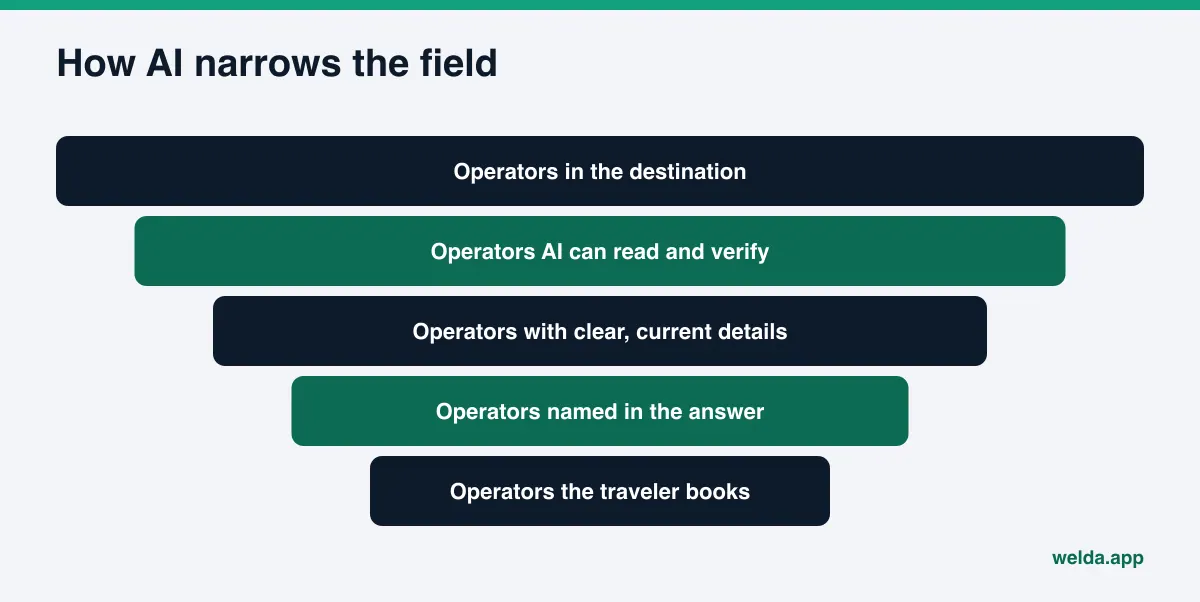
The sources AI cites in travel answers tend to fall into four groups: online travel agencies and tour marketplaces, review and listing sites such as Tripadvisor, Yelp and Google Maps, forums and community threads such as Reddit, and the business's own website. Which group dominates depends on the question, the destination and the engine. There is no single correct list.
The practical point: fixing your own site is necessary but not sufficient. If your marketplace listing still shows a route from two seasons ago, or your Google Business Profile does not mark the winter closure, AI can build a wrong picture from those sources. Knowing where you are missing or outdated is how you decide what to fix first.
There is also a cost angle. Every booking that comes through a marketplace carries a commission. When an AI answer names your own website as the source, the traveler has a direct path to you. That does not mean leaving the marketplaces, which bring real demand. It means making sure your own site is the most complete and current source about your tours.
How Welda handles AEO for tourism businesses
Welda is software that measures where a business shows up in AI answers and fills the gaps on the business's behalf. For a tourism business, three parts matter most: question-by-question tracking, the sources view, and pre-season fixes.
Question-by-question tracking. In the Welda dashboard, a question list is built around your tours and your destination. Each question goes to ChatGPT, Gemini, Perplexity and Google AI three times. The questions screen shows one row per question with a column for each engine: if you are named, you see your position; if not, the cell is empty. Click a row to read the answer and the sources it cited. Say you are missing from every engine on "family-friendly boat tour" but rank second on two engines for "sunset cruise." That tells you the gap is in family-focused information, not in your brand overall. Questions can be measured in English or Turkish.
The score formula is published: 100 × (0.5 × share of questions that name you + 0.3 × position score + 0.2 × share versus competitors). The spread across the three repeats gives a ± margin, so you can tell a real change from noise.
Sources view. The sources screen lists the sites AI leaned on when answering your questions, and your status on each: no listing, incomplete, unverified, or complete. For tourism, that list tends to fill with marketplaces and review sites. The decision gets simpler: the source that gets cited most and where your listing is weakest goes first. Each row says briefly what needs doing.
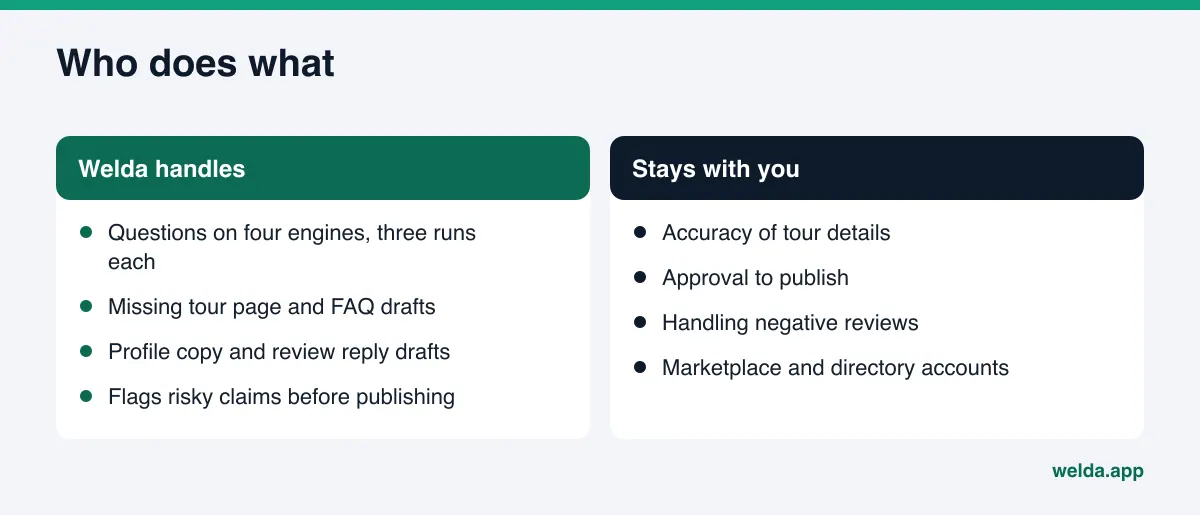
Pre-season fixes. The to-do list collects every gap in one place. Welda drafts the missing tour page, FAQ answers, profile copy or review replies. It does not invent facts: if the meeting point, pickup area or age limit is missing, it asks you. Drafts come to you for approval, and the publish decision stays with you. On WordPress sites, Welda connects through its own Editor user and an application password, with no code to install, and opens content as a draft that goes live once you approve it. On other platforms you get a ready-made package and apply it yourself or through your web person. Google Business Profile, Instagram and Facebook can be connected; anything not connected shows up as a manual task. Your content always lives on your own site.
Alongside this, a compliance check flags claims like prices, guarantees and "best" language before anything is published. It is not legal advice. A one-page monthly PDF report sums up the month.
To be straightforward about where things stand: the Welda dashboard is in early access and is opening first in Turkey. Regular four-engine tracking is being added during early access, and the dashboard screens are shown with sample data. What anyone can use today, in English, is the free site analysis. Pricing is discussed in the early access conversation.
What the free analysis shows a tour operator
You do not need to wait for the dashboard to see your own situation. The free analysis reads your homepage and a few inner pages (services, pricing, about, contact) the way Google and AI do. For a tour operator, the most useful findings are usually: whether AI crawlers can reach your site at all, whether your tours are clearly described, whether your business details carry structured data, whether your address and phone are consistent, whether your map and social profiles are linked from the site, whether there is an FAQ section, and how fast the pages load.
You get a score out of 100, split into technical and content, plus what was found for each gap, why it matters and how to fix it. You also get ready-to-use copy for your homepage title, description, headline, intro and FAQ, a simulation of how much each fix could lift the score, a comparison with competitors, a fix package to add to your site including business data markup, and a PDF and shareable score card. On top of that, five questions your customers might ask go to an AI assistant that can search the web, and the analysis checks whether your business is named in the answers. That is a one-time snapshot, not ongoing tracking. It is free once per site; your email and phone are verified, and the results link arrives by email and stays open for 14 days.
Limits: what Welda does not do
AI search visibility attracts big promises. Here is what Welda does not do.
- It does not guarantee rankings or placement in ChatGPT. Nobody controls AI answers. What can be done is to put accurate, consistent information where AI looks.
- It does not make up information. Tour length, pickup areas and season dates come from you.
- It does not write fake reviews. The honest way to get more reviews is to ask happy guests.
- Handling negative reviews, opening marketplace and directory accounts, and press work stay with you. Welda can draft replies and suggest tasks; you own the accounts.
- It does not publish sensitive content without your approval.
- It cannot make changes show up overnight. New content usually takes weeks to be reflected in AI answers, which is why pre-season work matters.
A seasonal AEO calendar for tourism businesses
In travel, timing is half the job. A change made when the season opens often shows up mid-season. The calendar below is an example for a summer season; winter operators can shift the same sequence onto their own dates.
| When | Task | Who |
|---|---|---|
| 3 to 4 months before season | Question list, first measurement, gap list | Welda measures, you approve the questions |
| 2 to 3 months before | Tour pages, FAQ, structured data | Welda drafts, you approve |
| 1 to 2 months before | Align marketplace and map listings | Welda on connected profiles, you on the rest |
| During the season | Review replies, monthly measurement, updates | Shared |
| End of season | Mark closing dates everywhere, plan next season | You, with a reminder from Welda |
Your season, product and booking window may differ, so treat this as a template.
Checklist: is your tourism business ready for AI search?
Each item below is a piece of information AI needs before it names you. Anything you cannot check off is a task.
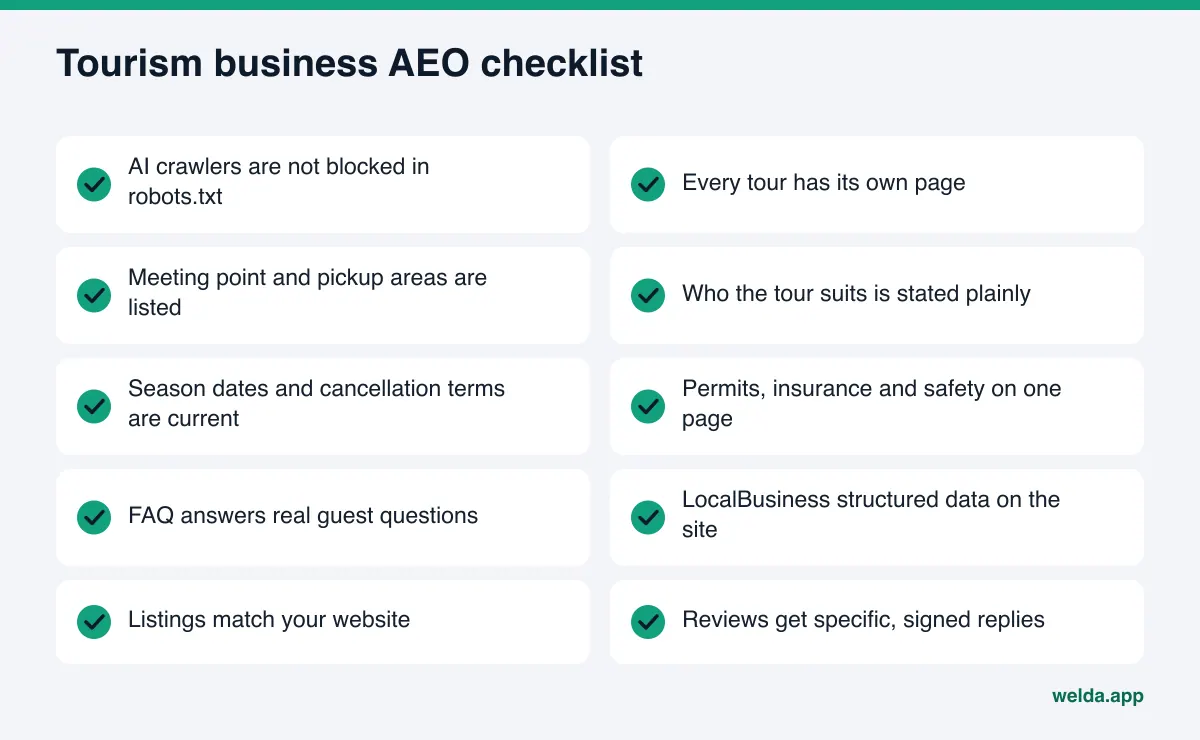
- AI crawlers are not blocked in robots.txt.
- Every tour or experience has its own page.
- Meeting point, pickup areas and times are written out.
- Who it suits, and who it does not, is stated plainly.
- Operating dates and cancellation terms are current and dated.
- Licenses, insurance and safety practices are on one page.
- The FAQ section answers real guest questions.
- Business details carry structured data.
- Google Business Profile and marketplaces match your site.
- Reviews get specific, signed replies.
- If you host international guests, core pages exist in their language.
Who owns this list depends on your size. In a small outfit it is the owner; in a larger company it is whoever handles marketing. What matters is that someone owns it. Operators who also depend on nearby foot traffic will find overlap in AEO for local businesses.
Frequently asked questions
Is AEO for tourism businesses different from hotel AEO?
The method is the same; the emphasis differs. For hotels, rooms, location and amenities lead. For tours and activities, route, duration, who it suits, meeting point and safety lead. The question list is built around that.
I have hundreds of reviews on a marketplace. Does my own site still matter?
Yes. A marketplace listing is one of the sources AI reads, but your own site is where you can explain the tour, the terms and how to reach you most completely. When two sources disagree, the AI has no reason to trust either one.
Do I need pages in other languages for international visitors?
If international guests are a real share of your business, yes. Travelers ask in their own language, and AI often relies on sources in that language.
How soon will I see results?
New content usually takes weeks to show up in AI answers, which is why starting a few months before the season makes sense. No one can promise a specific timeline or outcome.
Does Welda host my tour pages?
No. Welda does not host content. Drafts are published on your own site after you approve them. On WordPress they open as drafts; on other platforms you get a ready-made package.
Can I use the Welda dashboard in the US today?
The dashboard is in early access and is opening first in Turkey. The free site analysis works in English today and is open to anyone. Pricing is discussed in the early access conversation.
Next step
AEO for tourism businesses is work done ahead of the season, not at its start. When a traveler plans a trip by talking to an AI assistant, whether your name comes up depends on how clear, current and consistent your information is on your own site and on the sources AI reads. Start by seeing how your site looks to AI today: run the free AI visibility analysis, get the gap list and fix package, then work through the steps above.