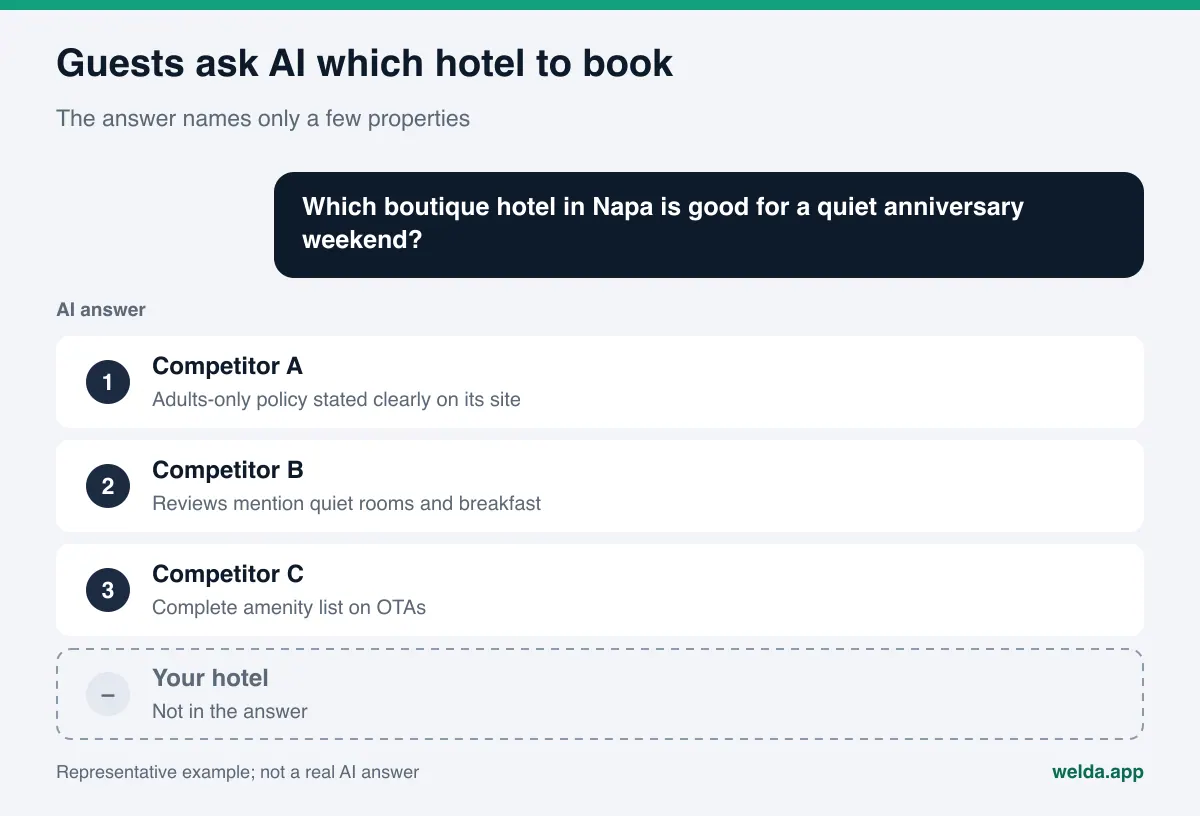
What does AEO for hotel marketing teams actually involve? Travelers now ask ChatGPT, Gemini, Perplexity or Google's AI Overviews questions like "Which boutique hotel in Napa is good for a quiet anniversary weekend?" and get back three to five names. AEO for hotel marketing teams is the ongoing work of measuring whether your property shows up in those answers and closing the gaps on your site, your listings and the sources AI assistants read about you.
This guide is written for the people who own demand at a hotel: the director of sales and marketing, the digital marketing manager, the group and events sales lead, and whoever handles direct bookings. You might run one independent property or a small portfolio. The question is the same: "When a guest asks an AI assistant about a hotel like ours, are we named, and if not, why?" Below we cover who on the team owns this work, what guests actually ask, where AI engines learn about hotels, and a step-by-step plan your team can run every month. If you want a baseline before you start, run the free site analysis. It reads your site the way Google and AI assistants do and lists each gap with the reason it matters and how to fix it.
Why AEO for hotel marketing teams belongs on this quarter's plan
AEO stands for answer engine optimization: making sure AI assistants mention your business when people ask questions. You will also hear AI search visibility, AI visibility, or GEO (generative engine optimization); they describe the same job. In a classic search, a traveler sees ten blue links, opens a few tabs and compares. In an AI answer, they usually see a short list of hotels, each with a one-line reason: "dog-friendly with a fenced yard," "walkable to the Pearl District," "reviewers praise the breakfast." A hotel that is not on that list may never be considered.
Hotels face this differently than most local businesses. Most of what the internet says about a hotel does not live on the hotel's own site. It lives on online travel agencies (OTAs), Google Business Profile and Google Maps, Tripadvisor, Yelp, wedding and meeting directories, travel blogs and Reddit threads. AI assistants read all of these together when they build an answer. Writing "family-friendly" on your homepage is not enough if your OTA description, your Google attributes and your reviews tell a different or incomplete story. When sources disagree, an assistant has less reason to name you.
Hotels also sell to several audiences at once. The same property sells leisure weekends to couples, summer stays to families, midweek meetings to corporate planners and off-season weddings to couples and their families. Each audience asks AI assistants different questions. If marketing tracks leisure questions while nobody tracks "hotel with a 60-person meeting room near the airport," you can be invisible in one of your most profitable segments without knowing it.
Finally, there is the direct booking angle. AI answers sometimes cite an OTA listing and sometimes cite the hotel's own site. When your site is the cited source, the traveler is one click from your booking engine rather than a third party's. For a team measured on direct revenue, that difference matters.
What guests ask AI assistants: a question list by segment
The first step, and the one most teams skip, is writing down the questions. You are not trying to learn whether "we show up in ChatGPT." You are trying to learn which guest questions you show up for. Sales and marketing should write this list together: group sales knows the meeting and event questions, marketing knows the leisure questions, and the front desk knows what people call to ask.
| Segment | Example question a guest might ask | What the answer depends on |
|---|---|---|
| Couples, short getaways | "Quiet adults-only boutique hotel in Sedona?" | Concept, child policy, room types, "quiet" in reviews |
| Families | "Hotel in San Diego with a kids' pool and cribs available?" | Family rooms, amenities, pool details, OTA amenity lists |
| Corporate meetings | "Austin hotel with a meeting room for 60 near the airport?" | Room capacities, AV, parking, a dedicated meetings page |
| Weddings and events | "Vineyard-view wedding venue hotel in Sonoma for 120 guests?" | Event spaces, capacity, season, catering details |
| Pet owners | "Dog-friendly hotel in Asheville that allows two dogs?" | Pet policy, weight limits, fees, written clearly |
| Price and trust | "Does this hotel charge a resort fee?" | Total price shown clearly, fee and cancellation FAQ |
These are examples; write your own list for your location, your segments and your seasons. Three patterns show up for almost every property. First, questions carry a place: not "hotel in Chicago," but "hotel walkable to McCormick Place." If your site does not describe your location in terms of nearby landmarks, venues and neighborhoods, you are weak on these questions. Second, policy questions about pets, fees, parking and cancellations come up constantly, and assistants often answer them from forums and OTAs. If your own site lacks a clear answer, someone else's text becomes the answer. Third, international guests ask in their own words and sometimes their own language. If you host many international travelers, read our guide to tourists asking AI for recommendations and the one on multilingual AEO.
Where AI engines learn about your hotel
When an AI assistant searches the web to answer a question, it pulls from several kinds of sources. For a hotel, it helps to group them by who controls them:
- Your own site: room types, concept, location, policies, meetings and events, FAQ. The only source you fully control.
- OTAs: property descriptions, amenity checkboxes, photos and guest scores. You supply the facts, guests supply the reviews.
- Directories and maps: Google Business Profile, Google Maps, Tripadvisor, Yelp, meeting and wedding directories. Address, phone, attributes and categories come from here.
- Community sources: Reddit, travel blogs, local news, Instagram. This is the guest's language, good and bad.
Two technical points deserve a check. First, AI crawlers have to be able to reach your site. OpenAI, for example, documents that ChatGPT's search features use a crawler called OAI-SearchBot, and that sites opted out of it will not be shown in ChatGPT search answers. Booking engines, firewalls and security plugins sometimes block these crawlers without anyone noticing. Second, Google states there are no extra technical requirements for AI Overviews or AI Mode beyond being indexed and eligible for a snippet, and that structured data should match the visible text on the page. In other words, there is no magic markup for hotels. The basics need to be clear, consistent and readable.
A common pattern: most of the sources AI assistants cite for a hotel are OTAs and directories, and the hotel's own site gets a small share. One reason is that many hotel sites are mostly a photo gallery and a "Book now" button. There is nothing quotable. A page that says, in plain sentences, "12 rooms, two blocks from the beach, no guests under 12, breakfast sourced from local farms" gives an assistant something to work with.
A step-by-step AEO plan for hotel marketing teams
This plan assumes you do not have a dedicated AEO specialist and that sales and marketing are a handful of people. Each step ends with a concrete output.
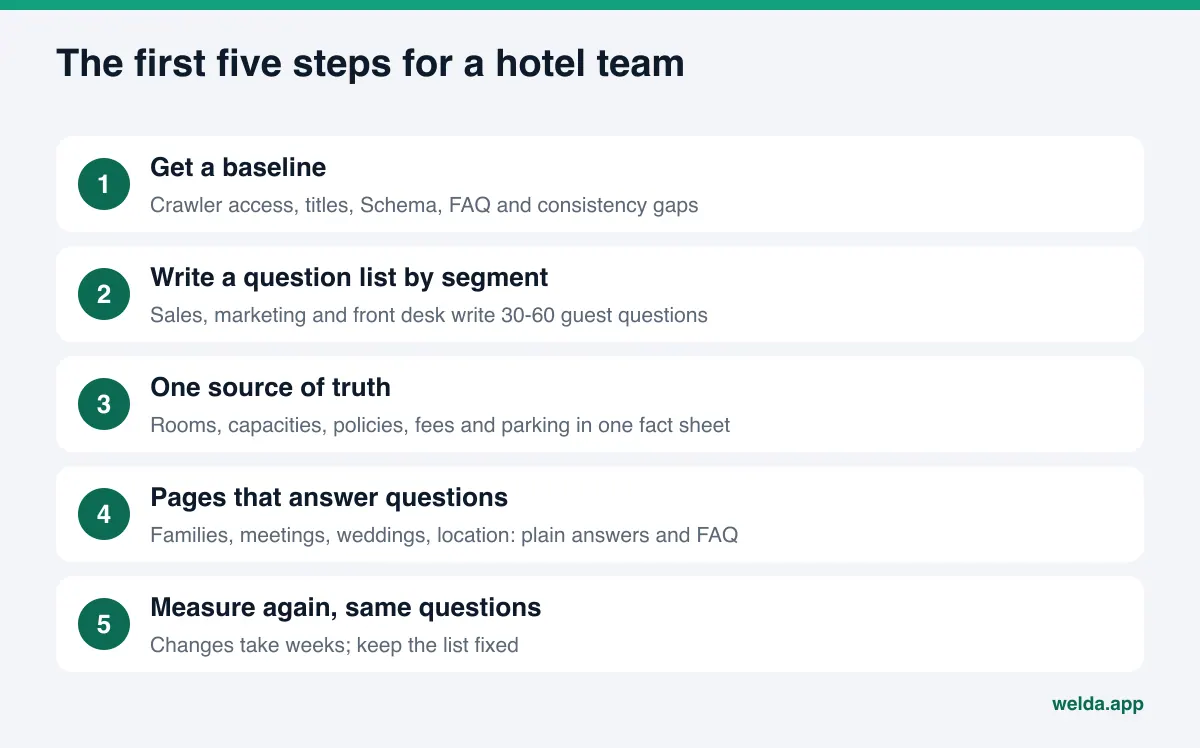
- Get a baseline. Check whether AI crawlers can reach the site, what your page titles and descriptions say, whether you have business information markup (Schema), whether address and phone match everywhere, and whether there is an FAQ. Output: a list of gaps and a starting score.
- Write a question list by segment. Five to fifteen real guest questions per segment. Group sales brings meeting, group and wedding questions; marketing brings leisure and family questions; the front desk brings the questions people call about. Output: a shared list of 30 to 60 questions.
- Create one source of truth. Room count, room types, capacities, child and pet policies, fees, cancellation terms, meeting room dimensions, parking and transit. Output: a one-page fact sheet that the site, OTAs and Google profile must match.
- Publish pages that answer questions. One page or section per main segment: families, meetings and events, weddings, location and getting here. Each page answers its segment's questions in short paragraphs and ends with an FAQ. Output: draft pages ready for approval.
- Align your listings. Compare Google Business Profile attributes, OTA descriptions, Tripadvisor details and directory entries against the fact sheet. Output: a correction list per listing.
- Answer reviews with facts. Review replies become indirect answers. If a review asks about cribs or parking, say clearly what you offer. Real replies to real reviews, never fake reviews.
- Read competitors question by question. For each question where you are missing, which hotel is named, and based on which source? A competitor may win because a meeting directory lists them, or because their site has a clear meetings page. Our guide to AI competitor analysis explains the method.
- Measure again with the same questions. New content usually takes weeks to show up in AI answers. Keep the question list fixed so you can tell what worked. Output: a one-page monthly summary.
Who owns what: splitting AEO work across the hotel team
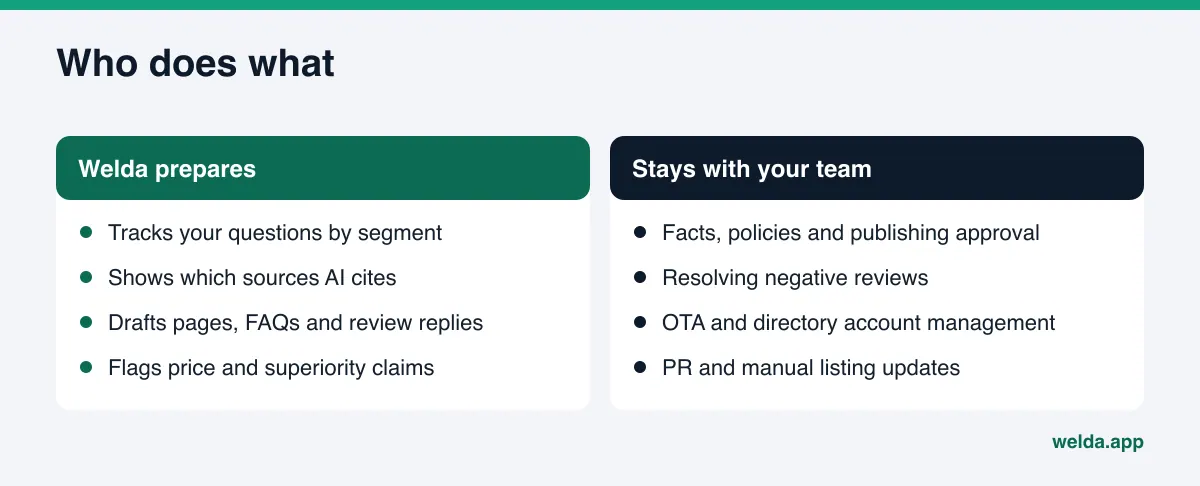
AEO stalls at most hotels for one reason: nobody is sure whose job it is. The web agency runs the site, revenue management runs the OTAs, the front office handles reviews, marketing runs social. AI assistants read all of it at once. Here is a sample split for a small or mid-size property.
| Role | AEO responsibility | Cadence |
|---|---|---|
| Digital marketing manager | Owns the question list, site content, monthly summary | Weekly check, monthly report |
| Group and events sales | Meeting, group and wedding questions; capacities and specs | Monthly update |
| Revenue or reservations | OTA descriptions, policies, fee and price consistency | Each season and on change |
| Front office and guest relations | Common guest questions, review replies | Weekly |
| General manager | Publishing approval, claim review, priorities | Monthly meeting |
The one rule when you adapt this: every question and every source needs an owner. If nobody can say who owns the meeting room questions, nobody owns your visibility for them either. For the leadership view of the same work, see AEO for marketing managers.
One compliance note belongs in the revenue manager's column. In the US, the FTC's rule on unfair or deceptive fees took effect on May 12, 2025, and covers short-term lodging, including hotels. Per the FTC's FAQ, if you show a price, you must show the total price upfront, including mandatory fees you can reasonably calculate. That matters for AEO too: fee questions are common, and the page that answers them should match what your booking engine charges. This is not legal advice; check with your counsel.
How Welda handles AEO for hotel marketing teams
Welda measures where a business appears in AI answers and prepares the fixes on its behalf. For a hotel sales and marketing team, three parts do most of the work: question tracking, the sources view and the monthly report. A note on availability first: Welda's panel is in early access and is opening first in Turkey. Regular four-engine measurement is being added during early access, and the sample screens in the panel use representative data. What anyone can use today, in English, is the free site analysis.
Question tracking: each segment on its own. Your team's question list is asked on ChatGPT, Gemini, Perplexity and Google AI, three times per question on each engine, because AI answers vary even for the same question. Each row is a guest question and each column an engine; a cell shows whether your hotel was named and in what position. Questions can be filtered by intent, so the group sales lead can look at only meeting and event questions and see which hotel is named instead and which source the answer leaned on. The question language can be set to Turkish or English.
Sources view: where AI reads about you. This view lists the sites engines cite in hotel answers and your status on each: an OTA listing might be marked unverified or incomplete, your own site might show an access problem, a forum might have no presence at all. Each row carries the next action, such as "complete room details" or "fix crawler access." A side panel splits citations by source type: OTA, directory, social, forum and your own site. For marketing, this answers "how much of the conversation is our own site, and where are we missing?" in one look. It also gives revenue management a concrete OTA to-do list.
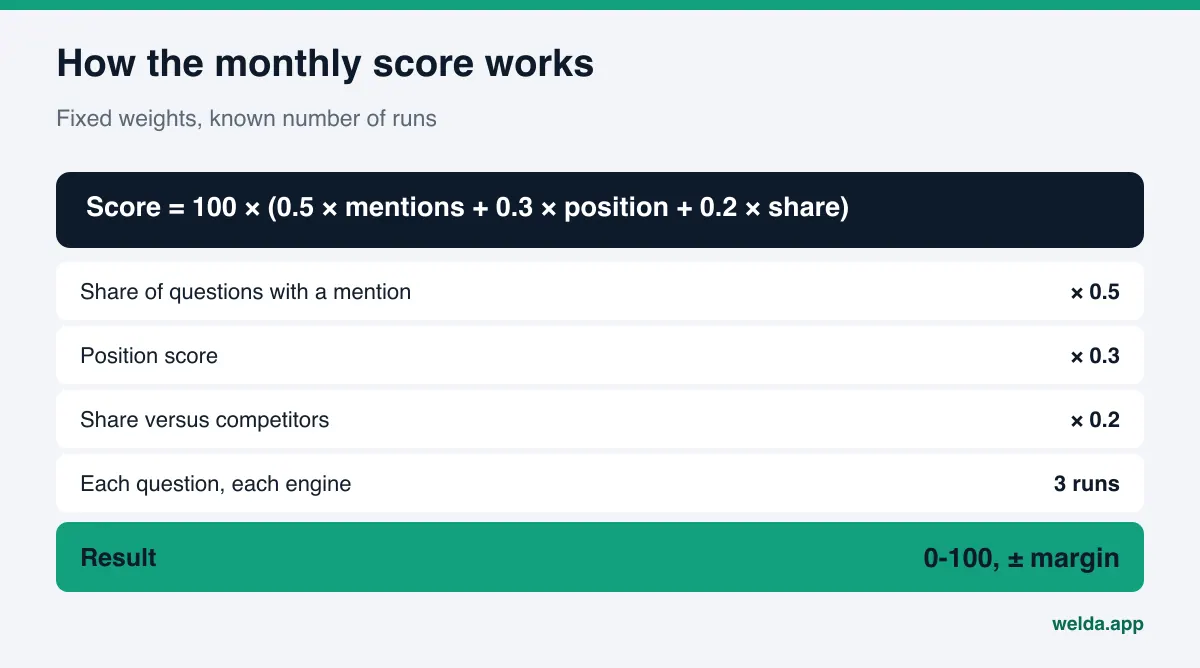
Monthly report: one page for the GM. At month end, the panel produces a one-page PDF: score trend, questions won and lost, where competitors lead, and next month's work. The score formula is public: 100 × (0.5 × share of questions where you are named + 0.3 × position score + 0.2 × share versus competitors). The spread across the three runs gives a ± margin. Because the formula is open, you can show leadership which part moved when the score changes.
The fixing side, briefly. Welda drafts segment pages, FAQs, profile copy and review replies. It does not invent facts; if meeting capacities or the pet policy are missing, it asks you on the to-do list. On WordPress, Welda connects through a separate Editor user and an application password, with no code install; drafts open on your site and go live when you approve. On other systems, Welda provides a ready package and your team applies it. Google Business Profile, Instagram and Facebook can be connected; anything not connected stays on the list as a manual task. A pre-publish check flags price, guarantee and superiority claims ("best hotel in town"); it is not legal advice. Content always lives on your own site; Welda does not host it. Pricing is discussed in an early-access call.
Limits, and what Welda does not do
- No ranking guarantees, and no promise of "getting into ChatGPT." AI answers vary, which is why measurement uses three runs and a margin.
- No invented facts. Room counts, capacities and policies come from your team.
- No publishing sensitive content without approval. Your team approves.
- No fake reviews. Welda drafts replies to real ones.
- Negative review resolution, OTA and directory account management, and PR work stay with your team.
- New content usually takes weeks to be reflected in AI answers. Expecting big moves in month one is unrealistic.
The free analysis has limits too. It does not measure rankings. It reads your homepage and a few inner pages such as services, pricing, about and contact, and it asks five questions a guest might ask to an AI assistant that can search the web, then checks whether your hotel's name appears. That is a one-time measurement, not ongoing tracking. Each site gets one free analysis; email and phone are verified, and the results link arrives by email and stays open for 14 days.
Weekly and monthly checklist for hotel teams
Use this list in your weekly sales and marketing meeting. For a broader version, see the AEO checklist.
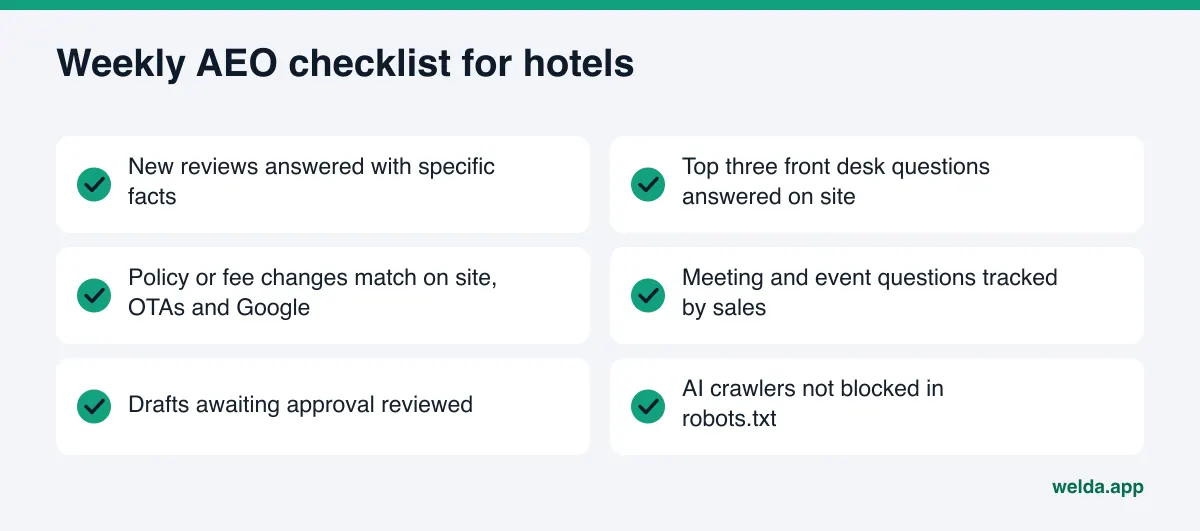
Weekly:
- Have new reviews been answered, with specific facts where guests asked?
- Are the three questions the front desk heard most this week answered on the site?
- Was any policy or fee change updated on the site, OTAs and Google at the same time?
- Have drafts awaiting approval been reviewed?
Monthly:
- How did the share of questions where you are named change, segment by segment?
- Did your own site's share of citations grow?
- Which questions do competitors win, and through which source?
- Are new seasons, room types or event spaces on the question list?
- Did the GM get the one-page summary?
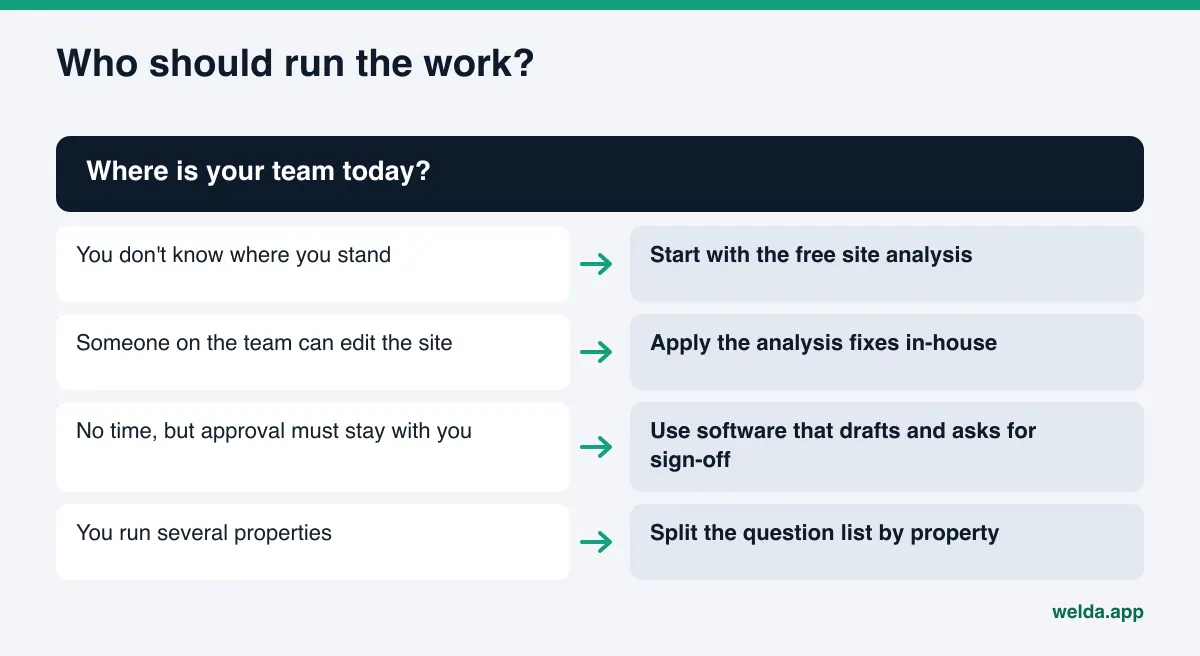
A simple decision rule helps. If someone on the team can edit the site and you can set aside a few hours a week, start with the free analysis and run the fixes in-house. If time is short but you want to keep publishing approval, software that measures, drafts and routes everything for sign-off is a better fit. For multi-property groups, split the question list by property and roll results into one monthly report format.
Frequently asked questions
Does AEO replace our hotel's SEO work?
No. AI engines rely on indexed, readable pages, so SEO fundamentals are the foundation. AEO adds guest questions, source consistency and being named in answers on top of that foundation.
We have strong OTA scores. Isn't that enough?
OTA scores are an important source, but not the whole picture. When the answer leans on an OTA, the traveler often books there. Pages on your own site that answer guest questions raise the chance that your site is cited too.
How many questions should our list have?
For a single property, 30 to 60 is a solid start. What matters more is that every revenue segment is represented. Revisit the list each season.
When will we see results?
New content usually takes weeks to show up in AI answers. Measuring monthly with the same question list helps you separate real change from normal variation.
What does Welda change on our website?
Nothing without your approval. On WordPress, content opens as drafts and goes live when you approve. On other systems, you get a ready package and your team applies it.
Is the full Welda panel available to US hotels?
Not yet. The panel is in early access and is opening first in Turkey. The free site analysis works in English today and gives you a baseline you can act on.
Your team's first step
AEO for hotel marketing teams is not a one-off project. It is a routine: a shared question list, the same questions measured every month, and clear owners for every source. The first step is to see where you stand. Run the free site analysis: you get a technical and content score out of 100, the reason behind each gap and how to fix it, ready-to-use homepage copy suggestions, a simulation of how much each fix could lift the score, a competitor comparison, a fix package that includes business information markup, and a PDF you can bring to your next sales and marketing meeting.