What is AEO for pest control companies, and how do you improve it? AEO (answer engine optimization) is the work of getting your company named when someone asks ChatGPT, Gemini, Perplexity, or Google's AI Overviews and AI Mode who can handle roaches, rodents, bed bugs, or termites near them. AI tools favor companies that clearly describe which pests they treat and how, show their licensing and contact details consistently, and are well spoken of on trusted sites. Start by measuring where you show up, then close the gaps in order.
Pest problems rarely wait for a convenient moment. A family flips on the kitchen light at midnight and sees roaches scatter. A renter wakes up with a row of bites. A restaurant manager finds droppings in the dry storage a week before a health inspection. All of them want a name, fast. More and more of them no longer type two words into a search box. They ask a full question on their phone: "Which pest control company in Austin is good with bed bugs and can come this week?" or "Who does monthly service for restaurants near me?" The answer comes from an AI assistant, and it usually names two or three companies with a short reason next to each. If your company is not on that short list, the customer never calls you or asks for a quote. This guide walks through AEO for pest control companies step by step: what AI tools look at, which work your team has to do, and how Welda measures and fills the gaps. If you would like to see your own starting point first, run the free AI visibility analysis before you read on. The report will help you put the steps below in the right order for your site.
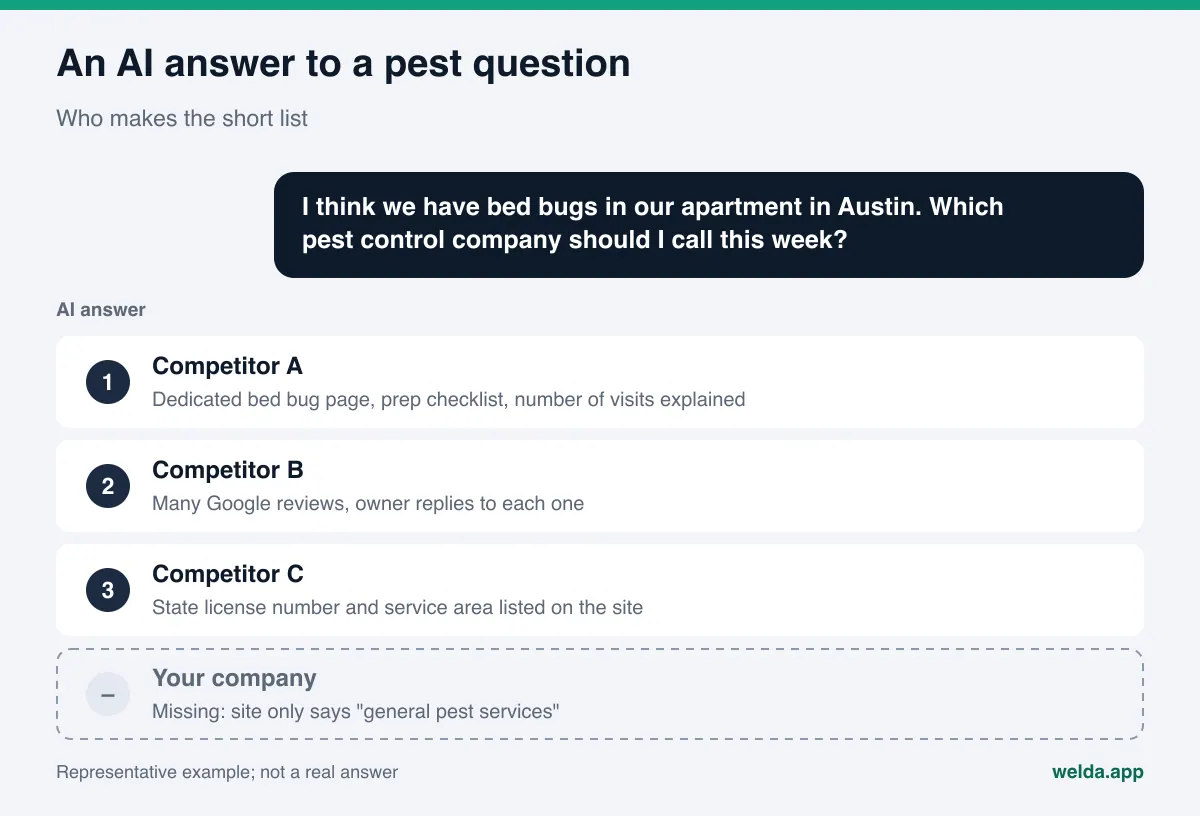
Why AEO for pest control companies matters now
Pest control is one of the local services where customers are both in a hurry and deeply cautious. The questions in their heads are almost always the same. Can you come today? What are you going to spray in my house, and what does that mean for my kids and my dog? When can we come back inside? What happens if the bugs come back next month? In classic search, the customer pieced those answers together by opening a handful of websites and review pages. In an AI answer, the assistant does that gathering and sums it up in a few sentences. Whoever is named in that summary makes the shortlist.
That shift has three consequences for a pest control business. First, ranking well in the local map pack does not mean you will be named in an AI answer. AI tools read your website, your reviews, complaint records, home service marketplaces, and community forums together. Second, the question is usually specific. Very few people ask for "the best exterminator." They name the pest, the property, and the city in one sentence. If your site only says "general pest services," the AI has nothing to connect you with a termite, rodent, or bed bug question. Third, trust carries more weight here than in most trades. People are deciding to let someone apply chemicals inside their home, so "is it safe," "are they licensed," and "what do I do afterward" come up in nearly every conversation. If your site does not answer those questions plainly, the AI builds its answer from another company's page.
The commercial side is moving the same way. A restaurant, hotel, school, or warehouse looking for recurring service asks which provider offers scheduled visits, keeps service records, and works in their industry. If those answers are not on your site, the buyer narrows the list before ever speaking to you.
A quick note on terms. You will also see this work called GEO (generative engine optimization), which means the same thing in practice. In the US, AEO and "AI search visibility" are the more common names, so this guide uses those.
What customers ask AI about pest control
It helps to sort the questions into five groups. The examples below were written for this article as illustrations, not pulled from a study. They show the angles to think about when you build your own list.
- By pest: "How many treatments does it take to get rid of bed bugs?" "Do I need a termite inspection before selling my house?"
- By property: "Pest control for restaurants with monthly service in Phoenix." "Who handles rodent problems for apartment complexes?"
- By location and urgency: "Exterminator near me that can come today." "Weekend pest control in Tampa."
- Safety and trust: "Is pest control safe with a newborn in the house?" "How do I know if a pest control company is licensed?"
- Price and results: "How much does roach treatment cost for a two-bedroom?" "Will they come back for free if the ants return?"
Each group needs a different kind of proof. Pest questions call for method and timeline. Property questions call for experience and record keeping. Location questions call for service area and hours. Safety questions call for licensing and a clear description of the process. Price questions call for how you quote and what your re-treatment policy is. If your site never answers a given type of question, your odds of being named for it drop.
The table below maps each group to the information that should exist on your site. Filling it in with your own services also gives you a list of pages to write.
| Question group | What AI tools look for | Where it belongs on your site |
|---|---|---|
| Pest type | Method, number of visits, timeline | One service page per pest |
| Property type | Homes, multifamily, restaurants, warehouses | Commercial services page with industries served |
| Location and urgency | Cities and ZIP codes served, same-day terms, hours | Contact or service area page, plus structured data |
| Safety and trust | License, prep steps, re-entry guidance | Licensing section and FAQ |
| Price and results | How quotes work, re-treatment terms | Pricing approach section, end of each service page |
How AI tools decide which pest control company to name
Before recommending a business, AI assistants pull information from several sources and check whether it lines up. For a pest control company, these are the signals that matter most.
Clear service definitions. "Pest control" is a category, not a service. For an AI tool to match you to a question, roaches, ants, rodents, bed bugs, termites, mosquitoes, and wildlife (if you handle it) each need their own description. Every page should say briefly how the treatment works, how many visits it usually takes, and what the customer needs to do beforehand.
Visible licensing. In the US, pesticide applicator certification is run by state agencies under federal standards. According to the EPA's page on certification standards for pesticide applicators, anyone who applies or supervises the use of restricted use pesticides must be certified, and many states also require certification for commercial use of other pesticides. Requirements differ by state, so check with your state lead agency; this is not legal advice. For AI visibility, the point is simple. When someone asks "how do I find a licensed exterminator," the AI needs to see your license on your site. A company that lists its license number, the states it operates in, and its service categories is a stronger candidate for that question.
Consistent business details. Your business name, address, phone, hours, and service area should match across your website, Google Business Profile, Yelp, BBB, Angi, and any directory you appear in. If one listing says "24/7 emergency service" and another says "Mon to Fri, 8 to 5," the AI cannot tell which to trust. LocalBusiness structured data (Schema) on your site repeats these facts in a format machines read directly.
Reviews and complaints. Google reviews, Yelp, BBB complaint records, Angi ratings, and neighborhood forums can all feed an AI answer. What matters is not only the count but how you respond. A calm, specific reply to "the roaches were back in ten days" tells both that customer and the AI that you follow through.
A process people can follow. Clearing cabinets, moving pets, how long to stay out, and when to ventilate are among the most common questions customers ask. Write these steps based on the product labels you use and your own procedure, and do not invent a general number. A company that explains this plainly can become the source for "what should I do after pest control."
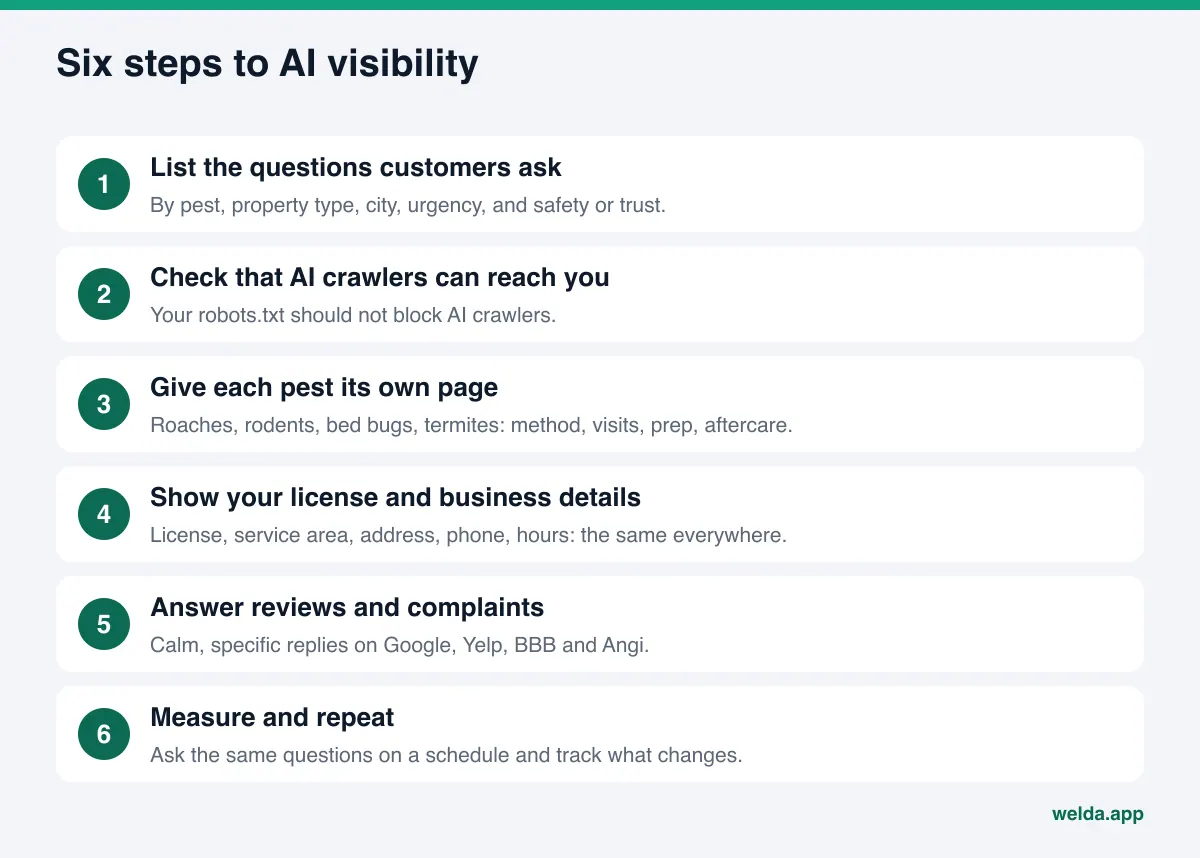
AEO for pest control companies, step by step
- Build your question list. Fill the five groups above with your own services. Combine the cities you serve with the pests you see most and you will have a list of thirty to forty questions. That list is the basis for both measurement and content.
- Make sure AI crawlers can reach your site. If your robots.txt blocks AI crawlers, nothing you write gets read. Some website builders and security plugins block them without anyone noticing. The free analysis checks this first.
- Write one page per pest. Open each page with a short, quotable definition, for example: "Bed bug treatment focuses on beds, furniture, and baseboards and usually takes more than one visit." Then cover method, number of visits, prep, aftercare, and a few FAQs.
- Explain commercial service separately. Put restaurants, hotels, property managers, schools, and warehouses on one page. Describe how you set visit frequency, what records or reports you leave after each visit, and how fast you respond to urgent calls.
- Make licensing and business details visible. Show your license, service area, address, phone, and hours in the page text and in structured data. List the cities or ZIP codes you serve.
- Complete outside sources. Bring your Google Business Profile services and description in line with your site, reply to BBB complaints and Yelp reviews, and update your Angi profile. Linking those profiles to your site makes it easier for AI tools to connect them to you.
- Measure and repeat. Ask the same questions on a regular schedule and note when your name starts to appear. New content usually takes weeks to show up in AI answers, so do not judge the work on a single week.
Your FAQ section deserves its own attention. Write down the ten questions you hear most on the phone and give each a direct two or three sentence answer. We cover how to structure it in our guide to FAQ pages for AEO. Keeping hours consistent is a small task that gets skipped often, especially for companies that change hours in peak season; see how to keep business hours accurate for AI.
Homeowners and commercial accounts need different pages
Most pest control companies serve two very different buyers, and they ask AI very different questions. Homeowners want a quick fix and clear safety information. Commercial clients want scheduled service, documentation, and confidence ahead of inspections. A single "Our Services" page that tries to speak to both ends up weak on both.
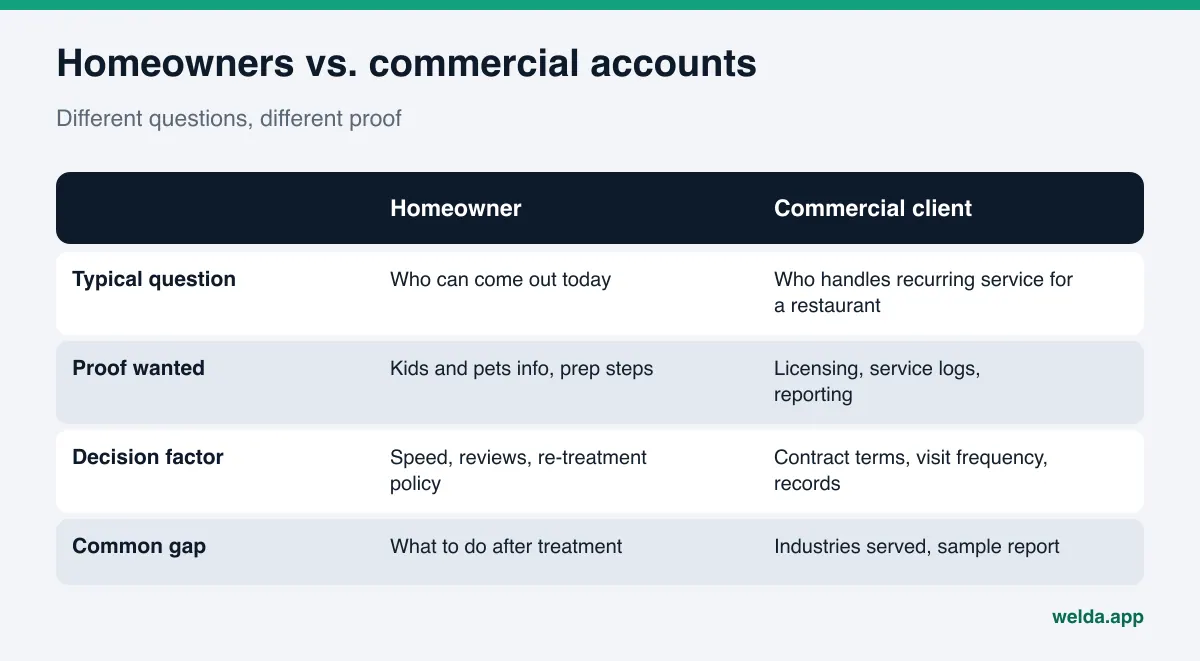
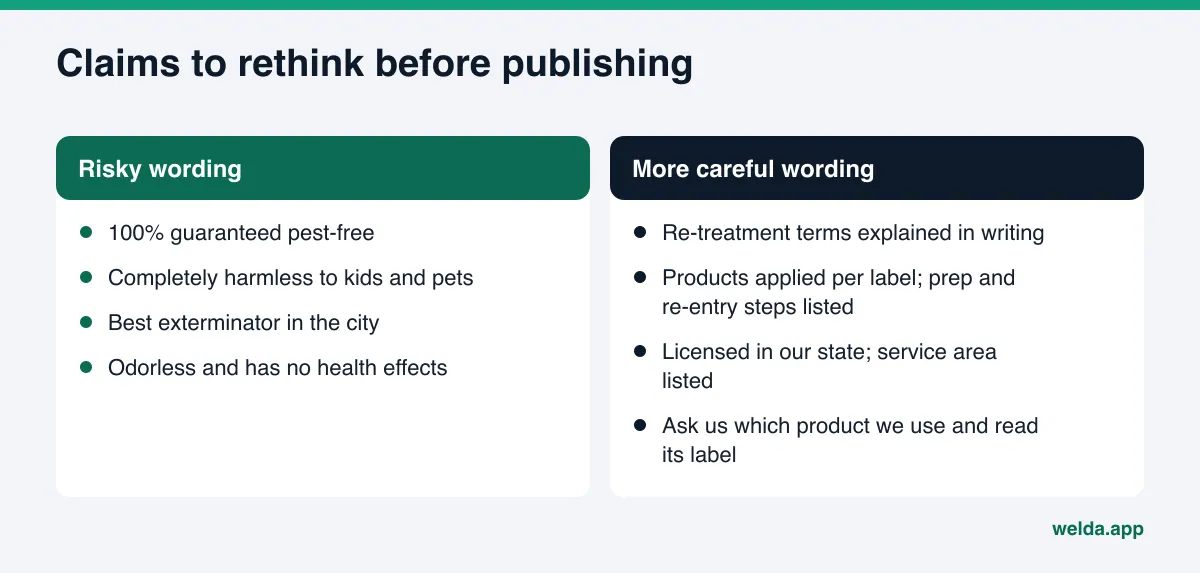
Residential pages should be plain and step by step. What happens on treatment day, how long the technician stays, which areas to clean afterward, and when a follow-up visit is needed. These pages can become the source for questions like "pest control with a newborn" or "is it safe for my cat." Be careful here: avoid absolute health claims. Phrases such as "completely harmless" or "no health effects at all" are easy to misread and can mislead customers. Instead, explain that you use registered products, follow the label, and tell customers exactly what to do before and after treatment.
Commercial pages should read more like a capabilities sheet. List the industries you serve, how visit frequency is decided, what you document after each visit, and your response time for urgent calls. When a restaurant owner asks "who does recurring pest control before health inspections," the AI needs to find those details on your page. Inspection rules vary by city, county, and industry, so describe your own process and avoid broad statements about regulations.
How Welda handles AEO for a pest control company
Welda is software that measures where a business appears in AI answers and fills the gaps on its behalf. For a pest control company, three parts matter most: measuring the questions, collecting missing facts and drafting the copy, and flagging risky claims before anything goes live.
Question tracking. Welda lists the questions your customers are likely to ask, grouped by pest, property type, and city. Each question is asked three times on ChatGPT, Gemini, Perplexity, and Google AI. For every engine you see whether you were named, in what position, and which sources the answer relied on. Say your company appears fourth on one engine for "bed bug treatment in Austin" while a competitor is first on three. That single row tells you which page to write next. Asking three times lets you see the natural swing in answers, so you do not make decisions based on one lucky or unlucky query. The score formula is public, and the spread across the three runs gives you a margin of error.
To-do list and missing information. Welda does not write facts it does not know. It asks you. For a pest control company that usually means your license details, the cities you serve, same-day terms, re-treatment policy, and the re-entry guidance from the labels you use. Once you enter them, Welda carries them into every draft: pest pages, FAQs, profile descriptions, and review replies. Your to-do list shows two kinds of work: drafts Welda prepared that wait for your approval, and tasks you do by hand. If your Google Business Profile is not connected, for example, the profile copy is ready, but pasting it in is your job, and the task is marked as manual.
Compliance check. Some phrases are common on pest control sites and risky to publish: "100% guaranteed," "completely harmless," "best exterminator in town." Before anything is published, Welda's compliance check flags patterns such as price claims, guarantees, and superiority claims, and suggests more careful wording. It is not legal advice and has not been reviewed by legal counsel; you or your advisor make the final call.
Content always lives on your own website; Welda does not host it. On WordPress, Welda connects through a separate Editor user and an application password, with no code to install. Drafts open on your site as drafts and go live only after you approve them. On other platforms, Welda gives you a ready-made package to apply by hand. The competitor view shows which topic and which source a competitor is winning from, and the monthly one-page report puts before and after side by side. For more on reading a competitor's advantage, see our guide to AI competitor analysis.
The Welda dashboard is in early access. It opens in stages and is launching first with businesses in Turkey. Regular four-engine measurement is being added during early access, and sample dashboard screens use representative data. What anyone can use today is the free site analysis, which works in English. Pricing is discussed during the early access conversation.
What the free analysis shows a pest control company
The free analysis reads your homepage and a few inner pages, such as services, pricing, about, and contact, the way Google and AI tools see them. For pest control sites, the most common findings are services listed in a single line, no structured data at all, a phone number and address that appear only as an image in the footer, no FAQ section, and a Google Business Profile that is not linked from the site.
The report gives you a score out of 100, with technical and content scores shown separately. For each gap it explains what was found, why it matters, and how to fix it. You get suggested copy for your homepage: title, meta description, main heading, intro paragraph, and FAQs. A simulation shows how much each fix would move your score, which makes it easier to choose where to start. The report also includes a competitor comparison and a ready-to-install fix package with LocalBusiness structured data, plus a PDF and a shareable score card.
The analysis also asks five questions your customers might ask to an AI assistant that can search the web, and checks whether your company is named in the answers. That is a one-time snapshot, not ongoing tracking. The analysis is free once per site. Your email and phone are verified, the results link arrives by email, and it stays open for 14 days. It does not measure rankings and does not promise any. If you want help reading the results, see how to read your AI visibility report, or look at how the same pattern plays out for another home service trade in AEO for HVAC companies.
Limits: what Welda does not do
AI visibility moves slowly, and it is worth being honest about that. Welda does not guarantee rankings or "getting into ChatGPT" for anyone. No one can, because each engine builds its answers by its own rules. New content usually takes weeks to show up in AI answers.
- Welda does not write what it does not know. License numbers, product names, and re-entry times come from you.
- It does not publish sensitive content without approval. Anything about health or safety comes to you first.
- It does not create fake reviews. It drafts replies, but the reviews themselves must come from real customers.
- Resolving negative reviews, setting up directory accounts, and press outreach stay with your business.
- The compliance check is a warning layer. It does not replace legal advice.
There is one limit specific to this trade. Welda does not give your customers health advice about pesticides, and it does not write such advice into your site. Drafts describe the process you tell it about. If a health question comes up, the copy points customers to the product label and, where needed, to their doctor.
Checklist and next decision
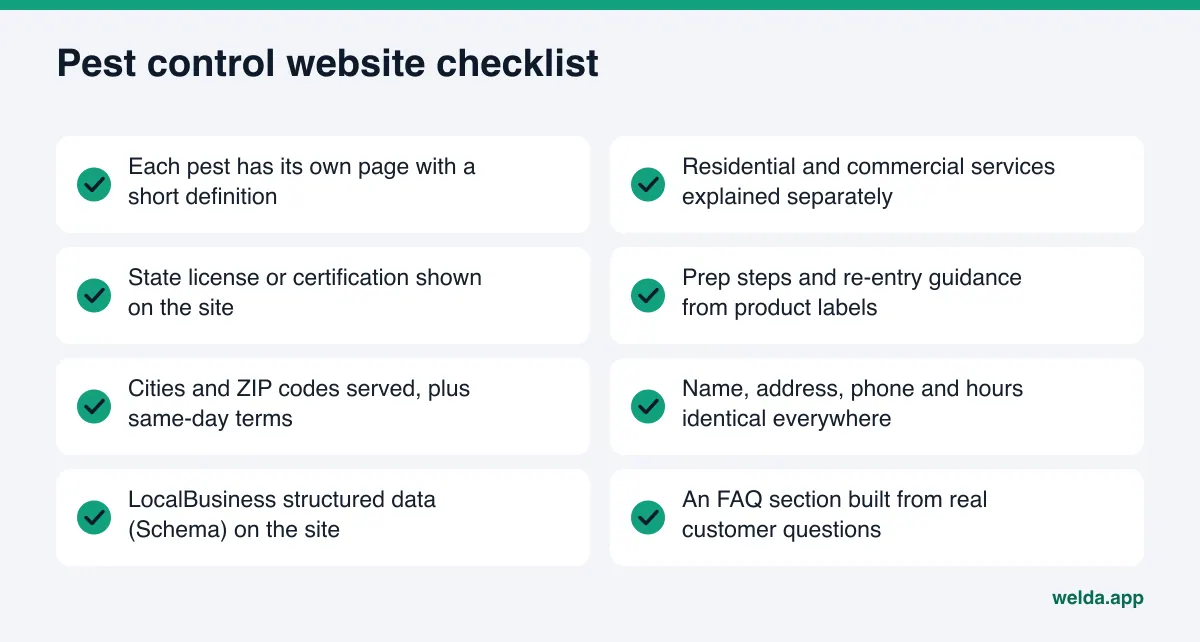
Once the checklist is done, let your measurement decide what comes next. The chart below covers the four situations we see most often.
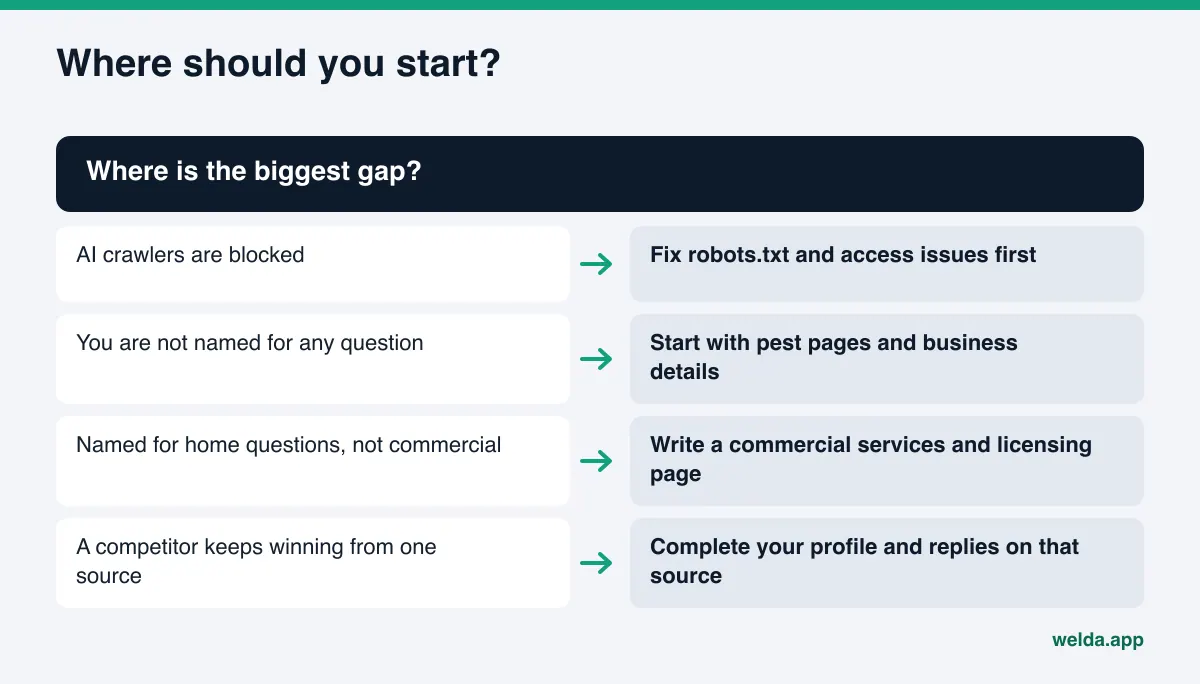
One thing to watch for when you decide. If you are named for residential questions but never for commercial ones, the problem is usually page structure rather than writing. When commercial service is buried under a subheading, AI tools do not recognize it as a separate offering. The reverse also happens. If you are named for commercial questions but not residential ones, your pest pages are probably too technical and do not match the everyday words homeowners use.
Frequently asked questions
Is AEO for pest control companies different from SEO?
Partly. A fast, well-structured site helps both. The difference is that AI tools do not rank one page. They build one answer from many sources and decide whose name goes in it. That makes consistent business details, clear service pages, and mentions on outside sources more important.
Does showing my license on the site really matter?
When someone asks how to find a licensed exterminator, AI tools look for that information. If it is not on your site, they cannot connect you to the question. Keeping license details current and accurate is your responsibility.
Do I need a separate page for every pest?
It is not required, but it helps a lot. If ten pests share one page, each gets a sentence or two. A dedicated page leaves room for method, timeline, and aftercare, which are the details customers actually ask about.
Do bad reviews hurt my chances in AI answers?
They can. AI tools may read reviews and complaint records. A calm, specific reply is a better signal than silence. Welda drafts the reply; fixing the issue and posting the reply stay with you.
How long does it take to see results?
New content usually takes weeks to show up in AI answers. Measure on a regular schedule and do not react to short-term swings.
How much does Welda cost?
The dashboard is in early access, so pricing is not published. It is discussed during the early access conversation. The free site analysis is free once per site.
See where your company stands today
AEO for pest control companies comes down to being named in the answer a customer gets at their most stressful moment. The way in runs through clear pages for each pest and property type, visible licensing, consistent business details, and regular measurement. Start with the free AI visibility analysis to see how AI tools read your site today. The report shows which gap to fix first, with suggested copy you can use right away.