What is AEO for OB-GYN practices? Answer engine optimization (AEO) for an OB-GYN practice means making sure that when a patient asks ChatGPT, Gemini, Perplexity or Google's AI Overviews for "an OB-GYN near me for prenatal care," your practice and your physicians are named with accurate information. What drives that is clear, consistent, compliant information on your own site and on the sources that mention you. Nobody can guarantee a specific position.
This guide is for OB-GYN physicians who own or run a practice, practice managers at women's health groups, and the people who handle their websites and listings. The question is simple: when a patient asks an AI assistant where to go for prenatal care, an annual well-woman visit or a Pap test, does your name come up? If not, why not, and how do you fix it without stepping outside the rules that apply to medical advertising? Below we cover the problem, the steps, how Welda does this work, and where it stops. If you want to see where your site stands today, start with the free AI visibility analysis.
Patients now ask AI to find an OB-GYN
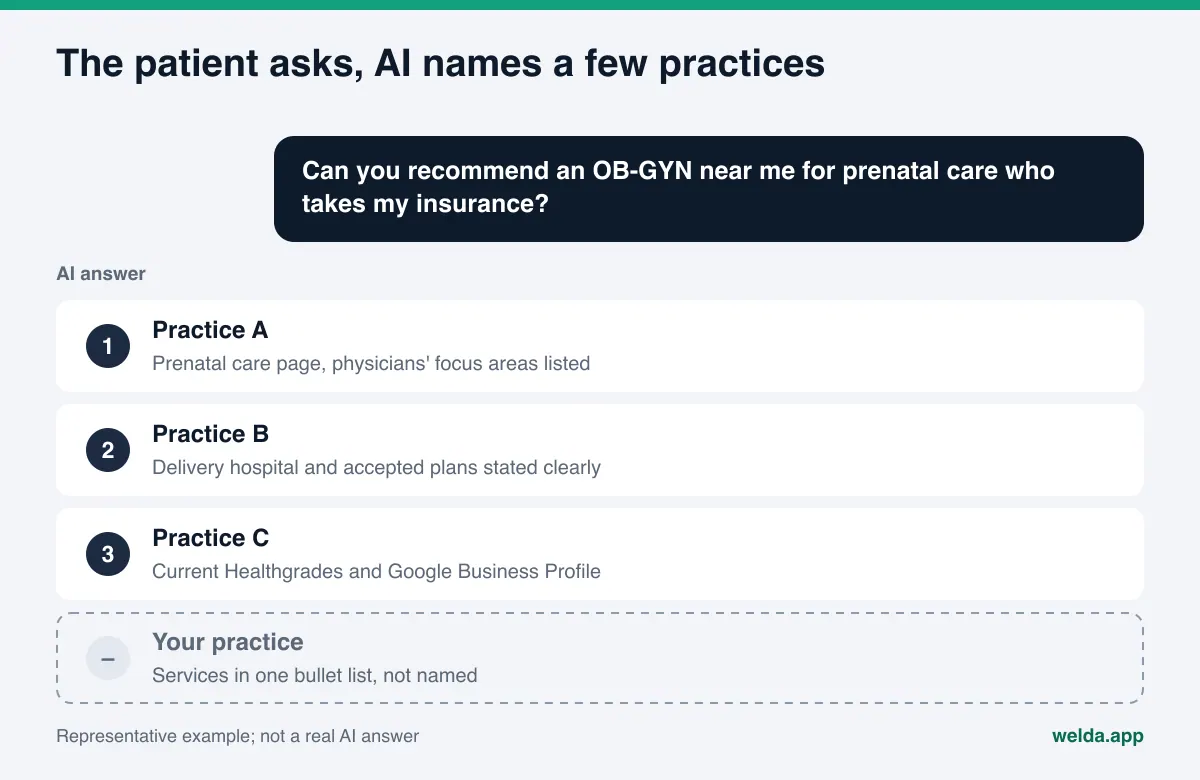
Choosing an OB-GYN is rarely a one-time decision. Prenatal care runs for months, and many patients see the same gynecologist for years. So patients take their time and ask a lot of questions. Not long ago those questions were spread across a search engine, physician directories, insurance portals and friends. AI assistants pull that research into one conversation. A patient types her city, her insurance, what she needs and whether she prefers a female physician, and the assistant answers with a few practice and physician names.
A practice that is not named in that answer is simply not on the shortlist. In classic search, ranking eighth on page one still earned the occasional click. In an AI answer, usually only a handful of names appear, and patients mostly choose among them. That makes AI search visibility less of a marketing preference and more a question of how new patients find you at all.
You will also see the term GEO (generative engine optimization) for this work. In the US, AEO and "AI visibility" are the more common names, and they describe the same goal: being a source that AI answers can quote and recommend.
Why AEO for OB-GYN practices is its own job
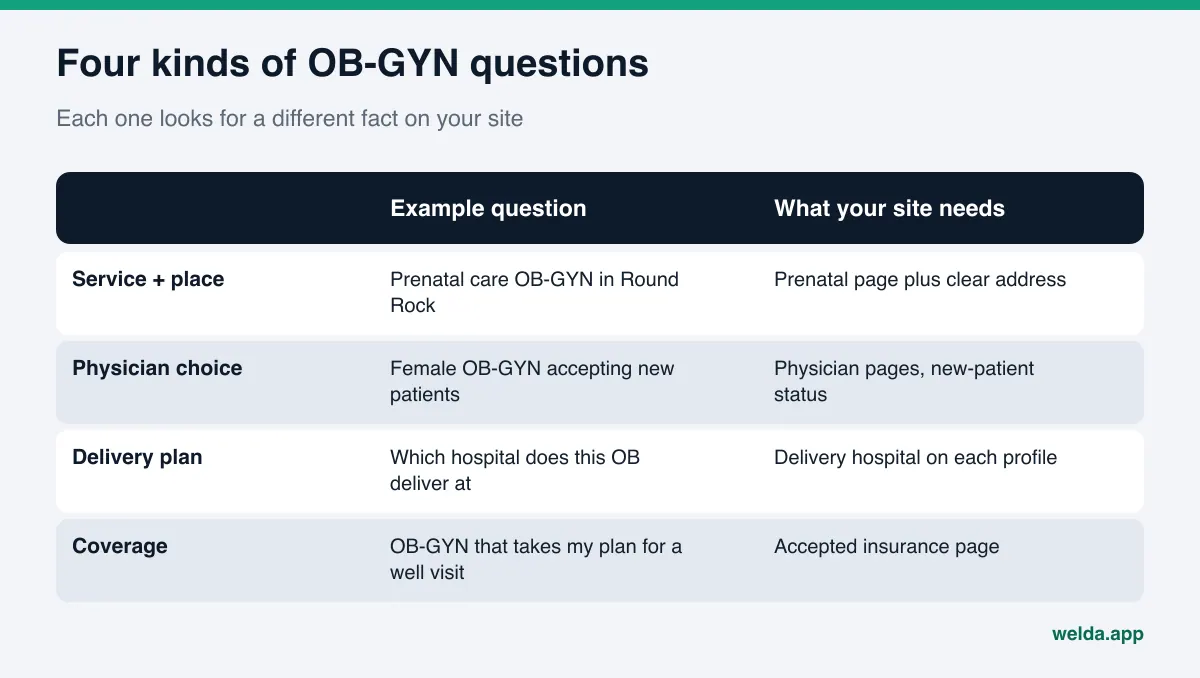
An OB-GYN practice gets different questions than a general clinic. For an AI assistant to describe you accurately, your site needs a clear answer to each of these patterns. Four things set this specialty apart:
- The services are very different from each other. Prenatal care, delivery, annual well-woman exams, cervical cancer screening, contraception counseling, menopause care, evaluation of fibroids or ovarian cysts, and infertility evaluation with referral to a fertility clinic. Each is a separate question with a separate answer. A site that lists all of them in one bullet list on a "Services" page is a weak source for every one of them.
- Patients choose a physician, not just a practice. Many OB-GYN questions are about a person: "a female OB-GYN accepting new patients," "an OB who does VBAC." Without physician pages, AI has no one to attach your practice name to.
- The delivery hospital matters. A patient planning prenatal care wants to know where she will deliver and who may be on call. If that is not on your site, both the patient and the AI look elsewhere.
- The topic is sensitive and regulated. Patient privacy, rules on reviews and testimonials, and state medical board advertising rules all apply. Every sentence you write to become more visible has to stay inside those lines.
Put together, AEO for OB-GYN practices is not a general "refresh the website" project. It is a specific set of pages, written in a specific order and in a specific voice.
What does AI look at before recommending an OB-GYN?
When AI assistants search the web, they read several kinds of sources together: your own site, your Google Business Profile and map listing, physician directories such as Healthgrades, booking platforms such as Zocdoc, your hospital affiliation pages, local news, and sometimes review sites like Yelp. When these agree, the answer comes out clean. When they conflict, for example an old suite number on one directory and a new one on your site, AI either leaves you out or repeats the wrong detail.
These are the gaps we see most often on OB-GYN sites:
| Missing information | Effect on the AI answer | Where to fix it |
|---|---|---|
| Physicians' board certification and focus areas | Practice not named when a patient asks about a physician | One page per physician |
| Delivery hospital | "Where does this OB deliver" goes unanswered | Prenatal care page and physician pages |
| Accepted insurance plans | Another practice wins the coverage question | A dedicated insurance page |
| New-patient status | You are left out of "accepting new patients" questions | Physician pages and FAQ |
| Office hours and locations | Missed in evening or Saturday questions | Site, Google Business Profile, structured data |
| What a first visit looks like | No quotable content for first-visit questions | FAQ section |
Step by step: AEO for OB-GYN practices
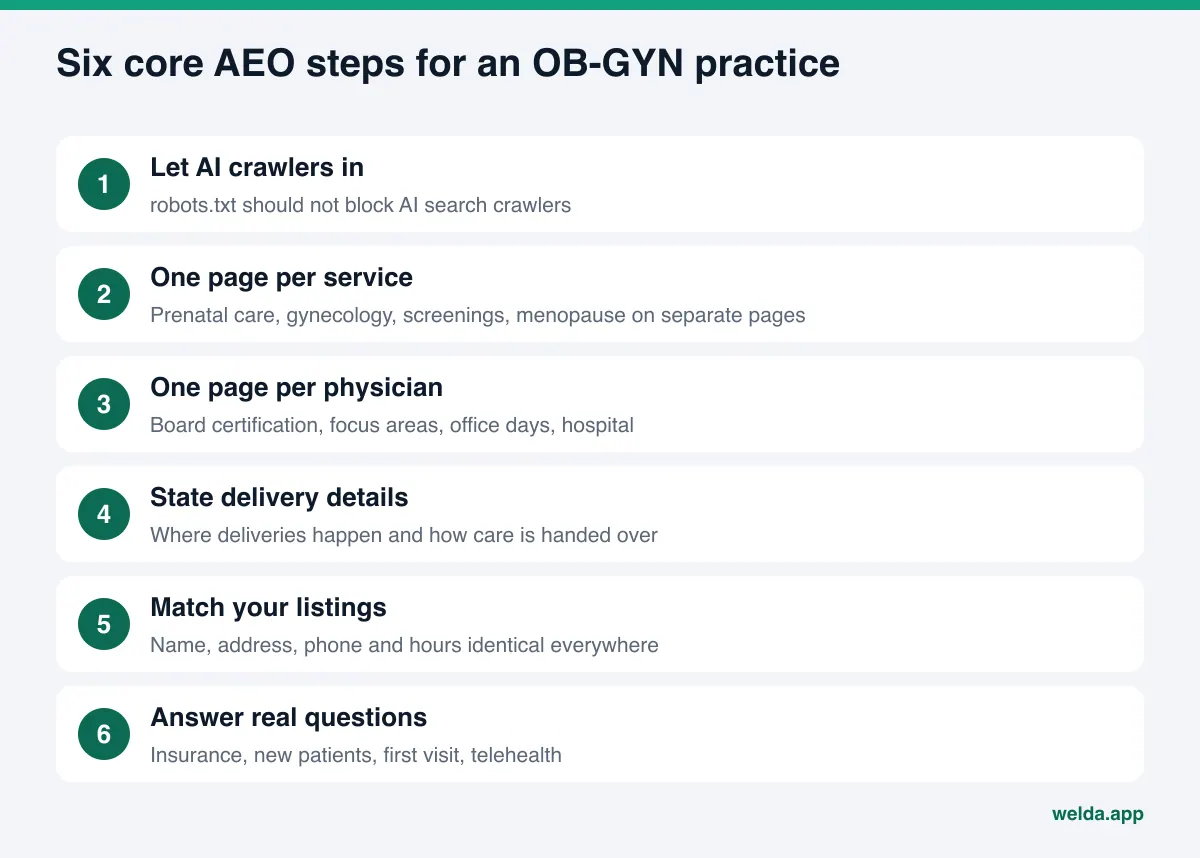
The steps start with technical access, move to content, and end with outside sources. Keep the order. If crawlers cannot read the site, even a well-written physician page does nothing.
- Check that AI crawlers can get in. Your robots.txt should not block AI search crawlers. According to OpenAI's crawler documentation, sites that opt out of OAI-SearchBot are not shown in ChatGPT search answers. Some security plugins and hosting firewalls block these crawlers without telling you.
- Make the title and description specific. The home page title should name the specialty and the place: "Obstetrics and Gynecology, North Austin." A line like "Compassionate care for every woman" answers no question.
- Give each core service its own page. Prenatal care, annual exams, cervical cancer screening, contraception, menopause care and infertility evaluation each deserve a page that says what the service is, how it works at your practice, who provides it and how to book.
- Write a page for every physician and advanced practice clinician. Board certification, training, focus areas, office days, the hospital where they deliver, languages spoken and whether they accept new patients. Use credentials exactly as they are held.
- Describe delivery and the handoff. Explain how care moves from the office to labor and delivery: which hospital, how call coverage works, whether midwives are part of the team. Describe the process; leave clinical timelines to the visit.
- Make your listings match. Name, address, phone number and hours should be identical on your site, Google Business Profile, Healthgrades, Zocdoc, your hospital's physician directory and insurer directories. If you moved, clean up the old listings.
- Add structured data (Schema). Use MedicalClinic for the practice; schema.org's list of medical specialties includes Obstetric, Gynecologic and Midwifery. Use Physician for each doctor and connect your profiles with sameAs.
- Add an FAQ section. How to book, what to bring to a first visit, whether a partner can attend, which plans are accepted, whether telehealth is available. Short, direct answers are exactly what AI assistants quote.
Most of these steps fit into a week of work. The slow part is the result: new content usually takes weeks to show up in AI answers. If you want to see the same playbook applied to another specialty, read our guide on AEO for eye clinics and LASIK centers.
Example: a physician page AI can actually read
Of all the steps, the physician page usually makes the biggest difference, because so many OB-GYN questions are about a person. Here is how a page for an example physician could be structured. Names and details are placeholders; fill them with your physicians' real information.
- Heading: "[Full Name], MD, FACOG, Obstetrics and Gynecology, North Austin." Credentials, specialty and place on one line.
- Short bio: Two or three sentences on residency, board certification, office days and focus areas. Specific facts instead of adjectives like "top-rated."
- Focus areas: Prenatal care, minimally invasive gynecologic surgery, menopause care, each linked to its service page.
- Delivery: The hospital where this physician delivers and how call is shared within the group.
- Booking: Whether new patients are accepted, how to book, which plans are accepted, office address and phone.
- Two or three short Q&As: "What should I bring to my first prenatal visit?" "Can my partner come to appointments?"
This gives AI a clean source that ties a physician to a service, a place and a hospital. When the same facts also sit in Physician structured data, the text and the code confirm each other. The page has no outcome promises, no prices and no hand-picked testimonials. AI does not need them, and they create risk.
Reviews, testimonials and claims: where are the lines?
Generic marketing advice does not transfer cleanly to an OB-GYN practice. There is no separate rule for content that AI reads; the rules that already apply to your website and social media apply here too. A short summary, for information only and not legal advice:
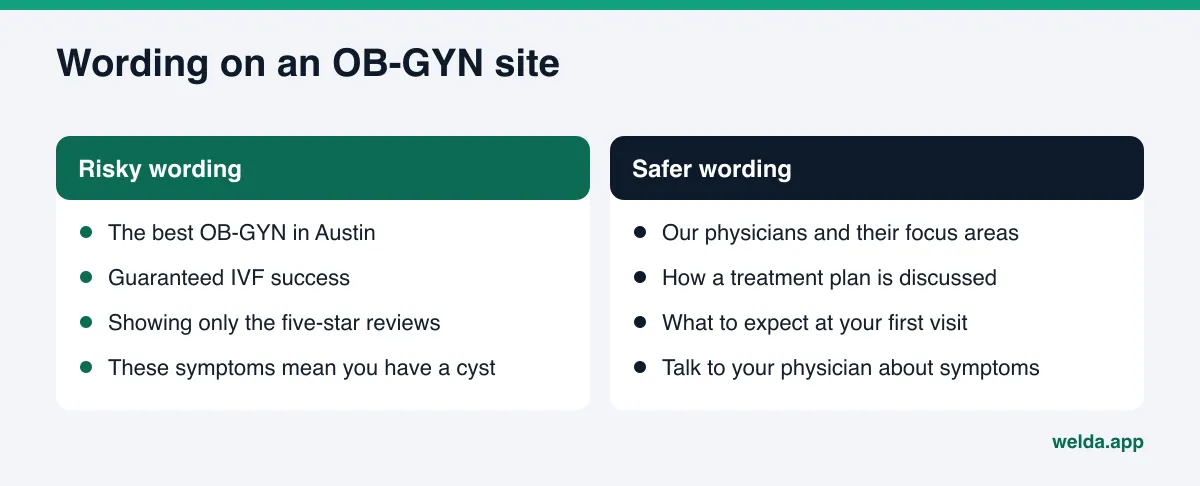
- The FTC's Trade Regulation Rule on the Use of Consumer Reviews and Testimonials (16 CFR Part 465, published August 2024) prohibits fake reviews, including AI-generated ones, buying reviews conditioned on a positive or negative sentiment, and certain forms of review suppression.
- Showing only five-star reviews while implying they are all you received is the kind of practice the rule addresses. Let patients review you on Google Business Profile, Healthgrades or Yelp and respond calmly.
- Replies to reviews must not reveal anything about a patient's care. Talk with your privacy or compliance officer about HIPAA before your team starts replying.
- State medical boards set their own advertising rules for physicians, often covering superiority claims and outcome promises. Check your state's rules.
The good news: what AI needs and what the rules restrict barely overlap. AI wants to know who your physicians are, which services you offer where and how patients reach you. That is information. Superiority claims, outcome promises and curated testimonials are not what AI looks for in a trustworthy source anyway.
How Welda does this work for an OB-GYN practice
Welda is software that measures where your practice shows up in AI answers and prepares the fixes for you. For an OB-GYN practice, three parts matter most.
Question tracking. The dashboard lists the questions your patients are likely to ask: "OB-GYN accepting new patients in North Austin," "female gynecologist open Saturdays," "prenatal care that takes my plan." Each question is asked three times in ChatGPT, Gemini, Perplexity and Google AI, and you see for each engine whether your name appears and in what position. For an OB-GYN practice, the value of this view is that it shows which service the gap is in. If you show up for prenatal care questions but never for gynecology questions, you know which page is missing. A separate view shows which competitor wins which question, and from which source. Questions can be tracked in English or Turkish.
An approval queue. Welda drafts the missing pages, physician bios, Google Business Profile descriptions and review replies. In healthcare nothing is published automatically: every draft comes to you, and nothing goes live until you read and approve it. Before that, a compliance check flags patterns such as prices, guarantees, superiority claims and diagnostic suggestions. That check is not legal advice and has not been reviewed by legal counsel; the final call is yours, and your counsel's where needed.
Asking instead of guessing. Welda does not make up facts. If your site does not say which hospital you deliver at or which plans you accept, Welda does not fill the gap with a guess; it adds the question to your to-do list. Once you answer, that fact is used in later drafts. Patient data is never sent to AI; Welda works only with your practice's public information.
The rest briefly: on WordPress sites, Welda connects through a separate Editor user and an application password, with no code to install; drafts open on your site as drafts and go live when approved. On other platforms Welda gives you a ready-made package that you or your web person applies. Content always lives on your own site. Each month you get a one-page PDF report.
Measurement: how the score works and when it moves
The dashboard score uses an open formula: 100 × (0.5 × the share of questions that name you + 0.3 × a position score + 0.2 × your share against competitors). Because each question runs three times per engine, the spread between runs gives a margin of error, and the score is shown with it. That matters in a specialty where questions spread across many services: the margin helps you tell real progress from normal variation between runs. Our piece on the margin of error in AI visibility tracking goes deeper.
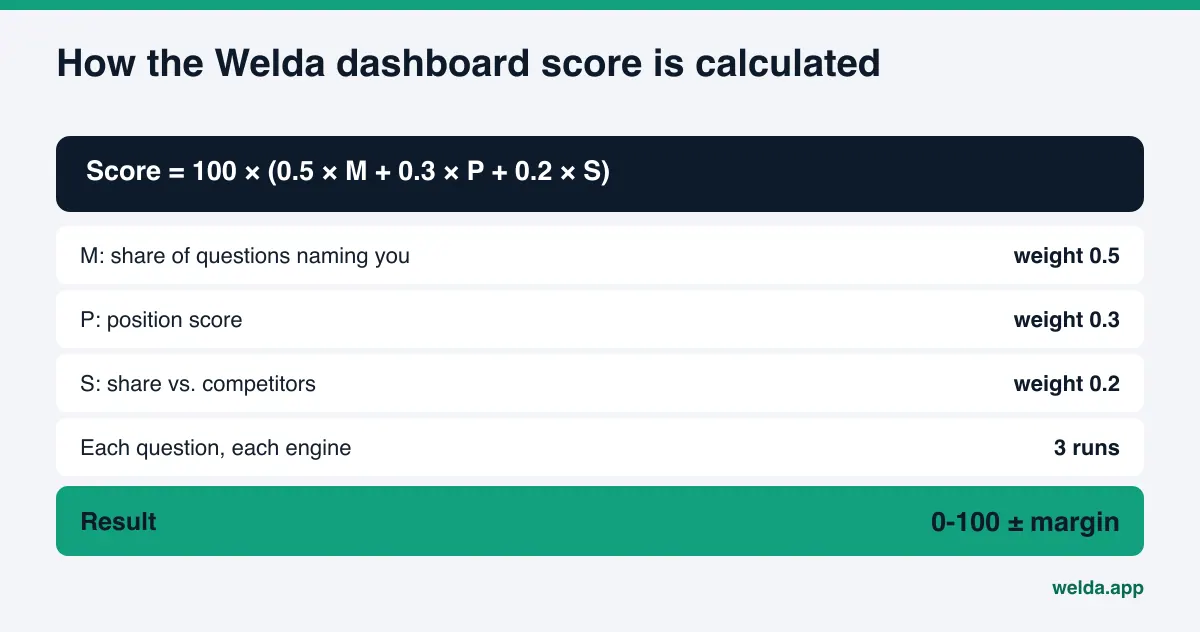
Do not expect the score to jump. After a new physician page or prenatal care page goes live, it usually takes weeks for AI engines to read it and reflect it in answers. Compare before and after across several weeks, not week to week.
Limits: what Welda does not do
For a medical practice, what a tool will not do matters as much as what it does. Welda:
- Does not guarantee rankings or "getting into ChatGPT." If someone promises that, our article on guaranteed ChatGPT rankings explains why it cannot be promised.
- Does not invent information. Credentials, accepted plans and delivery hospitals come from you.
- Does not publish any healthcare content without your approval.
- Does not write fake reviews. It drafts replies; the reviews come from patients.
- Leaves negative review resolution, directory accounts and press work with your practice. Welda lists those as manual tasks and gives you ready text.
- Does not produce content that offers a diagnosis or treatment recommendation; clinical decisions belong to physicians.
To be clear about where the product stands today: the Welda dashboard is in early access and is opening in stages, first in Turkey. Regular four-engine tracking is being added during early access, and the sample dashboard screens use representative data. What anyone can use today is the free site analysis, which works in English. Pricing is discussed in an early access call.
Decision guide: where should your practice start?
Every practice starts from a different place. Use this table to pick the first job based on where you are.
| Your situation | First job |
|---|---|
| Services in one list, no physician pages | Physician pages first, then prenatal and gynecology pages |
| Pages exist but AI answers never name you | Check robots.txt and technical readability |
| You are named, but with an old address or hours | Align Google Business Profile, directories and your site |
| A competitor always wins although your content looks fine | Find which source they win from: directory, hospital page or news |
| Your site has "best OB-GYN" claims or curated testimonials | Clean up wording first; visibility work after |
| Several locations | One location page each, with its own hours and physicians |
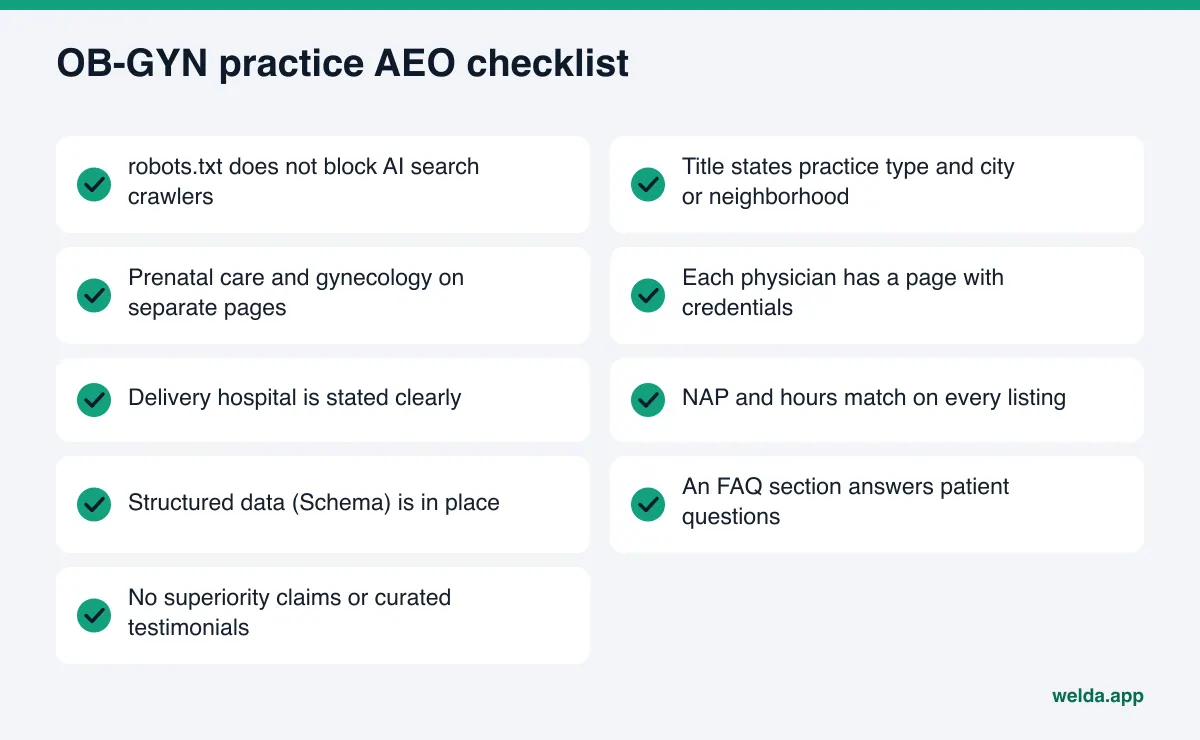
For a quick self-check, use the list below. Every "no" is a task.
Frequently asked questions
Is AEO for OB-GYN practices different from local SEO?
The foundation is shared: an accurate address, consistent listings, clear service pages. The difference is that AI writes an answer instead of showing a list. Only a few practices appear, and patients mostly choose among them. So physician and service facts need to be written clearly enough to be quoted in one sentence.
Should physician pages or service pages come first?
In OB-GYN care patients often choose a physician, so physician pages usually come first. But a practice without a prenatal care page will not be named in prenatal questions either. Write them as a pair: service pages link to physicians, and physician pages link to services.
Can we show patient reviews on our website?
You can, as long as they are real and you do not misrepresent them, for example by hiding the critical ones while implying you are showing everything. Check the FTC rule and your state's rules, and talk to counsel about your case. This article is not legal advice.
Does Welda see our patient data?
No. Welda works with your practice's public information: your site, profiles and directory listings. Patient data is never sent to AI.
How long until we see results?
Technical fixes are quick, but new content usually takes weeks to show up in AI answers. No one can promise a timeline or a position. Comparing measurements over several weeks is more meaningful.
What does the free analysis show for an OB-GYN site?
It reads your home page and a few inner pages such as services, about and contact. It checks crawler access, title and description, structured data, contact consistency, your FAQ section and how clearly your services are described. You get a score out of 100, a fix for each gap and ready-to-use text suggestions. It also asks five patient-style questions to an AI assistant with web search and checks whether your practice is named.
See where your practice stands today
AEO for OB-GYN practices starts with a few well-written pages in a compliant voice and the same facts everywhere. The first step is knowing where you stand. The free AI visibility analysis is free once per site; after email and phone verification, the results link arrives by email and stays open for 14 days. For the same approach in another surgical specialty, see our guide to AI visibility software for plastic surgeons.