What does AI visibility software for plastic surgeons actually do? It checks whether your practice is named when prospective patients ask ChatGPT, Gemini, Perplexity or Google's AI Overviews about rhinoplasty, breast augmentation, a tummy tuck or a board-certified surgeon near them, and it helps you fill the information gaps that keep you out of those answers. In plastic surgery, that work has to stay inside advertising, review and privacy rules. This guide covers what to fix, how Welda handles the measurable and the editorial parts, and why every publishing decision stays with your practice.
Why AEO matters for a plastic surgery practice
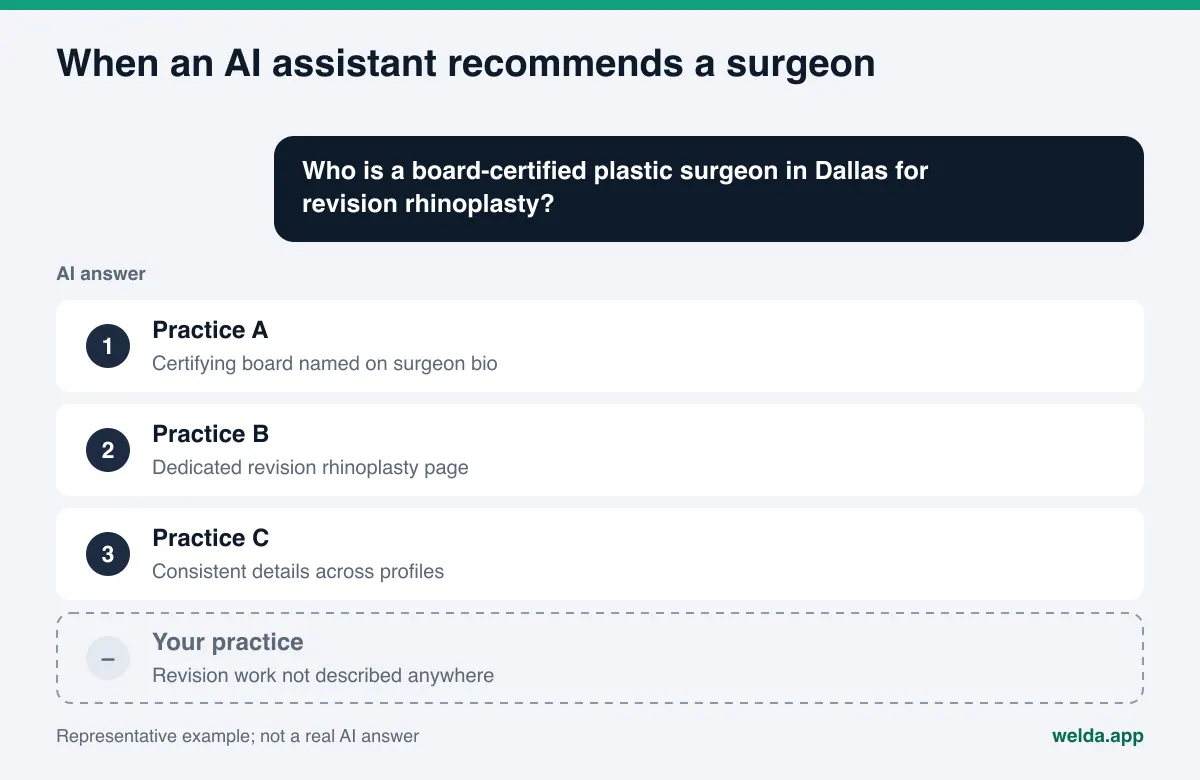
AEO, or answer engine optimization, is the work of making sure AI assistants can find, understand and cite your practice when they answer a patient's question. You may also see it called AI search visibility, or GEO (generative engine optimization); the idea is the same. The difference from classic search is the shape of the answer. A Google results page shows ten links and lets the patient browse. An AI answer usually names three or four practices, with a sentence or two of reasoning for each. If you are not in that short list, the patient may book consultations elsewhere without ever seeing your website.
Cosmetic surgery is a long, research-heavy decision. Patients compare surgeons for weeks, read reviews, look at credentials and ask very specific questions. More of that research now happens in conversation with an AI assistant. The questions tend to look like this:
- "Who is a board-certified plastic surgeon in Dallas who specializes in revision rhinoplasty?"
- "Which surgeons in Phoenix do breast reduction and operate in an accredited surgical facility?"
- "How long is recovery after a tummy tuck, and which practices near Scottsdale offer a post-op nurse line?"
- "Is there a plastic surgeon in Miami who does mommy makeovers and offers virtual consultations?"
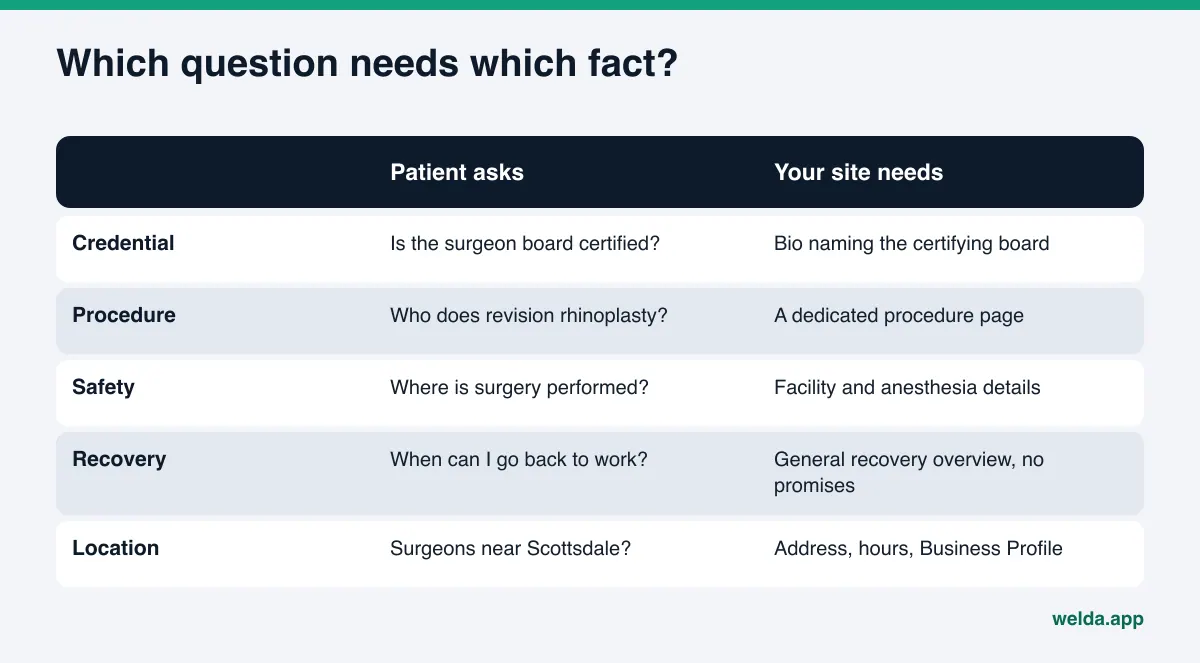
These are examples we wrote to show the pattern, not results from a study. The pattern itself is consistent: credential, procedure, location, recovery and trust. To answer, the assistant looks for pages that state those details plainly. If your site lists "body contouring" in one paragraph and never says where surgery takes place, who your surgeons are certified by, or how follow-up visits work, the assistant has little to quote. It will cite the practice that wrote those things down.
The fastest way to see where you stand is to check your site as an AI system would read it. Welda's free site analysis reads your homepage and a few inner pages such as services, about and contact, scores what it finds, and explains each gap and how to fix it.
What AI assistants read before recommending a plastic surgeon
AI assistants that can search the web pull pages, combine what they find and write an answer. For a plastic surgery question, the sources usually fall into four groups:
| Source | What the assistant looks for | Who controls it |
|---|---|---|
| Your practice website | Surgeon bios and certification, procedure pages, where surgery is performed, recovery overview, address and hours | You |
| Google Business Profile | Category, address, hours, photos, reviews and your replies | You; reviews come from patients |
| Doctor and review platforms | Profiles and reviews on sites such as Healthgrades, RealSelf and Yelp | The platform; your profile details are yours to keep current |
| Credential sources | Board certification records and professional society directories | The issuing organization |
The first two rows are under your direct control, so start there. When your site and your Business Profile disagree on hours, address or even the practice name, the assistant cannot tell which is right and may skip you or repeat the wrong detail.
The credential row matters more in plastic surgery than in most fields. Patients are often told to check certification, and the American Board of Plastic Surgery offers a public tool to verify whether a surgeon holds its certification. When your bio names the certifying board exactly, an assistant can connect your site to that record. Vague phrases like "board certified" with no board named give it nothing to match.
There is also a technical gate. If AI crawlers cannot reach your site, nothing else matters. OpenAI states in its crawler documentation that ChatGPT's search features use a bot called OAI-SearchBot, and that sites which block it in robots.txt will not be shown in ChatGPT search answers. Security plugins and CDN settings sometimes block these bots without anyone noticing.
The rules that shape plastic surgery content
AEO for a medical practice is not a license to say anything that might attract a click. Three sets of rules are worth knowing before you write a single new page. This is a summary, not legal advice; talk to your healthcare counsel about your own content.
- Reviews and testimonials. The FTC's Trade Regulation Rule on the Use of Consumer Reviews and Testimonials (16 CFR Part 465) prohibits buying or selling fake reviews, explicitly including AI-generated ones, covers insider reviews posted without disclosing the relationship, and addresses review suppression. AEO never means writing reviews for yourself.
- Patient privacy. Before-and-after photos and patient stories involve protected health information. Using identifiable patient material in marketing generally requires the patient's written authorization under HIPAA. Confirm your process with counsel.
- Credential claims. Many state medical boards have rules on how physicians may advertise specialty and board certification. Name the certifying board precisely and avoid implying a credential you do not hold.
Beyond the rules, there is a simple editorial standard: no promised outcomes, no "best in the city," no guarantees. Assistants tend to repeat what they find, and an exaggerated claim repeated by an AI system is not a risk you want. Fortunately, the content that helps AEO is exactly the content these rules allow: who operates, what each procedure involves, where it happens, what recovery generally looks like and how follow-up works.
Step by step: AEO for a plastic surgery practice
These steps are tool-agnostic. Whether or not you use Welda, working in this order pays off.
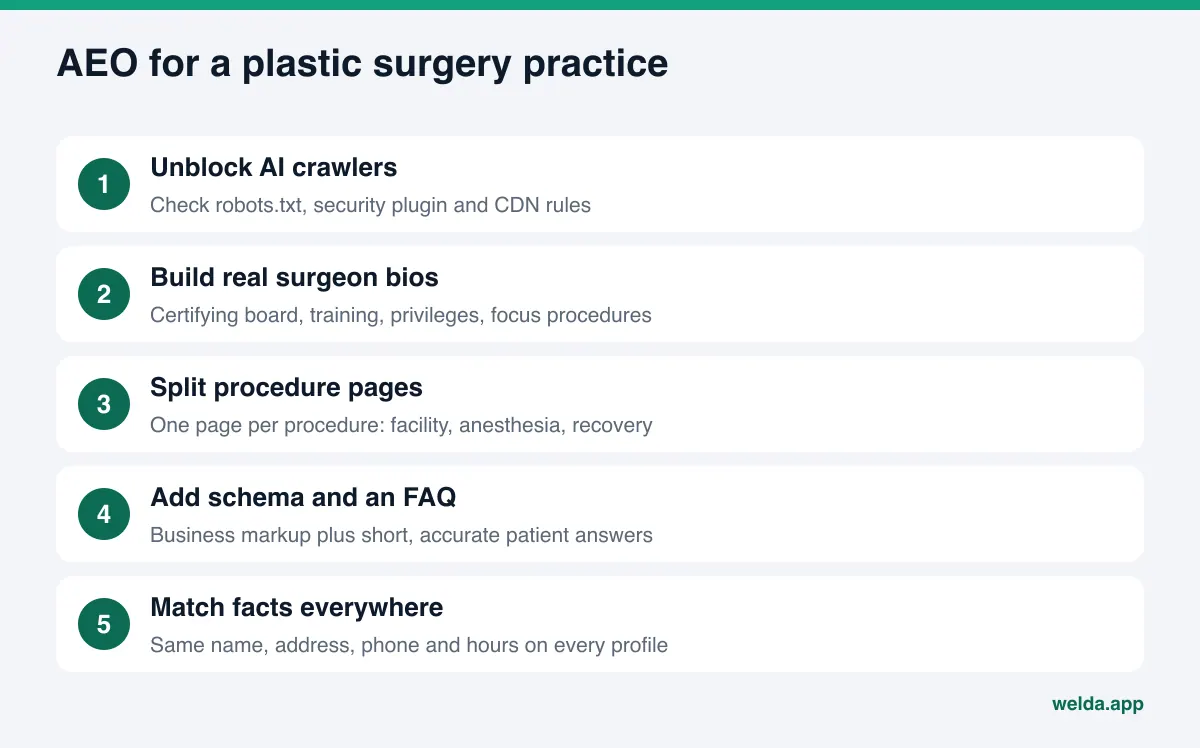
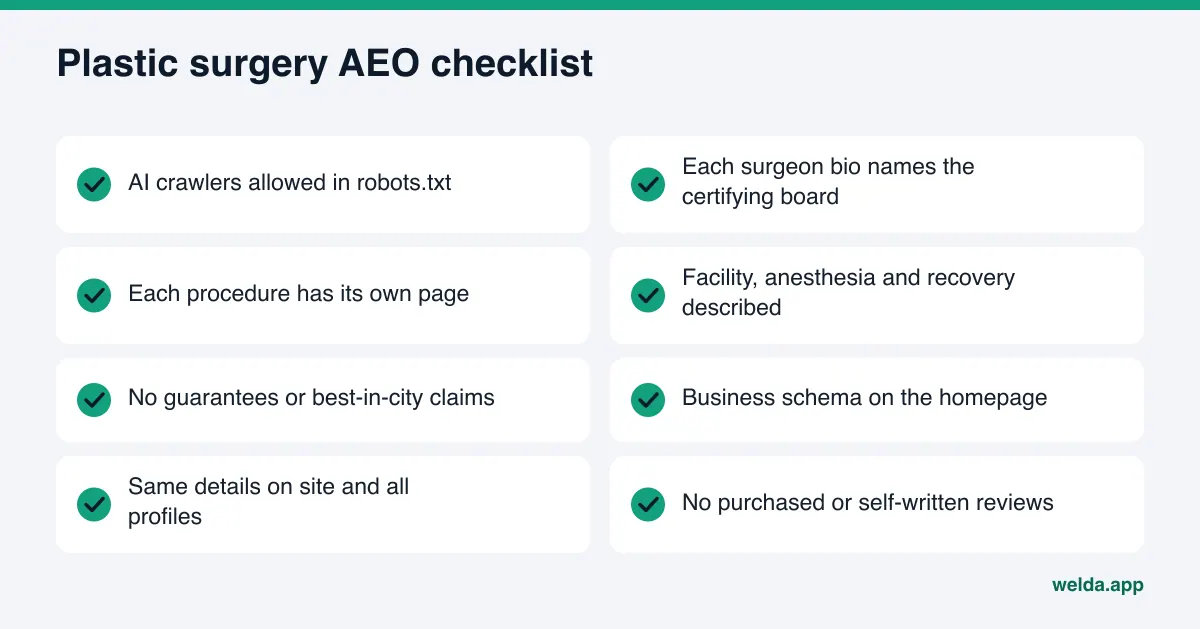
- Open the door to AI crawlers. Check robots.txt, your security plugin and your CDN rules so that search-related AI bots are not blocked.
- Give every surgeon a real bio page. Name the certifying board exactly, list training and hospital privileges, and state which procedures that surgeon focuses on.
- Split procedures into separate pages. Rhinoplasty, revision rhinoplasty, breast augmentation, breast reduction, abdominoplasty, liposuction, blepharoplasty. Each page should explain what the procedure is, who may not be a candidate, where it is performed, what anesthesia is typically used, what recovery generally involves and how follow-up is scheduled.
- Describe the patient journey. How consultations work, including virtual ones if you offer them; what pre-op testing is required; who patients can reach after surgery. Assistants use these details to answer "which practice has good aftercare" questions.
- Add structured data. Mark up your practice name, address, phone, hours and specialty on the homepage, and add person markup to surgeon pages. Our guide to schema markup for AI search covers the details.
- Write an FAQ from real patient questions. Short, accurate answers. Do not diagnose. "Your surgeon will assess this at consultation" is a valid answer.
- Make your facts match everywhere. Name, address, phone and hours on your site, Google Business Profile, Healthgrades and other directories should be identical. Link your profiles from your site.
- Reply to reviews carefully. Respond without confirming that the reviewer is a patient or discussing any treatment details. Never buy or write reviews.
Practices in neighboring fields face many of the same questions. If you want to see how the same structure works elsewhere, read our guides on AI search optimization for hair transplant clinics and AEO for eye clinics and LASIK centers.
How Welda works as AI visibility software for plastic surgeons
Three parts of Welda matter most for a plastic surgery practice: question-by-question measurement, the approval queue and the compliance check. Here is what each looks like from the practice's side.
Which procedures are you named for?
In the Welda dashboard, the questions your patients are likely to ask are sent to ChatGPT, Gemini, Perplexity and Google AI, three times each. The questions view shows, for every question and every engine, whether your practice was named and in what position. For a plastic surgery practice, the value of this view is that it splits results by procedure. If you appear reliably for rhinoplasty questions but never for breast reduction, the problem is not "visibility" in general. It is one missing or thin procedure page, and that is where you start.
The score behind this view uses a published formula, so you can check it yourself:
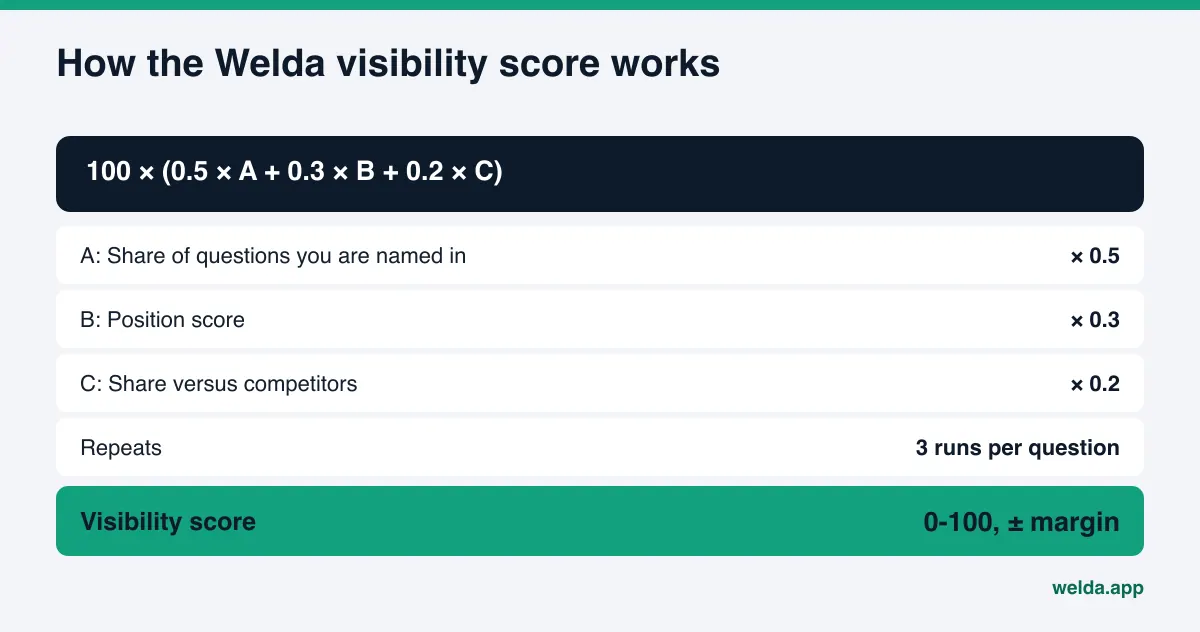
Because each question runs three times, the spread across runs produces a margin of error that is shown next to the score. AI answers vary from one run to the next, and a single run can mislead.
The approval queue: nothing publishes on its own
When measurement shows a gap, Welda drafts the content that addresses it: a procedure page, FAQ answers, a Business Profile description or a reply to a review. In healthcare there is no automatic publishing. Every draft lands in your to-do list for review, and you approve, edit or reject it. Patient data is never sent to the AI.
Welda does not invent facts it cannot verify. If it cannot find which facility you operate in or how your follow-up visits are scheduled, it leaves that field blank and asks you. Once you answer, the detail flows into every draft that needs it. In plastic surgery this matters: an invented recovery time or a wrong credential misleads patients and creates compliance risk.
On WordPress sites, Welda connects through a separate Editor user with an application password, with no code to install. Approved content opens on your site as a draft, and you take the final publish step. On other platforms, Welda hands you a ready-to-apply package. Your content always lives on your own site.
The compliance check: risky phrasing flagged before it goes live
Every draft in the queue passes through a compliance check that flags patterns such as pricing, guarantees, superiority claims and diagnostic suggestions. If a draft reads "permanent, flawless results" or "the top rhinoplasty surgeon in Texas," it comes to you with that phrase flagged and the reason shown. The check is not legal advice and has not been reviewed by legal counsel. Its job is to put easy-to-miss phrasing in front of you; the final call is yours and your counsel's.
The dashboard also includes a competitors view, a sources view showing which sites the AI draws on, a before-and-after comparison of your own visibility and a one-page monthly PDF report. For a plastic surgery practice, the three parts above are where most of the work happens.
Early access: what you can use today
The Welda dashboard is in early access and is opening in stages, starting with businesses in Turkey. Regular four-engine measurement is being added during early access, and the sample screens in the dashboard use representative data. The free site analysis works in English today and is the part anyone can use right now. Pricing is discussed in the early access conversation.
The free analysis runs once per site. It scores your site out of 100, with technical and content scores reported separately, lists each gap with what was found, why it matters and how to fix it, and gives you suggested homepage copy, a simulation of how much each fix could move the score, a competitor comparison and a ready-to-apply fix package that includes business schema. It also asks a web-search-enabled AI assistant five questions your patients might ask and checks whether your practice is named. That is a one-time snapshot, not ongoing tracking. Your email and phone are verified, and the results link arrives by email and stays open for 14 days.
Example: a practice's first four weeks
The scenario below is an example, not a real practice or a real result. It shows the order of the work and who decides what.
Picture a two-surgeon practice in a large US metro. Its site has one "Procedures" page with a paragraph each for face, breast and body. Surgeon credentials appear in a single sentence on the About page.
- Week 1: The free analysis shows that robots.txt blocks one AI crawler, there is no business schema, and there is no FAQ. The web team fixes the robots.txt line.
- Week 2: Question-level measurement shows the practice is named now and then for general "plastic surgeon near me" questions but almost never for procedure-specific ones. Decision: build separate procedure pages first.
- Week 3: Welda drafts rhinoplasty and breast reduction pages. It does not know which surgery center the practice uses, so it leaves that blank and asks. The compliance check flags "natural, permanent results" in one draft; the surgeon rewrites the line and approves.
- Week 4: The pages are live and Business Profile hours now match the site. Measurement continues, but because changes usually take weeks to show up in AI answers, nobody reads the result yet.
What Welda does not do
Being clear about limits up front saves a lot of disappointment later.
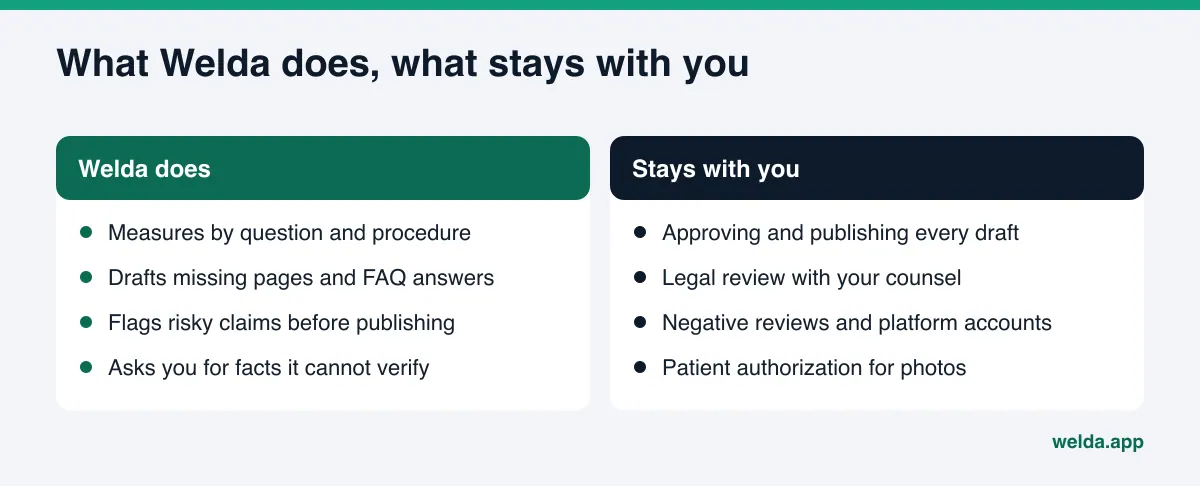
- No guarantees. No tool can guarantee that ChatGPT or Google's AI Mode will recommend you. Welda does not promise rankings or placement.
- No unapproved publishing. In healthcare every piece of content waits for your approval.
- No fake reviews. Welda does not write reviews or suggest buying them.
- No guessing. Credentials, facility details and recovery information come from you.
- Some work stays with you. Handling negative reviews, managing your accounts on directories and review platforms, and PR remain your practice's job.
Timing is the other limit. New or corrected content usually takes weeks to be reflected in AI answers, so before-and-after comparisons should be read over weeks, not days.
Checklist for choosing AI visibility software for plastic surgeons
Before you pick a tool or talk to an agency, run through this list. Each "no" is a work item, either for you or for the software.
| Question | Why it matters |
|---|---|
| Does it measure question by question and engine by engine? | A single overall score hides which procedures you are missing |
| Is the scoring method published? | You should be able to check how the number is calculated |
| Does it only report, or also draft the fixes? | A report alone leaves all the writing to your team |
| Does every draft wait for your approval? | In healthcare, unreviewed publishing is a liability |
| Does it flag risky claims before publishing? | Guarantees and superiority claims are easy to miss |
| Does it ask instead of inventing missing facts? | Invented credentials or recovery times mislead patients |
| Does content stay on your own site? | You keep ownership if you stop using the tool |
The broader question is whether you need a tool that watches or one that also does the work. We compare the two models in AI visibility monitoring vs done-for-you AEO.
Frequently asked questions
What does AI visibility software for plastic surgeons measure?
It measures whether your practice is named in AI answers to the questions patients ask, in what position, and where competitors appear instead. Welda runs each question three times on ChatGPT, Gemini, Perplexity and Google AI.
Is AEO different from SEO for a plastic surgery practice?
They overlap. Crawlability, clear page titles and structured data help both. AEO adds a focus on being quotable: plain statements of who you are, what you do and where, which an assistant can lift into an answer.
Can I use before-and-after photos in AI-friendly content?
That depends on patient authorization and your state's rules, so confirm with counsel. For AEO itself, text matters more than images: assistants mostly cite what is written on the page.
Does Welda publish content to my site automatically?
Not in healthcare. Every draft waits for your approval. On WordPress, approved content opens as a draft and you publish it.
How long until changes show up in ChatGPT or Gemini?
Usually weeks. There is no fixed timeline and no guaranteed outcome, and Welda does not promise one.
Can a US practice use Welda today?
Yes, the free site analysis works in English for any site. The full dashboard is in early access and is opening first in Turkey.
See where your practice stands today
The first step in AEO for a plastic surgery practice is seeing how your site reads to an AI system right now. Run the free site analysis to check crawler access, business schema, FAQ coverage and how clearly your surgeons and procedures are described, with a fix for each gap. You can request an early access conversation about the Welda dashboard from the same page.